Home Blog Page 713

Singapore Institute of Technology unveils first look at new Punggol campus

0

SINGAPORE: Construction work will begin on Singapore Institute of Technology’s (SIT) centralised campus in the Punggol Digital District after a groundbreaking ceremony on Tuesday (Sep 10) officiated by Prime Minister Lee Hsien Loong.

Estimated to cost more than S$1 billion, the new 91,000 sq m campus is expected to be completed by 2023 and can accommodate up to 12,000 students. There are currently about 8,000 students across SIT’s campuses.

It will be the first autonomous university to have its campus in the north-eastern region of Singapore.

Speaking at the ceremony on Tuesday, Mr Lee said SIT will become a big part of the Punggol community. Being at the heart of the Punggol Digital District will strengthen SIT’s “close nexus” with the tech industry, he added.

“We hope to support an ecosystem for digital and tech companies here, to trial new concepts to work, study and live, before scaling them up nationally. By being co-located here, SIT faculty and students collaborate with industry professionals on projects and test-bedding opportunities,” the Prime Minister said.

Aerial view of SIT Punggol campus heart

Aerial view of Singapore Institute of Technology’s Campus Heart, which houses the campus’ academic blocks. (Image: Singapore Institute of Technology)

Aeriel View of SIT campus court

Aerial view of Singapore Institute of Technology’s Campus Court plot, which houses the administrative building, additional academic blocks, auditorium and indoor sports facilities block. (Image: Singapore Institute of Technology)

The new campus will have link ways connecting it to JTC’s new business park. They will be served by Punggol Coast MRT Station, which is expected to open around the same time as the two developments.

WOHA and RSP Architects Planners and Engineers were commissioned to design the campus.

SIT and JTC have also exchanged 8,000 sq m of space to foster greater student-industry collaboration. Under this arrangement, industry partners will be able to operate within SIT’s campus, and students will attend classes in JTC’s building.

SIT new campus, Learning spaces within academic blocks

Learning spaces within academic blocks at Singapore Institute of Technology new campus. (Image: Singapore Institute of Technology)

PM Lee, ministers at SIT Groundbreaking Ceremony 2019

Prime Minister Lee Hsien Loong officiated Singapore Institute of Technology’s groundbreaking ceremony on Sep 10, 2019. (Photo: Deborah Wong)

COMMUNITY SPACES

SIT has also made a deliberate choice to create more shared spaces as part of its new campus. Faculties are not segregated by buildings, and will instead take different floors within a few buildings. Laboratories will also be shared, instead of being designated to a single course, to optimise space.

The campus is designed with many community spaces to make it more accessible to Punggol residents.

For example, 1.7ha of existing green space will be retained to create a forest courtyard, and a heritage trail will run through the campus and straight to the waterfront.

SIT New Campus, Administrative Block

Singapore Institute of Technology’s 11-storey high administrative building will house about 2,200 administrative staff and faculty at different levels. (Image: Singapore Institute of Technology)

SIT President Professor Tan Thiam Soon said that as the campus is being built in a time of technological change, it is a perfect time to reimagine the university’s role in the community.

“This is an opportunity for us to find new ways of learning and we have been working with grassroots leaders in Punggol to promote different programmes for the community,” he said, adding that the open design of the campus allows the public to observe students working on projects.

SIT has run science camps twice a year for primary school students in Punggol, as well as set up Skillscraft, a community makerspace in the Punggol 21 Community Club, Mr Lee noted.

The university will also offer more professional development courses for adult learners, including in areas of Food Technology and Precision Engineering.

“LIVING LAB”

SIT will install a campus-wide smart sensor network of more than 10,000 sensors, capable of collecting temperature, ambient light and human presence data.

The data is then shared with the building management system and will enhance campus experience and workspace efficiency, SIT added.

The campus is envisioned as a “living lab” that integrates applied research and innovation for SIT and its partners.

“The aim of the living lab is to support Singapore to be a regional hub for digital advancements and talent development, by integrating education, innovation and research into real-life environments and scenarios,” Associate Professor Steven Wong, SIT’s director of projects said.

The university will install a multi-energy micro-grid (MEMG) system – a collaboration between SIT and power supplier SP Group – at the new campus.
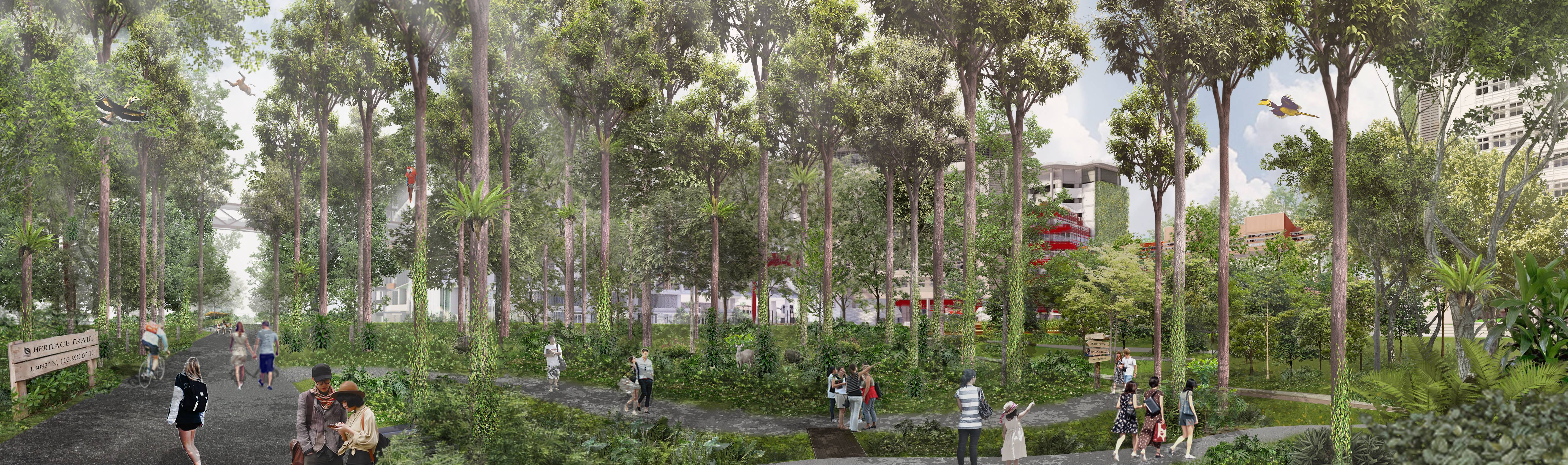
SIT new campus Heritage Trail Community Park

The existing Punggol Road will be transformed into a 1.3km pedestrianised Heritage Trail linking Punggol Waterway Pak to the Punggol Promenade Park connector. (Image: Singapore Institute of Technology)

About 10,000 sq m of solar panels will be installed on roof tops and the energy generated will supplement the university’s power supply.

“Now that we can monitor nearly every aspect of our energy, be it the consumption or the supply, this allows us to fine tune whether we need to save excess energy that we get from the solar panels into batteries,” Assoc Prof Wong said.

Beyond the MEMG venture, SIT is currently testing out the possibility of deploying robot sentries, as well as installing a facial recognition system for security purposes.

Source link

Work to construct 5 MRT stations on Jurong Region Line to start in 2020

0

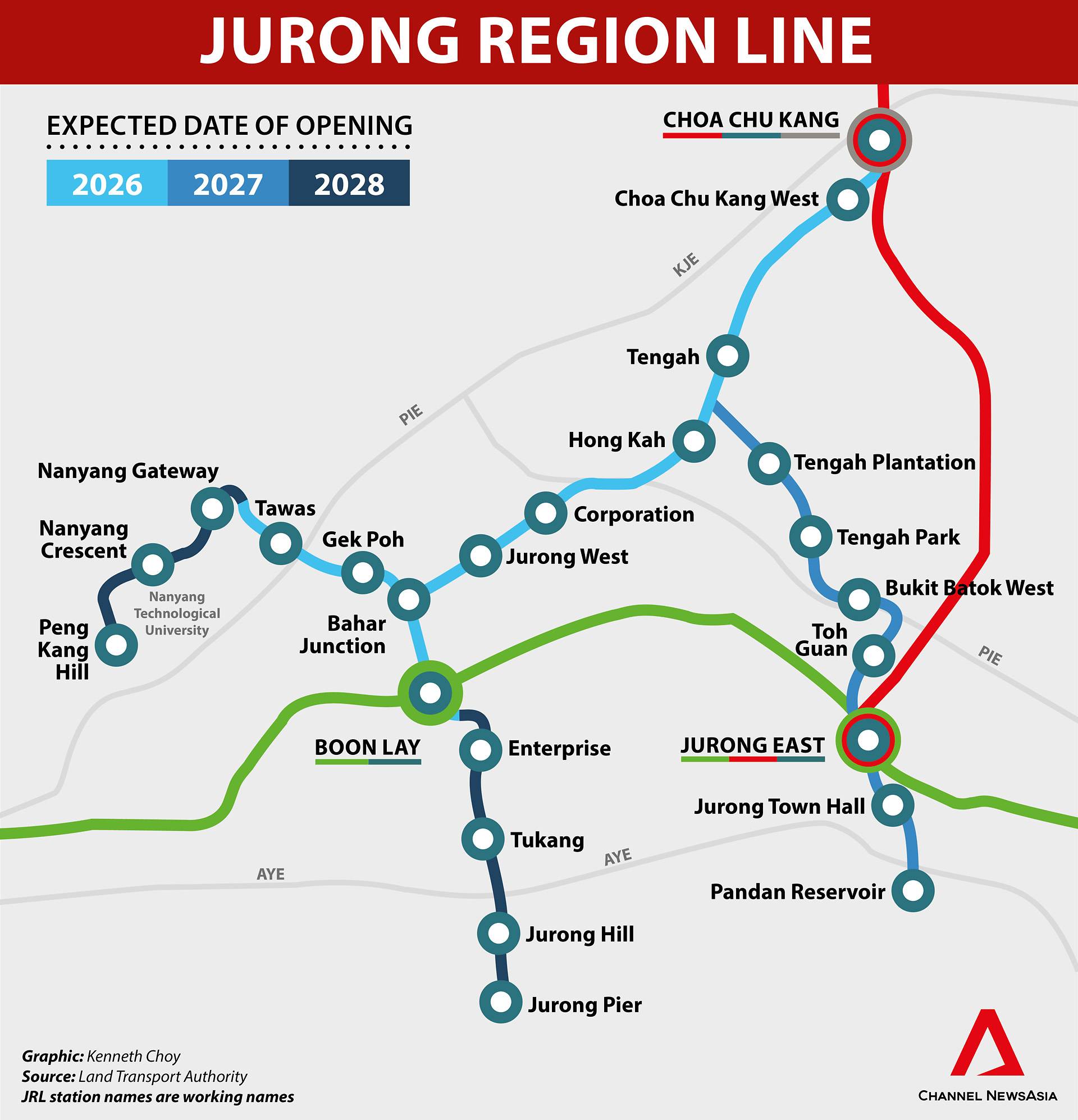
SINGAPORE: Construction works to build five MRT stations along the Jurong Region Line (JRL) are expected to start in 2020 and be completed in 2026, said the Land Transport Authority (LTA) on Tuesday (Sep 10). 

The five stations are – Choa Chu Kang, Choa Chu Kang West, Tengah, Hong Kah and Corporation. 

Two civil contracts worth a total of S$739.5 million were awarded for the projects, announced LTA in a media release.

For the contract covering Choa Chu Kang, Choa Chu Kang West and Tengah stations, it includes the building of a 4.3km viaduct between Choa Chu Kang and Tengah along Choa Chu Kang Avenue 3. 

There will also be addition and alteration works to the existing Choa Chu Kang station on the North-South Line, to integrate it with the new JRL station.

This contract was awarded to Shanghai Tunnel Engineering (Singapore), which LTA said has an “established track record” of railway infrastructure projects for the Circle Line, Downtown Line and Tuas West Extension.

It is also involved in the construction of some stations along the Thomson-East Coast Line (TEL).

Artist Impression of JRL Choa Chu Kang Station

Artist impression of Choa Chu Kang Station on the Jurong Region Line. (Image: Land Transport Authority)

Artist Impression of Choa Chu Kang West Station

Artist impression of Choa Chu Kang West Station. (Image: Land Transport Authority)

Artist Impression of Tengah Station

Artist impression of Tengah Station. (Image: Land Transport Authority)

Local construction companies Eng Lee Engineering and Wai Fong Construction will take on work for Hong Kah and Corporation stations. This includes a 3.4km viaduct between them. 

The joint venture company is currently involved in the construction of Mount Pleasant station and tunnels along TEL.

Artist Impression of Corporation Station

Artist impression of Corporation Station. (Image: Land Transport Authority)

The Jurong Region Line is Singapore’s seventh MRT line, which will open in three stages starting from 2026.

The 24km-long line will have 24 stations above ground, and will connect with the North-South Line and East-West Line with interchange stations at Boon Lay, Choa Chu Kang and Jurong East MRT stations.

Jurong Region Line map infographic

READ: Jurong Region Line to serve NTU, Tengah estate, Jurong Industrial Estate

READ: Residents, workers disappointed by Jurong Region Line land acquisition plans

In the initial years, the JRL is expected to serve 200,000 commuters daily, LTA said. This is expected to grow to more than 500,000 commuters daily in the longer term, it added.

Source link

Haze in Singapore may be back to stay: Winds, dry weather and 'persistent' hot spots in Sumatra to blame

0

[ad_1]

SINGAPORE – The haze may be back, and could persist in coming weeks.

The 24-hour Pollutant Standards Index (PSI) – a measure of air quality here – is steadily creeping towards unhealthy levels. As at 2pm, air quality in Southern Singapore was 98, nearly breaching the 100 reading that denotes “unhealthy” air quality.

The Meteorological Service Singapore said in a statement on Tuesday afternoon (Sept 10) that the hazy conditions experienced in the morning were due to smoke haze from persistent hot spots in Sumatra blown in by the prevailing winds.

[ad_2]

Source link

Wolbachia trials on mosquitoes raise hopes of defeating dengue in Southeast Asia

0

NHA TRANG, Vietnam: Hundreds dead in the Philippines; a threefold increase of cases in Vietnam; hospitals overrun in Malaysia, Myanmar and Cambodia – dengue is ravaging Southeast Asia this year due in part to rising temperatures and low immunity to new strains.

But one group of scientists is rolling out trials to breed dengue-resistant bugs in a bid to tackle one of the world’s leading mosquito-borne illnesses, raising hopes the untreatable disease can finally be beaten.

The World Mosquito Program (WMP) has pioneered a method where male and female Aedes Aegypti mosquitoes are infected with the disease-resistant bacteria called Wolbachia before being released into the wild.

In a matter of weeks, baby mosquitoes are born carrying Wolbachia, which acts as a disease buffer for the bugs – making it harder for them to pass on not only dengue, but Zika, chikungunya and yellow fever.

READ: Project Wolbachia still in study phase, will not be deployed in dengue clusters, says NEA

First trialled in northern Australia, it’s been tested in nine countries around the globe, including in Vietnam where early results are promising.

“We have seen a remarkable reduction of dengue cases after the release,” explained Nguyen Binh Nguyen, project coordinator for WMP in Nha Trang.

His team set free around half a million Wolbachia-infected mosquitoes last year in Vinh Luong, a crowded dengue-prone district in southern Vietnam.

Since the trials, dengue cases are down 86 per cent in Vinh Luong compared to nearby resort town Nha Trang.

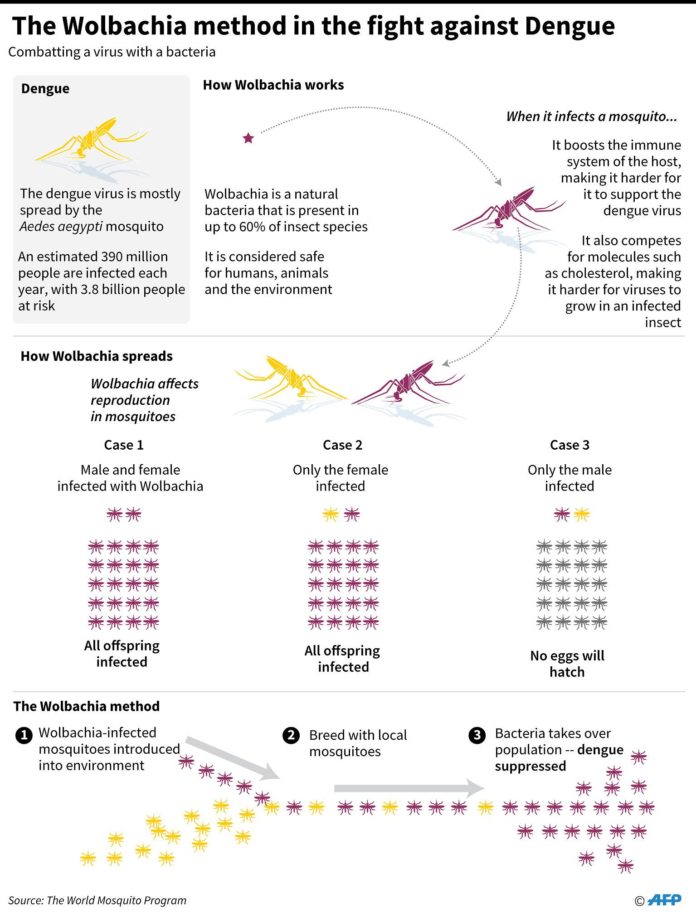
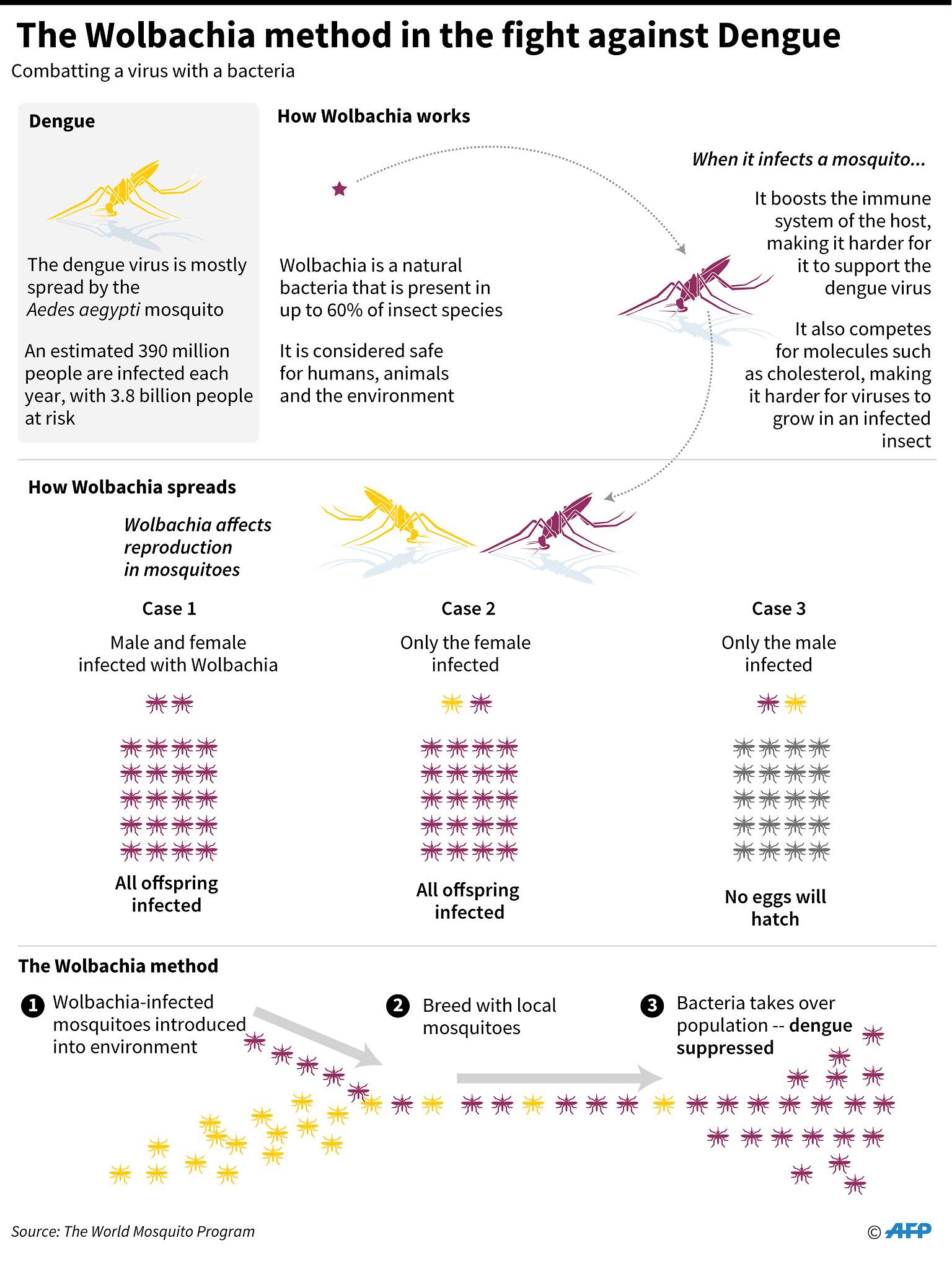
wolbachia graphic

Graphic on how the walbachia bacteria is being used on mosquitoes to eliminate the spread of Dengue fever. (AFP/John SAEKI)

That’s a major relief for Cong Thi Thu, an accountant who along with her two children suffered an intense bout of dengue in 2016, flooring the family for weeks.

She worries less after the trials but still makes her kids sleep under nets and no longer leaves stagnant water to collect in the pots around her garden, which offer ideal breeding grounds for mosquitoes.

“I feel at ease now, 70 to 80 per cent safe, but I still have to be careful,” Thu said from her leafy compound.

NO IMMUNITY

Today, mosquitoes still buzz about in the open-air shops, cafes and homes of Vinh Luong, but the majority in the test areas now carry Wolbachia compared to none before the trials, WMP said.

Cases of dengue surged not only in Vietnam this year but across Southeast Asia, with around 670,000

Cases of dengue surged not only in Vietnam this year but across Southeast Asia, with around 670,000 infected and more than 1,800 people dead in the region, according to an AFP tally of national and World Health Organization data AFP/Nhac NGUYEN

Convincing wary residents like Thu, along with health officials and ethics boards, that the mosquitoes won’t make them sick was not an easy task.

Residents have long ascribed to the official motto “no mosquitoes, no larvae, no dengue” to avoid the virus, dubbed “breakbone fever” because of its severe flu-like symptoms.

Dengue is passed along to humans by infected mosquitoes, which thrive in crowded, hot and humid neighbourhoods like Thu’s.

READ: More mosquitoes or mutating virus? Experts have different views on dengue spike

Cases have surged not only in Vietnam this year but across Southeast Asia, with around 670,000 infected and more than 1,800 people dead in the region, according to an AFP tally of national and World Health Organization data.

Experts say it’s the worst outbreak in years.

Dengue fever graphic

Factfile on dengue fever, one of the world’s most common mosquito-borne viruses. (Graphic: AFP/Gal ROMA)

Warmer weather is one factor – temperatures in July 2019 were the hottest ever recorded globally, and mosquitoes love hot weather – coupled with the introduction of new dengue strains that have spread among populations with no immunity.

Long-term trends are also at play: breakneck urbanisation in Asian megacities, a massive increase in international travel and trade and the cyclical nature of outbreaks.

“That creates the perfect ingredients for the dengue epidemic to happen,” Rachel Lowe, assistant professor at the London School of Hygiene & Tropical Medicine, told AFP.

Even the widespread use of plastics has contributed – as things like garden pots and takeout containers collect water they create perfect breeding pools for mosquitoes.

WOLBACHIA STUDIES PROMISING: SINGAPORE MINISTER

Wolbachia was first discovered by scientists in the 1920s in mosquitoes living in the drainage system beneath the Harvard University School of Public Health.

Found in 60 per cent of all insect species – including dragonflies, fruit flies and moths – the bacteria was mostly ignored until the 1970s when researchers discovered it could be used to prevent the spread of disease by bugs.

Over the years scientists have conducted anti-dengue experiments with Wolbachia-laden mosquitoes with varied success, but now WMP hopes its approach will stick.

It is one of the only organisations in the world seeking to repopulate colonies with Wolbachia-infected mosquitos to fight dengue, estimated to spread to as many as 100 million people globally every year.

Other groups, including in Singapore and Malaysia, are using Wolbachia but only in male mosquitoes who render female eggs infertile – a method that aims to suppress the mosquito population, which rarely lasts.

Singapore’s Minister for the Environment and Water Resources Masagos Zulkifli had said last week that while studies have “shown promise”, the Wolbachia technology has only been tested in small study sites in Singapore.

“The project is now in Phase 3, which aims to determine if the Aedes aegypti population suppression achieved thus far can be sustained in larger areas,” he said.

READ: Most dengue clusters closed, dengue cases down, says Masagos

Mr Masagos cautioned, however, that the Wolbachia method is not a “silver bullet”.

“It will not replace the community’s efforts to ensure good house-keeping, which is still needed to keep our homes and estates free from mosquitoes and dengue,” he said.

“Comprehensive mosquito surveillance, source eradication of mosquito breeding habitats and spraying of insecticide where necessary to control the adult mosquito population, continue to be Singapore’s key strategies for dengue prevent and control.”

RE-INVASION 

Many countries are fogging neighbourhoods with insecticides – effective in the short term, though the mosquitoes often come back in just a few days, or develop resistance to the chemical killers.

“No one has been able to get long-lasting suppression because the mosquitoes just keep re-invading,” said WMP director Scott O’Neill.

Results from WMP’s Wolbachia trials in northern Australia and on the Vietnamese island Tri Nguyen have been positive – local dengue transmissions are almost non-existent – and outcomes from trials in Indonesia are expected in the next year.

But experts say more long-term, and large-scale, studies are needed to see if the approach really works.

Dr Raman Velayudhan, coordinator of WHO’s global control programme on dengue, said: “Our bottom line is to make sure that it leads to the reduction of the disease.”

Source link

CASE launches new app to compare prices of groceries, household items and hawker food

0

SINGAPORE: A new crowdsourcing mobile application will allow shoppers to get more bang for their buck by comparing retail prices and promotions of groceries, household items and hawker food being sold at some outlets.

Price Kaki, launched by the Consumers Association of Singapore (CASE) on Tuesday (Sep 10), will also allow users to track price changes and earn cash vouchers by contributing information on prices and promotions.

It can be downloaded on Apple’s App Store and Google Play during a pilot run from Sep 28, before being launched islandwide in early 2020.

“Price Kaki will serve as a tool for consumers to compare prices easily so that they can make more informed decisions and stretch their dollar,” CASE said in a statement after the launch event.

CASE president Lim Biow Chuan said the association has been helping consumers through initiatives like grocery and hawker food price surveys.

“PROGRESSIVE MOVE” 

For a start, the app will list about 3,000 frequently purchased household and grocery items like milk, rice and eggs at 31 supermarkets in the pilot towns of Jurong West, Tampines and Toa Payoh.

Participating supermarkets are NTUC FairPrice, Giant, Sheng Siong and Prime Supermarket. CASE will continue to work with them to ensure the information is up to date.

The app will also list food prices at 11 hawker centres in the same towns, including the ones at Our Tampines Hub, Toa Payoh West Market and Boon Lay Place Market.

Senior Parliamentary Secretary for Trade and Industry Tan Wu Meng called the app a “progressive move” that “helps people starting with less”.

“It is a bit like a network of ‘kakis’ to share tips on shopping – exchanging knowledge on the best deals,” he said in a speech at the launch event on Tuesday.

“And this especially helps people who have less time; people who are less aware of market prices; people who are less experienced shoppers.”

CUSTOM SEARCHES 

Users can search for items by name or category, and apply search filters like location. For instance, you would be able to compare prices of black carrot cake from different eateries near Old Airport Road.

Users can also scan the barcode of an item in a supermarket to see how much it costs elsewhere.​​​​​​​

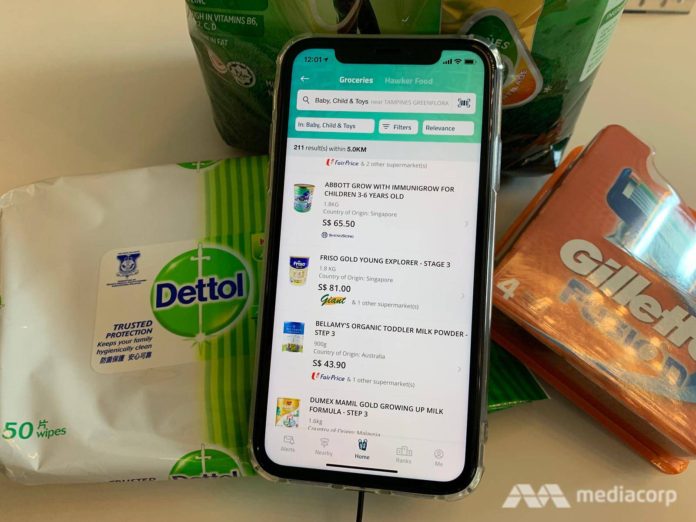
Price Kaki app by CASE

The interface of the Price Kaki app, newly launched by CASE. (Photo: Aqil Haziq Mahmud)

The app will notify users of price changes for items that have been added to an alert list, while users will get rank points for submitting new prices and promotions. The most active users stand to win groceries, food and beverage, movie and transport e-vouchers every two weeks.

“The mobile application is simple to navigate, encouraging use and contribution,” CASE said, adding that it had considered user feedback and conducted several user testing sessions.

During the pilot run from Sep 28, users can compare and contribute prices for items in the pilot towns. This also allows the app to be tested and improved based on user feedback and experience.

“To raise awareness among consumers, CASE will be organising a series of outreach activities and tapping on local community events at these towns to guide consumers on how to use the mobile application,” it said.

“Subsequently, consumers will be able to compare and contribute prices for items across Singapore during the nationwide launch.”

CASE said the app is part of its efforts to educate consumers on their rights to choose and make informed purchasing decisions.

Dr Tan said CASE’s efforts to help consumers do not end here, adding that the association will share more “in due course”.

“I am encouraging CASE to continue helping consumers stretch hard-earned dollars with other tools to help our people make more informed decisions,” he stated.

Source link

Singaporeans are one of the worst sleepers in the world. Fitbit wants that to change with Versa 2

0

[ad_1]

Singaporeans aren’t getting enough sleep. And that’s a clearly bad thing. Being a fitness metrics company with 10.5 billion nights of sleep data, Fitbit wants to change how the country can slumber for the better. 

The data they collated from 18 markets worldwide indicated that Singapore is the third most sleep-deprived nation globally (behind Japan and India), clocking in an average nightly sleep of seven hours and five minutes. Which, to be fair, is still within the recommended range of seven to nine hours, but a good deal lower than the average nightly sleep of Americans and Brits. 

It doesn’t help that a majority of Singaporeans go to bed later than most folks in other countries — 12.11am on average, according to Fitbit. But more importantly, we aren’t getting quality sleep. The company shared that we only get 80 minutes of deep Rapid Eye Movement (REM) sleep — the stage identified with low muscle tone throughout the body and a crucial phase that stimulates areas of the brain essential in learning as well as retaining memory. 

[ad_2]

Source link

Buses stuck in long queues to enter new Yishun interchange

0

[ad_1]

Commuters were upset and frustrated after their buses were stuck for almost half an hour waiting for their turn to enter the new Yishun bus interchange during morning and evening peak hours yesterday.

Several complained about having their journeys delayed, with some noting they would have reached their destination faster if they had walked.

When The New Paper was at the interchange around 5.30pm yesterday, there was a queue of 15 buses from the direction of Sembawang, and another queue of 10 buses from the direction of Khatib.

A commuter who wanted to be known only as Mr Aw, 60, said he was stuck on a bus coming from Khatib for half an hour before it could enter the interchange.

He said: “It usually takes less than 30 minutes to get from my home to the interchange, which is four stops away. But I took one hour to get here.

“So am I supposed to set aside one hour for just four stops? That is just ridiculous.”

NEW INTEGRATED HUB

The new interchange, managed by SMRT Buses, opened on Sunday and is part of the new Yishun Integrated Transport Hub (ITH), the tenth ITH here.

[ad_2]

Source link

Personal mobility aid rider crashes into glass door at SGH

0

[ad_1]

SINGAPORE – A rider on his personal mobility aid (PMA) crashed into an automated sliding glass door at Singapore General Hospital (SGH) at noon on Monday (Sept 9).

The door at the lobby of Block 5 in SGH fell when a visitor crashed into it while he was on the PMA, said SGH in a Facebook post on Monday.

The hospital added that no one was injured and the broken glass door has been removed.

“We urge all PMA users to be careful when moving around the SGH Campus,” it said.

This is the second known PMA accident in recent months.

In June, a woman on a PMA crashed into a sliding glass door at Toa Payoh bus interchange, causing it to shatter.

[ad_2]

Source link

McDonald's offers 40 days of 1-for-1 deals & other deals this week

0

[ad_1]

We scour the island for the best deals to help you stretch your dollar, and keep you in the loop on the hottest shopping trends.

‘Cos good things must share.


40 DAYS OF MCDONALD’S 1-FOR-1 DEALS

McDees has launched its ’40 Days of Thank You’ promotion to reward customers for their support.

Those with the McDonald’s app will be able to enjoy 1-for-1 daily deals from Sept 9 till Oct 18.

The promotion kicked off with a 1-for-1 McSpicy a la carte deal (till Sept 11) via the app. Deals can only be redeemed from self-ordering kiosks, front counters or drive-thru outlets.

According to a statement from the fast-food chain, the McDonald’s App was launched in July 2019 as a 40th anniversary gift for all customers to receive deals and more.

The new app incorporates functions like McDelivery, My Feedback, Restaurant Locator and nutritional information.

[ad_2]

Source link

Hackers impersonate electronics retail giants

0

[ad_1]

In less than a week, hackers have impersonated electronics retail giants Challenger and Harvey Norman, in a bid to stage phishing attacks by directing customers to fake sites.

Yesterday, both firms issued advisories about such scams, reiterating the warnings they had given on Sept 3.

In Challenger’s case, it involves an SMS sent to its customers that falsely claims they had won a mobile phone in a contest. They are then led to a website where they are asked to give their credit card details to pay for a processing fee.

PHOTO: Facebook/Christine Loh 

Challenger told The Straits Times yesterday it communicates with customers only through its official Facebook page, app and shopping sites. It does not do it through SMS.

[ad_2]

Source link