Home Blog Page 694

As beansprout prices shoot up in Singapore, will they go missing from our favourite dishes?

0

SINGAPORE: Be it laksa, mee soto, popiah or prawn mee, they all share a common ingredient we don’t often think about until it’s missing – the humble towgay or beansprout.

Few people realise that in Singapore, about 40,000kg of beansprouts are consumed daily; that’s well over 14,000 tonnes a year.

But in recent years, the prices of beansprouts have spiked dramatically; beansprouts at wet markets these days cost at least S$1.50 per kg as compared to about S$0.90 per kg about four years ago.

That works out to about 70 per cent increase, way more than inflation over those years.

“In the past ten years, costs have increased,” explained Thomas Tan, owner of Chiam Joo Seng Towgay in Lim Chu Kang, one of the biggest suppliers of this crop. 

“This is a very labour-intensive industry, the foreign workers’ levy has increased a lot more, diesel prices have increased by double, and bean prices increased by double too.”

But as the programme For Food’s Sake! discovers, is it really production costs that have gone up, driving the price of beansprouts or is the price spike due to a demand and supply issue?

READ: World food prices rise in May, cereal output forecast falls: UN FAO

SUPERMARKET TOWGAY DOUBLE THE PRICE

Beansprouts are probably one of the cheapest vegetables out there and for cooking at home, most people usually don’t need more than a handful.

This perhaps explains why most people have not noticed a sharp spike in beansprout prices in the last couple of years. 

file photo of beansprouts

File photo of a bowl of laksa.

But the price hike has not escaped the notice of vegetable sellers who deal with beansprouts in bulk.

Around 70 per cent of the beansprouts we eat is grown right here in Singapore.

Tan grew up in a beansprout farming family – his father and uncle were one of the earliest beansprout farmers in Singapore.

He said that most farmers in Singapore get their mung beans from Myanmar, and in 2015 there was a spike in the price of mung beans due to a bad harvest in India, which resulted in the latter buying more beans from Myanmar.

“The price went up as much as four times,” said Tan. 

“At that point I stopped selling to the wet market and I understand that the rest of the farmers (in Singapore) stopped absorbing the cost and increased the wet market price.”

The price hike in mung beans resulted in a price increase for beansprouts, an increase which was passed to consumers.

WATCH: The rising price of rice

In wet markets, beansprouts which used to cost S$0.90 per kg a few years ago now costs S$1.50 per kg.

But the same product in supermarkets has gone up even more – beansprouts which used to cost S$1 per kg now costs S$3.50 per kg on average.

That makes supermarket sprouts at least twice as expensive compared to wet market ones.          

So, what makes beansprouts in supermarkets so much more expensive than their wet market counterparts?

Tan said he stopped selling to wet markets because of the low prices, and he now supplies mainly to supermarkets and restaurants.

A decade ago, beansprouts would be de-husked at the farms the day before and then displayed loose in supermarkets, like they are at wet markets.

But at supermarkets, customers have unrestrained access to the sprouts, and all that manhandling meant unsold sprouts had to be tossed at the end of the day.

beansprouts supermarkets

Supermarket sprouts are at least twice as expensive compared to wet market ones.     

Tan saw a market opportunity and offered supermarkets pre-packaged beansprouts with cold chain management, a system of storing and transporting perishable products such as vegetables at recommended temperatures from the point of harvest to the final consumer.

What’s more, Tan also offered to deliver the beansprouts throughout the day, not just in the morning.

How this produce is delivered to supermarkets had a huge bearing on its price.

For Tan, the additional S$1 million investment for cold chain management such as packing machines, cold trucks and other equipment meant he had to raise the price of beansprouts to about S$2.20 per kg.

“We were the first ones to sell in the supermarkets the pre-packed form, to maintain the freshness (of the beansprouts). Over a period of time, customers got more used to it now,” said Tan, admitting that they were the ones who single-handedly raised the prices of beansprouts in supermarkets.

Since Tan started supplying pre-packed beansprouts to supermarkets, other companies have followed suit.

And they all follow Singapore Food Agency’s recommendations for cold chain management where vegetables are kept between 2°C to 6°C from farm to retail outlets, to bring about fresher and higher quality vegetables.

READ: The harsh realities behind the rising sugar cane prices in Singapore

PREMIUM BEANSPROUTS

Aside from freshness and convenience, there is another factor that is pushing up the average price of supermarket sprouts, the emergence of premium beansprouts.

The most expensive are the silver sprouts, which have been plucked on both ends, at an eye-watering price of $1.25/145g or S$8.60 per kg.

That is almost six times more than the wet market variety.

Plucking beansprouts is tedious but with pre-plucked and prepacked silver sprouts, all that is done for the consumers.         

“Silver sprouts are very popular. For every three regular packet of beansprouts, I sell one packet of silver sprouts,” said Tan. 

“But the problem is getting enough supply. Producing silver sprouts cannot be mechanised. Plucking sprouts is still a very labour intensive product.”

He shared that how he used to hire 40 women residing in two HDB blocks of flats to pluck the beansprouts during the 2008 global financial crisis but after that period, “no one in Singapore wanted to do it at that pay anymore”.

beansprouts

Supermarket sprouts are at least twice as expensive compared to wet market ones.  

These days, he imports his silver sprouts from Malaysia.

Angie Ng, owner of Mr Tauge, one of the main Malaysian suppliers of silver sprouts to Singapore, said that even they have trouble hiring full-time help to pluck the beansprouts.

She said that eventually they will not be able to find people willing to pluck beansprouts for a living, and silver sprouts could soon be a thing of the past. 

“We have tried hiring, but the results weren’t good,” she said. “You have to spend seven to eight hours here, a lot of people aren’t willing,” she said.

Watch the episode here.

Source link

iPhone 11 Pro flippers are already selling them for up to $4k on Carousell

0

[ad_1]

It’s pretty much known that the bulk of the massive queue outside the Orchard Road Apple Store is made up of non-Singaporeans wanting to lug their haul back home to sell off. 

There’s also the legion of flippers — folks who’d be willing to wait in line for hours to get a spare iPhone or two to sell at marked-up prices. The early bird catches the worm, and those who’d be willing to pay a couple hundred more for the latest iPhones always make ripe bird food. 

Anyway, what I’m trying to say is that if you want to get a brand new iPhone 11 Pro Max right now (like now now) and have some extra cash, you can totally get it on Carousell. No queuing up needed. 

Of course, the convenience of immediate iPhone purchase comes with a cost. A significant one too, with flippers looking to profit hundreds of dollars from the enterprise while stocks remain far from easy reach. 

[ad_2]

Source link

What you need to know about LTA's free e-scooter disposal and $100 incentive

0

[ad_1]

SINGAPORE – The Land Transport Authority (LTA) has announced that owners of registered e-scooters that do not meet stipulated safety requirements will receive a $100 incentive if they agree to dispose of their personal mobility devices (PMDs) early.

This will be done over six months from next Monday (Sept 23) to March 31, 2020.

This initiative is to help e-scooter owners meet the deadline for PMDs to comply with the UL2272 standard by July 1 next year.

PMD owners will be able to dispose their non-UL2272 certified devices at 180 designated disposal points set up by LTA-appointed e-waste recyclers across Housing Board estates, or at the LTA’s Sin Ming office.

1. My e-scooter was deregistered before the LTA’s announcement of the early disposal incentive scheme, but I still have it with me. Will I receive the incentive if I bring my deregistered e-scooter to the disposal points?

Deregistered e-scooters do not qualify for the early disposal incentive. However, you may still bring your deregistered e-scooter to any of the designated disposal points and dispose of it for free.

[ad_2]

Source link

Singapore Girl: The result of the world's 'most intense' cabin crew training

0

[ad_1]

A quick glance around Changi Airport and you’d find flight attendants aplenty. Yet, none are quite as impressive and timeless as our very own Singapore Girl.

Looking as immaculate as ever dressed in the iconic sarong kebaya, the Singapore Girl has become part and parcel of Singapore Airlines (SIA) — an iconic symbol of Asian hospitality. Their bonafide services are widely recognised, garnering a multitude of international awards.

Yet what exactly goes into maintaining this perfect standard? A documentary uploaded by British TV station Channel 4 titled “Does Singapore Airlines Have the Most Intense Cabin Crew Training in the World?” gives viewers an insider’s look on what makes a Singapore Girl.

Or as elegantly declared in their caption: “A look behind the scenes as Singapore Airlines bid to create a whole new level of opulence for first-class travellers.”

[ad_2]

Source link

13 places to make a pit stop to avoid the Singapore Grand Prix F1 crowd

0

[ad_1]

By now, we all know what to expect if you head into town during the Singapore Grand Prix weekend.

That’s right: Utter. Complete. Mayhem.

Being in the thick of the race action can be thrilling, but dodging the inconvenient road diversions and road blocks while trying to avoid getting elbowed in the face by a throng of people is decidedly not.

If you are so over that, we have a curated list where you can chill the weekend away at a less lightning-speed pace.

We promise it’ll be just as happening, just less frustrating.

THE PROJECTOR

[ad_2]

Source link

2 suspects arrested for brewing liquor in Bukit Batok flat

0

SINGAPORE: Two Chinese nationals suspected of manufacturing duty-unpaid liquor have been arrested, Singapore Customs said on Friday (Sep 20).

Singapore Customs officers also arrested a third Chinese man who had allegedly bought liquor from them. The three are between 25 and 40 years old, Singapore Customs said in a press release.

On Sep 12, Singapore Customs officers conducted an operation at the void deck of an HDB block at Jurong East Street 13, where they found a man with six bottles of duty-unpaid liquor. 

In a follow-up search of his home, officers found another three bottles of bootleg liquor. The type of liquor was not identified in the media statement. 

3 men arrested for involvement in duty-unpaid liquor activities

Duty-unpaid liquor seized in Jurong East. (Photo: Singapore Customs)

The man was arrested for dealing with duty-unpaid liquor. 

Investigations revealed that he had purchased the alcohol from two other men who had made the alcohol.

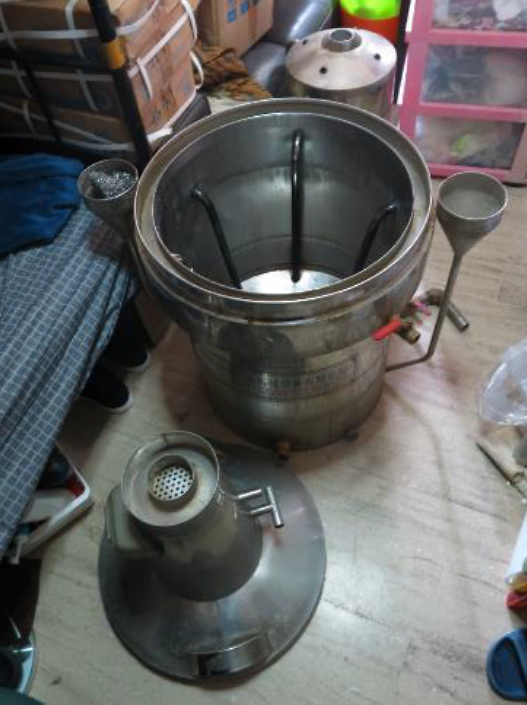
The next day, customs officers raided an HDB flat along Bukit Batok Street 21, arresting two men for manufacturing dutiable liquor, possessing a still without a licence and storing duty-unpaid liquor.

3 men arrested for involvement in duty-unpaid liquor activities (1)

A still used for distilling liquor. (Photo: Singapore Customs)

Officers also seized one porcelain jar, nine bottles containing about 58 litres of liquor and assorted manufacturing equipment. 

3 men arrested for involvement in duty-unpaid liquor activities (1)

Pails containing fermenting mash. (Photo: Singapore Customs)

3 men arrested for involvement in duty-unpaid liquor activities

Porcelain jar containing duty-unpaid liquor. (Photo: Singapore Customs)

Investigations are still ongoing, Customs said.

Those found guilty of buying, selling, conveying, delivering, storing, keeping, having in possession or dealing with duty-unpaid goods face up to six years’ jail and can be fined up to 40 times the amount of duty and tax evaded.

Anyone who manufactures dutiable goods or possesses any equipment used to manufacture dutiable goods without a licence can be jailed for up to 18 months and fined a maximum of S$5,000.

Source link

3 years' jail for maid who mixed detergent into infant's milk powder

0

[ad_1]

SINGAPORE – A maid purposely mixed detergent into an infant’s milk powder as she wanted to get another domestic helper in trouble.

The 29-year-old Indonesian committed the offence as she was jealous of the other maid who was working for her boss’ sister-in-law.

The offender felt that the 25-year-old Myanmar national needed only to take care of the baby, while she had to do all household chores.

The older woman was sentenced on Friday (Sept 20) to three years’ jail after pleading guilty to attempting to cause the three-month-old girl to consume a mixture of milk powder and detergent.

She cannot be named due to a gag order to protect the child’s identity.

The baby did not consume any of the tainted milk and the court heard that there was no evidence that the Indonesian maid had been abused or ill-treated.

Deputy Public Prosecutor Zhou Yang said the maid started working for the baby’s uncle in April 2015.

On certain occasions, the man, his sister-in-law and their family members would stay together in a house that his parents own.

[ad_2]

Source link

330 childcare centres to raise fees next year; some parents unhappy

0

[ad_1]

One in five childcare centres is raising its fees for full-day programmes next year, a move that has drawn unhappiness from parents interviewed. Some pointed out that it comes shortly after additional subsidies were announced last month.

The monthly income ceiling for families to qualify for additional subsidies was raised from $7,500 to $12,000. The quantum of additional subsidies was also raised, with more for those earning less.

The Early Childhood Development Agency (ECDA) said that 330 childcare centres would be increasing their full-day fees for Singapore citizens from next year. The median increase is “within 5 per cent of fees” and “broadly comparable” with previous years, it added.

Also, a large majority of the centres had informed ECDA of their planned hike for next year before the enhanced subsidies were announced at the National Day Rally on Aug 18. Details of the subsidies were announced on Aug 28. The rest did so before ECDA’s Sept 1 deadline.

This year, 220 centres raised fees and last year, 540 did so.

[ad_2]

Source link

Fire breaks out near Jurong Town Hall Road

0

SINGAPORE: An open grass patch near Jurong Town Hall Road caught fire on Friday (Sep 20) evening.

The Singapore Civil Defence Force (SCDF) said it was alerted to the fire at about 5pm.

Fire at Jurong East field Sep 20 2019 (1)

The fire broke out near Jurong Town Hall Road on Sep 20, 2019. (Photo: CNA reader)

The fire, which was near the Ayer Rajah Expressway, affected an area the size of a football field, SCDF said. 

It was put out using water jets and there were no injuries, it added. 

Fire at Jurong East field Sep 20 2019 (3)

A fire broke out near Jurong Town Hall Road on Sep 20, 2019. (Photo: CNA reader)

Fire at Jurong East field Sep 20 2019 (4)

Smoke is seen rising from the affected area. (Photo: CNA reader)

Photos show the flames engulfing trees and tall grass. Thick fumes of smoke could also be seen.

Jurong fire (1)

SCDF officers at the scene of a fire near Jurong Town Hall at about 6.05pm on Sep 20, 2019. (Photo: Ng Wei Hao)

Other photos show SCDF vehicles at the site. 

The cause of the fire is under investigation.

This story came from a reader tip-off. If you would like to send in photos or videos of something newsworthy, WhatsApp our Mediacorp news hotline at +65 8218 8281 or message us on Facebook.

Source link

Singapore is top in the world for retirement finances, but among worst for retirees' quality of life: Study

0

[ad_1]

SINGAPORE – Singapore emerged the global top scorer in retirement finances this year, although it performed poorly for retirees’ quality of life and material well-being, according to an annual retirement security index released on Friday (Sept 20).

In the overall ranking, the city-state remained at 28th place out of 44 countries surveyed in the latest edition of the Global Retirement Index for 2019 by Natixis Investment Managers.

Retirement finances here refers to the soundness of a country’s financial system, the level of savings and investment, and the preservation of the purchasing power of savings.

Quality of life captures the level of happiness and fulfilment in a society, air quality, water and sanitation, biodiversity and habitat, as well as natural environment factors.

Among Asian countries, Singapore came in third for overall retirement security, behind Japan and South Korea, who took the 23rd and 24th spots respectively in the global ranking.

[ad_2]

Source link