WASHINGTON – Prime Minister Lee Hsien Loong will arrive in New York on Saturday (Sept 21) for a week-long working visit, during which he will meet United States President Donald Trump and address world leaders at the United Nations General Assembly.
The meeting between PM Lee and President Trump, announced by the Prime Minister’s Office (PMO) in a statement on Friday, will be their fourth since Mr Trump took office in 2017.
PM Lee will head Singapore’s delegation to the 74th session of the United Nations General Assembly and deliver Singapore’s national statement – a speech laying out its position on global issues – during the high-level general debate.
It will be his first time attending and addressing the annual forum of 193 countries since he became prime minister in 2004.
It’s open season for flagship smartphones again and despite economists’ less-than-upbeat on the state of the Singapore economy, consumers here only have one focus in mind this week: getting the latest Samsung or Apple’s top of the line devices.
But if you are only thinking about getting the Galaxy Fold now, well, you’ll just have to wait a little longer to lay your hands on one – Samsung has announced that the foldable phone has been SOLD OUT on launch day (Sept 19) in Singapore.
The company did not provide any numbers, but in a press release claimed that “thousands” have registered their interest to purchase the phone.
For the curious and intrigued, Samsung is hosting exclusive 1-on-1 product experience at the Galaxy Fold Live Studio in Orchard Paragon.
SINGAPORE: After more than 30 hours of labour, Ms Christy Liew held her daughter in her arms, but the newborn was silent.
Just two days before, her baby had died in the womb, two months before she was due to come into the world. To avoid complications, Ms Liew and her husband decided to induce the birth of their now-dead child.
While other mothers were welcoming their babies at the KK Women’s and Children’s Hospital’s delivery ward, Ms Liew was struggling with pain and guilt.
“Instead of my baby crying, I was the one crying,” the 35-year-old financial adviser said, tears welling as she recalled what she went through on Apr 7.
“You have planned so many things, then all of a sudden, you can only hold someone who is dying in front of you.”
She was wracked with grief and physically exhausted from the labour, but there were many decisions to make which she and her husband had never planned for – and in a very short time, she would never see her firstborn, Amanda, ever again.
Some parents choose not to see their deceased child, but Ms Liew said it helped to spend some time with her baby and take photos with her before she reluctantly sent the infant off.
Then the nurses dressed Amanda in a tiny pink gown, put a bonnet on her head and even gave her a little teddy bear to hug before taking her away.
A charm in the shape of an angel was stitched on the gown, and a matching charm now sits on Ms Liew’s wrist.
She keeps a photo album, a lock of Amanda’s hair and a set of her footprints and handprints in a gold cardboard “memory box”, provided by the hospital.
“Next time, if you think of her, you can still look at those photos,” she said. “It’s like she existed in the world.”
Ms Christy Liew keeps her daughter’s footprints and handprints, along with a lock of her hair as mementos. (Photo courtesy of Christy Liew)
ANGEL HEARTS
Unknown to Ms Liew then, the gown that her baby wore was sewn by an Angel Hearts volunteer.
The organisation, formerly known as Angel Gowns, was started in 2016 to dress “angel babies” such as Amanda “with dignity”, and is based on similar groups in the United States and Australia.
Not everyone is comfortable with discussing the loss of an infant, mothers that CNA spoke to said. Many people advise them to move on and “have another one”, with their best interests at heart, they said.
But it’s not so easy for the mums, for whom each baby lost is etched in their hearts.
In 2018, there were 89 stillbirths and 39,039 live births recorded in the Report on Registration of Births and Deaths. The infant mortality rate was 2.1 per 1,000 live births.
And about 25 per cent of pregnancies end in miscarriage, according to Health Xchange.
Angel Hearts co-founder Felicia Tan, 41, said that she joined the organisation after miscarrying three children in 2011 and 2012.
Back then, before Angel Hearts had started, her babies were wrapped in white muslin cloth, which became stained with their blood, before they were taken to a mortuary, she told CNA.
The organisation now liaises with all the public hospitals in Singapore as well as some private hospitals to provide them with the gowns.
KKH said that it has received 204 gowns from Angel Hearts so far, and they complement the hospital’s collection of baby clothing offered to parents or caregivers of deceased babies.
The non-profit has grown from an initial group of five women to more than 100 volunteers currently – including Ms Liew.
“It was a comfort to see her in a nice dress, with a teddy bear,” she told CNA. “I find that it’s really something very meaningful.”
Like other volunteers, Ms Liew helps to stitch angel gowns in sizes from small and tiny to minuscule for the babies lost.
Angel gowns and a wrap sewn by Ms Christy Liew. (Photo: Chew Hui Min)
They also sew wraps scarcely larger than an adult palm – for foetuses miscarried while they are barely formed, all from the scraps of donated wedding gowns. Each gown comes with a set of charms – one for the child and one for the mother to remember her baby by.
After stripping down the donated wedding dresses, volunteers will take the fabric home to turn them into angel gowns. There are classes for those with no sewing experience and once a month, they meet up to exchange pointers.
Angel gowns for boys. (Photo: Facebook / Angel Hearts)
It can be an emotional process for the mothers – some find it therapeutic, some become distressed.
“Sometimes it can be too traumatising for them to sew, so they find other ways to help,” said Ms Tan.
From gowns, the group now also knits bonnets and booties, and also makes condolence cards for bereaved parents.
Besides hospitals, they also send gowns to funeral homes, if they request for them.
Not all miscarriages or stillbirths happen at hospitals, and they’ve had to personally deliver or courier gowns to grieving parents within hours – once during Christmas, said Ms Tan.
WHY DIDN’T I SAVE HER?
Sewing gowns and keeping busy has helped Ms Liew, but it has taken her a few months to battle depression and slowly rejoin society, despite an outgoing personality and the help she received.
“Why didn’t I save her?” she had thought, in the first few weeks after losing Amanda.
But speaking to other bereaved parents, and realising that her dark thoughts were “normal” helped her gain some perspective.
According to Ms Majella Irudayam, the co-chairperson of KKH’s Bereavement Support Committee, shock, confusion and feelings of extreme pain and suffering are common for parents who have lost a child.
“Many of these feelings can be frightening … (and) overwhelming. Hence parents need to be gentle and patient with themselves,” she said.
“It’s helpful for them to have ”meaningful reminders of their child’s existence”, such as photographs, handprints and footprints, she added.
But she also said that the pain of the loss will never disappear: “With time, they will find ways to cope with the pain.”
LETTING GO
For Ms Liew, giving her daughter a proper send-off was part of the healing process.
While she agreed at first to a mass cremation arranged by the hospital, she later changed her mind and claimed Amanda’s body for a private funeral, but had no idea where to get help.
A mother she got to know at a support group for bereaved parents told her to contact Ms Alverna Cher, funeral director of City Funeral Singapore.
In less than a day, Ms Cher arranged for a cremation at Mandai Crematorium, a small coffin, and Christian as well as Buddhist rites – in consideration of the religions of their families.
When contacted by CNA, Ms Cher, 37, said that she handles five to 10 cases of baby cremations a year and the funeral home provides these services pro bono for babies and children as well as for the needy elderly.
“As a mother myself, I understand the pain, worry and self-blame they are going through,” she said. “The most I can do is give the baby a dignified send-off.”
The hardest part for Ms Liew was letting go of her daughter. She recounted how, as Amanda’s body was pushed into the cremation chamber, she decided that she could not “hold her back”.
Speaking in Mandarin, she told her: “I really love you, but we’re fated to be with each other for only 30 weeks … I really want to be your mother but I have no choice, I need to send you away.”
Amanda’s ashes were later scattered at sea.
Baby Amanda’s ashes were scattered at sea. (Photo courtesy of Christy Liew)
WHERE TO GET HELP
Angel Hearts conducts sewing workshops for bereaved mothers to “work through their loss”. They have a donation drive for wedding gowns on Oct 11 and 12 at 91 Lorong Chencharu. The fabric from the wedding gowns will be used to sew angel gowns.
KK Women’s and Children’s Hospital has a Bereavement Support Committee to help patients who have lost their loved ones. They advise bereaved parents on their options, help them create memories of their loved ones and provide counselling, among other services.
Child Bereavement Support (Singapore) is an informal network of bereaved parents who support each other through their grief. They hold monthly support meetings and provides resources and information for the parents through their website.
SINGAPORE: Growing up, 18-year-old Nur Ayuni Abdul Rahim had always kept to herself.
In primary school, her older brother often came home with tales of how she had been bullied by other students. But she had never said a word to her family.
“It’s quite hard to understand what she’s feeling or thinking, and she’s not the type of person to express herself,” said her oldest sister, Nur Azian.
The bullying broke her family’s hearts. And their hearts took another beating when Ayuni’s primary school approached them when she was 11, suggesting that Ayuni transfer to Grace Orchard School, a special education school for students with mild autism and mild intellectual disability.
“We thought she was normal, but just needed to work hard,” said Azian.
Ayuni’s family had always known she was a slow learner, but it turned out that Ayuni had mild intellectual disability, a developmental disorder that makes it harder for her to grasp concepts and solve problems.
They also grew used to her silence.
After all, she was part of a large family, with 10 other siblings and even nieces and nephews living in the same house. Their flat in the western part of Singapore – home to 16 people – was often a boisterous place.
After Ayuni began to attend Grace Orchard School, the family noticed a change in her – she started coming home looking happier.
And one day, as Ayuni was helping to shower her niece Farisha, Azian heard the unmistakable strains of a familiar nursery rhyme echoing through the bathroom door. Ayuni had started to be trained as a childcare aide and was singing the nursery rhymes she had learnt to Farisha – something Azian had never heard her do before.
Ayuni helping to take care of her niece, Farisha.
Azian had never imagined something as simple as a nursery rhyme could make her so emotional, because hearing Ayuni sing out loud – naturally, and without prompting – was a testament to how far she had come: From a quiet, reserved girl, to one who can handle children with confidence, and harbours hopes of becoming a childcare teacher one day.
PRICELESS OPPORTUNITY
The seeds for Ayuni’s journey to becoming a childcare aide were first sown in 2014 when Grace Orchard School wanted its students to gain some work experience in a childcare setting.
At the time, the school provided four training tracks for its students – horticulture, retail, hospitality and F&B – and they were keen on exposing students to more areas of work.
“Not all of them are suitable, and not all of them are interested in these four tracks,” said Lisa Goh, Grace Orchard’s principal.
Imagine having to work your whole life in something you’re not interested in at all. That’s why we felt that we needed to give our students more career choices.
The school, which operates under the umbrella of voluntary welfare organisation Presbyterian Community Services (PCS), reached out to PCS.
As a trial, some Grace Orchard students began visiting PCS childcare centres a few hours a week.
And in 2017, to take the programme further, a pilot scheme was launched to formally train a pioneer batch of three students as childcare teacher aides. Their role would be to help teachers with routine tasks such as feeding and showering the children, and give additional support to the teachers during lesson time.
The structure of the curriculum that includes a mix of classroom training and hands-on experience at a PCS childcare centre in Jurong was jointly developed by PCS and the school.
Before they graduate from the programme, the three selected students – Ayuni and two other girls her age – would also be sent out as interns to different PCS centres.
Throughout the process, a job coach from Grace Orchard as well as a PCS trainer would work with the students, visiting them at the centres to observe and guide them.
During each of her visits, PCS trainer Gomathey Veeramari, who prefers to be known as Gomy, has one-on-one reflection sessions with each of the students to give her feedback on what was done well, and the areas that need improvement.
“It’s very important to do regular monitoring of the students, to check on their overall performance and to discuss with the principals and teachers how their performance can be improved further,” she said.
Gomy going through a list of tasks with Ayuni to tell her what she has done well, and what she needs to improve on.
It would take three years for the girls to complete the programme, which Lisa said was necessary as every task required of the students was broken down to help them understand better.
For example, instead of simply telling the student to feed a child, the student would be guided to first take the food out, scoop a certain amount onto the plate, check the temperature of the food, spoon it into the child’s mouth and wait for the child to swallow before repeating the process.
“They need that length of time and very specific instructions,” she explained.
But three years to train only three students?
Lisa stressed that they were more than happy to invest the time and effort in the students.
To see the life of a child change… I think it’s just priceless. You can’t put a price tag on it.
“If I can train these girls to be independent and contributing members of society… I think it’s something worth doing, regardless of how long the time is.”
ALREADY WELL-TRAINED
When the school first broached the idea of the programme to Ayuni’s family, Azian remembers being happy to give it a try. At the time, Ayuni had been working in her school’s training cafe and was planning to join the F&B track.
But her sisters had reservations about it.
“I used to be in the F&B line, and I know what it’s like,” said Azian. “If a customer were to complain or approach her directly in a rude manner… she’s not the type of person who would talk back and she’d just keep quiet.”
“Also because we have a lot of siblings… our mum trained us to take care of each other,” added Ayuni’s fifth sister, Nur Amirah. “So she already knew how to do things like changing diapers and showering the children.”
Amirah added that although Ayuni had initially wanted to stick with F&B so that she could continue schooling with her friends, she was happy that Ayuni eventually made the decision to try out the new opportunity.
“It was something new, and not everyone got the chance to be in childcare,” she said. “I thought she was lucky to get in.”
“I did not like to work in the kitchen, and I was scared to talk to the customers,” Ayuni chimed in.
I like talking to young children. It makes me happy.
DETERMINED TO MAKE IT A SUCCESS
When PCS centre principal Kelyn Soh received word from her manager in February that came April, a new intern named Ayuni would be joining her centre as a childcare aide, her first instinct was excitement.
“Even before they told me about this programme, I had already thought to myself: What if one day the early childhood sector could employ people with special needs?” she said.
“I was determined to make it a success.”
She had always believed that people with special needs should be given opportunities in life. Besides, she knew there were many benefits.
For one, these aides – who would have already gone through two years of structured, detailed training – would come in already knowing what they needed to do, and how to do it.
In comparison, no formal training is required for one to become a programme helper who would typically take on a similar role in the centre as these aides.
But Kelyn also knew there would be challenges.
“My concern as a principal would be my team, because I need them to support this programme as much as I do and to buy into the idea,” she said.
My second concern would be the parents. I didn’t know if they would be receptive to it.
Some of her teachers, she said, shared her concern about the parents. But she knew that was something she would have to take as it comes.
At the same time, the teachers also wondered whether the aide would slow down their work process, or have trouble understanding their instructions.
“When we react to children, at times we need to be very fast,” she explained. “So the teachers were concerned that it would be an added load for them having to take care of the children while taking care of the aide as well.”
PCS centre principal Kelyn Soh was determined to make Ayuni feel loved and accepted.
She worked with Grace Orchard School to help address these concerns.
Prior to Ayuni’s arrival, Gomy also came down to conduct a workshop for the teachers to help them understand how they could make her feel welcome.
In addition, Kelyn interviewed each teacher personally to make sure that Ayuni was placed in a class where the teachers would be more receptive to her.
We just wanted her to feel loved and accepted.
WATCH: A special kind of teacher (Dur 7:31)
A GIRL OF VERY FEW WORDS
Ayuni remembers being nervous on her first day at the centre.
Having gone through two years of training, alternating between lessons in the classroom and taking care of children at another PCS centre, she knew what she was expected to do. But being in a new environment made her uncomfortable.
“When I first came, the children didn’t want to talk to me,” she said. “They would move away and look at me from afar.”
“Inside, I felt scared.”
When she was nervous, she preferred to do her tasks in silence, and she had to be reminded to speak more to the children.
“She was a girl of very few words,” said Jean Ngoo, the teacher Ayuni was assisting. “The first day, whenever I spoke to her, she would just say, ‘Okay, okay, okay.’”
Jean remembers being concerned that she would have to spend extra time guiding her. But as the days went by, it got easier and easier to guide Ayuni.
Going outdoor with the children.
“When I tell her something, she remembers it very clearly. And when I teach her something new, she’s very willing to learn, and can take feedback well,” she said.
“As she got more comfortable with us, she started speaking a lot more and she doesn’t need reminders anymore.”
Being more communicative was also something that was emphasised during Ayuni’s weekly reflection sessions with Gomy.
“I would tell her how to start conversations with the children,” Gomy said. “Let’s say during lunch time, I would tell her she can say things like, ‘Do you like what you are eating? Can you tell me what is in your food?'”
Kelyn, being new to this childcare centre herself, empathised with Ayuni and made it a point to keep an eye out for her.
“She was scared at first, and she was worried that she couldn’t remember all the children’s names,” she said.
“It was like that for me when I first came to work. So many classes, so many teachers. It was so challenging so of course she would feel the same way.
“It’s normal.”
“When I did my rounds around the centre, I made an effort to intentionally look at her, make eye contact with her and smile,” she added.
“Soon, I realised that whenever I smiled at her and caught her attention, she would smile very brightly.”
THE CHILDREN LOVE HER
Today, Ayuni is in the final months of the programme before she graduates. To the children, she is Teacher Ayuni, no different from Teacher Jean and the other teachers in the centre except for her long ponytail and the green apron she wears that identifies her as a teacher aide.
She loves to sing songs to the children, and does the accompanying hand actions with gusto.
She knows the quirks and fancies of each child in her class, and can rattle off all their names on request.
When CNA Insider visited the childcare centre, a boy’s head turned the moment he heard her saying his name, and he ran towards her.
“Psssst!” He pointed at her with his finger, grinning.
“Psssst!” Ayuni mimicked the sound and action. When she smiles, it lights up her whole face.
“This one is my favourite,” she said, as the boy clambered onto her lap, giggling, and reached out to touch her face.
Ayuni has blossomed during her internship here and has even exceeded expectations by starting to read to the children, a task that was not initially in her job scope.
“The children love her so much that sometimes they run to her instead of to me and my Chinese teacher,” Jean said, laughing.
Ayuni has formed close relationships with the children in her class.
Ayuni’s relationships with her colleagues have also blossomed, but a special place in her heart is reserved for her principal. Every morning when she reports for work, she makes it a point to knock on Kelyn’s office door and greet her.
“If I don’t greet her, I feel like something is wrong,” she said.
“I like Ms Kelyn because every time she sees me in class, she keeps smiling,” she added. “So I smile back at her”.
Whenever Kelyn has to miss a day of school, Ayuni would, without fail, text her to tell her that she misses her.
“She would always ask me how I am, if I have eaten, and remind me to take care of myself,” Kelyn said.
She has such a beautiful heart… as beautiful as how she looks.
“She grew to be so close to the children, they love her and she loves them. I feel that she is no different from any other teacher,” she added.
“Nobody can tell that she has special needs.”
WOULD OTHERS GIVE HER A CHANCE?
When Ayuni and the other girls from the pioneer batch graduate, they will be guaranteed employment in PCS centres. PCS has also agreed to guarantee the graduates from the subsequent batch employment in their centres.
But beyond this, PCS hopes that other preschools would be willing to take them on, according to PCS executive director David Lim.
“We want to make them our ambassadors… to show other employers that they can do it,” he said.
Ayuni now reads stories to the children – something that was originally not in her job scope.
Currently, PCS is in talks with a preschool anchor operator to open up their centres to the students who graduate from this programme. They also hope to expand the programme and are planning to convert part of one of its centres to become a place for the students to undergo classroom training.
But David acknowledged that getting other preschools to give the likes of Ayuni a chance can be a challenge.
“Some preschools are sure to have some apprehension, especially those who have not worked with people with special needs before,” he said. “Some people have this misconception that people with special needs are those who are very severe… But these students have higher ability.
“We have seen that they are more than capable to serve in the childcare setting.”
In anticipation of parents’ concerns, the PCS centre in Jurong that was used for training the three girls invited parents down to meet the students. They were pleasantly surprised by the parents’ reaction.
“When they met the girls and got to see who they were, they were actually very positive about it,” said David. “We assumed it would be our greatest challenge, but it turned out differently.”
Back in Ayuni’s centre, Kelyn knew that it was only natural for parents to be worried about their children’s safety and well-being.
“From a mother’s perspective, it’s understandable. I want my children to be in good hands. So the preschool would need to assure parents that the childcare aides are well-trained and are able to take care of the children safely,” she said.
So far, parents whom she has spoken to about Ayuni were receptive and welcoming. She is also glad that Ayuni’s presence gave her the opportunity to spark conversations with parents about people with special needs.
“Some had this misconception that people with special needs have a different look, so they were surprised that she didn’t look different. That’s about it,” she said. “It is a good opportunity to raise awareness that there are some who are able to function normally and contribute to society.”
Kelyn also hopes that Ayuni’s presence would give rise to conversations between parents and their children about those who may be different – something which is already beginning to happen.
“My son is starting to stereotype people… perhaps those with abnormalities in their facial features, or people with no hair. So I tell him not to label and to just accept that they are different, but no less equal,” said mother of two, Cheryl Lim, whose younger son is in Ayuni’s class.
“I wouldn’t want to let him know that Teacher Ayuni is someone with special needs, but rather she is someone who is there to help him in his daily life and his learning,” she added.
BEYOND EXPECTATION
After months of seeing Ayuni come home from work smiling, and hearing the sound of nursery rhymes echoing through the house as Ayuni sang to her niece, Amirah decided to go down to the centre to visit Ayuni for the first time.
She had a day off from work, and wanted to see her sister’s transformation with her own eyes.
Amirah and Ayuni after the older sister visited Ayuni at work for the first time.
As she approached the centre, the general hubbub of children’s voices grew louder. It was a busy time. The children had just woken up from a nap, and the teachers were getting ready to feed them a snack.
In the thick of the action was Ayuni. After serving cakes, she sat down next to a boy to help him eat his snack. She was smiling at something the boy was saying, and laughed when he made a face at her.
As Amirah peered into the window to watch Ayuni at work, tears sprang to her eyes.
“We only know the stories of what she does at work, but this is beyond what I’ve expected,” she said. “I wasn’t sure if she would take care of other children well… but she’s doing great.”
The tears flowed again when Ayuni came out to meet her.
“I’m so, so proud of you,” she said, dabbing at her eyes. “You’re doing very well. Keep it up.”
Ayuni laughed shyly. “I want to cry too,” she said.
She is sure that she wants to continue in the early childhood sector. And she says she has hopes of one day becoming a fully-fledged childcare teacher.
Her sisters know of her dream, but they also know there are challenges. There will be courses and diplomas she needs to complete in order to be certified. They do not know if she is able to complete them.
But given how much they have seen Ayuni progress, and how far she has come, they hope that one day, she will succeed.
SINGAPORE: A “raging” fire broke out inside two semi-detached houses in Wilton Close near one-north on Saturday (Sep 20), said the Singapore Civil Defence Force.
Photos and videos on Saturday evening showed bright orange flames engulfing a multi-storey building, blowing thick smoke into the air that could be seen from 10 minutes away.
People were also seen standing on the road away from fire at 1 and 2 Wilton Close as firefighters worked to keep the situation under control.
SCDF vehicles at Wilton Close on September 21, 2019. (Photo: Leong Wai Kong, Andy Tan)
In a Facebook post on Saturday night, SCDF said it first got a call for assistance at about 6pm and arrived at the scene within seven minutes.
By then, it said, the occupants of the houses had self-evacuated.
“The fire was raging and burning through the roof,” said SCDF, adding that it deployed four water jets to prevent the fire from spreading.
In total, eight emergency vehicles and 22 firefighters were also deployed.
The flames were put out at about 6.40pm.
Smoke seen from the Mediacorp building on September 21, 2019. (Photo: Johannes Tjendro)
There were no reported injuries.
“Damping down operations and fire investigations are ongoing,” said SCDF.
This story came from a reader tip-off. If you would like to send in photos or videos of something newsworthy, WhatsApp our Mediacorp news hotline at +65 8218 8281 or message us on Facebook.
The movement has sparked many similar rallies around the world.
At the Singapore event, participants came bearing posters with slogans like “Don’t burn my future” and “O-Levels are soon, so is this irreversible climate crisis”.
There were also community activities such as writing postcards to Members of Parliament calling for government action.
Colourful sign boards are seen at the climate change rally at the Speakers’ Corner in Singapore.
The Singapore Climate Rally, organised by the non-profit organisation of the same name, was calling for systemic change from the Government as well as corporations because individual efforts were not sufficient.
In his National Day Rally last month, Prime Minister Lee Hsien Loong addressed threats of climate change such as rising sea levels and estimated the Government would spend S$100 billion in the long term to protect the country.
But the organisation said it wished to see more preventive rather than adaptive measures being taken.
A participant holds up a sign board with the words “climate justice now” at the climate change rally at the Speakers’ Corner in Singapore.
Co-founder Komal Lad, 19, said that today’s carbon taxes are not enough and although she anticipates it to increase by S$10 per tonne of greenhouse gas (GHG) emissions by 2030, “it is not enough to make a dent and not enough to pressure businesses to seek renewable resources”.
The current carbon tax is set at a rate of S$5 per tonne of GHG emissions from 2019 to 2023.
Apart from increasing carbon taxes, Ms Komal said she also wanted companies to divest from fossil fuels.
Rising awareness in recent years could be due to how the effects of climate change are more strongly felt with the increasing temperatures, she added.
Social media has also contributed to increased awareness and the volume of news about weather catastrophes in other countries has also resulted in greater “climate-consciousness”, said Ms Komal.
PARTICIPANTS STAGE “DIE-IN”
The event also saw a “die-in” – a move similar to a human chain domino that was a way for organisers and participants to show collective grief over the loss of biodiversity and human lives resulting from climate change.
Six poignant speeches were given as well from a diverse range of Singaporeans, who recounted their personal experiences with climate change.
Among them was Oliver Chua, a Primary 5 student from Temasek Primary School who described himself as a “typical 11-year-old”.
“I feel that my friends are in that ‘don’t know, don’t care’ or ‘I know but I don’t know what to do’ phases because we tend to take (things) for granted and we can’t really comprehend the impact of climate change,” he said.
He said schools could do more to expose students to the topic through classes solely dedicated to environmental issues.
Ms Komal said the rally was only the first step towards action against climate change and that it would not be the last time anyone would hear from the organisation.
“SG Climate Rally, we will definitely have something in time to come,” she said.
SINGAPORE – A fire broke out at an open grass patch near Jurong Town Hall Road on Friday (Sept 20).
The Singapore Civil Defence Force (SCDF) said it was alerted to the fire, which was near the Ayer Rajah Expressway, at 5pm.
SCDF said water jets were used to put out the fire, which broke out across an area roughly the size of a football field.
Videos of the fire show white smoke rising from the grass patch, adding to the haze in the area.
SCDF said no one was injured in the incident.
Netizens said they were worried about how the smoke could worsen air quality in the area, due to the current haze situation. One Reddit user who was not aware of the fire mistook the smoke from the Jurong fire for the dense haze blown in from forests burning in Indonesia.
SCDF said it is investigating the cause of the fire.
SINGAPORE – The haze that lifted on Friday seems to be back on Saturday (Sept 21), the second day of the Formula 1 weekend.
Air quality deteriorated overnight as the 24-hour Pollutant Standards Index (PSI) inched towards the “unhealthy” range.
The 24-hour PSI reading was 92 to 97, within the moderate range, at 10am on Saturday.
It was up from a reading of 66 to 67 at 10pm the previous night.
A PSI reading of zero to 50 indicates good air quality while a reading of 51 to 100 is in the moderate range, and a reading of 101 to 200 is considered unhealthy.
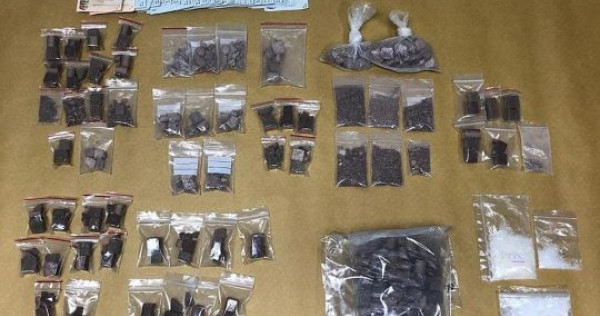
Five suspected drug offenders were arrested and $78,000 worth of drugs seized, including 1kg of heroin, in two operations on Thursday, the Central Narcotics Bureau (CNB) said.
The suspects include an 18-year-old Singaporean found with 345g of cannabis, which CNB noted was enough to feed the addiction of 49 abusers for a week.
He was arrested at a Housing Board void deck near Serangoon North Avenue 1 and is being treated as a suspected drug trafficker.
Officers also found a digital weighing scale in his flat.
Four men were arrested in a second operation. Three of them were linked to heroin, with a 48-year-old Singaporean suspected of being a trafficker.