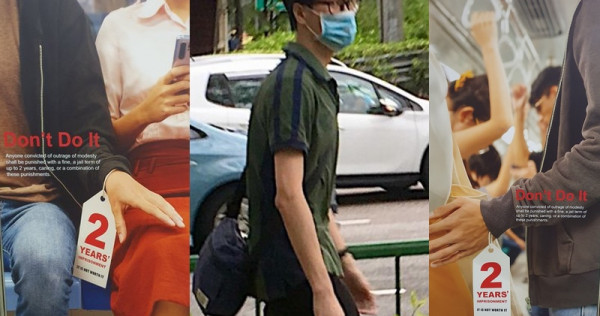
Forget about Xiaxue’s attempt to stay relevant in the current news cycle; there’s a bigger outrage (and one that’s actually worthy of your attention) that has taken hold across Singapore’s online landscape in the past 24 hours.
News feeds on Facebook, Twitter and other social media platforms are ablaze with posts related to a sentence handed down to a young National University of Singapore (NUS) student found guilty of outraging a woman’s modesty in a train last year.
Specifically, the ire is directed at the presiding judge’s decision to slap a 21-month supervised probation in lieu of jail time. According to The New Paper, District Judge Jasvender Kaur decided that 23-year-old Terence Siow was suitable for probation due to his academic results showing that he has “potential to excel in life” and that his offences are “minor” intrusions.
SINGAPORE: While there are various scenarios in which the Government is ready to step in to support the economy, it does not see the need for an “extraordinary budget” at this stage, Deputy Prime Minister Heng Swee Keat said on Friday (Sep 27).
Nevertheless, the Government is closely monitoring how the economy will pan out by the end of the year, and is prepared to take action when necessary, he said during an interview with CNA938.
Mr Heng, who is also Finance Minister, was responding to a question about the state of the Singapore economy and the measures that the Government has in place should it decide to step in.
Currently, while there are increasing downside risks to growth, some sectors have continued to do well.
These include the information and communications technology, financial services and insurance services sectors. Even within the electronics sector, some segments like data storage have also seen growth, Mr Heng said.
“But how the whole economy will pan out by the end of the year is something we are watching very closely and are prepared to take action when needed,” he added.
This as Singapore remains part of the global economy and is “very dependent” on trade and external demand.
“This trade tension is not helping. In fact the International Monetary Fund has cut global forecasts several times, which is quite unprecedented. It’s (a) much more uncertain state today,” he said.
Mr Heng pointed to monetary and fiscal policies that the Government can turn to when it comes to counter-cyclical measures.
For the former, the Monetary Authority of Singapore (MAS) is “weighing very carefully as to what is the appropriate exchange rate and they will be announcing this as part of the regular monetary cycle”.
In terms of fiscal policy, Mr Heng said: “Depending on the state of the economy, we have various scenarios in which we are ready to step in when the time comes. I do not foresee a need for an extraordinary budget at this stage.”
But more importantly, these will have to go alongside structural policies given how the global economy is seeing a combination of cyclical and structural changes.
“Many other economies also want to do better and therefore they are making changes and reforming their economy. When our trading partners make changes, we too must upgrade otherwise we will be left behind.
“So we have a whole range of important structural policies and in particular, helping our workers learn new skills and working together with companies to restructure jobs so our workers can do better,” he said.
Deputy Prime Minister and Minister for Finance Heng Swee Keat speaks to CNA938 on Sep 27, 2019. (Photo: Try Sutrisno Foo)
ON 4G LEADERSHIP, ELECTIONS
During the nearly hour-long interview on Friday morning, Mr Heng was asked about a range of issues, including living costs in Singapore with an impending hike in the Goods and Services Tax, his journey in politics thus far as well as his leadership style.
“I think we already have a very good team,” he said in response to a question from CNA938’s Arnold Gay on the qualities that he is looking out for as he forms the fourth-generation leadership team.
“Many of us have been working together when I entered politics in 2011 but at the same time, I am hoping for more to join us,” added Mr Heng, citing commitment to Singapore as a criteria and his hopes to assemble “a diverse group with experience”.
When asked how the next Cabinet reshuffle could play out given this vision that he has, Mr Heng said he and Prime Minister Lee Hsien Loong “have been discussing some of these issues quite regularly”.
Mr Lee has also been “sharing quite a lot of his views” with him.
“We are in discussions and when the time comes, he will announce it. But it’s progressing well and I am happy with the progress that we’re making,” said Mr Heng.
As to when the next General Election might take place, Mr Heng would only say that “it’s coming nearer each day” before going on to stress the need for “constructive politics” in Singapore.
“I think the most important issue to address is: What are the issues that Singaporeans like to see tackled in the coming years? What is our strategy for taking Singapore forward?
“It is easy for anyone to say you’re not doing enough on this (and) that but I think what we need is constructive politics in Singapore, which is that I offer this vision of where Singapore is going to go and Singaporeans decide first and foremost do I like that? Second, are you able to get it done? It’s not making empty promises,” he added.
Mr Heng also touched on Singapore’s long-standing identity as a multi-racial and multi-religious society.
“The pledge that our children take every day – regardless of race, language or religion – it’s a very important aspect of our society. Let’s keep it,” he said.
However, this is “always a work in progress” as misunderstandings can happen very easily.
“First and foremost, misunderstandings can happen even between the closest people – a husband and a wife – but when it takes on racial religious dimension, it can be dangerous,” he said.
“So it is important for our leaders to promote deeper understanding and appreciation of diversity, and value of that diversity.”
Deputy Prime Minister and Minister for Finance Heng Swee Keat speaks to CNA938 on Sep 27, 2019. (Photo: Try Sutrisno Foo)
On new areas such as LGBTQ and green activism, and how the Government is thinking of uniting these different views, Mr Heng said many societies around the world are seeing increasing polarisation when single issues dominate the national discussion.
This is “a very dangerous trend and it can be a fault line”, he said, noting that Singapore must “work doubly hard” to make sure these do not become fault lines.
“Depending on the issues at hand, the key is to come together and say what we can agree on and what we cannot agree on,” he said.
With that, there has to be a much stronger emphasis on partnership moving forward, said Mr Heng.
“By looking at what we all have in common, what we want to pursue, we can help each other realise our aspirations better. Working together is always better than working alone.
“In that way, I think the Singapore society can continue to make progress in the years ahead.”
After his interview, Mr Heng unveiled a plaque to mark the launch of CNA938.
Singaporeans complain about MRT breakdowns all the time, but the truth is that we’re a lucky bunch. Objectively speaking, the Singapore public transport system is reasonably efficient. Try taking the trains and buses in Bangkok and you’ll have a newfound appreciation for our transportation network.
If this news has got you grumbling, here are a few ways you can shave either time or money off your commute:
1. TAP INTO THE MRT BEFORE 7:45AM
Taking the train during morning pre-peak hours used to be free, but even though that policy has been scrapped, you can still benefit from rising early.
An event ticketing and payment app popular with university students across Asia and backed by the venture capital arm of Singapore state investment firm Temasek has suffered a second data breach, potentially exposing the personal details of more than 30,000 users in the city-state.
Get, which allows campus clubs and societies to list their social events and sell tickets, repaired the flaw after it was discovered earlier this month, a cybersecurity expert said, but it had yet to notify the users whose information may have been leaked.
Nandakishore Harikumar, CEO of Technisanct Technologies, which is based in Kochi, India, looked into a Reddit user’s comment earlier this month that said he had bought a ticket for a campus event through Get and was eventually able to access a list of other users’ names and details.
In a conference organised by the S. Rajaratnam School of International Studies yesterday (Sept 26), Home Affairs and Law Minister K. Shanmugam made clear that foreign attempts to influence politics — especially in today’s internet era — have no place at all in Singapore.
To get on the good side of the Singapore government — and also to make amends over its failure to detect Russian interference on the platform during the 2016 US Presidential election — Facebook has rolled out ad transparency tools to ensure that the upcoming General Election won’t get meddled with by foreign bodies.
SINGAPORE – The Chin Swee Road couple charged in court last Tuesday (Sept 17) with murdering their two-year-old daughter is a case known to social workers.
The Ministry of Social and Family Development (MSF) said on Thursday evening that there were “various interactions” between the family and various agencies and community organisations over the years, without elaborating.
The spokesman added: “The nature of these interactions with the family is relevant to ongoing criminal investigations. In the meantime, we are reviewing how the network of agencies and community organisations can be further strengthened.”
The case gripped Singapore as the child’s remains were said to have been found in a pot in a one-room rental flat about five years after her death.
The couple cannot be named due to a gag order.
The couple is believed to have at least three children and the MSF said the other children are in safe hands.
They are all under stable alternative care arrangements and the MSF will continue to provide the necessary support to ensure the children’s safety and welfare.
SINGAPORE – In a flash, Mr Mohamed Ferdaus Mohamed Yusoff bolted up a moving escalator in an MRT station to grab hold of a little boy hanging off its side.
The SBS Transit employee hauled him over the handrail, but lost his balance and fell on the steps of the moving escalator, hurting his knee.
He, however, held the boy tight as he hit the emergency stop button.
The six-second rescue drama that saved the boy from a 5m fall took place at Sixth Avenue MRT station on Tuesday (Sept 24) at about 6.40pm.
It was a “scene out of a movie”, said an eyewitness.
On Thursday, Mr Ferdaus, 39, a senior assistant station manager who was still limping from the fall, recounted the incident to The Straits Times.
The boy, who looked to be about five years old, had entered the Downtown Line station with his mother, who was pushing a stroller with another child.
As the mother moved down the platform, the child, lagging behind, began to play with the handrail.
“I heard a loud commotion, turned and saw the boy hanging off the escalator with one arm and one leg dangling,” said Mr Ferdaus.
SINGAPORE: By all accounts, Sharon’s (not her real name) surgery to remove fibroids earlier this year was a success.
The 32-year-old was discharged armed with information that urinary tract infection (UTI) was a risk from the surgery.
She found out during a follow-up visit a week later that she did contract UTI – an infection most commonly caused by E. Coli bacteria. As typical for the infection, Sharon was prescribed antibiotic pills.
When it looked like she was not recovering, Sharon was prescribed another course of antibiotics.
“I still didn’t get better. I bore with it and went for a follow-up appointment for my surgery,” the civil servant told CNA.
It was then that doctors discovered that the infection had spread to her kidneys. This could have serious consequences including permanent kidney damage if not treated. Tests done by the doctors showed that the antibiotics she took were ineffective to treat her UTI. She was resistant to the antibiotic.
She was immediately warded, and given antibiotics intravenously, which had a higher chance of curing the infection.
Sharon recovered, but doctors have warned her that she would need to be hospitalised if she gets another bacterial infection.
On her part, she is taking steps to ward off such infections. “My Vitamin C level is low, and that makes me more prone to infections, so I have been taking supplements,” she said.
Doctors told CNA that cases of UTI which do not get cured with the usual antibiotics are becoming more common.
Associate consultant in the Department of Urology at the National University Hospital (NUH) Dr Melissa Tay said she sees at least five patients with recurrent or complicated cases a week at her clinic, more than she used to. Half of them are new referrals, she added.
“In addition, there is also an increasing number of inpatient referrals for the management of complicated urinary tract infections,” she said.
Her peers observed similar trends.
Dr Christopher Chong, urogynaecologist at Gleneagles Hospital, also said that it is “fairly common these days” to see patients who are not cured by the usual antibiotics, pointing to antibiotic resistance.
The growing problem of antibiotic resistance in UTI is seen in other countries as well.
Research by the New York City Department of Health in the United States showed that a third of uncomplicated UTI cases were resistant to Bactrim, one of the most widely used drugs, and at least one-fifth of them were resistant to five other common treatments.
Medical journal, The Lancet, provides similarly bleak statistics. Research it published last year showed that more than a third of all UTIs caused by E-Coli in Britain were resistant to “key antibiotics”.
A recent Singapore study on treatment of UTI in three polyclinics also concluded that more than 20 per cent of patients were resistant to antibiotics prescribed to them.
“Patients who take many courses of antibiotics are more likely to develop resistant bacterial strains,” said Dr Valerie Gan, consultant in the Department of Urology at the Singapore General Hospital.
Those who have been hospitalised frequently for other medical problems could also develop resistance as they are exposed to more resistant strains of bacteria, she added.
UTI COULD BE FATAL
While Sharon recovered from her UTI infection, others are not so lucky. According to the Ministry of Health’s list of principal causes of death here, UTI ranked eighth, higher than chronic obstructive lung diseases and type 2 diabetes.
The numbers showed that 2 per cent of total deaths were caused by UTI each year – more than 400 people.
Researchers warn that overuse of antibiotics could cause resistance to spiral out of control, to an “unknown tipping point” when the drugs are no longer effective. (Photo: AFP/Jorge Drikx)
According to HealthHub, in Singapore, about 4 per cent of young adult females have contracted UTI. The incidence rises with age to 7 per cent at 50 years.
Dr Chong said that to deal with antibiotic resistance, he does a detailed urine culture test that takes three days to produce results.
“If a bacterium is found, then this bacterium is ‘matched’ with a list of antibiotics to see which one the bacterium is sensitive to and can and should be used to treat,” he said.
In some cases, when there is resistance against all oral antibiotics, the patient may have to be hospitalised so that intravenous antibiotics can be administered, he added.
ANTIBIOTIC RESISTANCE NOT LIMITED TO UTI
But UTI is not the only bacterial infection becoming resistant to antibiotics, said the Pharmaceutical Society of Singapore (PSS).
It highlighted pneumonia as another disease which has developed resistance to antibiotic treatment, and now typically requires higher doses of antibiotics.
The PSS also pointed to skin infections, which are commonly caused by bacteria that have been resistant to antibiotics for a long time.
It pointed to US’ Centres for Disease Control and Prevention numbers that showed at least 2 million people get an antibiotic-resistant infection, and at least 23,000 people die as a result, to highlight the seriousness of the issue.
“Antibiotic resistance isn’t just a hypothetical concept, but its impact is already being seen today and is causing significant morbidity and mortality,” PSS said.