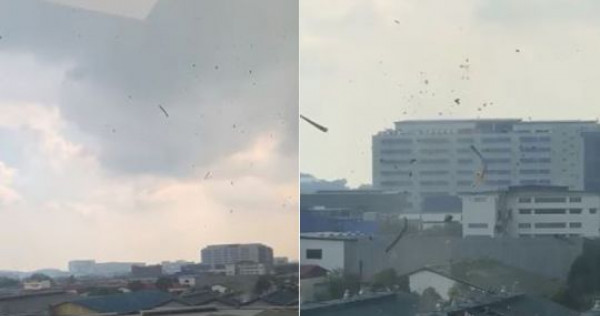
SINGAPORE – A “whirlwind” in Tuas captured on video that made the rounds online on Friday (Sept 27) is a landspout, the first such reported occurrence in Singapore, said the weatherman.
The National Environment Agency’s Meteorological Service Singapore (MSS) said the rotating column of wind was caused by the development of an intense thunderstorm under unstable atmospheric conditions.
A thunderstorm had developed over the waters off Tuas at 10.30am on Friday, subsequently moving inland at 11am.
“The moist air feeding into the intensifying storm resulted in a rotating column of winds over Gul Way around the Tuas area,” said MSS.
A landspout is similar to a waterspout that develops over a water body, it added. A landspout typically has a life span of several minutes and weakens quickly when the thunderstorm matures or dissipates.
A waterspout was last sighted on May 11 this year near Singapore’s southern shore, said MSS.
NEW YORK: Singapore stands out among other nations when it comes to weathering global uncertainties, said Prime Minister Lee Hsien Loong on Friday (Sep 27), adding that the country has remained united and cohesive, and has better resources in the face of challenges.
“These are problems which confront many countries in the world, big and small, and we’re not the only one. But compared to the other countries in the world, I think we are better prepared to deal with it,” said Mr Lee.
“We are more united, we are more cohesive, we have more resources. We’re better able to train our people and to deliver results and be competitive.”
Speaking to the media at the end of his seven-day trip to New York for the UN General Assembly, Mr Lee said he hopes Singapore’s fourth-generation leaders will continue to build on this cohesion and take the nation forward, especially as the country is set to face even more complex problems.
He gave the example of the US-China trade tensions which have weighed on Singapore’s economic growth, explaining that it is not a “temporary issue” which can be resolved once a “document or US-China trade agreement” is signed.
Prime Minister Lee Hsien Loong speaking to the media at the end of his seven-day trip to New York for the UN General Assembly.
“These are very deep conflicts of interest, even frictions … there is a risk of them becoming fundamental contradictions. We have to be prepared for that. And therefore, let us all get together and support the Singapore team, wear the same badge and we pull in the same direction,” Mr Lee said.
One other key challenge Mr Lee highlighted was climate change, an issue the prime minister spoke about in his first address at the UN General Assembly.
In his speech, Mr Lee said leaders have a duty to youth to act on climate change, because it is about their future.
To do so, Singapore has to ensure it has “good people in politics, responsible people who are able to get support from the ground”.
“Make sure you keep on voting in leaders who can serve Singapore well. There is no magic, 100 per cent safety net. You press this button, you sign this paper and you are safe for 100 years – there is no such solution,” he said.
“What we can do is … do our best to make sure we come through ok. That is the best we can do.”
Climate change had been described by Mr Lee as a “wicked global problem” that is best dealt with using a multilateral approach, even as US President Donald Trump indicated that he does not believe in the system and said that the future belongs to patriots, not globalists.
But Mr Lee said there are still many like-minded countries that believe in international cooperation, adding that their situations are different from that of the US.
“We will work together with all the countries who have this conviction that common problems need solutions where everybody comes together. And I hope that in time, America will come to a conclusion that it is in its own interest to join such a community of nations to work to solve problems and make progress together,” Mr Lee said.
On US-China trade tensions, Mr Lee said he does not expect a quick breakthrough, adding that he believes both countries expect it to be a long discussion, with “bumpy weather” for some time to come.
SINGAPORE: In the battle against climate change, global attitudes are finally shifting
Most respondents to a YouGov survey of 28 countries and 30,000 respondents carried out in June to July 2019 think climate change is likely to destroy the global economy, flood cities and cause migration.
Acknowledgement of mankind’s role in this changing climate is widespread.
These mindset changes are long overdue, nearly 20 years since global action on climate change got into full swing. In 1992, the United Nations held the first Framework Convention on Climate Change (UNFCCC) in New York, which entered into force in 1994 and was ratified by 185 countries.
Among its main objectives are the promotion and supervision of norms and policies to manage climate change. Signatories agreed to stabilise greenhouse gas concentrations in the atmosphere and take action to protect the environment.
Delegations gather in the General Assembly Hall for the 2019 United Nations Climate Action Summit at U.N. headquarters in New York City, New York, US on Sep 23, 2019. (Photo: REUTERS/Lucas Jackson)
ADAPTING, THE NEW BLACK
In 2016, many governments signed the Paris Agreement that outlines a plan of action to intensify actions and investments needed to realise a low-carbon future.
Countries are expected to establish policies and management, administrative, and technological mechanisms to mitigate national carbon footprints and protect their populations from the impact of climate change.
People are also expected to do their part by embracing more responsible forms of consumption and by becoming more climate resilient.
Adapting to climate change is the new black. Humankind must learn how to live with climate change.
Singapore is an example of a country that has consistently planned for the long-term. Climate change has led to accelerated efforts on every front– including the groundbreaking plans Prime Minister Lee Hsien Loong announced at the National Day Rally to deal with rising sea levels.
Labelling climate change “existential”, the Prime Minister raised the warning bell but guess what? Singaporeans’ attitudes about climate change in YouGov’s survey were one of the poorest in the region.
Fewer Singaporeans (four in 10) think climate change will have a great deal of impact on their lives compared to their counterparts in Indonesia, Malaysia, Thailand, Indonesia, Philippines and Vietnam.
Prime Minister Lee Hsien Loong speaking at the United Nations Climate Action Summit.
Barely half of Singaporeans surveyed acknowledge they could be doing more as individuals to tackle climate change. Barely six in 10 say Singapore could be doing more as a country.
DEVASTATING EFFECTS OF CLIMATE CHANGE
The reality is climate change will lead to rising sea levels, progressively higher temperatures and increasing variations in rainfall patterns, all of which Singapore is not immune from.
Globally, July 2019 was the hottest July recorded in history. The five-year period ending in 2019 is set to be the hottest on record, according to the UN.
Rainfall has become progressively uncertain during the last several years, with dry spells and flash floods more common than before.
The number one reason why global recognition of climate change is growing is because more people are directly experiencing climate change effects, a Yale and George Mason university study found. Singapore should be no different.
In Southeast Asia, between 2000 and 2015, floods have resulted in losses of over US$76 billion. More than 12.4 million homes have been damaged or destroyed and almost 16,000 lives were lost.
Jakarta is one of the world’s fastest-sinking cities and is at risk from earthquakes and floods. (File photo: AFP/ADEK BERRY)
During this period, in Singapore, flood damages have been estimated at US$23 million though no lives have been lost.
History shows floods have had ravenous effects on Singapore – national records remind us of floods in Newton Circus and Bideford Road in December 1969, Rochor Canal in November 1973, and Braddell Road in December 1978.
At the turn of this decade, Singapore experienced more intense and frequent rainfall, mainly during the wet season.
Bukit Timah was flooded when 110mm of rain fell in only two hours in November 2009. In 2010, Orchard Road and Bukit Timah were both affected when 100 mm of rain fell in two hours. Some 100 shops and almost 50 vehicles were damaged.
In June 2011, Orchard Road was again affected with 124mm of rain, with 65mm of rain falling in only 30 minutes.
Heavy rain led to a flood at Liat Towers at Orchard Road in 2010, which caused businesses there thousands of dollars in damage. (TODAY file photo)
From 2013, there have been several flash floods with floodwaters of up to 50mm deep. However, these brief occurrences have impacted limited areas.
Yet, with good long-term planning, Singapore has reduced its flood-prone areas from 3,17800 ha in 1978 to 29 ha today.
HUGE INVESTMENTS IN FLOOD PROTECTION AND MITIGATION
Might it be that Singapore has been so well protected from the effects of heavier rainfall and floods that Singaporeans think they will not be affected by climate change?
PUB, Singapore’s National Water Agency, has developed numerous multi-prong, long-term flood mitigation measures, including widening and deepening existing drains, major canals and rivers, diverting flows to other waterways with more capacity, raising road levels flood barriers, and stairs leading to MRT stations.
Between 2011 and 2018, improvements of around S$1.8 billion were carried out to protect Singaporeans from floods.
Furthermore, building codes have changed, with the minimum land reclamation levels for developments and infrastructure raised to 3m above sea levels in 2011 and soon to 4m, as announced by PM Lee at this year’s National Day Rally.
As a low-lying island, Singapore is especially vulnerable to the “grave threat” of rising sea levels, Prime Minister Lee Hsien Loong warned. (File photo: AFP/Roslan RAHMAN)
From 2014, new developments and redevelopments from 2,000 sq m, have to build storage tanks to reduce the speed of stormwater entry into public drainage. More than 470 residential, commercial and industrial developments have submitted plans and almost 140 have implemented them.
Other recent infrastructure developments include the construction of the Stamford Diversion Canal and the Stamford Detention Tank, to protect the Stamford catchment, which is 630ha and equivalent to 583 football fields, and safeguard major economic and commercial centres around Orchard Road from floods.
Similar networks of underground tunnels leading to tanks that store excess rainwaters have been built around the world – including Tokyo’s Metropolitan Area Outer Underground Discharge Channel (called Ryu-Q-Can) which discharges to the Edogawa River.
Extreme summer heat and poor water quality have given the Tokyo 2020 a headache at test events. (Photo: AFP/Charly Triballeau)
Fengxi new city, near Xian, has followed a different approach. In addition to storage for stormwater, it has developed open spaces with networks of rivers, wetlands, green belts and community parks.
NO FOOLPROOF PLAN
In cities increasingly affected by floods, heatwaves and other effects of climate change, people often ask if more infrastructure can be constructed for better protection.
The answer, unfortunately, is that cities cannot be completely insulated from the overwhelming effects of climate change. Damages can be significantly reduced but not completely eliminated.
It is also not possible to build more infrastructure that take up huge space, much less in a small city-state as Singapore, where land is needed for many other uses.
Flood management as a climate change challenge is a wicked problem.
Should a city plan for a 50-, 100-, or 200-year flood, with the clear understanding that infrastructure for a 100- or 200-year flood will remain unused for an overwhelming period of time, but which cost of construction will be significantly higher than a 50-year flood?
Continued growth in the world’s population and global economic activity will inevitably lead to rising consumption levels and resource depletion. (File photo)
Currently, only 0.0004 per cent of Singapore’s land area is affected by floods.
Populations all over the world are learning to live with bigger floods, without bankrupting public coffers with costly infrastructure projects.
Societies certainly have to think about the type of infrastructure, the space and investments a country requires in dealing with climate change, all of which are socio-political questions to be tackled, balanced against societal affordability.
There may also be many other cost-efficient options, including green infrastructure, green areas that retain rainwater, and mangrove restoration.
Also essential are monitoring and public communication systems that alert populations of flooded areas such as the ones PUB has developed, to provide early warning of risky, flooded areas.
Collaboration among countries, cities, institutions and members of the public will make us more resilient. Only by coming together can we learn what has worked, what has not worked in different situations, and what can be adapted to a country’s unique needs.
In an uncertain world, climate change is one certainty we must all have to learn to live with. We cannot let complacency get in the way of supporting climate action whole-heartedly.
Dr Cecilia Tortajada is Senior Research Fellow, Institute of Water Policy, Lee Kuan Yew School of Public Policy, NUS, and Editor-in-Chief, International Journal of Water Resources Development. Prof Asit K Biswas is Co-founder, Water Management International Pte. Ltd. Singapore, and Distinguished Visiting Professor, University of Glasgow, UK.
SINGAPORE – Personal mobility device (PMD) users should be aged at least 16, and pass a theory test before they are allowed on public paths, said the Active Mobility Advisory Panel (AMAP).
It issued its latest set of recommendations on Friday (Sept 27) to the Government, which include mandating that businesses procure third-party liability insurance to cover e-scooter riders who are riding in the course of work.
All three major food delivery companies – GrabFood, Deliveroo and FoodPanda – already have such a coverage for their riders.
Dr Faishal Ibrahim, head of the panel, posted on Facebook on Friday morning that he and other panel members were “deeply saddened” by the death of Madam Ong Bee Eng, a 65-year-old cyclist who collided with an e-scooter last Saturday.
Senior Minister of State for Transport Lam Pin Min, in a Facebook post, said the Ministry of Transport has received the latest recommendations.
“We will study these recommendations and provide our response in due course.”
Why I Do What I Do is an original AsiaOne series where we showcase people with uncommon professions and what it takes to get there.
They pose for photos, get paid hundreds to thousands of dollars for a sponsored post, and go around events socialising — influencers have it easy, don’t they?
SINGAPORE – A 30-year-old man died in hospital on Tuesday morning (Sept 24) after he fell off his e-scooter in Tanah Merah Coast Road.
Preliminary investigations suggest that he lost control of his e-scooter, police said on Friday.
The Singapore Civil Defence Force (SCDF) said it responded to a call for assistance at 3.45am on Tuesday, and that a man was taken to Changi General Hospital.
The man was pronounced dead at the hospital at 6.20am, which was when the police were alerted.
The man had serious spine injuries and had many fractures after he fell off his personal mobility device (PMD), his former colleague told Chinese-language newspaper Shin Min Daily News.
There were 228 reported accidents involving PMDs on public paths in 2017 and 2018, with 196 of them resulting in injuries.
Of these, there was one death – a PMD rider who skidded and died from his injuries.
There were 32 cases which involved major injuries, such as concussions or fractures.
SINGAPORE: The Apex court dismissed an appeal by blogger Leong Sze Hian on Friday (Sep 27) against a decision by a high court judge to strike out his counterclaim against Prime Minister Lee Hsien Loong.
The three-judge court, which reiterated that Mr Leong’s argument of abuse of process was not part of the law of Singapore, also ordered Mr Leong to pay the Prime Minister costs of S$20,000.
Mr Leong’s lawyer Lim Tean, who founded political party Peoples Voice, had contended that there was an abuse of court process when Mr Lee brought a defamation suit against his client for sharing a Facebook post.
PM DID NOT SUFFER DAMAGE: LAWYER
Lim Tean, lawyer for Leong Sze Hian, outside the Supreme Court on Sep 27, 2019. (Photo: Trisno Foo)
Mr Lim argued in Singapore’s highest court on Friday that the Prime Minister has not suffered any damage from the sharing of an allegedly libellous Facebook post, and is instead suing blogger Leong Sze Hian to chill freedom of expression ahead of the General Elections.
Mr Lee had sued Mr Leong over a post shared on Mr Leong’s Facebook page on Nov 7, 2018. It contained a link to an article by Malaysian website The Coverage, alleging that Mr Lee had helped former Malaysian prime minister Najib Razak launder money in relation to scandal-hit Malaysian state fund 1Malaysia Development Berhad (1MDB).
The Prime Minister’s legal team, led by Senior Counsel Davinder Singh, said the post and linked article alleged that Mr Lee was complicit in criminal activity and had corruptly used his position to help Mr Najib Razak launder billions.
The allegations are “false and baseless”, “calculated to disparage and impugn the plaintiff in his office as the Prime Minister”, said Mr Lee’s lawyers in their statement of claim.
Mr Leong’s lawyer then launched a counterclaim, alleging that Mr Lee was “abusing court process”, but this counterclaim was struck out by Justice Aedit Abdullah, who ruled that the suit would go to trial.
On Friday, Mr Lim reiterated his argument before Chief Justice Sundaresh Menon and Judges of Appeal Andrew Phang and Judith Prakash, insisting that Mr Lee had abused the court process.
“He has not used these proceedings to vindicate his reputation, but to shut down a prominent government critic,” said Mr Lim.
“We do not make any concession as far as the article is concerned. We do not support the article.”
“What is in the pleadings before the court is that we have said the respondent had no basis to bring this claim because it was an abuse of process,” added Mr Lim.
“That really, he has not suffered any damage, and he was bringing this action for a collateral purpose to chill freedom of expression … ahead of what might possibly be the General Elections in this country, to silence his critics.”
JUDGES NOT CONVINCED BY ARGUMENTS
The judges took issue with Mr Lim’s arguments and were not convinced by them. Chief Justice Menon said that he did not understand Mr Lim’s point that a person has the right to sue the person he has allegedly defamed, referring to Mr Leong’s right to countersue the Prime Minister.
“I cannot get my head around it, and I say with great respect, even you cannot get your head around the idea,” said Chief Justice Menon.
“The law makes sense. If you are right (that Mr Leong has not defamed Mr Lee), the remedy is to get the claim dismissed, and then seek protections.”
He said the law provides “ample remedy” for how to deal with people who have been wrongly sued.
“Your options are exactly what I told you – which is you can strike out the claim as an abuse, or eventually win, or seek sanctions. This is how the court has dealt with this area for the longest time,” Chief Justice Menon added.
Justice Andrew Phang said if the court allowed a person being sued for defamation to countersue the plaintiff for abuse of process, it would be “encouraging abuse of freedom of speech”.
“If a person has been defamed, they will think – goodness me, if I sue, I better think twice about vindicating my rights, because if I sue, I might be countersued for abuse of process, and that’s a chilling effect,” he said.
“If that is the case and there is a chilling effect, then the freedom of speech which you so strongly advocate and is such a central part of our constitution and our rights generally, would be open to abuse,” said the judge.
“So ironically, you would be encouraging abuse … of freedom of speech. ‘Think twice before you sue, because if you sue, I will sue you’.”
MY CLIENT WAS THE ONLY ONE SUED: LIM TEAN
Mr Lim also contended that his client was the only one “out of close to 10,000 people” who shared the offending link who was served a notice by the Infocomm Media Development Authority and sued by the Prime Minister.
“So here we have a case of a Prime Minister who exercises the highest form of selectivism in determining who the defendant of a libel claim of his will be and this case it is directed to a very prominent critic of the Government who has written well over 2,000 articles over the years,” said Mr Lim.
The Chief Justice pointed out that it is established that a plaintiff has the right to pick who to sue for defamation.
“You seem to think there’s something sinister in that,” said Chief Justice Menon. “It’s a common precept that a plaintiff is entitled to choose how he wishes to conduct his litigation. You know that.”
Justice Phang added: “By that same token … if you choose not to sue (someone) because you’re merciful … it’s your choice, it’s freedom of choice.”
JUDGES QUESTION LIM TEAN ON STATE MACHINERY ARGUMENT
The judges also questioned Mr Lim about a claim he repeatedly made that Mr Lee had brought in “mechanisms” or “machinery” of the state in suing Mr Leong.
Mr Lim had alleged that the Prime Minster had used “the state machinery” to shut down critics.
“What exactly is the state machinery?” questioned the Chief Justice. “What is it that you mean, when you say the plaintiff is abusing the machinery of the state in this context?”
“The only public agency is the court. I don’t think you are saying the court is the machinery of the state?”
At this, Mr Lim said that was not what he meant. He said Mr Lee had “government machinery at his disposal”, to which Justice Phang questioned what exactly this machinery was.
Referring to Senior Counsel Davinder Singh, the judge said: “I don’t think (Mr Singh) is part of government machinery, and I think he’s been paid his fees.”
This drew laughter from the public gallery, which held an audience of about 40 people including blogger Han Hui Hui with a baby in a pram and The Online Citizen editor Terry Xu, who is facing a defamation suit from the Prime Minister.
Activist Han Hui Hui speaks to Leong Sze Hian outside the Supreme Court on Sep 27, 2019. (Photo: Gaya Chandramohan)
“How is he a part of public machinery?” asked the judge.
“I’m not saying that Mr Singh is part of public machinery,” said Mr Lim.
“I certainly won’t dare to say that,” said Justice Phang.
He also said that a court “is not a court of politics”, which would be a contradiction in terms.
“We are a court of justice and law,” he said. “I think any person who claims he or she has been defamed has a right to bring this action in court, regardless of your station in society, be you ever so high or ever so low, the court is fair and just to everyone.”
The dismissal of the appeal means the original defamation suit will be brought to trial.
Don’t waste it away by spending it at home because there are lots of activities happening around the island to enjoy with your friends and family. Weekends will never be the same again with this weekend planner.
USS HALLOWEEN HORROR NIGHTS 9
The spookiest time of the year is upon us again and Universal Studios Singapore is back to unleash another year of terror.
Running from Sept 27 till Oct 31, the annual Halloween Horror Nights is back for their ninth edition and fans of the scarefest can brace themselves for five haunted houses, two scare zones and two nightmarish shows come sunset.
If you’re a fan of Thai horror, this year will be a special treat — for the first time ever, the directors of Shutter and 4bia have designed an original haunted house based on Naga, a mythological snake spirit.
Law and Home Affairs Minister K. Shanmugam has chimed in about the ongoing furore over the case involving Terence Siow, the National University of Singapore (NUS) who escaped jail time despite repeatedly molesting a woman in public.
Siow was let off with 21 months of supervised probation in lieu of time in prison for the offences he carried out on a train and at Serangoon MRT station last year. District Judge Jasvender Kaur found the 23-year-old suitable for probation due to his academic results that showed that he has “potential to excel in life”, and that his offences are “minor intrusions”.