SINGAPORE: Public housing has played an important role in building a social compact that holds Singapore’s society together.
More than 78.7 per cent of resident households in Singapore live in flats built by the Housing and Development Board (HDB) in 2018.
In the Built-To-Order (BTO) market, which covers new public housing sales, HDB sells flats at concessionary prices to eligible households.
The BTO market meets housing needs for low- and middle-income households.
Many households earning above the median income are also eligible for BTO. The income ceiling of S$12,000 per month set by HDB way exceeds the national median income of S$9,293.
(Source: Department of Statistics. Graphic: Sing Tien Foo)
Going by average monthly income data, households between the 60th and 70th percentile will still meet this eligibility condition.
This figure improves to around the 75th percentile, with the raising of income ceilings to S$14,000, which took effect in September.
So it looks like the BTO market has just been expanded to cover about 75 per cent of Singapore resident households.
GRANTS AND OTHER POLICIES ENSURE HOUSING AFFORDABILITY FOR ALL
Ensuring housing remains affordable has long been a key pillar of Singapore’s established social compact since independence.
The Government uses both demand-side and supply-side policies to keep new flats affordable.
The income ceiling has been an effective demand filtering mechanism designed to allow a targeted household segment to receive public housing subsidies.
These come in the form of direct financial grants – through the Additional CPF Housing Grants (AHG) and Special Housing Grants (SHG), disbursed to help families make partial payments in the purchase of new flats.
These two grants have since been replaced by the Enhanced CPF Housing Grants (EHG). The quantum ranging from S$5,000 to S$80,000 are linked to the income of first-timer families buying BTO flats.
The EHG caters specifically to those in the 50th percentile and below. Eligible first-timer families must not earn more than S$9,000 to qualify for the EHG.
(Source: Department of Statistics. Graphic: Sing Tien Foo)
On the supply side, the Government provides subsidies via the concessionary pricing scheme for new BTO flats. The level of subsidies is pegged to the flat type, such that buyers of smaller flats will receive more subsidies.
Since 2011, the Government moved another significant step to stabilise new BTO prices by delinking them from resale flat prices.
HDB then sets new flat prices based on a cost-plus basis. This approach allows HDB to better protect BTO flat buyers against price spillovers from the resale markets and their volatilities.
As a result, HDB can keep BTO flat prices affordable.
Past data suggest the housing prices of most HDB flats remain affordable. The price-to-annual income ratio remain below four in both BTO and resale public housing markets, based on the Department of Statistics’ latest data on income in 2018 and 2019 housing sale prices.
This figure is 7.21 and 5.83 for new and resale private non-landed housing markets respectively.
The numbers show a healthy level of affordability. A household needs to save four years’ worth of income (including CPF contributions) in order to purchase a new BTO flat, compared to seven years for private, non-landed housing.
Based on sale data in 2019. New sale housing prices were are obtained from the September 2019 launch of BTO flats at Punggol Point Cove and Punggol Point Crown. Annual income based on income data sorted by housing type. (Source: Department of Statistics, URA Realis and HDB resale data. Graphic: Sing Tien Foo.)
This affordability is further boosted by the provision of the EHG.
INCOME CEILING INCREASE TARGETS SANDWICHED GROUP
The sandwiched group has benefitted most from revisions to the income ceiling over the years and will likely be most impacted by the latest increase.
A policy lever applied since 1964 to ensure public housing eligibility remains broad-based, adjustments to the income ceiling has been used periodically to ensure housing provision keeps pace with changing economic and market conditions.
The income ceiling was set at S$1,000 for 3-room HDB flats in 1965, a figure which reached S$5,000 by 1990.
In the early 1990s, when both the private and public housing market prices were rising steeply, the Government revised the income ceiling three times in four years from S$5,000 in 1990 to S$8,000 in 1994.
The S$8,000 ceiling then stayed for the next 17 years, before it was revised to $10,000 in 2011, S$12,000 in 2015 and S$14,000 in September.
It is unclear if the income ceiling revisions were entirely triggered by rising income levels or if the income ceiling increases fuelled an increase in housing prices.
What we can unambiguously establish is its wider coverage of sandwiched households, for whom private housing is a significant financial stretch.
The proportion of households earning S$8,000 and below (and were therefore eligible for a BTO) declined sharply from 71.6 per cent in 2000 to 38.1 per cent in 2018.
At the same time, the number of those who are not eligible for a BTO rose. The proportion of households earning between S$8,000 and S$14,000 and above S$14,000 surged to 24 per cent and 26 per cent, respectively in 2018.
In fact, the number of high-income families earning above S$14,000 has exceeded those in the middle decile after 2016.
My estimates show if the income ceiling of S$8,000 had not been raised in 2011, 2015 and this year, nearly one in four families earning between S$8,000 and S$14,000 today will be excluded from a BTO.
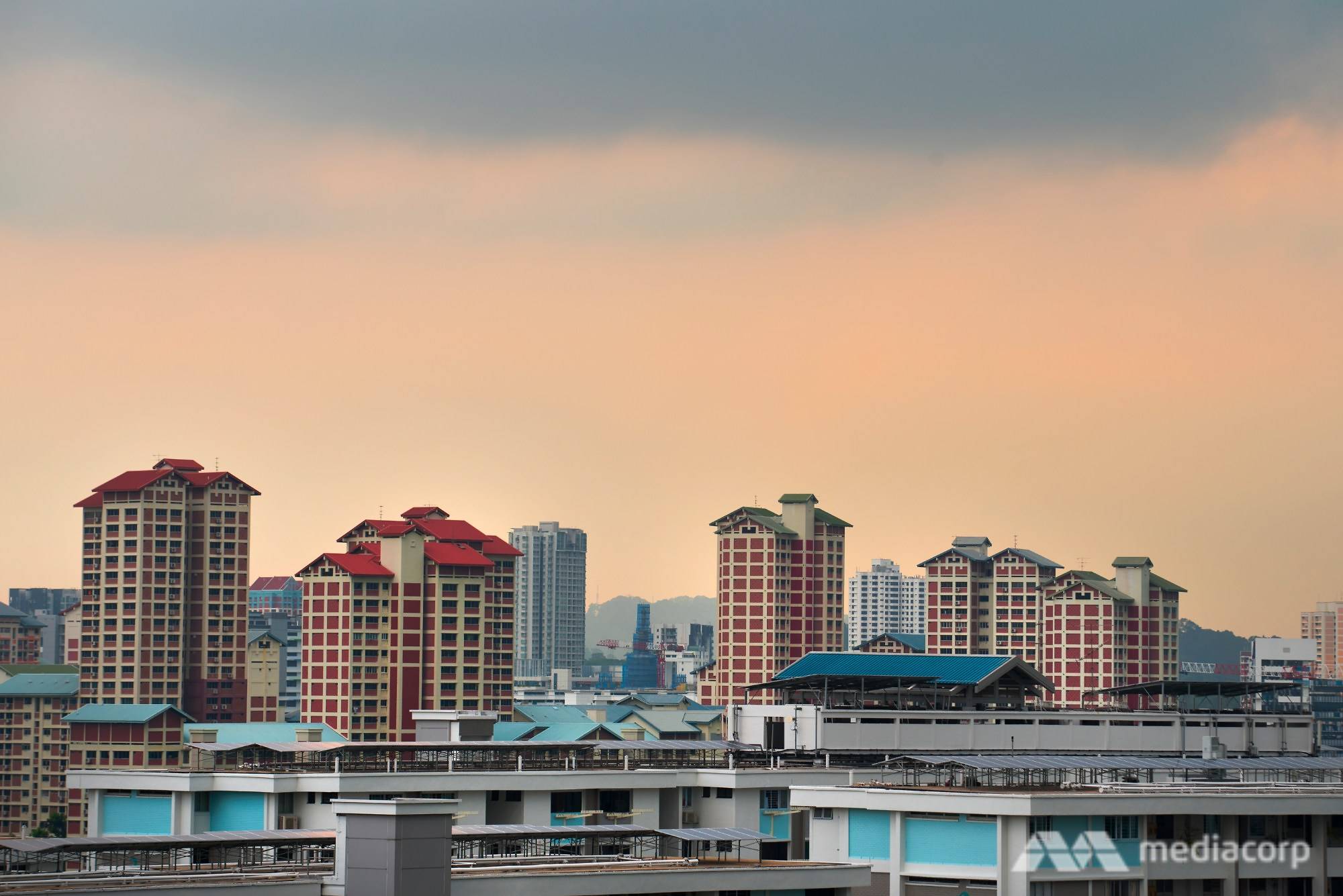
General view of HDB residential blocks against the Singapore skyline. (File photo: Jeremy Long)
The recent relaxation of the income criteria in the BTO market thus eases the squeeze on sandwiched households, giving them an option to buy a BTO flat.
Another group of households earning between S$14,000 and S$16,000, which make up about 6.8 per cent of households, will additionally have access to executive condominiums as a housing option.
IMPACT ON THE PRIVATE HOUSING MARKET
Since BTO flat prices have been delinked from resale HDB prices, will the recent policies create spillover effects in the resale and private housing markets? There are two competing hypotheses.
First, if households in the S$12,000 to S$14,000 income decile decide to buy a flat instead of a private home, demand for private housing will decline, putting downward pressure on private housing prices.
On the contrary, if the extension of the EHG to the resale housing market drives demand and pushes up prices of older flats in the resale market, this may motivate more HDB owners to sell older flats and upgrade to private houses. In this case, the EHG policy may have the effect of increasing private housing prices.
Regardless of the projections here, the housing market needs time to react to these policy changes and it will be premature to reach a conclusive outcome on their effects.
But historical data from the resale HDB price index and URA private property price index shows strong interaction between both markets.
First, short-term deviations in the two prices have seen correction in their long-term price trends.
Second, the private housing market tends to respond more quickly to such policy shocks, with the resale public housing market lagging behind.
KEEPING PUBLIC HOUSING ACCESSIBLE
The dual housing market model comprising a large regulated public housing market and a small private housing market has worked well to maintain a stable supply of affordable housing for Singaporean households.
It is useful for housing policy to keep up with changes in income, housing preferences and family structures to ensure public housing remains accessible to the broad middle.
Thus far, the Singaporean Government’s active intervention in recent years has proven that public housing can fill the gap that private housing does not meet.
Associate Professor Sing Tien Foo is the Dean’s Chair and the Director of Institute of Real Estate and Urban Studies, NUS
SINGAPORE: “Do you want to see my Goblet of Fire book?” Oliver Chua excitedly volunteers during an interview at his Tanah Merah home.
“It’s really mangled…it’s like you went to buy it after it was dug back up!”
Most 11-year-olds would be interested in showing off the newest, the fanciest and the best, but not Oliver.
He opts for secondhand books and toys – even if it means torn pages, missing arms and scratched paint.
“It’s very hard to read those books – sometimes you get one page torn out and there’s like all those drawings,” the Temasek Primary School student admitted. “Some people use correction tape and draw on the pages.
“Sometimes it’s even ‘third-hand’, if we really can’t find the books, worse comes to worse we go to the library and read them.”
The Primary 5 student goes through the hassle for one reason – he is deeply passionate about the environment.
One aspect of that means controlling the “temptation” to purchase new things and going thrift shopping instead.
He explained: “I would say the adjustment period is very hard and you always complain for the first few times. But now even if a toy is missing an arm or the control of a remote control car (is missing), we just pretend its battle damage or something.”
But the precocious Oliver isn’t just aiming to change his lifestyle or his family’s. Instead, he aims to spread his message of environmental awareness to the masses.
Just two weeks ago, he was the youngest of six speakers at the Singapore Climate Change Rally at Hong Lim Park.
“It was very overwhelming and I felt quite honoured because I was the first and youngest person to speak … Also I’m talking part in the first ever climate rally held in Singapore,” he recalled.
“There were people coming to me and saying that I did very well and that I spoke very well and there was this supporter who bought us a bunch of sunflowers and he gave them to me.”
“I’m doing what I think is right and I’m doing what I believe in, so there shouldn’t be people trying to stop me.”
Blue ribbons which 11-year-old Oliver Chua has received following speeches at the Mother Earth Toastmasters Club. (Photo: Matthew Mohan)
A POMEGRANATE PRIZE
Oliver’s interest in the environment was piqued almost two years ago, when he attended the Mother Earth Toastmasters Club, a group which organises monthly gatherings where members can speak on such issues.
“It was in December 2017 – the school holidays – we tried to engage him with different activities, a variety of outings, and we chanced upon the Mother Earth Toastmasters Club which was child friendly,” Oliver’s father Dr Steven Chua, an executive director at design company Kingsmen Ventures, told CNA.
Oliver’s mother Mrs Carol Chua, is an adjunct lecturer at Republic Polytechnic.
The topic of the day was about gifting and wastage, particularly whether there was a need for new gifts during Christmas, recalled Dr Chua.
“And we thought let’s for one evening listen to something different and very new for him. The main thrust was to expose him to new things … He went in, he sat and he listened intently. He asked to go back, so we brought him back again.”
As Oliver was underaged, he could not become a member of the group. Instead, Dr Chua signed up for membership and took Oliver along as his guest.
“After I attended the first few meetings, I listened in and understood. And then I realised that this climate change will affect the children the most,” shared Oliver. “Because most of the adults will not feel the biggest impacts of climate change and they may be gone by then. Therefore they don’t really give a lot of attention to it.
“We as children have to do our part for Mother Earth. I came back mostly because the climate change idea was new to me, I didn’t really understand it before so I wanted to learn more.”
And several months later during his fourth meeting, Oliver decided to give an impromptu speech of his own.
“I felt welcome enough and I also felt that I would like to try to do something,” he recalled. “I was quite worried that I might not say the right things or people may laugh at me but the Mother Earth Toastmasters Group is very friendly and welcoming, I was encouraged and I just did it – to my immense surprise.”
Blue ribbons are usually given out to the best speakers at the meetings – where individuals are assessed based on pause fillers, structure of speech and content among other things.
“The winners always get the blue best speaker ribbon, they only had one but they felt they had to encourage him so they went to the food table and they picked up a pomegranate and gave it to him,” said Dr Chua.
Oliver Chua speaks during the climate change rally at Hong Lim Park.
And Oliver hasn’t looked back.
He has gone on to speak to the group on a number of occasions, bringing home several blue ribbons which occupy a place of pride on the Chua family’s living room bookshelf.
“First I will jot down the points that I want to speak about or the message that I want to get across,” explained Oliver. “And then I will slowly use a bit of data or research, but sometimes I will also use my own experiences. When I’m done with the first few drafts, I will ask my parents to look through it.
“When we think it is good enough, we will print it out and rehearse many times.”
Oliver has gone on to speak at British bank Barclays’ staff luncheon and at the Singapore Press Holdings’ Earth Day event. He also gave a talk at a Singapore Environment Council event.
He said: “Every speech delivery needs practice and hard work, but sometimes when I’m trying to write a speech or thinking that I can’t really get the gist of the speech after I’ve written it – like I can’t memorise it – I’ll tell myself: ‘Look I’ve done it before and I surely can do it again.’”
Oliver isn’t merely interested in challenging adults to think about environmental issues – he brings the message to his peers too.
But it is not without some difficulties.
“They are focused on academia. Doing well, popularity, material things – like whoever has the newest stationery, whoever has the cleaner uniform. If I don’t bring it up, they won’t really talk about the environment,” he explained.
“Most of the time when I see them using disposables or single-use plastics, I will try and advise them next time not to. Some of them will just nod and say ok but the next time they will still do it – I think they do it to get me off their back.
“There are those that just don’t care – they will just say: ‘Aiyah, whatever la.”
Oliver Chua poses for a photo in his bedroom. (Photo: Matthew Mohan)
ALL TALK, ALL ACTION
Influenced by their son’s passion for the environment, the Chua family has followed suit by adopting eco-friendly practices.
The family not only buys at thrift shops, but also reduce food wastage by being intentional in finishing all their food.
“We are exposed to thrift shopping, but we are more conscientious that if there are reasonably usable things out there, because it’s already produced, we can buy them instead of buying new things,” said Dr Chua.
On weekends, the family often opts to take a 20 minute walk to the MRT rather than take the car.
“I have noticed that my parents, my relatives especially the closer ones have been trying to BYO (Bring Your Own) wherever they go and reduce their disposals like single-use plastics,” added Oliver. “I feel very encouraged and it drives me on to do more and encourage more people to change.”
Calling his son a “maverick”, Dr Chua explained that Oliver’s approach is a more “balanced” one as compared to young climate change activist Greta Thunberg.
“As compared to Greta, his approach is more balanced – that we do our little part,” he said. “His message is that if everyone were to do their little part, we can have an impact. It’s not about being revolutionary, but slowly we evolve.”
“As parents we support whatever the child finds joy and is passionate about,” added Dr Chua. “That’s the best way and it’s a win-win, because whatever he does, he will go all out to excel and in this case, do something for the greater good of society.
“We feel proud, we feel good that he can possibly can bring good when his time comes to himself, his generation and future generations. We remain supportive.”
Before the hour-long session with Oliver draws to a close, it is time for the articulate 11-year-old to pose for some portraits.
The blinds have been shut, leaving his bedroom rather dim. So the idea of switching on the lights is quickly floated.
But true to form, Oliver is mindful.
He pipes up politely: “Can we use the natural light instead?”
SINGAPORE: Seven Singaporeans were among 13 climbers rescued from Mount Raung in Indonesia on Saturday (Oct 5) after they were trapped overnight by forest fires.
The hikers became trapped after forest fires broke out in the area around 6pm Indonesia time on Friday, making the paths inaccessible.
Indonesia’s National Disaster Management Authority told CNA that a joint search and rescue task force of 25 men was sent to rescue the group on Friday night.
The 13 hikers were evacuated on Oct 5, 2019. (Photo: Twitter/BASARNAS)
In addition to the seven Singaporean hikers, the group comprised two guides, two porters and two Indonesian climbers, Indonesia’s National Search and Rescue Agency (BASARNAS) said in a statement.
Before the evacuation began, rescue personnel gave medical assistance to several hikers who had sustained mild burns and abrasions. The hikers were also given breakfast and opportunities to rest, the agency said.
Further medical checks were also conducted after the evacuation was completed.
A hiker receives medical treatment. (Photo: Twitter/BASARNAS)
The seven departed for Surabaya around 2pm Singapore time on Saturday are expected to arrive in Singapore in the evening.
SINGAPORE: Two men were caught trying to smuggle 2,500 cartons of contraband cigarettes into Singapore by concealing them in wooden planks, the Immigration and Checkpoints Authority (ICA) said on Friday (Oct 4).
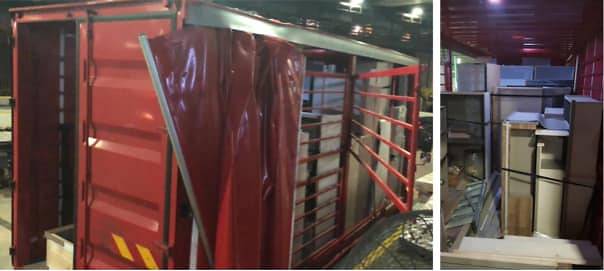
A Malaysia-registered lorry was stopped for further checks at the Woodlands Checkpoint on Tuesday after ICA officers noticed anomalies in the scanned image of the consignment.
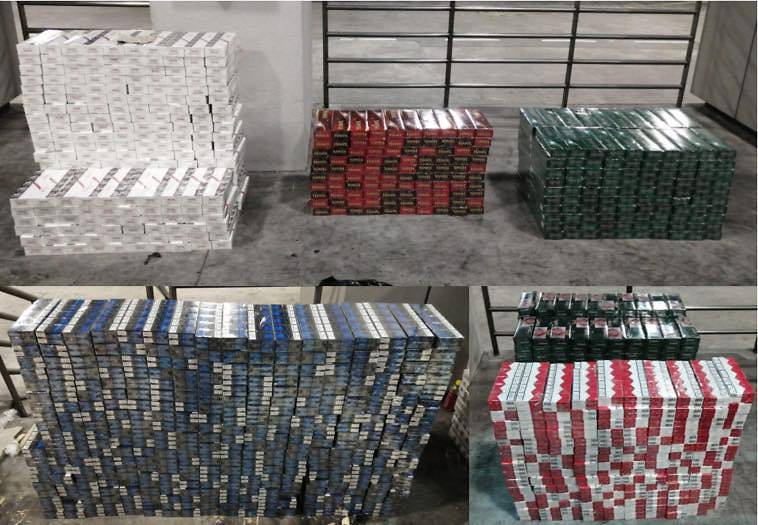
The checks revealed 2,500 cartons of duty-unpaid cigarettes hidden in the wooden planks.
Two Malaysian men, aged 38 and 19, were referred to Singapore Customs for further investigation.
The lorry is also liable to be forfeited, said ICA.
The lorry used to convey the duty-unpaid cigarettes. (Photo: Immigration and Checkpoints Authority)
“This method of concealment is a cause for concern as similar methods may be used by people with ill-intent to smuggle security items into Singapore,” ICA said.
This incident is the latest in a string of contraband cigarette smuggling attempts in recent weeks.
A total of 2,500 cartons of duty-unpaid cigarettes were retrieved from the Malaysia-registered lorry. (Photo: Immigration and Checkpoints Authority)
In four separate cases between Sep 9 and Sep 20, ICA officers found hidden cigarettes on three Singaporeans and a Russian.
The four men, aged between 28 and 64, had hidden the cigarettes underneath their clothes, inside the socks and boots they were wearing, as well as around their waists and ankles.
SINGAPORE – Two children were among those taken to the hospital following a chain collision on the Pan-Island Expressway (PIE) on Saturday afternoon (Oct 5).
A video of the accident circulating on social media shows at least six cars stalled on the rightmost lane of the expressway following the accident. Most have their front or rear bumpers mangled.
The Singapore Civil Defence Force said that it responded to the accident, which took place along the PIE towards Changi, around 2.15pm.
Two children were taken to KK Women’s and Children’s Hospital, while four other people were taken to Tan Tock Seng Hospital.
The Straits Times understands that they were all conscious at the time, and that their injuries were not severe.
Two other people declined to be taken to the hospital after being assessed by paramedics.
ST has approached the police for further information on the accident.
SINGAPORE – Three people were evacuated and one taken to Singapore General Hospital after a fire broke out at a Jurong East coffee shop on Saturday morning (Oct 5).
Footage of the incident circulating online shows black smoke billowing from the windows of a first floor coffee shop as firefighters tackle the blaze.
The Singapore Civil Defence Force (SCDF) said it was alerted to the incident, which took place at Block 346 Jurong East Street 31, around 8.05am.
The fire involved the contents of a kitchen in a coffee shop and was extinguished by SCDF using three water jets.
Three people had to be evacuated from a second-storey residential unit above the coffee shop.
The Straits Times understands that the person taken to hospital was in a stable and conscious condition.
The cause of the fire is under investigation.
In a Facebook post on the same day, MP for Yuhua Grace Fu said that the grassroots would provide necessary assistance to affected residents, and that agencies would be working to assist the affected stalls.
SINGAPORE – The police said on Friday (Oct 4) that they are investigating a Telegram chat group suspected of sharing obscene photos and videos of Singaporean girls after reports were lodged by some of the victims.
The photos allegedly include upskirt photos.
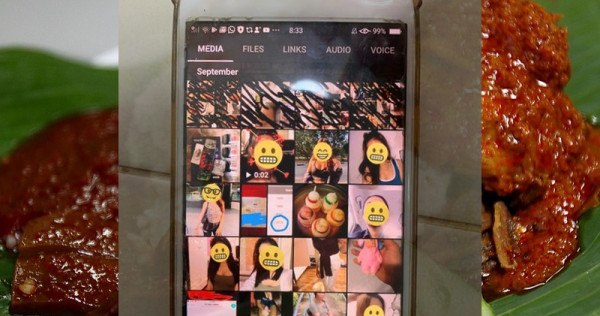
The chat group under investigation, “SG Nasi Lemak”, is no longer accessible, although screenshots seen by Chinese evening daily Lianhe Wanbao show there had been more than 44,000 members when it was still active.
According to a reader Wanbao interviewed, the group had been set up for more than a year, but its membership had spiked in recent months with more people coming to know of it.
Those interested in gaining access to the group would pay $30 as an “entry fee”.
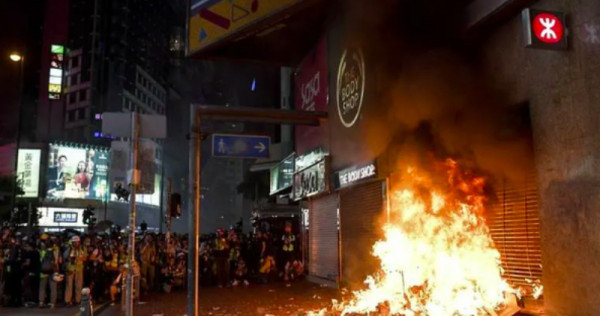
HONG KONG – All train services in Hong Kong including the line to the airport were suspended on Saturday (Oct 5), the city’s rail operator said, after violent clashes between police and pro-democracy protesters saw subway stations vandalised.
“All MTR services covering the Heavy Rail including Airport Express, Light Rail and MTR bus cannot be resumed this morning,” the MTR Corporation said in a statement, AFP reported.
“After the outbreak of violence at multiple districts, maintenance staff has to make sure of their own safety before they could travel to the damaged stations to inspect and assess the extent of damages at our stations, and to carry out repair works,” the statement said, adding that the closure would be reviewed later on Saturday.
Bus services running in the morning may be diverted due to road conditions after more than 100 sets of traffic lights were damaged or tampered with on Friday night, Bloomberg reported.
SINGAPORE: For the past nine years in my research on religious practices in Singapore, I have noticed the growing use of media and digital technology.
Many Chinese temples have become attuned to social media, setting up their own Facebook pages, and employing digital technology, from selling recordings of their festivals on DVDs, to flying drones over the heads of their devotees and curious onlookers as they film the temple’s processions.
It was once important to veil altar spaces or effigies with yellow cloths as a mark of respect for their sacredness.
That has now been replaced in some cases with the use of video cameras to document the space and the spirit possessions that take place. Devotees can also upload and share videos of these private rituals online with the internet.
Many religions also live-stream rituals and religious events through Facebook and YouTube. The Hindu Endowments Board, for example, has in recent years provided live-streaming of key Hindu processions such as the annual Fire Walking Festival.
Religious practices once unseen and even unheard of, are now actively showcasing their events and rituals. Spirit mediums are now posing for the camera before carrying out divine interventions and rites.
As religion meets the digital, this has profound implications to how we relate to our religious beliefs, gods, and fellow believers.
Religious groups in Singapore are acutely aware of the possibilities new technologies bring.
For one, many religious institutions and leaders now have a significant digital footprint across many platforms where followers can connect with them.
Devotees offer their joss sticks to their god, then, brandish out their camera phones and keep copies of their god. (Photo: Alvin Lim)
Christian pastors in Singapore also have a prominent online presence since the advent of online social media, first with Twitter and Facebook, and now Instagram.
They have also learnt how to use Instagram Stories to deliver bite-size messages, promote longer recordings of sermons and share news, photos and videos of the missionary work that they do around the world.
New media has refreshed popular forms of religion in Singapore, involving the younger generation in promoting, documenting, and learning from their elders the ways and practices of their religion.
Involving the young have in turn helped religious practices and traditions to be refreshed and adapt to new technology, ensuring that religion remain relevant. As a result, gods and religious leaders are now more accessible to their devotees.
SHARES SPACES, SHARED GESTURES
Still, not everyone is comfortable with the proliferation of technology in our sacred spaces. For many, technology cannot replace the face-to-face and their relationship with their gods.
For others, technology can facilitate other forms of interaction that builds relationships and affirms their commitment to a community.
We are likely to find that both can co-exist in a diverse religious landscape. In the last few years, when visiting a religious festival at the temple, I have observed many devotees raising their camera phones in unison to capture an image of their god.
While the offering of joss sticks may be the main gesture done in honour of a deity, for some, this is quickly followed by a photo-taking gesture to commemorate the act.
This simple transition from tradition (offering of joss sticks) to remembrance (whipping out our smartphones) expresses a novel way in which we maintain a connection with a divine being.
The local getai host, Wang Lei, interacts with popular Taiwanese comedian and television host, Hsu Hsiao-shun during a getai performance. A large screen is placed at the entrance of Lorong Koo Chye Sheng Hong Temple for audience members who were not able to find a seat near the stage. (Photo: Alvin Lim)
In some ways, this is not new, at least for popular Chinese religion, as devotees have also carried home talismans and amulets from the temple in the past, to take a piece of the divine back with them.
CONNECTING A COMMUNITY
A getai performance at Sheng Hong Temple I attended shed light on how technology can bring big religious communities together.
Unable to get into the performance space to watch the getai show, the crowd spilled onto the driveway just outside the temple and stayed there for hours, standing and watching the screen which showed the performances.
The Taiwanese celebrities invited to the show no doubt played a part in drawing in the crowds, but it is telling that a screen had such magnetic power.
In so doing, the audiences shared a moment together, their gaze held by the events unfolding on the screen.
This happens in secular performances and concerts too, where we might prefer to focus on the large projection screens because it is impossible for us to see the facial expressions and actions of the performers from our seats.
What the use of technology for religion shows us is how much we strive to connect with the unseen. Media technology allows us to overcome uncertainty and distance.
After all, a religious experience need not be confined to an altar or sacred space, but can happen through our everyday interactions with technology.
WIDELY DISSEMINATED MESSAGES
There is no doubt popular religion in Singapore has now extended to the digital space and become more public.
There is, however, a flipside to this as religion online shares this virtual space with other forms of social media — videos, tweets, songs played from Spotify, Instagram stories, Snapchat notifications, gifs and memes shared across WhatsApp, Facebook messenger or Telegram, Tik Tok notifications, emails, pop-ups, and advertisements of a product that you may have been browsing on Shopee.
The effect is religion can be outsized by the other distractions on social media, given the Internet’s expanse and 24/7 work email at your fingertips, vying for your attention.
Just as technology has powered religion, the smartphone has also brought life’s other priorities into the houses of our gods.
GUARDING AGAINST INTOLERANCE
The risk however is also that this same digital space can be a site for bigotry and religious intolerance, accentuated by falsehoods and “fake news”—a term that has perhaps become too quickly used to label any news that do not align to our beliefs and expectations.
This calls for added vigilance — not everything shared on WhatsApp, for instance, is real or had happened in Singapore, as the recent photograph of a falling roof mistaken to have happened at Changi Airport Jewel shows.
As a society, we have much to learn to manage our digital spaces, be more discerning of sensationalist messages we receive, and more responsible when connecting with others.
Sometimes, we may be too quick to hit “send” and “share”.
Our unique multi-religious landscape can be easily threatened by an over-zealous spread of an ideological message that undermines the social cohesiveness we have tried so hard to forge.
When we create multiple versions of ourselves on different social media platforms, it can be easy to passively divorce ourselves from the need to be responsible for our thoughts and actions, and mindful of how they may come across to others.
Gods do not yet have their own social media profiles but as their stewards, there is just that ethical responsibility to represent them.
Alvin Eng Hui Lim is Assistant Professor at the National University of Singapore Faculty of Arts and Social Sciences, where he does research on local religious performances and the use of digital technology in religion and theatre.
SINGAPORE: He stood frozen in the toilet for up to five hours at a go, often walked an overhead bridge backwards and found comfort opening and closing the refrigerator door repeatedly for hours.
These are the memories that Evelyn Chng and Tony Kee have of their son’s childhood.
Evelyn and Tony first noticed something was amiss in 2011, when they received a memo from their eldest child, *Bruce’s (not his real name) Mathematics teacher about him not handing in eight weeks of homework.
Tony had wondered if his 14-year-old son – who was exceptionally skilled at Math – was struggling under the stress of his Triple Science course or his experience being bullied a year ago. Concerned, he looked for Bruce’s school bag.
“I discovered the question papers, all crumpled inside. That’s when I realised that something was not right,” the 51-year-old recounted.
For the next two years or so, the Kees watched as their usually happy-go-lucky and active child became increasingly reticent and withdrawn. Bruce, who used to place in the top 10 per cent of his cohort, started to become untidy and fall behind in school. as well.
Just months before he was due to sit for his O-Level examinations, he was diagnosed with Obsessive Compulsive Disorder (OCD).
OCD is a mental health condition that makes it “difficult for individuals with the condition to process information”, says Haanu Prithivi Raj, senior clinical psychologist at the Institute of Mental Health’s (IMH) Department of Child and Adolescent Psychiatry.
“Having OCD is similar to having a broken filter or sieve in the brain. When the sieve works, the brain is able to ignore intrusive thoughts (that do not make sense) that we all have. However, when we have OCD, the sieve or filter is broken or torn and hence these thoughts fall through and this causes distress to us as we are not able to ignore these intrusive thoughts and fears anymore,” Ms Raj told CNA.
While there is not much data on OCD in Singapore youth, Ms Raj estimates it could affect up to 4 per cent of youths here, which is almost double the global prevalence of 2 to 3 per cent. From 2014 to 2018, the IMH Child Guidance Clinics saw an average of about 130 children and adolescents aged between 6 to 18 years old with OCD.
When Tony and Evelyn received the diagnosis, they didn’t know what to do.
“We thought that it could be treated,” recalled Evelyn.
“We thought OCD could be fully recovered from – with everything reset back to normal,” Tony said.
Then, Bruce started to display compulsions during his first semester in polytechnic.
“By 17, his condition was already severe. He would keep going in and out of the classroom doors during class because of anxiety,” said Evelyn.
Both parents recall having to wait hours in the school’s carpark as their teenage son flitted in and out of his empty classroom in a deserted school. Because they had no access to the school’s facilities, they sometimes had to enlist the help of a security guard to escort their son down.
Bruce also began calling his mother from the canteen every day to help him decide what to eat. Once, he called her to ask if he could bring an empty wrapper back.
“He couldn’t seem to make decisions. His decision-making was affected,” said Tony, who works in the financial services sector.
At home, Bruce would spend several hours in the toilet after a shower, standing in one spot as if frozen in time.
When he was ready to exit the toilet, his family was forced to rearrange the house to the state it had been in before he entered hours earlier, or else, he could not bring himself to enter an environment he perceived to have no control over.
Bruce would stand in the toilet for hours without moving as he attempted to complete his OCD rituals. (Illustration: Kenneth Choy)
This daily occurrence meant having to switch off all the lights and gas and wait around, even if the family happened to be preparing dinner at the time.
These rituals were a way for Bruce to relieve his anxiety, Evelyn, 49, explained.
Whether it is counting or what, he will have to do whatever feels right. If he doesn’t count properly to relieve the anxiety, then he will feel like it is incomplete. Once he does complete it, he releases his anxiety and everything goes back to normal.
“OCD MANIPULATES THE WHOLE FAMILY”
Even though they were hoping it was just “a passing phase of puberty”, the Kees brought their son to a temple where they were told to perform rituals to rid him of “spiritual possessions” and “bad luck”.
“It’s that thing when you’re hopeless and confused and everything people say, you just believe. You just grab it,” said Tony with a wry smile.
“It was so bizarre that we could not even try to understand. We were trying to see what we could do to help him because … he had just changed into another person,” Evelyn said.
Things soon came to a head in 2014 when Bruce was asked to leave his diploma course after his first year of study due to poor results. Hospitals they had applied to for treatment also rejected him due to the severity of his condition. Evelyn suffered two breakdowns and had to be hospitalised, she said.
“I was under too much stress … I had a panic attack because of his rituals. It affected the whole family because we had to try and manage his anxiety,” Evelyn recounted quietly.
Back then, she was acting as caregiver to her mother with dementia as well.
“I felt like an octopus. I didn’t know what to do. I didn’t know what to handle and what came first. I didn’t know how to manage.”
Bruce also didn’t allow the family to eat in the kitchen or talk at home as it made him anxious and affected the rigid rules and order he expected himself and others to abide by.
He also targeted his younger sister whom he couldn’t stand the sight of, once going so far as to impede her from going to the toilet for several hours when their parents were out.
Soon, Bruce began demanding that his mother helped him with some rituals, such as the opening and closing of the refrigerator door.
“I was being sucked into his rituals. My husband tried to intervene and I got sandwiched in between trying to manage his anxiety and not participate,” said Evelyn.
“When he got tired, he would ask me to complete the ritual and I had to do exactly as instructed. He would beg me saying ‘Please mummy, last time, last time’ when I refused. He would also shout and yell.”
Evelyn often attempted to remove herself from the situation. In the middle of the night, she would walk out of their home and sit at the staircase landing.
To remove herself from participating in Bruce’s OCD rituals, Evelyn would oftentimes leave the house in the middle of the night to sit at the staircase landing. (Illustration: Kenneth Choy)
“He would try to stop me from leaving – which stopped him (doing his rituals) … and sometimes, I would end up dozing off because I had to sit there for one to two hours while waiting for him to calm down,” she said, grimacing.
“It was painful, but I had no choice.”
Dr Adrian Loh, visiting consultant with the Department of Child and Adolescent Psychiatry at IMH explained that children and teens suffering from OCD frequently display compulsions such as touching certain objects in a specific pattern, or having to say things in a certain way, without understanding why.
“In some of these cases, all they can explain is that this just ‘feels right’, leading to much parental frustration. In some cases when sufferers are unable to obtain relief from overwhelming anxiety and discomfort, they may even end up with rage attacks which can be misunderstood as misconduct by family members,” added Dr Loh.
“IT WAS HELL. IT WAS HELL”
Dealing with a child who had to perform rituals at the expense of the family’s peace meant several clashes and fights within the family.
“The police have come (to the house) so many times that we can apply to be VIP members,” joked Tony.
“Sometimes, it was us who called. And sometimes, it was the neighbours from the opposite block who called because … of the serious fights. It was too stressful and my daughter and I would get very scared when they fought as they would throw things here and there,” Evelyn said.
Tony and Evelyn were also at constant loggerheads due to the mounting stress.
Said Tony: “It’s like … as a man, in the office, you can solve an issue. But you can’t even bring your child from the toilet to the bedroom. It’s just a short distance but you can’t do it, you know? The frustration was just too much,” he said.
At their lowest, the couple who have been married for 25 years, briefly considered ending it all.
“It was hell. It was hell,” said Evelyn.
We even thought of ending our lives that time. We couldn’t take it, because we were actually feeding his OCD. He was also refusing to seek continuous treatment with the psychologist so we were at a loss because we didn’t know how to manage.
At their lowest, Bruce’s parents briefly considered ending it all. (Illustration: Kenneth Choy)
Father and son stopped speaking to each other, and Bruce began to regard Tony as an enemy.
Not even extended family were privy to the situation and the Kees suffered in silence as both parents feared the stigma young Bruce would face if people found out he had a mental condition.
Neighbours started giving the family the cold shoulder on account of Bruce’s odd behaviour in public. They had spotted him walking backwards on roads and overhead bridges, or pacing up and down in nearby bus stops for hours.
“Once, we tried dragging him home, but he went back to the place because he had to complete his ritual. (At home), whenever we tried bringing him from the toilet to his room, after we turned off the lights, he would come out and go to the toilet and finish his ritual then go,” said Tony.
Oftentimes, when he was coming home, Bruce would stop just shy of his front door to perform a mental ritual that would have him wait outside for one to two hours while his family waited inside, unable to leave.
THE TURNING POINT
A turning point came in 2015, three years after Bruce was diagnosed. Tony recalled being in a heated quarrel with Bruce one night when the elder Kee’s cousin – who was called in for help – walked into the house, demanding to know: “What happened again this time? Why again?”
“When I heard her saying it like that, I told myself I need to make some changes, otherwise one day, even your own cousin will not come and help you anymore,” he said.
The realisation drove Tony and Evelyn to begin searching for support groups. They attended an OCD seminar at IMH where they came across Caregivers Alliance (CAL) which helps caregivers of mentally ill people.
“We began attending their classes and from there, it started to change our perception,” Evelyn said. “We got to hear other people’s stories when they shared. We learned about how to journey with them, the symptoms itself and working closely with the medical team. (This) really helped us.”
Around the same time, Bruce was accepted by IMH for treatment and his parents picked up skills on how to reinforce those messages at home.
“I tried to find out how I could actually support him at home – how to not reinforce his behaviour and participate in his rituals at home,” said Evelyn. “They used Exposure Response Therapy (ERT), so at home I used other forms like daily chores or daily routines to build back his confidence and self-esteem.
“Because of his OCD, he was very good at cleaning, cutting vegetables – so I would ask him to do that for me. After that, I started to look at his strengths. If he could do (a task), I would tell him, ‘Thank you son for helping me with this’.”
“After that, he started to change and we could empathise with what he was going through. We were no longer fighting,” she added with a smile.
For Tony, the courses helped his wife and him to develop a “common language” that helped them at home when caring for Bruce.
“In the past, she had her method and I had my own method and we always clashed. So going for the courses helped us a lot,” he said.
JOURNEYING WITH OTHER SILENT SUFFERERS
Motivated by their breakthroughs, Tony and Evelyn began volunteering with CAL, conducting training for other caregivers in Mandarin.
“Along the way, things got better and better,” said Tony.
In class, caregivers marvelled at the pair’s experience dealing with their son’s OCD and Evelyn’s mother’s dementia.
“They asked us: ‘Eh? How come you look healthy?’” laughed Tony.
“That’s how people viewed us,” said Evelyn. “We were a source of inspiration, a source of hope.”
Encouraged by the results, Evelyn left her job in retail pharmacy to join CAL as a caregiver support specialist.
She and her husband also signed up for an 18-month-long graduate diploma course in counselling and psychology, which allowed them to become counsellors with CAL. They now hold three-hour classes for caregivers in Mandarin every week. When this reporter sat in for one of their classes, the pair was engaging and jovial, often joking to keep things lighthearted.
“We wanted to help those walking the same journey as us. Patients themselves may be in denial because they don’t have much insight. The family members might feel that it’s okay la, just cope and live with it. But it’s very difficult – it will get worse, and not only that, it will disintegrate the family,” said Evelyn.
Looking back, Tony admits he wouldn’t have considered volunteering if not for years of struggle with Bruce and his mother-in-law’s situation. “I took it as a lesson that I needed to go through to learn from it.”
Perhaps most surprising is that Bruce himself, now 23, recently joined IMH as a full-time peer support specialist, egged on by his mother.
“I told him: ‘Since you’re recovering to a stage where you are more stable, what do you want to do? What do you want to move on to in life? Work or study?’ So when the National Council of Social Service offered this course, I actually encouraged him to go for it,” Evelyn said.
“On the first day, he was five minutes late, but from the second day onwards, he was half an hour early and even volunteered to leave the house early,” Tony said.
He and Evelyn were soon amazed at the transformation in their once-incapacitated son.
“I encouraged him to view his illness in a different light and he began to realise that there were so many people walking a similar journey. His view and perception of his peers, mental health and people with similar conditions really changed then,” Evelyn said.
She was overjoyed when Bruce told her: “Mummy, I am happy you know”, when he came back home after work.
“Along the way, he told me: ‘All of us have gone through a certain kind of abuse for our mental condition and there are so many people out there who actually need support in health’ and that he wanted to thank his psychologist and psychiatrist for helping him to achieve what he is today. He had never thanked them until that moment, but after the course, he had learned to appreciate them, and I remember thinking ‘Wow’,” Evelyn said proudly.
“Now he is able to advise me on what kind of therapy to give his por por (Mandarin for grandmother) and how to speak to her. There is a drastic change and we can see that he is going back to what he used to be – a very lovely, kind and helpful boy,” she said.
Still, they understand that Bruce’s mental illness is a life-long journey.
“Of course, now he may be coping well, but in the future we don’t know. It’s still a lot of uncertainty, but we can only be hopeful and be positive,” said Evelyn.
“We told him that ‘This is meaningful, and you’re creating value with your life, and that is all that is important – you don’t need to have very high qualifications to live that type of life … you’re actually giving hope to others that recovery is possible and your loved ones can be treated. That is the satisfaction.’”
***************
CNA spoke to Bruce about his experience with OCD and this is what he shared with us:
What is your OCD based on?
Bruce: For me it’s checking and mostly I have to do things right. I have a particular way (of doing things) that is correct that I have to do. It’s based on my own logic.
What kind of rituals are involved?
Bruce: Like there are things that I need to place in certain areas of my house. And when I do things, I sort of plan them out in my head before I do them – there’s a certain order.
What happens when it doesn’t fall in that order?
Bruce: Then I will feel like very stressed out, because I had already planned out everything nicely in my head. I’m very aware of how people view me. Even if people aren’t judging me, I have that feeling that people are judging me.
What kind of rituals were you doing in the toilet?
Mental rituals. After bathing, I do my mental rituals inside my mind and they mostly involve counting and running through all the steps and all the things in my head. The steps are mostly related to showering. I’m just usually slowly moving through the steps. And I’m also trying to sort out all the things in my life, because in the toilet I feel more comfortable. After bathing I’m very relaxed, so I just sort like staying in there. So I’m done with my shower already when I do the rituals, I just want to stay in the shower.
Your parents said after you come out of the shower, the surroundings have to be the same.
Yes, because I sort of feel like things are moving around without me – it’s like I didn’t have a feeling of control over the moving things. I need everything to be in the same place because I want to feel a sense of control.
How are you learning to cope with OCD now? How are you living with the anxiety?
What I do now is mostly keep myself engaged … like do things. Even if I’m at home, I’ll be surfing the Net, or finding something to do to keep my mind occupied to distract myself. Because if I don’t do anything, I tend to think a lot. Because my normal state is picking on all the details where I am very aware, I’m hyper-aware.
So I know that if I don’t do anything, I will go back to that state and nitpick on everything happening around me. I know that that is actually not good for me and it would make me go back to past habits so I try to focus on what the ERP (Exposure Response Prevention) taught me – which is keeping myself occupied.
Between graduating from therapy and now, have you ever felt the need to perform your rituals creep up on you?
Yes, when I started work, I did. Because working needed me to go back to work the next day. But now it is more controlled – I can sort of resist it even though I still had the urge to do (the rituals). I try to distract myself, mostly.
It has helped me to be more spontaneous also. Because of doing things that are sort of losing the control already so I’ve gotten used to it and I start to feel more at ease with just suddenly doing things instead of overplanning and making sure that things go a certain way. Now I am more able to just react as things happen.
Your parents took up a lot of courses and studied to walk on this journey with you and today they are helping caregivers. What do you think about what they have done?
I think it’s a good thing because they help others. It’s because of my mum taking part in this caregiver thing that she made me go for the sessions and that made me more aware that I wanted to help people also. After I went for the sessions then I started to want to help out with peer support. I was inspired when I saw my parents teaching others.
I am grateful that they took those steps to help me. They were my pillars of support as well as my psychologists … they were not ostracising me.
What has it been like as a peer support specialist for the past three months?
I feel like it’s a good thing, even though it may not seem like a good job in the eyes of the public. I feel like it makes me able to do things. It is meaningful and it’s something that I want to wake up and do. It’s not like some jobs where you have to drag yourself to work because this environment is quite good I feel. The people are nice and I feel very at ease. I work with a multi-disciplinary OCD team where I’m the only PSS.
What is a regular day like for you?
Because they don’t want to rush me through, I only currently have a few patients that I’m working with. I either talk to them over the phone or if I can meet them face-to-face, I’ll meet them face-to-face and just talk to them. It’s quite simple, it’s just befriending and just being yourself.
Have you met any patients who are in the same place that you once were?
Yes, some bits, but not exactly the same. Certain parts when I hear more about their personality, I can relate. If they are perfectionists, I can sort of relate that I’m also like that in a certain way. I can use my experience to talk about how I would react to and how I apply and handle certain things.
I think doing this helps me in my own recovery because I go back home and reflect on it and it becomes more instilled in myself that I did go through this and I’ll remind myself that I should not (go back to that).
What is one piece of advice you would give a youth who has OCD?
They must be willing to seek help, because for me at that point, I didn’t really accept that I had OCD. I think awareness … being aware of it is quite hard. For me, I didn’t have awareness but my parents sort of forced me to seek help, so I sought help.
If you have a feeling that maybe things are not really right, try to seek help and be willing to receive therapy, treatment and medicine. I think one thing that stops people from recovering is that a lot of the patients with OCD, if they aren’t being forced to receive help, they won’t want to seek help – they think that there is nothing wrong with them.
For me, I also thought that way. I thought: “I’m normal, what. OCD is just some doctor’s label”. Spending 4 hours in the toilet … To me, it was not illogical in my point of view. I just thought that it was my way of doing things. It didn’t occur to me that it was OCD. I just thought it was my personality.
OCD is highly treatable. You have to be conscious of what OCD is like so that you know if you have some traits that start to affect your life, then you have to be willing to seek help. It’s not the end of the road if you are diagnosed with OCD.
*Bruce’s name has been changed to protect his privacy.