SINGAPORE: From April 2020, all e-scooters will have to undergo inspection every two years to ensure that they comply with the criteria for use on public paths, said the Land Transport Authority (LTA) on Monday (Oct 7).
This comes after Senior Minister of State for Transport Lam Pin Min announced in August that all e-scooters will have to go through a mandatory inspection. The inspections will check for UL2272 certification, width, weight and device speed limits.
“These are part of a series of measures to improve public safety,” said LTA in the media release.
LTA said that it will schedule free inspections for e-scooters registered before Apr 1, 2020 and were declared as UL2272-certified.
Owners of these devices will receive a notice from LTA informing them to bring their devices to one of the inspection centres.
“Those who fail to send their devices for inspection by the stipulated deadline could face a fine of up to S$1,000 and/or jailed up to three months, if convicted,” said LTA.
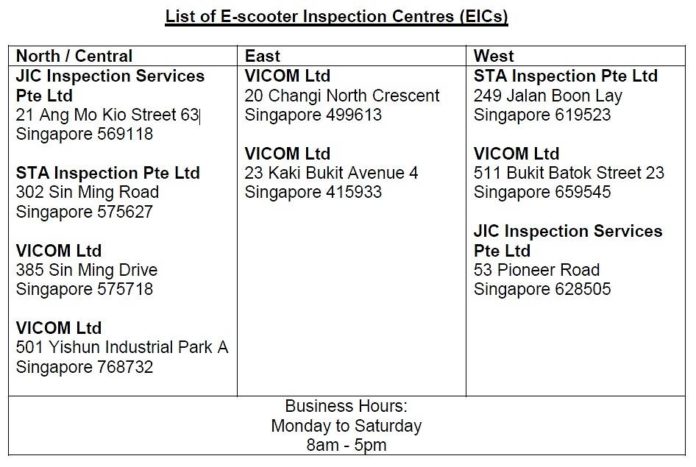
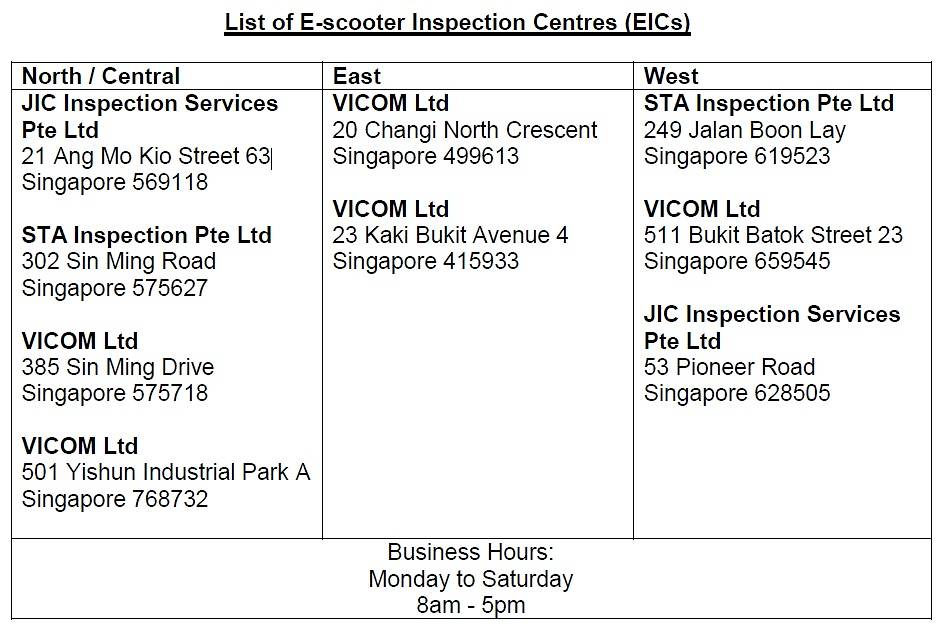
List of E-scooter Inspection Centres (EICs). (Source: Land Transport Authority)
Devices that are UL2272-certfied but do not comply with weight, width and speed requirements during inspection will have their registration cancelled by LTA.
From April next year, all new e-scooters will be required to pass the inspection before they can be registered for use on public paths, said LTA.
“Retailers and businesses will only be able to display, sell or lease devices that have passed the inspection and bear the requisite registration mark,” it said.
Those found guilty of riding an unregistered e-scooter on public paths can be fined S$2,000 and/or jailed up to three months.
It is also illegal to ride non-compliant e-scooters on public paths. Offenders can be fined S$5,000 and/or jailed up to three months.
In the release, LTA said it was also studying upstream measures to tackle the issue of non-compliant Personal Mobility Devices (PMDs) more effectively.
“LTA is also reviewing the penalties for illegal modification of PMDs and other offences, and will not hesitate to come down hard on users who flout the rules flagrantly and endanger the lives of others.”
SINGAPORE – Scenes from the past and present lit up the Istana’s facade on Sunday (Oct 6) night in a light show that narrated the story of the building’s 150-year history.
The show was one of the highlights of the Istana 150 Commemorative Event, which saw 2,000 people flocking to the presidential residence, the first time the building has been opened to the public at night.
Hosted by President Halimah Yacob and her husband, Mr Mohamed Abdullah Alhabshee, the event marked the finale of a year-long commemoration of the Istana’s 150th anniversary.
Madam Halimah expressed her delight that many Singaporeans were able to join in the event, saying: “Many shared with me that they especially enjoyed the light show, as it was a rare opportunity to see the Istana all lighted up at night.”
She added: “I thank Singaporeans for their warm support of the series of commemorative events and activities held over the past year. I hope that they managed to learn more about the history and heritage of the Istana, and in that process better appreciate our Singapore story.”
Football fans in Singapore were left upset on Sunday night (Oct 6), with Singtel’s streaming app Cast facing issues again, for the second night in a row.
In a Facebook post at 9.22 pm, Singtel said: “We are aware that some customers may be experiencing difficulties accessing the Cast app. Please bear with us as we work on resolving the issue. Thank you for your patience.”
In an update at 9.45 pm, Singtel said the issues had been resolved. It did not give a reason for the disruption.
09:45 PM Update
The issues with the CAST app have been resolved. We sincerely apologise for interrupting your viewing…
SINGAPORE – The Online Citizen and its editor have published an article and a Facebook post on the fake news law which contain falsehoods, the Ministry of Communications and Information (MCI) and Ministry of Law (MinLaw) said on Sunday (Oct 6).
MCI said in a post on its Facebook page that the post by TOC’s chief editor Terry Xu and the article on TOC’s website, for example, “incorrectly assert that ministers can use the Protection from Online Falsehoods and Manipulation Act (Pofma) during the elections to restrict and curtail online content”.
“The Act states that for the entire election period ministers cease to exercise their powers under Pofma. Instead, senior civil servants are appointed as the ministers’ alternate authorities for the election period,” said MCI in the post titled MCI and MinLaw clarification on Terry Xu’s FB post and TOC article.
“The robust safeguards on the use of Pofma will continue to be in place during the elections. It is disingenuous to talk about the need for voters to know ‘what actually happened’, while suggesting that falsehoods should be allowed to go unaddressed during an election period,” the ministries added.
SINGAPORE: The scammer struck at just the right time. When the elderly man answered a phone call from an unknown number last month, his usual defences were down.
“Remember, when you say ‘hello’ once, if there is no immediate response, you put down the phone and they won’t call you back anymore … but I couldn’t think straight at the time,” he recounted, adding that he vividly remembered saying “hello” three times.
The person on the other end of the line was impersonating a Singtel staff member. He redirected the elderly man to a purported Singapore police officer, who told him that he was in trouble for money laundering and starting a pornography business.
It took just two hours for the scammer to trick the senior citizen into downloading software that allowed remote access to his computer, and try to persuade him to part with hundreds of thousands of dollars.
File photo of a mobile phone. (Photo: Xabryna Kek)
The victim counted himself lucky for losing only a few thousand dollars in the end. But it was a harsh lesson for someone who described himself as “quite computer literate” and not usually susceptible to such ruses.
“When you’re not mentally alert, anything can happen. I’ve rejected (such calls) before,” he told reporters during a phone interview arranged by the police on Wednesday (Oct 2), which came on the heels of a warning about a new type of scam, in which scammers pose as technical support employees.
The elderly man did not wish to be named or reveal his age and the exact amount he was swindled out of. But he had already told some of his friends about what happened.
He was lucky as his son got home just in time to jolt him into realising that he had been scammed, which led to an immediate police report. To his relief, DBS Bank managed to block the larger of the two transactions before they were completed.
Another 60-year-old woman whom TODAY spoke to thinks she may have fallen victim to a scam even though it seemed legitimate when she first started investing.
In 2016, she got tangled up in an investment trading scheme which she is still involved in.
The civil servant said she was – and still is – clueless about the financial world. She got a call from someone with a British accent “who wouldn’t let me go” and convinced her to pump in thousands of dollars, in order to get good returns.
This worked for about a year. One of its managers was “very nice” to her, she added, sharing details about his life and making her believe that he was a real professional and that he “understood my feelings”.
However, she said that things soon deteriorated when he “left”. She lost US$140,000 (S$193,000) within a few days – half of what was in an account which she set up for the investment scheme.
To this day, she still has US$116,000 in the account, but its managers have told her that she is not allowed to withdraw the sum as it includes bonuses, and she must first conduct large volumes of trades before she is entitled to the money.
She has not reported her case to the authorities here out of embarrassment and fear of losing credibility in her job. She still harbours some hope of getting her money back too, by withdrawing small sums each month.
“It’s a lesson learned. Don’t do this anymore,” she added.
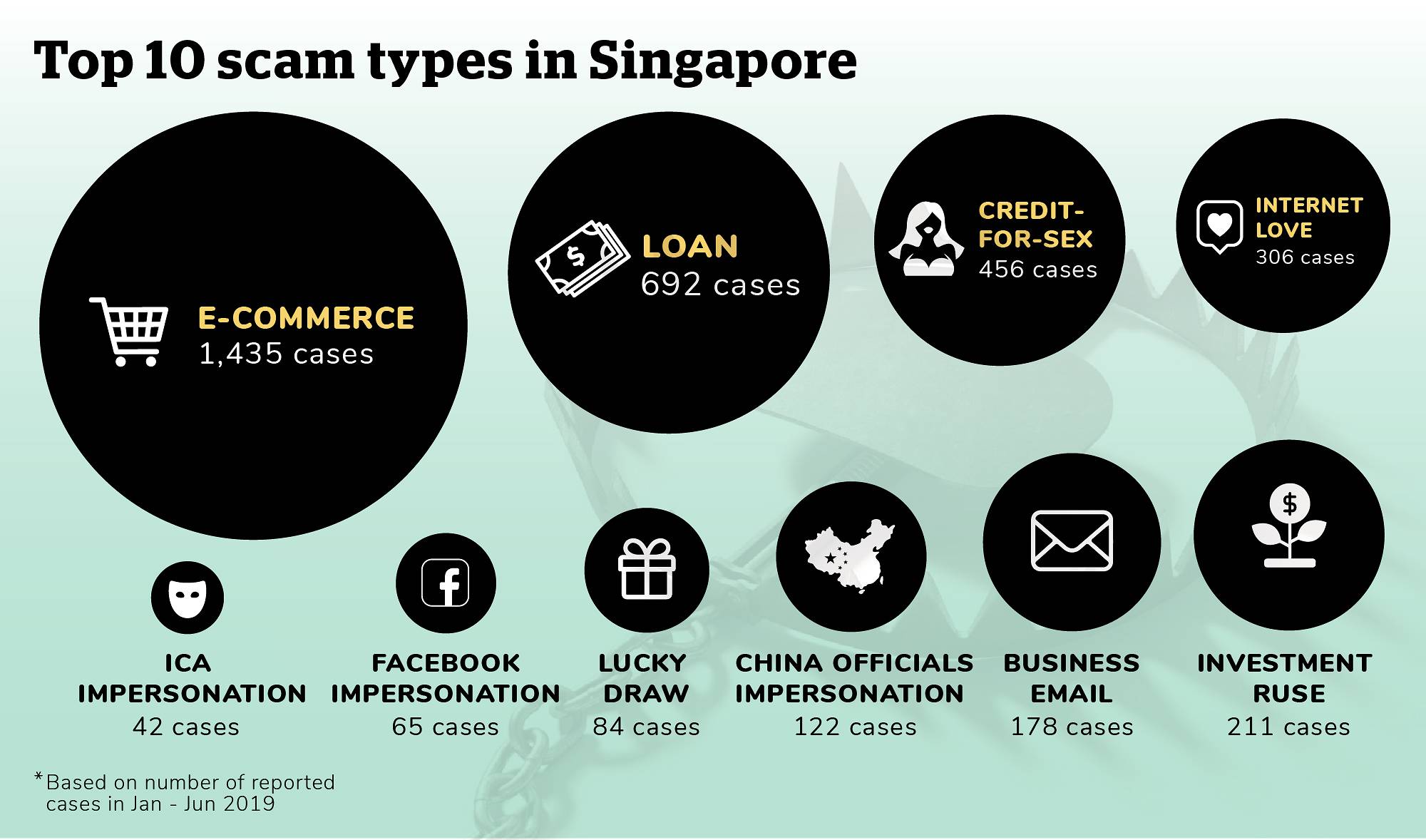
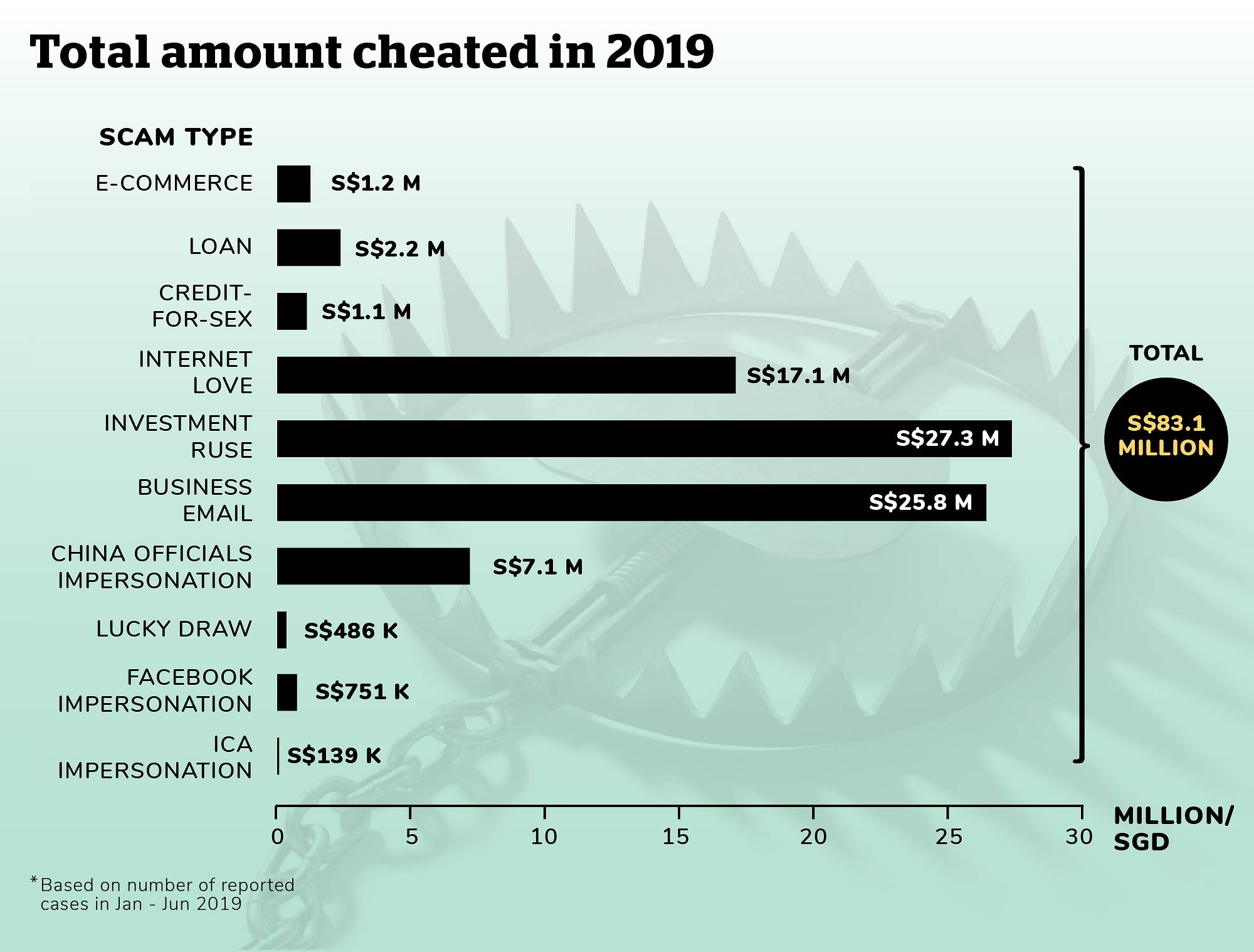
The numbers are staggering. For the top 10 types of scams from January to June this year, 3,591 cases were reported with a total loss of S$83.1 million. The largest sum cheated in a single case this year was S$4.3 million, via an investment ruse.
(Graphic: TODAY/Raymond Limantara)
The continuing surge in scams has contributed to the growing crime rate here this year despite a slowdown in almost all other crimes – and it is not just Singapore which is facing this problem.
Hong Kong authorities have flagged a rise in online and phone scams in the city since last year. Many victims were young people, and 65 per cent of phone scam cases involved conmen posing as “mainland officials”, according to a report in the South China Morning Post (SCMP).
SCMP attributed this to the fact that most youths – as digital natives who prefer online chats to voice calls – would not think of calling the other party to check.
(Graphic: TODAY/Raymond Limantara)
Meanwhile, in China, victims lost an estimated 390 million yuan (S$75.2 million) in Internet scam cases last year. This was a five-year high, with many young people similarly falling for them as they use online payment platforms more frequently.
Australia has also seen an overall rise in scams in recent years. In August, the Australian Competition and Consumer Commission forecasted a 56 per cent increase in scam-related losses over the past two years, with an estimated loss of A$532 million (S$495 million) by the end of this year.
Over in the United States, the reported losses from online romance scams increased more than four times from 2015 to last year. The country’s Federal Trade Commission noted that more than 21,000 people were tricked out of US$143 million last year alone through such scams.
ARE SINGAPOREANS “TOO TRUSTING AND OBEDIENT”?
In recent years, the authorities here have stepped up efforts to stem the scamming tide, from regular public warnings about the latest tricks by fraudsters, awareness campaigns to the establishment of a dedicated Anti-Scam Centre by the police.
The centre, which was set up in June, is aimed at disrupting scammers’ operations and help mitigate victims’ losses.
Yet, people from various walks of life – young and old, working professionals, housewives and retirees – continue to be cheated. Indeed, as the cases here and elsewhere have shown, there is no such thing as anyone being “too smart” to fall for a scam.
In fact, some experts believe scammers are exploiting Singaporeans’ general trust in authority and the fact that they live in a low-crime environment.
Deputy Assistant Commissioner of Police (DAC) Aileen Yap (centre) with the police officers involved in the conceptualising of the Anti-Scam Centre. (Photo: SPF)
They noted that Singaporeans seem to be especially vulnerable to impersonation scams that involve officials. For example, victims here lost S$7.1 million to China official impersonation scams in the first half of this year – up from a S$6 million loss in the same period last year.
“Singapore is a country with low crime, and often we let our guard down and we do not usually have a high level of suspicion. We are also more trusting of authority figures and do not question their identity,” said psychiatrist Dr Lim Boon Leng from Dr BL Lim Centre for Psychological Wellness.
Ms Nur Izyan Ismail, a senior psychologist with the police’s psychological services division, noted that scammers use certain persuasion techniques to hook their victims.
When it comes to impersonation scams, one of the psychological principles in play is obedience to authority.
This means that when scammers pretend to be authority figures, such as police or immigration officers, “we are used to listening to figures of authority and we just obey them”, she said.
Dr Tan Ern Ser, a sociologist from the National University of Singapore (NUS), said he was “reluctant to argue that vulnerability to scam amounts to a Singaporean trait”, given that the number of victims – albeit rising – remain a small proportion of the population.
“But I’d guess the people most at risk of being scammed in the case of impersonation are likely to be quite trusting of others, and quite timid and fearful when encountering someone sounding officious,” he said.
TOP SCAMS
In recent years, several types of scams have emerged and despite extensive media coverage and police public advisories, many Singaporeans continue to fall for them.
TODAY takes a look at the most prevalent types of scams based on the number of reported cases, according to statistics released by the police in August.
Scams involving online purchases remain on top of the list here. There were 1,435 reported cases in the first six months of this year, compared to 1,013 in the same period last year.
Victims lost a total of S$1.2 million, with one case involving S$43,000, between January and June – up from S$870,000 during the same period last year.
Scammers usually target victims on online shopping platforms, the most common one being e-marketplace Carousell, by listing popular items for sale at cheaper prices. These range from popular concert tickets to cheaper stays at hotels like Marina Bay Sands.
When people pay for the items, such as through bank transfers, they either do not receive the items at all or get fake ones. The scammers often become uncontactable or make up excuses about why they cannot deliver on their promises.
Some people even head to the respective venues with the fake tickets before discovering they cannot be used.
File photo of someone using a phone and looking at a computer.
Twenty-one-year-old Elle (not her real name), was one victim who lost S$500 to a Carousell concert ticket cheat. She was desperate to find tickets to American singer-songwriter John Mayer’s gig earlier this year and managed to get one from a legitimate seller, but wanted to buy more.
“I found this guy who was really normal – not super friendly but you couldn’t really tell he was lying. I trusted him because he was selling at the original price, so I thought if anyone wanted to cheat, they would charge more,” Elle added.
When he sent her a PDF copy of the tickets through WhatsApp, alarm bells started ringing in her head. She compared the tickets with the legitimate one she had bought and saw differences.
She made a police report, but the scammer contacted her again a few days later asking if she wanted more tickets. He later deleted the messages when she did not respond.
“It’s funny because I see these scam warnings on television and online, but when you experience it, it becomes very real and hard to believe. I never really knew about the warning signs,” she lamented.
Carousell has introduced several scam-prevention measures, such as flagging “high-risk categories”, which include concert tickets and hotel rentals, within its app, as well as getting sellers looking to list in these categories to use its escrow service.
In order to avoid falling prey to e-commerce scams, Ms Abigail Ng from the National Crime Prevention Council said people should realise that when a deal sounds too good to be true, it probably is.
“It’s always good to compare prices, and it’s good to want to save, but if the price that you check out is much, much lower than the market rate, I think that’s a red flag,” she said.
People should also check a seller’s ratings and reviews, and then check if the reviews are genuine. Websites offering escrow services – where money is released only when a buyer confirms the items have been received – are also safer, Ms Ng added.
Bogus loan offerings constituted the second-highest number of scams reported in the first half of this year, more than doubling to 692, from 315 during the same period last year. Victims have lost S$2.2 million so far this year.
Such scammers may claim to work for licensed moneylenders, and send SMS or WhatsApp messages offering loans and loan services to random users. Those interested have to transfer money as a deposit before getting their loans. After doing so, they will no longer be able to contact the “moneylenders”.
Some scammers also ask for personal information such as bank account numbers, then use these details to get their victims to hand over their money.
Similar scams include investment ruses, where victims are offered investment opportunities with extremely attractive returns on social media platforms such as Facebook.
If data is collected from web and smartphone users, for example, we can’t expect it to fairly represent the elderly population who are likely to use such technologies less. (Photo: Xabryna Kek)
These scammers often pretend to be stockbrokers or working in banks or financial institutions. They would then ask for personal details, like NRIC numbers, and ask the victims to transfer money to banks overseas in order to receive returns and profits.
In lucky draw scams, victims receive a phone call or SMS that they have won a prize in a lucky draw. However, they have to pay administrative fees or taxes to get the prize, or make payment to a foreign bank account to convert the prize into cash.
The authorities have also recently flagged a new variant of the lucky draw scam, where a victim received calls from an unknown overseas number saying she had won a lucky draw.
She was asked to contact a local number through WhatsApp, shown a photograph of a bank cheque with her name on it and asked to provide her bank account number.
When she refused to claim her “winnings”, the scammers threatened to refer her to the police, so she ended up transferring money to pay for “fees and charges”.
The number of reported cases also more than doubled from 209 in the first half of last year, to 456 in the first half of this year. The total amount cheated also increased from S$464,400 to S$1.1 million.
Scammers befriend their victims – usually young, tech-savvy males – through dating apps or social media platforms such as WeChat.
They pretend to be attractive women and dupe their victims into buying them items or gift cards, commonly AliPay purchase cards or iTunes cards, in exchange for sexual favours, a date or a meet-up.
They would then ask for more money under the pretext of having to pay a registration fee or admin fee.
Police officers on patrol at a mall in Singapore. (Photo: Hanidah Amin)
In a recent interview, a 22-year-old man told reporters about how he almost fell prey to such a scammer, who sent him voice recordings of her whispering sweet nothings on the Line chat app.
She told him she was a foreigner studying at a local university and gave massages to earn money. He agreed to pay for a massage from her.
She told him to transfer S$100 at an AXS machine, but police officers stopped him just in time. He had ignored a scam warning message that flashed on the machine’s screen after he selected the AliPay option, and did not spot scam alert posters on the wall.
“I know about such scams from newspapers, but didn’t think they could be linked to a dating app. Now I am more careful, and have uninstalled all my dating apps (Tinder, OkCupid and Badoo),” he said during the interview.
The total amount of money lost in these love scams, as well as the number of reported cases, increased in the first half of this year compared to the same period last year. The largest sum cheated in a single case was S$2.4 million.
Love scammers usually pretend to be attractive foreigners and befriend their victims online. After getting the victims to trust them or even fall in love with them, the fraudsters pretend to have fallen into trouble or hard times.
They ask their victims for money as proof of the latter’s love before disappearing once they get the cash.
While many types of people fall prey to these scams, Assistant Superintendent of Police Kristian Kirkwood said that over the years, middle-aged to elderly women had often emerged as the victims.
“(This is) perhaps because they have saved up all this retirement money and the scammers very well know that. We also see individuals who have recently got out of divorces, because when they have done that, they’re more emotionally susceptible to falling prey to these scammers,” added the investigation officer in the transnational commercial crime task force.
File photo of a man looking at the computer screen. (Photo: Xabryna Kek)
Ms Izyan, the police psychologist, said that Internet love fraudsters create profiles similar to their targets.
They also use the “reciprocation” principle by initially sending them gifts or showing concern, then getting their victims to return the favour when they are purportedly in trouble.
“What we tend to overlook is that victims of Internet love scams also have to grieve over the loss of a relationship. While it may seem (to be) only online, it is an actual loss, so they do go through the grief of a break-up,” Ms Izyan added.
One such victim, 43-year-old Alice (not her real name), almost lost US$5,000 (S$6,900) to a man named Francis whom she met on a dating app, after breaking up with her boyfriend.
He sent her love poems every morning and evening, and the pair talked on the phone daily. Warning signs started to pop up not long after, such as when he told her he was actually 44 even though he listed his age as 39 on the app.
Alice’s suspicions grew stronger when Francis told her that he had ordered diamonds from a shipping agent and his package “did not go through” because there was a problem with his bank account, and asked her for help. Still, she transferred US$5,000 to a foreign-based account given by him.
But when Francis kept telling her he did not receive the money, she decided to lodge a police report. Alice later managed to get the bank to return the money to her account.
Impersonation of authority figures
These fake officials could say they are from China or Malaysia, the Immigration and Checkpoints Authority, or the Singapore Police Force, to name a few.
Chinese official impersonators typically pretend to be a staff of a courier company, or an officer from some government organisation.
Scammers tell their victims that they have been involved in some illegal activity, then ask for the victims’ personal particulars and bank account details.
A Singapore Police Force car. (File photo: Hanidah Amin)
The victims would then be asked to provide their personal particulars and bank account details for investigation purposes, such as their Internet banking details and one-time security passwords. The callers then use these details to transfer money out of the victims’ bank accounts.
One victim whom TODAY interviewed in September, a 21-year-old Chinese national, transferred S$500,000 in order to clear her name before realising that she had been scammed.
Someone claiming to be a DHL representative had called her, saying that the company had received a suspicious parcel in her name that was being sent to China. The parcel purportedly contained some clothes, fake passports and credit cards.
The phone call was then transferred to a Singaporean “police officer” and some “Chinese authorities”, who accused her of being involved in a money-laundering scheme.
Social media accounts: Fraudsters masquerade as their victims’ relatives or friends, by taking over their Facebook accounts. They contact their victims through the accounts, introduce them to various types of grants, and tell them to provide their personal details and transfer money to bank accounts or remit money overseas. Of late, a similar scam has also surfaced on WhatsApp.
Business email: Scammers hack into business email accounts and monitor their correspondence with others. They then use the other party’s email, or spoof it (create one closely resembling the email), to send emails asking to transfer money for business payments.
“ANYONE CAN BE CHEATED”
Dr Emily Ortega, who heads the psychology programme at the School of Humanities & Behavioural Sciences at the Singapore University of Social Sciences (SUSS), reiterated that anyone can fall for a scam.
“There is no particular personality type, age group, or demographic that is spared. Scammers use persuasive techniques to influence and some even impersonate or clone emails so well, hoping to trick people to use their gut feelings in their decision making,” she added.
Dr Lim, the psychiatrist in private practice, also noted that those who think they are intelligent and unlikely to be scammed are, in reality, more at risk of being defrauded as they are “less guarded and less likely to cross-check their decisions with others”.
File photo of a man using a laptop. (Photo: AFP/Frederic J Brown)
Scammers also exploit vulnerabilities such as making rash decisions under time pressure, or even greed or lust.
“Many a time, victims may suspect that the transaction is a scam but may take the risk and pay up to avoid potential danger or inconvenience, or to obtain something they ordinarily are unable to get, be it an object or love,” Dr Lim added.
Mr Daniel Koh, a psychologist from Insights Mind Centre, pointed out that victims could fear losing out on an opportunity. Scammers could also start with smaller steps that lead to bigger goals, which people tend to lose track of, or be friendly and sympathetic towards their potential victims.
While the authorities constantly give tips on how to avoid being scammed, Dr Tan said public education can help reduce ignorance and carelessness among the general population.
“Perhaps, a simple message that any request for money, personal information, or offers by unknown persons or sources, should be rejected and reported,” added the NUS sociologist.
ANTI-SCAM HOTLINES
For scam-related advice, call the anti-scam hotline on 1800 722 6688 or go to www.scamalert.sg.
Anyone wishing to provide information on scams should call the police hotline on 1800 255 0000, or submit it online at www.police.gov.sg/iwitness.
SINGAPORE: Tucked away in the south-west of Singapore, at Sembcorp Marine’s Tuas shipyard, Royal Caribbean’s 15-deck Voyager of the Seas cruise ship is getting a US$97 million (S$134 million) facelift.
The 20-year-old ship is getting a complete 41-day overhaul, with almost 2,000 contractors working on reshaping the ship to include 72 new staterooms, as well as replacing items ranging from carpets and curtains to furniture.
The Voyager of the Seas is the fourth in a series of 10 ships in Royal Caribbean’s fleet being brought up to date as part of a US$1 billion investment by the cruise operator.
Following research and guest feedback, the Voyager of the Seas will also see the introduction of a number of new features when it sets sail once again on Oct 21, aimed at appealing to a younger crowd.
These include two new interlocking waterslides – together dubbed the Perfect Storm – as well as Battle for Planet Z, a laser-tag game.
And with multi-generational families typically making up more than half of Royal Carribean’s passengers, the Voyager of the Sea hopes to appeal to young parents with the introduction of a nursery, where infants and toddlers will be under the supervision of certified child-minders.
The Voyager of the Seas is getting a US$97 million refresh, as part of a US$1 billion investment Royal Caribbean is making for 10 of its cruise ships.
CRUISE INDUSTRY GROWING, CHANGING
This investment comes as the worldwide cruise industry continues to grow.
Asia is the industry’s third largest market after North America and Europe, with 4.24 million cruise passengers last year, up 4.6 per cent from the previous year, according to Cruise Line International Association.
And figures from the Singapore Tourism Board showed that 1.87 million in Singapore went on a cruise holiday last year, up 35 per cent from 2017.
Dynasty Travel marketing communications director Alicia Seah said cruises give holidaymakers a chance at a more relaxing vacation, without the need to constantly pack and unpack.
This is especially attractive for more elderly travelers, or those with young children, she said.
“They simply board the cruise and get to relax and rest,” she said, adding that cruise travel makes up some 25 per cent of Dynasty’s sales revenue.
Ms Seah notes that Singapore’s position as a cruise hub in Asia means many cruise lines ply routes in Southeast Asia.
While food and gaming have traditionally attracted older passengers, she said that cruise operators are now expanding their offerings with attractions for a younger crowd such as water slides and rock climbing, as well as unique events like music festivals on board ships.
WHAT CRUISE OPERATORS ARE DOING
Cruise operators are indeed tapping new market segments.
“We see an increasing number of millennials and young families sailing with us in addition to first-time cruisers. This is very encouraging as these are new target groups for us to reach out to,” said Princess Cruises Southeast Asia director Farriek Tawfik.
While millennials are keen on bucket list destinations such as Alaska, Baltics & Russia, the Mediterranean and Caribbean cruises, young families and first time cruisers tend to go for short sailings around Southeast Asia, he said.
Meanwhile, Dream Cruises says as part of efforts to expand and tap into newer markets, it is rolling out thematic cruises for the 18-deck Genting Dream cruise ship.
These include the family-friendly “Justice League @ Sea” cruises, which feature activities and parties themed around the DC Comics superheroes, as well as the culinary-themed “Taste the Dream – Wine and Dine at Sea”, said Dream Cruises president Michael Goh.
“We also offer post fly-cruise packages with access to some of Singapore’s popular international events like the recent F1 Singapore Grand Prix and the upcoming UFC Fight Night to encourage travellers to cruise and extend their stay in Singapore,” he added.
To enhance the passenger experience, cruise operators are banking on technology.
Royal Caribbean has introduced a mobile app that passengers can use to plan their activities and book dining slots, among others, once onboard.
Meanwhile, Princess Cruises has introduced the Ocean Medallion, a wearable device which can be used for everything from opening room doors to ordering food, drinks and services on-demand.
It will also be introducing greener ships to appeal to environmentally conscious customers.
By 2025 Princess Cruises’ fleet will also include two liquefied natural gas (LNG) ships – which will be the largest in its fleet – in line with the International Maritime Organisation’s tighter sulphur emission regulations which will come into effect next year.
As work on the Voyager of the Seas ramps up, its crew is looking forward to welcoming the first batch of passengers onboard later this month.
“What I’m looking to is seeing the first impressions of the guests when they come on board,” said Voyager of the Seas hotel director Gary Waugh.
“I think a lot of people will be in awe at what we’ve changed here. That will be fun.”
SINGAPORE – A man who moved in with his girlfriend to take care of her allegedly stole around $52,000 from her by stealing and using her ATM and credit cards, a district court heard on Friday (Oct 4).
Marcus Kong Wei Keong is accused of 32 counts of theft for stealing from his ex-girlfriend, Ms Felicia Lee Yen Pheng, who was suffering from severe eczema.
He also faces another 21 charges for offences under the Computer Misuse Act, related to unauthorised fund transfers made from Ms Lee’s accounts to his own.
Kong, whose age and occupation were not stated in available court papers, is also accused of giving a false statement to a police officer. He allegedly denied knowing how money was transferred from Ms Lee’s accounts to his.
On the first day of the trial, Deputy Public Prosecutor Edwin Soh said in his opening statement that Kong had offered to move in with Ms Lee around May 2015, so that he could “take care” of her.
“However, the accused abused Felicia’s trust and stole various credit and ATM cards belonging to her,” said DPP Soh, according to court documents.
Ms Charlotte Chia is not losing sleep over the ugly talk about her.
Netizens, including many from Malaysia, have posted some pretty nasty remarks about the 21-year-old model who bagged the Miss Singapore International crown in July.
Ms Chia, who will represent the country in the Miss International pageant in Tokyo in November, has been compared with Ms Charmaine Chew, her Malaysian rival.
Malaysian netizens, gushing over Ms Chew’s looks that they say can stand up to the top lookers from South Korea, feel that Ms Chia is not in the same class.
One person wondered why Singapore could not have picked a more attractive candidate.
Others noted that Ms Chia looks like a canteen aunty and even Rosie Phua, the character from the hit sitcom Phua Chu Kang Pte Ltd.
The online dissing started when a netizen posted a collage of pictures of the beauty queens from South-east Asia, with favourable reactions garnered for the girls from Thailand, the Philippines and Malaysia.
About halfway through the concert, guitarist Jae suddenly paused the talk segment to ask the crowd whether they had seen Day6’s setlist from their previous concerts in the US.
“Well, we’ve changed the setlist!” he burst out in laughter, much to the surprise of the fans, known as My Day, in the crowd.
After receiving a barrage of tweets from fans in Singapore about the songs they wanted to hear live, the Korean boyband couldn’t help but respond to their enthusiasm by changing the song lineup just for them.
Dubbed a throwback session, the band rocked out to old favourites from early albums such as Colours and I Wait.
It’s hard to say whether fans truly went wild at this point, as they had already been on their feet and in a frenzy before the first song of the night.
After all, it’s been three long years since the band was in Singapore. While they were here for a fan meet then, this is the first time the group of five has held a full-scale concert on our sunny island.
As they graced the stage on Saturday (Oct 5) at The Star Theatre for their Gravity world tour, the band couldn’t believe their eyes and ears.
SINGAPORE – When she and her husband divorced about 17 years ago, Madam Jamalia Shariff felt her whole world come crashing down.
She was left without a home and for six months, she and her three teenage children had to move from relative to relative, before she found a rental flat in Chai Chee to start rebuilding her life.
With only primary school education, Madam Jamalia did not have an easy time finding a job. She eventually started work as a housekeeper, earning $500 monthly.
Now 64, her resilience and patience paid off, with her children now finding successful careers. Her eldest son works in the service sector, while her second son is an entrepreneur. Her youngest child, a daughter, is a doctor at Changi General Hospital.
Madam Jamalia’s story won her this year’s Exemplary Mother Award (EMA), given every year by Jamiyah Singapore to a mother who has shown resilience in overcoming life’s challenges.
Chosen by a judging panel from 10 nominees, Madam Jamalia received her award in a ceremony at the Swissotel The Stamford on Saturday (Oct 5) from President Halimah Yacob.