A ban is being considered in Parliament, but some personal mobility device (PMD) users aren’t helping at all in the case against outlawing them outright.
On Oct 6, an e-scooter rider knocked down a toddler along the common corridor of an HDB block.
The shocking moment was captured on CCTV. In the clip, a three-year-old girl can be seen walking outside a ground floor flat as two adults engage in conversation.
Mere seconds later, a young PMD user whizzed by and crashed into the child, as well as some items that were leaning against a pillar.
The collision sent the rider crashing onto the pavement, but he quickly got back to his feet and picked up his e-scooter.
A woman screamed and turned around to check on the child, while several other residents gathered at the scene to help.
What happened afterwards remains unknown as the clip ended right there.
SINGAPORE: Hepatitis E (HEV) infections surged in Singapore between 2012 and 2016, according to a study led by the Singapore General Hospital (SGH).
In a media release on Wednesday (Oct 9), SGH said that the incidence of the infection more than doubled, from 1.7 cases per 100,000 residents in 2012 to 4.1 cases per 100,000 residents in 2016.
The individuals infected by HEV tend to be Chinese men aged 55 years and above.
The findings of the study were published in medical journal Zoonoses Public Health in July.
HEV can be acquired by ingesting faecally contaminated water or eating raw or undercooked products from infected animals.
Worldwide, HEV foodborne infection is generally associated with the consumption of pork meat or offal, game meat, and shellfish.
An analysis on HEV samples showed the same HEV subtype detected in three raw pork liver samples, said SGH.
Electron micrograph of Hepatitis E viruses (HEV). (Photo: Wikimedia Commons/CDC/PHIL #5605)
“Although we could not ascertain if pig liver is the main contributor of HEV cases in Singapore, we observed that pig liver can be found in many local dishes,” said Dr Chan Kwai Peng, senior author of the study and Senior Consultant at SGH’s Department of Microbiology.
“As most people like it a little undercooked for its texture, this may put them at risk of hepatitis E infection. The safest way of consuming food, including pork, is to cook it thoroughly.”
The virus infects the liver, with infections going away on their own within a few weeks.
Most patients show no symptoms but if they do, the symptoms include fever, feeling very tired, nausea and jaundice.
Infections do not usually lead to long-term illness or liver damage, but can be dangerous for pregnant women or people with weak immune systems like transplant patients or people with pre-existing chronic liver disease.
In 2010, Hong Kong’s Centre for Food Safety had issued a report about eating undercooked pig liver and the associated risk of HEV infection.
Stomp contributor Serf alerted Stomp to a photo of a police report on the incident that has been circulating online.
The report was made by a 24-year-old delivery rider who said he was approached by a “Sikh man” in his 50s at about 12.42pm that day.
The older man struck up a conversation with him and told him he was from Kuala Lumpur before asking him for cash donations for his temple.
The rider proceeded to give the man all the cash he had in his wallet, which was over $300.
The man said in his report: “I would like to inform that while giving him the money, I was completely unaware of my actions and it seemed that the old man had “hypnotised” me.”
He said that he came to his senses only after the man left with his money.
When he tried to look for him, he could not find him.
SINGAPORE: Taxpayers in Singapore subsidise about S$1 for every trip made on buses and trains here, said Senior Minister of State for Transport Janil Puthucheary on Wednesday (Oct 9) during an interview with CNA938.
According to figures released by the Land Transport Authority (LTA) earlier this year, 7.54 million trips are made on buses and trains here daily.
Dr Janil was discussing the reasons for the 7 per cent public transport fare increase announced by the Public Transport Council on Tuesday. This increase, which will kick in on Dec 28, will see fares go up by 9 cents per journey for adult commuters paying by card.
Though public transport fares were able to cover the cost of operating buses and trains here in the past, increasing costs have meant taxpayers have had to bear the burden of subsidising costs such as infrastructure investments, Dr Janil said.
“The key issue is that costs for the operators have risen quite significantly, up to 30 per cent over the last few years; and our fares have not in any way kept up with that,” he said.
Senior Minister of State for Transport and for Communications and Information Janil Puthucheary speaks to CNA938 on Oct 9, 2019. (Photo: Gaya Chandramohan)
INCREASED GAP BETWEEN COSTS AND REVENUES
Rail operator SMRT Trains – which operates the North-South, East-West and Circle Lines, as well as the upcoming Thomson-East Coast Line – reported a net loss of S$155 million for the financial year ending in March.
The train division of SBS Transit – which runs the North-East and Downtown Lines – lost “tens of millions of dollars” in the last financial year, with losses of S$125 million for the Downtown Line over the past three years.
Both companies had applied for the 7 per cent increase, citing rising costs due to increasing expenses in areas such as maintenance and manpower.
“We’ve had the opportunity to increase fares a lot more (in the past few years) but we haven’t, as a result of which the gap between the costs to the operators and how much revenue has been generated (has increased),” said Dr Janil.
The fare increase will help close this gap, he told hosts Arnold Gay and Yasmin Jonkers.
He noted that rail reliability in Singapore had improved substantially over a relatively short period of time.
LTA figures show the MRT network here managed to clock 955,000km between delays of more than five minutes as of June this year – up from just 181,000km two years ago.
But these improvements have come at a cost, with Dr Janil noting both rail operators have had to ramp up hiring rail engineering talent to enhance maintenance capabilities.
National University of Singapore transport economist Timothy Wong, who was also part of the radio interview, said subsidising public transport helps encourage its use and promote the country’s car-lite vision.
“But at the same time, if we don’t allow fares to increase so that they (transport operators) don’t have revenue, as cost efficient as they are, they’re not going to be profitable,” he said.
Dr Wong added that it would be a “huge concern” if transport operators were unable to make profits, as this might discourage companies worldwide from participating in Singapore’s rail industry, creating a less competitive environment.
And while the perception exists that public transport operators should not focus on profitability, this “competitive dynamic” helps reduce costs, said Dr Janil, noting that public transport fares here are among the lowest in the world.
A study of 12 major cities by the Nanyang Technological University last year ranked Singapore second in terms of public transit affordability, just behind San Francisco.
Dr Janil said the fare increases over the past two years have allowed for concessions to be extended to more people.
This has allowed polytechnic students – who previously had to pay adult fares – to enjoy student concessions, which will see their fares capped at 63 cents per trip, as with junior college and Institute of Technical Education students.
Dr Janil also noted that the Transport Ministry is also expanding its Public Transport Voucher exercise to assist lower-income households, with one in five households now eligible for a vouchers of S$50 to cover their transport expenses.
Despite the increase in fares, public transport will continue to be subsidised, he said, with the main concern being by how much, to ensure funds are not diverted away from other areas.
This is because transport is an essential part of day-to-day life, he said.
Dr Janil said that having a well-functioning transport system was going to be key to normal, day-to-day functions in Singapore. He added that it was also vital to Singapore’s future and “the kind of city that we want to be: A dynamic, growing economy creating opportunities”.
The police, who were alerted to the case of voluntarily causing grievous hurt by dangerous weapon at around 4.15pm on Oct 3, said the youth had slashed a 31-year-old man on his face at 1 Tras Link.
The victim was conscious when conveyed to Singapore General Hospital.
On Oct 4, the police released a photo of the assailant, who had fled the scene, to appeal for information on his whereabouts.
In the photo, the youth can be seen smiling and holding a knife believed to have been used in the attack, reported Lianhe Zaobao.
He was arrested along Orchard Road on Tuesday (Oct 8), following ground enquiries and with the aid of images from CCTV footages, said the police.
According to Zaobao, the youth had visited a moneylending firm at 1 Tras Link on the day of the incident. It is believed that he had been trying to borrow money but got rejected.
Have you ever watched zombie flicks and wished you’re actually in one to smash in on the fun?
You don’t have to wait much longer — Australia’s tech-enabled, live-action role-playing event, Zedtown, will be crashing onto our shores come Oct 26.
Ahead of Z-day, AsiaOne had been invited to a media preview, where we took part in a trial game of Zedtown Asia: Battle for Singapore at the National Stadium.
For the uninitiated, you start off as a survivor in a faction and fight your way to survival while completing missions. Along the way, if you aren’t careful and happened to be tagged by a zombie, you’ll turn into one. What is dead may never die, so zombie players have infinite lives, simply needing to make their way back to their hub to respawn.
Amazon is giving online shoppers in Singapore access to a wider selection of offerings, with the launch of Amazon.sg.
The local online marketplace, which launched on Tuesday (Oct 8), not only stocks a larger range of international goods but also has products from local small and medium-sized businesses.
Singapore is the first country in South-east Asia to get Amazon, which is available in 15 other countries including the United States, Australia, Brazil, India, Mexico and Japan. Previously, though shoppers here could access Amazon.com, many products were not available for shipping to Singapore and those that were available for international shipping would typically charge high shipping fees.
The US company launched its Prime membership programme for Singapore in 2017, offering its fast delivery service through a mobile app. But its initial local selection mainly focused on groceries and household essentials.
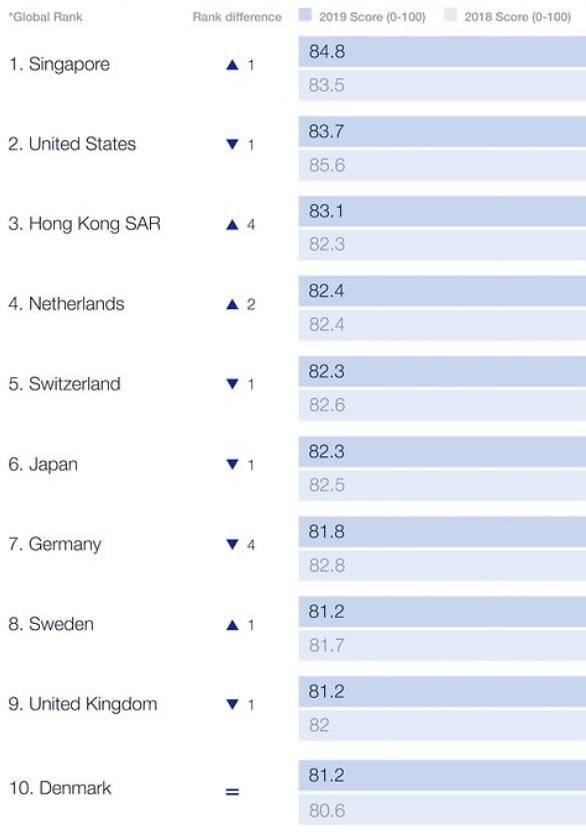
GENEVA: Singapore overtook the United States to become the world’s most competitive economy in 2019, according to the World Economic’s Forum (WEF) flagship Global Competitiveness Report released on Tuesday (Oct 8).
The report measures competitiveness on a scale of zero to 100 based on factors that include infrastructure, health, the labour market, the financial system, quality of public institutions and economic openness.
Singapore scored 84.8 out of 100, but WEF noted that the country had benefited from trade diversion through its ports triggered by the tariff battles between the world’s top economies.
Hong Kong rose four spots to claim third place with a score of 83.1, but WEF said the data used in the report was collected before waves of protests began shaking the financial hub.
The Netherlands finished fourth – up two slots from last year – while Switzerland came in fifth place.
TROUBLE SIGNS HAVE EMERGED IN US: WEF
While the report noted that the US “remains an innovation powerhouse” and the world’s second-most competitive economy, some trouble signs have emerged, WEF said.
“There are no two ways (about) it. It is important to ensure the countries are being open to trade,” said Saadia Zahidi, a WEF managing director, when asked to comment on the impact of the tariffs imposed by the Trump administration.
She noted the lack of “hard data” on the impact of US tariffs imposed on several of its main economic partners, as the set of products impacted remains limited compared to overall trade.
But the sentiment surrounding investing in the US “has been going down”, she told reporters in Geneva.
“That will end up impacting long-term investment; that will end up impacting how decision makers are thinking; that will end up impacting the view of non-American business leaders (of) the United States. So it does matter in the long term,” she added.
The competitiveness report relies in part on executive surveys, in addition to hard economic data.
Zahidi said that the US had also fallen in the rankings because healthy life expectancy in the country was now lower than in China.
In data published last year, the World Health Organization said that a newborn in China could expect 68.7 years of healthy living, compared to 68.5 for American newborns.
The WEF, which organises the annual gathering of business and political elite in Davos, has released an annual competitiveness report since 1979 that assesses which economies are well placed to see productivity and long-term growth.
The world’s most competitive economies, according to the World Economic Forum. (Table: WEF)
Let’s face it, we Singaporeans love our Macs and probably everything under the sun that’s related to the golden arches. Be it Hello Kitty plushies, My Melody food holders or Minion figurines, if there’s any limited-edition merchandise, you can be sure to find a queue snaking out of the shops.
So what happens when McDonald’s has special jammies going on sale on their website and mobile app on Monday evening (Oct 7)?
You guessed it — the platforms waved the white flag the moment the clock struck 6 pm.