Home Blog Page 663

Commentary: Taking obituary photos and the difference between death and dying

0

LIVERPOOL: Before I became a sociologist, I was a photographer working the wedding and family circuit in Singapore. With the latter, I would often be asked to visit people’s homes to photograph extended families, especially when someone had given birth.

Parents, grandparents, and sometimes great-grandparents would gather dutifully for an hour to pose with the newborn. Once the “official” photos were done, I would inevitably be asked to do one of two things – throw in a few “passport photo” style images, or take a sneaky obituary photograph for the oldest family member present.

Now obviously no one actually tells the subject they are preparing a picture for their death. It was always “Ah Ma! Look here! Smile!” or something like that.

Although I always suspected Ah Ma knew. She always knows.

PEOPLE DON’T LIKE TO TALK ABOUT DEATH

If you do not like talking about death, you’re not alone. The aversion towards engaging with death and dying is a well-studied and well-documented phenomenon.

READ: We treat the business of death like it’s dirty work, a commentary

bukit brown cemetery

Bukit Brown Cemetery. (Photo: AFP)

One may think it is a particularly Asian thing, but that’s not true either – scholars like Tony Walter and Glennys Howarth have been charting societal perceptions of death for many years.

Walter notes in his study The Sociology of Death how society’s engagement with death has changed alongside technological and economic advancements.

Where once death was dealt with largely by family members, those duties have largely gone to professionals. Where dying at home was once a common thing, this has been replaced by hospitals and hospices.

Sociologist Anthony Giddens calls this the sequestration of death – meaning that death is now hidden away from view, whether through the delegation of duties to others, or in the landscapes that we build. Remember how everyone got so huffy when proposals to build hospices in neighbourhoods were floated?

Some have argued that this is a sign of “death denial” – a way of life where society actively refuses to acknowledge that death is an inevitable fate, or even a thing at all.

READ: For the dying, home hospice care offers a ray of hope, a commentary

File photo of a hospital

File photo of a hospital. (Photo: Unsplash/Daan Stevens)

Taken to its extreme, death denial can come in the form of cryogenic freezing – a phenomenon where individuals pay to have their bodies (or for cheaper, just their heads) frozen and stored after death in hopes that future technology can help them live forever.

It sounds like the stuff of dreams (or nightmares), but completely understandable when you think about what death means to an individual.

Death is not just physical but social – to die is to be removed from others, to be sequestered in a different kind of way.

This is why many religions emphasised a sense of social belonging post-death, such as how we would be reunited, both with the divine as well our loved ones who have gone before.

It is also why much social research show that individuals consider dying surrounded by loved ones a “good” death as compared to doing so alone or among strangers.

READ: Contemplating the future of dying, a commentary

But that same body of research also shows that a good death entails preparation and autonomy. If given a choice in how, when and where we die, we would stand a greater chance of encountering death more peacefully or stoically.

FEAR OF DYING

This brings us back to the problem of talking about death in Singapore.

Most Singaporeans have no issues with talking about the state of death. We surround ourselves with ritualistic engagements with death such as Facebook dedications, tomb cleaning, memorial services, and online obituaries.

Taking Obituary Photos and the Difference between Death and Dying

So much effort to remember the dead – Hungry Ghost Festival 2017 (Photo: Terence Heng) 

READ: Dealing with the difficult issue of organ donation when a loved one passes on, a commentary

But when it comes to talking about the process of dying, that’s when the “ick” factor comes in.

Ever the pragmatic bunch that we are, we end up discussing logistics, wills, coffin, flower arrangements.

Even then, these discussions on dying, which touch on the scary, unknown transition between living and not living, frightens us the most.

Despite my religious faith, the potential prospect of nothingness sends me running to get distracted by work, television or whatever the equivalent of Pokemon Go is now.

Death appears to be fine (especially if it’s about someone else), it’s the getting there that’s the problem.

While some may point to superstition (a term which I find dismissive of belief systems) or fear of death that prevents us from having constructive conversations about death, the reality is this: It is the fear of dying and dying poorly, that perhaps forces so many of us to procrastinate until it is too late.

Why else then as a nation do we struggle to talk about end-of-life care and living wills?

IN ORDER TO LIVE WELL

We need to overcome our fear of dying, both culturally and policy-wise, by being sensitive to that fear, and to situate it as not necessarily something directly connected to dying (even if it is).

dead flowers

(Photo: Unsplash/Annie Spratt)

READ: Don’t let caring for the dying become a burden on the living, a commentary

A greater menu of options for living well prior to death, both public and private, offered in a frank but sympathetic way through various channels of communication, is a good step forward.

In all my years doing sneaky obituary photographs, I met one family that showed no fear of talking about making preparations. They posed gamely for photographs, ensuring I got their best side.

Perhaps it was their faith, perhaps it was sheer bravado, but they certainly appeared to take delight in being prepared.

That preparedness is to me, a good way to live as well as one can for the next stage of being human.

Terence Heng is a lecturer in Sociology at the University of Liverpool, UK, where he is also an associate at the Centre for Architecture and the Visual Arts.
Source link

What’s making pork more expensive? There’s a fatty belly factor

0

SINGAPORE: Sio bak (roast pork belly) is one of the fattiest cuts of meat — seemingly decadent but hardly unwanted. And demand for it has indirectly driven up pork prices, in Singapore and worldwide.

“The demand has increased, pork belly prices have increased, and what happens is that you can’t just keep selling pork belly — you have to basically sell all the cuts in the carcass,” said Huber’s Butchery executive director Andre Huber.

“Naturally, that cut has to increase (in price) to control the demand because there’s only a limited supply.”

Just last year, pork fat was reported as one of the world’s top 10 most nutritious foods, as ranked by scientists.

“The Europeans, the Americans … are also now starting to consume a lot (of pork belly),” added Huber, whose butcher shop is the largest in Singapore, supplying meat to almost 1,000 restaurants and hotels.

“So if demand from the world is increasing for this particular cut, then yes, I see the price (of pork belly) really starting to go up more and more.”

Huber’s Butchery executive director Andre Huber (right) with For Food’s Sake! host Ming Tan.

Andre Huber (right) with For Food’s Sake! host Ming Tan.

In Singapore, the average retail prices of chilled pork have increased steadily over the past decade: By 11 per cent for lean pork, 15 per cent for pork ribs and more than 20 per cent for pork belly.

The programme For Food’s Sake! examines the factors, which include consumer preferences. (Watch this episode here.)

‘EVERYTHING ADDS UP’

Pork is Singapore’s second favourite meat after chicken; more than 126,000 tonnes of pork were imported last year.

The bulk of the fresh chilled pork comes from Indonesia, Australia and East Malaysia, while the frozen pork and other pork products are from countries such as Brazil, the Netherlands, Spain and the United States.

In Sarawak, where the farm Green Breeder exports 1,300 live pigs to Singapore every week, its owner Ng Siew Thiam has increased prices because the costs of crucial ingredients in pig feed — grain, fishmeal and vitamins — have risen over time.

The costs of crucial ingredients in pig feed — grain, fishmeal and vitamins — have risen over time.

Pigs feeding.

“Over the last 10 years, (feed prices) have increased by 40, 50 per cent. Bad weather or drought would affect prices badly, which is happening all the time,” said the veterinarian by training.

Transportation costs, which make up around 10 per cent of each pig’s selling price, have also gone up.

“Oil prices, in the last few years, haven’t been very good,” cited Ng, who rears around 65,000 pigs on his farm. “If you look at building a ship … the prices (of iron ore and other metals) have also increased.

Everything adds up, so we have no choice — everything has to go (up).

At importer OJJ Foods, which is responsible for almost a third of the chilled pork entering Singapore, the cost of labour — a big component of its overheads — has also inched up over the years.

Importer OJJ Foods is responsible for almost a third of the chilled pork entering Singapore.

At importer OJJ Foods.

The company processes and distributes both chilled and frozen pork, supplying the meat to major supermarkets here. Automation helps, but there is “not a lot of buffer”.

“We can’t say, ‘Just increase prices.’ But … if the raw material prices were to increase significantly —10, 15 per cent — we have to pass on (the increase) to the customer,” said OJJ Foods managing director Ting Puong Huat.

IS MORE FOR LESS POSSIBLE?

Supermarkets typically sell frozen pork belly now for about S$10 per kilogramme and chilled pork belly for S$14.50/kg.

Although chilled pork costs close to 50 per cent more, most of the consumers this programme interviewed choose to pay more for it because they believe it has better taste and texture compared with frozen pork.

Shoppers prefer fresh pork, as For Food's Sake! host Ming Tan found out.

Shoppers prefer fresh pork, as For Food’s Sake! host Ming Tan found out.

But is that true? To find out, programme host Ming Tan roasted a fresh piece of pork belly and a frozen piece, and asked people whether they could discern a difference in flavour and texture.

Some of them could not, while others even preferred the frozen pork.

Professor William Chen, the director of Nanyang Technological University’s Food Science and Technology Programme, was also able to do a test using a texture analyser, which can be done for any food product.

He tested two samples of roast, one made from fresh chilled pork and the other, frozen pork. The analysis showed that the frozen pork was tenderer.

A test using a texture analyser showed that frozen pork was tenderer than chilled pork.

Put to the test.

In addition, the scientist said nutrition is preserved better with the fast freezing of the pork, whereas fresh pork is more susceptible to bacteria contamination when put in storage and transported.

“When we immediately freeze (pork), all the nutrient value would be preserved. So it’s safer in a sense, and it’s cheaper than fresh pork,” he said.

And that goes for pork belly too.

Watch this episode of For Food’s Sake! here.

The fondness for pork belly is growing.

The fondness for pork belly is growing.

Source link

Dyson hits the brakes on electric car project: What the shift in gears means for Singapore

0

SINGAPORE: It was on Sep 26, 2017 when British inventor James Dyson announced ambitious plans for his household appliance firm to plough in £2 billion (US$2.5 billion) to produce electric cars by 2020.

Cities around the world were filled with “smog-belching cars, lorries and buses” as major car makers “circumvented and duped clean air regulations”, he wrote in an email to employees then. Resolving air pollution woes was his “ambition”, the billionaire entrepreneur added.

And that solution would be in the form of electrically powered vehicles.

“Dyson has begun work on a battery electric vehicle, due to be launched by 2020,” Mr Dyson wrote, formally kicking off an ambitious project for his company, which is better known for its vacuum cleaners and bladeless fans.

A year later on Oct 23, the company said it had picked Singapore as the place to build its much-anticipated electric car plant. It followed up with another announcement three months later that it was moving its corporate head office to Singapore.

READ: Why did Dyson pick Singapore to build its electric car?

That Dyson chose Singapore reflected “the increasing importance of Asia” to its business, as well as the country’s attractiveness in having an extensive supply chain and a highly skilled workforce, the company said then.

In May this year, Dyson unveiled brief details of patents filed for its electric car and said that its vehicle would be more energy-efficient than rivals.

Dyson’s ambitious project seemed to remain in high gear until on Thursday (Oct 10) when the company said it was hitting the brakes.

Breaking the news in an email to employees, Mr Dyson wrote: “Though we have tried very hard throughout the development process, we simply can no longer see a way to make it commercially viable.

“I wanted you to hear directly from me that the Dyson board has therefore taken the very difficult decision to propose the closure of our automotive project.”

READ: Dyson to scrap car project, about 20 jobs in Singapore ‘affected’

U-TURN NOT A SURPRISE: EXPERTS

Two experts that CNA spoke to said they were not surprised by the company’s shift in gears. 

“I would say that I half expected the project to not take off,” said Associate Professor Nitin Pangarkar, who had described the hype over Dyson’s Singapore car plant as “a load of hot air” in a commentary published in the South China Morning Post in November last year.

Echoing that, Associate Professor Zafar Momin from the Nanyang Technological University’s (NTU) Nanyang Business School said he had been “quite skeptical” of the company’s ability to pull off the ambitious venture.

“Using innovation to crack the home appliance market is one thing; making road-worthy electric cars and entering the automotive industry is a whole different ball game,” he said.

Both professors cited a myriad of factors. For one, producing electric cars is a complex process that requires new entrants to face “high-entry barriers on several fronts”.

Apart from perfecting the technology and design, Dyson would have to build up a reliable and cost-effective supply chain as well as a sales and distribution network across international markets. It would also have to comply with regulations on safety and reliability across various jurisdictions, among others. 

“It is a tall order to assemble all these capabilities,” said Assoc Prof Pangarkar from the National University of Singapore’s business school.

READ: British technology company Dyson to build electric car in Singapore

Venturing into electric cars would also be capital intensive, with additional investments needed on a regular basis for product development, facilities, and research, said Assoc Prof Zafar.

Pointing out that with profitability a challenge even for leading manufacturers, the challenges were multiplied several times for Dyson in what has become an increasingly crowded market and a car industry that is “past its peak”. 

“Even though Tesla has been a successful entrant into the car market from a product and brand standpoint, their profitability is highly suspect even after 15 years,” said Assoc Prof Zafar.

“With the current trend of established carmakers pivoting their investments toward electric vehicles, and new players entering the electric vehicle market, including several from China, the bar for cost-effectiveness, product performance and capital requirements would be significantly higher for a newcomer like Dyson.”

Dyson campus EV

British technology company Dyson is closing its automotive division. (Photo: Dyson)

With the car industry seeing falling sales and profits, Assoc Prof Pangarkar said the risk-reward “doesn’t look great” even if a newcomer like Dyson assembles all the necessary capabilities.

This as the rise of the sharing economy and improvements in public transport mean many millennials see little point in owning a car. Some traditional car brands have also been riding on new concepts, such as car subscription plans.

“The car industry may be past its peak, especially in terms of sales and profits,” he told CNA.

Overall, both professors concurred that Dyson had “underestimated” the challenges of producing electric cars.

READ: Dyson to move corporate head office to Singapore

READ: Commentary: Why big businesses like Dyson have moved their HQs elsewhere in the world

But when asked if the British technology firm had made a bad move, experts disagreed and noted that the electric car venture was very much in line with the company’s innovative past, characterised by its bold designs and innovative reinventions of common household products.

The move by Dyson to call off the project after two years should not be seen too negatively, they added.

“Dyson may have had a far-fetched idea in the first place, but deemed it worthy of exploration and eventually concluded it to be unviable. There is nothing wrong with that. Trial and error is part of the innovation process,” said Assoc Prof Zafar.

“I think it was a case of ‘Let’s try and see if this works’ and this is perhaps typical of Dyson,” said CIMB Private Banking economist Song Seng Wun.

“Like their vacuum cleaners, they tend to think outside of the box but unfortunately, not all ideas that are outside of the box work.

“The fact that they were willing to think so much bigger than a consumer project is encouraging. So is the fact that were willing to cut losses so quickly once they realised it was not going to be making money,” he added.

This is not the first time that Dyson has ended an unprofitable project. In 2005, the company stopped its Contrarotator washing machine after bad sales.

In his email on Thursday, Mr Dyson said: “Since day one we have taken risks and dared to challenge the status quo with new products and technologies … This is not the first project which has changed direction and it will not be the last.”

WHAT IT MEANS FOR SINGAPORE

With the shuttering of Dyson’s automotive unit, plans for its maiden car plant in Singapore will be scrapped. 

If Dyson’s plans had materialised, the plant could have brought about some benefits, said Maybank Kim Eng economist Chua Hak Bin.

“It was a different kind of manufacturing investment,” he said. “Dyson was a lot more futuristic and new tech so we wondered if it would bring parts of the supply chain, in terms of supporting industries, to Singapore.”

READ: Dyson looking to hire ‘substantially’ more electronic engineers, digital marketers in Singapore

READ: Dyson launches three new products – and they have origins right here in Singapore 

When Dyson announced its Singapore plans last year, Prime Minister Lee Hsien Loong took to Facebook to describe it as “one of the companies creating new and exciting opportunities here” and urged local engineers to “rise to the challenge”.

Trade and Industry Minister Chan Chun Sing also posted on Facebook that he was “happy” about the announcement, as it reflected Singapore’s attractiveness as a base for investments in innovation.

The Economic Development Board, in its yearly report published in February, highlighted autonomous vehicles and smart mobility as one of its key priorities ahead, in a bid to ride on the crest of Dyson’s announcement.

The government agency was in “active negotiations or discussions” with a couple of other electric car makers so as to “build clusters”, its managing director Chng Kai Fong told Bloomberg during an interview in April.

In response to CNA’s queries on its strategy moving forward, EDB’s assistant managing director Tan Kong Hwee said Singapore remains interested in advanced manufacturing activities, including electric vehicles. 

“We believe Singapore is well-positioned for activities that leverage on the deep skills of our workforce, the use of advanced technologies such as robotics and automation, and ecosystem of suppliers locally and in the region,” said the emailed response. 

“Singapore’s proximity to the markets in Asia will also enable companies to capture growth opportunities in the region.”

READ: Commentary: Dyson’s Singapore car plant a tale of trade opportunities in turbulent times

The U-turn in Dyson’s plans is set to affect about 20 employees in Singapore. The company told CNA that it has “sufficient vacancies” to absorb most of those affected.

Dyson currently employs about 1,100 people in Singapore, with 350 of them being engineers.

While it may be a lost opportunity for Singapore to produce electric cars, economists think the scrapping of the plant will bring about minimal impact.

“Since the project was very much on the drawing board, I think there will be fairly minimal disruption to local labour force and supply chains,” said Mr Song.

He added: “It would have been a nice feather in the cap. But even without it, we haven’t done too badly going by the investment commitment numbers for the first half of the year.”

At almost S$8.1 billion, Singapore’s fixed-asset investment commitments during the first six months of 2019 already falls within the EDB’s full-year forecast of S$8 billion to S$10 billion.

This despite trade tensions and other global uncertainties slowing down economic growth.

READ: Singapore continues to attract investments despite global economic headwinds

Mr Rajiv Biswas, chief economist for Asia Pacific at IHS Markit, said Dyson has signalled its intention to continue expanding its operations here in Singapore.

“Dyson is expected to continue to develop R&D and technology segments related to electric vehicles, such as battery technology, robotics and artificial intelligence.

“Therefore Singapore’s manufacturing sector may continue to benefit from Dyson’s future R&D in a range of key high technology sectors,” he told CNA.

Source link

F-15SG fighter jet detachment in US turns 10; commander says it’s RSAF’s ‘tip of the spear’

0

BOISE, Idaho: In May 2009, the Republic of Singapore Air Force (RSAF) took delivery of its first F-15SG and, shortly after, inaugurated a detachment based in Idaho, United States. Its aim was build a critical mass of pilots and engineers capable of flying and maintaining the fourth-generation fighter jet.

A decade later, the Peace Carvin Five (PC V) detachment at Mountain Home Air Force Base has come a long way, validating the capabilities of a fully-fledged fleet and winning awards at high-level multilateral exercises.

Peace Carvin Five 10th anniversary detachment commander

Peace Carvin Five detachment commander Liuetenant-Colonel Oon Kok Choon. (Photo: Aqil Haziq Mahmud)

PC V detachment commander Liuetenant-Colonel (LTC) Oon Kok Choon, 41, said the detachment has trained well with the United States Air Force (USAF), earned international recognition for the RSAF and benefited the entire Singapore Armed Forces (SAF).

“In the past few years here, I have developed new tactics for the RSAF, operationalised new weapons for the RSAF and integrated new weapon systems for the RSAF,” he told reporters at the base on Thursday (Oct 10).

“This is the value that Peace Carvin V brings to not just the RSAF, but the SAF as a whole.”

Peace Carvin Five 10th anniversary Singapore-US

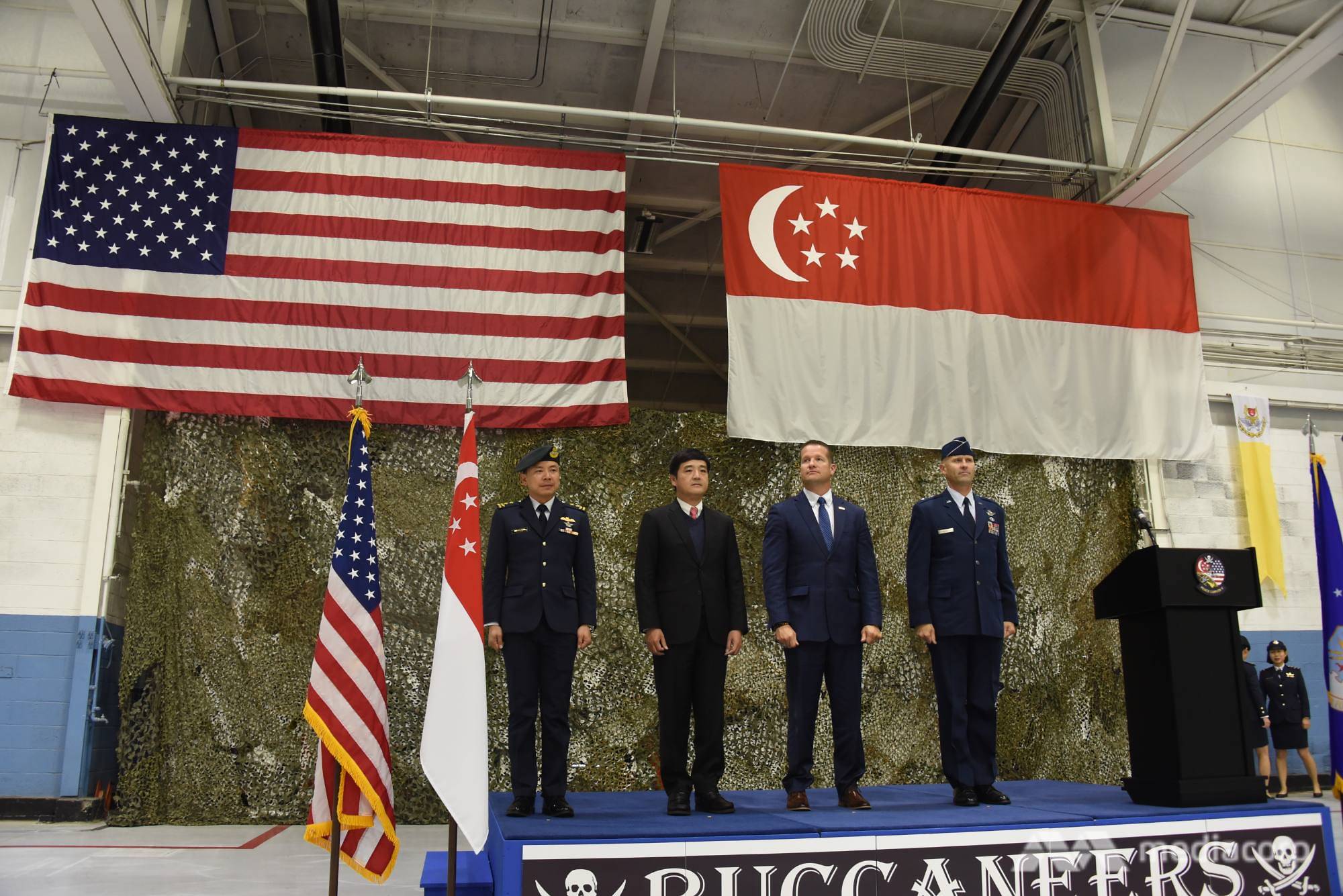
Senior Minister of State for Defence Heng Chee How (second from left) before the national anthems of both countries were played at the parade. (Photo: Aqil Haziq Mahmud)

The detachment celebrated its 10th anniversary on Thursday with a parade officiated by Senior Minister of State for Defence Heng Chee How, who said the occasion is testament to Singapore-United States defence ties that have “stood the test of time”.

“The confluence of our country’s strategic influences, and in mutual commitment to military interactions, have enabled us to develop our defence ties to be strong and excellent,” he said in a speech in front of a contingent of PC V personnel.

Peace Carvin Five 10th anniversary Heng Chee How inspection

Senior Minister of State for Defence Heng Chee How inspecting the parade. (Photo: Aqil Haziq Mahmud)

PC V is where RSAF crew like pilots, weapon systems officers, engineers and air warfare officers continue their training with the F-15SGs, benefiting from being close to vast overland airspace, live-firing facilities and experienced US fighter squadrons.

“I see Peace Carvin Five as the tip of the spear that the RSAF has,” LTC Oon said. “We’re here to have high-end training so as to sharpen the edge of all the men and women I have here. We are also here to push our operational boundaries.”

Peace Carvin Five 10th anniversary attendees

Spouses and children of Peace Carvin Five personnel attended the parade. (Photo: Aqil Haziq Mahmud)

LTC Oon added that the detachment “actively participates” with their counterparts from the USAF’s 366th Fighter Wing – which the PC V is under – in exercises and competitions held throughout the year.

“It is through our RSAF’s professionalism here that our American counterparts get to see us as a world-class air force here and treat us as equals,” he said. “So with this relationship, they will understand how we operate and be more willing to continue to work with us.”

Peace Carvin Five 10th anniversary national anthem

The national anthems of both countries were played. (Photo: Aqil Haziq Mahmud)

At the international level, the detachment most recently won the outstanding aircraft maintenance unit award at the Exercise Red Flag-Nellis in March, which saw the participation of the US, Belgium, the Netherlands, Norway, Saudi Arabia and the United Arab Emirates.

“We train with international partners and also make it deliberate to engage and reach out to these partners, firstly to improve our interoperability with each other, and more importantly to enhance our relationship (with other nations),” LTC Oon added.

Peace Carvin Five 10th anniversary 366th Fighter Wing commander

United States Air Force 366th Fighter Wing commander Colonel Richard Goodman. (Photo: Aqil Haziq Mahmud)

The RSAF has shown that its capabilities are “good and getting better”, said Colonel Richard Goodman, commander of the 366th Fighter Wing, also called the Gunfighters.

“So out here at the Mountain Home Range Complex, through exercises like Forging Sabre or Gunfighter flags, both in the air or on the ground, I’ve gained an appreciation for,” he said. “And again, everything I’ve seen is professional, lethal and ready.”

Peace Carvin Five 10th anniversary  Heng Chee How speech

Senior Minister of State for Defence Heng Chee How giving a speech at the PCV 10th anniversary parade. (Photo: Aqil Haziq Mahmud)

In his speech, Mr Heng thanked the 366th Fighter Wing “for being such a trusted partner and gracious host”.

“Let me now take this opportunity to thank the US government, the United States Air Force and our industry partners,” he said. “The rapid build-up of the F-15SG and the success of the PC V detachment are only possible because of your steadfast support throughout these 10 years.”

Mr Heng also unveiled a commemorative 10th anniversary tail flash on an F-15SG, symbolising the strong partnership between the RSAF and USAF.

Peace Carvin Five 10th anniversary Heng Chee How interaction

Senior Minister of State for Defence Heng Chee How interacting with servicemen and family from Peace Carvin Five. (Photo: Aqil Haziq Mahmud)

The PC V is the largest of the three RSAF detachments in the US, with about 375 personnel including spouses and children living on base or in the town of Mountain Home.

READ: ‘Small kampung’ far from wanton mee: Family of RSAF engineer describes ups and downs of life on US base

The RSAF also conducts flying training with the F-16C/Ds at the Peace Carvin II detachment at Luke Air Force Base, Arizona, and with the AH-64D Apaches at the Peace Vanguard detachment in Marana, also in Arizona.

Source link

AHTC case: What you need to know about the High Court judgment

0

SINGAPORE: Workers’ Party (WP) leaders have been found liable for the misuse of tens of millions in town council funds, the High Court ruled on Friday (Oct 11).

High Court judge Kannan Ramesh said that WP Members of Parliament Mr Low Thia Khiang and Ms Sylvia Lim were not only derelict in appointing a managing agent for Aljunied-Hougang Town Council (AHTC) without calling for a tender, they had also painted a narrative that was “misleading and not honest” in order to do so.

“Their conduct was improper and the attempt to cloak the same with a veneer of truth and credibility collectively leads to the conclusion that they had not acted honestly and therefore breached their duty of unflinching loyalty to AHTC as fiduciaries,” he said.

The judgment for the first stage of the landmark case, which Justice Ramesh likened to a “hydra” for its complexity, was given in a 329-page document.

This following is a summary of key points raised in the judgment:

Who’s involved and what were their roles?

AHTC trial

(From left) The Workers’ Party’s Pritam Singh, Low Thia Khiang and Sylvia Lim. 

The three main defendants are WP Members of Parliament for Aljunied GRC: Ms Sylvia Lim, who is also chairperson of the party, Mr Low Thia Khiang and WP secretary-general Pritam Singh.

They were elected as town councillors of Aljunied-Hougang Town Council (AHTC) following the 2011 General Elections.

The other defendants are:

  • AHTC councillors Mr David Chua Zhi Hon and Mr Kenneth Foo Seck Guan.
  • Mr Danny Loh, the town council’s secretary and Ms How Weng Fan, who held positions as deputy secretary and general manager.
  • FM Solution and Services (FMSS), AHTC’s managing agent, which was owned by Mr Loh and had Ms How as a director. As Mr Loh died in 2015, he is represented by his wife Ms How.

They were sued by AHTC and Pasir Ris-Punggol Town Council (PRPTC) on the back of audit reports, which flagged “serious flaws” in AHTC’s governance.

What were defendants accused of?

The plaintiffs alleged that the MPS and town councillors had breached their fiduciary duties in the following ways:

  • That they appointed FMSS as AHTC’s managing agent and awarded contracts for Essential Maintenance Services Unit (EMSU) services to the company without calling tenders.
  • That they failed to ensure meaningful oversight of payments to FMSS and its service provider FM Solutions & Integrated Services (FMSI).
  • That they improperly awarded contracts to companies for maintenance and other works in the estates they managed

What were they found in breach of?

The defendants are liable for most of the claims made against them, mainly for lapses in appointing FMSS as the AHTC managing agent without a tender.

There was also a lack of safeguards for payments to FMSS and FMSI, creating an “inherent risk of overpayment”, said Mr Ramesh.

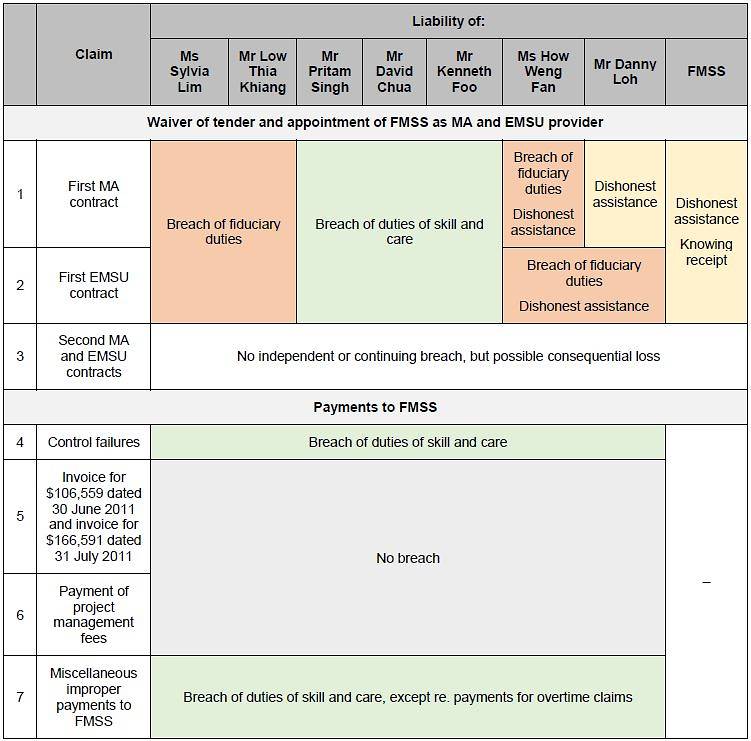
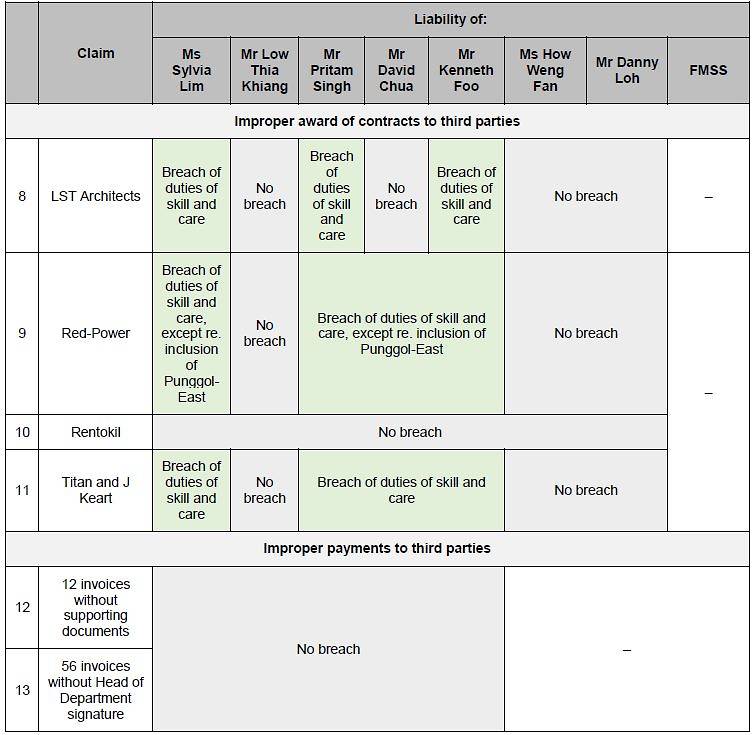
They were faulted for the contracts awarded to some third-party contractors. The defendants’ liabilities are summarised in the two tables below:

AHTC defendant's liability (2)

AHTC defendant's liability (1)

Appointment of FMSS as managing agent

The judge found that there was “a clear plan for FMSS to replace the incumbent managing agent CPG” after the 2011 GE, regardless of CPG’s intention to stay on or withdraw from its contract.

While Ms Lim and Mr Low had argued that they were forced to hire FMSS because CPG wanted to terminate its contract with the town council, the judge said that correspondence between the parties involved during that period showed that this was not the case.

“The defendants, or at least some of them, wanted CPG out. This means that the waiver of tender and the appointment of FMSS was not a contingency at all, but a fait accompli,” he said in the judgment.

One of the reasons was that Mr Low had a distrust of CPG and entities he thought were linked to the People’s Action Party, he added.

READ: Low explains reason for distrust of CPG, Davinder Singh says he’s lying to the court

READ: Defendants used residents’ hard-earned money to improve political standing, claims Davinder Singh

Mr Ramesh called the decision to waive the tender for a new managing agent “inexcusable”, as CPG was bound by contract to serve until mid-2013 and the circumstances were not urgent as claimed by the WP MPs.

“None of the town councillors explored the possibility of asking CPG to stay on for a longer period so that a tender could be called, even though there was nothing stopping them from doing so,” he noted.

Mr Low and Ms Lim had also made a “deliberate and calculated” move to keep CPG and the town council in the dark about their plan to appoint FMSS without a tender, the judge concluded.

“Political considerations”

The judge pointed out how Mr Low involved Mr Loh in the hiring of his own company by asking Mr Loh to help draft a report on the assessment of and the decision to appoint FMSS.

Ms Lim later circulated a revised version of the report and asked Ms How and Mr Loh to examine it to see if it would “pass the auditors’ eyes”.

“I find this to be quite extraordinary and casts serious doubt on the integrity of Ms Sylvia Lim,” said the judge.

“They should have been the last persons involved in any step in the process by which FMSS was appointed. Their conflict of interest is crystal clear.”

The way FMSS was appointed thus pointed to “extraneous considerations”, including politics and a “misguided sense of loyalty” to Hougang town council staff members who had worked with Mr Low for 20 years, said the judge.

“I am not suggesting that Mr Low Thia Khiang and Ms Sylvia Lim were expected to have no regard to any political considerations in making their decisions, which would surely be unrealistic,” said Justice Ramesh.

“However, they were expected to not subordinate the interests of AHTC, not to mention their statutory and fiduciary duties, to their own political interests.”

He found Ms How also liable as she was “heavily involved” in the award process, but said that Mr Singh’s involvement in these early events was less clear.

READ: Defendants acted ‘in good faith’ at all times, say lawyers in closing submissions

READ: Managing agent ‘enjoyed’ 300% profit increase as town council’s finances suffered, say lawyers

However, he, Mr Chua and Mr Foo should have asked about the circumstances of the waiver and thus have breached their duties of skill and care to AHTC.

Justice Ramesh made a similar ruling on a contract to have FMSS provide EMSU services to AHTC.

He added that the WP MPs painted a “misleading picture” to the public with a press release issued on Aug 5, 2011 which said that there was insufficient time to call a tender. 

“That was not the true picture and it camouflaged the real reasons why tender was waived. It is particularly unsatisfactory that this misleading narrative was conveyed to the public, and specifically the very constituents that the elected MPs were elected to serve,” he said.

“Improper payments” to FMSS and FMSI

People who were shareholders of FMSS were also tasked to approve payments from the town council to the company, the judge found, giving rise to conflicts of interest and “systemic” control failures.

“I find that the approval process for payments to FMSS was insufficiently rigorous given the involvement of the conflicted persons,” said Mr Ramesh.

Standing instructions for the payments to be co-signed by the AHTC chairman or vice-chairman was not a sufficient safeguard as there was no system for independent parties to verify each cheque, he added.

The judge also found breaches in the award of certain contracts to LST Architects, Red-Power Electrical Engineering, Titan Facilities Management and J Keart Alliances, a provider of fire-safety equipment and services.

What were they not found liable for?

One of the contracts the plaintiffs took issue with, awarded to Rentokil for pest control, was found to be justified.

READ: Defence produces email that disputes assertion AHTC breached town council rules

There were no breaches of duties for a total of 68 invoices for more than S$845,000 made to third-party contractors.

AHTC also did not show that payments of about S$1.2 million to FMSS for project management fees were unjustified.

What might they need to pay?

That has yet to be determined.

This first stage of the trial focuses on the defendants’ liability, a second stage is planned to assess the quantum of compensation that the plaintiffs – AHTC and PRPTC – are entitled to.

If the defendants are unable to pay damages, AHTC could commence bankruptcy proceedings against them, and the WP MPs may lose their parliamentary seats as undischarged bankrupts cannot be MPs nor contest in parliamentary elections.

Source link

‘Small kampung’ far from wanton mee: Family of RSAF engineer describes ups and downs of life on US base

0

BOISE, Idaho: When Ms Angelia Giam, 36, wakes up in Singapore craving for wanton noodles, she knows it is a short walk away at her usual hawker centre.

But it is a different story at the Mountain Home Air Force Base 14,000km away in Idaho, where nearby food options are Popeyes, Burger King and Taco Bell. “If you want something here, you have to make it yourself,” she told reporters at the base on Thursday (Oct 10).

Peace Carvin Five Lee and Chia kids playing

Damir (left) taking Fayth for a piggyback around the flight line. (Photo: Aqil Haziq Mahmud)

This is where Ms Giam lives with her husband Military Expert 2 (ME2) Lee Ban Chin, who is based there as a Republic of Singapore Air Force (RSAF) engineer. The 37-year-old maintains the F-15SG fighter jet as part of the Peace Carvin Five detachment, which celebrated its 10th anniversary on Thursday.

While ME2 Lee ensures the fighter jets are fit to fly, Ms Giam takes care of their four children: Clemens, 14; Damir, 12; Eytan, 5; and Fayth, 3. Their initials complete the first six letters of the alphabet. “He (ME2 Lee) is my employer,” Ms Giam joked, saying: “I cannot say that I don’t have a job.”

Peace Carvin Five Lee and Chia base exchange

Some of the dining options on the air base. (Photo: Aqil Haziq Mahmud)

Indeed her job starts at 6.30am, when she makes breakfast for the kids. Then she sees her two eldest sons off before they take a bus to school in the town of Mountain Home. Next up is feeding her toddlers, after which she sends Ethan to school on base and Fayth in Mountain Home.

“Everything ends at about 8.30am before I drive back to do some groceries and then start prepping for lunch and dinner,” she said.

Peace Carvin Five Lee and Chia eating carnival

Ms Giam reaching out for a gift. (Photo: Aqil Haziq Mahmud)

ME2 Lee and his family have lived in the US for two-and-a-half years now, with his stint ending at the end of next year. He had also completed a tour at the same detachment from 2014 to 2016. Then, the family was together too.

So when duty came calling again, it was an easy decision for Ms Giam to quit her job as an administrative executive at a local bank. “I have always been with him wherever he goes,” she said. “It was a no-brainer to follow.”

OVERCOMING OBSTACLES

But the determination to stick together as a family doesn’t come without challenges. Beyond the issue of convenience, Ms Giam said she misses the help she gets from relatives, while days at home eating alone with the kids can get boring.

There are also some obstacles in education, with only a kindergarten and primary school on base and a “limited” choice of schools in Mountain Home. Furthermore, the US school curriculum is different from the one in Singapore.

Peace Carvin Five Lee and Chia ring game

ME2 Lee carrying Fayth during a game as Clemens cheers. (Photo: Aqil Haziq Mahmud)

“When my eldest son was preparing for his Secondary 2 SPERS, I saw him struggle a lot,” Ms Giam said, noting that Clemens did not go through Primary 6. “His foundation is not that strong.”

SPERS refers to the School Placement Exercise for Returning Singaporeans, a posting exercise for students who want to join secondary schools at the Secondary 1, 2 or 3 level from the next academic year. Students will have to sit for an English and mathematics test.

Peace Carvin Five Lee and Chia Fayth

Fayth watching her brother get a prize. (Photo: Aqil Haziq Mahmud)

So after the kids return from school, they finish their homework then go through an online tuition programme which follows the Singapore curriculum. Ms Giam also prints out test papers from Singapore.

“There’s no choice; he just has to do it,” she said. “We try to replicate the Singaporean exam system when he was preparing for his (SPERS) exams.”

Peace Carvin Five Lee and Chia meal

The family enjoying a meal at the carnival. (Photo: Aqil Haziq Mahmud)

Ms Giam also tries to cook familiar dishes like chicken rice and the wanton noodles she misses, and when it gets lonely while her husband is at work, she invites the other Singaporean wives over for a meal, pot luck style.

The Singaporean community there celebrates holidays like Chinese New Year with small gatherings and the giving of hongbaos, and gets in touch with families to support them even before they uproot to the US.

It is a tight-knit community of about 375 RSAF personnel including spouses and children living on base and in Mountain Home.

EMBRACING CULTURE

However, that’s not to say that the Lee family lives in a bubble. Their children have made friends at school and enjoy going to proms and have sleepovers. Their neighbours are personnel from the US Air Force, so the kids play with each other.

“Their kids are running all around the neighbourhood; every evening they’ll ask my kids to come out and play,” ME2 Lee said. “To them it’s like a very small kampung, because the military kids also move around a lot. So typically, their friends are whoever that’s in the community.”

But Ms Giam said she still plays the role of an “Asian mum”, adding that she expects her kids to abide by a curfew even though they ask why their American peers do not have to.

Peace Carvin Five Lee and Chia cherry picking

The family on a cherry-picking trip in Idaho during warmer weather. (Photo: Lee Ban Chin)

On weekends, the family goes to the city of Boise, about an hour’s drive away, to do their groceries and take the kids outdoors. Activities are seasonal: Since it’s approaching Halloween, they have visited a pumpkin farm to check out the annual harvest.

“I’d like my kids to enjoy the experience here,” ME2 Lee said, adding that he’s grown fond of working with his counterparts from the US Air Force.

The Americans have been sporting too. Some have tried spicy dishes with chilli and curry, and had Chinese New Year reunion dinners with RSAF personnel who do not have family with them.

STICKING TOGETHER

Having his family around is something ME2 Lee does not take for granted. He met Ms Giam as a 16-year-old and they got together just before he started Basic Military Training. They married at 23 and have stuck together ever since.

“I’m grateful that she’s here,” ME2 Lee told CNA. “She gave up so many things – it’s not easy to give up her career and support from her family. She’s here only by herself.”

Peace Carvin Five Lee and Chia lever game

Fayth and Eytan try to score with their feet. (Photo: Aqil Haziq Mahmud)

At the carnival games during the anniversary celebration, the two eldest kids ran around winning goodie bags. Ms Giam crouched beside Fayth – adorably dressed as Elsa from “Frozen” – as the girl jumped on a lever to flip a toy fish into a hole. ME2 Lee carried Eytan as the boy cupped his ears, disturbed by the roar of a fighter jet flying low overhead.

Peace Carvin Five Lee and Chia Eytan

Eytan covering his ears. (Photo: Aqil Haziq Mahmud)

Earlier in the day when the family lined up for a photo next to an F-15SG, someone rattled off their initials: “A, B, C, D, E, F.” One of the older brothers looked straight at Ms Giam and kept repeating the letter “G”. She laughed and smiled.

Source link

NUS student allegedly stalked by man who tried to take upskirt photos of her

0

[ad_1]

A National University of Singapore (NUS) student was allegedly stalked by a man who tried to take upskirt photographs of her outside Kent Ridge MRT Station on Wednesday.

She has made a police report on the incident.

Police confirmed the report was made and said investigations are ongoing.

The student posted on social media that another commuter told her the man had been following her and had at one point knelt behind her, appearing to tie his shoelaces.

[ad_2]

Source link

Sex work in Singapore: Will changes to the Women’s Charter be enough to tackle exploitation?

0

SINGAPORE: Providing sexual services without payment, being made to work more than 13 hours a day and being asked to take “sexy photographs” of themselves – these were some of the ways nine Thai women were used as part of a vice syndicate in Singapore.

These are the types of women the Women’s Charter aims to protect.

Fifteen changes to the Women’s Charter – Singapore’s law to keep women and children safe – were laid out in Parliament on Monday (Oct 7), and revolved around sex work in the country. 

Prosecution against people who exploit women and girls for sex work remains tough, lawyers explained, because those in the sex trade are “trapped” and may struggle to report crimes against them to relevant authorities, lawyers said

More understanding of sex work in Singapore is needed to ensure women and girls are not exploited, NGOs and academics added. 

Among the amendments, harsher penalties for crimes like trafficking and exploiting children for sex were proposed. For trafficking women and girls, a first time offender could face a jail term of up to seven years and a maximum fine S$100,000 – a 10-fold increase from the current maximum fine.

READ: Jail, fine for ex-cop who had sex with prostitute tenants without disclosing HIV-positive status

People who trick women or girls to rope them into prostitution will also face a similar punishment.

The amendments do not only cover penalties – new definitions for brothels and extra-territorial powers to combat online vice were also tabled.

Sex work in Singapore is not strictly illegal, explained Mr Cory Wong, senior associate at Invictus Law Corporation.

“The way the law works in Singapore is that it does not outlaw prostitution, but it outlaws the activities linked to prostitution,” he said. These activities include advertising prostitution and living off the earnings of prostitution.

silhouette shot

Prosecution against people who exploit women and girls for sex work remains tough, lawyers explained, because those in the sex trade are “trapped” and struggle to report crimes against them. (Photo: Sutrisno Abdul Rahman)

In 1999, then Home Affairs Minister Wong Kan Seng explained in Parliament that prostitution per se is not an offence.

“Governments around the world and through the ages have tried to eradicate prostitution, but none had succeeded. Criminalising prostitution will only drive such activities underground, resulting in crime syndicates taking control over such activities,” Mr Wong had said when asked about what the ministry’s policy was on the sex trade.

The latest changes to the Charter were introduced on the same day a pimp Lee Si Hong pleaded guilty to bringing nine Thai women into Singapore for sex work.

The women were made to work for 13-and-a-half hours a day, servicing 26 to 28 customers without receiving payment. Starting at 10.30am every day, the women would only finish at around midnight. 

They would only be given S$80 for each subsequent client, but only after they had met the quota.

READ: Pimp managed Thai sex workers in 3 brothels, advertised their services on Sammyboy Forum

The changes to the Charter will look to increase the sentences meted out to people like Lee.

The amendments are to be welcomed but there is scope for more to be done, said Mr Michael Chiam, executive director at Hagar, an organisation which helps women and children who have endured trauma, including slavery, human rights abuse and human trafficking.

DIFFICULTIES IN PROSECUTION

Tougher penalties alone may not help, said Dr Alistair Cook, senior fellow at the Centre for Non-Traditional Security Studies (NTS Centre) at the S Rajaratnam School of International Studies (RSIS).

“The first motivation (for the changes) is that a higher penalty will act as a greater deterrent to human traffickers operating in Singapore. “The penalty increase will likely need to be accompanied by greater prosecution and conviction rates.”

But prosecution in some cases, like trafficking, is not easy.

“There are always challenges in prosecution,” he explained.

“The trafficked person may be the crucial witness to what exactly went on. If there are not protections in place for the trafficked person (offering a safe-house placement, etc) then it is difficult to get them involved in the case. This is made harder if they are overseas.”

Police raid brothel in Jurong West

Local authorities after a raid at a brothel in Jurong West.

READ: ‘Monster’ who prostituted wife, sexually assaulted 6-year-old daughter gets jail, caning

It is “always difficult” to track down the masterminds behind the exploitation of women and girls for sex work and hold them legally liable, said Ms Gloria James-Civetta, head lawyer at Gloria James-Civetta & Co.

These women and girls are often tricked into coming to Singapore with promises of a better life after paying hefty amounts of money to middlemen back home. 

They are then forced into sex work after reaching Singapore and not given the necessary work passes to stay in Singapore legally.

“These women and the girls are trapped and they would not report it to the relevant authorities since it is an offence to stay in Singapore without a valid work pass and they would risk being repatriated back to their home countries,” she said.

“They also risk their families back home being put in danger by the middlemen in the event the women or girls decide to report to the relevant Singapore authorities.”

The amendments are “useful” as they will form a deterrent function, the lawyer explained.

The Ministry of Home Affairs (MHA) said the new extra-territorial powers will help authorities deal with people who run overseas businesses offering sexual services in Singapore. 

Mr Wong from Invictus Law believes this amendment will help to prosecute offenders.

Currently, the section of the Charter dealing with such offences is “limited in its application to persons in Singapore who operate or maintain in Singapore a remote communication service that offers or facilitates, or organises, manages or supervises, the provision of sexual services”, according to the Bill.

“Vice activities perpetuated through online platforms, or online vice, are a serious concern,” said MHA.

“Vice syndicates have leveraged technology to facilitate their operations and extend their reach, with increasing sophistication in their modus operandi, by running their businesses remotely, often from overseas.”

READ: Jail for men who set up prostitution website in Singapore, living off S$71,000 earnings

In the case of Lee, he relied on online forum Sammyboy to advertise the women and their sexual services. He was working with an individual named as “Boss” who was based in Thailand to bring the women into Singapore.

“The prosecution can go on lesser charges such as going for the webmasters/advertisers to cast the net wider,” Mr Wong said.

“With more offenders apprehended, there may also therefore be potentially more prosecution witnesses who would tell on higher members in the syndicate for a stronger prosecution case,” he added.

DEFINING A BROTHEL

One amendment will see the definition of a brothel extended to cover any place that has been expressly or implicitly advertised or represented as being for the purpose of prostitution, or is likely to be used for sex work.

The current Charter states that a police officer not below the rank of Sergeant can provide evidence that a place has been used a brothel until proven otherwise. This makes it “quite easy to prove that a venue is a brothel”, Mr Wong explained.

“With the new definition, my view is that it simply adds examples of circumstantial evidence which can be used to secure the brothel definition.”

He explained that he had not encountered cases where it was difficult to establish that a venue could be a brothel because sex workers are often ready to admit that they had engaged in sex work at a venue.

Trials where both the sex workers and their upline flatly deny any prostitution is rare, Mr Wong added.

READ: Taxi driver who sublet condominium units to prostitutes jailed and fined

SPF Raid (7)

People arrested during a vice raid in Singapore in 2018. (Photo: Gaya Chandramohan)

MHA said the Bill will “strengthen the ability” to deal with landlords and tenants who let out their premises for vice activities.

Lee’s role in the syndicate involved making arrangements for a property to be rented to be used as a brothel. When he was arrested on Sep 19, 2018, items used for sex work such as condoms and lubricants were found.

Property owners must be meticulous, Dr Cook said.

“(The amendment) will be a disincentive for those property owners who previously turned a blind eye to the goings-on in their properties regarding sex crimes,” he said.

Under the proposed changes, homeowners and tenants will need to show that they had no knowledge of and could not, with “reasonable diligence”, have known that the place would be used for vice activities, should such activities be detected at their premises.

READ: Jail, fine for landlady who ‘turned a blind eye’ to prostitution activities

PROSTITUTION CANNOT BE “WISHED AWAY”

The law can only go so far.

It is easy to find disparaging comments hurled at sex workers online, implying their trade is “shameless” and that sex workers are “unvirtuous”. 

“Beyond amending the Women’s Charter, Singapore generally needs to take further steps in protecting women who voluntarily engage in sex work,” said Dr Kevin McGahan, a political science lecturer at the National University of Singapore (NUS) who specialises in the topics of human rights and trafficking.

“Both government agencies and civil society organisations in Singapore should work together to help empower sex workers and raise awareness about the many issues they confront – ranging from verbal abuse to discrimination to physical violence.”

abuse shot

File photo of man threatening a woman. (Photo: Sutrisno Abdul Rahman)

Mr Wong told Parliament in 1999 that MHA took “a pragmatic approach” of recognising that prostitution cannot be “totally suppressed or wished away”.

Tougher sentences are not the only way forward, Hagar’s Mr Chiam explained. 

He said: “While the harsher penalties may improve deterrence, this alone will not help eradicate the presence of vice activities if the demand for commercial sex continues. More needs to be done in the areas of education and awareness raising of such issues in Singapore.”

While the amendments are a good step in protecting women and girls from being exploited for sex work, they might not be enough.

“The deterrence may provide extra protection for female sex workers however, as online prostitution is becoming more extensive and sophisticated, it may become increasingly difficult to track women who are being trafficked,” said president of the Singapore Council of Women’s Organisations June Goh. 

“The enhanced penalties might not be sufficient if the vice syndicates are able to find a way to circumvent and avoid the law,” said Dr Goh. “Vice syndicates will continue to exploit sex workers as long as the benefits outweigh the penalties.”

Source link

Singer fined $30.6k for evading GST on branded goods bought overseas to sell on Instagram

0

[ad_1]

SINGAPORE – A local singer was fined $30,600 on Thursday (Oct 10) for not paying goods and services tax (GST) on branded goods that she bought overseas to sell here on Instagram.

The goods were worth over $205,980.

Singapore Customs said Nur Sarah Aqilah Sumathi, 35, had brought back to Singapore branded goods – such as handbags, wallets and shoes – she bought in Europe to sell them on Instagram between 2015 and 2017.

In 2017, Nur Sarah also started to provide personal shopping and concierge services for her clients during her travels overseas.

The Singaporean did not declare and pay GST on the 141 branded goods when she returned to Singapore, which Singapore Customs said amounted to $14,460 of GST evaded.

Nur Sarah was convicted of two charges of fraudulent evasion of GST and another five charges were taken into consideration during sentencing.

She was the winner of a 2009 singing competition called Anugerah, Malay television channel Suria’s version of Singapore Idol.

[ad_2]

Source link

SIA, Scoot flights to Japan affected ahead of Typhoon Hagibis

0

SINGAPORE: More than 10 flights to and from Japan this weekend by Singapore carriers have been affected by delays and cancellations, as Japan braced for a storm that could be the strongest to hit its capital in 60 years.

Typhoon Hagibis is due to make landfall on the main island of Honshu on Saturday (Oct 12), and is expected to bring record rainfall and gusts of up to 216kmh, said Japan’s meteorological agency.

Singapore Airlines (SIA) said several of its flights have been affected, with four flights departing ahead of schedule before the typhoon makes landfall.

Affected SIA flight routes include Los Angeles-Narita, Singapore-Kansai, Kansai-Singapore, Singapore-Nagoya and Nagoya-Singapore.

READ: Japan’s capital braces for what could be heaviest rain in 60 years

READ: Super typhoon approaches Japan, weather agency warns of ‘grave impact’

“We will provide further updates on flights serving Tokyo Haneda, and Tokyo Narita airports when we have more available information,” said SIA in an advisory on its website.

The airline’s low-cost arm Scoot said it has cancelled eight flights and retimed another seven. Flights to and from Tokyo and Osaka were cancelled, with customers re-accommodated to flights scheduled on Sunday and Monday.

Some of its flights to Kaohsiung and Taipei in Taiwan have also been delayed or cancelled.

Typhoon Hagibis

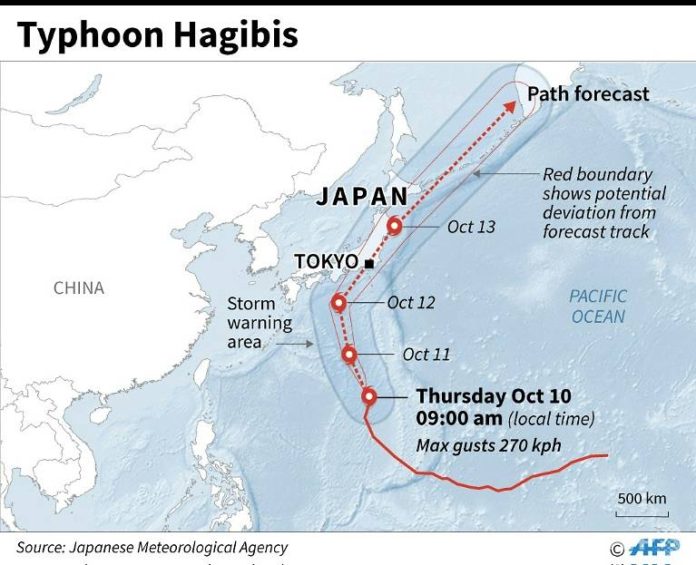
Map showing forecast path of typhoon Hagibis which is approaching Japan and threatens to disrupt the Rugby World Cup. (AFP/Laurence CHU)

Scoot said it is monitoring the situation for subsequent flights, and will notify customers by SMS or email for updates.

“As the situation remains fluid, customers are encouraged to prepare for possible contingencies in their travel plans, including purchasing travel insurance, during this period,” the airline said.

The storm is expected to cause transport chaos over a holiday weekend in Japan, with many forced to cancel travel plans.

READ: F1 cancels all Saturday running due to Typhoon Hagibis

READ: Rugby fans frustrated as typhoon disrupts World Cup

Japan’s two main airlines, All Nippon Airways and Japan Airlines, have cancelled hundreds of domestic flights. Bullet train services and local rail lines have also been suspended.

The storm has also disrupted a Formula One Grand Prix and rugby’s World Cup.

Japan is hit by around 20 typhoons a year, though the capital is not usually badly affected.

Hagibis is bearing down on the region just weeks after another powerful storm, Typhoon Faxai, hit the area with similar strength, killing two and causing major damage in Chiba, east of the capital.

More than 36,000 homes were damaged or destroyed in Chiba, and the local government has urged those in damaged buildings to take shelter elsewhere during the storm.

Source link