WHAT MUST YOU PROVE TO GET A DIVORCE BASED ON THE FACT OF ADULTERY?
According to section 95(3)(a) of the Women’s Charter, a divorce can be granted, based on fact of adultery, for a marriage that is at least 3 years old. The plaintiff (i.e. the spouse filing for divorce) must prove:
Their spouse has committed adultery; and
The plaintiff finds it intolerable for him or her to live with their spouse
An adulterer cannot use evidence of his or her own adultery to file for divorce.
WHAT CONSTITUTES ADULTERY?
Conventionally, voluntary extramarital sex constitutes adultery. It is immaterial whether the third-party is married as well.
It is also possible for extramarital homosexual affairs to constitute adultery.
WHAT EVIDENCE WILL YOU NEED IN ORDER TO PROVE ADULTERY?
A plaintiff who files for divorce must adduce evidence proving that adultery has taken place.
To do this, he or she may secure irrefutable proof, such as video evidence of the act.
Stomp contributor Jacky was about to board the train at Kallang MRT Station towards Tuas at 4.30pm when he saw the rider.
“It was a Sunday and the train as already crowded,” he said.
“He was moving back and forth which is why people were avoiding him and trying to keep a distance from him.”
Jacky said he decided not to board that train and waited for the next one.
“The potential for numerous injuries to many people is blatantly disregarded by that person,” he said.
“I reported the matter to Kallang MRT Station’s control station staff.”
According to the Land Transport Authority (LTA), commuters are allowed to bring their PMDs on public transport but they must keep their devices folded up at all times.
Commuters are advised to hold their device and not block doors and pathways.
An eight-year-old boy sustained a cut above his right eye while playing at the Mirror Maze attraction in Jewel Changi Airport’s Canopy Park on Wednesday last week.
According to Chinese-language newspaper Shin Min Daily News, the boy’s family are from Malaysia and had landed in Singapore after their holiday in Thailand.
They wanted to have dinner before going back to Johor Baru.
His mother, Ms Wen Meiqing, 40, told Shin Min that she and her husband had taken their two sons, aged 10 and eight, to Canopy Park. But she soon lost sight of her younger child as he was excited and was running around in the maze.
“Not long later, I heard him shout. When I found him, he was already injured and his glasses were cracked. There was also blood on his shirt and on the floor.”
SINGAPORE: Two Jurong Region Line stations will be designed and constructed by the Singapore branch of China Railway 11 Bureau Group, the Land Transport Authority said on Monday (Dec 9).
The S$210.1 million contract for the Jurong West and Bahar Junction stations also includes 1.15km of viaducts.
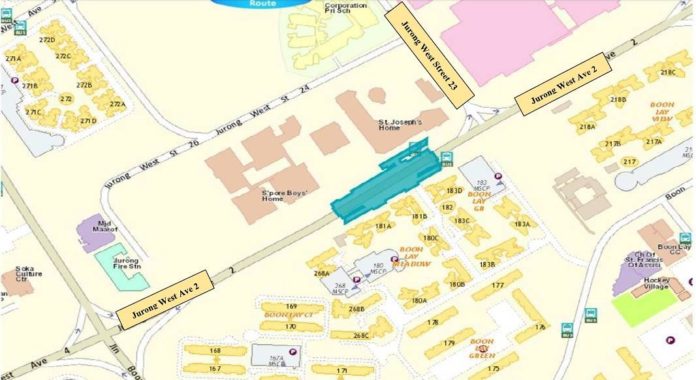
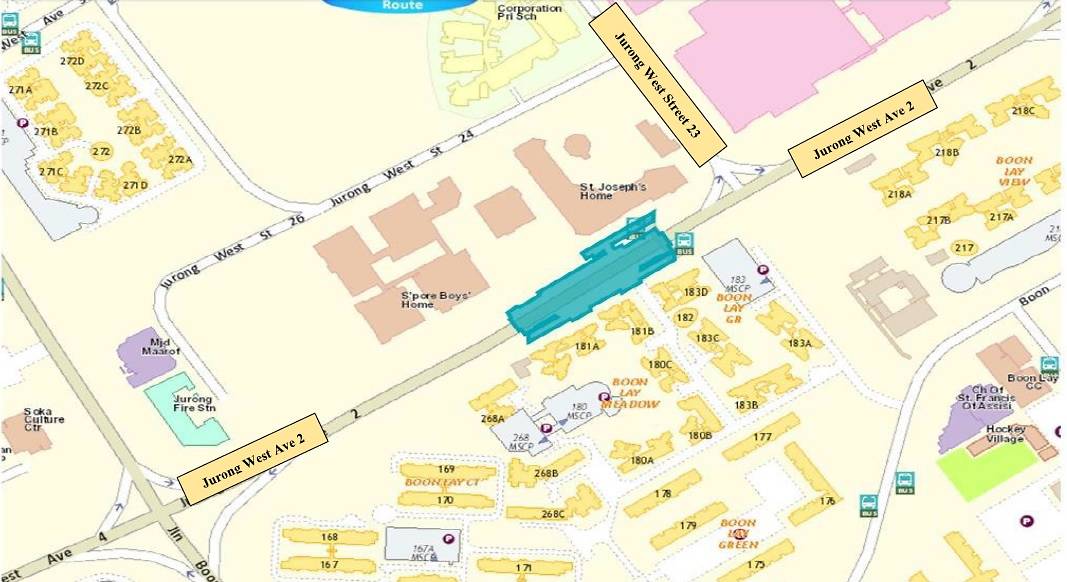
Jurong West station will be located along Jurong West Avenue 2, adjacent to Jurong West Street 23. The station will have a single island platform serving trains for both the Choa Chu Kang-bound and Jurong Pier-bound directions.
Location of Jurong West Station. (Image: Land Transport Authority)
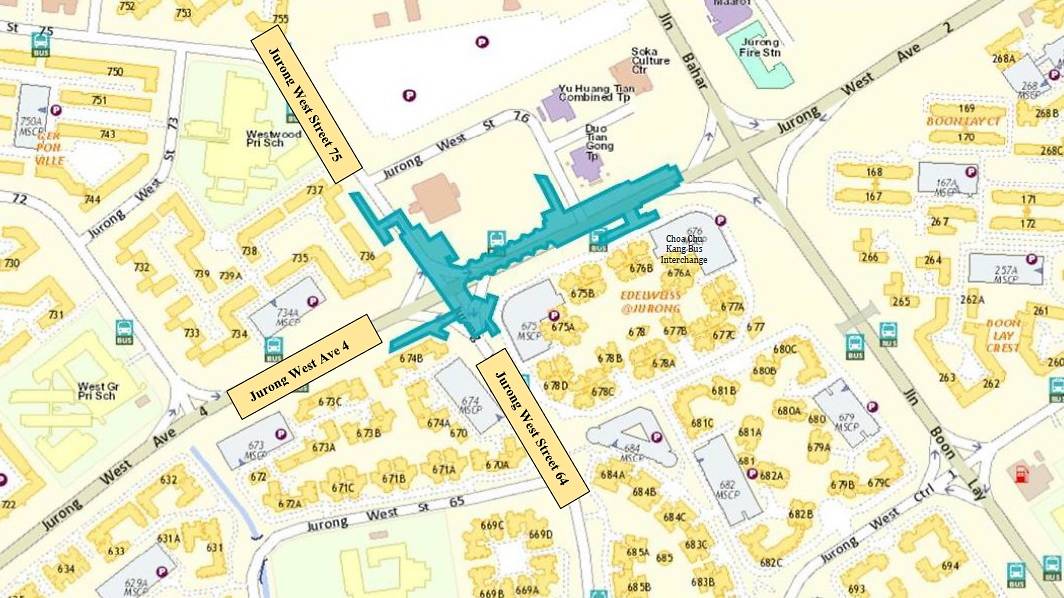
Bahar Junction station will be located along Jurong West Avenue 4, near the junction of Jurong West Street 64 and Street 75. It will have two platforms connected by a 100-metre covered link bridge with travellators.
One platform will serve trains heading to Choa Chu Kang and Jurong Pier while the other platform will serve trains heading to Peng Kang Hill.
Artist’s impression of Bahar Junction Station. (Image: Land Transport Authority)
Location of Bahar Junction Station. (Image: Land Transport Authority)
LTA said the Singapore branch of the China Railway 11 Bureau Group is an “established and experienced” construction company that has completed various rail-related projects worldwide.
The company has completed several major infrastructure projects in Singapore including three MRT stations – Tuas Link, Tuas West Road and Tuas Crescent stations – and their associated viaducts on the East-West Line’s Tuas West Extension.
“The company also constructed Singapore’s first integrated rail and road viaduct as part of the Tuas West Extension project,” LTA added.
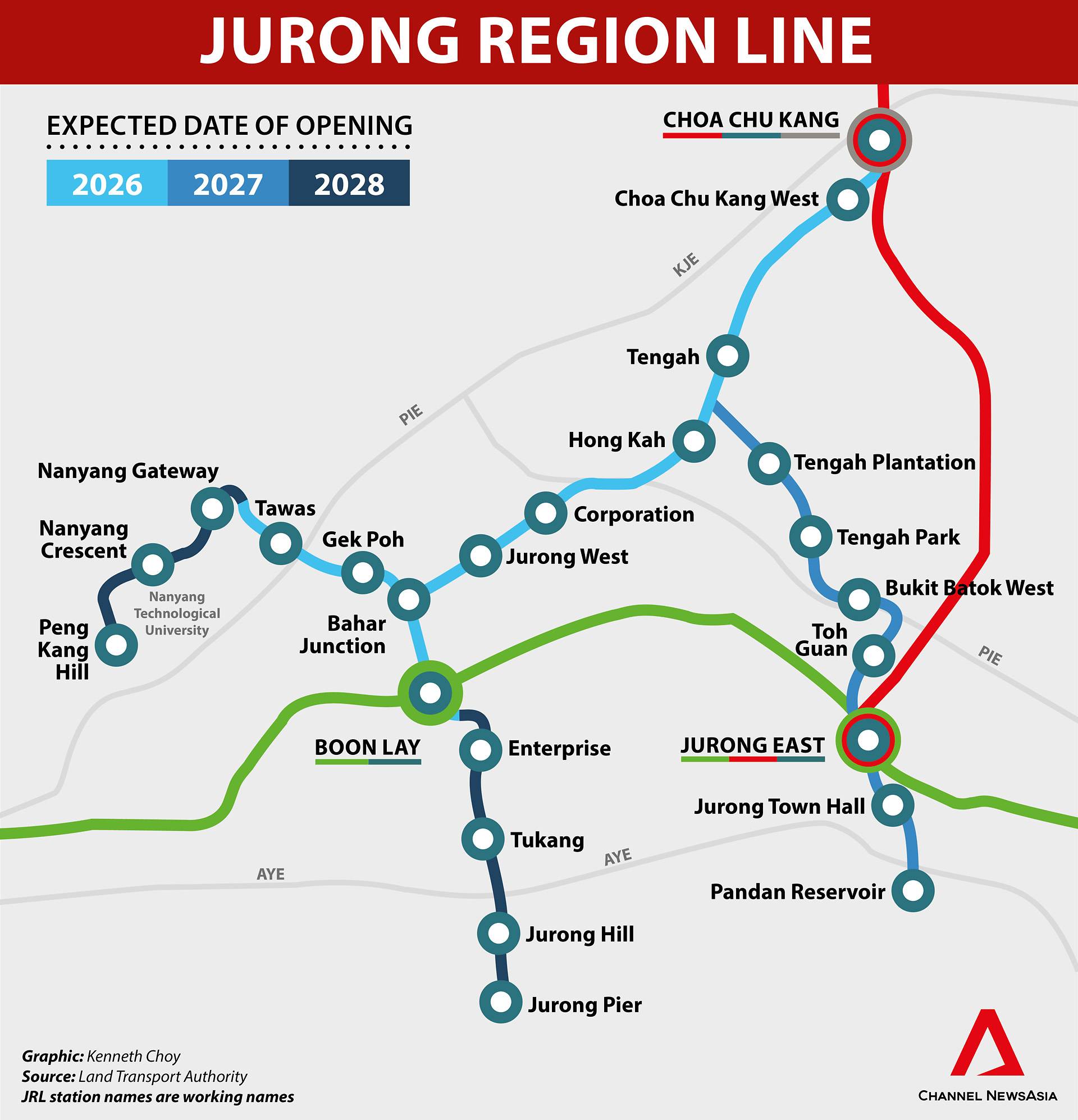
The Jurong Region Line is Singapore’s seventh MRT line, which will open in three stages starting from 2026.
The 24km-long line will have 24 stations above ground, and will connect with the North-South Line and East-West Line with interchange stations at Boon Lay, Choa Chu Kang and Jurong East MRT stations.
The Jurong Region Line is expected to serve 200,000 commuters daily in its initial phase of operation. This is expected to grow to more than 500,000 commuters daily in the longer term, according to LTA.
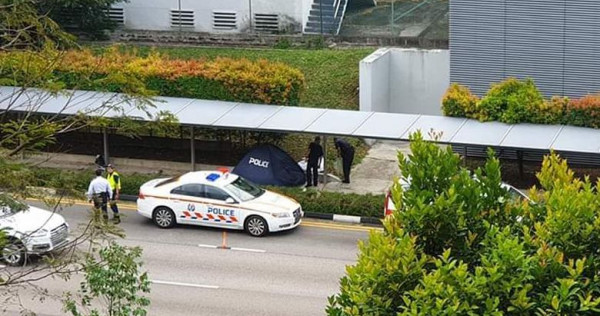
A 49-year-old woman was killed after a car went out of control and hit her while she was walking on a covered walkway outside Farrer Road MRT station in Bukit Timah.
The police said they were alerted at around 6am on Saturday to a hit-and-run accident involving a pedestrian and a car in Farrer Road, heading towards Queensway.
The victim, a Filipino domestic worker, was pronounced dead at the scene by a paramedic. The New Paper understands her name is Lyn Ocampo Santos.
The police subsequently arrested a suspect, 24, for causing death by dangerous driving.
Chinese-language evening daily Lianhe Wanbao said Ms Santos had taken a bus to the nearby Empress Road Market and Food Centre and was walking on the covered pavement when the accident happened.
She went there every morning to shop for groceries and would meet her sister, who also works in Singapore, and other maids at the food centre for breakfast.
The owner of an Indian food stall, who wanted to be known only as Mr Shahu, 59, told Wanbao that Ms Santos’ sister and friends were waiting for her to have breakfast that morning, but she did not turn up.
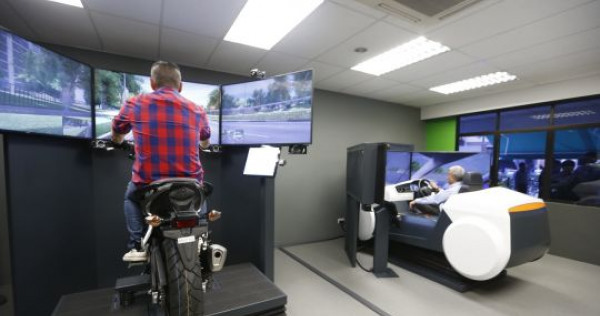
SINGAPORE – Learner motorists will be required to undergo driving or riding simulator training before being allowed to book their Practical Driving or Riding Tests with effect from Dec 16 this year.
All Class 2, 2A, 2B, 3 or 3A learner motorists will be required to complete the driving or riding simulator training, the police said on Saturday (Dec 7).
The training is only available at the ComfortDelGro Driving Centre, Bukit Batok Driving Centre and Singapore Safety Driving Centre.
The move is part of the traffic police’s efforts to help learner motorists better prepare for various road situations, and inculcate good and safe driving habits, the police said.
The simulator training, which comprises three modules, provides motorists with the opportunity to practise defensive driving or riding in a safe and controlled environment.
Each module takes between 15 and 20 minutes to complete, and includes scenarios based on the top 10 causes of traffic accidents which often result in injuries.
These include high-speed expressway cornering, cyclists in blind spots and driving or riding in wet weather conditions.
A man and a woman were arrested at East Coast Park for having an airsoft gun in their possession.
A police spokesman told The New Paper they received a call for assistance at Block 429 Woodlands Street 41 at around 2.20pm on Saturday.
The 34-year-old man and 30-year-old woman, believed to be a couple, were subsequently detained along East Coast Park Service Road in relation to the case.
Chinese newspaper Shin Min Daily News reported that an eyewitness, who did not want to be named, said there were about 10 police officers and several police cars at the scene.
There were also many onlookers, he said.
“It seemed they were conducting checks on a car. I also saw them questioning a man.”
He added: “While there was no cordon, it felt like the situation was serious.”
Shin Min reported that a member of the public is believed to have spotted the couple carrying the gun.
The police were in the area for about five hours and left around 7pm.
PHOTOS
Some netizens also posted photos of the incident online.
NEW CLARK CITY, Philippines: No permanent home turf. No proper lighting. No excuses.
The Singapore men’s softball team trained in less than ideal conditions prior to the 2019 SEA Games but emerged with the most ideal outcome on Sunday (Dec 8) when they beat Philippines 6-1 to clinch gold.
This is Singapore’s first softball gold in the history of the Games.
In doing so, the team broke the dominance of the Philippines whose men’s team had won the gold medal at the SEA Games all but once.
“It’s definitely not easy and I think we’ve managed to topple a giant this year,” said captain Ivan Ng. “It’s no easy feat for any of us but I think the team stuck through together and made sure we battled through. We are just so happy.”
The team has had to surmount stacked odds to achieve the giant-killing feat.
Singapore men’s softball team celebrate their historic gold at the 2019 SEA Games on Sunday Dec 8, 2019. (Photo: Sport Singapore)
After having to vacate their previous homeground at Kallang, they have been training at the Farrer Park fields since last year.
“It was very tough, it was a ground that was not ideal at all, because there’s a lot potholes and stuff. But at least we have a ground to train (at),” said head coach Diamond So.
This meant having to do things like weeding and flattening the ground to get it ready for practices, added Ng.
“It’s not the easiest of places because of the lighting … but also because of the terrain, the ground and we had a couple of minor injuries here and there,” he added.
“Our manager and our NSA (National Sport Association) were resourceful enough to get lighting, and the players did our part in weeding the ground and flattening the ground. Pretty much a lot of self-help.”
Singapore men’s softball team at the 2019 SEA Games on Sunday Dec 8, 2019. (Photo: Sport Singapore)
But this did not deter the team in pursuit of their gold, said Ng.
“We worked with our resources, the lighting and all. (We) brought in generators, pushed them in from one end of the field of another – whatever we could make use of,” said Ng.
“We try not to make any excuses for ourselves, we just make the best of it and train hard.”
Even before the Games, the team were seeing their efforts bear fruit.
At the Men’s Softball World Championship earlier this year, the team beat regional powerhouses Philippines.
“We first set sights on our gold medal right from our world championships earlier in June,” explained Ng. “When we beat them 4-3, we kind of knew there was a chance and to do so in their homeground, we knew it wasn’t going to be easy but we were up for the fight.”
But first, they had to overcome an 8-0 loss in the round-robin to the Philippines.
“We knew that we didn’t get a good start in that game for sure,” said Ng.
“As much as the victory went to them, I’m quite sure that they were well aware that they didn’t get any good hits off us. We weren’t at our top form as well … When we did our own reviews, we were much more ready for the playoff games.”
Singapore men’s softball team celebrate their historic gold at the 2019 SEA Games on Sunday Dec 8, 2019. (Photo: Sport Singapore)
The team rebounded back to beat the Philippines in the semi-finals 4-3 to secure an automatic spot to the finals.
“When we won the playoff match … we kind of knew we had a chance to go all the way out and make sure that we bring the gold back to Singapore and make history,” added Ng. “So the boys were all ready for battle right from the start.”
They called their victory “a dream come true”.
“I would say this is a dream come true, not only a dream that we had, the main thing is everyone who plays softball had this dream,” he said.
“(It was) not only my coaches – all the players, everyone that plays softball in Singapore wanted this win.”
Follow Mediacorp’s coverage of the 30th SEA Games and get the widest Team Singapore coverage with four LIVE channels on Toggle. Go to toggle.sg/seagames2019 for details.
SINGAPORE: When it comes to LGBTQ (lesbian, gay, bisexual, transsexual and queer) issues, a 22-year-old lamented how she and her mother could never see eye-to-eye.
The fresh graduate, who wanted to be known only as Ms Teo, said: “My mother doesn’t understand homosexuality at all. I’ve tried explaining to her over 500 times about 377A (the law that criminalises sex between men) and why I go to (LGBTQ rally) PinkDot, but she still doesn’t understand.”
While her mother conceded that she would try to be more accepting if one of her three daughters were gay, she still admitted to Ms Teo that she would not promote her colleague because she is lesbian.
“She just cannot and does not want to understand anything that is beyond her immediate surroundings … That is what I don’t understand (about the older generation). Why are these social issues not important to them?”
Like many of her peers, Ms Teo believes there is a divide between her and her parents, who are in their 50s, which appears impossible to bridge.
Generation gaps have existed since time immemorial. But the chasm between millennials and baby boomers has come under the spotlight, and taken a new twist — an insulting one from the older folks’ perspective — after a popular Internet meme became the retort of choice for youngsters fed up with the supposedly patronising, outdated and know-it-all ways of their elders.
The “OK boomer” phenomenon may have originated in the United States, but interviews with millennials and boomers in Singapore found that intergenerational quarrel had already broken out here long before the meme found its way here.
Millennials are generally defined as those born between 1981 and 1996, while baby boomers were born between 1946 and 1964.
Millennials, including those in Singapore, have taken to private Facebook groups to vent their frustrations by role-playing as baby boomers. They can be seen mocking the way older people use Internet abbreviations and make common spelling errors. As of Friday (Dec 6), one of these groups, called “a group we all pretend to be KIASU boomers”, has over 2,300 members.
For millennials all over the world, their frustrations run the gamut of social and domestic issues, such as fears surrounding job insecurity, changing values when it comes to family and marriage, and disagreements with their elders on social issues, such as the looming climate crisis.
The baby boomers, on the other hand, have expressed exasperation over millennials’ stubborn individualism and idealism. Though they recognise that their kids are growing up in different circumstances, they are still baffled by the youngsters’ motivations.
Some experts we spoke to believe young Singaporeans share some of the same worries expressed by millennials in other developed economies.
Assistant Professor Woo Jun Jie, a Singaporean academic from Education University of Hong Kong’ Department of Asian and Policy Studies, said: “These include rising home prices, stagnating wages, and an increasingly competitive job market that was fuelled by immigration. While real wages have been rising in Singapore, the unfortunate reality is that the rise in home prices have outpaced wage increases.”
Professor Chua Beng Huat, who is the Provost Chair Professor of the National University of Singapore’s (NUS) Department of Sociology, noted that millennials and Gen Z are unlikely to have the same economic opportunities that their elders had.
Among other things, baby boomers were able to accumulate wealth as they were the first generation to have dual-income professional families. They also benefited from opportunities provided by the reconstruction efforts after World War II, Prof Chua said.
These opportunities are unlikely to be repeated for post-boomers, he added.
DAY-TO-DAY FRICTION
Outside of the wider social issues, millennials and baby boomers who spoke to us said that clashes also arise from personal, day-to-day affairs.
For the millennials, common grievances include disagreements on jobs, marriage and family.
A woman walking in Singapore’s financial business district. (Photo: AFP/Roslan Rahman)
Ms Jasmine Hussain, 23, a postgraduate student at the University of Edinburgh, was seen as a “princess” by her parents for taking her time to decide what she wanted to do after she graduated.
“My dad said I was being so picky because instead of going for whatever job (that was out there). I wanted to wait out to find a job where I can do something that I enjoy,” she said.
Meanwhile, Ms Charlene Tan shared the arguments that she had with her parents over parenting styles.
The 34-year-old mother of two said disagreements over things such as food choices for her children were not uncommon.
She said: “There are certain things I would tell my mum not to feed the kids. But she would say, ‘you also ate this rubbish growing up’. That’s why there’re a lot of tensions along the way.”
For their part, the baby boomers said they see millennials as individualistic, idealistic and spendthrift.
“When we spend, we try to be thrifty. We would go for value-for-money food, cheap and good. Nowadays, young people always go to the food court, restaurants. They don’t go to the coffeeshops or hawker centres anymore” said Mr T P Neo, 64, a businessman in the building and construction industry.
Retiree Ivan Fu, 58, said that family discussions become more heated when the topic of family values is brought up.
He said: “We discuss a lot about the values today and the different generations seem to prioritise values differently … (The younger generation) would be more individualistic but my generation would be more focused on family values. It is a default responsibility for people my age, your family will come first and all your decisions are based on your family.
“Millennials are given a lot of choices today and they tend to sacrifice their family for passions and individual goals.”
While these discussions have never turned into shouting matches, Mr Fu believes that it is difficult to find common ground. “It will be a continuous communication and it never ends because it is just difficult to find the point of agreement,” he added.
A DIVIDE AMPLIFIED BY SOCIAL MEDIA
The “OK boomer” phrase started as a meme on social media platforms such as TikTok and Twitter. First, as a retort aimed at those who voiced criticisms on millennials and Generation Z, generally defined as those born after 1997. Then, it evolved into a viral meme on the social media app TikTok.
The TikTok video, which shows a 16-year-old girl holding up a sign that says “OK boomer” next to an unidentified man ranting about millennials and their inability to grow up, has been viewed over 15,000 times.
The phrase has since become the caustic, rallying cry of millennials and Gen Z all around the world, bandied about in response to social posts on social media that dwell on often-heard stereotypes of young people.
The young people who have used “OK boomer” said the snappy response encapsulates the collective exhaustion and exasperation that has built up over the years of trying to explain themselves to their elders.
Dr Crystal Abidin, a senior research fellow at Curtin University who specialises in Internet cultures, describes the meme as “a way of just ending a conversation and not investing energy in something that is a lost cause anyway”.
“OK boomer” has since found its way into the real world.
A 25-year-old New Zealand lawmaker, Ms Chloe Swarbrick, used the phrase in early November after being heckled by an older Member of Parliament while she was giving a speech supporting a climate crisis bill.
Green Party MP Chloe Swarbrick speaking in New Zealand parliament. (Screengrab: Facebook/Chloe Swarbrick)
But the chorus of youthful mockery has not been left unchallenged — it has received a significant pushback from the very group that the meme targets.
Much ink has been spilled about the meme in the old and new media after it entered the popular lexicon, with many arguing that “OK boomer” is an ageist epithet.
An article in The New York Times declared the end of “friendly generational relations” between millennials and baby boomers.
Experts we spoke to reiterated that generation gaps are not new and the supposed “generation war” between millennials and boomers only appears amplified because of the Internet.
Dr Abidin said: “This is not something that affects people on an everyday basis, as much as it’s quite prevalent (on the Internet). Virality in Internet culture is always going to be amplified to give the impression of scale.”
Nevertheless, the “OK boomer” phenomenon has thrown into relief the longstanding gripes that each generation has about the other, the experts said. The Internet has magnified these differences and made them more visible, they added.
As Associate Professor Lim Sun Sun put it, the anonymity of the Internet promotes “more unbridled expressions of differences where people are less conscious and respectful of social niceties”.
“So differences of opinion are expressed more sharply and could to some extent make social differences more pronounced,” said Assoc Prof Sun, who is also the head of Singapore University of Technology and Design’s School of Humanities.
REFLECTION OF SOCIO-ECONOMIC ANXIETIES IN US, UK
While the extent of the generational divide may be exaggerated by social media, experts noted that the “OK boomer” retort should not be dismissed as just a response used to entertain millennials at baby boomers’ expense.
Interviews with millennials and Gen Z conducted by The New York Times and Vox revealed that there are specific socio-economic anxieties that young people in the United States experience, but are too exhausted to articulate.
Concerns over climate change, economic instability, student-loan debt and job insecurity are among the common refrains echoed by the young people interviewed.
To top it all off, they are frustrated because they believe these problems were created by the choices made by generations that came before them.
Young people at a climate change rally in Singapore.
A Vice News report, backed by data from the US Federal Reserves, found that when baby boomers were the same age as millennials, they were much more well off than millennials today.
The data showed that back in 1989, when baby boomers were aged between 25 and 43, they owned 20.9 per cent of the country’s wealth.
This year, millennials are between 23 and 38, and they currently own 3.2 per cent of America’s’ wealth, which means that baby boomers had over six times as much wealth in 1989 compared to millennials today.
In the United Kingdom, a report by think-tank Resolution Foundation found that Britain’s young generation earned 8,000 pounds less during their 20s than their predecessors.
The report, which was released in 2016, highlighted that millennials today are faring significantly worse than those in Generation X during their first years of employment.
The data paints the bleak reality that has left these young people fatigued. The baby boomers have added insult to injury by not taking the younger generation’s worries seriously and by resisting the changes that millennials and Gen Z are urgently fighting for, the report said.
This fatigue is what makes this generational conflict different from the ones that had come before it, said Dr Holly Scott, an assistant professor of history at Piedmont Virginia Community College in the US, in response to our queries.
SITUATION IN SINGAPORE
There are currently no public studies available to show that intergenerational income mobility — the degree to which income status persists across generations within a family — has slowed for the millennial cohort in Singapore.
The most recent study, conducted in 2015 by Singapore’s Finance Ministry, found that for those aged 37 to 41 — who belong to Generation X — intergenerational income mobility in Singapore has remained high.
However, the study acknowledged that upward mobility for younger cohorts of Singaporeans would not be as easily achieved as the country’s development slows.
It said: “As the pace of Singapore’s development slows, it will be an increasing challenge to sustain such mobility in the future”.
While this is an indication that Singapore could face similar problems of slowing intergenerational income mobility in the future, they are at present still less pronounced in Singapore than elsewhere, some experts said.
The gulf between generations in Singapore has more to do with disagreements on the “softer” social issues, where boomers and millennials see things differently and where the younger generation is able to blame their elders directly for the existing situation, said Prof Chua.
Echoing his sentiments, Associate Professor Tan Ern Ser from NUS’ Sociology Department said that there is less cultural continuity between the baby boomers and millennials, as compared to the latter’s predecessors.
He said: “There is a high degree of cultural continuity between the baby boomers and Gen X and even older Gen Y, given that they subscribe to the same mobility game: Study hard, work hard, work smart, move up the social ladder, take care of family.”
Today, millennials are confronted with a different economic environment that requires practical skills on top of a degree — and this has fragmented the concept that baby boomers hold dear, said Assoc Prof Tan.
Recent studies conducted by CNA and the Institute of Policy Studies (IPS) revealed some of the issues where a clear difference in ideologies could be observed between the generations.
A door-to-door survey conducted by CNA between April and June, which involved over 1,200 respondents from different age groups, explored the views on issues such as the environment, foreign talent, LGBTQ and politics.
In particular, there were stark differences between the age groups on how they saw LGBTQ issues: When asked if they agreed, disagreed or were neutral to not exposing their child to LGBTQ influences, 69.8 per cent of baby boomers agreed. In contrast, only 39.6 per cent of millennials agreed.
Similarly, when the respondents were asked if they would have positive or negative emotions if their child were LGBTQ, 61.5 per cent of boomers indicated “negative” compared with 37.5 per cent of millennials.
Separately, an IPS survey conducted between August last year and January this year also showed that younger Singaporeans had become increasingly liberal towards homosexuality over the past five years.
The study involved 4,015 Singaporeans and permanent residents, and its findings were compared with the results of a similar survey conducted in 2013.
In 2013, 47.6 per cent of Singaporeans aged 18 to 25 felt that gay sex was always wrong but for the latest survey, the figure was nearly halved, to 25.4 per cent.
The proportion of Singaporeans from this age group who felt that gay sex was not wrong at all nearly tripled from 11.6 per cent to 30.2 per cent between 2013 and 2018.
In 2013, about 40 per cent of Singaporeans aged 18 to 25 believed gay marriage was always wrong. This fell to 23.9 per cent in 2018.
In response to our queries, a Pink Dot spokesperson said that young Singaporeans have more access to different platforms that provide LGBTQ content, and this, among other things, has led to a general increase in open-mindedness and acceptance towards the LGBTQ community among them.
Participants at a Pink Dot rally.
Ms Jean Chong, founder of women gay rights group Sayoni, noted that with more people coming out of the closet, it is likely that a young person would have a friend or a classmate who is LGBTQ, which has led to greater acceptance.
The baby boomers, on the other hand, came from a time when there was not much exposure on these issues.
“It came much later to them when they are much older. If you talk to many of (the baby boomers) they will say, ‘oh I don’t know any LGBTQ people’. But actually, they do know them. It’s just that (LGBTQ people) were not out (of the closet) during their time,” Ms Chong said.
ATTITUDES ON CLIMATE CHANGE
Climate change is another issue that has been perceived as dividing the young and the old, with young people generally viewed as more passionate about environmental causes.
For instance, millions of youths, inspired by Swedish teen activist Greta Thunberg, held protests in some 150 countries, to speak up about the impending effects of climate change.
World leaders, including Singapore’s Prime Minister Lee Hsien Loong, have also acknowledged a greater interest and concern among youths regarding climate change.
Environmental experts told us that youth leaders play a major role in influencing others in their generation to take on more active roles in tackling environmental issues.
Earth Society’s vice-president Low Chip Khoon said: “With youth leaders such as Greta Thunberg sounding off the alarm, the youths began to realise that if we do not do anything about climate change, they may not have a liveable planet to inherit from us (the older generation)”.
He added: “Youths are the ones who are more willing to make lifestyle changes like eating less meat, to help the planet. Most adults have not realised the urgency and seriousness of climate change.”
Climate change activist Greta Thunberg attends a news conference, before a climate change protest march, as COP25 climate summit is held in Madrid, Spain, December 6, 2019. REUTERS/Sergio Perez
Still, some experts pointed out that older Singaporeans might be just as concerned about the issue.
Ms Kia Jiehui, the principal strategist at Forum for the Future, a non-profit organisation that promotes sustainable practices in the workplace, said that the generational divide on climate change in Singapore is more of a question of different approaches than a “fundamental mismatch of ideals”.
Indeed, CNA’s survey revealed that both millennials and baby boomers were willing to protect the environment even at the expense of economic growth, with 86.5 per cent of millennials and 87.2 per cent of baby boomers agreeing to the trade-off.
DANGER OF FRAMING CONFLICTS AS ‘YOUNG VS OLD’
Some experts have warned against labelling the divide as a generational issue, arguing that the reality is much more complex than a matter of young versus old.
“It assumes entire generations are monolithic, and in many ways, scapegoat people who are also from the boomer generation but suffer from consequences of decisions made by others,” said Assistant Professor Walid Jumblatt Abdullah of Nanyang Technological University’s School of Social Sciences’ public policy and global affairs programme.
“Rather than looking at (the issues in terms of) boomers versus Generation X or millennials, I would rather look at things from the elite-masses, powerful-powerless, just-unjust angles.”
In a similar vein, Dr Scott argued in an opinion piece for The Washington Post that framing conflicts in generational terms can be dangerous.
Citing the example of student activism in the US in the 1960s, which was also framed as generational conflict, she said: “Getting bogged down in generation clashes ensured these problems went unresolved, and we run that risk again today if we distill our divisions into a generation gap.”
Asst Prof Walid reiterated that while there may be specific issues which different generations face, this by no means indicate a “generational war”.
To cast it as such would be ill-advised, he cautioned. “The phrase itself is patronising in many ways, implicitly or explicitly juxtaposing the cool, ‘woke’ millennial alongside a backward, older person,” he said.
BRIDGING THE GAP
There are no easy answers to bridging the divide between millennials and baby boomers.
Associate Professor Thang Leng Leng, the co-director of NUS’ Next Age Institute, suggested more dialogues to foster greater intergenerational understanding.
“We do the same for racial understanding, and understanding across genders. If people don’t know each other, they would imagine the worst … so I think we should do more for generational understanding,” Assoc Prof Thang said.
However, some millennials are doubtful that conversations are enough.
“I don’t think (these differences) can be bridged. Even if you have a lot of conversations, what we want is for our parents to come down to our level, but they don’t want to (do that),” said Ms Tan, the 34-year-old mother of two.
Mr G Tan, 56, believes that it is all about give and take.
When his 23-year-old daughter told him that she was dating a Caucasian man from the US, he was so upset that he did not want to speak to her for a few days.
Intercultural relationships were not common when he was growing up and he was afraid that his daughter, who was studying in the United Kingdom at the time, would emigrate overseas to be with him.
“I did not know his family background … and maybe it’s just tradition but her grandfather also didn’t approve. It came to a point where I was prepared to lose her,” Mr Tan said.
He gradually accepted it and learnt to see things from his daughter’s perspective.
He said: “Having four kids from the younger generation, you can’t outnumber them. So these are some things that we try to figure out, learn to accept and understand.”
SINGAPORE: More than 1,000 years ago, in Tang Dynasty China, the imperial examinations were everything.
Candidates were confined to tiny cells during the examination period, often for days at a time, eating and sleeping there.
The published results and rankings were of tremendous importance as they had the power to decide the social standing of an entire family and were used as a system of talent selection.
In fact, the examination system was a positive development for the poor as scholars from humble families used their results to transcend socioeconomic classes and become government officials, giving rise to a form of meritocracy.
Today, centuries later, metrics are still everything, especially in result-obsessed Singapore where every week brings us a new array of headlines of where we stand versus the rest of the world – including this week’s PISA results.
But while it’s useful to collect data, our obsession with rankings can also be dangerous for three reasons.
First, an obsession with maintaining rankings can ironically lead to the death of innovation.
I’ve seen this phenomenon in educational institutions where once they reach the top of the charts, they switch from playing offence to defence.
The entire system starts becoming risk-averse, paralysed by its own success, and no one at the top wants to tinker with the “winning formula” for fear of criticism and slipping down the rankings tables.
However, the brave new future necessitates making bold decisions that may appear counter-intuitive and unproven.
The iPhone XS and iPhone XS Max are displayed at the Apple Store in Singapore September 21, 2018. REUTERS/Edgar Su
For instance, Apple’s wildly successful iPhone, iPad and watch products were all widely derided as “white elephants” by the consumer tech industry when they were introduced.
On this front, I must commend the Ministry of Education in Singapore for making some progressive moves towards de-emphasising grades and encouraging more critical thinking, but we also need to have these messages trickle down to our educational institutions and educators.
While the Government is trying to instill a love for learning and the broadening of skillsets, these messages are still not yet fully integrated on the ground by educators.
I often hear from parents that it is commonplace for schoolchildren to be actively discouraged by their school teachers, and asked to “drop” subjects they are not deemed proficient in for fear of laggards dragging down the school rankings. This is the antithesis of the growth mindset we are trying in inculcate in our youth.
Secondary school students in a classroom in Singapore. (File photo: MOE)
In my line of work, I often meet educators in Singapore who cite rankings as an impediment to change.
On a training camp I conducted for more than 80 professors and educators, several educators said while they would dearly love to experiment with innovative teaching methods and formats, in practice they were discouraged to rock the boat by their superiors, deans and principals for fear of student and parent complaints.
“The number one rule is no student complaints”, said one teacher, shaking her head rigorously. Yet, innovation starts with conviction and courage, not dull consensus on the least controversial way to teach.
Second, rankings may divert attention away from what actually matters.
For example, as a student or parent, choosing a university is a huge decision and you may think that when you choose a top ranked university that you are paying for the quality of teaching you will receive.
However, the stark reality is that most university ranking calculations place much more emphasis on the quality and quantity of its research than they do on quality of teaching.
For instance, The Times Higher Education University Rankings, gives 60 per cent weighting to research and citations, and only 30 per cent on teaching metrics.
The QS survey is largely based on the opinion of academics. Many global university rankings do not even factor in teaching quality.
Students attending a mathematics class at a primary school. (File photo: TODAY)
Thus, it is, unfortunately, a common experience for educational institutions to “game” the rankings system using tactics such as discouraging professors from publishing research in journals deemed to be less prestigious (e.g. Southeast Asia studies), or using the bulk of their budget to hire prominent research professors who barely see students while outsourcing the actual “teaching burden” to junior teaching assistants
A SIGN OF INSECURITY
Third, overfocusing on rankings is a symptom of insecurity. In our avid desire to reach the top of the charts, if that is indeed what most Singaporeans would be prouder of, we give our power away to an outside authority to judge us on arbitrary measures of their deciding.
Is an education system better if it has higher average scores, or if there are less children left behind? How do we measure how much value our educators have added?
We measure our academic outcomes but do we pay as much attention to the prices we pay for them – anxiety, lack of psychological safety, depression and in some cases, suicide?
Why not put our focus to comparing ourselves in terms of what actually matters to us? If nothing else, it would force some societal reflection on our values and what outcomes we truly want for our youth.
Bhutan for instance has deliberately chosen to steer their focus away from using GDP as a measure of success to their own GNH (Gross National Happiness) index, which measures nine domains including psychological well-being, health, culture, education and ecology.
File picture of secondary school students in Singapore. (Photo: TODAY)
RANKINGS DO HAVE SOME UTILITY
However, I’m not saying that rankings are totally pointless. Last week I was speaking at an educational symposium organised by the Soros Foundation in Kazakhstan and graphics of ranking comparisons with the OECD were often used as a wake-up call to urge concerted effort towards focusing on challenges in literacy, maths and education resources.
It reminded me of my childhood growing up in Singapore when we were lower down on our development trajectory.
Fear of not surviving made us work harder, faster and spurred us on to advance to first world status in record time. But that was a simpler era.
We now live in a complex world of massive disruption where not even the best experts can predict the jobs of the future. Half of the companies on the S&P 500 will not exist in the next 10 years. More than half of the work tasks in the world can already be automated.
The human brain is not accustomed to change at this speed, not to mention the proliferation of new threats to the psyche such as digital addiction and social media. The result is that burnout, anxiety and depression are increasing at scary levels.
Some have said that the PISA finding that many Singapore students have a huge fear of failing may be a positive development if it spurs a pursuit of excellence.
Sure, fear of failure and loss of face may have been an effective motivator in the past, but now our youth are grappling with so much unpredictability, that what they need is empathy and encouragement to measure themselves against what they have achieved and how much they have grown.
File photo of A-level students receiving their results. (Photo: MOE)
It is useful that the Ministry has clarified that their intent in signing up for PISA isn’t about trying to beat every country but learning important areas for improvement for ourselves, and learning from countries who do well, in order to make the educational journey a positive one.
Indeed, we need educators who understand how to create an environment of psychological safety where our students feel accepted and included.
And we need Singapore leaders and Singaporeans to have the clarity of mind to decide what we want to stand for and the conviction to believe that we can be our own best judges – instead of relying on PISA scores for validation.