SINGAPORE – The number of fires related to personal mobility devices (PMDs) has reached its highest in five years.
There were 73 PMD-related fires in the first nine months of this year, the Singapore Civil Defence Force (SCDF) said in a Facebook post on Sunday (Dec 15).
This number is almost equal to the 74 fires involving these devices for the whole of last year. More of such fires have happened since September.
A man and an infant were taken to hospital on Oct 8 after a fire in a Bukit Batok flat, suspected to have been caused by a PMD.
And on Dec 5, a PMD that was being charged in a Clementi Housing Board common corridor caused a fire that led to three residents being evacuated.
Fires involving these devices have become increasingly common in recent years.
In 2017, there were 49 PMD-related fires, up from 14 in 2016 and just one in 2015.
A total of 71 victims were injured by these fires from 2016 to September this year.
SINGAPORE – A rare “ring of fire” will be visible on Boxing Day afternoon as the annular solar eclipse returns to Singapore skies for the first time in 20 years.
Areas in the southern half of Singapore, including Sentosa, Jurong, Bukit Timah and Changi, will be able to witness the phenomenon from about 11.30am to 3.20pm on Dec 26.
The Moon will cover about 94 per cent of the Sun’s surface leaving its outer edges visible in a “ring of fire” from about 1.22pm to 1.24pm.
The Astronomical Society of Singapore, in collaboration with the People Association, is hosting a viewing party at PAssion WaVe @ Jurong Lake Gardens from 11am to 4pm and setting up telescopes and binocularswith filters for enthusiasts to witness the rare sighting.
There will also be a live screening of the annular solar eclipse in a sheltered open area.
Organisers say they are expecting a crowd of about 500 to 1000.
President of the Astronomical Society Singapore Albert Ho said: “Our main issue is with the weather, it’s been raining consistently over the past week but hopefully we’ll still be able to see (the annular solar eclipse).”
SINGAPORE – The student union of Nanyang Technological University (NTU) has urged those on campus to stay indoors after a reported case of assault.
In an Instagram story posted by the NTU Student’s Union page at about 2am on Sunday (Dec 15), the union said: “NTUSU understands that there has been a recent reported case of assault that happened on campus.Those that were involved are currently aiding the police on their ongoing investigation.
“For your own safety and to better aid the ongoing investigations, we urge everyone who is currently in NTU to stay indoors,” the post read.
Students were also urged to “look out for one another” and dial campus security or the police if they saw anything suspicious.
In a tweet at about 8.45am, the university assured students that “there is no cause of concern for their safety on campus”, and that it was working with the police.
“An official statement would be released later today,” it said.
The Straits Times has contacted NTU and the police for more information.
SINGAPORE: Police are investigating a 19-year-old student from Nanyang Technological University (NTU) for making a false report over an alleged assault on campus, the authorities said on Sunday (Dec 15).
At about 1.45am, the NTU Students’ Union (NTUSU) published an Instagram Story advising members to stay indoors for their own safety after a “reported case of assault” on campus.
Screenshot of a message posted on Instagram by the Nanyang Technological University Student Union.
In response to queries sent at 3.30am, police sent a statement to CNA at 9.50am which urged the public to refrain from speculation to “avoid causing unnecessary alarm”.
“On Dec 14, 2019 at 6.24pm, the police were alerted to a case of an alleged assault on a female NTU student along Nanyang Walk,” the statement said.
“Investigations subsequently revealed that the 19-year-old student had provided false information to the police and the alleged assault did not occur. The police are investigating her for providing false information.”
The statement added: “The police would like to urge members of the public to refrain from commenting or speculating on the case so as to avoid causing unnecessary alarm.”
The police statement came as speculation on the incident emerged overnight.
Online platforms such as Mothership cited hall residents in NTU as saying that “loud noises” were heard around midnight. One of the sounds heard was like a “shotgun”, the report added.
In response to queries by CNA, police said that Gurkhas were deployed for this incident.
SINGAPORE: Shan Shan* approached one of our family service centres a number of years ago seeking financial help for her children.
Her husband’s mental health condition had deteriorated and he was no longer able to remain employed.
As a result, she became the sole breadwinner for her household of five. Shan Shan had been working in a hospital as a cleaner for a few months when she approached us for assistance.
She shared that because she spoke little English, she was afraid that she would not be able to interact with her colleagues in the hospital, especially her supervisors, the nurses and the other professionals.
A CARING SUPERVISOR
A few months into her new job at the hospital, however, Shan Shan’s supervisor, Raja*, began to take notice of her performance. He saw that she was able to complete her duties promptly and had an excellent work attitude.
Raja took it upon himself to plan and consider ways to help Shan Shan progress in her career. Raja had only a primary school education and had always struggled to find better paying jobs in the service industry.
When Raja first started working at the hospital, his supervisor identified his strengths and helped him find progress in his career.
Because of his experience, Raja believed extending that same helping hand should be something natural he also does for Shan Shan.
Furthermore, the hospital had an internal skills upgrading programme in place, and Raja made a recommendation for Shan Shan to be placed on the programme.
TRAINING
File picture of a hospital ward in Singapore. (Photo: SGH)
In the following two to three years, Shan Shan went through on-the-job training, external training courses and coaching to help her learn the ropes of a healthcare assistant.
Shan Shan struggled with juggling going for training courses and caring for her husband and young children at the same time.
However, because of the support she received in her workplace from her colleagues, as her social worker, I was able to focus on helping Shan Shan procure community resources to manage her caregiving responsibilities.
I also spent time helping Shan Shan find new ways to manage her caregiving and work stress, and provided counselling to tide her through difficult periods at work and at home.
Shan Shan eventually successfully completed her training and became a healthcare assistant. In addition to earning a better income, Shan Shan’s mood improved tremendously and she was generally happier and more confident.
NOT SO FORTUNATE
On the other hand, Daniel*, another client at our family service centre, wasn’t so fortunate. Daniel works long hours as a security guard. The hours are demanding and the work is exhausting.
Because of manpower constraints, Daniel often skips meals or takes only quick lunches during his shift work.
Even if he manages a lunch break, he does not have a place to rest. What bothers Daniel most is the low income he draws. It does not allow him to provide sufficiently for his family of four.
File photo of a Singapore security guard.
Daniel spoke often about how he found it difficult to secure a higher paying job because of his low educational qualifications. I asked Daniel from time to time if he had considered going for courses conducted by the various adult training centres in Singapore to equip himself with supervisory skills.
This way, he could at some point be promoted to a security supervisor, earning himself a better salary.
I also asked Daniel if his supervisor had encouraged him to go for courses and spoken to him on how he can progress in his career.
But Daniel often looked uncomfortable when I raised these issues. The company he works for is a small one, he reminded me.
He and his colleagues are always putting in overtime hours to cope with the number of projects the company has acquired. No one has time to think about going for courses, he said.
In addition, Daniel shared he found it hard to sit in class for long hours and stressful to take the compulsory assessments at the end of the courses.
“I never did well in school”, he lamented. In as much as the journey to upgrading may appear straightforward to many of us, to people like Daniel, it is an emotional, fearful and anxiety-provoking experience.
MORE MONEY IN THEORY, BUT PRACTICAL SUPPORT NEEDED
With the implementation of the Ministry of Manpower’s Progressive Wage Model for the security sector in 2016, both Shan Shan and Daniel now receive more income every month.
File photo of the Ministry of Manpower logo.
However, I noticed Shan Shan looked happier and sounded more confident about her work and financial situation compared to Daniel. She attributed this to the support she received from her supervisor and her workplace.
Shan Shan’s workplace had what human resource experts call a “growth culture” – a culture that values learning as a priority for everyone and all team members feel a sense of purpose in the work they do.
Employees believe they are contributing in meaningful ways to the whole organisation.
While there are many skills upgrading programmes available, employees thrive in workplaces that have their interest at heart. They do better in workplaces that create and implement learning and development structures that would help them achieve their aspirations.
News of new guidelines for companies to provide proper rest areas are also a right step in the direction to improve the work environment of low-wage workers in Singapore.
While these are good practices for all employers, the positive impact go beyond higher productivity and employee satisfaction. It provides upward mobility for low-wage workers.
EMPLOYERS MAKE THE DIFFERENCE
Shan Shan and Daniel’s experiences at their workplaces highlight how employers play a big part in helping to boost progress and social mobility in our society.
Low-wage workers face bigger challenges in keeping up with the fast pace of change at work. When employers adopt people-centric employment practices, and consider the well-being and potential of their low wage workers, they get a better shot at life.
A worker cleans a tunnel walkway in Singapore. (Photo: AFP/ROSLAN RAHMAN)
Daniel’s progress and experience could have been so much different if only his workplace recognises and supports the development of his abilities the way Shan Shan’s employer does.
Even small actions by employers can have an immense impact when it concerns the lives of low-wage workers.
They have a big stake in the development of an enabling environment where everyone of us feels supported and encouraged to do our best to realise our potential and contribute back to the workplace.
Cindy Ng is Head, MWS Family Service Centre – Tampines & Yishun at Methodist Welfare Services, and a social worker with extensive experience working with low-income families and persons experiencing violence and abuse.
SINGAPORE: I opened a huge envelope on Friday (Dec 13) containing what is now my fourth 2020 desk calendar and a greeting card.
Why do I need four desk calendars? Why do I need ANY? I don’t.
Like most people, the only calendar I use resides on my smartphone and is synced to my work emails and personal schedule.
But now I’m confronted with a huge moral dilemma pondering what to do with a gift like this, which was sent by a company with which I have had intermittent contact.
Frankly, the best case scenario is – where possible – to put them straight into the newsroom’s recycling bins. But some of these calendar have pages coated in plastic, making them tough to recycle.
However, a better solution would be for the givers not to send such wasteful items in the first place. After all, not only are things such as desk calendars largely redundant, they also rarely have the desired effect of creating a positive feeling about the companies which send them.
Nothing screams thoughtlessness like a pre-fabricated, mass-printed card that is as personal as the dozens of flyers that come through our mail boxes.
There wasn’t even a signature or a handwritten anything on the card accompanying the calendar.
I get it. There’s a huge list of Christmas greeting cards to get through, so why not leverage technology to reap economies of scale and let Microsoft Excel unshackle you from the actual need to think about something to write?
The power of automation has freed us from the mundane humdrum of meaningless tasks and surely doing up that corporate Christmas gift list must be the first to go.
A woman who’s incredibly frustrated. (Photo: Unsplash)
SO MANY WONDERFUL TIMES OF THE YEAR
Yes, it is that most wonderful time of the year again isn’t it?
Where pantries and snack corners in offices and workplaces will be filled with mostly unwanted gifts and suspiciously packaged foods. As the holiday season progresses, those areas will start to overflow, provoking the boss to send out a passive-aggressive office email implying we’ve all been barbarians and asking for the scourge to be cleaned out.
And as the pile of goodies grows, so the identities of the companies that sent them will be forgotten – if they’re even registered in the first place.
This nightmare isn’t unique to Christmas. Every Chinese New Year and Mid-Autumn Festival, this ghoulish cycle haunts us like an old photo post with the ex that Facebook keeps reminding you about every year.
The Mid-Autumn festival is perhaps the worst when it comes to meaningless corporate gifts that create mountains of waste.
Stalls selling mooncakes at a shopping mall in Singapore. (File Photo: Ang Hwee Min)
With the packaging getting ever more fancy, it fills me with horror when I see how each mooncake is sometimes wrapped in plastic, placed inside a plastic tray, which sits inside an individual cardboard container, which is stacked inside an even bigger cardboard box.
Corporate gift buyers should know that I’m not impressed by such intricate packaging – I’m appalled by it.
CORPORATE PROTOCOLS
It escapes me why so many companies still choose to participate in this annual mindless ritual of holiday gift-giving.
NUS Business School Assistant Professor Adelle Yang once suggested we buy gifts to wow the recipients and create a good impression of ourselves. This gift-as-self-advertisement argument seems like a sensible explanation that extends to organisations.
Understandably, corporate protocol dictates the primacy of form and custom, sometimes over substance. And so the number of recipients can only get larger over time.
The thinking usually goes: We’ve been doing this for years so what if someone notices that we’ve dropped them from our Christmas gift list and gets offended?
Unless you’re giving out Apple iPhone 11s (no one is, I checked), it’s safe to assume few will pick up on that.
Often, gifts end up as regifts, like a game of musical chairs until someone summons the courage to throw the darn thing away.
KILLING THE ENVIRONMENT
Much has been said about our profligate consumerism and the incredible amount of waste that goes to landfills, and yet this practice persists.
Look, I’m no Greta Thunberg but there’s something inconsistent about corporate norms when profit-driven companies say they want to honour the United Nations Sustainable Development Goals and factor emissions into investment decisions, yet carry on with useless gift-giving.
Market forces may be driving the private sector into the arms of climate action. But our animal spirits are stuck in the first industrial revolution.
Sadly, it’s not just the private sector which seems obsessed with conspicuous displays of largesse. Some of the biggest and most wasteful gifts I received were from climate change and environment-related organisations. I also get gifts from public-sector entities.
Hopefully, Minister for Environment and Water Resources Masagos Zulkifli talking this week about how the existential challenge of climate change requires global action will give some corporate gift-givers pause for thought.
This broader culture of gift-giving waste that needs serious rethinking includes burgeoning National Day Parade funpacks and ballooning conference welcome packs – gestures that aim to make you feel good about attending an event but which follow you home like a bad hangover after one too many glasses of prosecco and sits in your living room like an ugly wine stain.
We’ve passed the Resource Sustainability Bill but it looks like our Christmas greetings and gifts bill is something we need to look closer at.
The reusable funpack for NDP 2019. (Photo: Corine Tiah)
WASTE NOT WANT NOT
Economist Joel Waldfogel at the US National Bureau of Economic Research has been urging us to quit gift-giving for decades.
His 1993 groundbreaking research even shows there’s a huge deadweight loss when we buy presents for others. And that’s for people in our lives we really like.
If not gifts, then what? Economists suggest the best present is cash but I doubt outright bribery is on anyone’s wish list. Santa Claus may not be watching but CPIB will be.
How about a nice email of a few lines? As a writer, I relish it when people spend time selecting words to express appreciation.
If one really insists on a gesture, why not donate to a worthy cause in someone’s name? At least the money will be put to good use.
Otherwise, I say that no gift and no card is the best way to go.
Just please stop throwing all these things in my general direction. It’s not gifting. It’s spamming.
SINGAPORE: He was 18 years old when he received a job offer from a gaming company. Daryl Lim was thrilled; his parents were not.
It was not because he wanted to be a professional gamer — at least they had heard of that before. But what in the world was shoutcasting?
“It was like an alien language,” his mother, 56-year-old Charlene Yong, says about the first time she watched her son in action.
There were tiny characters running amok on the screen. There were flashes of red and blue, followed by some concoction of fireballs and magic dust. Throughout, his voice rang out, varying in speed and emotion.
As one of about 15 professional shoutcasters in the country, he commentates on e-sports matches to a live audience and online viewers.
He is at once the analyst and the entertainer, for a match that ranges anything between 20 minutes and an hour. Rarely does he allow a moment of silence to pass.
His role is one of many interesting e-sports jobs that are finding a footing in Singapore as the industry starts to open up and gain acceptance here.
“My mum was very sceptical upfront. She didn’t understand e-sports in the beginning,” recalls Daryl, now 24 and pursuing psychology and communications at university.
Daryl Lim with his parents.
But now she is a fan of his work and even encourages him to take a gap year in his education to shoutcast full-time.
While she still cannot say with confidence what he actually does, she knows he has worked hard to make it to tournaments overseas, is able to earn up to S$4,000 a month and has long-term career plans.
“I don’t know the game well, but we should make an effort to find out what’s going on in the industry,” says Yong, a human resources consultant. “We have to be extremely open-minded about taking (e-sports) as a profession.”
Her son discovered professional shoutcasting in 2012, when e-sports tournaments in the United States and Europe started to become glamorous.
“Like football and basketball, at the very high level, there’s a demand to watch professionals play,” he says. “So the natural thing was to have someone explaining and hyping up the action as the game was going on.”
WATCH: My life as a professional shoutcaster (5:20)
What used to be informal gatherings in game cafes evolved into sold-out shows in arenas and millions of viewers watching online.
In particular, the second season of the League of Legends World Championship — the annual finale for the battle action game — sparked Daryl’s interest.
“They had shoutcasters who were extremely good. There were multiple camera angles on them, the lighting was great, and the music was on point,” he recalls.
The fact that a gaming event “could be this professional” — and its US$2 million prize pool — convinced him that the role was one he could take seriously.
Granted, Singapore’s e-sports scene at the time was nowhere near the more developed markets. But opportunities were coming.
In fact, as he began looking into shoutcasting, local gaming company Sea, then known as Garena, was having an audition for League of Legends shoutcasters to join its existing batch of five. He decided to give it a shot.
After all, he played the game decently, he knew enough about the prominent teams and players, and he loved to talk. But when his big moment came, words failed him. So he was asked to man the in-game cameras instead.
Even now he considers himself lucky, as that was how he set foot in the local gaming industry.
NOT JUST ABOUT PLAYING
Shoutcasting was harder than Daryl imagined because in League of Legends, spontaneous fights happen throughout the game as opponents try to conquer each other’s bases.
“There’s no actual indicator that a team’s going to win a fight until it happens,” he explains. And amid the frenzy, shoutcasters must focus and pick out the most important move to talk about in a split second.
In his first audition, his mind was whirling “a mile a minute” instead. “I couldn’t translate my thoughts into words, and when they came out, they just didn’t make sense,” he admits.
It took him a year of understudying and practice before he could take the stage at a live event.
For one thing, he had to pick up better vocabulary and phrases to sound interesting. He had to train himself to speak with more energy and to vary his pace during the ups and downs of the play.
Primers for play-by-play vocabulary were a good place to start for Daryl.
Throw in the need to simplify the game’s concepts in real time, and it becomes clear that what makes a good shoutcaster also has less to do with knowing the actual game.
The one thing he must do for every match, Daryl says, is to research the players and teams so that he can convey the importance of the tournament.
“What makes you a return viewer is (you) being invested in (whether) that team wins,” he says.
So whether it is two sisters competing together for the first time, a team making its seventh attempt to win a championship or a prominent player whose signature move flopped, Daryl must know that history like the back of his hand.
No more is he the teenage boy who played hours of games and neglected his homework. Today, his love of gaming is purposeful, and his parents are convinced.
Daryl’s hard work, professionalism and decent salary convinced his parents.
“There’s that facet of discipline — to get up for your gig, prepare properly and dress the part. Then, let the results show,” he says.
In between studying at school, reading voraciously and spending time with family and friends, he has worked hard at making a name for himself as a shoutcaster.
As a freelancer, he can get four or five jobs a month and earn hundreds or even a thousand dollars from each, depending on the scale of the event.
Last year, he was hired to shoutcast overseas for the first time — in Hong Kong, Shanghai and Bangkok. His parents tuned in to the livestream to catch a glimpse of him, never mind that they could not decipher his speech.
He shoutcast at the ICBC (Asia) E-Sports and Music Festival, Hong Kong’s largest e-sports extravaganza.
“Gaming is something I’m not familiar with, but he knows what he’s doing,” says his father, 57-year-old Alex Lim. “And with the happiness he’s gained from working in this line, there’s no reason I should stop him.”
Figures from e-sports market research firm Newzoo also show that the industry is a force to be reckoned with. Since Daryl started shoutcasting in 2015, global e-sports viewership has doubled to 453.8 million. Global annual revenue has grown, on average, by more than 30 per cent.
In Singapore, the tide is also turning: Support for the industry was brought up in parliament; the first Asian edition of gamescom, the world’s largest gaming festival, will be held here next year; and gaming company Razer is spending S$10 million to grow the local e-sports and gaming scene.
With the industry abuzz, the Singapore Cybersports and Online Gaming Association (SCOGA), which has been around since 2008, is seeing more parents concerned with helping their children with a career in e-sports and gaming.
“We do see a shift from parents saying ‘my child’s addicted to gaming, what do I do?’ to ‘if my child wants a career in e-sports, is it viable?’” says SCOGA chairman Nicholas Khoo, 41.
The association, which runs the country’s first e-sports academy, has seen parents of children as young as nine years old enquiring about its courses. These include foundation and master classes for various games, live-streaming and even e-sports journalism.
And when it held a career talk by an e-sports coach this year, half of the attendees were parents, when there were only youth in the past.
“We hope to provide more clarity in terms of career pathways so parents will be more assured,” says Khoo.
PAYING IT FORWARD
Having ventured successfully into shoutcasting, Daryl also wants to help gaming enthusiasts, like him, tread those paths.
Paying it forward by running a workshop. (Photo credit: SCOGA)
He wrote to the SCOGA, and in May, they started a mentorship programme together, where he covers topics from shoutcasting tips to conducting business as a freelancer.
“E-sports really did change my life for the better,” he says. “I’d be very happy if I could change one person’s life through e-sports also.”
Of the 30 youth who attended his class, four were chosen to debut live at the SCOGA’s annual Campus Game Fest (CGF), held in August at the Singapore Indoor Stadium for the first time since it rolled out in 2013.
One mentee, in particular, quite reminds Daryl of himself. Lim Chu Farn has been his understudy at various tournaments since the CGF and has got at least three shoutcasting jobs after the mentorship programme.
Daryl with Lim Chu Farn.
“The local industry is much larger than I expected,” says the 18-year-old, who is in his second year studying game design at polytechnic. And it will get better with efforts to bring in new talent, he adds.
All that said, his mentor is not looking to shoutcast for the long haul. Daryl has set his sights further: “I want to transition into working with (e-sports) players, maybe as a sports psychologist or sports therapist.”
He takes his inspiration from e-sports psychologist Mia Stellberg, who has made the news for her role in bringing teams like Germany’s SK Gaming, Denmark’s Astralis and, most recently, European-based OG to victory.
“Hopefully, we come to a point where (such jobs) become more common in Singapore,” he says.
For now, he will continue shouting into computer screens.
After graduation, he plans to shoutcast full-time first.
SINGAPORE: The Singapore Democratic Party (SDP) has been directed to correct two Facebook posts and an article on its website that are related to manpower issues, the authorities said on Saturday (Dec 14).
“The Minister for Manpower (MOM) has instructed the POFMA Office to issue three Correction Directions (CD) to the Singapore Democratic Party (SDP), on the false statements made in two Facebook posts and a website article by SDP,” said the POFMA Office in a news release on Saturday (Dec 14).
“The Correction Directions require SDP to carry in full, the correction notice at the top of both the Facebook posts, as well as the website article,” it said.
The Ministry of Manpower (MOM) in a separate release on Saturday said that SDP’s posts and article on Singapore’s population policy contained “a misleading graphic and false statement of facts”.
A correction direction is issued to a person who has communicated a falsehood that affects the public interest, the POFMA Office said.
It requires the recipient to publish a correction notice with the facts, but does not require the post to be taken down or edits made. The order also does not impose criminal sanctions.
This is the third time correction directions have been issued since the Protection from Online Falsehoods and Manipulation Act (POFMA) came into force in October. Previously, directions were issued to Progress Singapore Party (PSP) member Brad Bowyer and the States Times Review.
NO RISING TREND OF LOCAL PMET RETRENCHMENTS
On Dec 2, 2019, the SDP published a sponsored Facebook post with a graphic depicting plunging local PMET employment.
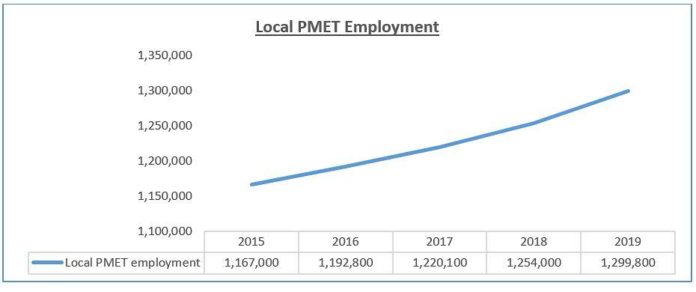
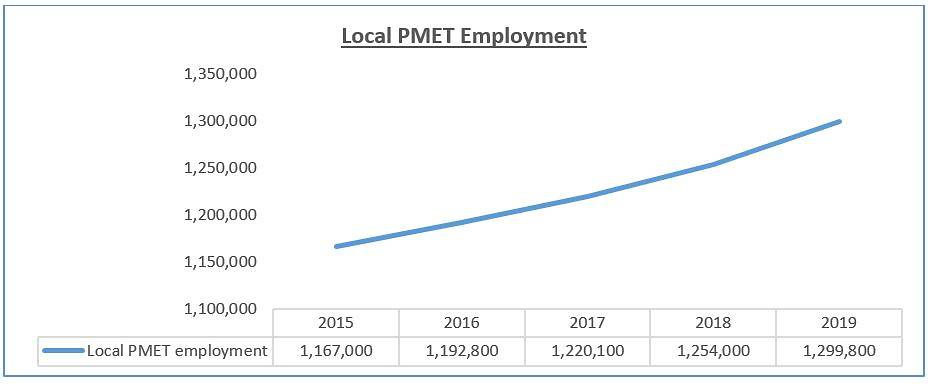
MOM said that the graphic was wrong, citing its Comprehensive Labour Force Survey, which shows the employment of local PMETs has risen steadily since 2015.
According to the Government’s Factually website, the number of local PMETs employed has increased from 1.17 million in 2015 to 1.30 million in 2019, with the local PMET share as a proportion of the total local workforce increasing from 54 per cent in 2015 to 58 per cent in 2019.
“The CDs will require SDP to carry a correction notice stating that its sponsored Facebook post, the post on its Facebook page, as well as the article on its website, contain a misleading graphic and false statement of facts,” said MOM.
The number of local PMETs employed has increased from 1.17 million in 2015 to 1.30 million in 2019. (Image: www.gov.sg)
Both SDP’s sponsored Facebook post on Dec 2 and another Facebook post on Nov 30 link to an article on the SDP website published on Jun 8 titled SDP Population Policy: Hire S’poreans First, Retrench S’poreans last.
In the press release, MOM noted that the article contains the statement: “The SDP’s proposal comes amidst a rising proportion of Singaporean PMETs getting retrenched”.
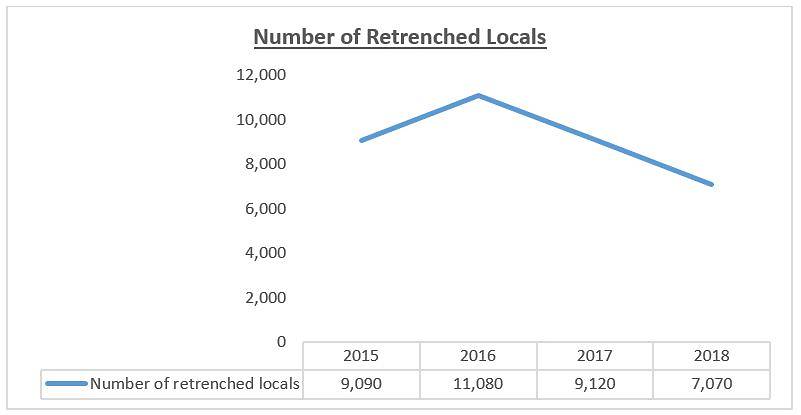
MOM refuted the statement, and said there is no rising trend of local PMET retrenchments. On the Factually website, it is stated that there has been no rising trend of local retrenchments since 2015.
There has been no rising trend of local retrenchments since 2015. (Image: www.gov.sg)
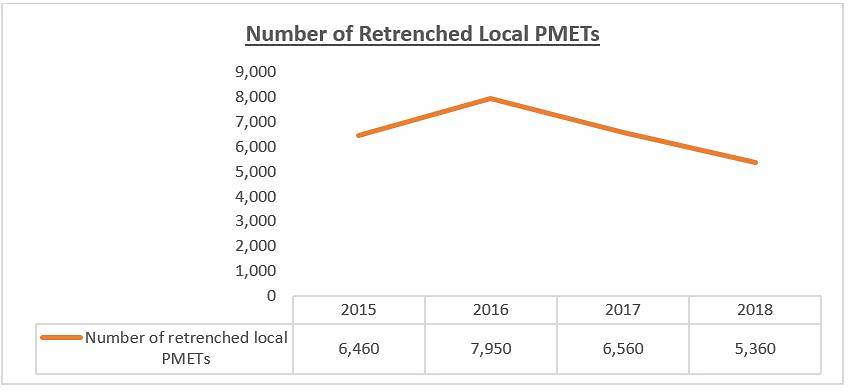
There has also been no rising trend of local PMET retrenchments since 2015, with the number of retrenched local PMETs has declined from 6,460 in 2015 to 5,360 in 2018, the lowest since 2014.
The number of retrenched local PMETs has declined from 6,460 in 2015 to 5,360 in 2018, the lowest since 2014. (Image: www.gov.sg)
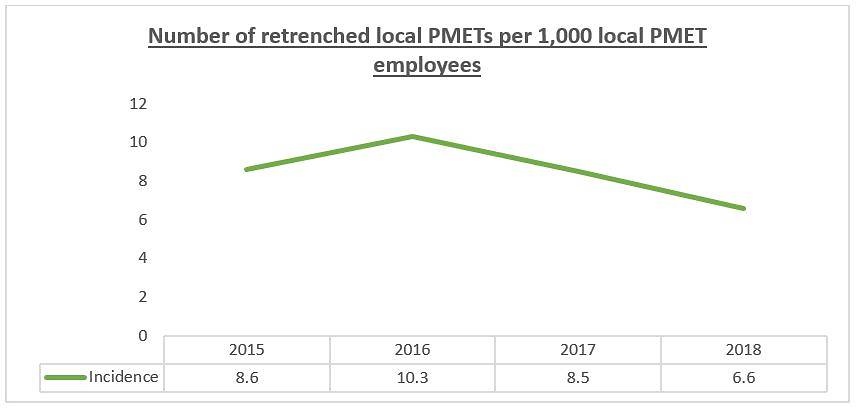
The number of local PMETs retrenched as a share of all local PMET employees has also declined since 2015.
The number of local PMETs retrenched as a share of all local PMET employees has also declined since 2015. (Image: www.gov.sg)
“The number of local PMETs retrenched in 2018 was, in fact, the lowest since 2014. Local PMETs retrenched as a proportion of all local PMET employees, has also declined since 2015,” said MOM.
“The Singapore economy is continuing to create jobs despite the economic headwinds. Local PMET employment has increased consistently. There is no rising trend of retrenchment, whether amongst PMETs or otherwise.”
On the Factually website, the Government also issued a clarification on Foreign PMETs.
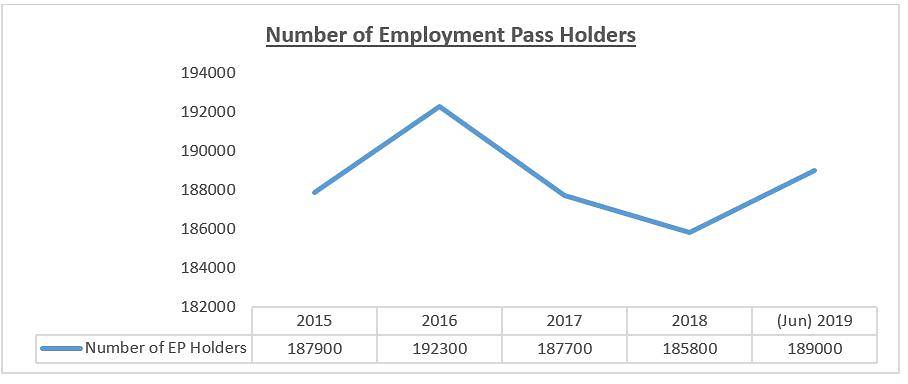
“The number of Employment Pass (EP) holders has historically fluctuated depending on economic conditions,” it said.
“EP qualifying salaries are also regularly adjusted to safeguard employment of local PMETs.”
As a result, local PMET employment has continued to grow while the number of EP holders in Singapore remained stable, ranging from 187,900 in 2015 to 185,800 in 2018. The latest figure as of Jun 2019 is 189,000.
The number of Employment Pass holders has historically fluctuated depending on economic conditions. (Image: www.gov.sg)
“FALSE AND MISLEADING STATEMENTS”
MOM said that it is understandable that some Singaporeans would feel anxious about employment prospects and retrenchments given the current uncertain economic climate.
“This makes it all the more critical that public debate on the important issue of jobs is based on accurate facts, and not distortions or falsehoods,” said the ministry.
“These false and misleading statements by the SDP have a singular objective – to stoke fear and anxiety among local PMETs. It is important to set the facts straight so that Singaporeans are not misled.”
When contacted by CNA, the SDP said it is looking into the directions.
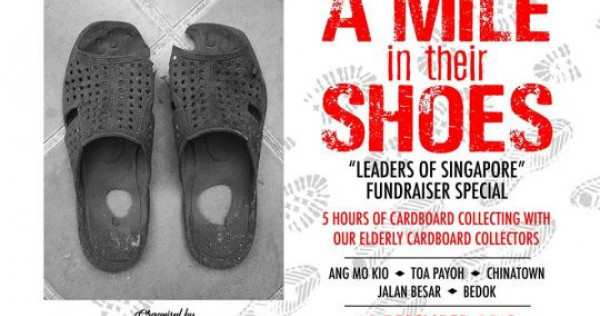
SINGAPORE – A fundraiser for cardboard collectors to be held on Saturday (Dec 14) has been cancelled, said its organisers on Friday evening.
The five-hour event was to have involved at least four opposition parties, said non-profit group Happy People Helping People in a Facebook post.
The reason for the cancellation is that “the police did not want us to do this without a permit”, the group added.
Earlier on Friday, the police had said the event would require a permit as its organisers had politicised a social cause.
It pointed out in its statement that the event – titled A Mile In Their Shoes – ‘Leaders of Singapore’ Fundraiser Special – had been assessed to be a public assembly and, hence, would need a permit under the Public Order Act.
This is because “the event goes beyond simply helping cardboard collectors, and appears to be politicising a social cause”, it added.
The group had said in a Facebook post on Thursday that representatives from four political parties would take part in the fundraiser: the Singapore Democratic Party, Progress Singapore Party, Reform Party and the People’s Power Party.
SINGAPORE – The year has not ended and there has already been more money lost to cheats in more cases of scams involving the impersonation of China officials compared to last year and the year before.
The police said on Friday (Dec 13) that from January to November, people were cheated of at least $18.8 million in at least 400 cases of such scams.
This figure is up from 302 cases in 2018, when about $12.7 million was lost to scammers, and about $12.8 million in 188 cases in 2017.
From August to November alone this year, at least $10.8 million was lost to scammers in 242 cases.
The police said these crimes involved people impersonating staff from courier companies, telecommunications service providers, or officers from government organisations.
The scammers would trick victims by claiming that a mobile number registered in their name was involved in a crime; that a parcel under their name containing illegal goods was detained; that there was a pending case in court against them; or that they had committed a criminal offence and were required to assist in investigations.