Home Blog Page 553

Commentary: Why sports still has a place in Singapore

0

SINGAPORE: I learnt a new word at the recently concluded Southeast Asian (SEA) Games: “chonky”.

“Chonky” in Doggolingo (another new word I learnt, and it means “dog internet jargon”), is an affectionate word to describe a slightly overweight animal.

And it was used to describe Joseph Schooling cutting a less than flattering image of a swimmer at the New Clark City Aquatic Centre. 

READ: Commentary: It’s not okay to say ‘OK boomer’

Having grown up in the 1980s, I am perhaps a generation removed from those who can now live entire virtual lives in the ether, and completely missed the reference.

SHOULD WE EVEN BOTHER?

Growing up in a pre-internet era where local sports really mattered, when runners, bowlers, footballers, hockey players, swimmers – not just Olympic champions – were backed, celebrated and recognised on the streets, I wonder if modern day Singapore should just give up entirely on sports.

After all, football, which is the one sport that’s most highly watched, has yet to deliver any gold medal in the SEA games’ 60 years history.

Singapore did come away from the SEA Games with the two best performing athletes – Quah Ting Wen and her brother Zheng Wen – a first Singapore-born men’s singles table-tennis champion in Koen Pang and a 53-gold medal loot that is a very decent record.

READ: Commentary: Why success should not be the only factor in deciding what is Singapore’s national sport

But there are other accolades that make us proud to stand behind our flag, accolades that come with very literal boosts that we do tend to enjoy.

According to the World Economic Forum, we are the world’s most competitive economy this year.

People walking along the pier overlooking the skyline of Singapore's financial district

Singapore has overtaken the US to take first spot in the 2019 Global Competitiveness Report compiled by the renowned World Economic Forum (File photo: AFP/Roslan Rahman)

We appreciate the efforts that went into making the Singapore passport – along with Japan’s – the most powerful travel document on the planet.

We are the second safest city – just a shade behind Tokyo – and also home to an airport that has been named the world’s best for seven years running.

Pragmatic Singapore embraces these, enjoying their fruits.

NONE OF IT MAKES SENSE

Sport, in comparison, is a seemingly inconsequential chase that never ends – even when you win, that proverbial boulder rolls back to the bottom of the hill, and the whole process necessitates doing it all over again.

In any rational analysis, sport – every sport – is absurd. Take the case of football: 22 people running around a specifically defined patch of grass, believing that the number of times they kick a ball into a net is of profound importance.

Every world mark that was considered insurmountable will eventually become commonplace.

But world records – like Neil Armstrong setting foot on the moon – take humanity on a journey to a place it has never set eyes on.

READ: Commentary: Jo Schooling, a hunted man on a quest for gold and so much more

We are well aware of that feeling, we came out in droves to catch a glimpse of Joe and Singapore’s first Olympic gold medal in 2016, didn’t we?

WHAT’S GOING ON?

Stepping back to get a broader view of the sporting picture in Singapore, it does seem that the odds in Singapore are stacked – and wildly so – against the hopeful dreamer.

And at every recent failed attempt, the issue of National Service and academic commitments inevitably come to the fore again.

But there is some truth to that, and you do feel for the athletes who run in their military boots from the camp to the stadium, only to change into cleated boots and run again; and also for those who train till their muscles burn, then head home to burn the midnight oil with their head buried in books.

While the results of their efforts are celebrated, very few witness athletes pushing their chosen boulders up that hill, a daily – often solitary – grind.

There is no need for curfews for this ilk who march to their own almost monastic beat. There is no headspace for internal bickering either.

Muhamad Ridhwan Ahmad is the first Singaporean boxer to become a professional world champion.

Muhamad Ridhwan Ahmad is the first Singaporean boxer to become a professional world champion.

Boxer Muhamad Ridhwan has, in the past, risen before dawn to train before the start of fasting in the month of Ramadan, then got his head down to train again at night, after a day of school and work.

The likes of our floorball women, SEA Games champions for the last two editions, took it on the chin when they had to partly pay for their trip to the Women’s World Floorball Championship campaign that came merely days after their SEA Games exertions.

The women finished 12th – the Republic’s best ever showing since the tournament switched to a one division format in 2011.

READ: Commentary: Odd new sports at SEA Games aren’t a bad thing for Singapore

The floorball women are not alone in this tribe of doers. There are sailors, boxers, rowers, even those gunning for the pinnacle of sport, the Olympics, who scour for funds to fuel their dreams.

Olympic rowing hopeful Joan Poh, has even gone from Greece to Canada in search of a suitable sporting ecosystem to ensure she can get up to speed. And that approach of working around obstacles is similar to what sons of Singapore football legend Fandi Ahmad took to National Service, enlisting early so they could ply their trade overseas before they were considered too “old.”

IS THERE HOPE?

Funding also remains an issue for several sporting hopefuls. While some in the sporting fraternity assert that too much funding is channelled to undeserving sports – they usually finger football – others, even sailors and rowers who chase Olympic qualification, believe they don’t receive enough. 

The general sentiment in the sporting fraternity is that the clarion call for Singapore-based corporates to jump in and back our own as they chase their dreams goes largely ignored.

Schooling’s endorsements are an anomaly and understandably so. He is after all our only Olympic champion, and as an individual, has been a shining example of a brand ambassador.

But the lack of corporate interest should come as little surprise. 

READ: Commentary: Is it mission impossible for Young Lions at the SEA Games?

In a Sport Singapore Sports Index that studied participation trends in 2015 – the latest study available on its site – 48 per cent of Singaporeans said they did not participate in sports because they are “not interested in sports”.

That same study revealed that 76 per cent are proud of athletes’ international sporting achievements.

BUT THERE IS A TRIBE

But there are those who still believe in sport.

Swimming clubs noted a glut of new young members taking to the pool after Schooling’s Olympic win, watched over by eager parents who embraced this new drive they were witnessing in their young dreamers.

Teong Tzen Wei is one such born-again dreamer of the Schooling effect, and at the Philippines SEA Games, the 22-year-old went out and beat the man who inspired him in the 50m fly.

Teong Tzen Wei

Teong Tzen Wei at the 2017 SEA Games. 

And even among everyday Singaporeans, the stock of sport has risen. We may not be known as a great sporting nation but the limited success we have had and the efforts our sportsmen and women take to compete in national colours has had a trickle-down effect. It has inspired a deeper ethos of participation in sports across the nation. 

There are ultramarathoners, Muay Thai and Brazilian Jujitsu exponents, Spartan racers, and even crazy ones who dive deep into open waters with only a single breath of air for company.

READ: Commentary: High-intensity exercise does more than improve your fitness

They now crowd cross-fit gyms and speak up on social media when sports get judged merely by medals at major games, not by effort or the amount of funds backing it, lending their weight to athletes battling seemingly unfair practices.

Being part of the tribe in the past meant thronging to stadiums and hissing at the opposition, but the crowd couldn’t directly speak to our sporting heroes then, we just hoped to bear witness. Being part of the sports tribe in Singapore now is no longer about being a mere spectator. It is about embodying that grit and determination and seeing it manifest in each one of us – professional sports person or amateur.  

They cheer the man next to them perhaps even more than the footballer in the stadium, but they still stroll into stadiums when Hariss Harun and company start to play like Lions, and they still care if Schooling will once again send the Singapore flag atop poles at an Olympic arena. Here in lies the value of sports to Singapore.

Makes you wonder if sport actually doesn’t matter to Singaporeans anymore, or if it’s merely viewed differently, backed by actions and words strange and unfamiliar to now-chonky folks like me.

Shamir Osman was a former sports journalist for 12 years before crossing the aisle to work in public relations.


Source link

Annular solar eclipse in Singapore: Thousands gather to catch rare 'ring of fire' in the sky

0

[ad_1]

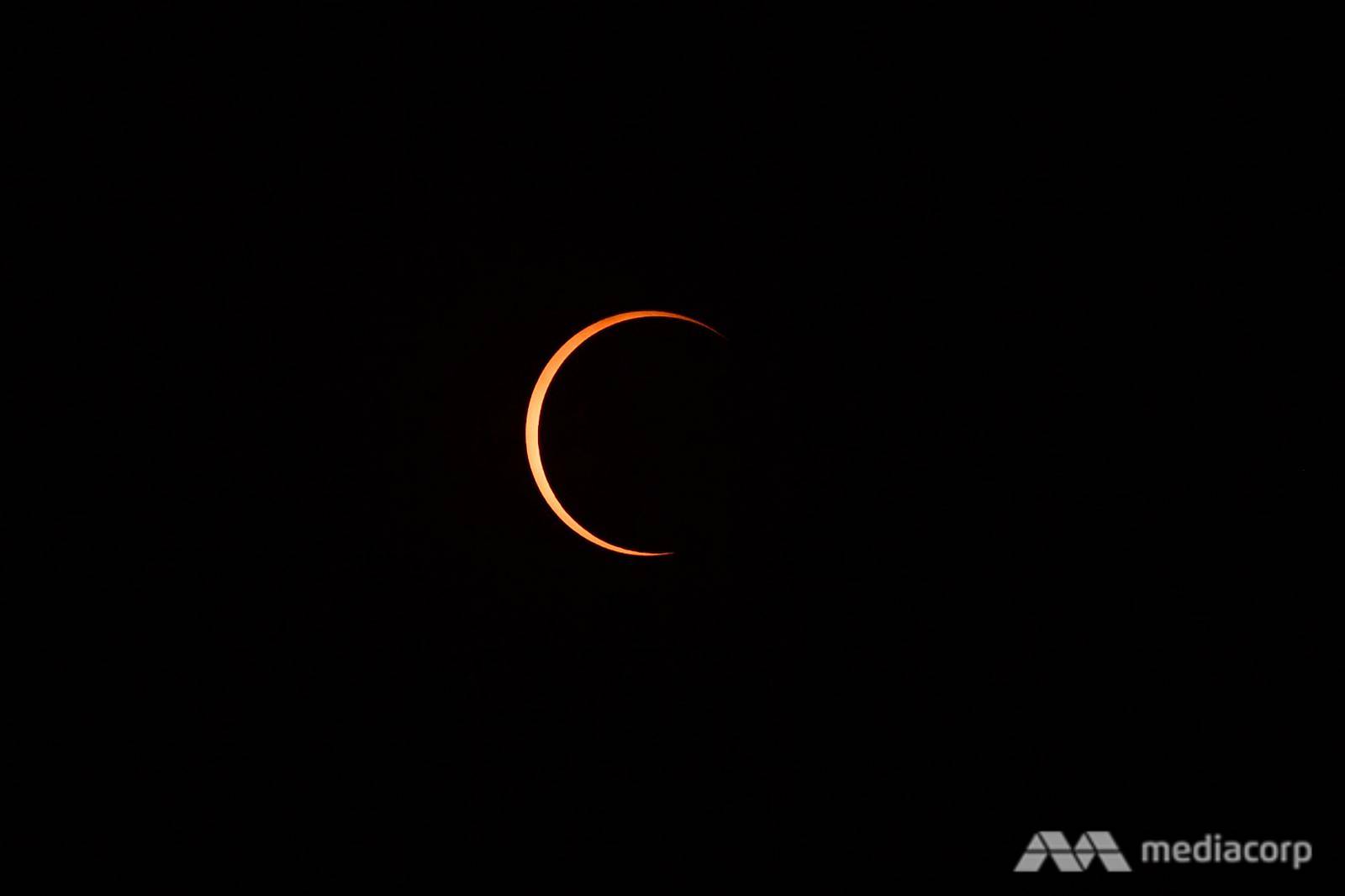
SINGAPORE – Hundreds of excited onlookers cheered at the Science Centre as the Moon moved into position to obscure the Sun at 1.24pm on Thursday (Dec 26) and form a “ring of fire”, in what has been dubbed the “greatest astronomical event in Singapore”.

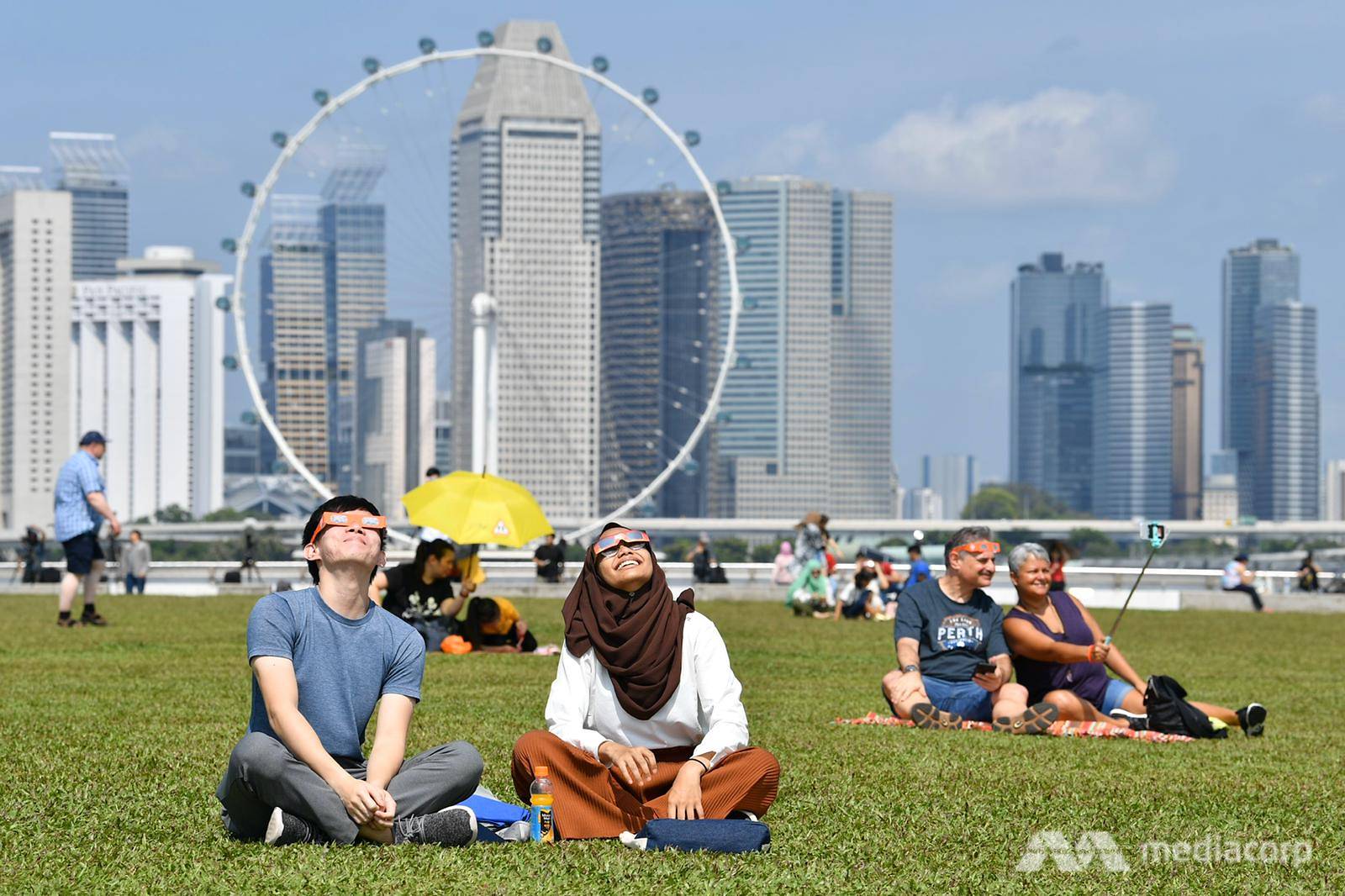
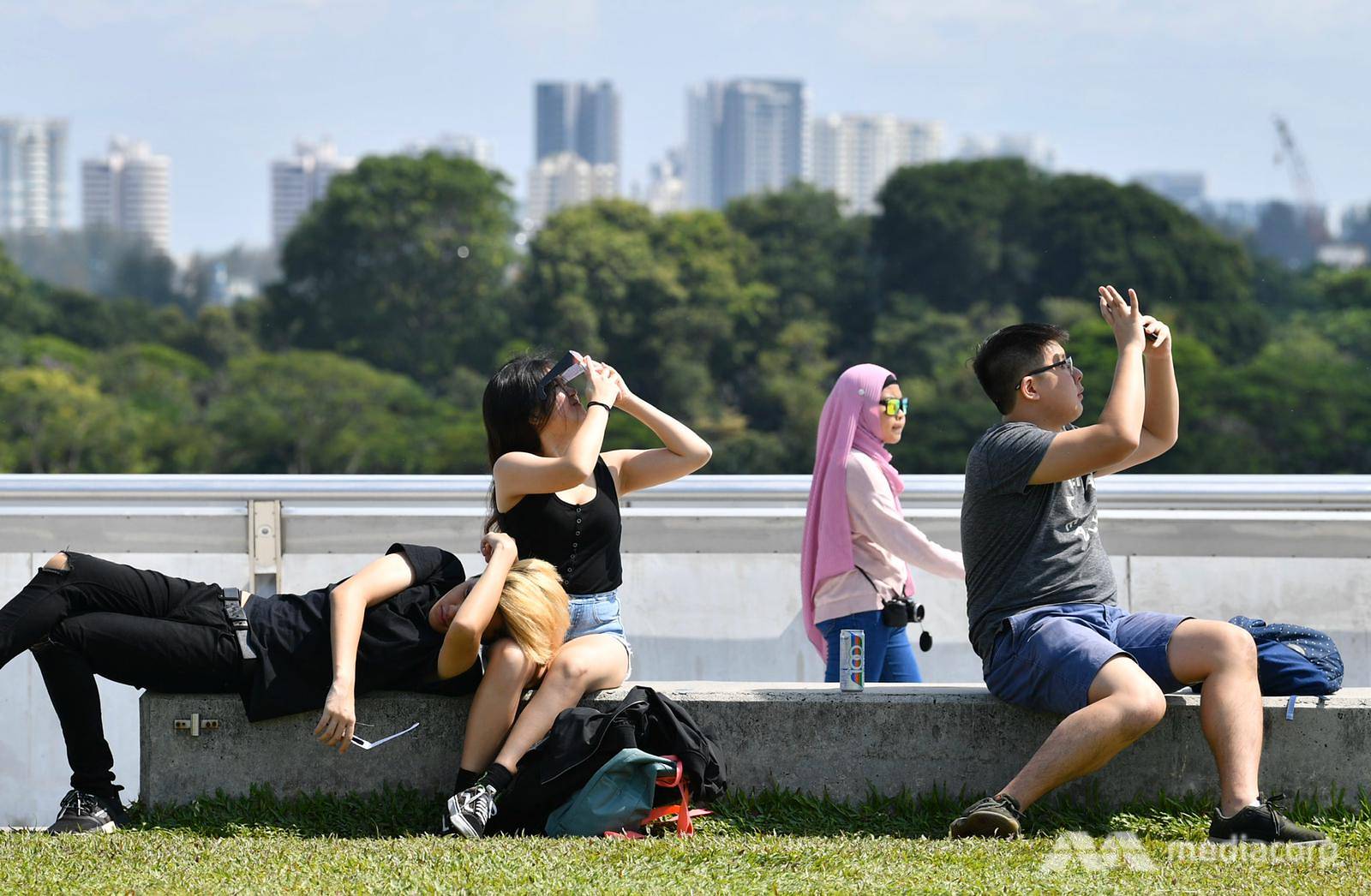
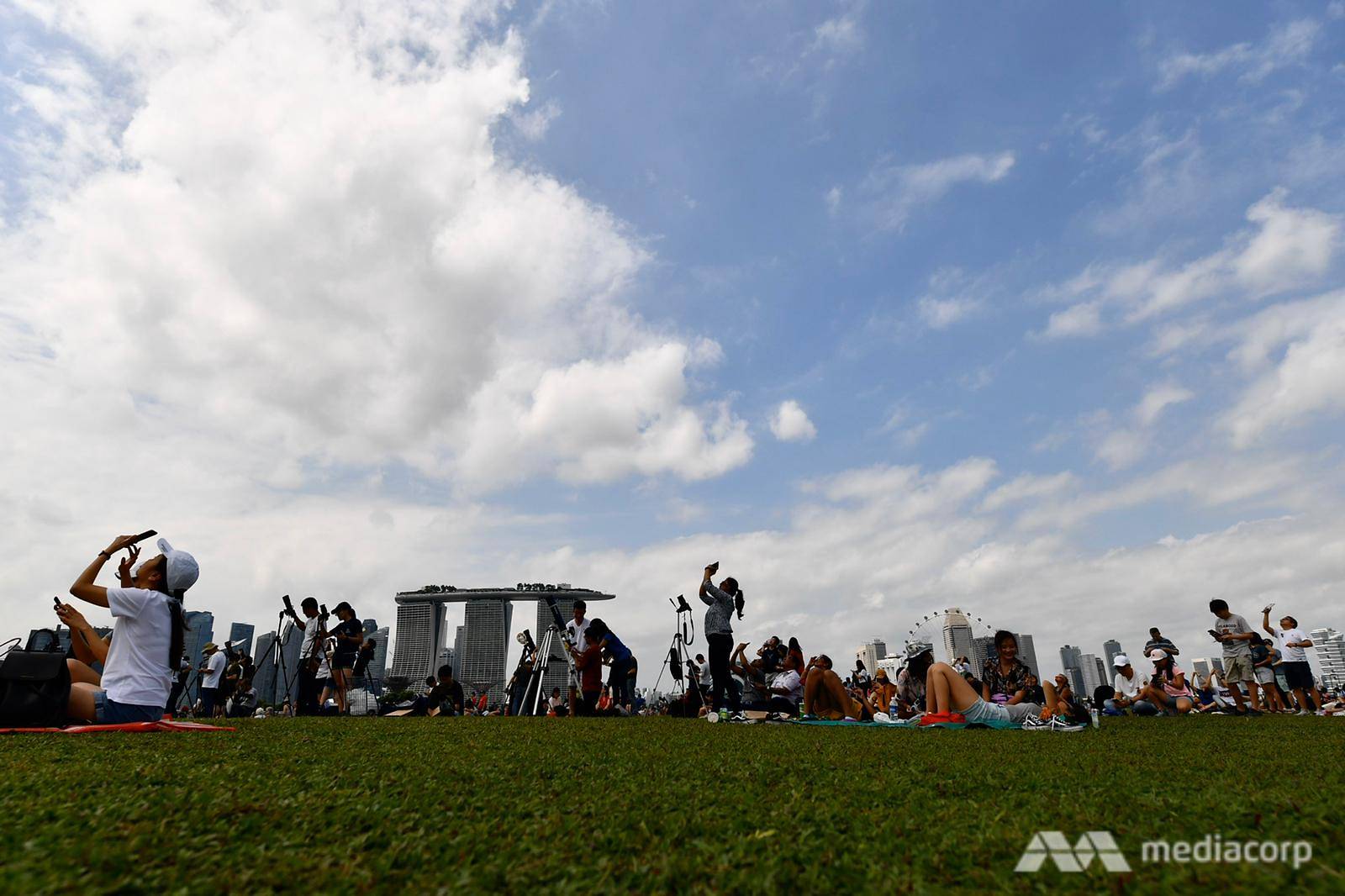
They were among the thousands at the Science Centre in Jurong and elsewhere across the island, from Ang Mo Kio to the Marina Barrage, who turned their eyes to the sky to catch the annular solar eclipse.

Many turned up with their young children and elderly parents, with several bringing along hats, mats, stools and umbrellas for the wait under the warm Sun before the eclipse began at about 11.30am. The phenomenon was expected to last until 3.18am.

More serious enthusiasts came armed with telescopes on tripod stands to photograph the historic moment.

“It’s much better when you see it with your own eyes, instead of on television or in photos,” said Ms Nurul Huda, 27, who was at the Science Centre to attend her first astronomy event.

[ad_2]

Source link

Solar eclipse: CNA readers capture images of rare ‘ring of fire’

0

SINGAPORE: Life in Singapore paused early on Thursday afternoon (Dec 26) as people across the island went out on the streets to catch a rare annular solar eclipse.

The astronomical event occurs when the moon covers the sun’s centre, leaving a flaming ring at the edges.

CNA readers captured the “once in a lifetime” event  – the next one will only appear in Singapore in 2063 – from their locations across the city and sent in their photos and a video timelapse:

annular solar eclipse boxing day Dec 26, 2019 reader photo Carlos

A photo of the annular solar eclipse from Singapore. (Photo: Carlos Monforte)

Boxing Day annular eclipse Dec 26, 2019 ring of fire

The annular solar eclipse on Dec 26, 2019 captured by a CNA reader in Clementi. (Photo: Fiqqo)

Boxing day annular solar eclipse Dec 26, 2019 ring of fire

The annular solar eclipse on Dec 26, 2019 captured by a CNA reader in Clementi. (Photo: Fiqqo)

Boxing day annular solar eclipse Dec 26, 2019 ring of fire (1)

A collage of images of the annular solar eclipse on Dec 26, 2019 shot from Gillman Barracks. (Photos: Aidil Abudllah)

Boxing Day solar eclipse Dec 26, 2019 ring of fire

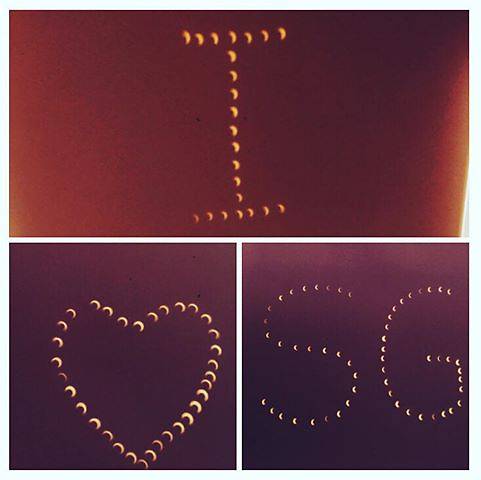
Pinhole art created by a CNA reader from Bedok by projecting the eclipse’s light on a piece of paper. (Photo: Ashwin Gawli)

Annular solar eclipse in Singapore at Nanyang Technological University

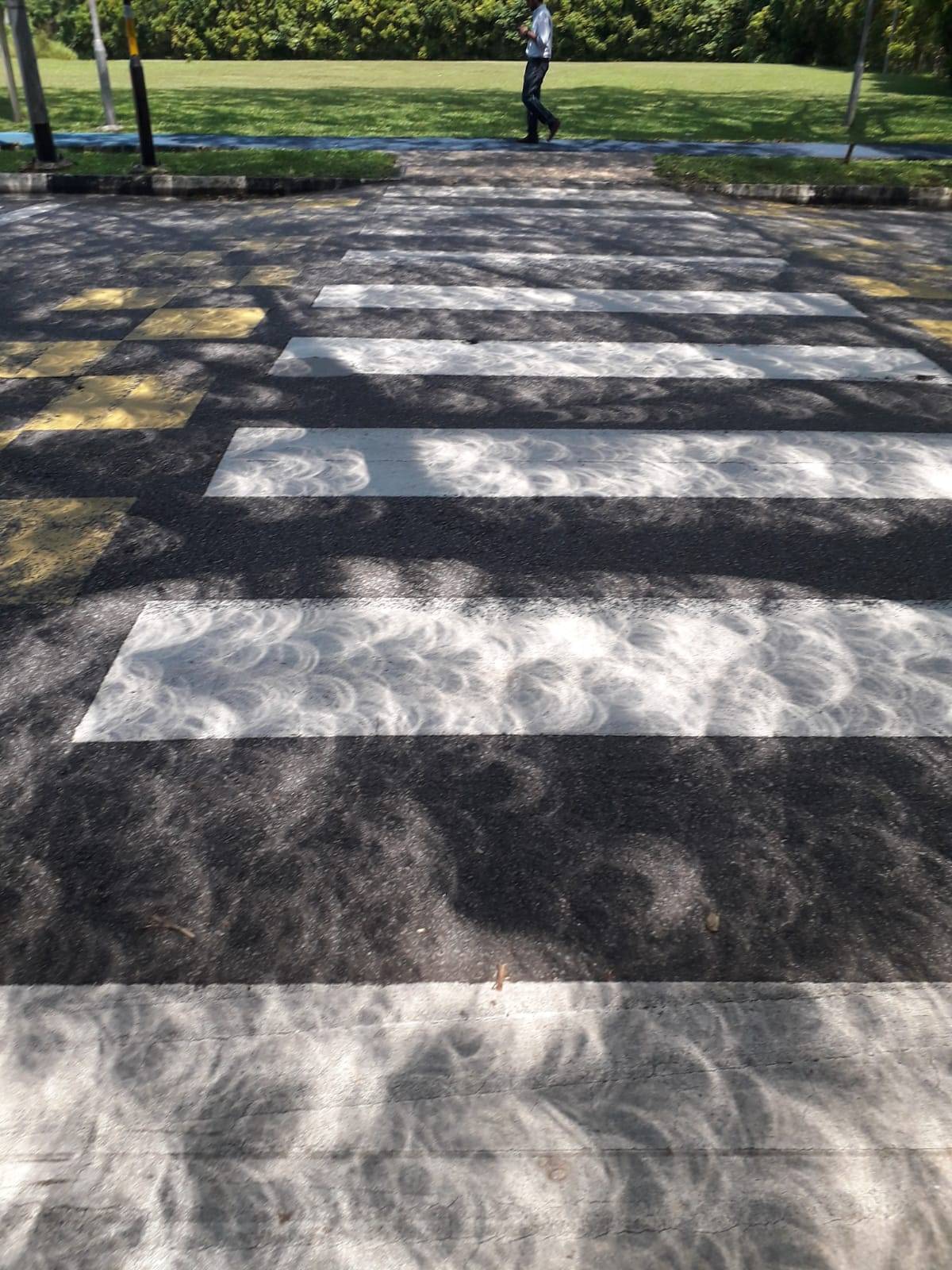
Interesting patterns of the eclipse as captured by a CNA reader on Dec 26, 2019. (Photo: Divya Krishnan)

The annular solar eclipse seen in Singapore

IT engineer Ng Kok Keng used a piece of green-tinted glass from a welding mask his father gave him as a child to capture photos of the eclipse from East Coast Park. (Photo: Ng Kok Keng)

WhatsApp Image 2019-12-26 at 3.22.42 PM (1)

IT engineer Ng Kok Keng used a piece of green-tinted glass from a welding mask his father gave him as a child to capture images of the eclipse and protect the sensor of his camera phone. (Photo: Ng Kok Keng)

Solar eclipse readers Lloyd Chua

Clouds covering the solar eclipse, seen from West Coast. (Photo: Lloyd Chua)

Annular solar eclipse boxing day Dec 26, 2019

CNA reader Lloyd Chua also took photos through the lens of welding goggles from West Coast. (Photo: Lloyd Chua)

Annular solar eclipse in Singapore 3

The eclipse seen from Bukit Batok East Avenue 3. (Photo: Shamini Priya)

Boxing Day eclipse Dec 26, 2019 ring of fire Clementi

A view of the annular solar eclipse from Clementi on Dec 26, 2019. (Photo: Christina)

Annular solar eclipse in Singapore 4

The eclipse seen from Bukit Batok East Avenue 3. (Photo: Shamini Priya)

Annular solar eclipse in Singapore 5

The eclipse seen from Bukit Batok East Avenue 3. (Photo: Shamini Priya)

Boxing Day annular eclipse Raffles Place Dec 26, 2019

A view of the annular solar eclipse from Raffles Place on Dec 26, 2019. (Photo: Kanika Joshi)

READ: In photos: Crowds across Singapore witness rare ‘ring of fire’ solar eclipse on Boxing Day

READ: ‘Ring of fire’ eclipse wows across Asia

These photos came from our readers. If you would like to send in photos or videos of something newsworthy, WhatsApp our Mediacorp news hotline at +65 8218 8281 or message us on Facebook.

Source link

In photos: Crowds across Singapore witness rare ‘ring of fire’ solar eclipse on Boxing Day

0

SINGAPORE: Thousands of people in Singapore looked to the sky on Boxing Day (Dec 26) to catch a rare annular solar eclipse as darkness set in across the island. 

An annular solar eclipse happens when the moon covers the sun’s centre, leaving the sun’s visible outer edges forming a ring around the moon. 

It occurs when the moon is farthest from the earth and appears smaller, hence not blocking the entire view of the sun, according to the National Aeronautics and Space Administration (NASA). 

Marina Barrage eclipse crowd

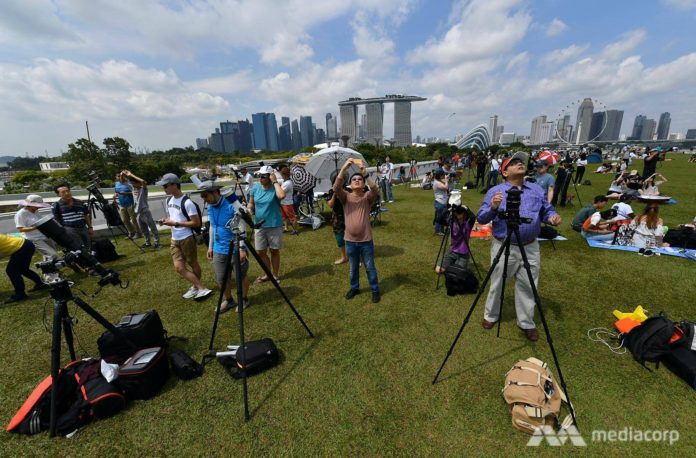
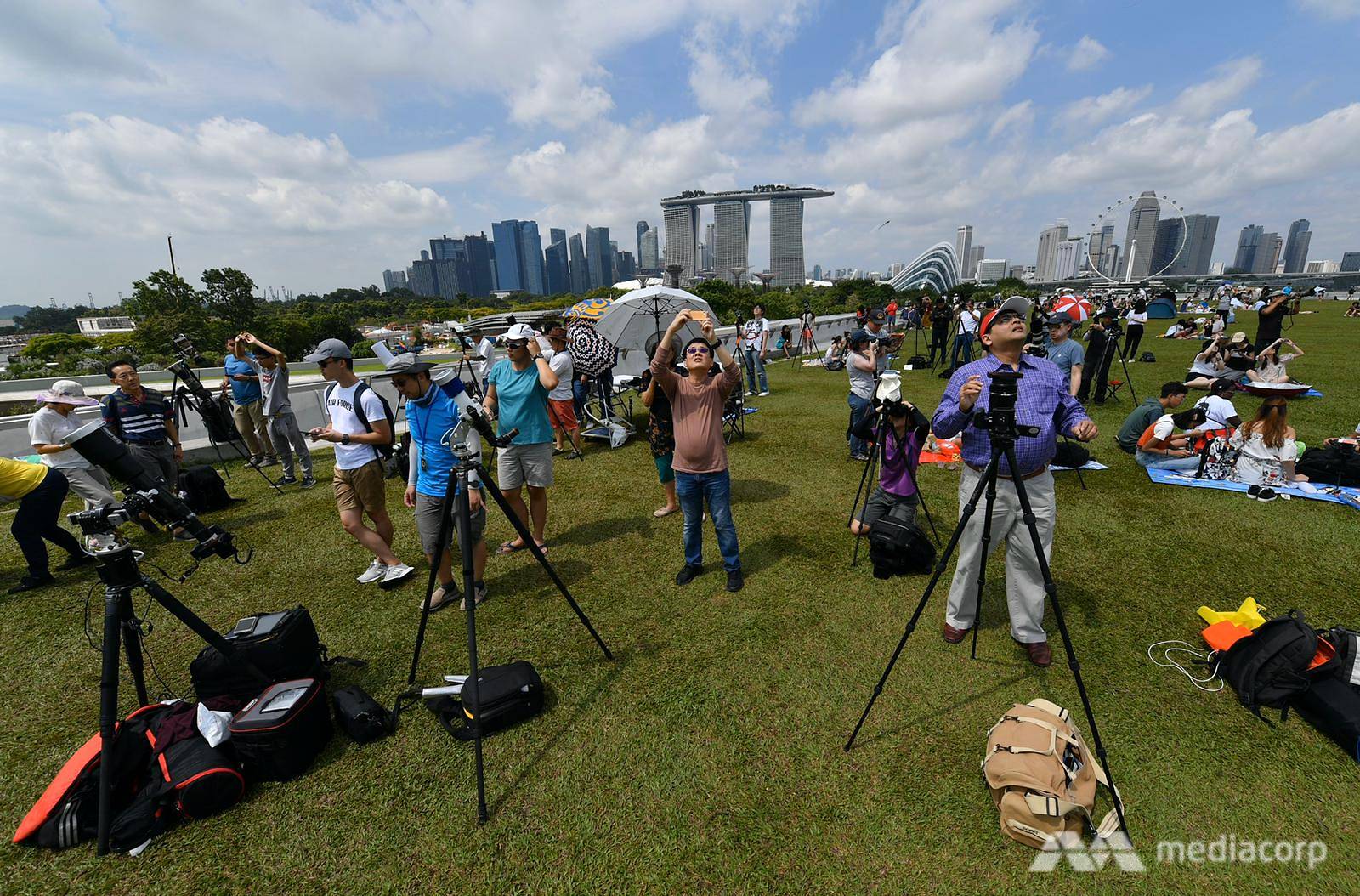
About 1,000 people gathered at Marina Barrage to view the solar eclipse on Dec 26, 2019. (Photo: Jeremy Long)

Eclipse Dec 26, 2019

Members of the public gather at Marina Barrage to view the solar eclipse on Dec 26, 2019. (Photo: Jeremy Long)

Marina Barrage eclipse

Members of the public gather at Marina Barrage to view the solar eclipse on Dec 26, 2019. (Photo: Jeremy Long)

The phenomenon began to unfold at around 11.30am on Thursday.

This Boxing Day eclipse has been described as a “once in a lifetime” event, as the next annular solar eclipse that can be seen in Singapore will only occur in 2063. 

Solar eclipse Dec 26

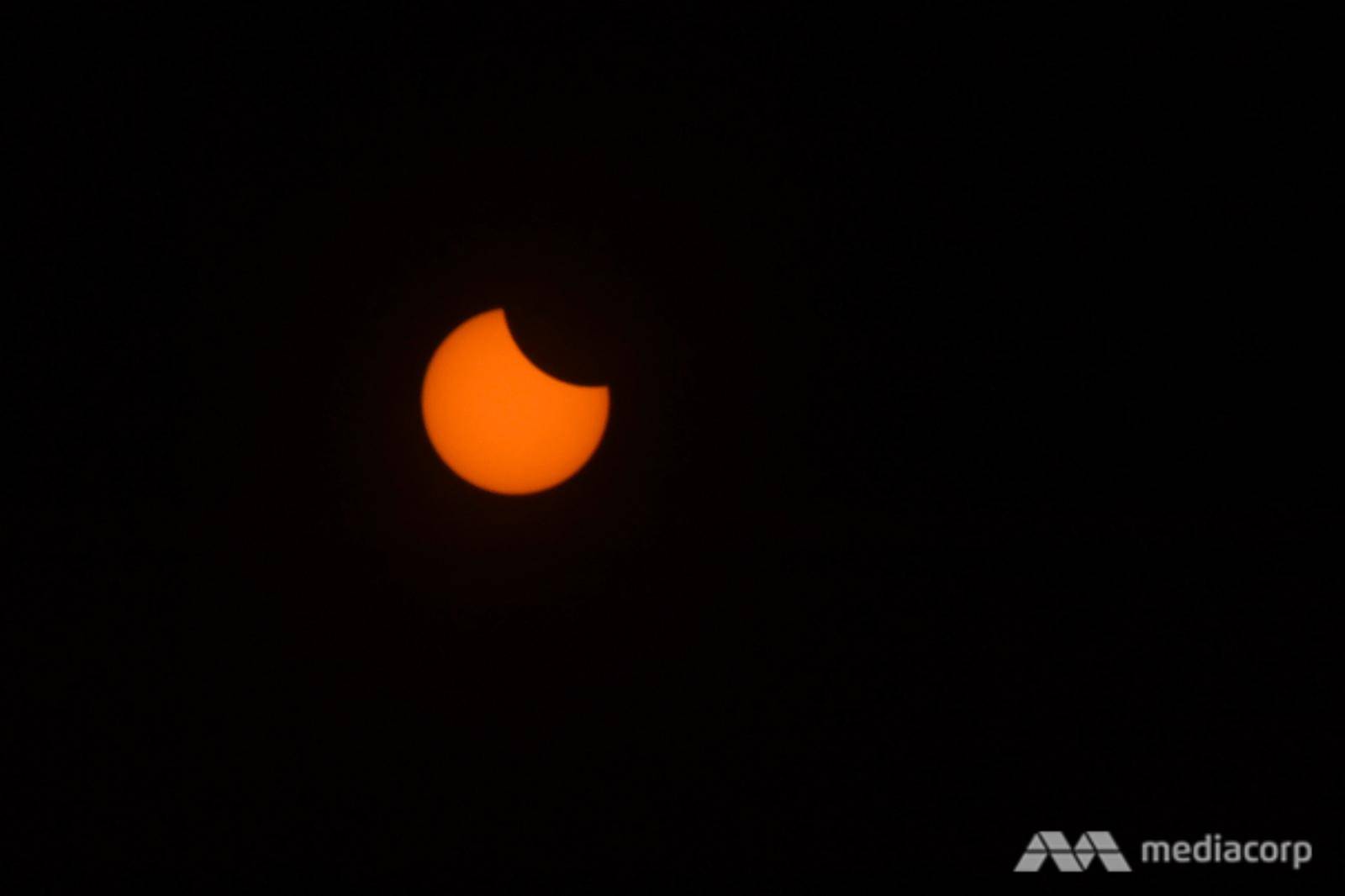
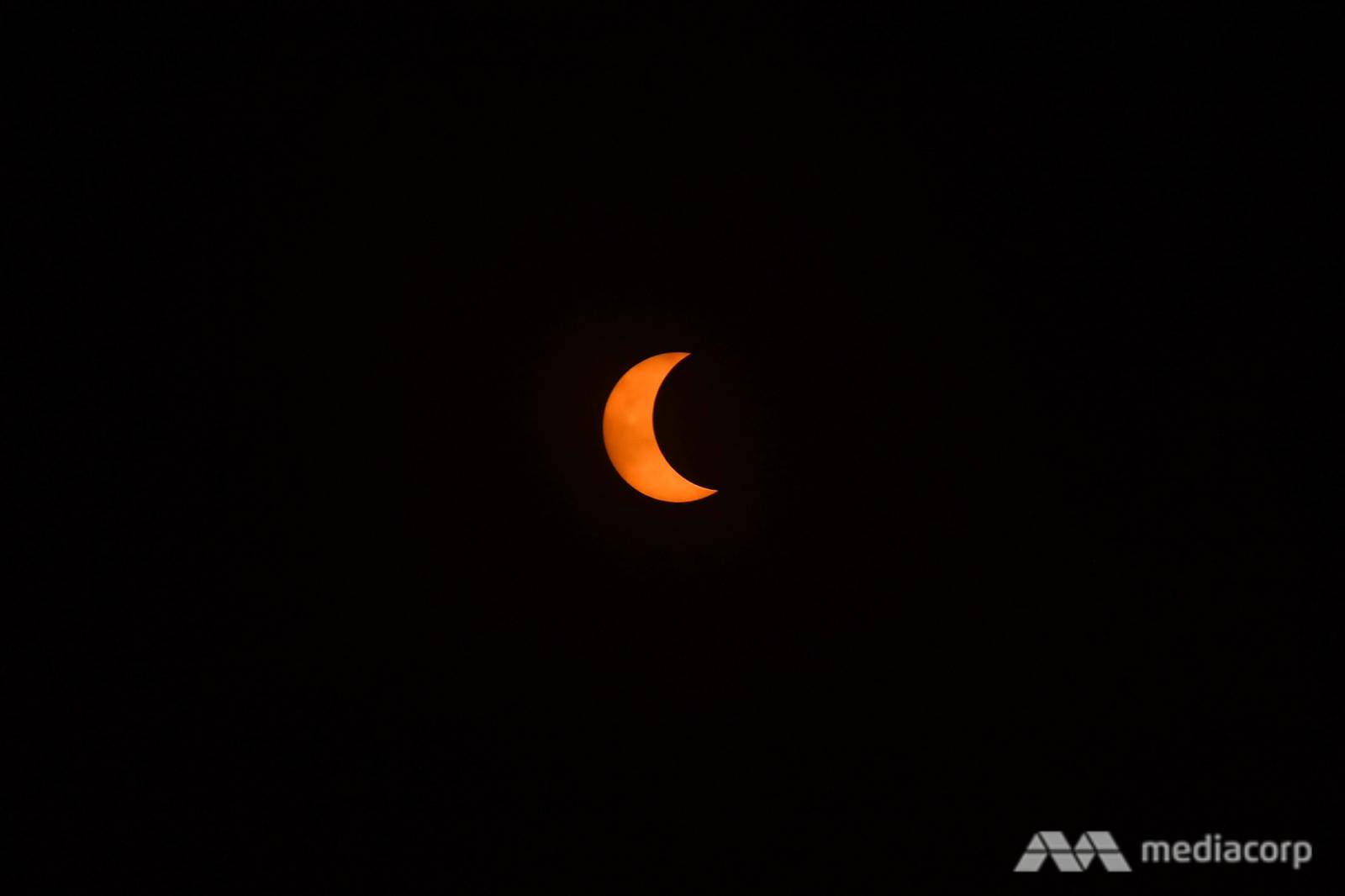
View of the solar eclipse at 11.58am on Dec 26, 2019. (Photo: Jeremy Long)

Eclipse at 12.42pm

View of the solar eclipse at 12.42pm. (Photo: Jeremy Long)

Eclipse 1.20pm

View of the eclipse taken at 1.20pm at Marina Barrage. (Photo: Jeremy Long)

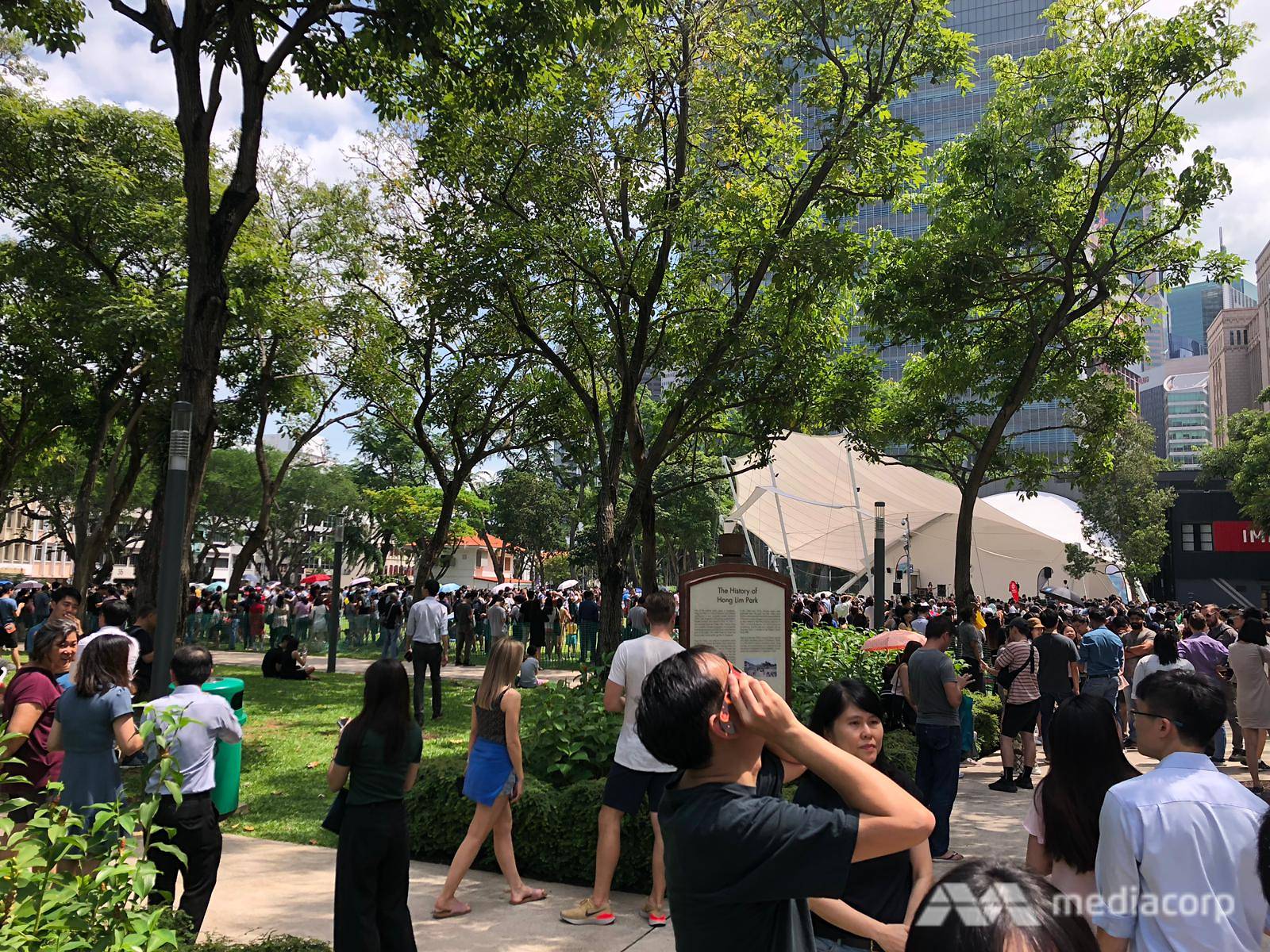
Huge crowds could be seen gathered at the Marina Barrage, Boat Quay and Hong Lim Park to witness the rare eclipse. 

People were armed with mobile phones and other devices to capture the moment with several seen without the protective solar glasses.

Hong Lim park eclipse

A crowd gathers at Hong Lim Park to view the solar eclipse on Dec 26, 2019. (Photo: Lin Suling)

Crowds gathered near Boat Quay to watch the annular solar eclipse

Crowds gathered near Boat Quay to watch the annular solar eclipse on Dec 26, 2019. (Photo: Joannes Tjendro)

Eclipse glasses

A boy views the solar eclipse on Dec 26, 2019. (Photo: Jeremy Long)

Woman using eclipse glasses

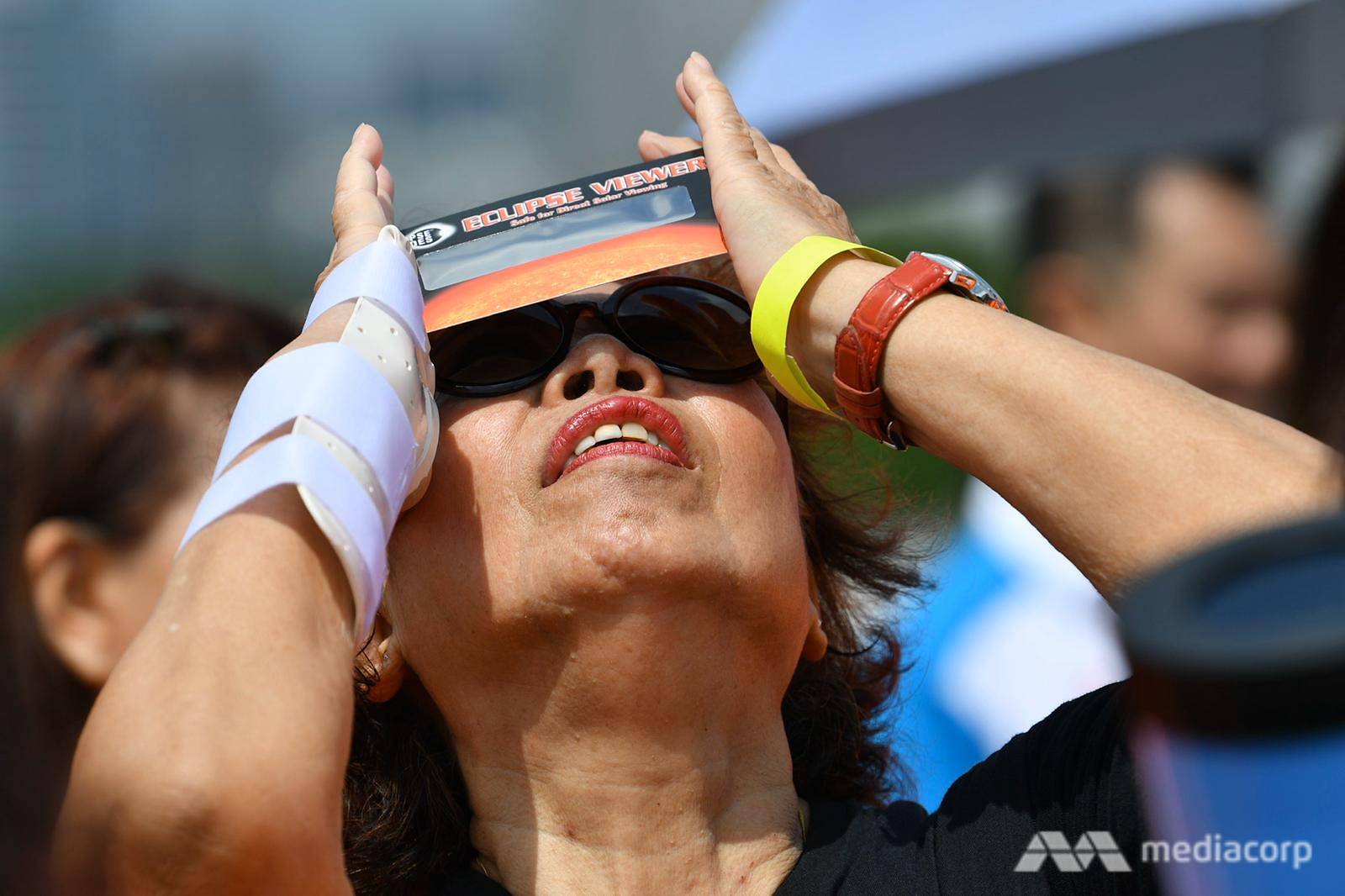
A woman at Marina Barrage views the eclipse through solar eclipse glasses. (Photo: Jeremy Long)

Marina Barrage eclipse viewing

The next annular solar eclipse that can be seen in Singapore will only occur in 2063. (Photo: Jeremy Long)

Eclipse photographer

A man photographs the solar eclipse on Dec 26, 2019. (Photo: Jeremy Long)

Source link

Teen accused of molesting 3 women, including 2 senior citizens

0

[ad_1]

SINGAPORE – A teenage boy has been taken to court after he allegedly molested three women, including two in their 70s, on the same day.

Khamalhan Kavnor Subramaniam, 17, who appeared in a district court on Tuesday (Dec 24) now faces three counts of molestation.

The Malaysian teenager allegedly went to the eighth storey of a block of flats in Whampoa at around 6pm on Dec 16 this year and touched a 79-year-old woman’s private parts as she was squatting down in a corridor.

He is also accused of molesting a 49-year-old woman in a lift at a Bendemeer block of flats minutes later.

He is said to have struck for the third time about four hours after that.

According to court documents, Khamalhan allegedly molested a 73-year-old woman at a lift lobby on the seventh storey of another block nearby.

The teenager’s case has been adjourned to Jan 7 next year.

If convicted of molestation, Khamalhan can be jailed for up to two years and fined or caned for each charge.

He is one of several teenagers who have appeared in court in recent months over molestation charges.

[ad_2]

Source link

Police investigating man for taking part in Marina Bay public assembly without permit

0

[ad_1]

SINGAPORE – A 32-year-old Indian national is being investigated for participating in a public assembly without a police permit, the police said on Wednesday (Dec 25).

He had allegedly committed the offence at Marina Bay, to protest against India’s Citizenship (Amendment) Act.

The Straits Times understands that the man had posted a picture of himself on social media, holding a placard to express his unhappiness.

His occupation and residence status in Singapore are currently unclear.

ST also understands that he is the only one being investigated in this case.

In a statement, the police said that organising or participating in a public assembly without a police permit is illegal and an offence under the Public Order Act.

[ad_2]

Source link

2 minutes of darkness: Where you can catch the annular solar eclipse in Singapore

0

[ad_1]

Skywatchers across Singapore are looking out for a chance to witness – weather and cloud cover permitting – a spectacular natural phenomenon on Thursday (Dec 26).

Here are six places you can view the rare annular solar eclipse dubbed the “greatest astronomical event in Singapore”:

1 PAssion WaVe @ Jurong Lake Gardens, 100 Yuan Ching Road 

Admission: Free

Time: 11am to 4pm

Highlights: • See the eclipse from a kayak on the lake.

• Free workshops to make your own solar viewer, Japanese pastel nagomi art, watercolour painting.

• Six solar telescopes and a giant set of binoculars on site.

• Sign up via onepa.sg, or just drop by. 

2 National Junior College, 37 HillCrest Road

Admission: Free

Time: 9am to 4pm

Highlights: • Observe the Sun magnified up to 500 times its size at the school’s High-Resolution Solar Research Observatory.

[ad_2]

Source link

Valve sues Singapore-based esports organiser GESC over unpaid prize money and wages

0

[ad_1]

Another day, another storm brewing on the corporate side of esports.

This time, the issue stems from Singapore-based tournament organiser GESC, who previously held two Dota 2 Minor events in Thailand and Indonesia in 2018. That’s all well and good, except for the fact that GESC has still not paid out the prize money and wages to the respective parties!

In response, Valve has since proceeded to sue GESC over the US$750,000 (S$1.02 million) that they reportedly owe the participating agencies and players, after a series of late payment invoices and reminders were not acted upon promptly by GESC nor its representative, a certain Mr Feng.

According to Valve’s VP of Marketing Doug Lombardi, the lawsuit was filed earlier this year on April 8, 2019, in the High Court of the Republic of Singapore, and the US gaming giant has since discontinued any existing agreements with GESC.

All things considered, the legal action was probably motivated in part by an open letter published by the affected parties last October, warning against further esports collaboration with the defendant until the previously unpaid debts had been settled.

[ad_2]

Source link

2 people arrested over cheating cases involving Apple AirPods

0

[ad_1]

SINGAPORE – Two people were arrested for their suspected involvement in a series of cheating cases linked to Apple’s wireless AirPods earbuds.

The police said on Wednesday night (Dec 25) that they received multiple reports between Dec 21 and 23 from victims who alleged they were cheated by the two people into buying fake AirPods, when they responded to an online advertisement.

Officers from the Bedok Police Division identified the male suspects, aged 19 and 23, and arrested them on Dec 23.

The police are investigating the two suspects.

Those convicted of the offence of cheating may be jailed up to 10 years and fined.

The police advised the public to take precautions when shopping online.

Consumers should be wary of people selling items at prices that sound too good to be true.

Buyers can also check a seller’s track record by reading reviews of his services or contacting past customers.

Consumers should buy goods from authorised dealers and use payment methods that provide arrangements for advance payment to be released to the seller after receiving the item.

[ad_2]

Source link

Commentary: The end of the decade – how the world has become a less safe place

0

SINGAPORE: Generally understood as the freedom from potential harm, security has played a critical role in ensuring the survival and advancement of societies through the ages.

Security is central to our well-being to the extent that it is enshrined in the Charter of the United Nations (UN), and recognised as a fundamental prerequisite to the pursuit of all other goals of human endeavour.

At around the same period the Charter was established in 1945, psychologist Abraham Maslow proffered in his now famous “hierarchy of needs” that our security and safety are only second to our biological ones. 

READ: Commentary: 2019 was a year of global unrest and rising inequality. 2020 is likely to be worse

As Maslow argued, an adequate provision of security creates the space for societies and individuals to focus on achieving economic, social and cultural progress that could unlock humanity’s self-actualisation.

HOW SECURITY DOCTRINES HAVE CHANGED

Classically, security is said to be achieved when threats ranged against people are either defeated or when the vulnerabilities that make them susceptible to such threats are reduced through protective measures.

However, the traditional doctrine constituting security has become obsolete. Rapid technological developments and disruptive innovation have created new means for terrorists, criminals and dissenters to harm our well-being.

Several threats we face today cannot be neutralised, unlike the threat of total, all-out war by a conventional enemy, where traditional strategies of deterrence and retaliation with overwhelming force can be employed. Instead they should be thought of as security risks that can only be mitigated.

All these have the common aim of bringing a country to its knees by creating fear, disrupting moving parts that are essential for a well-functioning society.

HOW THE TARGETTING OF CIVILIAN LIVES HAS CHANGED

One such security risk that targets innocent civilian lives is terrorism, particularly the new version of terrorism manifested by the Islamic State (IS) terrorist network that had captured lands in Syria and Iraq around 2014.

READ: Commentary: Will killing Islamic State leader Baghdadi give Trump a boost in the polls?

READ: Commentary: Islamic State chief Baghdadi’s death exposes its vulnerabilities

The group has utilised a blend of low- and high- technologies to generate simple but widespread attacks that will likely become a model for future terrorist groups to emulate.

The IS recognised that security agencies around the world have learned to adapt to the large-scale terrorist attacks carried out by Al Qaeda over the course of the 2000s – many of which required a significant amount of planning, financial resourcing and training of trusted operatives as demonstrated by the 9/11 attacks.

Many of these Islamic State fighters are now heading home.

 Fighters of the Islamic State (IS) terrorist network that had captured lands in Syria and Iraq since 2014

Instead, leveraging on the social pervasiveness of digital media to recruit as many followers as possible, the IS has moved to a more decentralised system of terrorist attacks by indoctrinating citizens in target countries all over the world, and advocating the use of easy-to-carry-out knife attacks and vehicular ramming of citizens to create public fear and anxiety.

Comprehensive crib sheets on how to carry out such attacks are circulated online. These attacks themselves require literally no concrete planning, financial resourcing, or training—signatures that intelligence agencies try to pick up to detect an impending assault.

To date, IS’ new small-scale model of threats have produced over 50 knife attacks and nearly 30 vehicle ramming operations across the world. In comparison, major attacks attributed to al-Qaeda in the 2000s amount to about 20 incidents.

READ: Commentary: The secret group dynamics that fuel horrifying terror attacks

READ: Commentary: Why the London Bridge attacker walked free – while serving terrorism offences

The 9/11 attacks alone resulted in about 3,000 deaths, over 25,000 injuries, and caused at least US$10 billion in infrastructural damage. Terrorist groups are moving towards a strategy of a larger quantity of smaller attacks over a few big hits.

A NEW TOOL: CHEAP, EASILY OPERATED DRONES

Another security risk is the proliferation of commercial off-the-shelf technology such as drones.

These aerial vehicles, which have flooded the market, have been used by terrorist groups such as the IS, criminals, and other bad actors to attack or harass people and are difficult to detect.

Since 2016, the IS has been using modified quadcopter drones drop small bombs onto human targets in the Middle East.

READ: Commentary: We are woefully ill-equipped to deal with rogue drones

READ: Commentary: Desperate Iran’s dangerous game of brinksmanship in the Gulf

In September this year, British police seized a modified drone seized from an IS supporter’s home that was intended to be used in an attack against a military installation in the country. In May last year, a criminal syndicate launched a swarm of drones to obstruct a hostage raid by a Federal Bureau of Investigations (FBI) rescue team.

Drones may not always be delivering gifts

Drones may not always be delivering gifts AFP/AMOS GUMULIRA

Unauthorised drones flown by errant operators or individuals with malintent have also endangered people or disrupted our commercial airspace.

In January 2015, a drone accidentally crashed into the compound of the White House, after evading the White House’s radar that was calibrated to warn of much bigger threats, such as airplanes and missiles.

In December last year, a drone attack caused a shutdown at London’s Gatwick Airport, with about 1,000 flights cancelled or delayed and about 140,000 passengers affected. In June this year, unauthorised drones caused flight delays and disruptions at Changi Airport.

Going forward, the greatest danger posed by drones flying near airports is the possibility of mid-air collisions with aircraft, which would be catastrophic and erode trust in commercial air travel.

Such disruptions not only stoke fear, they also intend to disrupt commercial activities and fracture business sentiments in the country.

WHY DIGITAL IS THE NEW BATTLEGROUND

With the advent of digital technology, and as countries become increasingly reliant on the flow of digital data and service to power their economies, this area can also be a new vulnerability.  

READ: Commentary: Islamic State militant group ran an info war ‘like a viral marketing campaign’

This decade was marked by the rise of by cyber-crimes, computer attacks, and online influence operations, powered by artificial intelligence (AI), against governments, corporations and individuals.

cyber attack

Australian intelligence determined China was responsible for a cyber-attack on its national parliament and three largest political parties before the general election in May. (AFP Photo)

Intelligent algorithms and deep-learning software that automate and improve speech recognition, machine translation, spam filters, and search engines are increasingly being used by cyber-criminals and terrorists to improve their ability to breach security systems, increase the volume and speed of attacks while preserving their anonymity.

READ: Commentary: Careful with photos you post online. You may be putting your digital identity at risk

With the growing ubiquity of the Internet of Things (IoT)—to which there are currently about 200 billion smart devices connected to each other and to people— the impact of such breaches by bad actors could be widely felt, especially if they target critical installations such as transport infrastructure and utilities services to create outages and steal information.

READ: Commentary: Is Huawei dangerous because it’s Chinese? What about Facebook?

Corporate giants including Google, Facebook, Marriott, Equifax and Under Armour have lost critical user data owing to hacks over this decade.

The huge Equifax breach affecting 143 million people is the latest in a spate of cyber incidents

The huge Equifax breach affecting 143 million people is one example in a spate of cyber incidents which include ransomware attacks AFP/Andrew CABALLERO-REYNOLDS

Singapore too is no stranger to cybersecurity attacks as more of our data is placed on networks. SingHealth experienced one of the serious breaches in October 2018.

FRACTURING A SOCIETY’S ABILITY TO MAKE DECISIONS

A new threat has also emerged as technology advances, one that threatens to undermine society’s ability to tell what is real and what isn’t, creating fear and divisions among people and fracturing the ability to take decisive action.

Deepfakes — using AI to superimpose one person’s face or voice over another in a video—are beginning to play a role in social-media cybercrime.

In August this year, it was reported that criminals had employed AI-based software to replicate the voice of a UK-based energy company’s CEO to command a senior executive to make an urgent transfer US$243,000 to a supposed foreign supplier.

Deepfakes involving Donald Trump taunting another country and Nancy Pelosi supposedly slurring in her speech could also have far-reaching implications if used to spread disinformation, complicating domestic policy-making and foreign relations.

Paul Scharre of the Center for a New American Security looks at a "deepfake" video of

Paul Scharre of the Center for a New American Security looks at a “deepfake” video of former US President Barack Obama manipulated to show him speaking words from actor Jordan Peele on January 24, 2019, in Washington AFP/Robert LEVER

These could not only sway the upcoming 2020 US presidential elections, if not found to be deepfakes and disproved in time, but also deepen divides and damage trust over the long term.

A COMPLEX SECURITY LANDSCAPE

Terrorism, drone threats, cyber-crimes, computer attacks, and online influence operations reflect that it is becoming increasingly challenging for societies to achieve security compared to the past.

The experience of the 2010s has reinforced the point that attacks, disruptions and breaches have evolved rapidly and added to our increasing security complexity and risks.

These will add new demands on security and law enforcement agencies around the world as they face these new risks.  

For one, they must outpace bad actors in the technological game of innovation. In addition to reducing vulnerabilities, investments must be made in risk and crisis management to blunt the impact of security incidents and other mishaps.

Second, agencies will also have to expand their capabilities in the detection, monitoring and pre-emption of such threats as their traditional methods and channels become inadequate.

patrolling device

A self-driving vehicle and surveillance drone on display at the launch of the Security Industry Digital Plan in Singapore. (Photo: Fann Sim)

On the technological front, surveillance radars, for instance, must be geared to detect small drones and not just aircrafts or missiles. 

On the human front, intelligence agencies must see how they can intercept knowledge of small-scale and “lone-wolf” attacks.

Third, laws must be updated to create the appropriate instruments and deterrents to deal with such threats.

In addition, deeply embedded within a risk-ready society is resilience.

Singapore has made significant investments to future-proof its people through efforts like the Total Defence initiative established in 1984.

The notion of psychological defence as one of now six pillars (“developing resilience and the strength to return to our normal activities as soon as possible after a crisis hits”) remind us that citizens must prevail over whatever newfound risks confront us as we venture forward.

Indeed, for all the new strategies, laws and technologies put in place to ensure Singapore remains safe and secure, what underpins security is the strength of a united people that think critically and respond to new threats decisively.

That key ingredient will remain essential in Singapore’s bid to combat these new security threats not only for the next decade but many more after.

Graham Ong-Webb is adjunct fellow at the S. Rajaratnam School of International Studies, Nanyang Technological University, Singapore. He also advisor to the Security Industry Institute at Temasek Polytechnic.

Source link