SINGAPORE: Three men have been arrested after nearly 7,400 cartons of duty-unpaid cigarettes were found in two trucks at an industrial building in Pioneer, said Singapore Customs in a media release on Friday (Dec 27).
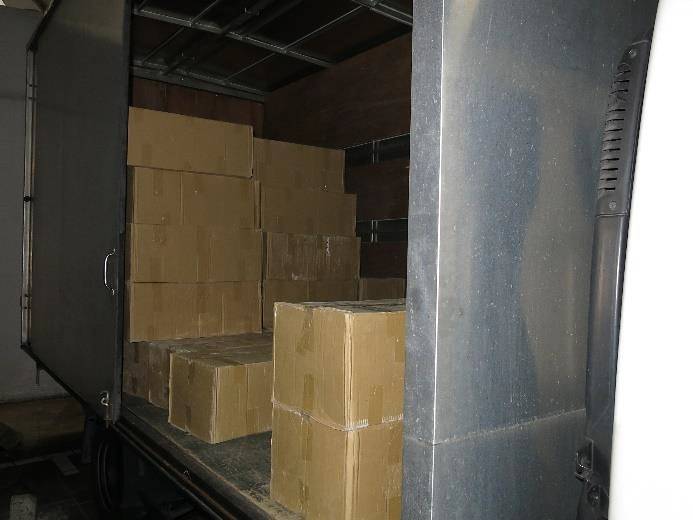
Customs officers conducted an operation at an industrial building at Sunview Road on Saturday and saw what they suspected to be boxes of contraband cigarettes being transferred from a Malaysia-registered truck to a Singapore-registered truck, the release said.
Officers uncovered duty-unpaid cigarettes in two trucks found near Sunview Road. (Photo: Singapore Customs)
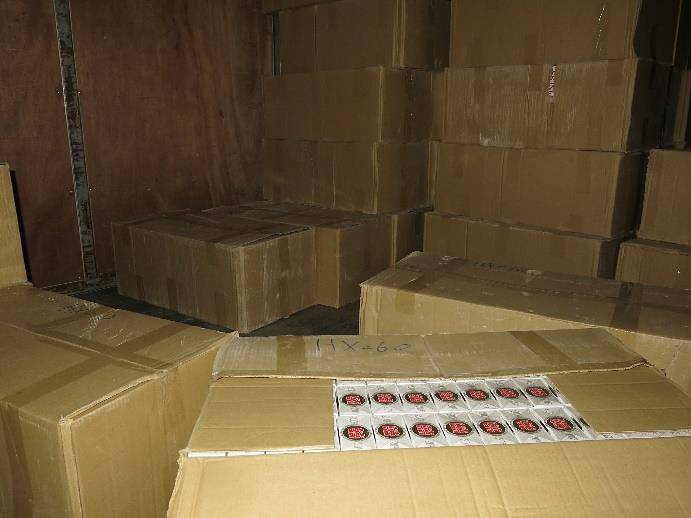
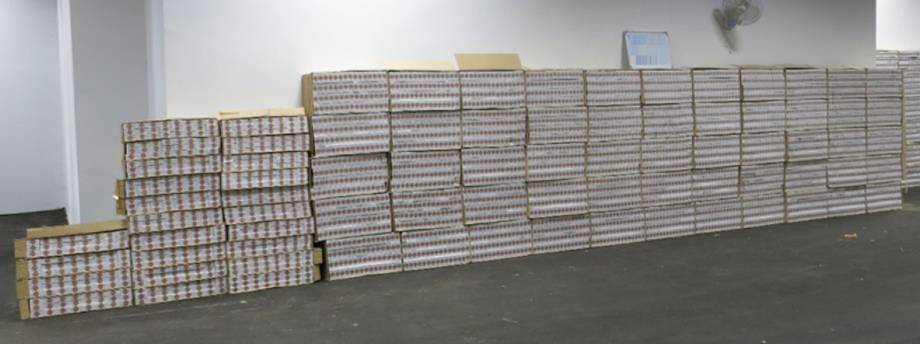
When they moved in to search the trucks, the officers found 7,392 cartons of duty-unpaid cigarettes. Three men aged between 35 and 39 – a Singaporean and two Malaysians – were arrested. The cigarettes and two trucks were seized.
The boxes were transferred from a Malaysia-registered truck to a Singapore registered truck. (Photo: Singapore Customs)
A total of 7,392 cartons of contraband cigarettes were seized. (Photo: Singapore Customs)
“Subsequently a follow-up search was conducted at an industrial unit in Gul Road, where officers uncovered 14 hollow concrete blocks,” said Singapore Customs.
“Investigations revealed that the duty-unpaid cigarettes found in the two trucks were earlier retrieved from these concrete blocks.”
In all, about S$631,270 in duty and S$46,540 in Goods and Services Tax (GST) were evaded.
about S$631,270 in duty and S$46,540 in Goods and Services Tax (GST) were evaded (Photo: Singapore Customs)
Buying, selling, conveying, delivering, storing, keeping, having in possession or dealing with duty-unpaid goods are offences under the Customs Act and the GST Act.
Offenders can be fined up to 40 times the amount of duty and GST evaded and/or jailed for up to six years. Vehicles used in the commission of such offences are also liable to be forfeited.
Snacc Attacc is a bi-weekly video series where we try out different snacks and let you know if it’s worth “snacc-(a)ttacking“.
This week, we try 7-Eleven’s new and exclusive snacks from the US that look ‘atas’ but come at wallet-friendly prices.
It’s the year-end party season for fun get-togethers with friends and family — and what’s a party without a truckload of snacks?
We’re not talking about the ones for kids, either.
Just in time for the festive period, 7-Eleven in Singapore has recently launched on Dec 19 an exclusive range of premium snacks from the US to make your party the talk of the town.
Lovers of savoury chips should appreciate the 7-Select exclusive potato chips that come in six flavours. They are cooked in small batches, and according to the description in the press kit we received, “seasoned to perfection”.
Among them is the Prime Rib Wavy Potato Chips ($2), “slow-cooked all day au jus and topped with horseradish for a premium, grade-A flavour and crunch”.
SINGAPORE: Patients admitted to hospitals for surgical procedures from January next year will be able to claim more from MediShield Life, the Ministry of Health (MOH) said on Friday (Dec 27).
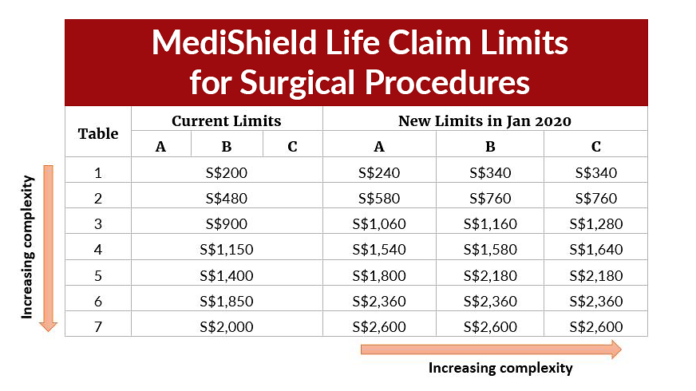
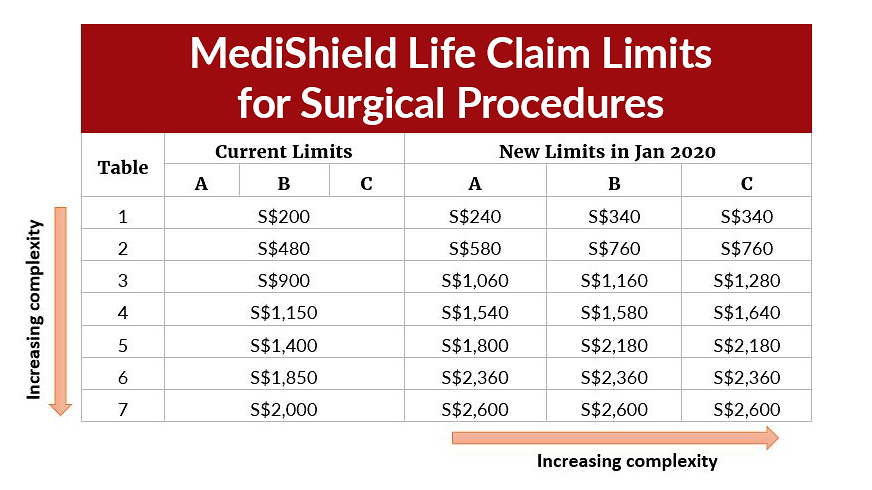
Currently, patients can claim between S$200 and S$2,000, depending on the complexity of their procedures. From Jan 1, the amount will be between S$240 and S$2,600.
The claim limits have been adjusted to “keep pace with increased healthcare cost since the last revision in 2015”, MOH said.
Currently, MediShield Life has seven claim limits catering to more than 2,000 procedures in the Table of Surgical Procedures. This will increase to 21 (1A to 7C) from 1 Jan 2020. (Source: MOH)
MOH said the enhancement was recommended by the MediShield Life Council (MLC), as part of its ongoing review of MediShield Life benefits and premiums. The review is expected to be completed by the end of next year.
“Even as the MediShield Life Council undertakes their review, which will be completed by end 2020, we will start off by implementing the new claim limits for surgical procedures so that patients can benefit earlier from this enhancement,” said Senior Minister of State for Health Edwin Tong.
“Around 90,000 patients per year are expected to benefit from higher MediShield Life payouts with the implementation of the new claim limits,” MOH said.
While there will be no premium adjustments at this point, as part of its overall review of the scheme, the MLC will also assess adjustments to premiums accordingly, after factoring in enhancements to the scheme and actual claims experience, the ministry said.
When the scheme was launched in November 2015, the Government’s commitment was to keep premiums constant for five years, it added.
MediShield Life is a basic health insurance plan, administered by the Central Provident Fund (CPF) Board, which helps to pay for large hospital bills and selected costly outpatient treatments, such as dialysis.
MOH has also added 14 new tiers to the MediShield Life claim limits to cater to surgical procedures of different complexities under the Table of Surgical Procedures (TOSP). The TOSP is an exhaustive list of more than 2,000 procedures for which MediSave and MediShield Life can be claimed, subject to their respective limits.
There are seven claim tiers currently. From Jan 1, there will be 21.
“The introduction of more granular and higher tiers will provide better coverage for more complex surgical procedures, which tend to be costlier,” MOH said adding that it will also better protect Singaporeans against large medical bills.
This is a key enhancement that the MLC has been working on this year, its chairman Mrs Fang Ai Lian, said.
“As we have finished the review, we have recommended to MOH to roll it out ahead of the larger review, which will benefit Singaporeans with more complex procedures,” she said.
No action is needed on the part of patients. The new claim limits will be automatically applied to MediShield Life claims for patients admitted for surgeries from Jan 1 next year, MOH said.
SINGAPORE: Christmas came early for the Singapore Zoo as it welcomed a white rhinoceros calf on Dec 19, a species considered “near threatened” in the wild.
Wildlife Reserves Singapore (WRS) announced the female calf’s arrival on Friday (Dec 27) via a Facebook video.
The calf, which is yet unnamed, was born to mother Donsa and father Hoepel. The parents are from South Africa and arrived in Singapore in 1992 and 2000, respectively. Donsa is an experienced rhino mother – this is her 12th calf, according to a fact sheet from WRS.
The white rhino calf with her 34-year-old mother Donsa. (Photo: Wildlife Reserves Singapore)
The rhino calf is “quickly getting her footing and growing strong”, according to WRS.
“The Rhino Care Team has started conditioning her to scrubbing sessions – brushing her body with a long brush to enhance the bonding process and get her used to being touched,” WRS said, adding that this is beneficial for “future husbandry and medical procedures”.
“The little calf already voluntarily participates in these sessions,” it added.
The yet-to-be-named calf staying close to her mother. (Photo: Wildlife Reserves Singapore)
Visitors to the zoo will not be able to catch Donsa and her baby rhino yet, but they can meet Hoepel and other white rhinos during their daily feeding session.
The white rhino, together with the Indian rhino, is the largest land mammal after the elephant.
White rhinos are considered near threatened in the wild, according to the International Union for the Conservation of Nature’s Red List of Threatened species. They are poached for their horns, which some believe have medicinal properties, although there has been no scientific evidence to suggest the horns are a cure for anything, according to the fact sheet.
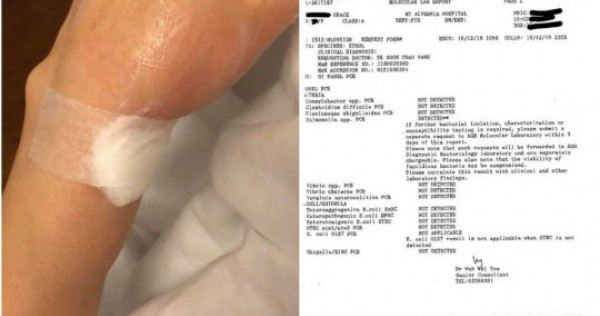
Salmonella bacteria was not detected in food samples taken from Itacho Sushi at Jewel Changi Airport, the Singapore Food Agency (SFA) said in response to a customer’s claim that his wife had fallen ill after dining at the restaurant.
However, an unregistered food handler was found working there, it added.
On Tuesday, the customer, Mr Marc Wong, posted on Facebook that he and his wife had patronised Itacho Sushi at Jewel Changi Airport on Dec 13.
In his post, he alleged that his wife had contracted a salmonella infection after dining at the restaurant.
Mr Wong also said he had filed a complaint with SFA, and claimed he was told that the restaurant had “failed on some criteria” and that action would be taken against it.
The post has been shared about 1,900 times as of last night.
A year ago, I was your typical unfulfilled millennial — slaving away at a job that didn’t fit me and dreaming of my next overseas getaway. Every weekday was just a hurdle to cross in order to get to the finish line i.e. the weekend.
Then, I joined AsiaOne in June this year. I’m not going to lie, weekends are still the best thing ever. But I’ve also got to do some pretty cool things while on the clock. Six months and 170 stories later, here are some of my highlights of the year, all in the name of work.
For an e-commerce platform under four years old, Shopee has done pretty well for itself.
Since it was established in 2015, the Singaporean e-commerce site has become the most visited across Southeast Asia, according to a recent iPrice report which also found that Shopee’s mobile app ranked at the top of its category in terms of downloads and average monthly active users in the region.
One of the secrets to its success? Being “late” to the industry, according to chief commercial officer Zhou Junjie.
“Back in early 2015, we were looking at e-commerce as an industry and while there were players who had been there, we saw that there was a lot of [potential] growth and many areas that weren’t being addressed well by existing players,” he said in an interview with the Post.
At the time, most existing e-commerce players were focused on websites as their main platform. Shopee took a different strategy early on by launching as an app first to tap Southeast Asia’s high mobile penetration rate.
SINGAPORE – A student from the National University of Singapore (NUS) has been placed on a mandatory leave of absence since September after he allegedly shot upskirt videos of women on campus and at Haw Par Villa MRT station.
Luah Chao Zhi, 23, will also appear before an NUS board of discipline in January next year.
He appeared in a district court on Tuesday (Dec 24) and is now accused of five counts of insulting a woman’s modesty.
According to court documents, Luah allegedly intruded the privacy of 31 unknown women by capturing their videos at various locations islandwide between April and August this year.
He is accused of committing similar offences four more times on Aug 23 by shooting upskirt videos on campus and at Haw Par Villa MRT station.
SINGAPORE: Following a boom in their popularity in recent years, the number of personal mobility devices (PMD) such as e-scooters looks set to plunge in the coming year with the deadlines for several schemes affecting their use either ending or kicking in at the end of this month.
As of Dec 17, the Land Transport Authority (LTA) said it had received 23,500 applications under the early disposal incentive scheme for e-scooters which do not meet the UL2272 fire certification standard.
Next Tuesday (Dec 31) marks the end of the scheme, which provides a S$100 incentive to those who dispose of their registered e-scooters at one of about 200 locations islandwide.
The devices are recycled for their parts.
This comes amid an increasing number of fires involving PMDs, with 73 such cases between January and September this year, resulting in 36 people injured and one dead.
Meanwhile, the LTA’s e-scooter trade-in grant – which allows delivery riders from Deliveroo, Foodpanda and GrabFood to trade-in their e-scooters for e-bikes or bicycles – will also come to an end on Dec 31.
Taken together, both measures will see about 27,000 e-scooters taken off the streets here – more than a quarter of the roughly 100,000 registered e-scooters here.
The trade-in grant followed a ban on the use of e-scooters on footpaths, which came into effect on Nov 5.
Next Tuesday also marks the end of the “advisory period” for the ban on the use of e-scooters on footpaths, where those found riding them on footpaths are issued warnings.
More than 3,400 such warnings were issued by the LTA in the first month of the footpath ban.
From Jan 1, a “zero-tolerance” approach will be taken and e-scooter users found riding their devices on public footpaths can be fined up to S$2,000 or jailed for up to three months, or both.
Other types of PMDs such as hoverboards and electric unicycles are also expected to be included in the ban by next year.
The devices can still be used on the more than 440km of cycling paths around the island, though this is a significant decrease from the 5,500km of footpaths available to riders previously.
The ban followed the death of 65-year-old Madam Ong Bee Eng, who died in September after getting hit by a PMD rider while on her bicycle, sparking anger and concern among pedestrians with many turning to social media to express their feelings.
Last month 20-year-old permanent resident Hung Kee Boon was charged with causing her death. He was also handed two other charges of riding an unregistered and non-compliant device under the Active Mobility Act.
These developments have dented the popularity of PMDs, said Denis Koh, who chairs local PMD enthusiast group Big Wheel Scooters Singapore.
The footpath ban in particular has dealt a “deadly blow” to users here, he said adding that it disrupts the connectivity required to make PMDs a viable mode of transportation.
Further regulatory requirements next year, such as mandatory inspections, are also likely to hamper their use, he added.
But Singapore University of Technology and Design (SUTD) researcher Julienne Chen said the ban on the use of e-scooters on footpaths was appropriate.
“PMDs and pedestrians travel at very different speeds, and do not belong on the same path. This has been clearly illustrated through the well documented conflicts between them,” said Ms Chen, who is a research fellow at SUTD’s Lee Kuan Yew Centre for Innovative Cities.
Still, such devices have a role in urban transportation, noted Singapore University of Social Sciences (SUSS) transport expert Walter Theseira.
“Private car transport, even if it is autonomous or electrified, simply uses too much road space and energy for short distance travel. Current forms of public transport, such as buses or rail, are cost ineffective when passenger loads are low,” he said.
In contrast, PMDs use little energy and provide “sufficient speed and flexibility” for short commutes, noted Associate Professor Theseira, who heads the master of urban transport management programme at SUSS.
The popularity of PMDs as well as dockless bike-sharing, points to a “very clear demand” for different ways of getting around the city, said Ms Chen.
An e-scooter rider in Singapore. (File photo: AFP/Roslan Rahman)
BUILDING INFRASTRUCTURE FOR PMDS NOT AN “INSURMOUNTABLE CHALLENGE”
Mr Koh – who sits on the Active Mobility Advisory Panel – said by not imposing an outright ban on PMDs, the authorities is giving a clear sign that they are trying to find the “right balance” in accommodating all users.
Senior Minister of State for Transport Lam Pin Min recently announced that the expansion of Singapore’s cycling paths – set to grow to 1,300km by 2030 – could be expedited.
This is a welcome announcement for PMD users, said Mr Koh, adding he hoped all footpaths wider than 2.5m could be reclassified as shared paths to allow for the responsible use of e-scooters.
“It’s common for people to say that Singapore is a land scarce country, and therefore does not have room for bicycle or PMD infrastructure,” said Ms Chen, noting this is a problem found in most cities.
Still, this is not an insurmountable issue with some engineering and design creativity, she said.
“For instance, decreasing the width of car lanes can free up the extra space needed for bicycle lanes without widening the overall road. It requires some creativity and innovation to conventional models of traffic engineering.”
However in certain areas – such as private housing estates – tweaking the infrastructure in such a way may not be possible, said Associate Professor Theseira.
“The right solution there might be to allow PMDs onto local roads.”
Mr Koh said there needs to be greater education efforts to ensure PMD riders are more civic-minded.
“We can have first world infrastructure but we also need the right attitude to pull this off,” he said, adding a mix of “social etiquette, infrastructure and enforcement” are needed.
Still, the fear of yet more rules on their use may cause prevent many from riding their PMDs again, said Associate Professor Theseira.
He pointed out that many users were caught off guard by the adoption of the UL2272 fire safety standard after having already bought PMDs before the requirement was introduced.
“I think if we are to have PMDs come back into use, we should have a more carefully constructed regulatory framework, particularly in terms of PMD construction standards and licensing, so that users can make any purchasing decisions without risk of being caught out.”