SINGAPORE – Friends and family members on Tuesday (Dec 31) attended the wake of Ms Abigail Danao Leste, one of two women who died after a car crashed into them at Lucky Plaza.
When The Straits Times arrived at the funeral parlour in Geylang Bahru, a woman understood to be Ms Leste’s cousin was sobbing by the casket.
A priest from the Church of Our Lady Star of the Sea conducted Catholic rites for Ms Leste, as part of a 10-minute service arranged by the Centre for Domestic Employees.
Ms Leste’s cousin read some scriptures as part of the service, her voice quavering throughout. She later discussed arrangements with the centre and the funeral parlor.
The nine friends and family members at the wake declined to be interviewed, with some saying they were still coming to terms with the tragedy.
Mr Shamsul Kamar, the centre’s executive director, said there are plans to fly Ms Leste’s daughter to Singapore within the next few days.
SINGAPORE: 2019 has been a roller-coaster ride for financial markets and the global economy including Asia.
Geopolitics has loomed large over business sentiments.
The year has been driven by US President Donald Trump’s frequent tweets, bouts of market volatility and geopolitical tensions on both the trade and technology fronts, the never-ending drama called Brexit, and much hand-wringing over China’s ongoing growth slowdown, among others.
Despite initial market fears about a US recession, the US economy escaped a contraction. Global central banks, led by the US Federal Reserve, had ridden quickly to the rescue with interest rate cuts and liquidity provisions.
Hence, notwithstanding the economic uncertainties and bouts of risk-aversion, financial markets still performed fairly well as illustrated by the S&P 500’s continued surge.
At home, the Singapore economy managed to avert a technical recession in the third quarter of 2019, albeit with full-year growth likely to come in at the lower end of the official growth forecast range.
THE OUTLOOK FOR SINGAPORE IN 2020
Looking ahead, there are some tentative green shoots on the macroeconomic front, including favourable borrowing conditions and a slightly stronger outlook for emerging markets.
But we should remain cautious not to count the chickens before they hatch, given that many factors, such as the US-China bilateral relationship, can turn in an instance.
The Singapore economy may eke out modestly improved growth prospects of 1 to 2 per cent year-on-year in 2020, versus a subdued 0.5 to 1.0 per cent forecast range for 2019.
Global trade growth has slowed in 2019 according to the WTO. (File photo: AFP/Roslan Rahman)
This assumes that the global trade tensions do not escalate further from here and the manufacturing and trade outlook sees a modicum of stabilisation.
Moreover, the challenges ahead for the Singapore economy over the next few years may be more structural and difficult to navigate.
Take for instance, climate change, which has manifested in fires, floods and global warming, and will require significant investments for countries adapting to a changed environment. Prime Minister Lee Hsien Loong had earlier highlighted the need for US$100 billion for the Singapore economy to prepare for rising sea levels at the National Day Rally in 2019.
The greying of the Singapore population with attendant health, retirement and housing planning needs could also strain fiscal resources over the long term.
The rise of the gig economy also poses fresh challenges for policymakers who now have to think about how to strengthen job security, plan for medium-term career development and approach retirement needs for workers in this new economy.
THE BIG RISKS FROM THE EXTERNAL ENVIRONMENT
The good news is major economies appear to be navigating global economic headwinds well thus far, although Eurozone growth remains sluggish for now.
That said, the US is heading into an election cycle and if the impeachment process against incumbent president Trump is any guide, the noise level is likely to remain elevated in 2020.
In Asia, regional economies are carefully treading the bifurcation of manufacturing supply and trading chains as businesses adopt a “China plus one” approach to avoid US-China trade tariffs.
US President Donald Trump and China’s Xi Jinping started to redefine one of the world’s most significant geopolitical relationships in the 2010s. (File photo: AFP/Brendan Smialowski)
The biggest risk for the Singapore economy remains the fragility of the external environment and the prospect of anaemic global growth amid uncertainties pertaining to US-China tensions beyond trade, Brexit, China’s slowdown, and geopolitical hotspots (such as the Hong Kong unrest) which could continue to weigh on business and consumer confidence.
CHALLENGES TO SPECIFIC SECTORS
Sectoral challenges remain mixed for the Singapore economy. The services and construction sectors are likely to provide the bulwark for 2020 growth, even if manufacturing sector stages a modest recovery.
Manufacturing, especially electronics, has been suffering a global demand slowdown, coupled with the wax and wane of the US-China trade war that has impacted both business and consumer confidence.
While there were tentative signs of a bottoming- out in the middle of 2019, a quick V-shaped upturn remains elusive for now, although there are hopes that the 5G implementation will lend a helping hand going forward. There are also hopes the impending conclusion of a US-China Phase 1 trade deal heralds a more reconciliatory trade relationship.
Still, domestic demand conditions may remain subdued due to the lack of fresh growth catalysts.
The outlook for cyclical industries, like retail, remain challenging due to a combination of supply-side factors like high operating costs including rents and the ongoing manpower crunch, whereas the demand side is likely restrained by potential belt-tightening in households.
SINGAPORE’S LABOUR MARKET WILL REMAIN RESILIENT
The domestic labour market had stayed relatively resilient over the course of 2019.
Although the overall unemployment rate had crept up to a 10-year high of 2.3 per cent, retrenchments for the 12 months to September 2019 was actually lower at 10,490, compared to the same period a year before (11,900) and in 2017 (16,480).
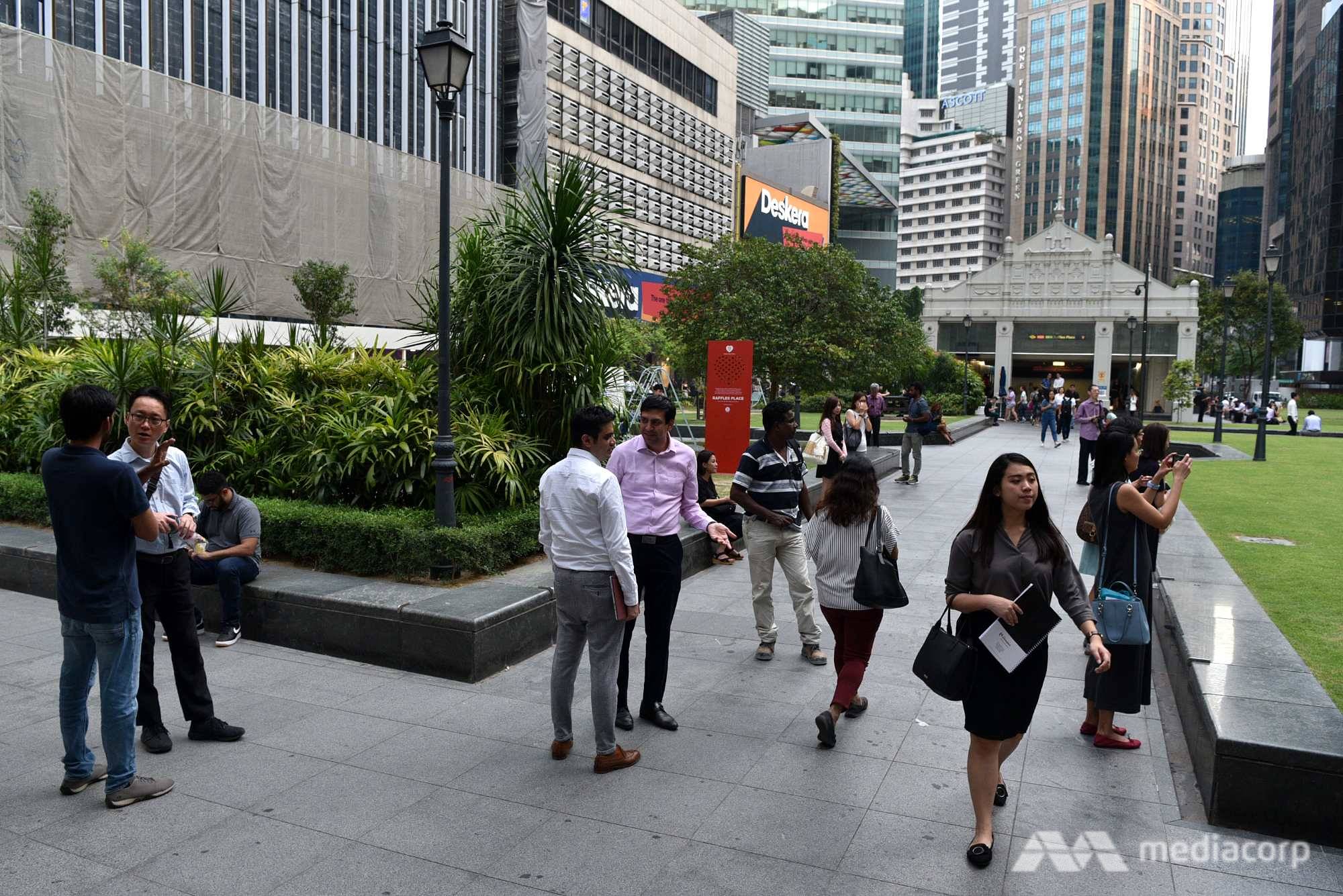
File photo of office workers at Raffles Place in Singapore’s CBD (Photo: Jeremy Long)
Hiring intentions have turned more cautious, which explains in part why resident wage growth for the first nine months of 2019 had come down slightly to 3.3 per cent, down from 3.7 per cent for the same period a year ago.
However, looking ahead, the services sector will have to grapple with the Dependency Ratio Ceiling cut from 40 per cent to 38 per cent from Jan 1, 2020 for the proportion of foreign workers on work permits or S Passes, with a further cut to 35 per cent from Jan 1, 2021.
This may buffer against any softening of the domestic labour market amid an expected lacklustre growth recovery environment in 2020.
Growth industries likely to offer employment opportunities include healthcare, education services, information and communications (ICT), and finance and insurance.
The unemployment rate may hover around the 2.3 to 2.5 per cent in the interim, but should avoid the sharp spikes seen in the global financial crisis back in 2009.
The biggest challenge for labour remains keeping up with advances in technology. In the medium term, with the advent of the Internet of Things, automation, and the employment of artificial intelligence, Singapore is expected to see the largest disruption in its workforce among ASEAN countries.
Singapore may see a faster and more widespread digital transformation compared to its ASEAN peers.
Major upskilling or reskilling will be needed for the labour force to stay relevant and fill new jobs created by the Fourth Industrial Revolution. This is likely to remain a key focus for policymakers.
EXPECTATIONS FOR POLICY SUPPORT AND BUDGET 2020
There is space for a stronger fiscal response at the upcoming 2020 Budget, after a more accommodative monetary policy in 2019. Market attention is increasingly focused on what is touted to be a pre-election budget.
Looking around the region, Singapore would not be alone if it unveils a more expansionary budget. Countries around the region have announced proactive fiscal policy support including China, South Korea, Thailand and India.
Japan has announced a stimulus package amounting to some 13 trillion yen (S$160 billion), while Hong Kong has announced waves of fiscal packages to tackle its recession.
Residential and commercial buildings in the Kowloon district (foreground) with the skyline of Hong Kong Island past Victoria Harbour in the distance. (Photo: AFP/Anthony Wallace)
Many Singaporeans will look to Budget 2020 for aid for workers and companies.
To better assist displaced workers and SMEs to ride out these challenging times, it may be timely to top up the SkillsFuture Credit scheme from the initial S$500 per Singaporean and offer more work transition support by scaling up the Professional Conversion Programmes.
For SMEs, greater assistance in terms of enterprise capability building, innovation and internationalisation efforts in light of the global trade tensions will be likely.
We should also expect Budget 2020 to reflect a focus on medium-term priorities such as healthcare, education, security (including cybersecurity and food security), productivity improvements and environmental and financial sustainability.
Budget 2020 may also provide greater clarity on how to fund the S$100 billion to combat climate change.
Aside from any stimulus package to tackle concerns over the state of the economy and measures to support businesses, many will also look to Budget 2020 for support for households.
There had been strong hints of a GST offset package in the offing. Without a specific timeline on the actual implementation of the planned GST hike from 7 to 9 per cent, it may be premature to speculate on the actual quantum of the 2020 GST offset package.
The focus of social programmes will likely target low-income households and seniors and costs of living concerns.
For the new year in 2020, one has to be thankful that many much touted external downside growth risks did not materialise, and look forward with an air of cautious optimism that the global and regional economy will improve from a very volatile 2019.
Selena Ling is Chief Economist and Head of Treasury Research at OCBC Bank.
SINGAPORE: Deliberate online falsehoods, National Service (NS) deaths and streaming in schools were just three of the main topics discussed in the Singapore Parliament in 2019.
Over the course of the year, more than 200 stories were published by CNA on the issues raised in the chamber.
Here is a look back on some of the issues that were debated in Parliament over the course of 2019.
DELIBERATE ONLINE FALSEHOODS
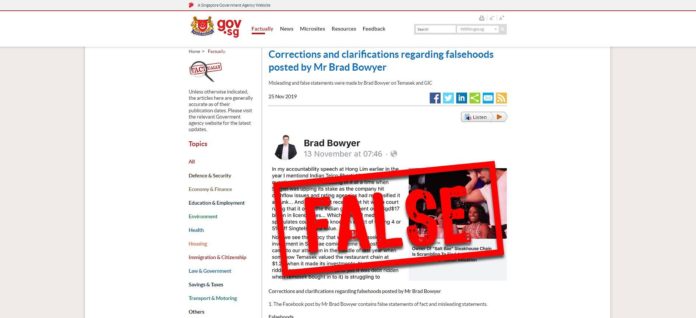
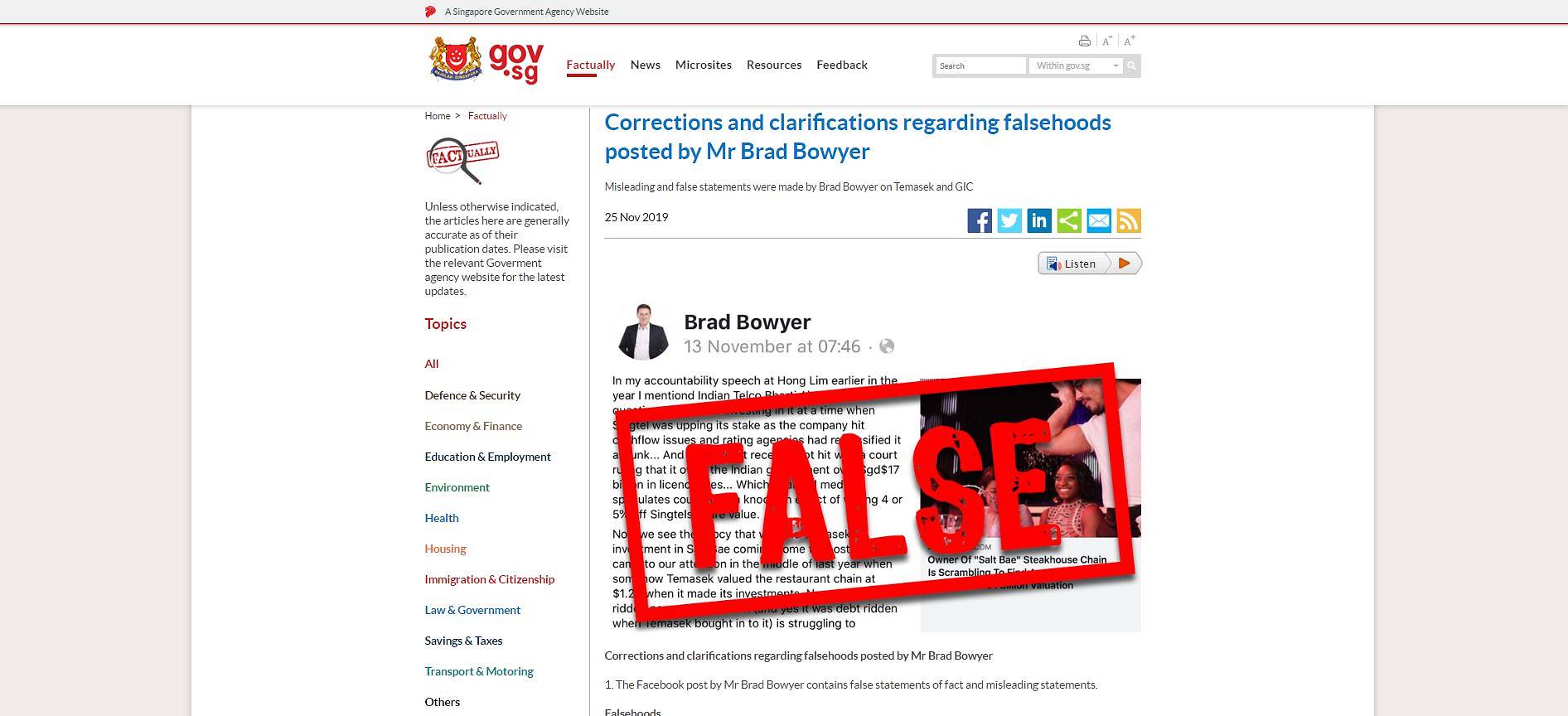
A screenshot of the Factually post citing the corrections and clarifications regarding falsehoods posted by Mr Brad Bowyer on Temasek and GIC on his Facebook account. (Image: www.gov.sg)
The Protection from Online Falsehoods and Manipulation Act (POFMA) was passed in May after a two-day debate that lasted more than 14 hours.
Designed to tackle deliberate online falsehoods, it was passed with a majority of 72 to nine, with three Nominated Members of Parliament (NMPs) abstaining.
Members of the opposition Workers’ Party voted against the Bill.
There were concerns raised by members that the definition of falsehoods might be too wide and ambiguous and have a chilling effect on people expressing their opinions.
“You put up an article, Government says this is not correct. You carry a correction (and) let your readers judge. What’s the problem? More transparency, the better,” Law and Home Affairs Minister K Shanmugam argued.
In December, the Singapore Democratic Party (SDP) was asked to correct two Facebook posts and an article on its website that were related to manpower issues.
In the same month, lawyer Lim Tean was directed to add a correction notice in full at the top of two Facebook posts about the Ministry of Education’s (MOE) spending on local and foreign students.
PMDs BANNED ON FOOTPATHS
A GrabFood rider on an e-scooter. (File photo: TODAY/Najeer Yusof)
Personal Mobility Devices (PMDs) was a widely debated topic in Parliament in 2019.
The Ministry of Transport said in May there were no plans to ban PMDs on Singapore’s footpaths.
In August, it was announced that all 15 town councils run by the People’s Action Party (PAP) will ban PMDs from void decks and common corridors to increase the safety of public paths.
The Aljunied-Hougang Town Council run by the Workers’ Party said they have the “powers to deter PMDs from riding at common areas” but “enforcing these powers without evidence of an infraction is a challenge”.
Several incidents involving PMDs, such as crashes and a rise in the number of fires involving the devices, were reported before the issue came before Parliament again.
Students at Bendemeer Primary School after collecting their PSLE results in 2018. (Photo: MCI)
The current approach to streaming in secondary schools will be phased out by 2024. Under the changes, secondary school students will not be posted into Express, Normal (Academic) or Normal (Technical) streams.
“In its original form, streaming assumed that students needed a certain pace of learning in all their subjects, whereas many students, in fact, have uneven strengths across different subjects,” Education Minister Ong Ye Kung told parliament.
“More importantly, entering a stream that is considered ‘lower’ can carry a certain stigma that becomes self-fulfilling and self-limiting,” he added.
“Students can develop a mindset where they tell themselves, ‘I am only a Normal stream student, so this is as good as I can be.’”
There is also room for specialised schools, Integrated Programme schools and schools that take in only Express students to offer more subject options at different levels, Mr Ong added.
NS DEATHS
The body of Aloysius Pang leaves for Mandai Crematorium from wake venue at Macpherson. (Photo: Jeremy Long)
The Singapore Armed Forces (SAF) renewed its emphasis on safety after the deaths of four servicemen in training over 17 months.
This comes after Defence Minister Ng Eng Hen told Parliament that he was “deeply sorry” for the deaths and that MINDEF and the SAF will hold themselves accountable for every NSman.
Soldiers have the right to stop unsafe training, Dr Ng added. “If you think it’s unsafe for your buddies, yourself, raise it up. If you think that someone is pushing beyond his means to physical harm, do so. I think that’s the way we maintain realistic training and give comfort to our parents.”
In a ministerial statement in February, Dr Ng told Parliament that in addition to the Committee of Inquiry (COI), the Singapore Armed Forces (SAF) Special Investigation Branch (SIB) will also investigate the death.
In that month’s sitting, Dr Ng also presented in Parliament the results of a Committee of Inquiry (COI) investigation into the death of Corporal First Class Liu Kai, who died in November 2018.
In March, it was announced that all high-risk and field training will be inspected for safety.
Dr Ng also presented in May the results of a COI into the death of Aloysius Pang. The committee found that his death was due to lapses by Pang and two other servicemen who were in the howitzer at the time.
DOXXING
Photo illustration of a man using a laptop. (File photo: Gaya Chandramohan)
The act of doxxing, which involves publishing someone’s personal information with the intention to harass was criminalised under changes to the Protection from Harassment Act (POHA) in May.
In their debate on the amendments, MPs said online vigilantism impinges on individuals’ personal rights, hurts their physical, mental and financial health, and sometimes targets the wrong people.
One recent example of such online vigilantism was a dispute involving a Gojek driver and his passenger, which was recorded and posted online.
An NUS undergraduate is seeking “real” justice from the authorities after she was filmed in a hostel shower. (Photo: Instagram/Monica Baey)
The issue of how sexual misconduct cases were handled by local universities came to the fore after National University of Singapore (NUS) student Monica Baey revealed she had caught another student filming her in the shower at a hostel.
The university handed the perpetrator a 12-month conditional warning, with Ms Baey appealing for a heavier sentence. She said her mental health suffered as a result and called for the university to “take real action”.
Education Minister Ong Ye Kung said there were 56 disciplinary cases involving sexual misconduct at the six autonomous universities in Singapore in the last three academic years.
Second Minister for Education Indranee Rajah called for strong support for victims, and said more will be done to strengthen privacy and security on campus.
Law and Home Affairs Minister K Shanmugam warned there will be “no free passes” for anyone when it comes to such cases.
“All of this – being tough, taking a no nonsense approach – does not mean that every offender must be or will be automatically charged in court. Police and (the) AGC (Attorney General’s Chamber) must look at the facts of each case and exercise discretion,” Mr Shanmugam had said.
HIV DATA LEAK
Mikhy Farrera Brochez, the American citizen at the centre of the data leak of Singapore’s HIV registry. (Photo: Clark County Detention Centre/Mugshots.com)
January brought news that the HIV-positive status of 14,200 people had been leaked online, along with their personal information such as their identification numbers and contact details. The data was leaked by US citizen Mikhy Farrera Brochez.
The records were those of 5,400 Singaporeans diagnosed with HIV from 1985 to January 2013 and 8,800 foreigners, including work and visit pass applicants and holders, diagnosed with HIV from 1985 to December 2011.
About a month later, Health Minister Gan Kim Yong said he rejected any allegation that his ministry had sought to “cover up the incident”.
CNA traced Brochez to a small county in Kentucky, US, where he was subsequently charged for several crimes, including the data leak.
The Workers’ Party’s Low Thia Khiang and Sylvia Lim arriving at the Supreme Court on Oct 16, 2018. (Photo: Gaya Chandramohan)
The People’s Action Party (PAP) ministers laid out a range of reasons why opposition members Mr Low Thia Khiang and Ms Sylvia Lim should recuse themselves from financial matters relating to Ajunied-Hougang Town Council (AHTC).
It comes after a High Court ruling in October that Mr Low and Ms Lim had “acted dishonestly and in breach of their fiduciary duties” in appointing FM Solutions and Services as managing agent for AHTC.
High Court judge Kannan Ramesh, in his written judgement on Oct 11, had said there is “serious doubt” about the integrity of Ms Lim and Mr Low.
Deputy Prime Minister moved a motion on Nov 5, calling for the Workers’ Party MPs to recuse themselves and that was the “least they could do”.
Mr Heng also asked the party to “take action” and that it “cannot stay silent” on the issue.
“Will they at long last be conducting their own investigation? Or will they continue to duck, dodge and deny?” the Deputy Prime Minister had added.
Workers’ Party chief Pritam Singh said Parliament was “prematurely hijacked” to debate the recusal, saying the case was not resolved and that the window for appeal had not closed.
“The window for appeal remains open and the PAP (People’s Action Party) must explain truthfully what is its motive in hurriedly filing this motion before the case is concluded,” he stated.”
SINGAPORE: As the new year begins, CNA takes a look back at the most read court cases in 2019, with several murders making the headlines and politically significant cases unfolding before the judges.
Here are 10 cases heard in both the State and High Courts last year.
1. Orchard Towers death
Satheesh Noel Gobidass died on Jul 2, 2019. (Photo: Facebook/Mohana Anba)
On Jul 2, 2019, 31-year-old Satheesh Noel Gobidass collapsed at the entrance of Orchard Towers after a brawl. Closed-circuit television footage showed him walking slowly before collapsing.
Of the seven, only one is accused of possessing an offensive weapon – 27-year-old Tan Sen Yang, who allegedly had a foldable Karambit knife at Naughty Girl Club on the morning of the incident.
James Nalla Rajan Naidu Adhiseshan’s 13-year run from the law came to an end when he bumped into a man, freshly released from prison, whose identification card he had been misusing to see a doctor.
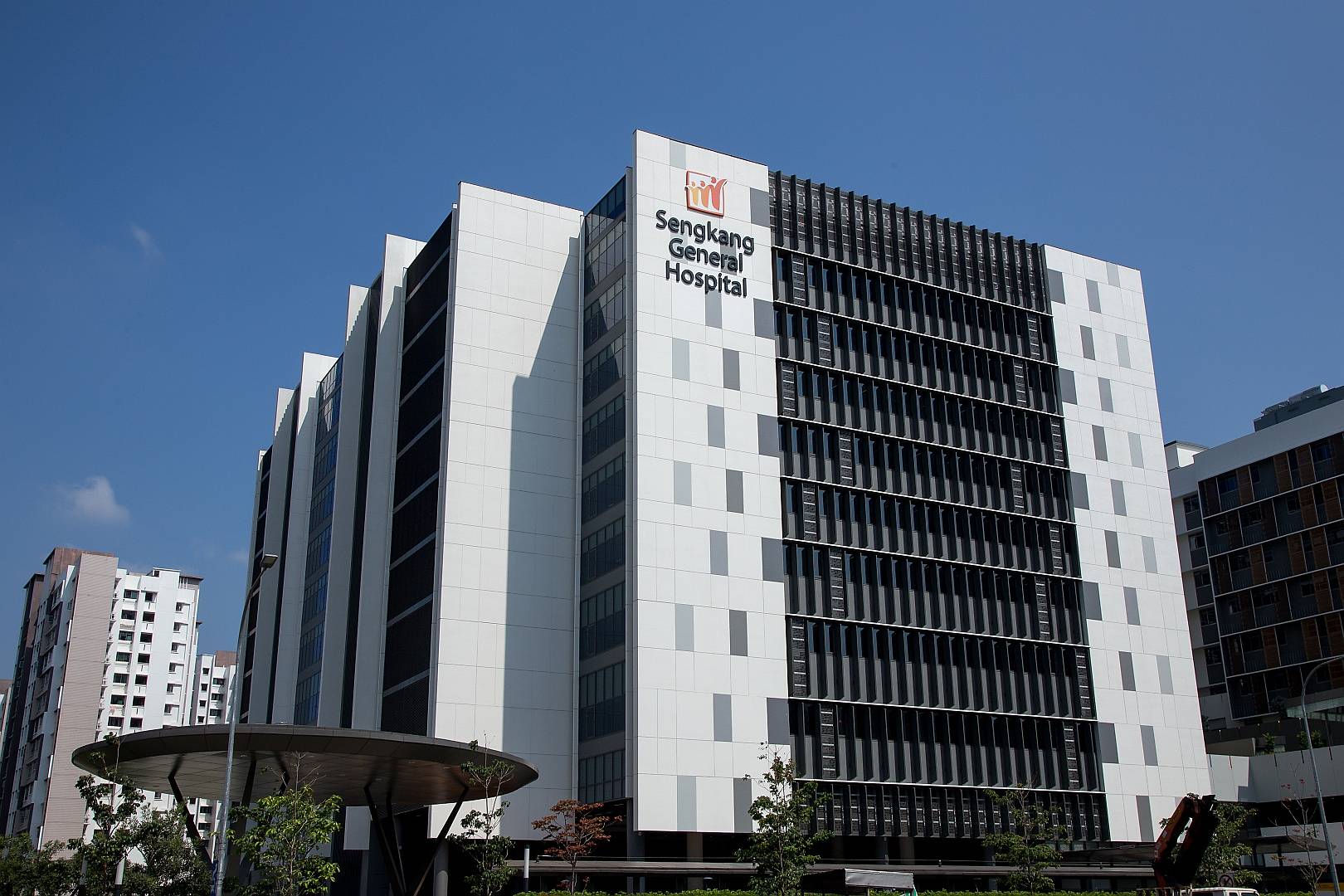
The man had kindly offered to help wheel the fugitive to the counter at Sengkang General Hospital and recognised the identity card as his own.
The case was widely shared and spawned memes on the Internet, with many commenting on how remarkable their meeting was.
4. Woodlands double deaths
Teo Ghim Heng is accused of killing his daughter (right) and wife. (Photos: Mediacorp, TODAY/Wee Teck Hian)
Several murder cases went to trial last year, but the Woodlands double deaths may be one of the most tragic, resulting in the deaths of a little girl, her pregnant mother and the unborn foetus that had been carried for six months in the womb. The charge involving the foetus was stood down.
He set fire to the bodies and slept next to the charred remains for more than a week until his wife’s brother forced open a window after smelling what he thought was gas and called the police
During the trial, details of the family’s life came to light – including of how Teo earned a basic salary of S$1,500 as a sales coordinator and had S$70,000 in unpaid debts, while paying S$850 a month in school fees for his daughter.
The court heard that he had argued with his wife on the day of the incident. He claimed that she had chided him for not being able to provide for the family and told their daughter how useless he was.
The trial continues in 2020.
5. The case of the boy who was scalded to death
Photos from court documents of the cage allegedly used to confine the boy, and the hot water dispenser purportedly used in the offences.
His parents went on trial for murder, with prosecutors charging that they had systematically abused their five-year-old boy, freshly returned to them after being privately fostered out for about four years.
The boy was repeatedly splashed with hot water, pinched with pliers, hit with household tools and kept in a cage for a cat barely big enough for him.
6. A beauty queen, a businessman and a banquet waiter
Businessman Lim Hong Liang (right) was found guilty of hiring hitmen to attack Joshua Koh Kian Yong (left), the lover of his mistress Audrey Chen Ying Fang. (Photos: TODAY/Najeer Yusof)
He paid hitmen S$5,000 to attack the younger man, who was himself married to another woman, twice.
The attacks left the victim with a permanent scar on his mouth, and Lim was convicted and sentenced to six years’ jail.
The love triangle led to seven men being taken to court over the case, with five of them receiving sentences of up to 14-and-a-half years’ jail.
7. The Aljunied Hougang Town Council case
(From left) Workers’ Party MPs Pritam Singh, Low Thia Khiang and Sylvia Lim leaving the Supreme Court on Oct 8, 2018. (Photo: Koh Mui Fong/TODAY)
In a verdict which could have political repercussions, the High Court found three Workers’ Party (WP) Members of Parliament liable in a landmark case involving the misuse of town council funds.
A second tranche of hearings will decide on the damages if any.
If the WP MPs are declared bankrupt because they cannot pay the damages, they will lose their parliamentary seats as undischarged bankrupts cannot be MPs nor contest in parliamentary elections.
8. The other town council court case – Ang Mo Kio Town Council
Former Ang Mo Kio Town Council general manager Wong Chee Meng and company director Chia Sin Lan. (Photos: Najeer Yusof/TODAY)
Another case involved the former general manager of Ang Mo Kio Town Council (AMKTC). He took a steady stream of bribes from a director whose companies did work for the town council.
Victor Wong Chee Meng, 59, was sentenced to 27 months’ jail while 64-year-old Chia Sin Lan, whose two companies provided construction services to town councils, received 21 months’ jail.
Chia’s two companies were fined S$75,000 each, and Wong has to pay a penalty of about S$23,000 for gratification received.
File photos of Mr Leong Sze Hian (left) and Prime Minister Lee Hsien Loong. (Photos: Facebook/Leong Sze Hian, Tang See Kit)
The court also heard applications and appeals over the defamation suit brought by the Prime Minister against blogger Leong Sze Hian, over the sharing of an article that claimed Mr Lee helped his former Malaysian counterpart Najib Razak launder money.
Mr Leong was represented by Lim Tean, lawyer and founder of opposition party Peoples Voice, and the pair filed appeals even before the case went to trial – once against a judge’s dismissal of their counterclaim that Mr Lee was abusing court process, and again in the Apex Court.
They also ordered Mr Leong to pay the Prime Minister costs of S$20,000.
The Chief Justice pointed out that a plaintiff has the right to pick who to sue for defamation, in response to Mr Lim saying his client was the only one out of close to 10,000 people who shared the offending link who was sued.
CJ Sundaresh Menon also questioned Mr Lim’s allegation that Mr Lee had used “state machinery” to shut down critics and sue Mr Leong.
When asked if the court was the machinery of the State, Mr Lim backed down and said it was not what he meant, clarifying that Mr Lee had “government machinery at his disposal”.
Justice Andrew Phang added that a court is “not a court of politics” and said anyone has a right to sue for defamation, “be you ever so high or ever so low”.
The suit will go to trial at a later date.
10. Doctor linked to HIV data leak stands trial
Ler Teck Siang at the Supreme Court on Mar 11, 2019. (Photo: Gaya Chandramohan)
A doctor linked to the leak of thousands of records from Singapore’s HIV registry took to the court to appeal against his sentence after being convicted for lying to government ministries and then again to conduct his own defence in a trial for drug offences.
Dr Ler Teck Siang’s partner Mikhy Brochez was convicted in the United States of leaking the data that he obtained in Singapore, and Ler had access to the HIV registry as part of his work as the former head of the National Public Health Unit. The pair started living together in Singapore in 2008, and were married in New York City in 2014.
Dr Ler failed in his appeal in March against his conviction and two-year jail sentence for abetting Brochez to cheat the Ministry of Manpower (MOM) regarding Brochez’s HIV-positive status, and of giving false information to the Ministry of Health (MOH) and the police.
Months later in May, Dr Ler stood trial over selling illegal drug injections to clients, concocting his own defence with props like syringes and giving elaborate explanations for items found on him.
He claimed that he was not providing illegal drug injections but instead giving prostate massages, saying he used a meth-stained syringe found on him to flush out food particles from his teeth, and using a straw not for drugs but to fold origami.
He was found guilty and sentenced to 15 months’ jail in October by a judge who found his evidence “disingenuous and illogical” and said he was “incredulous” at some of his explanations.
Dr Ler’s medical registration was suspended for nine months, the Singapore Medical Council said in March.
SINGAPORE: The last time Mr Reynaldo Nucos spoke to his sister Arceli, they talked about having one of the family’s motorised rickshaws repaired.
“We spoke on Friday or Saturday. She asked me if it was still running fine,” Mr Nucos told CNA in a phone interview from the family’s hometown in La Union, Philippines. “I said it runs, but it needs a bit of repair. We just need to allocate some funds to get it done.”
Ms Arceli replied that it’s “no problem” and they will have it fixed when she returns to the Philippines. She was supposed to fly back in January.
However, on Sunday (Dec 29), the 56-year-old and their sister Arlyn were among the six people involved in a car crash near Lucky Plaza in Orchard Road. Arlyn, 50, was killed in the accident, while Arceli was seriously injured.
“What happened instead is that one of my sisters is suffering in the hospital, and the other has died,” Mr Nucos said. “I don’t know why this had to happen.”
SISTERS WERE GENEROUS, CHEERFUL, CHATTY
Both sisters had been working in Singapore for nearly 30 years. Ms Arlyn arrived first, with Ms Arceli following a few months later in 1990.
He described both of his sisters as generous, cheerful and chatty.
“They’re also always helpful. Whatever we need, they would give it to us, even when we don’t ask for it,” he said. “They’d always help us, even when we couldn’t reciprocate the kindness. That’s how good they were.”
Ms Arceli and Ms Arlyn, both unmarried, doted on their nephews and nieces, he added.
This generosity also extended to their friends and relatives. When asked, the sisters would lend a hand, even when they don’t have much to give, Mr Nucos said.
They would ask him to cook food so that friends coming back to Singapore from their hometown can bring it with them.
“Once it gets there, they would divide it up and share it with their friends,” he said.
They would also order Christmas ham to be given away to friends and relatives during the holidays, he said.
Ms Arceli and Ms Arlyn would return to their hometown in the Philippines every two years or so, Mr Nucos said.
Usually they would go together, at times with a cousin who is also working in Singapore. This time, Ms Arceli had planned to go back in January 2020 and Ms Arlyn in February.
Often, they don’t mention the exact date or month of their return, preferring to surprise their family.
“We always have a good time when they’re here,” Mr Nucos said. “The family would gather and we would eat at home. Our sister’s house is close by, and we have our breakfast, lunch and dinner together. Even our meryenda (mid-afternoon snack).”
Mr Nucos said a different voice answered when he called one of his sisters on the day of the accident. He then called his wife Rose, who is also working in Singapore.
“At first, I thought I pressed something different,” he said. The person on the line mentioned one sister’s name and asked if he knew her. When he said “yes”, the other person asked if he knew what had happened to them.
“I hung up immediately. I thought something bad had happened so I decided to call my wife. I tried calling Arlyn’s phone. It still rang. Arcely’s did not, so I thought she may have run out of phone credit.”
Eventually, he reached his wife. A friend of the sisters was with her, but she was hardly able to speak because she was crying so much. She was the one who told him his sisters were in the car crash.
“I cried,” he said. “I cried, and wondered why it had to be them.”
A screengrab of a video circulating on social media of paramedics attending to victims after an accident at Lucky Plaza on Dec 29, 2019.
Mrs Nucos was given leave by her employer so that she could accompany Ms Arlyn’s body back to the Philippines.
A brief memorial will be held before they leave. A wake will be held at their hometown, though no funeral plans have been discussed, he added.
The family had planned to fly to Singapore to get Ms Arlyn’s body but were unable to get passports in time.
“We are still planning to get passports,” Mr Nucos said. “If there’s financial help, we will fly to see Arceli. I hope that if we manage to get to her, she would get the strength to fight. It makes a difference when someone is taking care of her.”
For now, his wife has said she is willing to take care of Ms Arceli, who has had two operations. She has since regained consciousness, but remains in hospital.
“My two cousins are there too. I think the three of them will be the ones who will take care of our sister for now. And they have friends. I’m sure they would not neglect her.”
SINGAPORE: It was a somber New Year’s Eve afternoon on Tuesday (Dec 31) as friends and family gathered inside a small memorial hall in Geylang Bahru to remember Abigail Danao Leste.
Ms Abigail Danao Leste’s cousin being comforted by a close friend. (Photo: Jeremy Long)
Standing in front of her casket, 13 friends, family members and staff from the Centre for Domestic Employees (CDE) teared as the priest conducted her last rites.
Mr Shamsul Kamar, the executive director of CDE, who came to pay his respects to Ms Leste, said that they were trying to help Ms Leste’s daughter come to Singapore and she should be here “within the next few days”. She also has a son.
Ms Leste’s employers have given their blessings to hold this wake for her, he said.
A photo of Ms Abigail Danao Leste at the wake. (Photo: Try Sutrisno Foo)
Friends and family attend the wake of Ms Abigail Danao Leste, who died in the Lucky Plaza accident. (Photo: Jeremy Long)
Mr Kamar said that the process of helping the victims has “not been as fluid as we want it to be” given the difficulty of communicating with members of Ms Leste’s family in the Philippines, and her employers who are currently abroad.
Ms Leste’s cousin, a foreign domestic worker in Singapore, organised the wake with the help of CDE. She declined to speak to the media.
A person lays down flowers on a casket at the wake. (Photo: Jeremy Long)
She is working with CDE to decide on their next steps after the wake.
The memorial hall at Direct Funeral Services, 89 Geylang Bahru, has been reserved till Jan 2.
Members of the public who would like to pay their respects can attend a public viewing on Wednesday from 10am to 2pm.
SINGAPORE: Sameride, a carpool app for commuters travelling between Johor and Singapore, has maintained that it is a communication platform and thus not subject to the Land Transport Authority (LTA) regulation.
Its statement on Tuesday (Dec 31) came after LTA warned of “strong enforcement action” against vehicles involved in cross-border hire-and-reward carpool services without a valid public service vehicle licence (PSVL).
The app launched the Johor-Singapore route on Monday and saw more than 500 ride offers and requests created, which it described as “higher than expected”.
In its statement, Sameride emphasised that it is not an e-hailing app.
“Sameride does not operate a fleet of cars or hire drivers to provide rides. It is not a taxi app.
“It is rather a messaging and social platform (allowing users to be grouped according to their) home areas, work areas, and schedule. So, similar to the messaging and social platforms, the use of the Sameride app is not subject to regulation,” the statement read.
LTA, in its Saturday statement, had advised commuters against engaging the services of drivers with unlicensed vehicles, as the vehicles might not be sufficiently insured against third party liabilities.
Drivers caught providing such service without PSVL could be jailed and fined, it added.
Several commuters who registered on Sameride told CNA they were concerned that some of the drivers were operating without the required PSVL and were evasive when asked.
They added that the drivers also wanted to charge excessively high fees for one-way trips across the Causeway that were comparable to licensed taxis.
Sameride matches driver offers and requests from riders to travel.
On its website, Sameride said the prices are agreed between drivers and passengers, and that they should be based on two factors – market price, or how much other drivers charge, and cost price, the cost of the trip.
Sameride added that it does not regulate the cost of the ride, and said its app can be compared to a marketplace platform with rides as “traded goods”.
The app does not have a payment function.
Commuters who spoke to CNA said they were quoted prices between S$38 and S$90 per person for a driver to pick them up at a location in Singapore and drop them off in Johor Bahru.
Cars entering Malaysia at the Johor CIQ complex.
Mr Henry Chua, a Johor Bahru resident who works as an engineer for a microchip company in Singapore, told CNA that he was quoted S$90 by a driver named Ley on the app for a trip on Monday afternoon from Chai Chee to JB Sentral, the main train station in Johor Bahru.
He ended up taking the public bus as he found the price “way too expensive” and that the driver did not reply when he asked if he had a PSVL.
“The price is about the same as a licensed tourist taxi,” said Mr Chua.
“I think these drivers are taking advantage of the app to make money. They are not just picking up passengers on the way to their own destination, they are operating business,” he added.
In his offer, Ley specified that he would transport a maximum of four passengers for S$90 to S$150.
Another commuter, Ms Cally Ho, took up an offer by a driver on the Sameride app who charged S$38 per passenger on Monday.
She and her mother were heading to JB City Square from their home in Bukit Timah and decided to use the app as it was more convenient than taking public transport.
She told CNA that her driver admitted that he did not have a PSVL, but she took up the offer anyway as she was in a rush and did not have time to find alternative transport.
“I knew it was a risk because there is no insurance if something happened, but the ride was okay, we got across safely,” said the 41-year-old.
“I think paying S$76 for two people is expensive though. I might not use the app again unless I have really no choice,” she added.
CARPOOLING WITHOUT PSVL SHOULD BE ALLOWED: COMMUTER
Mr Razali Tompang, a Malaysian who drives to Singapore from Johor Bahru daily for work, told CNA that he registered as a driver on the app, but withdrew his offer following LTA’s warning.
He said he did not have a PSVL and did not want to risk breaking the law.
“My objective as a driver was not to make money, but to share costs to travel across,” he said.
Traffic on the Causeway heading back into Singapore. (Photo: Aqil Haziq Mahmud)
However, Mr Razali opined that the app was a wasted opportunity to facilitate carpooling and reduce congestion at the land checkpoints between Singapore and Johor Bahru.
“It is a good way to reduce the number of cars on road,” he said.
Mr Razali is also the administrator for Facebook group The Southern Vengers, a community of Malaysians who commute to Singapore for work from Johor Bahru.
He hoped the authorities would consider permitting commuters who want to carpool to operate without a PSVL license if they are doing it for commercial reasons.
“The app is a good initiative. If more people use it, maybe we’ll see less traffic on the Causeway and every one will benefit,” he added.
SINGAPORE: The victims of the Lucky Plaza car accident were not taken to the nearby Mount Elizabeth Hospital because it is not equipped to “provide timely management for severe trauma patients”, authorities said on Tuesday (Dec 31).
Emergency services were called to Lucky Plaza around at about 5pm on Sunday afternoon after an accident involving a car and six female pedestrians.
The six victims were instead taken to Tan Tock Seng Hospital using five ambulances, said the Ministry of Health (MOH) and the Singapore Civil Defence Force (SCDF) in a joint statement in response to CNA’s queries.
“SCDF emergency ambulances will convey patients with severe trauma to the nearest accident and emergency department that is equipped with the necessary resources, equipment and specialist medical support to deal with such complexities of care,” said the statement.
“Although Mount Elizabeth Hospital is located near the incident, it is not equipped to provide timely management for severe trauma patients.”
It added that all SCDF ambulances are equipped with the “necessary medical equipment” as part of pre-hospital medical care management, and that paramedics and crew are well-trained and capable of performing resuscitation on patients.
Online criticisms had mounted over the decision to send the victims to Tan Tock Seng Hospital, rather than the nearby Mount Elizabeth Hospital.
Ms Arlyn Nocus, 50, and Ms Abigail Leste, 41, died of their injuries. Arlyn’s sister, 56-year-old Arceli was seriously injured and is still warded in hospital along with Ms Egnal Limbauan, 43.
Two of the victims, Ms Laila Laudencia, 44, and Ms Demet Limbauan, 37, have been discharged.
Sisters Arceli (left) and Arlyn Nucos were both in a horrific car crash outside Lucky Plaza on Dec 29, 2019. Arlyn died from her injuries while Arceli was warded in hospital. (Photos: Facebook)
Mount Elizabeth Hospital said on Monday it was not part of the Singapore Civil Defence’s (SCDF) list of medical providers.
The hospital’s CEO Noel Yeo said that this meant that the hospital would not be activated by SCDF even if such an incident was within close proximity.
“While the hospital is capable of treating emergencies, it is not set up like the restructured hospitals for severe traumatic conditions, which include multiple trauma and extensive burns,” said Dr Yeo on the hospital’s Facebook page.
But Mount Elizabeth’s A&E team would have responded immediately had it been alerted to the emergency, he said.
“Our 24-hour A&E department is open to all patients, regardless of who they are.
“We will even dispatch our staff to attend to emergencies via our ambulance service. Our A&E team would have reacted immediately to help stabilise the injured while waiting for the SCDF to arrive, had we been activated.”
Earlier on Monday, Senior Parliamentary Secretary (Manpower) Low Yen Ling and Foreign Affairs Minister Vivian Balakrishnan visited the accident victims at Tan Tock Seng Hospital.
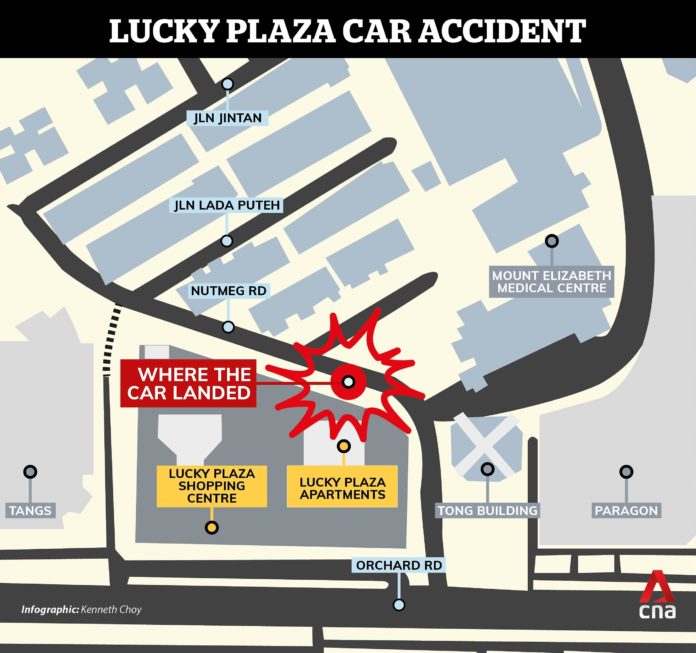
Eyewitnesses said a car ran into several women who were gathered on a walkway along Nutmeg Road just outside Lucky Plaza.
CCTV footage also emerged on Monday showing a car crashing into a railing where a few people had been seated, before landing on a service road leading out of Lucky Plaza’s car park.
A 64-year-old male driver was arrested on Sunday for dangerous driving causing death.
Households can expect higher electricity bills and lower gas bills for the next three months, starting tomorrow.
Electricity tariffs for households powered by the SP Group are set to rise by an average of 3.5 per cent in the first quarter of next year, the energy utilities provider said yesterday.
This is mainly due to higher energy costs compared with the previous quarter, SP Group added.
For these households, electricity charges will go up by 0.81 cent per kilowatt hour (kwh) for the period from Jan 1 to March 31, compared with the previous quarter.
Excluding the goods and services tax (GST), this translates to an increase of 23.43 cents per kwh to 24.24 cents per kwh for households powered by SP Group.
This rate is the highest since the period from October to December 2014, when it was 25.28 cents, before GST. The previous highest rate was 24.22 cents from July to September this year.
The latest increase means that the average monthly electricity bill for a family living in a three-room Housing Board flat will go up from $58.51 to $60.53, a rise of $2.02.