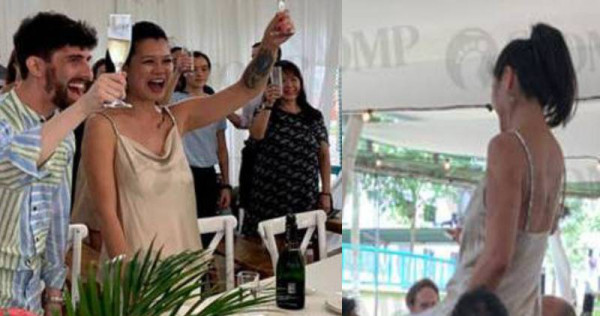
Grace said: “We’ve all been to weddings in Singapore, but what made the recent one I attended so special is the couple’s effortless way of bringing multiculturalism together on their wedding day.
“For background, my good friend is a Singaporean Chinese who recently married a Brit who has been living here in Singapore for a number of years now.
“With friends and family coming in from all parts of the world, they wanted to show the unique culture of Singapore.”
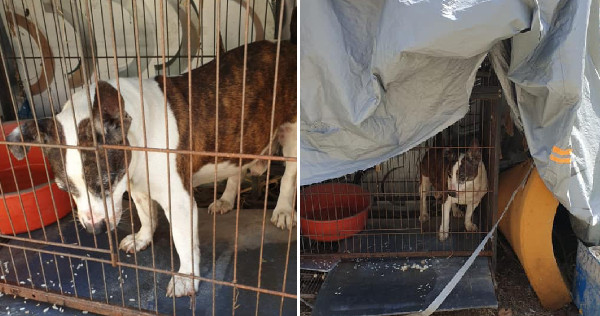
Being stuck outside in Singapore’s sweltering hot weather is an ordeal in itself. Now imagine being locked in a metal cage with barely any room to move.
That was the state in which volunteers from Chained Dog Awareness Singapore (CDAS) discovered a dog at an Ang Mo Kio industrial estate on Jan 5.
In a Facebook post appealing for help and a foster home for the dog, CDAS uploaded several photos of its poor living conditions.
Kept under the sweltering sun, the dog appeared to only have a plastic basin of water in its cage. It did not have any food save for several grains of rice strewn about on the ground.
The cage appeared to be covered with a grey cloth that was torn in some areas and a mattress.
CDAS wrote: “Did the owner consider the fact that the dog can get heat stroke in this scorching heat with no ventilation? Does he or she not know that the metal plate will be too hot for this dog to lie on it?”
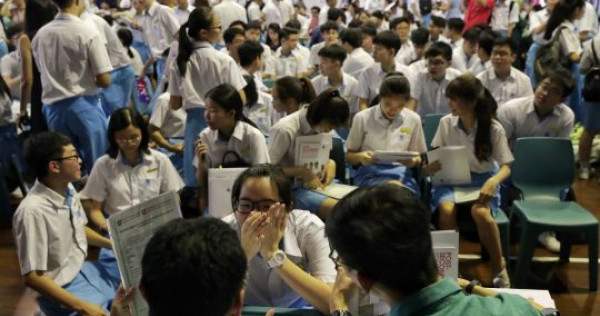
SINGAPORE – Candidates who sat last year’s GCE O-level examinations will get their results next Monday (Jan 13).
Students may collect their results from their respective schools at 2pm that day, while private candidates will be notified by post, the Ministry of Education (MOE) said in a statement on Monday (Jan 6).
The result slips of private candidates will be mailed next Monday to the address provided during the registration period.
Private candidates can also obtain their results online using their SingPass account on the Singapore Examinations and Assessment Board website.
Students who wish to apply to junior colleges (JCs), Millennia Institute, polytechnics or the Institute of Technical Education (ITE) can do so through the Joint Admissions Exercise (JAE).
The JAE will open from 3pm next Monday to 4pm on Jan 17.
The senior police investigator who molested one suspected sex worker and got another to perform sex acts on him in a police interview room has been demoted and dismissed.
Lee Sze Chiat, 39, who was a senior staff sergeant with 17 years’ experience, was jailed for a year and given one stroke of the cane in November last year.
He had been interdicted from service since Dec 26, 2017, and the Singapore Police Force (SPF) commenced disciplinary proceedings against him after his conviction on Nov 19 last year.
According to information published in the Government Gazette last Thursday, Lee was demoted to the rank of police constable and dismissed from the SPF effective Dec 21 last year. He joined the force in 2002.
He was a senior investigation officer at Jurong Division at the time of the offences. Last Friday, a police spokesman confirmed with The New Paper that Lee had been dismissed.
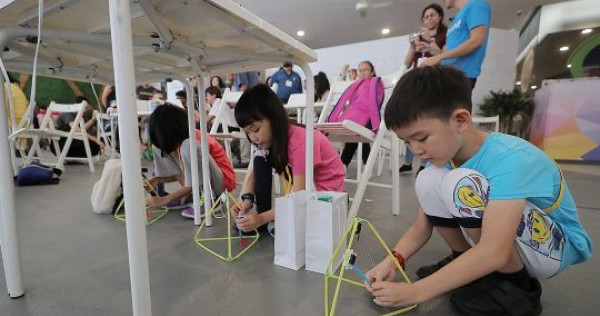
Eight-year-old Aiden McEwan fell in love with coding after attending classes to learn the Scratch coding language last year.
Knowing of his keen interest in science, mathematics and anything to do with numbers, his mother Josephine Ng signed him up for coding classes under the Code in the Community (CITC) programme.
The initiative, started by Google in 2017, offers free coding classes to children from low-income families to teach them basic coding skills and inspire them to discover and explore with technology.
Speaking to The Sunday Times yesterday at a graduation ceremony at Our Tampines Hub for students who completed the programme last year, Aiden said: “It is fun when I put the codes together on my computer and I can see that it creates a program. I like experimenting with the different codes.”
One of the programs he created is a five-question quiz in which a cat poses questions to the player.
Through the CITC initiative, other participants have also managed to create useful programs.
SINGAPORE: When I squint back at these last 10 years and think about what it will be remembered for, what comes to mind is the opening lines of W H Auden’s poem September 1, 1939, penned at a dismal time – the German invasion of Poland which marked the start of the Second World War:
I sit in one of the dives On Fifty-second Street Uncertain and afraid As the clever hopes expire Of a low dishonest decade: Waves of anger and fear Circulate over the bright And darkened lands of the earth, Obsessing our private lives; The unmentionable odour of death Offends the September night.
Auden saw a decade of lost opportunities, freedom and democracy increasingly losing ground to narrow ethno-nationalisms; people roused by demagogues, and impelled to violence by ideology and political lies.
I wonder whether future generations will look back at the challenges of the 2010s and say the same things.
TERRORISM CIRCUIT CHANGING
The terrorism “circuit” – the space where academics, experts and practitioners commingle – is changing as attention spans, including of those who fund such work, are getting shorter.
Even though the Islamic State (IS) is not beaten in the battlefield of the mind, still studying it, and terrorism in general, is important. But there is the feeling, among those of us in the field of security studies, that we can move on and address seemingly more pressing issues like cybersecurity or disinformation.
This is reminiscent of the myopia we had in 2011. Recall the triumphalism we had following Osama Bin Laden’s killing and the concomitant sense that al-Qaeda was a spent force.
Instead, we should be using this time to build deeper understandings of all sorts of violent extremism and its feedstock, intolerance.
I tell my own analysts who study radicalisation we cannot carry on as before. We have to understand society, ethnographic approaches, issues concerning tolerance and dialogue. And then maybe we might have something useful to say when IS 2.0 or new forms of radicalism come along, as they inevitably will.
THE MOOD MUSIC
The decade has seen in various places the nostalgic longing to recapture the (largely chimerical) old days and to restore the “pure” (usually monocultural) nation or a pure ideal. The growing narrative of the Great Replacement being propagated by right-wing groups in parts of Europe of that the indigenous white Christian population is being replaced by immigrants abets this.
This is not something that exists simply at ground-level. People are egged on by leaders of different religious and political persuasions.
This entire mesh becomes part of the mood music, which does not permit space for the other, for someone who looks, acts, thinks or feels differently or who has a different opinion. This is a very monochromatic point of view and is not healthy for pluralist societies.
April 2010: White supremacists brandish the apartheid-era flag outside a court in Ventersdorp ahead of the trial of two men accused of killing far-right leader Eugene Terre’Blanche AFP/ALEXANDER JOE
Individuals whose lives are irradiated by social media – indeed whose validation comes from the interplay of their private and public, social media lives – are alienated from meaning and thereby seek it even more fervently and in different places.
What the French call anomie. Alienation, sense of worthlessness.
Sometimes, this sense of worthlessness can take on a more serious dimension. For example, in the most recent statistics released by the UK Home Office, the largest proportion of referrals in its PREVENT referral programme concerns individuals at risk of radicalisation exhibiting ideologies which are unstable and not altogether clear.
These individuals depending on what content they find online can shift between different ideologies.
In North America, where right-wing supremacists’ plots and attacks have eclipsed those of jihadist hue for some time, security agencies are now being forced to take niche groups like the Incels (involuntary celibates) movement – part of an online subculture who have been responsible for attacks in North America – as an actual viable threat. Oddball niche threats are metastasising.
Those responsible may be pursuing violence in their search for meaning. But some, from their own point of view, may see themselves as changemakers or activists who have exhausted all other non-violent means to get their point made.
INTOLERANCE
We’ve seen reciprocal radicalisation rear its ugly head in the West. The far right radicals and Islamists feeding off each other in a negative and reinforcing spiral. Egged on by politicians, whose loyalties are to themselves, then to their party, and only then to their country (completely in the wrong order).
We tend to discount this type of thing happening in Singapore because you don’t really have a defined far-right feeding off issues like immigration or asylum seekers.
But the mass base of intolerance across the board is unfortunately rising. You can feel it in the region. We can’t escape this and it comes into Singapore, either through social media, ideas or people.
MOVING UPSTREAM
We need to address the roots of this risky behaviour, some (but not all) of which clearly lies, far upstream, in intolerance.
The decade has seen important upstream work being done internationally – in mentoring people who are lost, who seek direction, but who might one day fall into the “at risk-of-radicalisation” category. Some of the intervention needed for such individuals is not a direct counter-radicalisation one, but more like the social work being done in areas such as prevention for delinquents.
But should we not be going even further upstream?
An interfaith panel discussion in Singapore.
Preserving common space is going to be critical. In Singapore, we still talk about resilience, understanding, tolerance and multiculturalism without sniggering. There is a diminishing group of nations like this.
Young people in Singapore have of their own accord come together to do this kind of work including the numerous interfaith dialogues and platforms we have.
I have talked to these people – they are committed, they know what is at stake, and they are keen to engage people, away from the crowd of people who usually turn up, in more personal and face-to-face interactions. Efforts such as these are going to be critical in sustaining the bedrock of diversity we have.
(DIS)INFORMATION
George Keenan, the first Director of the US State Department’s Policy Planning Staff, observed: “We have been handicapped however by a popular attachment to the concept of a basic difference between peace and war, by a tendency to view war as a sort of sporting contest outside of all political context.”
When it comes to disinformation and cyberattacks, there are no red lines, with states routinely impugning the sovereignty of others through disinformation and real world interventions.
We need an international treaty that clearly reaffirms what sovereignty means in the information age, but given the lack of international norms, we are not likely to even come close for decades.
When it comes to disinformation and cyberattacks, there are no red lines, with states routinely impugning the sovereignty of others through disinformation and real world interventions. AFP/PHILIPPE HUGUEN
In the meantime, the states trying to shore themselves up against these threats will continue to play defence.
Too many studies talk in a general and airy fashion about the panacea. Serious studies are needed to understand what these actually are, how they can be introduced into societies, early, and what real effect they have.
In this respect, funders and policymakers need to understand that not everything that has value can be measured. These things are hard to measure and quite often they slip in between interagency cracks, particularly when no one is looking, or, when we assume someone else is taking ownership.
In other locations, the constant attrition leads to poor political hygiene, enabling all sorts of things – groupthink, demagoguery, the manufacture of outrage, to name some.
The philosopher Sissela Bok, whose life’s work has been the study of lying and deception, observes that lies use deception to narrow our choices in political societies. Lies about politics are therefore, she argues, the “most dangerous body of deceit of all.”
Bok observes differences between states that understand the principles of veracity and honesty and those, on the other hand, that harness the energies of the state to the enterprise of lying. Such societies, she argues – where truth and falsehood are hopelessly jumbled – inevitably implode.
THE SINGAPORE MODEL
Singapore has been spared from a great deal of the world’s vicissitudes. Some people think therefore that it has all the answers. It doesn’t.
Singapore has always thrived in equilibrium and seen the world prosper in such times. How can it counsel otherwise, even if it is targeted, as it increasingly will be, I suspect for failing to take sides?
Foreign dignitaries come to us in the wake of domestic events tragedies as they are interested in the “Singapore model” of tolerance.
Members of the National Steering Committee on Racial and Religious Harmony at the ICCS saying a prayer to commemorate the commitment to religious harmony. (Photo: Gwyneth Teo)
This is why events such as the International Conference on Cohesive Societies (ICCS) organised by the S Rajaratnam School of International Studies (RSIS) with the Ministry of Community, Culture and Youth (MCCY) are going to be very important in time to come – nodes where experts, practitioners, religious leaders and youth ambassadors can come together in an unforced atmosphere, to share notes and experiences.
When the history books are eventually written, if people do indeed look back on this decade like they did the 1930s, I wonder what they will say about states which prized tolerance, veracity and pluralism.
Singapore cannot avoid all of what is coming. But we need to think seriously about building a rugged generation, battening down the hatches, and attempt to ride out some of what is coming.
As our first prime minister, Lee Kuan Yew, observed in 1964 talking about the Konfrontasi – which was a sort of political warfare mixed with bursts of kinetic action: “We’ve got to build up men and troops who can meet this kind of warfare – you know, constant harassing, constant pressure, no real war as such but international thuggery. This is what it is. And we’ve got to train our men to meet this sort of situation.”
Shashi Jayakumar is the Head of the Centre of Excellence for National Security and Executive Coordinator of Future Issues and Technology at the S. Rajaratnam School of International Studies (RSIS) at the Nanyang Technological University (NTU), Singapore.
SINGAPORE: Flowers, candles and snacks lined the footpath outside Lucky Plaza on Sunday (Jan 5), forming a makeshift memorial one week after a fatal accident claimed the lives of two Filipino domestic workers and injured four others.
The two deceased – Ms Abigail Danao Leste and Ms Arlyn Picar Nucos – have been repatriated, after their wakes were held last week.
As of Thursday, two of the four injured were still warded in Tan Tock Seng Hospital.
When CNA visited the memorial in the late afternoon, a steady stream of people could be seen along the walkway towards the Lucky Plaza Apartment. Most of them appeared to be Filipinos.
Some of them came to light candles for the deceased, and some were seen offering prayers as well.
Many expressed sadness and shock at the accident, which occurred just behind Lucky Plaza, a popular hangout for many Filipino domestic workers on their days off.
“It’s really sad, I really feel like I want to cry,” said Ms Marjorie Bugaoan, who has worked in Singapore for more than nine years. “When I see the video, they were just eating and happy.”
The 37-year-old is from La Union province, the same place where Ms Nucos was from.
“It’s very sad, very hard,” said Ms Bugaoan, brushing away tears. “You don’t know how these things happen.”
A crowd had gathered on Sunday (Jan 5) to pay their respects to Ms Abigail Leste and Ms Arlyn Nucos, the victims of a fatal car accident that happened on Dec 29, 2019. (Photo: Cindy Co)
SENSE OF KINSHIP Many of those who came to pay their respects said that while they did not know the victims personally, they wanted to say their goodbyes out of a sense of kinship as fellow countrymen.
“I came to feel the presence, to give a prayer,” said Ms Marivc Surio, 30, as she started crying. “They are my co-Filipina.”
A woman lights a candle at the memorial. (Photo: Cindy Co)
Ms Marites Rivera, 34, said that she feels “scared” after the accident and that her two sons have told her to “take care” of herself.
One of the two women who died from injuries caused by the accident, Ms Leste, had two children.
“I pray that their souls will go to heaven, that they are peaceful,” said Ms Rivera.
Members of the Filipino community, many of whom were domestic workers, came to visit the memorial. (Photo: Cindy Co)
Several other people CNA spoke to also said their families have expressed concern for them.
“My family messaged me (and said), how are you there, don’t stay at roads which you are not sure,” said Ms Surio. “They are concerned.”
There were candles, flowers and snacks laid out at the memorial. (Photo: Cindy Co)
FILIPINOS GATHERING ON THE PAVEMENT
A foreign domestic worker CNA spoke to said that the stretch of pavement where the car crashed through last Sunday is a popular gathering place for helpers on their days off.
“I come here every Sunday, because this place is nice for us,” said Ms Dolly Dagdag, 40.
Ms Dagdag said she was an acquaintance of Ms Nucos, although they did not spend their Sundays together.
Ms Dagdag said that while she will continue to gather at the pavement on her days off, some of her friends are spooked by the accident and will no longer do so.
“(My family said) don’t sit,” said Ms Dagdag, as she sat by the memorial quietly. “But I said: ‘Accident, if it will happen, it will happen’.”
SINGAPORE – The Ministry of Health said on Saturday (Jan 4) that it had been notified of the first suspected case of the mystery Wuhan virus here, involving a three-year-old girl from China who had pneumonia and a travel history to the Chinese city of Wuhan.
She had been warded for further assessment and treatment, and isolated as a precautionary measure, said the ministry.
Countries have grown concerned over a viral outbreak in Wuhan marked by unusual cases of pneumonia. These appear to be linked to a wholesale seafood market there, where not just seafood is sold, but also live animals, including, reportedly, birds and snakes, and the organs of rabbits and other wildlife.
At least 44 people had been affected there; and 11 were seriously ill, raising the spectre of severe acute respiratory syndrome (Sars) which hit Singapore hard in 2003.
Singapore has started temperature screening for passengers arriving from the city at Changi Airport, and doctors are on the look out for possible cases.
Experts, however, say that there have been no reports of human-to-human transmission, which means much less risk to the public.
Muhammad Hayden Dany Osman, 11, had to miss almost two months of school after being hurt in a road accident last April.
But with a little help from his family members, friends and teachers at Townsville Primary School, Hayden eventually recovered, and even qualified for the Teck Ghee Citizens’ Consultative Committee (CCC) Bursary Award.
Hayden was one of more than 1,100 students in Teck Ghee who were recognised for their efforts in school at a presentation ceremony yesterday.
The Teck Ghee CCC Bursary was awarded to 351 students, while another 760 received the Ministry of Education Edusave Awards. Prime Minister Lee Hsien Loong, adviser to Ang Mo Kio GRC grassroots organisations, was the guest of honour at the event.
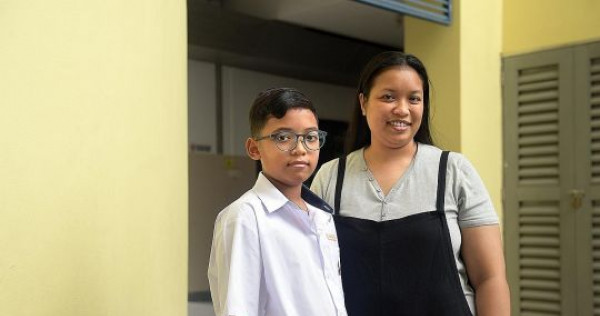
Hayden’s mother, Madam Nur Farhana Abu Bakar, 35, said she was proud of Hayden, the youngest of her four children, for his determination and drive to do well in school.
“He managed to do well even though he had to miss many days of school and was on crutches after the accident,” said Madam Farhana, a teaching aide for students with special needs.