Home Blog Page 512

What you need to know about live-stream auctions, including ghost bidders

0

SINGAPORE: Rheon Garcia is hooked on live-stream auctions. In less than a year, he has spent some S$3,000 on plenty of sundry items in such auctions.

He usually takes part in bundle auctions, in which he bids for one item like an extension plug, and the price can even go up to S$500 because it comes bundled with 10 mystery items.

“You wouldn’t know what items you’d get. So it’s like a thrill,” he said, citing the boxes of Bluetooth earpieces, a mini oven and even a blackhead remover lying around his flat, all unused.

Facebook Live shops, the latest battleground for bargains, have been popping up in the past two years thanks to buyers like him.

Rheon Garcia showing Talking Point host Diana Ser an item he bought in a live-stream auction.

Rheon Garcia showing Talking Point host Diana Ser one of the items he bought.

Today, there are more than 50 such outlets, offering products one may have never thought could be hawked online, from fresh fruits to sports cars.

Live auctioneer Joyce Leong from Freshcatch Seafoodbidding has been selling seafood, for example, via live-stream auctions from an Ang Mo Kio wet market for the past year.

Using her smartphone propped on a tripod, she can attract hundreds of online viewers — enabling her business to target working parents who “won’t have time to go to the market” and the elderly who may be unable to do so.

“Sometimes they’re sick and (have difficulty) walking,” she said. “So … we can send (the items) to them.”

Joyce Leong live-streams a seafood auction six mornings a week. (Photo: Nuria Ling/TODAY)

Joyce Leong live-streams a seafood auction six mornings a week. (Photo: Nuria Ling/TODAY)

There are good reasons that live-stream auctions are the latest trend in online shopping, but can you really bag a good bargain in these auctions, or are you paying an invisible price for the items?

The programme Talking Point finds out five things you should know. (Watch the episode here.)

1. THERE MAY BE GHOST BIDDERS

Some bidders collude with the auctioneers to drive up the price of an item, according to Hong Heng Mobile Auction founder Lim Jiafeng.

He has been hosting live web auctions even before they started trending. And he knows of bidders taking part in shill bidding, in which they make bids just to lure others to follow their lead, thereby cheating legitimate bidders.

2. HOW DO YOU SPOT THEM?

During one auction, Lim pointed out the ghost bidders to Talking Point host Diana Ser — when a genuine buyer made a bid, they outbid him or her by a wide margin.

Talking Point host Diana Ser with Hong Heng Mobile Auction founder Lim Jiafeng.

Ser with Lim Jiafeng.

In this case, they increased the bid by S$10 to S$15 each time, whereas the genuine bidder’s increment was S$5, “which is normal”, said Lim, as “nobody wants to pay a high price”.

He added that ghost bidders sometimes work in teams, outbidding one another to drive up the final price.

“The smarter ghost bidder would mimic a real buyer. They’d be asking questions … about the product, maybe the specifications and the features,” he said.

“Imagine there are five to six persons doing that. So it makes it (the fake bidding) very foolproof.”

3. LOOK OUT FOR THE TIMER

A telltale sign of a rigged auction is the lack of a timer. Legitimate auctions usually have a time limit for buyers to place their bids, but when there is none, it means the auctioneer can delay closing the auction.

The countdown has begun for prawn bidding on Leong's live-stream auction.

The countdown has begun for prawn bidding on Leong’s live-stream auction.

He or she would do that after a ghost bidder has raised the bid. So once a legitimate bid is made for the item, “the countdown would suddenly go very fast”, said Lim.

A timer ensures that everything is fair, as “it isn’t (for) the auctioneer to decide who gets the item”.

4. THERE MAY BE DEFECTIVE OR RETURNED ITEMS

Some auctioneers sell products, especially electronic items, very cheaply, like a wireless mouse for S$1 or a hair curling iron for S$5. This may mean the product is defective or was a returned purchase from online retailer Amazon, said Lim.

The retailer has a generous free-return policy, and these items are bundled into pallets and sold by weight. Every year, an estimated 200 to 400 tonnes of Amazon return pallets are shipped to Singapore.

Typically, in a pallet, about a third of the items are used, another third are new and the remaining are discontinued stock, said Amoz Lee, who owns web auction house Lelong Factory.

Amoz Lee showing Ser the items in an Amazon return pallet.

Amoz Lee showing Ser the items in an Amazon return pallet.

To spot an item from an Amazon pallet, look for a return label — a bar code with “a four-digit number or maybe an alphanumeric” — advised Lim.

5. NOT ALL SELLERS ARE UPFRONT ABOUT IT

While many items auctioned on live streams come from Amazon return pallets, some sellers are upfront about defective items but others are not.

Programme host Diana Ser managed to bid successfully for several items, but out of 12 products, two — a wireless mouse and a pair of Bluetooth earphones — did not work.

The earphones also looked “greasy”, as if they had been used before, she said, while noting that some of the sellers do offer a window for the exchange of any defective product.

“The disappointment is really when the seller passes off used items as brand new. But defective items aside, it’s hard to argue the prices weren’t a steal. And snatching bargains does feel good,” she added.

“It’s really buyer beware. When things are so cheap, there’s usually a catch. And yes, it can get addictive.”

Watch this episode of Talking Point here. New episodes on Channel 5 every Thursday at 9.30pm.

Rheon Garcia with some of the items he snared in livestream auctions.

Garcia with some of the items he snared via auction.
Source link

Wuhan virus: MFA in touch with 35 Singaporeans in Wuhan, all are safe

0

[ad_1]

There are 35 Singaporeans in Wuhan who are in touch with Singapore’s Foreign Ministry.

They are all well, MFA said in a statement on Saturday (Jan 25).

All Singaporeans currently in China are advised to register with MFA so that they can receive updated information and consular assistance where necessary, the ministry added.

Singaporeans should avoid all travel to Hubei province in China, including its capital city of Wuhan from where a virus outbreak that has killed more than 40 people originated from.

The virus, which was first reported about last December, has also infected more than 1,200 people.

Singapore confirmed its first case on Thursday (Jan 23) and two more cases on Friday (Jan 24), bringing the total to three.

Suspected and confirmed cases have also surfaced in Taiwan, Japan, South Korea, Macau, Thailand, Vietnam, Europe and the United States.

[ad_2]

Source link

Singapore confirms 2 more Wuhan virus cases, bringing total to 3 infected

0

[ad_1]

Another two people here have been confirmed to have the Wuhan virus, bringing the total to three, the Ministry of Health said on Friday (Jan 24).

The first confirmed case was a 66-year-old man from Wuhan who is here on holiday. He is currently in stable condition at the Singapore General Hospital (SGH).

His 37-year-old son who was travelling with him has since been confirmed to have the virus too. He is also at SGH and in stable condition.

In addition, another Chinese tourist – a 53-year-old woman from Wuhan who came separately from the two men – has been confirmed as having the virus. She is warded at the National Centre for Infectious Diseases (NCID) and her condition is stable.

At a briefing, the ministry said that there have been a total of 44 suspected cases with patients aged between one to 78.

Of the 44, 13 patients have tested negative for the Wuhan virus, and three are confirmed.

Contact tracing has started to identify close contacts of the three.

Close contacts will be quarantined and monitored for symptoms for 14 days from last exposure with the patient.

[ad_2]

Source link

Commentary: Why tradition still trumps tech this Chinese New Year

0

SINGAPORE: Growing up, Chinese New Year’s (CNY) eve was riddled with my mum’s “standard operating procedures”- odd things that she needed us to do.

At the stroke of midnight, Dad, as head of the household, would dutifully open the front gate to symbolically welcome good luck.

My sisters and I would be sent to switch on all the lights in the house, to signal a year filled with brightness and light.

THE LOGIC OF TRADITION

Years later, my sister and I still repeat this ritual – at our respective households – to usher in the new year.

LISTEN: Heart of the Matter – Will you give an e-hongbao this Chinese New Year?

Of course we wondered the need to do so in the first place, and whether leveraging technology could simplify the process. With smart homes today, it wouldn’t take much to programme all the lights to be switched on at midnight.

But yet, despite these conveniences, we still continue these sometime illogical rituals.

There’s a part of me that wants to pass on these traditions from my elders – who are not getting any younger – to my kids. There is hope that, just like me, they too will unquestionably preserve these traditions and guard them like a family heirloom.

DEFEND THE KITCHEN

Take CNY food for instance. Many families have made the switch to catering instead of toiling in the kitchen, given the convenience of food delivery apps.

From popular hotpot stalwarts Haidilao to western bar-grills like Brotzeit, you can enjoy high-quality restaurant food in the comfort of your home.

READ: Commentary: The ‘variety effect’ explains why we overeat most holidays

My family has stuck with tradition though.

Beauty in The Pot Chinese New Year CNY restaurant home catering

Many families have made the switch to catering instead of toiling in the kitchen, given that you can enjoy high-quality restaurant food in the comfort of your home. (Photo: Beauty In The Pot)

So that’s why, my grandma’s cooked mee sua (longevity noodles) served with a hard-boiled egg is still a must do. “Must eat so you will always have food to eat in the new year!” she would belt out in Hokkien. 

“You are getting old, Ah Ma, let’s just cater”, a cousin said last CNY, even showing her the yummy bowls of mee sua available online.

She balked at our suggestion. “It’s not the same!” she exclaimed, “It’s not made in my kitchen!” And she’s right. With our busy schedules, a considerable amount of our food consumed daily already comes from outside.

I too relish the opportunity every CNY to taste grandma’s cooking peppered with her maternal love.

BAK KWA PIETY

Similarly, one of the highlights of my snacking frenzy at grandma’s place undoubtedly involves a packet or two of bak kwa (roasted sweetmeat), which a grandchild queued for hours to buy.

In an age where e-commerce and food delivery are commonplace, it is half-baffling that snaking long bak kwa queues are still a thing. “My queued-for bak kwa tastes better because its flavoured with filial piety,” my cousin would exclaim.

(ll) CNY Bak Kwa

In an age where e-commerce and food delivery are commonplace, it is half-baffling that snaking long bak kwa queues are still a thing.

READ: Commentary: Why is Chinese New Year so stress inducing?

These days, bak kwa piety can even be bought by paying for someone to stand in queue for you. Apps like iqueue and even Telegram chat groups help you get that done for a small fee.

I doubt the un-queued for bak kwa tastes any less sweet.

READ: Commentary: Christmas shopping has changed over the years – with more power to the shopper

Yet, the rush of heading to your favourite bak kwa outlet amid the last-minute cleaning and shopping, along with the opportunity to make small talk with other shoppers on all things CNY, is just a part of the overall festive atmosphere you can’t miss.

Convenience has its place, but sometimes it has to take a back-seat to more emotive causes.

RED PACKETS

I use the same line of thinking when it comes to the ubiquitous red packets (hongbaos). At grandma’s house, regardless of marital status, everyone gets a red packet.

Like other Chinese families, the horde of us would queue up to wish grandma well and she, in turn, would bless us as she hands us our hongbaos.

Grandma’s memory is failing. Several years ago, she lost track of who had collected and who hadn’t. Someone quipped that she should consider giving out e-hongbaos so that she can track and trace and go cashless. 

I am glad to say that on this side of the pussy willow, e-hongbaos are, thankfully, not quite fashionable yet even if reports suggest a gain in popularity.

In China, platforms like WeChat and Alipay give out e-red packets at festive seasons that people can e-snatch by clicking on their app. Over 45 billion are given out each year, with Alibaba-owned marketplace, Taobao, announcing plans to give out 2 billion yuan (S$390 million) in cash during the Spring Festival holidays in 2020.

Hongbao 1

A row of hongbaos. (Photo: Wendy Wong)

Ride-hailing company Grab has a similar game where gifting a S$1 Grabpay e-red packet could win you as much as S$288.

DBS launched a new iteration of loadable QR red packets that “would allow users to preserve the traditional act of giving and receiving physical red packets, while eliminating the use of cash”.

READ: More red packets recycled due to specialised efforts, increased digital transfers over Chinese New Year

Despite all these incentives, I will pass on the opportunity to look “cool” and technologically-sophisticated in front of my cousins this year.

Instead, I opt to join the family queue to receive grandma’s blessings – all the while eagerly anticipating what her wisdom has in store for me this year. A woman of few words otherwise, her blessings reveal what she does not get to say for the rest of the year – how she is happy that you have a new job, or how she wishes that you would come learn her mee sua recipe.

NO RUNNING AWAY FROM TECH

It would be naive of me to think that CNY, like other traditional festivals, would remain immune to the advent of technology.

Already, you can pretty much commandeer all your needs from your smartphone.

Spring cleaning? Select from a host of home cleaning services on platforms like Page Advisor, a real-time mobile-commerce marketplace platform.

Need groceries? Between, NTUC, Lazada and Shopee, you can buy virtually everything and anything. You can even rent a boyfriend on Carousell to help stave off that nosy-parker aunt.

cny hampers

These days CNY groceries, goodies and hampers can be ordered online in the convenience of your home. 

So, between tech and tradition, huat gives? 

As much as I want to hold on to these passed-down family traditions, in some areas pragmatism has to take precedence.

For instance, traditionally, CNY is a season where many out-of-town family members make the long trek home – a time when family and friends reconnect and catch up.

In recent years, however, many opt to skip the annual pilgrimage. “Too far. So expensive. I’ll video call.” Even though the catch-up over FaceTime is brief, seeing their happy faces squashed in a small screen brings a smile to grandma’s face.

READ: Commentary: There is nothing inherently sustainable about going digital

That can’t be all bad. Perhaps this is what the spirit of CNY means to me – to go that extra mile to preserve traditions, renew relationships and create new memories. If tech helps us do that, there is certainly some place for it alongside existing family traditions.

As for me – someone who sits at the confluence of technology and storytelling – I find myself mildly scrambling to hold on to small moments that make this season personally meaningful to me, like precious family quirks that hold a fast commercialising festive season at bay.

So I know that at the close of this CNY eve, I’ll be reminding my husband to open the front gate and hustling my sons to go turn on all the lights.

Cherie Tseng is Chief Operations Officer at a local fintech company, a mother of three and editor with The Birthday Collective.

Source link

Wuhan virus: What we know about the outbreak so far

0

SINGAPORE: A new strain of coronavirus has infected hundreds of people in China and overseas, killing more than 20 people since it was reported in the Chinese city of Wuhan earlier this month.

Here is what we know about the outbreak so far:

IT IS SIMILAR, BUT SO FAR MILDER THAN SARS

The pathogen appears to be a new strain of coronavirus, a family of viruses that can cause diseases such as the common cold and the Severe Acute Respiratory Syndrome (SARS), which killed hundreds in mainland China and Hong Kong between 2002 and 2003.

READ: Wuhan virus outbreak – At a glance

It has been named “2019-nCoV”.

Arnaud Fontanet, head of the department of epidemiology at the Institut Pasteur in Paris, told AFP that the new strain was 80 per cent genetically identical to SARS.

The symptoms caused by the new virus appears to be less aggressive as compared to SARS, according to an AFP report. These include fever, difficulty breathing and coughing.

However, its milder nature can also cause alarm as it allows more people to travel further before symptoms can be detected, the director of the Institute of Global Health Antoine Flahault said.

SUSPECTED TO HAVE ORIGINATED FROM ANIMALS, STARTED AT A SEAFOOD MARKET IN WUHAN

The virus was first detected at a seafood market in the Chinese city of Wuhan, which has been shut down by authorities following the outbreak.

The Wuhan Huanan Wholesale Seafood Market

The Wuhan Huanan Wholesale Seafood Market, where a number of people related to the market fell ill with a virus, sits closed in Wuhan, China on Jan 21, 2020. (Photo: AP/Dake Kang)

The market offered exotic wildlife for sale, including live foxes, crocodiles, wolf puppies, giant salamanders, snakes, rats, peacocks, porcupines, camel meat and other game, AFP reported.

READ: On the menu at Wuhan virus market: Rats and live wolf pups

Gao Fu, director of the Chinese centre for disease control and prevention, said authorities believe the virus likely came from “wild animals at the seafood market” though the exact source remains undetermined.

Two studies from China indicated that bats are the likely origin, as the strain was found to be closely related to a strain that exists in the animal.

“Bats being the native host of the Wuhan CoV (coronavirus) would be the logical and convenient reasoning, though it remains likely there was intermediate host(s) in the transmission cascade from bats to humans,” the researchers from several institutions in China wrote in a paper.

Another study identified snakes as a possible intermediate host.

MORE: Our coverage on the Wuhan virus and its developments

HUMAN-TO-HUMAN TRANSMISSION, NOT AIRBORNE BUT SPREAD THROUGH WATER DROPLETS

Animals have been determined as the source of the virus, but human-to-human transmission of the virus is “affirmative”, top Chinese expert on infectious diseases Zhong Nanshan told state broadcaster CCTV.

It has since been passed to people who have had no contact with the market where the virus first broke out.

Doctor Nathalie MacDermott of King’s College London told AFP that it seems likely that the virus is spread through droplets in the air from sneezing or coughing.

There is currently no vaccine for the virus.

RECOMMENDED PROTECTION

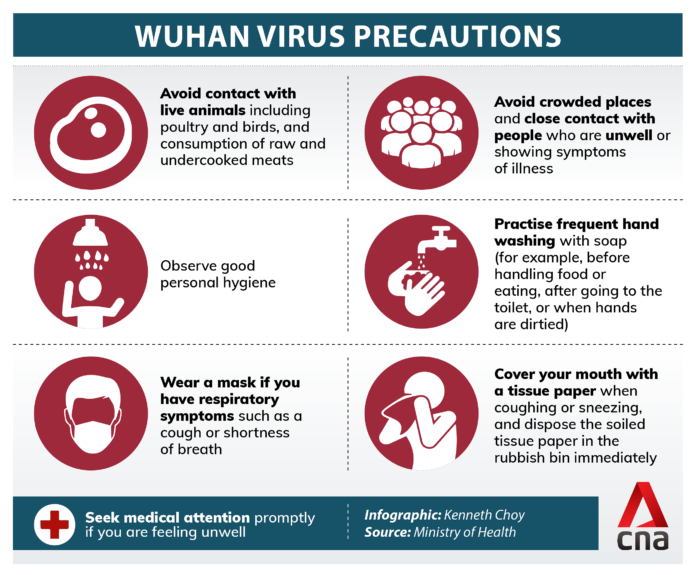
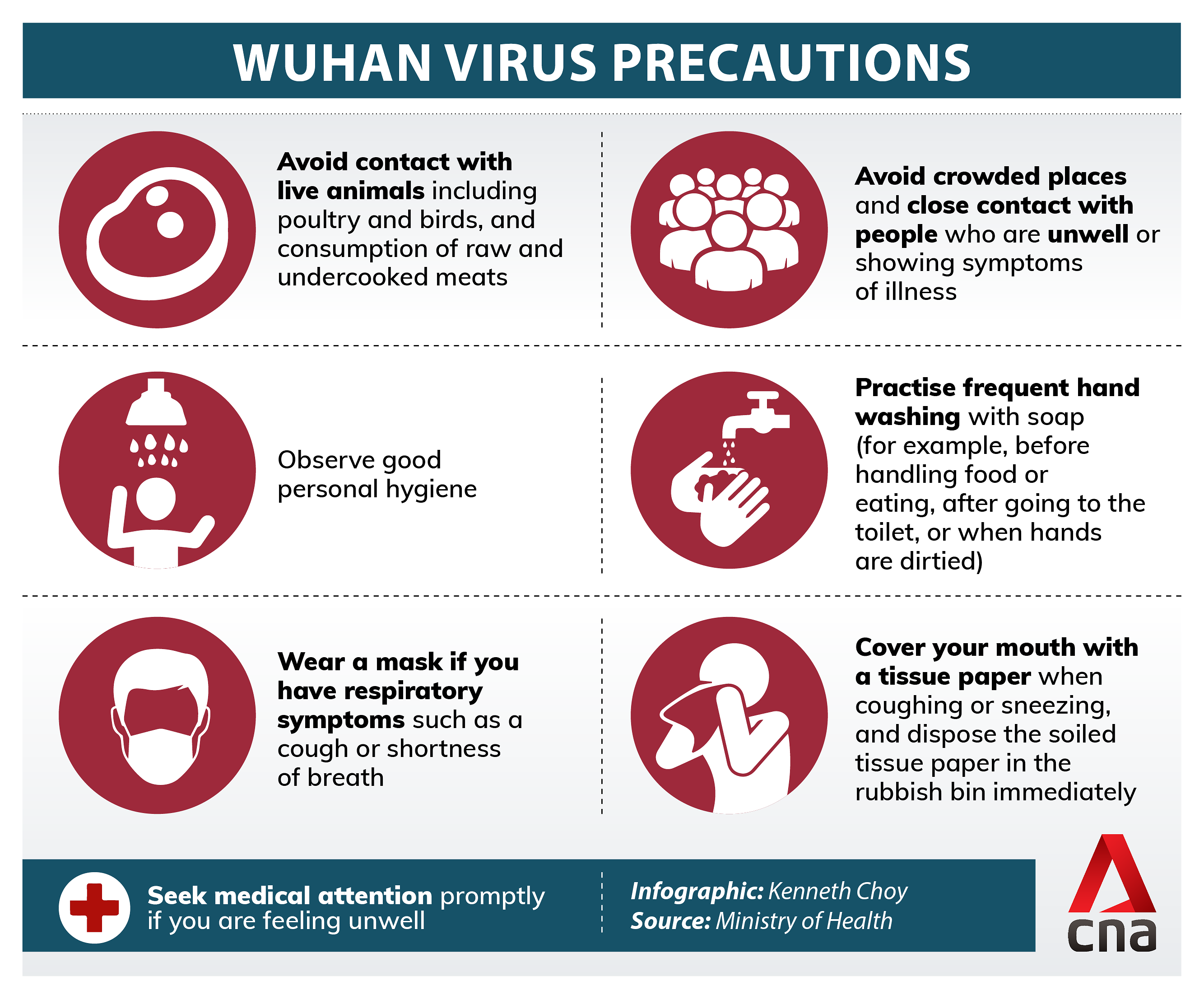
Members of the public have been advised to take steps to prevent the spread of the virus. This includes wearing masks when experiencing respiratory symptoms such as coughing or sneezing, and observe good hygiene practices, like washing their hands frequently.

READ: N95, surgical masks run out at retails outlets; MOH assures public there is enough stock

READ: Wuhan virus in Singapore: What can you do?

They should also avoid places and close contact with people who are unwell or showing symptoms of illness.

Singapore’s Ministry of Health has issued an advisory asking travellers to avoid contact with live animals and consuming raw and undercooked meat.

Those who are feeling unwell should also seek prompt medical attention, it added.

CITIES LOCKED DOWN IN CHINA

More than 800 people have been infected with the coronavirus in China, with at least 26 fatalities reported.

People look at a notice at the gate of the Lama Temple saying that the temple is closed for the saf

People look at a notice at the gate of the Lama Temple saying that the temple is closed for the safety concern following the outbreak of a new coronavirus, in Beijing, China January 24, 2020. REUTERS/Carlos Garcia Rawlins

Most of the patients came from Wuhan, where the virus started. It has since spread to other major cities, such as Beijing, Shanghai and Hong Kong.

READ: Wuhan virus: Number of cases in China tops 800, death toll hits 26

Transport in and out of Wuhan have ceased operations in an effort to prevent and control the spread of the virus.

Authorities have also locked down several cities in Hubei province as a response to the outbreak. Entertainment venues such as Shanghai’s Disneyland park, theatres and karaoke bars have also been closed down.

READ: Cirque du Soleil cancels shows in China over Wuhan virus

Hubei province authorities also said they were calling off cultural performances and public cultural venues. Travel agencies in the province have suspended business and the government has announced that refunds would be given to those who cancel transport tickets.

Beijing has also cancelled Chinese New Year holiday gatherings at temples.

NINE COUNTRIES REPORT CASES, INCLUDING SINGAPORE

The first case of the virus reported outside of China was on Jan 13, when a Chinese woman was diagnosed with mild pneumonia after returning to Thailand from Wuhan. Another case was confirmed in Japan the next day.

So far, there have been confirmed cases in nine countries outside of China. Thailand has the most reported cases, at four.

READ: Wuhan virus: 2 more cases confirmed in Thailand

Singapore reported its first case on Jan 23 – a 66-year-old Chinese man from Wuhan who arrived in Singapore on Jan 20 and stayed at Shangri-La’s Rasa Sentosa Resort.

Shangri-La's Rasa Sentosa Resort and Spa (2)

The exterior of Shangri-La’s Rasa Sentosa Resort and Spa. (Photo: Gaya Chandramohan) 

He reported symptoms such as a sore throat and fever and went to Singapore General Hospital, where he was diagnosed with pneumonia and identified as a suspect case. He was confirmed to have been infected by the virus on Jan 23.

Contact tracing has been initiated to identify people who may have had close contact with the man. Two other cases have since been confirmed, one of which is the man’s 37-year-old son.

READ: Two more people test positive for Wuhan virus in Singapore

Border screening has been implemented in several countries, including Singapore, as a response to the outbreak.

READ: Temperature screening begins at Woodlands, Tuas and sea checkpoints

Budget carrier Scoot has cancelled its daily flight to Wuhan and schools across the island have asked parents to declare their travel plans for the Chinese New Year weekend.

Follow us on Telegram for the latest updates: https://cna.asia/telegram

Source link

Wuhan virus outbreak: Temperature screening at Tuas Checkpoint a breeze so far, say travellers

0

SINGAPORE: Travellers passing through Tuas Checkpoint on Friday (Jan 24) afternoon thought the protective measures rolled out in response to the spread of the Wuhan virus were a breeze. 

Temperature scanners have been set up at the entrance of the customs area. Travellers taking the bus only have to walk past these machines as they head to the immigration counters. 

Tuas Checkpoint Masked Traveller Walking_mod

A masked traveller who has just cleared baggage screening at Tuas Checkpoint on Jan 24, 2019. (Photo: Try Sutrisno Foo)

Mr Zheng Pei Nan, 75, was travelling from Malaysia with his family. He told CNA he was not bothered by the scanners, part of the Mass Fever Screening System. 

“It wasn’t inconvenient to pass the scanners after alighting from the bus,” he said in Mandarin, adding that the family only comes to Singapore once a year. 

READ: Wuhan virus: Temperature screening begins at Woodlands, Tuas and sea checkpoints

READ: Wuhan virus outbreak – At a glance

He told CNA that he was aware of the virus but was not worried because he rarely travels to faraway countries. 

Mr Li Jian, a tourist from Changsha, Hunan Province in China, said he did not notice the scanners at first, but lauded them as a good idea. 

“It’s important to protect yourself and take your own measures,” he said. 

Tuas Checkpoint Masked Traveller Being Screened_mod

A masked traveller being screened by a security officer with a handheld metal detector at Tuas Checkpoint. (Photo: Try Sutrisno Foo) 

The 50-year-old, who will be travelling around Singapore and Malaysia for six days, said he was not worried about catching the virus in Singapore. 

“Singapore is a developed country,” he said. 

MORE DELAYS EXPECTED FOR THOSE TRAVELLING BY CAR

According to the Immigration and Checkpoints Authority, screening measures for visitors arriving by car will ready by Friday night. Those for motorcycles, lorries and trains will be rolled out progressively, said Superintendent Joe Tan, who is deputy commander of ground operations at Tuas Checkpoint. 

Visitors arriving by car will have to roll down their windows to allow healthcare assistants to use Forward-Looking Infra-red Radar thermometers to check their temperature, he said. 

Tuas Checkpoint Masked Traveller in Queue_mod

A masked traveller in the immigration queue at Tuas Checkpoint on Jan 24, 2019. (Photo: Try Sutrisno Foo)

Those who have a temperature of 38 degrees Celsius and above will be taken to a holding area, where a nurse will interview them about their travel history and who they have been in contact with. 

Depending on the patient’s answers, a doctor may carry out further checks to determine whether he or she is a suspected case and should be taken to the hospital. While waiting for the ambulance, the individual will be isolated and quarantined in another room. 

READ: Wuhan virus in Singapore – What we know about the confirmed cases 

READ: Wuhan virus in Singapore – What can you do? 

If the individual arrived by car, their vehicle and travel partners will also be moved to a holding area and further assessment will be carried out, said Superintendent Tan. 

As for affected individuals who arrive by bus, the people travelling with the suspected case are not treated as contact cases until the case is confirmed, said Associate Professor Vernon Lee, director of communicable diseases at the Ministry of Health. 

Tuas Checkpoint Child with mask_mod

A child adjusting his mask at Tuas Checkpoint on Jan 24, 2020. (Photo: Try Sutrisno Foo)

“We will only initiate the contact tracing proper, to label someone as a close contact, if the initial suspect case turns positive and it then becomes a confirmed case,” he said. 

“For suspect cases they are still (treated as) suspect. There are quite a number of suspect cases and we don’t perform aural (ie phone) contact tracing or any other measures on individuals travelling with the suspect cases.” 

According to an ICA news release on Friday morning, the screening was implemented in anticipation of increased travel volume leading up to the Chinese New Year holidays. 

Due to the festive period, travel volume is expected to increase and there will naturally be delays, said ICA. During the year-end festive period in 2019, Tuas and Woodlands Checkpoints collectively saw about 475,000 visitors per day. 

Tuas Checkpoint New Health Advisory_mod

An advisory issued by Singapore’s health ministry at Tuas Checkpoint advising travellers who have recently travelled to China and are unwell to seek medical attention. (Photo: Try Sutrisno Foo)

While there will be minimal delays for those who arrive by bus because visitors can just walk by the temperature scanners, visitors arriving by car can expect delays because of the additional measures, said Superintendent Tan. 

The delay will depend on how many individuals there are in the car. 

“We’ll have to seek citizens’ understanding that there will be delays because it is an additional check that has been put in place,” he added. 

Tuas Checkpoint Nurses_mod

Nurses are on standby at Tuas Checkpoint to receive and isolate any passengers with fever. (Photo: Try Sutrisno Foo)

Temperature screening also started at noon at Singapore’s sea checkpoints, said the Maritime and Port Authority of Singapore (MPA) in response to CNA queries.

Singapore authorities had announced on Thursday that border screening would be expanded to all land and sea checkpoints, while a travel advisory has been expanded for Singaporeans to avoid travelling to Hubei province, where Wuhan city is located.

Tuas Checkpoint Nurse Station_mod

Nurses on standby in the holding area where passengers detected with a fever at Tuas Checkpoint will be sent to. (Photo: Try Sutrisno Foo)

Health advisories have also been put up at the land and sea checkpoints to advise travellers on the precautions they are to take, especially when traveling to or arriving from China.

Singapore confirmed its first case of the Wuhan virus on Thursday evening – a male Wuhan resident, 66, who arrived in Singapore with his family on Jan 20. He is currently in isolation at the Singapore General Hospital and is in stable condition. 

Two more people were confirmed to have the virus on Friday afternoon, including the 37-year-old son of the first confirmed case.

For full coverage and latest developments on the Wuhan virus outbreak: https://cna.asia/wuhan-virus

Additional reporting by Zhaki Abdullah

Source link

Wuhan virus in Singapore: What can you do?

0

SINGAPORE: Doctors have urged members of the public to remain calm and observe proper hygiene practices, as the number of confirmed coronavirus cases in Singapore rose to three on Friday (Jan 24).

This includes wearing masks when unwell and practising proper hand washing, they told CNA.

As of Friday, the number of suspected cases had climbed to 44, with patients aged between one to 78, according to the Health Ministry.

READ: Wuhan virus outbreak – At a glance

READ: Wuhan virus in Singapore – What we know about the confirmed cases

At least 25 deaths had been reported in China as of Friday, with more than 830 confirmed cases of the virus. Cases have also been confirmed in Japan, Thailand, South Korea, Taiwan, Vietnam and the United States. 

Below are some guidelines on how to respond to the Wuhan virus situation in Singapore, according to medical professionals. 

1. DON’T PANIC

Members of the public should stay calm, said infectious diseases expert Associate Professor Hsu Li Yang.

“Because the Wuhan coronavirus is currently not spreading in Singapore, people should not panic and overreact,” said Assoc Prof Hsu, who is programme leader of infectious diseases and co-director of global health at the National University of Singapore’s Saw Swee Hock School of Public Health.

READ: Patients’ travel history, dedicated isolation areas – GPs take measures in wake of Wuhan virus

“There is no need to stockpile masks, for example. The Ministry of Health, which has learned critical lessons from the various outbreaks that afflicted Singapore including Severe Acute Respiratory Syndrome (SARS), will issue appropriate guidance and information in a timely manner,” he added.

Instead, people should keep abreast of the situation, put on masks when they feel unwell, wash their hands properly and avoid travel to Hubei province, which is the epicentre of the crisis. 

2. WEAR A SURGICAL MASK

Infectious diseases expert Dr Leong Hoe Nam urged people to use a surgical mask instead of an N95 mask. 

“A surgical mask works both ways. It can prevent transmission from others to you and from you to others,” he said.

When worn, the mask should cover the nose and mouth and rest on the chin, he added. It is important for the mask to fit well, he said. 

MORE: Our coverage on the Wuhan virus and its developments

The mask can be used until it is wet inside. Once wet, it should be replaced with a new one. This means that a dry mask can be used again, Dr Leong said. He advised users to keep it in a bag without deforming it.

He cautioned that drying a mask in the open could allow the germs to spread in the air.

Wearing an N95 mask could be counter-productive as users might touch their faces more often from discomfort, spreading viruses on their hands, he said. 

Advice from MOH on curbing spread of viruses

3. WASH HANDS THOROUGHLY

Head of primary care at Healthway Medical Dr John Cheng said the use of anti-bacterial and alcohol-based soaps is recommended.

“This is especially when coming into contact with common exchanged items such as money and utensils, and items such as handrails and lift buttons,” he said. Using hand sanitisers is as effective, he added. 

According to Singapore’s HealthHub, proper hand washing means washing hands for at least 30 seconds with soap and water. 

READ: N95, surgical masks run out at retail outlets; MOH assures public there is enough stock

“The constant rubbing action helps soap break down the grease and dirt that carry most germs. This way, your hands don’t just smell fresh, but you’ll also reduce the germ count on your hands by up to 99 per cent,” according to the website.

The recommended eight-step hand-washing routine includes cleaning between fingers, the base of thumbs and fingernails.

If there is no soap available, Dr Leong said that water alone could be effective as it can also break down viruses. 

4. VACCINATIONS

While there is no vaccination available for the Wuhan virus, Dr Leong said that the general public being vaccinated against influenza will reduce the risk of them from falling sick. 

This will reduce the burden on the healthcare system and prevent distraction from people who need attention more urgently, he added. 

Dr Cheng said that aside from the influenza vaccine to protect an individual against influenza-based infections, it is also important to have all other vaccinations up-to-date to safeguard your general health and immunity.

These include vaccines for hepatitis A, B, typhoid, region-specific vaccines and pneumonia vaccines. 

“This is important especially for the elderly and immunocompromised patients,” he said. 

Source link

Wuhan virus: How to keep safe and calm this Chinese New Year

0

[ad_1]

Singapore now has one confirmed Wuhan virus case. The Chinese man, who is from the epicentre of the outbreak, tested positive for the novel coronavirus on Thursday (Jan 23). He is warded in an isolation room at the Singapore General Hospital and his condition is stable.

To keep safe and calm this festive season, here’s what you can do:

Be prepared to welcome your visitors

You can get a bottle of hand sanitiser ready and let your guests use it freely whenever they want. This will allow everyone to keep their hands free as well as allow you to start a conversation on the Wuhan virus, particularly if you have nothing much to talk about.

“It is extremely important to practise good hygiene, especially when interacting with large groups of people – which is bound to happen during festive occasions such as Chinese New Year,” said Dr John Cheng, the head of primary care at Healthway Medical Group.

“The use of antibacterial and alcohol-based soaps is recommended, so hand sanitisers also fall under this category and can be a convenient way to ensure our hands are clean.”

[ad_2]

Source link

Internet laughs at antics of inattentive woman who got knocked down by carpark gantry arm

0

[ad_1]

Before you head off to your Lunar New Year family gatherings tonight, I’d just like to nudge your attention to a dashcam clip that popped up on Facebook yesterday (Jan 23). 

In a video simply captioned “Look out when crossing road” on the Singapore Road Accident Facebook page, a young woman’s plight at Holland Village was captured in two acts via dashcam. 

The first: not paying attention while crossing a road and awkwardly dashing to the other side, presumably after getting honked at. 

The second: not paying attention (again) while crossing the road and getting knocked down to the ground by a descending carpark gantry arm. From the looks of it, that little bump seemed pretty painful too — enough for the arm to go up again. 

As if the affair wasn’t embarrassing enough that evening, the entire thing will live on forevermore on the Internet. We genuinely hope that the Year of the Rat brings better fortune for her. 

[ad_2]

Source link

Actress Lee Sinje turns 44 as she jokes that she is 'a plain and simple housewife'

0

[ad_1]

Malaysian actress Lee Sinje turned 44 on Thursday (Jan 23), but she almost forgot about her birthday until she woke up in the morning and saw several wishes from friends.

She said in a social media post on Thursday that she has been sleeping and waking up early in recent years, as she thanked everyone for the wishes and wished them a happy and prosperous Chinese New Year.

On Thursday morning, her good friend, actress Charlie Young, posted a photo of herself, Lee, singer-actress Gigi Leung and singer-songwriter Valen Hsu at a birthday party.

However, sharp-eyed netizens noticed that the photo was taken in 2018, when the sisterhood of famous friends was celebrating the first birthday of Young’s twin sons.

Fans speculated that Young posted an old photo because the four celebrities could not hold a gathering for Lee’s birthday this year as they were busy with either their work or personal lives.

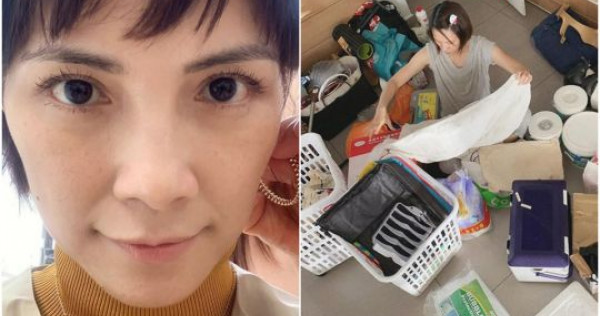
In an earlier post on Wednesday, Lee put up a photo of herself doing spring cleaning before Chinese New Year, as she joked that she is “a plain and simple housewife” after playing the beautiful Yun Ling in The Garden Of Evening Mists (2019).

[ad_2]

Source link