Home Blog Page 498

When mobile phone usage comes between employers and domestic workers

0

SINGAPORE: Noraini Wahid was going to renew her foreign domestic worker’s contract when she discovered something distressing: The latter had a secret mobile phone, with pornographic photos and videos inside.

Unknown to her, the maid — who had a boyfriend — had also been taking selfies on the bed in her mother’s room “wearing just a bra”, and sharing those photos with him.

Noraini, a mother of three, had earlier put restrictions on the domestic worker having her own phone. But the latter bought one from another maid living in the same block, and hid it from her employer.

“The handphone is the root of all evil,” said Noraini. “I understand that they’re away from home, they miss their families … but you need to show me (that) I can trust you with your phone.”

So, while mobile phones keep many of us connected today, they are driving a wedge between helpers and employers like her. And the programme Talking Point finds out how employers can manage their maids’ smartphone usage to prevent misuse. (Watch the episode here.)

Mobile phones are driving a wedge between employers like Noraini Abdul Wahid and their helpers.

Noraini Abdul Wahid.

PRIVACY, SECURITY CONCERNS

International Labour Organisation (ILO) statistics last year show that fewer than half (47 per cent) of 297 employers surveyed in Singapore let their domestic workers access their phone outside working hours.

The confiscation of migrant workers’ mobile phones, or restriction on usage, is a “tactic in which employers exert power” over the workers, the ILO said in the report, Mobile Women And Mobile Phones.

The way some maids use their smartphones and overshare information, however, can be worrying.

In video-sharing network TikTok, for example — which is popular among domestic workers right now — it took Talking Point host Diana Ser only five minutes to find 50 accounts created by them.

One showed a maid in a bath towel dancing at her employer’s home. Another video was of a domestic worker singing and dancing with her employer’s daughter. And another one showed the street and block of the employer’s private estate.

“I’m wondering if permission was given by the parents for this video (with the child) to be taken and uploaded,” said Ser.

“Quite a few videos were taken within the premises of the employers. Again I wonder if that’s with the employers’ permission.”

For John Gee, a former president of non-profit organisation Transient Workers Count Too, it would not bother him if his helper were to share videos of herself “dancing around the kitchen, having fun”.

But he draws the line at pictures or videos of his children or even their bedrooms.

“We wouldn’t bring strangers into the bedroom — why would you want your bedroom to be shown online, on social media?” he said. “That’s something that you should definitely (make) very clear shouldn’t happen.”

Images of children or even their bedrooms are a no-no for migrant rights activist John Gee.

While some of these videos did not reveal precise locations, technology writer Paul Mah, who covers cybersecurity trends, thinks there is cause for concern.

The images and videos were probably uploaded without the employers’ permission or knowledge, he said. And “over a period of time, (they) reveal a lot of information”, such as the household they are employed in and the people living there.

In fact, from one of the TikTok accounts, Ser was able to track down the domestic worker’s address, down to the Housing and Development Board unit in Tampines and the employer she was caring for.

“Even when the helper moves on to the next household, these videos (and) images presumably will … stay on social media,” said Mah. “And anybody is able to log in and view (them).”

These videos could also attract scammers, who may potentially use them to “find out more information about a household before trying to call (on) the vulnerable and elderly”.

COMMUNICATION IS KEY

While first-time foreign domestic workers in Singapore must attend a one-day Settling-In Programme to be familiarised with local laws and equipped with on-the-job safety training, there is no module covering the dos and don’ts of using mobile phones at work.

The Manpower Ministry also does not have explicit rules on how employers should manage their helper’s smartphones.

Instead, it is left to the policy of employment agencies and for employers to lay down the house rules, such as when she can use her phone.

Calvin Chew, for example, lets his maid use her phone when she has finished her duties. But to restrict her from overusing it, he does not provide her with Wi-Fi access at home.

“She’d be using (her) own data plan. So the more she uses, the more she pays,” he said. “In that sense, she’ll know how to control (her usage).”

Domestic worker Robina Navato knows many others whose phones were confiscated before they started their jobs, which is why they resort to buying a second, secret phone.

Her previous employer was strict about her phone usage, allowing her to use it only after 11pm. But by then, her family members would be asleep. She began to feel homesick, and called it quits after two months.

She decided to share her story because “it’s very important for employers to know that we domestic workers are human beings too”. “Sometimes they forget that we’re away from our families,” she said.

Especially for the new ones, it’s very important … to communicate with our families back home or to our friends. At least they’d know our situation here.

Over the past 20 years, Gee and his wife Cecilia Siow have employed six helpers in their household, and they have never had to place any restrictions on mobile phone use.

“I’ve never had my boss … talk to me about handphone usage,” pointed out Siow. “I’d be appalled if I have to do that with Lyn (the current helper). She’s not a child.”

But what happens if there are helpers who, despite having guidelines, continue to use the phone when they are not supposed to do so?

Said Gee: “If we (employers) have concerns, then we should share them. We talk about it, and we come to an understanding.”

Watch this episode of Talking Point here. New episodes on Channel 5 every Thursday at 9.30pm.

In five minutes, Talking Point host Diana Ser found 50 TikTok accounts created by domestic helpers.

Harmless fun or inviting trouble?
Source link

Coronavirus: Travel insurance may not cover losses from the virus outbreak in Wuhan

0

[ad_1]

SINGAPORE – Travel insurance is unlikely to cover losses from the coronavirus outbreak in Wuhan, depending on when the policies were activated.

Coverage of certain parts of mainland China may also be affected as the outbreak situation develops, according to a General Insurance Association update on Tuesday (Feb 4).

“Most insurers consider the (virus outbreak) a known event and have issued consumer advisories on travel insurance claims,” the association noted.

A known event usually means a civil commotion, natural disaster and so on that threatens a person’s health or disrupts his trip. It is typically made known to one by the airline or hotel, or publicised through media reports or government travel advisories, before the sign-up for the policy.

The association urged customers with travel insurance policies or claims for disruptions due to the coronavirus outbreak, such as shortened or cancelled trips and postponed flights, to check with their insurers on what their coverage entails.

“Many travel insurers have issued consumer notices on claims eligibility and consumers are encouraged to keep themselves updated,” it said.

[ad_2]

Source link

MPs express concern over livelihoods of food delivery riders, jail terms for underage PMD users

0

SINGAPORE: Members of Parliament (MPs) welcomed amendments to the Active Mobility Bill on Tuesday (Feb 4), although some raised concerns on issues that could arise with the new law in place. 

They also sought clarification on licencing for active mobility device-sharing operators, under the new Shared Mobility Enterprises (Control and Licensing) Bill.

In their speeches, MPs Darryl David and Ong Teng Koon noted that the amendments were “timely”.

“(The amendments are) not so much to stop the use of these devices, but to ensure that our footpaths are once again safe for the significant majority of the population,” said Mr David. 

MPs Lee Bee Wah and Alex Yam also expressed their appreciation for the e-scooter ban on footpaths which come into effect last November. 

“Since then, I have received fewer complaints from residents about reckless riders, and my residents have generally expressed support for the ban,” said Ms Lee.

While it must have been a “difficult decision to make”, Ms Lee said that “something had to be done given the casualties, injuries, near-misses caused by reckless e-scooter users, besides the fire caused during the battery charging”.

She added: “Human lives must be prioritised above everything else.”

Eleven MPs stood to speak on the two Bills, which were passed in Parliament on Tuesday.

CONCERN OVER LIVELIHOODS

Several MPs raised their misgivings towards last November’s sudden ban on using electric scooters on footpaths, as they affected the livelihood of residents whose livelihood depended on the use of such devices.

Nominated Member of Parliament (NMP) Anthea Ong said that the overnight ban that came into effect on Nov 5 “was seen by many as blunt and rigid and not well supported with an inter-ministry response” and users should have been consulted before the ban was implemented.  

MP for Marsiling-Yew Tee Ong Teng Koon said that when the law was announced, about 30 riders went for his Meet-the-People session to ask for help. They were angry and felt their livelihood was taken away “without any warning”, Mr Ong said. 

Many of these delivery riders were the sole breadwinners of their families, and some were ex-prisoners marginalised due to their criminal records, he added, presenting policy recommendations to ensure greater gig worker rights, particularly on changes to the Employment Act.

In his closing speech, Senior Minister of State for Transport Janil Puthucheary said that this issue underlying the gig economy is a significant one, but lies outside the scope of the Bills. Instead, Dr Puthucheary said he would convey the suggestions to the Ministry of Manpower

UNDERAGE RIDERS COULD FACE JAIL

Ms Ong and Nee Soon MP Louis Ng raised concerns over a new offence scheme, which could imprison underage riders for riding a personal mobility device (PMD).

“I am deeply disturbed by this and I hope (Minister for Social and Family Development) Desmond Lee is too,” said Ms Ong.

From the second half of 2020, underage e-scooter riders who use their devices on public paths face a S$1,000 fine or three months’ jail, or both, for a first offence. 

Subsequent offenders will face a S$2,000 fine or six months’ jail, or both.

She noted that the Children and Young Persons Act has “clear restrictions” on punishing children and young persons, and “they should not be ordered to be imprisoned for any offence”.

“I would like to ask the Minister to consider commensurate measures, other than imprisonment, for a child or young person found guilty of underage riding of PMD on shared paths,” she said.

“Should there not be warnings issued and reformative training actions considered before we impose such inappropriate punitive measures on children?”

In response, Dr Puthucheary said that the penalties “only provide the limit of the possible sentence”, and that the courts “retain the discretion to consider the circumstances of the case”.

To a further clarification by Ms Ong, he added: “We need to give (officers) the operational leeway to deal with the circumstances that are in front of them.”

On another point, Workers’ Party Non-Constituency MP Dennis Tan asked if underage riders were allowed to use mobility devices with supervision, who would be legally liable if the underage rider causes injury or damage to property while riding under supervision.

Dennis Tan Active Mobility Bill Parliament

Workers’ Party Non-Constituency Member of Parliament Dennis Tan on the bills to enhance active mobility laws. 

Dr Puthucheary replied: “If an underage rider commits an offence, it will not fall on the supervisor to be liable for that offence, for example speeding or reckless riding.

“But the supervisor can be held responsible for improper supervision if he or she did not take reasonable and practical measures to ensure that the underage rider would not commit such offences.”

THIRD-PARTY LIABILITY INSURANCE SHOULD BE EXTENDED

One matter the MPs approved on was that businesses would need to provide third-party liability insurance – which covers the cost of a victim’s expenses – for their riders from the second half of this year. 

However, they asked if the requirement could tightened, such as making all users – not just delivery riders – purchase third-party liability insurance.

MP for Tanjong Pagar GRC Joan Pereira said that this would ensure all victims could “seek recourse and compensation”.

Joan Pereira active mobility bill

MP for Tanjong Pagar GRC Joan Pereira speaking on newly enacted active mobility laws in Parliament.

“Without insurance, victims can only try for private settlements through mediation or make civil claims,” she said, which had led some of her constituents who were injured to approach her for help.

Ang Mo Kio GRC MP Ang Hin Kee, also an adviser to the National Private Hire Vehicles Association, suggested making it mandatory for operators to provide riders with accident or prolonged medical leave insurance.

Ideally, all users should be covered by some form of insurance, said Dr Puthucheary. 

Currently, only businesses have to take out third-party liability insurance on their riders. Individual riders do not need to purchase third-party liability insurance as there are currently few active mobility-related insurance products available, Dr Puthucheary said.  

The Government, he said, will work with the Active Mobility Advisory Panel and insurers to ensure users have access to affordable insurance products.

ENFORCEMENT 

MPs also brought up the need for consistent enforcement, and whether LTA had enough resources and training for their officers to deal with errant riders.

Mr Tan blamed poor cycling culture, lack of enforcement and the lack of political will of past governments to improve the riding culture.

“(This means) that in recent years, with the introduction of e-scooters, we need to create from scratch a new culture of safe and considerate use of bicycles and PMDs,” he said.

He also questioned the effectiveness of getting riders to comply with the footpath ban and suggested that the number of enforcement officers and spot checks were inadequate.

“People may take their chances and continue to use their devices illegally or in unlawful ways if they think that the chances of meeting enforcement officers are slim,” he said.

Ms Ong and Mr David noted an incident in December 2019 where an auxiliary police officer kicked a speeding e-scooter rider.

“We should not condone the use of force by enforcement officers in the course of performing their duty, but I feel there should be proper protocols in place for dealing with errant speeding PMD riders,” said Mr David.

READ: Certis CISCO officer suspended from active duty after kicking PMD rider off road

Both Ms Ong and Mr David asked Dr Puthucheary if the Transport Ministry would train enforcement officers to handle errant riders.

LTA has caught more than 130 e-scooter riders who rode on footpaths since Jan 1 this year, Dr Puthucheary said in his closing speech.

It will “continue this approach to deter errant riding”, train its enforcement officers to catch those who try to evade the authorities, and use technology such as mobile closed-circuit television cameras.

USER PERSONAL DATA PROTECTED

Under the Shared Mobility Enterprises (Control and Licensing) Bill, which introduces new rules for shared-device operators, these companies will be allowed to either disclose or request for information about users who persistently park their active mobility devices improperly in order to impose a collective ban on the individual.

Several MPs said they were concerned that this could breach a customer’s data rights.

“The modern business collects huge amounts of private data on its customers, and this data can be worth huge amounts of money,” said Mr Louis Ng.

He added: “Is it possible that some organisations will seek to acquire private user information under the pretense of identifying bad parkers?”

Dr Puthucheary assured that the information shared is limited to making sure that the ban is enforced. 

The Personal Data Protection Act will still be applied to all operators and “they are required to comply with existing data protection and privacy standards”, he said. 

Source link

President Halimah meets counterpart Widodo in first state visit to Indonesia

0

BOGOR, Indonesia: President Halimah Yacob was received by President Joko Widodo at the Istana Bogor on Tuesday morning (Feb 4) during her first state visit to Indonesia, said Singapore’s Ministry of Foreign Affairs (MFA) in a press statement.

Both presidents reaffirmed the longstanding friendship and excellent relations between the two countries.

“We agreed that bilateral cooperation across the economic, security and people-to-people sectors was substantive and wide-ranging,” said Madam Halimah in a Facebook post, adding that economic cooperation is a cornerstone of bilateral relations with Indonesia.

“As neighbouring countries with complementary strengths, Singapore and Indonesia are natural economic partners.

“I am therefore happy to co-witness the signing of the updated Double Taxation Avoidance Agreement (DTA) with President Joko Widodo this afternoon.”

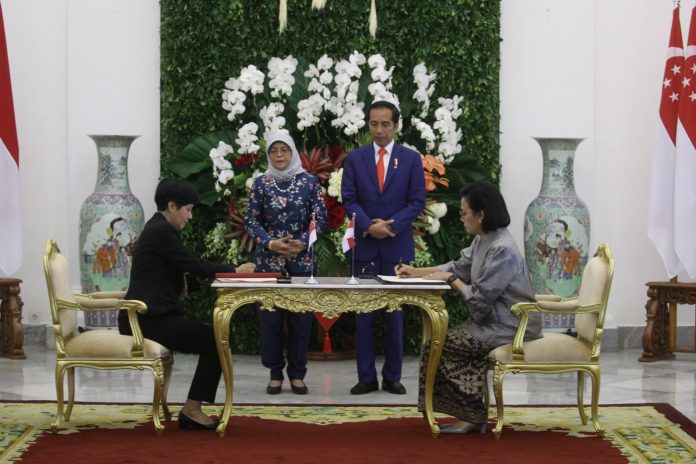
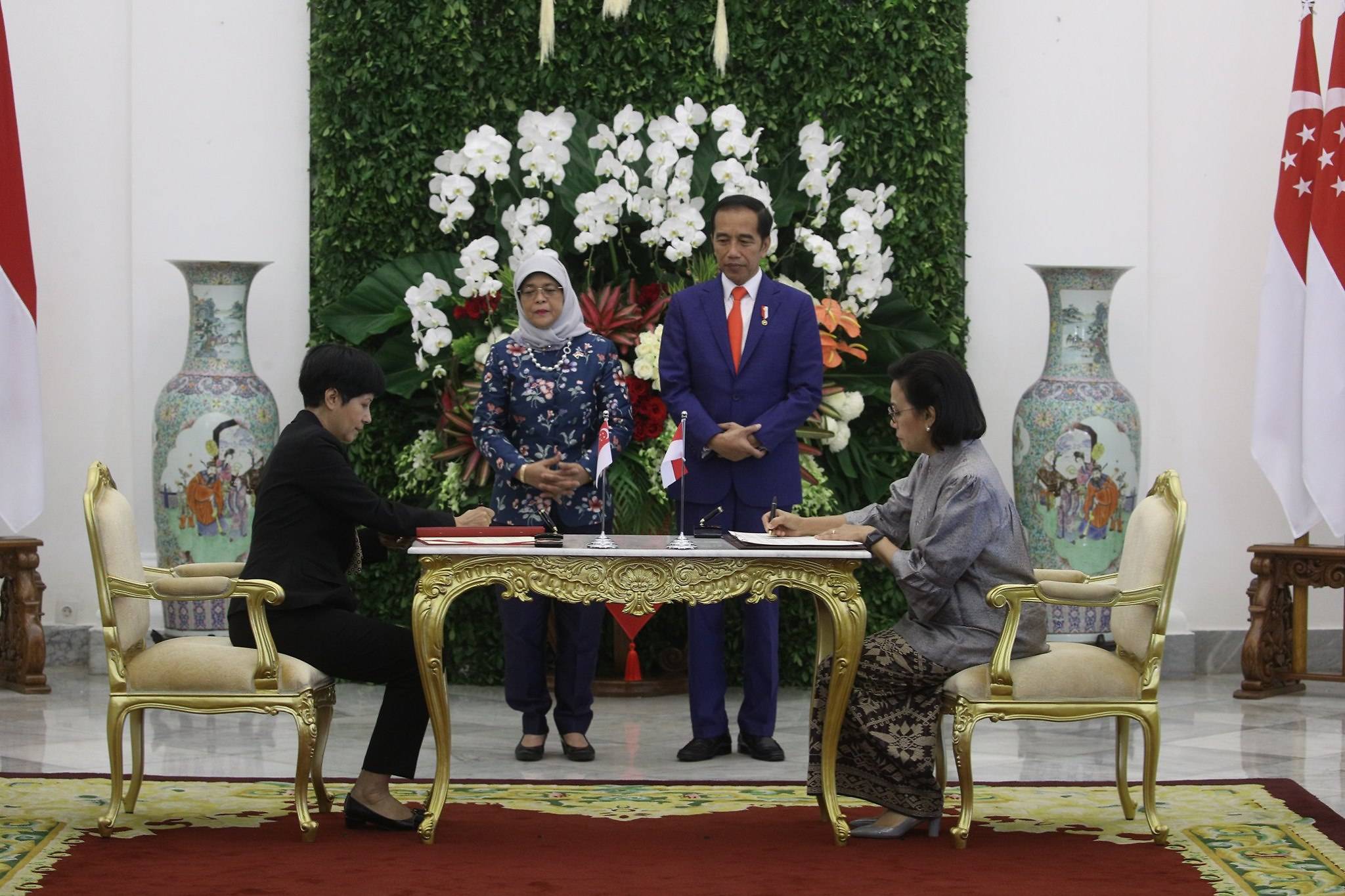
The agreement was signed by Minister in the Prime Minister’s Office and Second Minister for Finance and Education Indranee Rajah and the Indonesian Finance Minister Sri Mulyani Indrawati.

Halimah Yacob Joko Widodo agreement signing

Signing of the updated Singapore-Indonesia Avoidance of Double Taxation Agreement by Second Minister for Finance Indranee Rajah and Indonesian Finance Minister Sri Muliyani Indrawati. (Photo: MCI/Chwee)


“The early ratification of the DTA, together with the Bilateral Investment Treaty concluded earlier, will enhance the already strong bilateral trade and investments between the two countries,” added Mdm Halimah.

READ: No time to waste ‘fighting yesterday’s battles’, says Vivian Balakrishnan on ties with neighbours

Mdm Halimah and Mr Widodo agreed that there was significant potential for Indonesia and Singapore to explore cooperation in “new, forward-looking areas such as the digital economy and Industry 4.0”, said MFA.

The two heads of state also welcomed the ongoing excellent cooperation between Singapore and Indonesia in human resource development and agreed on the importance of maintaining strong people-to-people ties.

Mdm Halimah highlighted the need for Singapore and Indonesia to continue working together on initiatives such as Youth Corps Singapore’s Youth Expedition Project Plus, which allows the younger generations from both countries to forge friendships and strengthen mutual understanding.

Halimah Yacob Joko Widodo

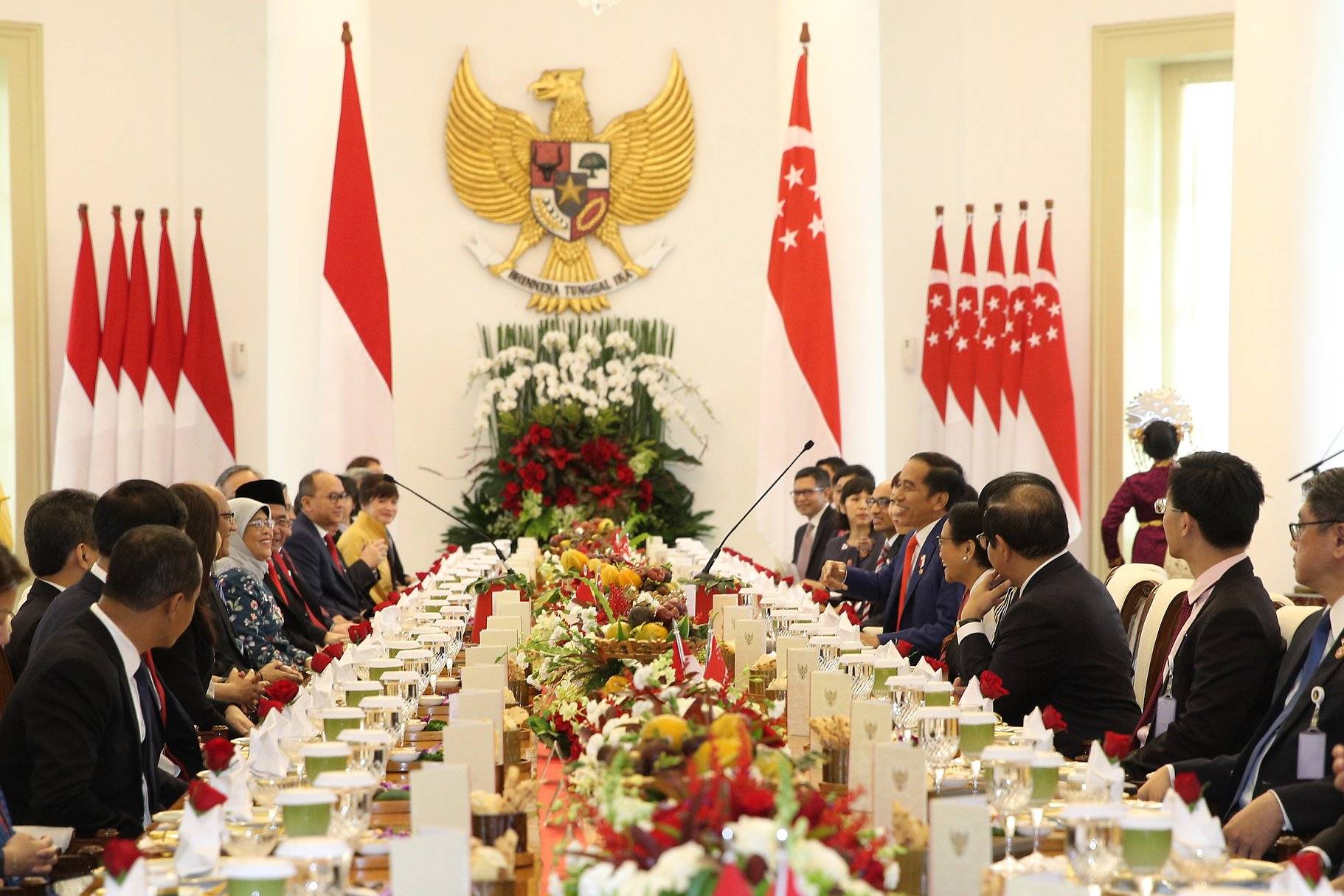
Singapore President Halimah Yacob shares a light-hearted moment with his Indonesian counterpart during the state banquet hosted by President Joko Widodo on Feb 4, 2020. (Photo: MCI/Chwee)

“President (Halimah) and President Joko Widodo also discussed Singapore’s ongoing efforts to strengthen cooperation with Indonesia’s regions, and were pleased that the inaugural RISING Fellowship for Indonesia’s regional leaders was held successfully from Nov 18 to Nov 21, 2019,” said MFA.

They were also pleased to note that the Singapore Police Coast Guard and its Indonesian counterpart had signed a Memorandum of Understanding on Monday that would provide for information exchanges and the conduct of regular joint operations, patrols, as well as bilateral training initiatives.

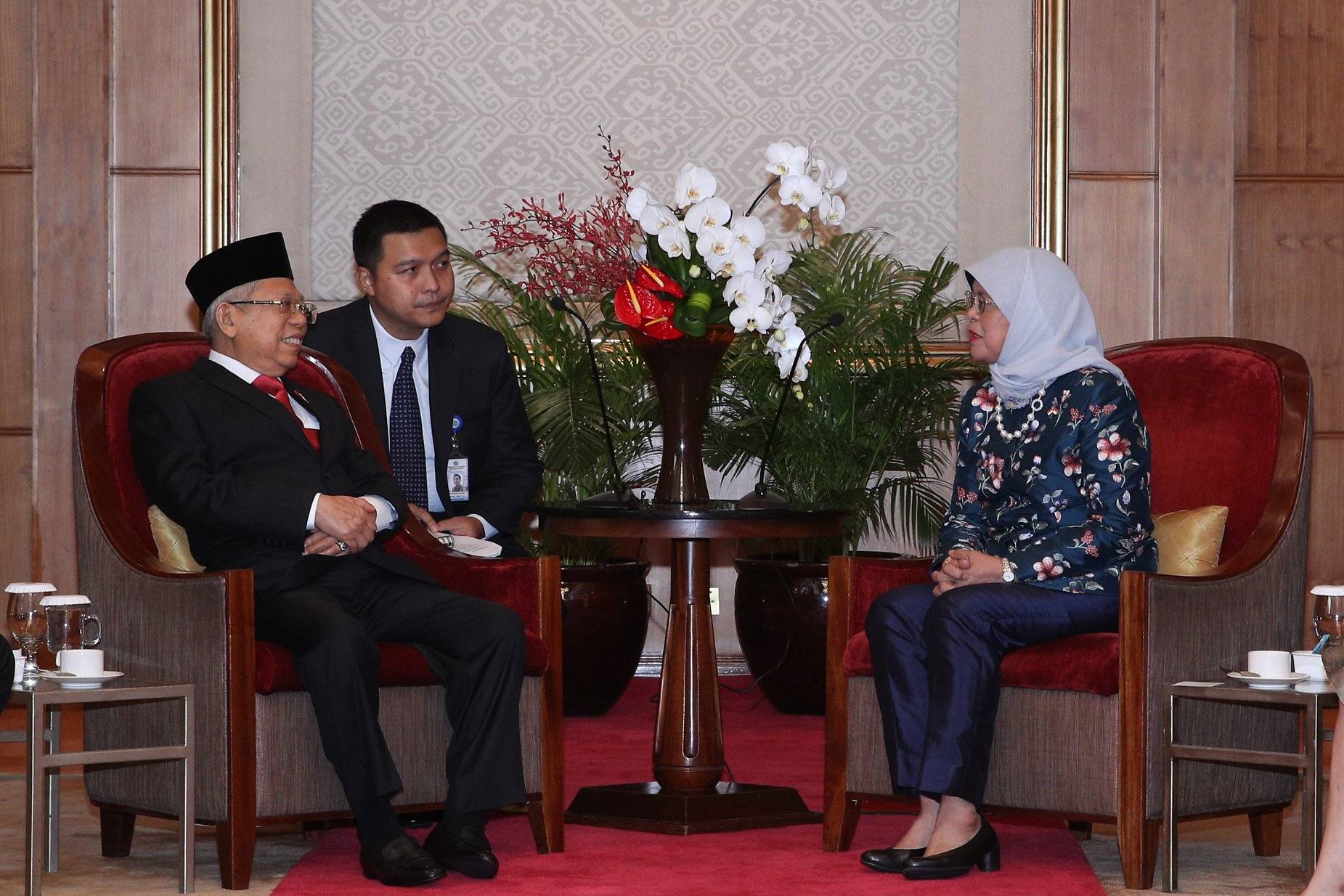
Mdm Halimah met Vice-President Ma’ruf Amin in the afternoon. 

“They had a good discussion about the importance of education and vocational training in promoting human resource development,” said MFA.

“They also exchanged views on building cohesive and harmonious societies, and agreed that Singapore and Indonesia could step up cooperation in this area, including through inter-faith dialogue.”

Ma'ruf Amin Halimah Yacob

Indonesian Vice President Ma’ruf Amin calls on Singapore President Halimah Yacob on Feb 4, 2020. (Photo: MCI/Chwee)

READ: Singapore-Indonesia ties need to be ‘continuously strengthened in every aspect’: Vice President Ma’ruf Amin

Mdm Halimah will attend a reception with Singapore and Indonesian business leaders on Tuesday evening, as well as a reception for overseas Singaporeans in Jakarta, according to MFA.

She will continue her visit in Jakarta on Wednesday before travelling to Yogyakarta in the afternoon.

Source link

HIV drugs used to treat ‘small number’ of coronavirus patients: MOH chief health scientist

0

SINGAPORE: A “small number” of coronavirus patients in Singapore are being treated with HIV drugs, the Ministry of Health’s (MOH) chief health scientist Tan Chorh Chuan said on Tuesday (Feb 4).

“In a small number of cases some of the HIV drugs Lopinavir and Ritonavir have been used here,” said Prof Tan at a press conference.

“The trials are being done in China and other places, but they’re being used here. We need to see the results of the trials to see how effective they are, but the results so far from other studies have looked quite promising.”

He said the results of the clinical trials “should be out, we hope, in the weeks ahead”.

READ: 4 locally transmitted cases among new coronavirus patients in Singapore

READ: What we know about the 6 new cases of novel coronavirus in Singapore

Doctors in Thailand, where there are more than two dozen cases, said on Sunday they have seen success in treating severe cases of the coronavirus with a combination of medications for flu and HIV. 

The Thai doctors said the treatment had improved the condition of several patients under their care, including a 70-year-old Chinese woman from Wuhan.

The treatment includes a mixture of the HIV drugs Lopinavir and Ritonavir, in combination with flu drug Oseltamivir in large doses, they added.

READ: Schools, eldercare facilities to suspend large gatherings after first local transmission

READ: Novel coronavirus patient discharged from NCID after recovery: MOH

Speaking to reporters after the press conference, Prof Tan said clinical trials would be “much easier” in a place with more patients, like Wuhan, the epicentre of the coronavirus outbreak.

“We’re waiting to see how it proceeds and we hope in the weeks ahead we’ll have some indication,” Prof Tan said.

“In the meantime, I mean, amongst the different drugs that have been tested in the past, these agents appear to be effective, but we can’t be certain at the moment. They appear promising. I think the trials will help us understand, whether or not, how effective it will be,” he added.

READ: China coronavirus death toll soars past 400

READ: Malaysian infected with novel coronavirus had travelled to Singapore

Prof Tan noted that when the first case of the coronavirus was detected in Singapore, a diagnostic kit was ready due to the efforts of scientists and researchers in the background. 

“That’s because we’re able, really, to take the sequences that have been published, and to create rapid diagnostic kits, and to rapidly scale up the numbers so that we are able to diagnose the cases early,” he said. 

This is “quite different” from the Severe Acute Respiratory Syndrome (SARS) outbreak, when there were no diagnostic kits for the first five weeks, which made containment efforts “much more difficult”, Prof Tan added. 

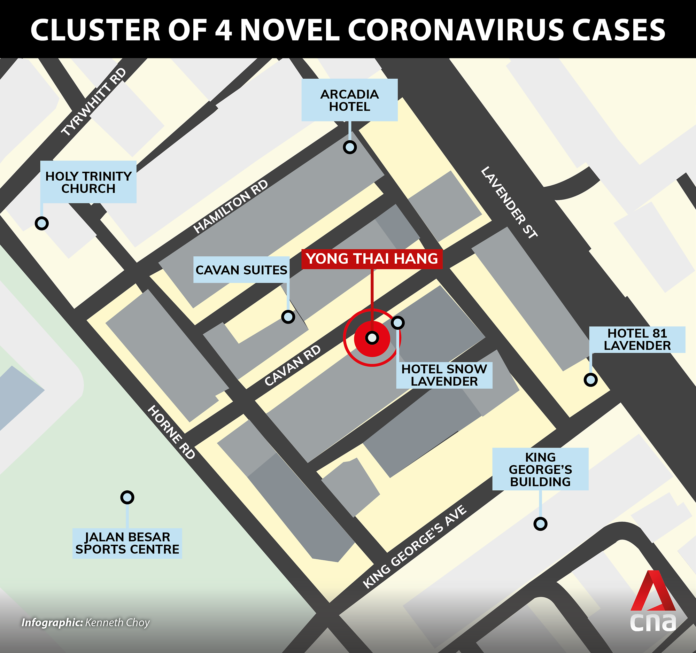
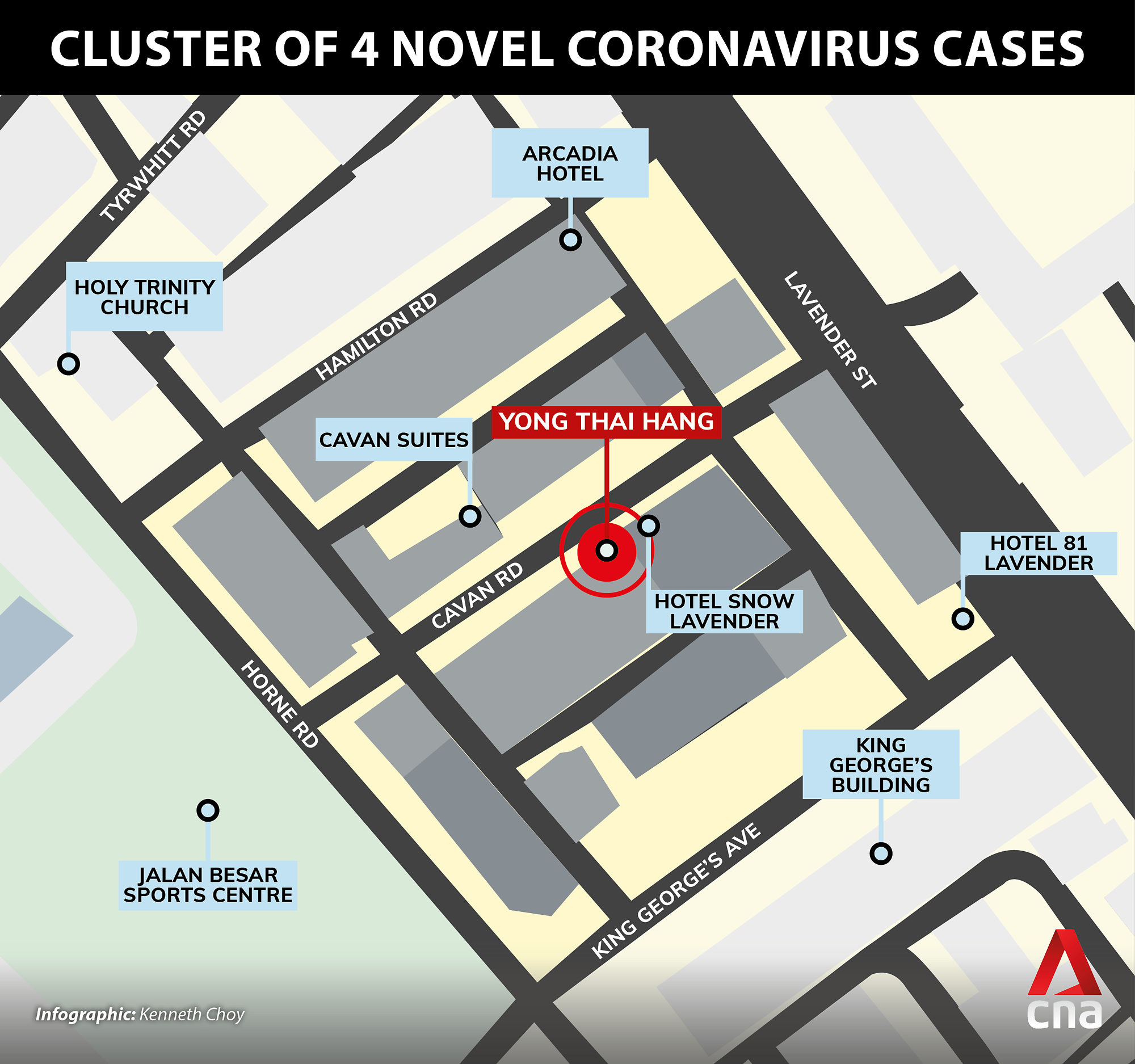
Coronavirus - Yong Thai Hang map, Singapore locally transmitted cluster

Singapore confirmed on Tuesday its first locally transmitted cases of the novel coronavirus, among six new cases of the virus. 

One patient was a tourist guide for a group of Chinese tourists, two work at a shop the group had visited, while a fourth case of local transmission was the domestic helper of one of the cases, said MOH at a briefing. 

BOOKMARK THIS: Our comprehensive coverage on the Wuhan coronavirus and its developments

Download our app or subscribe to our Telegram channel for the latest updates on the Wuhan virus outbreak: https://cna.asia/telegram 

Source link

This pastry chef at a Michelin-starred restaurant had no formal training

0

[ad_1]

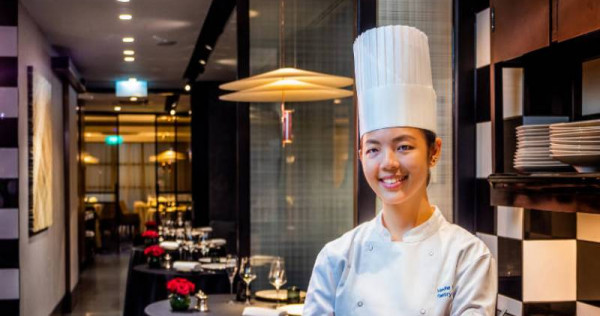
Pastry chef Maxine Ngooi has an impressive culinary resume: she cut her teeth at renowned restaurants Les Amis and Joël Robuchon Restaurant and now works at Vianney Massot Restaurant, a newly-minted Michelin-starred establishment.

But you might be even more impressed to find out that she started out without formal culinary training.

“I was always interested in baking and often joined my mum in the kitchen. However, I never took it seriously until I went to study for a degree in commerce in Australia, where I was introduced to a variety of quality ingredients,” says the 28-year-old.

“I started to purchase cookbooks and look for recipes. And by the time I graduated, I was convinced baking is where my passion lies and was very keen to get into the industry.”

Given her lack of formal experience, however, breaking into it was no walk in the park. Many doors were slammed in her face before she was presented with an opportunity.

SHE STRUGGLED A LOT IN THE CUT-THROAT CULINARY INDUSTRY

[ad_2]

Source link

Footpath ban for all motorised PMDs from April; minimum age requirement and online theory test to follow

0

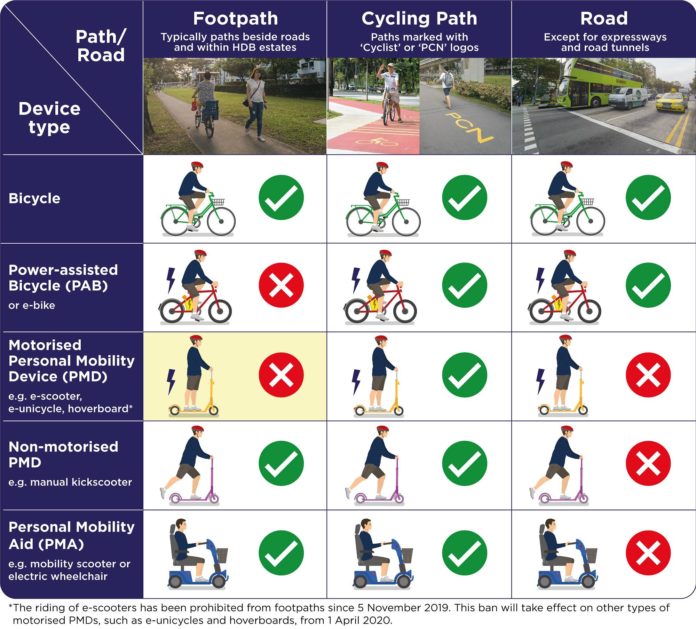
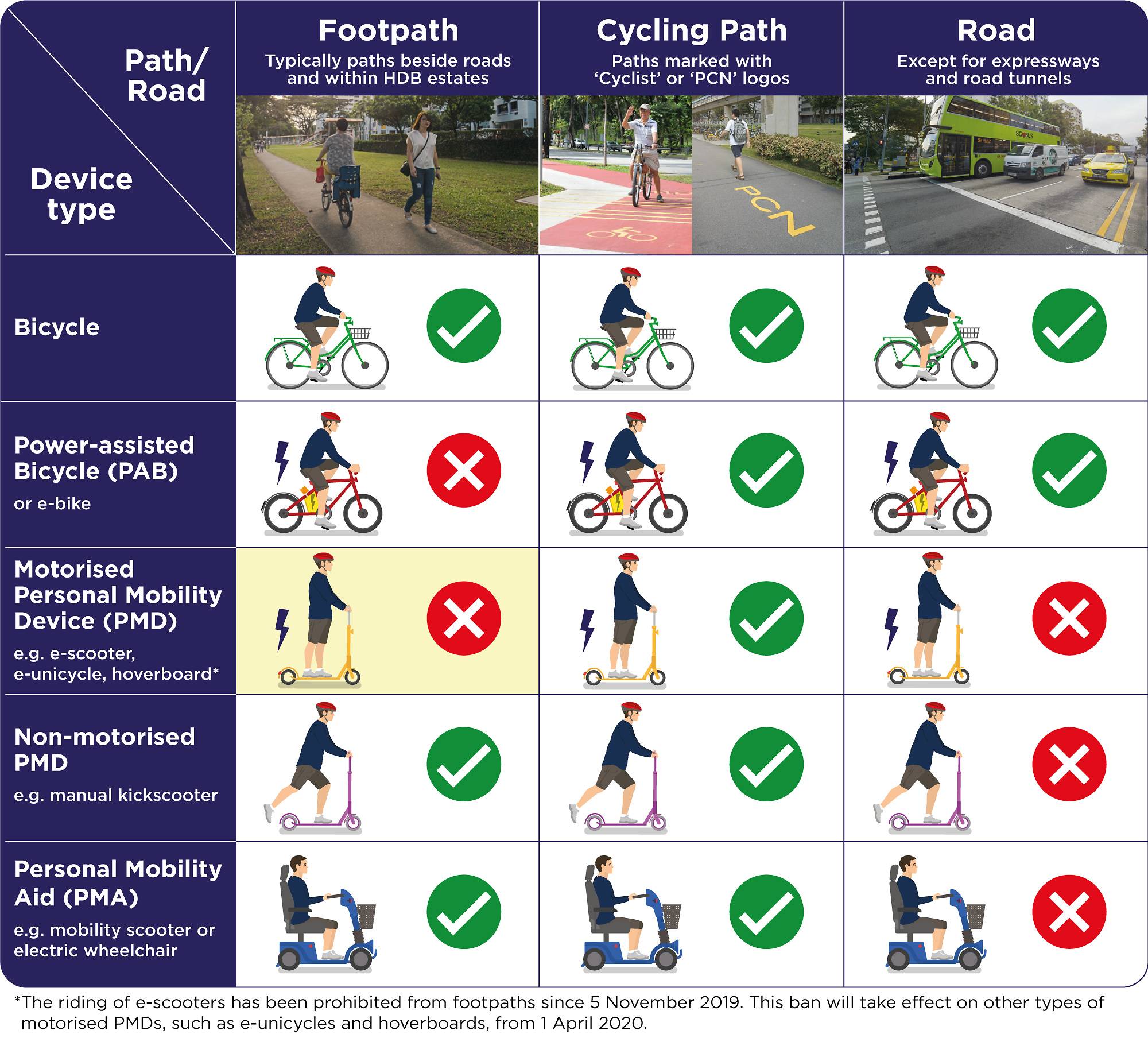
SINGAPORE: All motorised personal mobility devices (PMDs) will not be allowed on footpaths from Apr 1.

Electric scooters have been barred from footpaths since last November. This ban will now be extended to include other motorised PMDs, such as hoverboards and electric skateboards, after the Active Mobility (Amendment) Bill and Shared Mobility Enterprises (Control and Licensing) Bill were passed in Parliament on Tuesday (Feb 4).

Personal mobility aids used by people with walking difficulties, such as motorised wheelchairs, are exempted from this wider restriction.

Those caught flouting the rules can be fined up to S$2,000 or jailed for up to three months, or both, for a first offence. Repeat offenders face fines of up to S$5,000 or imprisonment of up to six months, or both.

Senior Minister of State for Transport Janil Puthucheary acknowledged that the expanded ban will be a “connectivity loss” for motorised PMD users.

But since barring e-scooters from footpaths last November, accidents on footpaths involving PMDs have fallen by 52 per cent, he said.

Sentiments towards public path safety have also improved, he added during the second reading of the Bills. 

LTA's Graphic on extended footpath ban to all motorised PMDs

(Graphic: Land Transport Authority)

MINIMUM AGE REQUIREMENT, ONLINE THEORY TESTS FOR INDIVIDUALS

Other regulatory measures targeted at individual users are also set to kick in progressively from April until the first half of next year.

A number of them were recommendations made by the Active Mobility Advisory Panel (AMAP) last September, following a fatal collision involving an e-scooter rider and an elderly cyclist. The recommendations were then accepted by the Government in December.

One of which is the introduction of a minimum age for e-scooter riders from the second half of this year. Unless supervised by an adult who is at least 21 years old, those below the age of 16 will not be allowed to ride an e-scooter on public paths.

Supervisors will need “to take reasonable and practicable measures to ensure that the under-aged rider does not ride in a way dangerous to people or property”, said Dr Puthucheary, adding that authorities will release guidelines in this area. 

Separately from the first half of next year, users of e-scooters and power-assisted bicycles will need to pass an online theory test before being allowed to ride their devices on public paths. 

As power-assisted bicycles are also allowed on roads, riders will similarly be required by the Traffic Police to pass a theory test. Those who successfully complete the required tests will be issued a competency test certificate. 

Dr Puthucheary said this is “a calibrated approach to improve awareness of rules and regulations, while managing the regulatory burden on device users”.

If necessary, the Land Transport Authority (LTA) will have the flexibility to introduce other tests, such as practical riding tests, in future, he added.

READ: E-scooter ban on footpaths to extend to all motorised PMDs under amendments to Active Mobility Act

READ: E-scooters to be banned from Singapore’s footpaths starting Nov 5

To ensure only compliant mobility devices are in use here, there will also be a mandatory inspection regime that will require all e-scooters here to go for inspections every two years, starting from April.

“LTA will be rostering e-scooters that are already registered and declared as UL2272-certified for inspections,” Dr Puthucheary told Parliament. 

“LTA will also periodically call up certified and registered e-scooters for re-inspections every two years to ensure that they remain compliant and are not illegally modified.” 

In addition, it will soon be an offence to hold and use a mobile communication device while riding mobility vehicles on public paths. 

This measure, aimed at tackling “distracted riding”, takes effect from the second half of this year. 

MEASURES FOR RETAILERS AND OTHER BUSINESSES

Retailers of active mobility devices and businesses using these devices will also be subject to new measures under the Bills passed in Parliament. 

Last year, there were 28 instances where retailers were caught for various offences, including displaying and advertising non-compliant active mobility devices, said Dr Puthucheary, who stressed that retailers “must also behave responsibly”.

From April, retailers will be required to send their e-scooters for inspection before putting them up for sale. Selling an uncertified vehicle could carry a S$20,000 fine, a 24-month imprisonment, or both, for first offenders. 

Noting that this will give consumers assurance, Dr Puthucheary said: “We will retain the flexibility to extend this to other active mobility devices in future if necessary.” 

As illegally modified devices can pose public path safety and fire safety risks, the LTA’s ability to enforce against such illegal modifications will also be strengthened.

Rules will be broadened from April to cover users who modify their own devices and those who do so for others for free. 

From the second half of this year, businesses will also have to ensure that their riders who use active mobility devices on public paths are covered by third-party liability insurance. This is to provide victims greater recourse to compensation. 

The new rule will be imposed on businesses, such as food delivery firms. 

READ: Ban on personal mobility devices? ‘The battle is always against errant use’

Describing this as a “staged approach” to first impose insurance requirements on certain businesses, Dr Puthucheary said authorities are still working with the panel and the insurance industry to study how best to extend such insurance requirements to individual riders. 

Overall to deter “errant and irresponsible behaviour, both users and retailers will face harsher maximum penalties for key offences. 

While most individual riders are law-abiding, Dr Puthucheary said LTA’s enforcement officers detected about 4,900 offences in 2019. 

“This is not acceptable,” he said. “To send a stronger deterrent message to this group, we will increase the maximum penalties for certain offences.” 

For example, the penalty for a first-time offender caught speeding on public paths will be doubled to S$2,000 or 6 months’ imprisonment, or both. 

Similarly for retailers, the penalty for selling a non-compliant device for use on public paths will be increased by more than four times, said Dr Puthucheary.

REGULATIONS FOR OPERATORS OF SHARED VEHICLES

Also passed in Parliament on Tuesday, the Shared Mobility Enterprises (Control and Licensing) Bill expands the current licensing regime for operators of shared bicycles and mobility devices. 

This will replace the device-sharing licensing regime, which currently falls under the Parking Places Act and focuses on tackling indiscriminate device parking, particularly by shared bicycles. 

Dr Puthucheary said there are a variety of operators using different devices, including motorised ones, causing problems with parking and safety today.

“For example, there have been operators who provide e-scooters for hire on private land, and these devices were subsequently observed on public paths. Different business models are likely to be developed in the future.

“Thus, it is necessary to update our regulatory regime,” he said. 

READ: The Big Read: After the sound and fury, the dust settles on e-scooter footpath ban

Under the expanded regulatory regime, there will be two types of licences – regular and class licences. 

The regular licence applies to all operators who offer dockless devices for hire, which will be subject to various requirements such as banning users who have committed serious offences on shared devices and ensuring users are covered by third-party liability insurance. 

As bicycles are non-motorised and pose a smaller safety concern, dockless bicycle-sharing operators will be subject to requirements that deal with parking matters only for a start, Dr Puthucheary said. 

Authorities will also take a “calibrated approach” in applying the safety requirements, depending on whether the operators are offering for hire motorised or non-motorised devices, he added. 

Meanwhile, the class licence will apply to docked motorised device-sharing operators for a start.

Those operating non-motorised devices, such as docked bicycle-sharing operators, have “fewer safety concerns” and will be excluded from this regime.

According to Dr Puthucheary, class licencees do not need LTA’s explicit periodic approval to operate and only need to register with LTA soon after commencing operations. 

Class licencees will also be subject to a smaller set of regulatory requirements, such as installing speedometers on their active mobility devices. 

This “lighter-touch approach” boils down to how docked operators, such as those who operate from a physical shopfront or who have built racks where their devices are affixed to, cause less parking disamenities due to their use of docking infrastructure, said Dr Puthucheary 

“They generally have to incur higher initial infrastructure costs, which naturally restricts the scale of their operations, and correspondingly their safety impact,” he added. 

“Notwithstanding this, LTA will have the flexibility to shift such operators into the regular licensing regime subsequently, if there is a need to do so.”

Source link

Where to buy the prettiest Valentine's Day flowers in Singapore to impress your partner

0

[ad_1]

Roses are red. Violets are blue. Valentine’s Day is around the corner. This is for would-be-cupids without a clue (where to get flowers).

So maybe I’m no Romeo but I can tell you there are some pretty spectacular flower shops popping up around town. With bespoke designs and exotic flowers, these floral shops are elevating the bouquet game.

1. DAWN.Q 

PHOTO: Dawn.Q

Providing intrinsic, timeless and elegant floral design for all occasions, you’ll find that the beauty of the flowers speak for themselves in all the lovingly crafted arrangements.

For Valentine’s Day this year, they got a mix of fresh and preserved flower arrangements. Or take it up a notch with the Everlasting Endearment gift box; which has pretty preserved flowers arranged in a lux burgundy velvet box with a gift of your choice (Kindred Teas or Hush Candle) to sweep your partner off their feet.

[ad_2]

Source link

Coronavirus: S'pore reports first cases of local transmission; 4 out of 6 new cases did not travel to China

0

[ad_1]

SINGAPORE – Singapore has recorded its first cases of local coronavirus transmission, with four women here infected who had not travelled to Wuhan, the epicentre of the outbreak.

Two work at Yong Thai Hang, a Chinese health products shop in Cavan Road in Lavender which caters to Chinese tour groups.

The third is a maid of one of the women, while the fourth is a tour guide who had taken groups to the same shop.

The tour group in question has since returned to China.

In addition, another two confirmed cases were announced on Tuesday (Feb 4).

The two were among a group of 92 people flown back to Singapore from Wuhan on a Scoot flight last Thursday. Before this, another two on the same flight had been reported as confirmed cases.

In total, there are now 24 confirmed cases in Singapore.

The new cases constitute “limited local transmission”, the Health Ministry said on Tuesday.

“There is however no widespread evidence of widespread community transmission,” said Health Minister Gan Kim Yong at a press conference.

[ad_2]

Source link

What we know about the 6 new cases of novel coronavirus in Singapore

0

SINGAPORE: Six patients in Singapore, including four with no recent travel history to China, have tested positive for the novel coronavirus, the Ministry of Health (MOH) announced on Tuesday (Feb 4).

The four cases of local transmission are linked to travellers from China, the ministry said. Another two cases are Singaporeans evacuated from Wuhan on Jan 30.

This brings the total number of confirmed cases in Singapore to 24.

Of the four locally transmitted cases, three had “prolonged interactions” with recent travellers from China. Two of the Chinese travellers have since been confirmed to have been infected with the coronavirus, according to health authorities in China.

“Though four of these cases constitute a local transmission cluster, there is as yet no evidence of widespread sustained community transmission in Singapore,” MOH said.

READ: 4 locally transmitted cases among new coronavirus patients in Singapore

Here is what we know about the six new cases:

A tour group from China had arrived in Singapore on Jan 22. A day later, the group visited a health product shop at 24 Cavan Road in Jalan Besar, among other places.

CASE 19

Case 19 is a 28-year-old Singapore resident who works as a salesperson at Yong Thai Hang, a complementary health product shop that primarily serves Chinese tourists. She has no recent travel history to China.

She reported having a sore throat and fever on Jan 29 and sought treatment at a GP clinic on the same day, MOH said.

She went to Tan Tock Seng Hospital’s (TTSH) emergency department on Jan 30 and was discharged after a chest X-ray came back negative for pneumonia.

She did not leave her home at Jalan Bukit Merah from Jan 31 to Feb 2. On Feb 3, she was admitted to the Singapore General Hospital (SGH) and tested positive for the novel coronavirus past 11pm on the same day.

MOH’s director of services Associate Professor Kenneth Mak told reporters that the patient had not met the “case definition” on Jan 30 because she did not have pneumonia when she was checked at TTSH and had no recent travel history to China. 

The situation changed on Feb 3 when she went to SGH, where she was diagnosed with pneumonia, Assoc Prof Mak said.

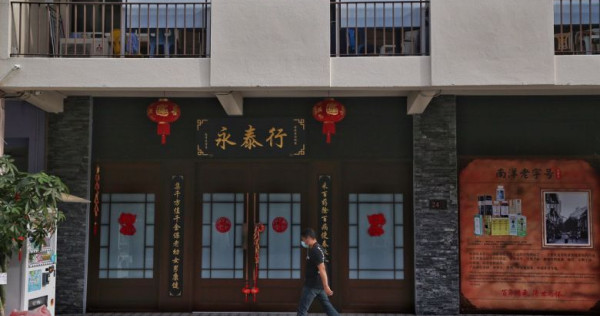
24 Cavan Road storefront

View of Yong Thai Hang 24 Cavan Road. (Photo: Gaya Chandramohan)

CASE 20

Case 20 is a 48-year-old Singapore resident who also works as a salesperson at Yong Thai Hang. She has no recent travel history to China.

The woman, who stays at Hougang Street 61, reported onset of symptoms on Jan 25 and was admitted to the National Centre for Infectious Diseases (NCID) on Feb 3.

“Given that she is a colleague of case 19, she was classified as a suspect case and immediately isolated,” MOH said in a press release. Test results confirmed the infection on Tuesday morning.

CASE 21

Case 21 is case 19’s domestic helper. The 44-year-old Indonesian national has no recent travel history to China and resided at Jalan Bukit Merah as well.

She reported onset of symptoms on Feb 2 and did not leave her place of residence. She was also admitted to SGH on Feb 3. She was tested positive for the novel coronavirus on Tuesday afternoon.

READ: NATAS postpones travel fair amid concerns that coronavirus outbreak will dampen turnout

CASE 24

Case 24 is a 32-year-old Singapore resident who works as a tour guide and brings groups of tourists to Yong Thai Hang, where cases 19 and 20 are employees. She had no recent travel history to China.

She had no symptoms when she went to NCID on Feb 3, where she was immediately isolated. 

Test results confirmed the infection on Tuesday afternoon.

“We are also contacting individuals with profiles similar to the above four cases of local transmission, who had recent close contact with individuals with travel history to mainland China,” said MOH. 

CASES 22 AND 23

Cases 22 and 23 were among the 92 Singaporeans evacuated on Jan 30 from Wuhan, the epicentre of the coronavirus outbreak.

They did not have any symptoms when they boarded the Scoot flight and they were put under quarantine upon landing in Singapore.

All Singaporeans who were evacuated from Wuhan were tested for the novel coronavirus. On Monday, cases 22 and 23 tested positive, despite continuing to show no symptoms.

They are warded in isolation rooms at NCID.

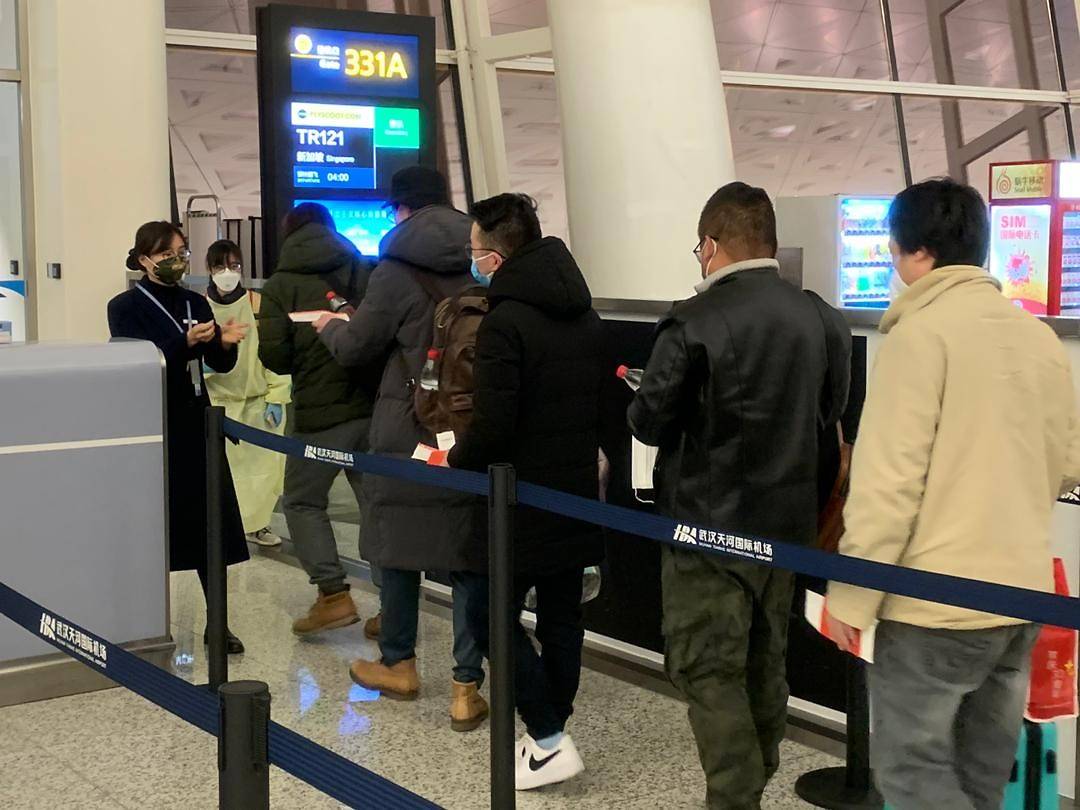
Singaporeans return from Wuhan

Singaporeans returning home from Wuhan on Jan 30, 2020. (Photo: Ministry of Foreign Affairs)

Last Friday, it was announced that all new visitors with recent travel history to mainland China will not be allowed to enter Singapore. These visitors will also not be allowed to transit in Singapore. 

Those with Chinese passports, with the exception of Singapore permanent residents (PRs) and long-term pass holders, will also not be allowed to enter Singapore. 

The coronavirus has killed more than 400 people and infected more than 20,000 around the world. The World Health Organization has declared the virus outbreak a global emergency.

BOOKMARK THIS: Our comprehensive coverage on the Wuhan coronavirus and its developments

Download our app or subscribe to our Telegram channel for the latest updates on the Wuhan virus outbreak: https://cna.asia/telegram 

Source link