Home Blog Page 495

More new drug abusers arrested in 2019: CNB

0

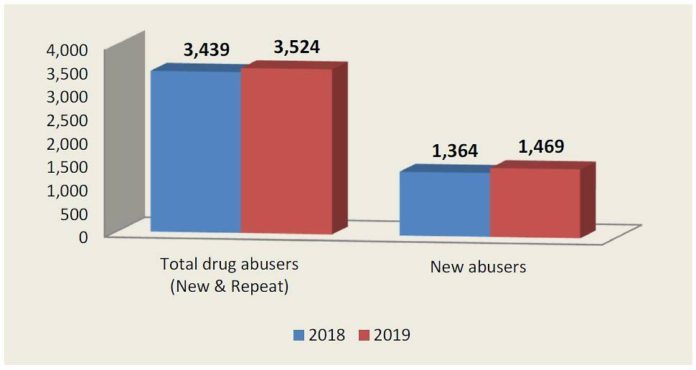
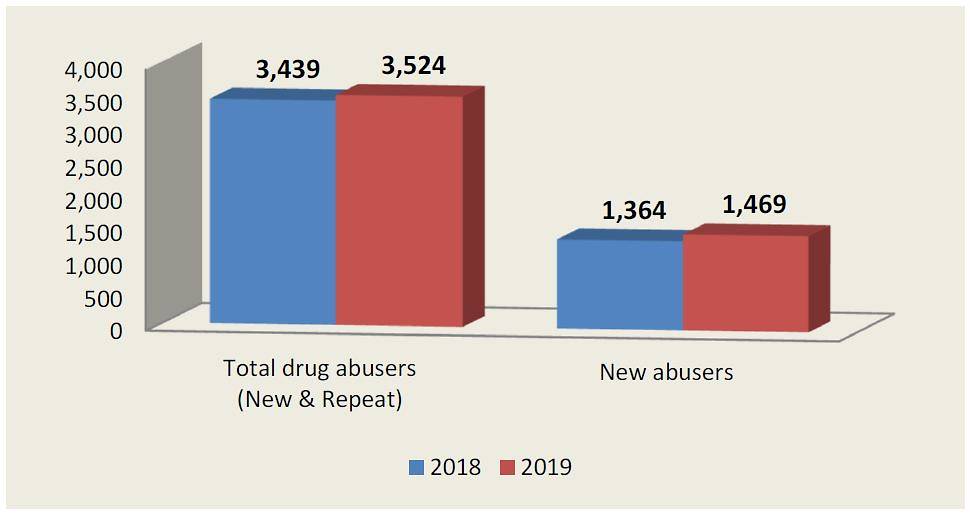
SINGAPORE: The number of new drug abusers arrested in 2019 went up by about 8 per cent compared to the year before, the Central Narcotics Bureau (CNB) said on Thursday (Feb 6). 

A total of 1,469 new drug abusers were arrested last year, up from 1,364 in 2018, said CNB, adding that 61 per cent of the new abusers arrested were under 30 years old.
Drug abusers arrested table 1

Total and new drug abusers. (Table: CNB) 

The total number of drug abusers arrested also increased by 2.5 per cent to 3,524 in 2019 from 3,439 in the previous year. 

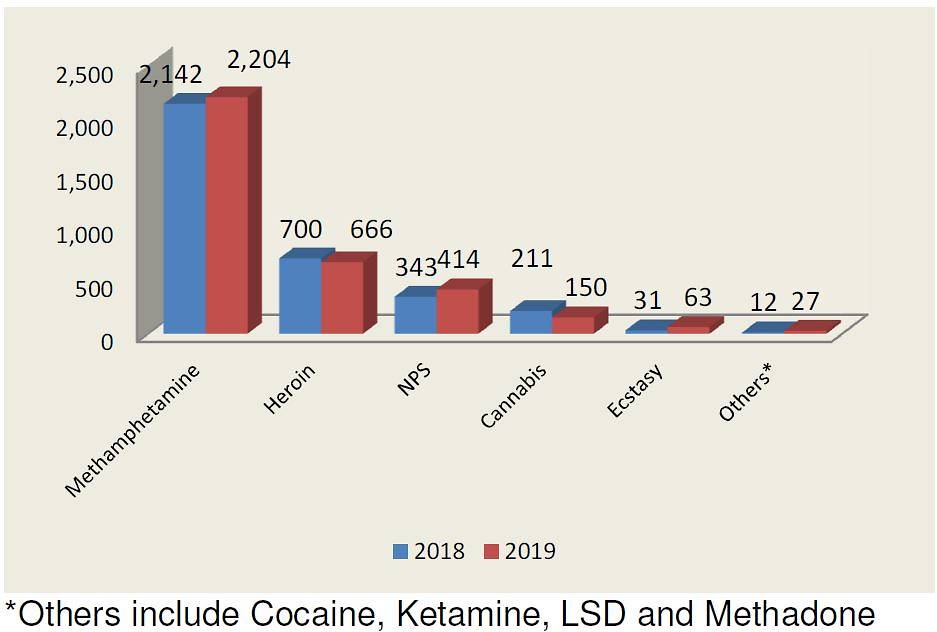
“This was due to the increase in the number of new psychoactive substances (NPS) and methamphetamine abusers arrested,” CNB said in its media release.

However, arrests of repeat drug abusers dropped slightly by 1 per cent to 2,055 in 2019 from 2,075 in the previous year. 

CNB also noted that the number of Chinese drug abusers arrested went up by 9 per cent while the number of abusers in other ethnic groups did not change significantly.

The number of new Chinese abusers arrested jumped 23 per cent to 497 in 2019, from 404 in 2018.

READ: Changes to drugs law based on evidence, not softening of stance: Shanmugam

Methamphetamine, heroin and NPS were the three most commonly abused drugs in 2019, said CNB, with 93 per cent of drug abusers abusing at least one of these three drugs.

Methamphetamine abusers made up the largest proportion of all new abusers.
Drugs abused in 2019

Total abusers by drug type. (Table: CNB) 

Last year, together with the police and immigration authorities, CNB conducted 17 island-wide operations targeting drug traffickers and abusers, as well as 1,434 operations at Singapore’s checkpoints to intercept attempts to smuggle drugs into Singapore. It also carried out major operations which crippled 28 drug syndicates.

CNB said that the street value of all drugs seized in 2019 was approximately S$6.52 million.

There was a 35 per cent drop in seizures of heroine from around 58kg in 2018 to about 38kg in 2019. Cannabis seizures also decreased by 55 per cent to 28kg in 2019 from close to 62kg in the previous year. 

The amount of crystalline methamphetamine, also known as “Ice”, seized increased by 61 per cent to 31kg in 2019 from about 19kg in the previous year.

READ: Rehabilitation regime to be strengthened as part of proposed changes to Misuse of Drugs Act

Touching on regional developments, CNB said that the increase in methamphetamine supply could have “adverse downstream implications on our drug situation”.

“The push for drug liberalisation in some countries is a cause for concern,” said CNB. 

“We must also not underestimate the impact of social media and mass media in spreading misinformation that normalises drug use, especially among our young.”

The 2019 World Drug Report by the United Nations Office on Drugs and Crime World reported that Southeast Asia (SEA) has “emerged as the world’s fastest growing methamphetamine market”. 

The illicit methamphetamine market in SEA and the wider Asia Pacific region is estimated to be worth between US$30.3 billion and US$61.4 billion annually, said the report. 

Source link

'Singapore Noodles' packaging with Native American imagery baffles actual Singaporeans

0

[ad_1]

Should tourists go up to a local hawker and ask for a fresh plate of Singapore noodles, they’ll only receive a steaming hot bowl of confused, blank looks because what the hell even is that dish. 

Granted, the vaguely-defined dish known as Singapore Noodles does exist in many places overseas, especially in Asian restaurants in predominantly Caucasian countries. But adding to the level of perplexity in the already baffling discussion is this post by Facebook user Kevin Bathman. 

On Jan 30, Kevin uploaded a peculiar picture of packets of instant noodles. Let’s try to break it down. 

[ad_2]

Source link

Exhibition marking 200 years of policing in Singapore opens at National Museum

0

SINGAPORE: An exhibition at the National Museum of Singapore which brings visitors through 200 years of policing in Singapore was officially opened to the public on Thursday (Feb 6).

Showcasing a collection of archival photos, videos and artefacts, some of which date back to 1821,  the SPF200 exhibition – Frontier Town to Safest City tells the stories of how officers “exhibited bravery in the face of danger, of bringing criminals to justice, and of duty above self”, said the Singapore Police Force (SPF) in a press release.

READ: A bomb threat that could have ended his life: A former police officer tells his story

The main exhibition at the National Museum will run till May 17.

Mr Shanmugam interacts with exhibition guide Chan Soo Wah

Home Affairs and Law Minister K Shanmugam interacts with exhibition guide Chan Soo Wah at the SPF200 exhibition – Frontier Town to Safest City on Feb 6, 2020. (Photo: Matthew Mohan)

There will also be a roving exhibition at the museum’s concourse area till Mar 5, and this will subsequently be staged at public libraries, community clubs and police community roadshows throughout the rest of the year.

The exhibition, which was officially opened by Minister for Home Affairs K Shanmugam, is part of a year-long series of events to commemorate the 200th year of policing in Singapore.

“This exhibition titled Frontier Town to Safest City, provides an overview of Singapore’s policing journey over two centuries,” said Mr Shanmugam. 

“The exhibition pays tribute to police officers, past and present for their sacrifices. The journey is an inspiring one – it holds many lessons both for SPF and for Singapore as a whole.”

Starting off as a 12 man team, the Singapore Police Force is today a highly regarded, highly respected force of 15,000 people, said Mr Shanmugam.

Given challenges during early colonial times, the police officers fought an uphill battle, he added.

“They often put their lives on the line to keep law and order but over time their abilities grew, their capabilities grew.”

Later on, as a young nation, Singapore also faced issues such as violent crime and drug abuse, Mr Shanmugam said.

“Facing all these challenges, the government  decided to form the police academy in 1969 and expand the recruitment. And in the mid 1970s … there was tough and effective law enforcement … and support from the government for effective police law enforcement and through the courts as well.

“The crime rate was brought to the lowest since independence. That underpinned the peace and security that in turn led to Singapore’s growth in the social and economic sectors.”

Along with the police, community partners also are vital in keeping Singapore safe, said the minister.

“There are many examples of our community partners – individuals, grassroots associations, hotels, businesses, public agencies – they continue to play an essential role in keeping Singapore safe together with the police,” he said. 

K Shanmugam speaks at exhibition marking 200th year of policing in Singapore

Home Affairs and Law Minister K Shanmugam speaks at the SPF200 exhibition – Frontier Town to Safest City on Feb 6, 2020. (Photo: Matthew Mohan)

Guided tours for walk-in visitors at the exhibition are available daily at 10.15am and 1.15pm, while groups of between 10 and 12 visitors can book group guided tours.

Such tours will be conducted in English by retired police officers.

Source link

Here's an online map that pinpoints coronavirus infection cases in Singapore

0

[ad_1]

The latest updates on the ongoing coronavirus outbreak have not been uplifting, as the spread continues. In Singapore, the total number of confirmed local cases currently stands at 28, including a six-month-old baby whose parents are infected as well

The concerning bit is that signs of local transmissions have appeared. Four of the infected patients had no recent travel history to China, though they had “prolonged interaction” with recent travellers from China. The Ministry of Health (MOH) assured the public that there is no evidence of widespread community transmission in Singapore for now.  

[ad_2]

Source link

Jurong Region Line fleet to have 62 trains, testing to start in 2024

0

SINGAPORE: A total of 62 three-car trains will make up the fleet for the upcoming Jurong Region Line (JRL), which is expected to start operations in 2026.

The S$416.5 million contract for the trains was awarded to South Korea’s Hyundai Rotem Company, which is supplying new trains to Singapore for the first time, the Land Transport Authority (LTA) said on Thursday (Feb 6).

The company was previously engaged to carry out mid-life refurbishments of first-generation trains for the North-South and East-West lines in 2006.

JRL, Singapore’s seventh MRT line, will serve areas such as the Jurong Lake District, the Jurong Innovation District and Nanyang Technological University in western Singapore.

READ: Jurong Region Line to serve NTU, Tengah estate, Jurong Industrial Estate

Construction will begin this year.

The trains, to be designed and manufactured by Hyundai Rotem in South Korea, will be fully automated and driverless.

The first train is expected to arrive for testing in 2024, Transport Minister Khaw Boon Wan said at the signing of the contract with the South Korean company on Thursday.

Signing of the contract for Jurong Region Line trains on Feb 5, 2020

LTA chief executive Ngien Hoon Ping (seated, left) and Hyundai Rotem chief operating officer Choi Dong-hyun sign a contract for the Jurong Region Line trains on Feb 6, 2020. (Photo: Facebook/Land Transport Authority)

“As the line travels through an already built-up area, each train will be made up of three smaller train cars, so that they are more manoeuvrable along tighter curves,” LTA said in a press release.

READ: LTA awards S$210 million contract for Jurong West, Bahar Junction MRT stations

READ: Work to construct 5 MRT stations on Jurong Region Line to start in 2020

The trains will have features such as emergency batteries and condition monitoring and diagnostic systems, which will allow operators to track the performance of train systems and detect faults in real time.

It will also have wider doors to allow for easy boarding and alighting, as well as space for wheelchair users and strollers.  

Hyundai Rotem has also committed to set up a base in Singapore to “facilitate knowledge transfer and technical support to the JRL operator”, Mr Khaw said.

“This will also allow Hyundai Rotem to provide the operator with long-term service support for enhanced maintenance of these trains.”

The company also will tap on various existing suppliers of sub-systems of other trains in Singapore, LTA added.

“This allows for greater commonality of spares, and enables more efficient and responsive maintenance support,” it said.

Source link

Can Singapore share? Netizens lambast Stefanie Sun, By2 for 'sweeping up' face masks here to give China

0

[ad_1]

As kids, we learnt that we should share with others in need.

But when supplies are short and people are not able to get enough for themselves, can we, or should we, still share? 

On Feb 2, Singapore girl group By2 said on Weibo that they met up with local songbird Stefanie Sun in Singapore where the trio “swept up” medical supplies to be donated to China. When the news was shared on Facebook, netizens really let it rip, with some feeling we should “help our own people first”.

One netizen said her mother has a kidney disease and requires peritoneal dialysis. Alcohol wipes and face masks are some medical items the patient needs at home for her treatment. However, the family has not been able to stock up on those items because of “people who panic buy and panic stock” as well as those who “bulk buy to do charity”.

Singaporean DJ Jade Rasif also commented that there were “less selfish ways to do publicity stunts”.

[ad_2]

Source link

5 arrested, e-vaporiser items worth S$60,000 seized

0

SINGAPORE: A total of 4,000 electronic vaporiser items with an estimated street value of more than S$60,000 were seized at Woodlands Checkpoint and in a subsequent raid, Singapore authorities said on Thursday (Feb 6).

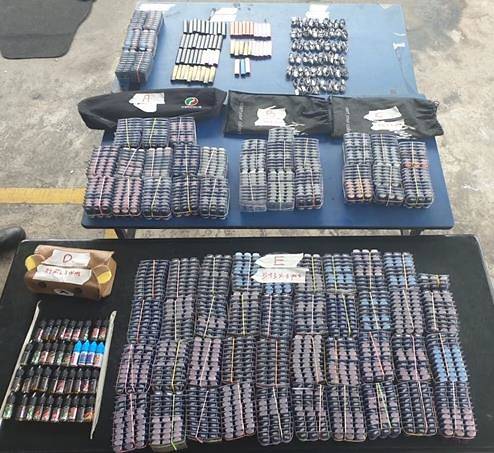
On Jan 23, Immigration and Checkpoints Authority (ICA) officers at Woodlands Checkpoint found more than 2,000 e-vaporisers, cartridges and bottled e-liquids concealed in various compartments of an arriving car.

The Health Sciences Authority (HSA) was notified and it launched an investigation.  

READ: Authorities seize S$66,000 worth of e-vaporisers, accessories

E-vaporiser items found in a vehicle intercepted at Woodlands Checkpoint

E-vaporiser items found in a vehicle intercepted at Woodlands Checkpoint. (Photo: Health Sciences Authority)

HSA officers subsequently arrested five men, aged between 20 and 27 years old, who were awaiting the delivery of the banned items in the eastern part of Singapore. 

More e-vaporiser related items were discovered in their homes.  

READ: 2 Malaysian men caught trying to smuggle e-cigarettes through Woodlands Checkpoint

E-vaporiser items found in a vehicle intercepted at Woodlands

An arriving car at Woodlands Checkpoint was stopped for checks on Jan 23, 2020. (Photo: Health Sciences Authority)

HSA said that it takes a “very serious view of the smuggling and peddling of e-vaporisers which are banned in Singapore”. 

First-time offenders can be fined up to S$10,000 and jailed up to six months. Subsequent offenders face a fine of up to S$20,000 and jail time of up to one year.

The purchase, possession and use of e-vaporisers are also prohibited. This includes purchases made through the Internet and from overseas. Those found guilty face a fine of up to S$2,000.

READ: More than 450 people nabbed for possession after vaporisers were made illegal

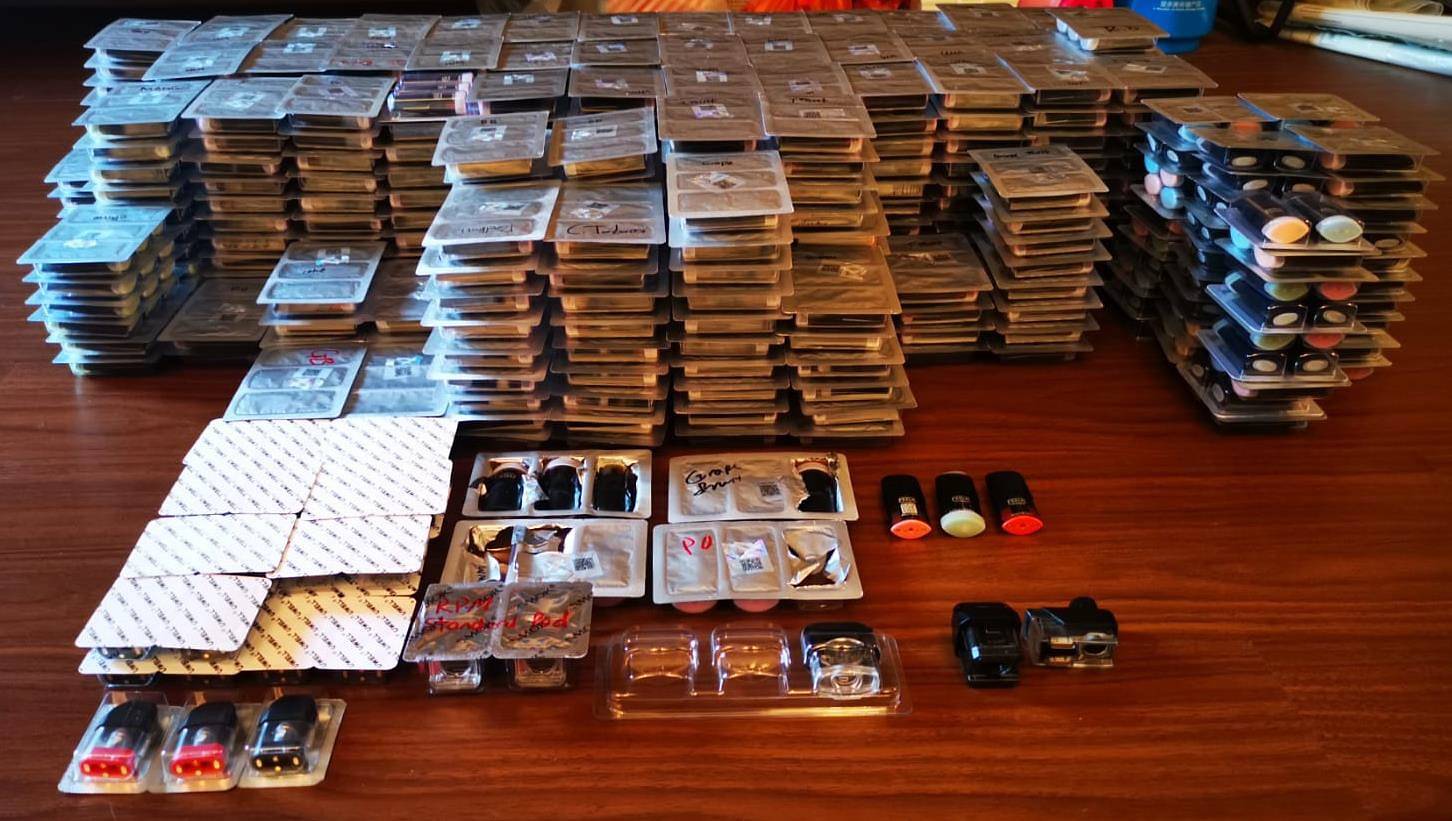
E-liquid cartridges seized from a suspect's residence

E-vaporiser cartridges seized from a suspect’s home. (Photo: Health Sciences Authority)

ICA said that safeguarding Singapore’s borders remains its top priority. “The same methods of concealment used by contraband smugglers may be used by terrorists to smuggle arms and explosives to carry out attacks in Singapore,” it said.

Members of the public who have information on illegal activities involving e-vaporisers can contact the Tobacco Regulation Branch.

Source link

A bomb threat that could have ended his life: A former police officer tells his story

0

SINGAPORE: The young inspector couldn’t believe he was alive. 

A bomb had just gone off right in front of his eyes, and he was a kick away from being blown to smithereens.

“After the bomb went off, I came to my senses that this was for real,” said 74-year-old Chan Soo Wah, a retired police officer and one of the exhibition guides at the SPF200 Exhibition – “Frontier Town to Safest City”.

“I was shivering because I could smell the gunpowder, the flashes of pyrotechnics. I could see the ground tremble … I was actually shivering because I was suffering from shock, I thought I was dead.”

The year was 1969, and what must have seemed like an eternity earlier, Mr Chan had been activated to the scene of a suspected bomb threat – a parcel left somewhere along Bukit Timah Road.

Mr Chan Soo Wah SPF

Mr Chan Soo Wah poses for a photo at the SPF200 exhibition at the National Museum of Singapore. (Photo: Matthew Mohan) 

READ: Exhibition marking 200 years of policing in Singapore opens at National Museum

“Around 6pm, we got a call which said that there was a parcel found on the roadside, placed by a lady who came in a yellow top taxi,” said Mr Chan, who was the duty officer for the E Division that day. 

As part of his duty tour which required him to work a 24-hour shift, Mr Chan had to receive and investigate routine cases as well as attend to reports of possible bomb threats. 

“I was in and out of the police station, for the whole day I was getting these calls – hoax calls, (there was a) bomb here, (a) bomb there – maybe a basin, a pain or bag,” he recalled. “It turned out to be a hoax call every time.

“I went there and saw a brand new shoe box placed in a paper bag. I saw the thing, I was tired, hungry, a bit annoyed and wanted to kick the thing like a football.”

But Mr Chan wasn’t the only one at the scene. A Volunteer Special Constabulary officer had been on hand to secure and guard the suspicious object, and he stepped in.

“He actually held my thigh, blocked me from kicking the thing, because I treated the bomb like a football, as an object … I’d been working around the clock. And I didn’t realise it was real, this was for real – a bomb.”

It was not till the SAF bomb disposal unit had detonated the package, that it finally dawned upon Mr Chan just how close he had come to certain death.

“I wouldn’t be here today if I had kicked that thing,” he said. “I was very thankful to this saviour who saved my life. Unfortunately, I lost touch with him. 

“He must be quite old because I was a young man and he was already middle-aged.” 

FROM BEING ROBBED TO JOINING THE FORCE

Mr Chan joined the Singapore Police Force in 1965. He had decided on that career path after being accosted by gangsters with knives and robbed of his watch.

“I joined the force because I was robbed,” said Mr Chan, who was a Secondary four student at the time, and on the way to the National Library with two other friends.

“So after I went to the police station and made the report, I saw this officer – he would become my boss after that.

“I was very impressed with the inspector who recorded my statement … so I felt I would join the force to be like him.”

Beginning his career as a constable, Mr Chan remembers helping with the Marine Police during the Konfrontasi.

“(Serving during the) Konfrontasi times was one of the most difficult part of my career,” he said “I was given a rifle and asked to join the Marine Police group.

“It was very tough, I’m not attached to the Marine Police but there was a shortage of men so they put me there, (and said) you just carry on. They just give us some bullets, a 303 rifle. (It was) you and your helmsman, two people in a boat …We were told that if we saw Indonesian gunboats, we would have to intercept them,” explained Mr Chan.

“Fortunately, this deployment was only for a short period, we were then sent to guard the coastline – all the way from Changi to Labrador. After 8 hours you come back like a lobster – burnt.”

Later on, Mr Chan went on to become an investigation officer with the Secret Society Branch in the CID.

There, he helped to clamp down on gangs, compiling evidence to put members of secret societies behind bars.

“Those days secret societies were more organised,” he explained.

“Some may have gone through triad ceremony, you can call it the initiation ceremony. The ceremony entails you to drink each others’ blood, just a little bit, with some Chinese wine, and maybe you slaughter the chicken with some blood and then you drink (that as well).”

The Criminal Law (Temporary Provisions) Act (CLTPA), in force since 1955, also helped break the “backbone” of secret societies, said Mr Chan.

The CLTPA allows for the detention of suspected criminals without trial for the sake of “public safety, peace and good order”.

“We broke down the secret societies managed in the 60s, because this law, the legislation was so strong,” he said. Those days, it was about the safety of families because … it was rampant.

“This was in the 60s, this problem continued until the mid-70s to late 70s or so. By then, we had a stronghold on these people.”

Mr Chan retired in 1999 as a Deputy Superintendent of Police, but remains eager to share his experiences with others as one of the guides at the SPF200 main exhibition at the National Museum of Singapore.

The exhibition is part of a year-long series of events to commemorate 200 years of policing in Singapore.

“It certainly is an honour to be here. I’m still alive, I would like to share this story with everybody,” explained Mr Chan, who is now married with two children. 

“I wish to encourage people who love this (form of) service to join the police force. It is a wonderful career. And I have no regret joining it.”

Source link

Microsoft's Xbox Adaptive Controller is now available in Singapore

0

[ad_1]

For most people, getting prepped for a console gaming session is almost as simple as snapping our fingers – sit down, get comfy and pick up a controller, right?

Well, for people with limited mobility, it may not be such a cakewalk.

When you’re standing in their shoes, even such everyday tasks can be quite a chore, and to make matters worse, sometimes they can’t even accommodate the conventional controller design that we’re used to.

As such, these people, who are every bit as passionate about gaming as you or I, have to resort to expensive customised controllers in order to enjoy the latest Call of Duty or Devil May Cry title.

However, these controllers are often more troublesome to make than they’re worth, due to the high degree of personalisation required for such items.

Fortunately, Microsoft has come forth with a solution, and that solution is now available in Singapore via the Microsoft Store.

Introducing the Xbox Adaptive Controller – a labour of love developed in tandem with various charity organisations, such as The AbleGamers Charity, The Cerebral Palsy Foundation, Craig Hospital, SpecialEffect, and Warfighter Engaged.

[ad_2]

Source link

First court challenge against fake news law fails; High Court dismisses SDP's appeal

0

[ad_1]

SINGAPORE – The High Court has dismissed the Singapore Democratic Party’s (SDP) appeal to reverse the correction order against it under the fake news law, in a case that is set to define the way in which such challenges are brought the court.

It ruled that in such a court challenge, the Government has to prove a statement is false, after it has ordered a correction under the Protection from Online Falsehoods and Manipulation Act (Pofma).

The court’s judgment released on Wednesday (Feb 5) said statistics cited by the Ministry of Manpower showed the SDP’s statements about Singaporean professionals, managers, executives and technicians (PMETs) were indeed false.

Contrary to the SDP’s claim, the number of local PMETs retrenched has gone down from 2015 to 2018, and the number of local PMETs employed, in absolute numbers, had been rising steadily in the same period, according to MOM’s figures.

As such, Justice Ang Cheng Hock said, the SDP’s statements “are in fact false in the face of the statistical evidence against them”.

The party thus cannot remove the correction notices it was required to put up alongside the relevant online posts.

[ad_2]

Source link