SINGAPORE – A man continued hitting his girlfriend’s son after checking that there were no injuries on the boy’s face – only to have his actions captured on close-circuit television (CCTV).
The 32-year-old Singaporean had checked the boy’s face because he knew his girlfriend would be angry if she discovered that he had hit her then six-year-old son in their home in August 2018.
Satisfied that there were no visible injuries on the boy, he continued to scold and hit him.
However, his actions were captured on the CCTV camera she had installed in the room.
The man pleaded guilty on Thursday (Feb 6) to one count of ill-treating a child, and was sentenced to two years’ jail.
Both the man and the boy cannot be identified due to a gag order.
Court documents stated that the man and the boy’s 28-year-old mother were in a romantic relationship and living together at the time of the incident.
At that time, she was going through divorce proceedings, and her children from the marriage – the boy and his then eight-year-old brother – were under her care.
She had also entrusted the care of the boys to her boyfriend.
SINGAPORE – With the novel coronavirus keeping people off the streets, love is not exactly in the air ahead of Valentine’s Day next week.
But staying in on this special day does not have to be a drab occasion. There are still ways to celebrate without leaving your home. And with online shopping, you can have practically any gift imaginable shipped right to your doorstep.
Here are some novel (pun intended) ideas to make V-Day 2020 a memorable one – for all the right reasons.
FRILLS-FREE PRIVATE DINING
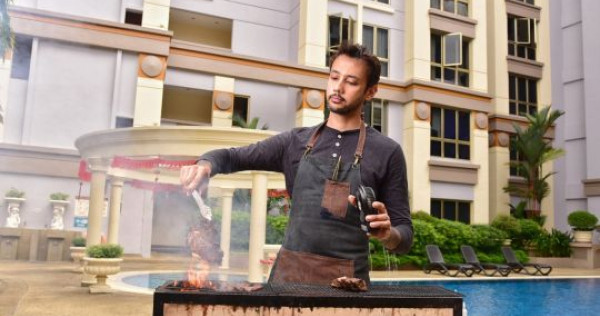
Meat lovers, fancy a roaring barbecue in the background of your romantic meal for two, in your own home? Chef Sam Chablani can deliver the magic right to your doorstep.
The 35-year-old chef, formerly of Asian barbecue restaurant Fat Lulu’s, stumbled into the world of private dining by accident. After closing his restaurant in 2018, he got requests from people who missed his food to cook for them and their friends.
Working for professional caterers on the side, he started doing one party a month from August 2019, before word-of-mouth helped business pick up.
SINGAPORE – Retail stores visited by a group of Chinese tourists linked to the nation’s first local cluster of coronavirus infection appear to have been hit by the outbreak.
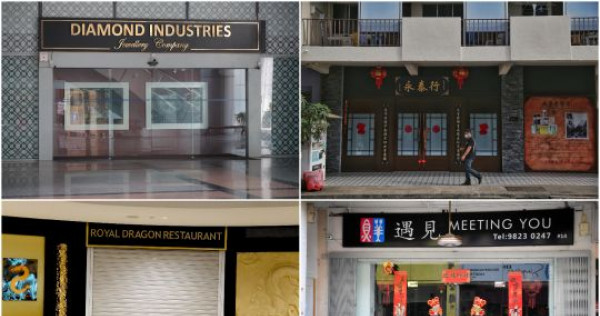
Four of the six places visited by the tour group during their stay from Jan 22 to 23 were shuttered when The Straits Times visited them on Thursday (Feb 6), while the other two were deserted.
The Ministry of Health (MOH) announced on Wednesday that the tour group – linked to seven cases so far – had visited these places during their stay from Jan 22 to 23.
One of them was the Diamond Industries Jewellery Company, a jewellery store located in the PSA Vista office building in Harbour Drive.
ST observed masked security personnel conducting temperature checks on all visitors outside the building entrance. When asked about the closure of the jewellery store in the building, a security staff member declined to comment.
The store was closed after one of its employees, a 40-year-old local patient, was confirmed with the virus on Tuesday.
His wife, a 32-year-old Singapore citizen, was the group’s tour guide, and had tested positive for the virus on the same day.
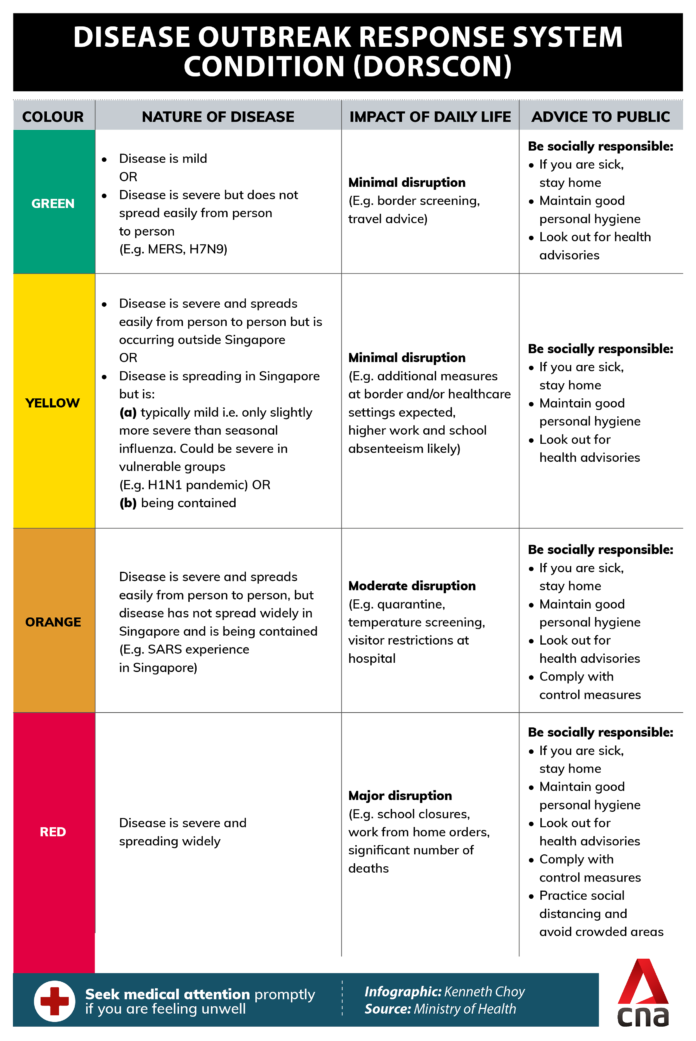
SINGAPORE: The way Singapore deals with outbreaks like the novel coronavirus is guided by a framework known as DORSCON (Disease Outbreak Response System Condition), according to the Ministry of Health (MOH).
The colour coded system – which has green, yellow, orange and red categories – shows the current situation. It also indicates what needs to be done to prevent and reduce the impact of infections.
There were 30 confirmed cases in Singapore involving mostly Chinese nationals as of Thursday (Feb 6). MOH has pegged the novel coronavirus outbreak to DORSCON level Yellow.
DORSCON takes into account the current disease situation overseas, how transmissible the disease is, how likely it is to arrive in Singapore and what impact it may have on the local community, MOH said.
Here is what you need to know about the DORSCON framework:
HISTORY OF DORSCON
While the crisis management plan did not exist in 2003, it was drafted after SARS and refined again in the wake of the swine flu (or H1N1) pandemic in 2009.
According to a book published by MOH Holdings, global concern that avian flu could mutate to transmit easily between people led MOH to publish its first version of the influenza preparedness and response plan in 2006, which was built around a colour-coded DORSCON.
The MOH said in 2013 that the H1N1 influenza pandemic four years before highlighted some limitations in the old DORSCON framework. While the disease had widespread transmission in the community, there were few hospitalisations and deaths.
Hence, flexibility was applied to allow relevant control measures to cater to the milder disease.
In the response plan, which was last revised in 2014, MOH said the DORSCON is a generic framework that enables the Whole-Of-Government to respond immediately to any outbreak and serves as the nucleus to ramp up for a higher level of response during a pandemic.
LEVELS ARE RECOMMENDED BY MOH, ENDORSED BY MHA
The response plan also says that the activation of the DORSCON levels are based on MOH’s recommendations and endorsed by the Ministry of Home Affairs.
The recommendations are endorsed by the Homefront Crisis Ministerial Committee (HCMC), which provides strategic and political guidance during a crisis, and the Homefront Crisis Executive Group (HCEG), which ensures that a comprehensive and integrated multi-agency system is in place to anticipate threat and disaster scenarios.
The HCMC is chaired by the Minister for Home Affairs and the HCEG is headed by the Permanent Secretary for Home Affairs.
The HCEG is supported by various Crisis Management Groups that deal with the operational issues under their charge. MOH chairs the Crisis Management Group for Health.
WHY IS THE DORSCON LEVEL AT YELLOW?
During a press conference announcing the first local transmissions of the coronavirus on Tuesday (Feb 4), Health Minister Gan Kim Yong described them as “limited”. This is because MOH has so far been able to identify all the contacts that are involved in the cluster of infections and the source of the infection.
Things will be different if there are cases “popping up” in different parts of Singapore, he said.
“You have a few clusters where you have no idea where these cases come from, they do not have a specific source, then you have widespread transmission.”
“When that happens then we will then move to DORSCON Orange,” he said.
“So today we’re still at DORSCON Yellow, but we’re watching the situation very carefully, monitoring the developments and we may adjust as we go along,” he said.
At its most severe, the H1N1 pandemic in 2009-2010 was at Orange status. According to the National Library Board’s Infopedia, an estimated 415,000 people were infected with the H1N1 influenza in Singapore, and there were at least 18 fatalities.
WHAT THE DORSCON LEVEL MEANS FOR YOU
MOH said the DORSCON framework contains a communications component to convey the health impact to the public and to advise people on how to respond. The definitions of the four DORSCON levels have been crafted to correspond to the public health impact of the disease.
At the yellow level, the disease is expected to cause minimal disruption to the public.This stage could be marked by additional measures in efforts to contain the disease. The advice from MOH for the current yellow level is to stay at home when sick, maintain good personal hygiene and look out for health advisories.
The Government has also put in place social distancing measures, such as suspending large gatherings in schools and eldercare facilities. According to MOH’s response plan, while such distancing measures may be activated at the most severe level, under certain circumstances, selective social distancing measures may be required in the mitigation of a milder pandemic.
WHAT HAPPENS IF THINGS GET MORE SEVERE
If DORSCON existed during the 2002-2003 Severe Acute Respiratory Syndrome (SARS), it would have been colour-coded Orange, according to MOH.
At this stage, the disease would be deemed severe and spreads easily from person to person, but has not spread widely and is being contained. At this stage, moderate disruption is expected, due to measures like quarantine and visitor restrictions at hospitals.
At the red level, the disease is severe and is spreading widely. Major disruption is expected, such as school closures, and this stage denotes a “significant” number of deaths. Despite school closures during the SARS period, it was classified as DORSCON Orange in retrospect.
SINGAPORE: No, you cannot steam your face masks in order to reuse them in the battle against the novel coronavirus.
But this is exactly what a purported doctor advised in a video that has been viewed hundreds of thousands of times in multiple Chinese-language posts on Facebook, Weibo and Youku in January.
While Facebook’s third-party fact-checker has since debunked it as false, this could just be the tip of the iceberg when it comes to fake news on the coronavirus.
There has been a “steady wave” of misinformation on the virus in the region, fact-checker Agence France-Presse (AFP) revealed, although it told CNA the situation in Singapore is less severe.
What’s happening in Singapore is “certainly nothing compared to what we’ve seen” in some countries in the region, Hong Kong-based AFP fact-check editor Rachel Blundy said.
The fact-checker covers 10 countries and territories in Asia, including Singapore, Malaysia, Hong Kong and Thailand.
“Generally there has been a steady wave of misinformation about the coronavirus coming from Sri Lanka, the Philippines, Australia, Pakistan, Malaysia and more recently India and Thailand,” Ms Blundy said.
“We’ve generally seen a lot less misinformation in Singapore, but this is consistent with normal misinformation trends.”
FILE PHOTO: Attendees walk past a Facebook logo during Facebook Inc’s F8 developers conference in San Jose, California, U.S., April 30, 2019. REUTERS/Stephen Lam
This is not to say Singapore has been free from the scourge of coronavirus fake news.
In January, authorities invoked the Protection from Online Falsehoods and Manipulation Act (POFMA) to issue correction directions to several parties including Facebook regarding false claims related to the coronavirus.
Several ministers have stressed the importance of using POFMA to deal swiftly with falsehoods as Singapore tries to contain the virus, with Prime Minister Lee Hsien Loong acknowledging that he was “glad” to have the legislation.
On Jan 31, Mr Lee said the Government is aware that some individuals are deliberately coming up with fake news to foment fear, uncertainty and doubt on social media.
ONE FACEBOOK FACT-CHECKER WORKING ON SINGAPORE
Facebook says it has been working on tackling the issue.
“Several of our third-party fact-checking partners around the world have rated content false so we are dramatically reducing its distribution and people who see this content or try to share it,” a Facebook spokesperson told CNA.
“This situation is fast-evolving and we will continue our outreach to global and regional health organisations to provide support and assistance.”
Last May, the tech giant announced it was partnering AFP to combat fake news in Singapore and other countries on its platform, which uses artificial intelligence (AI) to identify potentially false posts.
The AI uses signals like user feedback and comments to determine posts that should be reviewed by the third-party fact-checker. Facebook has also allowed fact-checkers to proactively review posts.
Ms Blundy said fact-checkers tend to make a judgement within an hour of seeing a post on whether it should be fact-checked, adding that AFP has one fact-check reporter working on Singapore content remotely from Kuala Lumpur.
“Reporters pitch ideas for fact-checks to editors, who approve,” she said, clarifying that these fact-checkers don’t have to undergo special training before covering the coronavirus outbreak. “We use digital verification tools and normal journalistic methods to debunk posts.”
If the fact-checker rates the content as false, Facebook will push it lower down the news feed, meaning users are 80 per cent less likely to see it. The platform will also attach a warning label to false content, and send a notification to those who try to share it.
WHATSAPP A TARGET TOO
Facebook’s popular messaging app WhatsApp has not been spared from fake news either.
FILE PHOTO: Silhouettes of mobile users are seen next to a screen projection of Whatsapp logo in this picture illustration taken Mar 28, 2018. (REUTERS/Dado Ruvic/Illustration)
A group of Nanyang Technological University (NTU) undergraduates trying to fight fake news on Singaporeans’ most-used messaging app said misinformation on the virus has been circulating “widely” on the platform.
“Since WhatsApp is a closed platform – messages being exchanged can only be seen by those involved in the exchange – it is harder for researchers and policy people to track what fake news are being spread around in these exchanges,” NTU Associate Professor Edson Tandoc said.
The NTU group, Sure Anot, has launched a campaign encouraging older adults aged 50 to 64 not to forward news messages they get on the virus until they have verified the authenticity with the sender and family members.
“We realised that older adults may feel overwhelmed when asked to perform technologically-advanced fact-checking steps, such as reverse image search,” the group’s leader Lee Yun Ting said.
On the back end, WhatsApp has moved to limit forwarding messages to five chats at once, reducing the amount of forwarded messages by a quarter.
WhatsApp can also automatically detect accounts that engage in bulk or automated messaging, and has removed more than two million accounts a month for such behavior.
In addition, the Singapore Government is using a WhatsApp business account to send health information to people who have opted to receive updates on the developing coronavirus situation. More than 300,000 people have signed up for the service.
Despite the measures, authorities are keen to crack down further on fake news.
CAN MORE BE DONE?
On Jan 30, the Ministry of Communications and Information (MCI) removed temporary provisions that exempted social media companies and search engines from being issued general correction directions under POFMA.
Platforms like Facebook, Twitter and Google, when issued with such directions, are now required to disseminate a correction notice in Singapore using their service to all their end‑users or users specified by the direction.
MCI had called the move “critical” given the evolving coronavirus situation. Facebook, Twitter and Google have not responded to requests for comment on the move. It is not clear how they might broadcast such a platform-wide notice.
TWITTER AND GOOGLE JOIN IN THE FIGHT
Nevertheless, Twitter has launched a dedicated search prompt to ensure that users who search for the coronavirus are given “credible and authoritative” information first, through partnerships with global health organisations and local authorities.
FILE PHOTO: The Twitter App loads on an iPhone in this illustration photograph taken in Los Angeles, California, U.S., July 22, 2019. REUTERS/Mike Blake
It has also collaborated with organisations to “amplify authoritative, official content across the globe”.
“At present, we’re not seeing significant coordinated attempts to spread disinformation at scale about this issue,” a spokesperson said.
“However, we will remain vigilant and have invested significantly in our proactive abilities to ensure trends, search and other common areas of the service are protected from malicious behaviours.”
FILE PHOTO: The logo of Google is seen at the high profile startups and high tech leaders gathering, Viva Tech,in Paris, France May 16, 2019. REUTERS/Charles Platiau/File Photo
Likewise, Google said its systems automatically place “even more importance” on authoritative content when users search particularly sensitive topics like health content.
“When we highlight information on medical topics, we show information that reflects broad scientific consensus,” it said.
The company had recently introduced an alert providing users who search for the coronavirus direct access to news, safety tips and information from the World Health Organization. The alert will appear at the top of the results page.
FILE PHOTO: Silhouettes of mobile device users are seen next to a screen projection of Youtube logo in this picture illustration taken March 28, 2018. REUTERS/Dado Ruvic/Illustration
For news and information queries, Google’s YouTube also said its systems “prominently surface” authoritative sources at the top of search results and in the “watch next” panels.
“We aim to surface videos from experts or media outlets, like public health institutions or news organisations, in search results,” it added. “Millions of search queries are getting this treatment today, including coronavirus-related queries.”
VERIFIED INFORMATION
Regardless, authorities feel citizens also have a part to play in quashing fake news.
In a ministerial statement on the coronavirus outbreak, National Development Minister Lawrence Wong urged Singaporeans to turn to official or credible sources for accurate and up-to-date information on the virus.
“We ask Singaporeans to be discerning, and share only verified information,” he told Parliament on Feb 3. “We also have a responsibility, in this time of heightened alert, not to spread unverified information or false news which can cause needless panic and fear.”
Mr Wong said the Government has used POFMA to correct such falsehoods and clarify the facts quickly. “We will continue to do so to avoid unnecessary panic and anxiety,” he added.
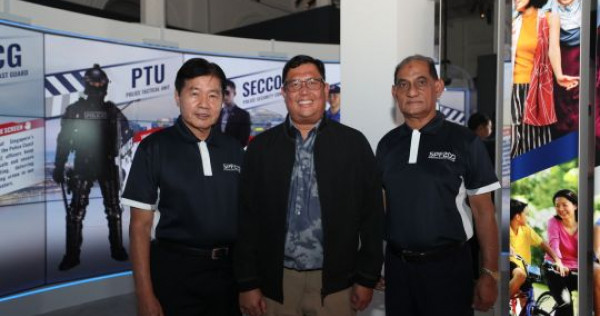
SINGAPORE – As the police celebrate their 200th anniversary with an exhibition at the National Museum of Singapore, The Straits Times speaks to past and present police officers who have been part of the police force’s transformation.
Superintendent Abdul Halim Osman, 55
Supt Abdul Halim Osman tells of the audacity of the One-Eyed Dragon killer. ST PHOTO: TIMOTHY DAVID
It was a daring, cold-blooded execution-style murder rarely seen in Singapore.
Nightclub owner Lim Hock Soon had been shot in his home on Feb 15, 2006, right in front of his distraught family.
When Superintendent Abdul Halim Osman’s team of Criminal Investigation Division officers got to the scene, the body was still on the floor with five bullet holes.
The scene was chaotic, with Mr Lim’s distressed wife, daughter and maid in the same flat.
SINGAPORE: Singapore confirmed two new cases of the novel coronavirus on Thursday (Feb 6), bringing the total number of people infected in the country to 30, the Ministry of Health (MOH) said.
One of the cases is a 41-year-old Singaporean with no recent travel history to China and does not appear to be linked with previous confirmed cases, MOH added. He was admitted to Mount Elizabeth Novena Hospital on Monday and was confirmed to have the virus at 11pm on Wednesday.
According to MOH, the man said he had developed a fever on Jan 28 and visited a GP clinic the next day. On Jan 30, he sought treatment at another GP clinic before being admitted to Mount Elizabeth Novena Hospital on Monday.
Epidemiological investigations and contact tracing are ongoing to identify individuals who had close contact with this patient, said MOH, and to establish any contact he may have had with confirmed cases in Singapore or travellers from mainland China.
Another confirmed case is a 27-year-old Singaporean who also had no recent travel history to China.
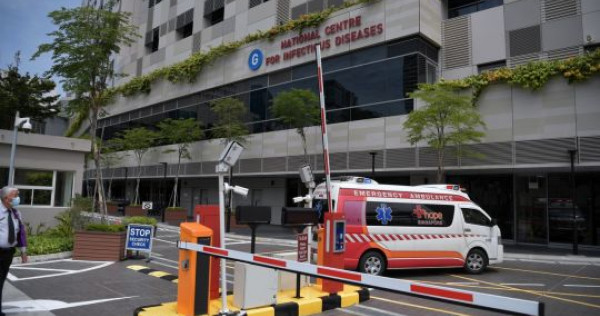
According to MOH, he is one of the four Singapore residents who are being investigated at the National Centre for Infectious Diseases (NCID) after attending a private business meeting at Grand Hyatt Singapore from Jan 20 to 22.
The meeting included participants from China, including Hubei province, as well as the confirmed cases from Malaysia and South Korea. Subsequent test results confirmed infection with the novel coronavirus on Feb 6 at about 2pm.
Contact tracing for the confirmed cases is ongoing, MOH said, adding that, once identified, they will also be quarantined for 14 days from their last exposure to the patient.
CONDITION OF TWO EARLIER PATIENTS WORSEN
Of the earlier confirmed cases, MOH said that two patients’ conditions have worsened, with one in critical condition in the intensive care unit. Another requires additional oxygen support.
As of noon on Thursday, 310 suspect cases have tested negative, with the test results of the remaining 147 cases pending, MOH added.
Singapore confirmed its first case of the novel coronavirus on Jan 23, a 66-year-old Wuhan resident who arrived in Singapore from Guangzhou on Jan 20.
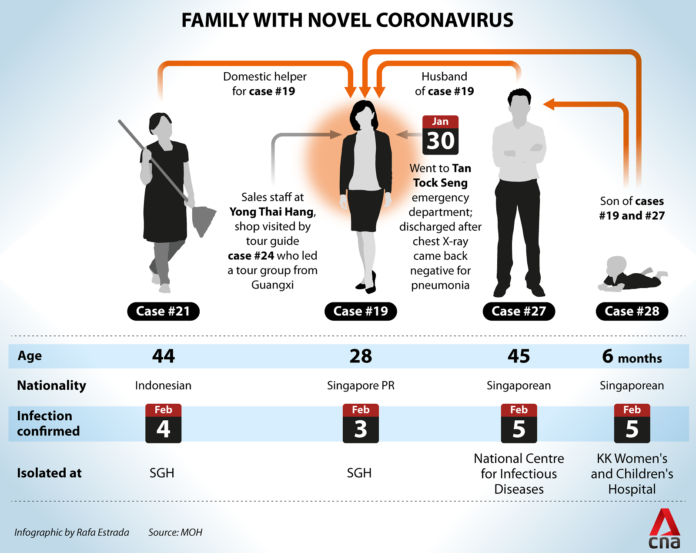
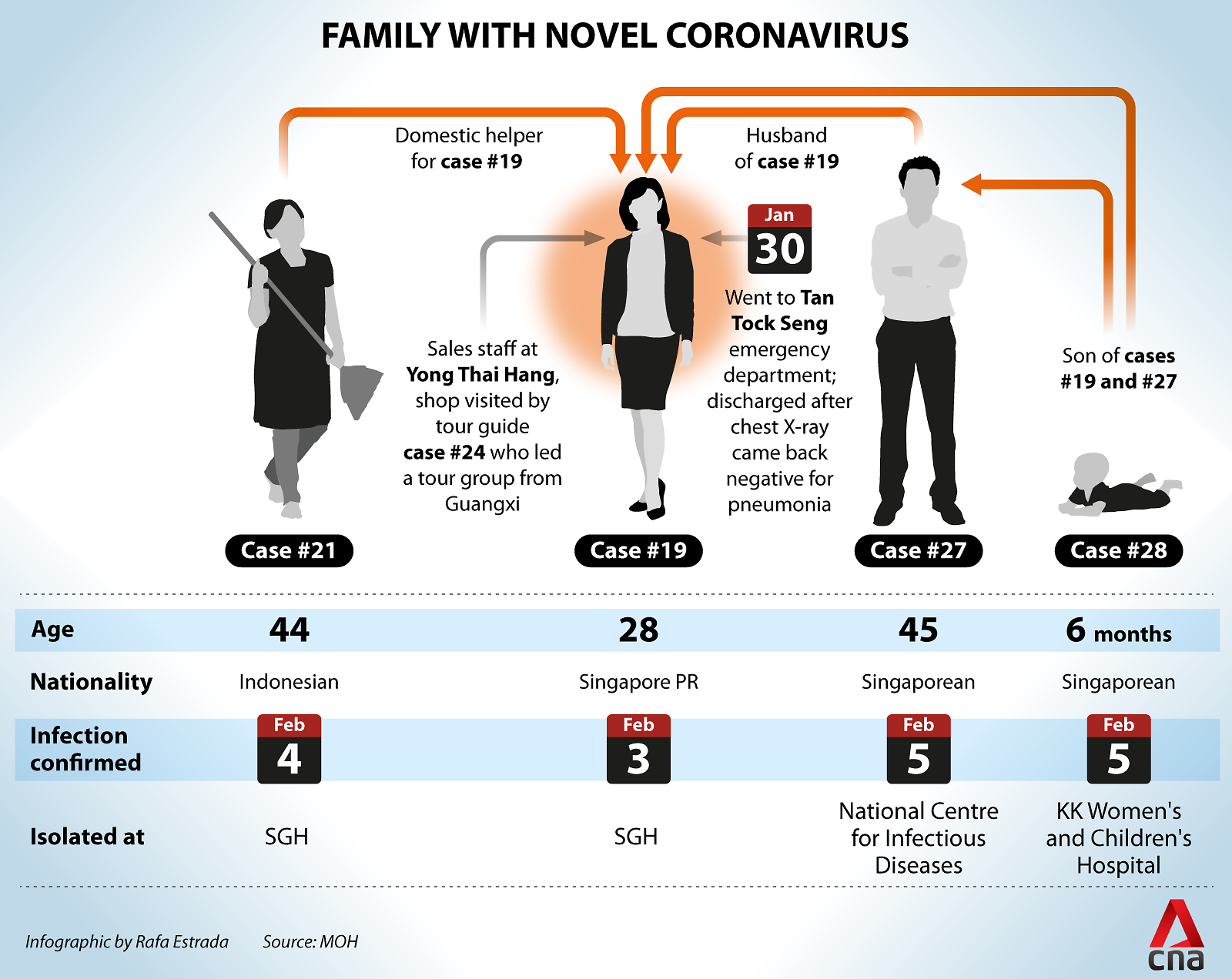
It includes a 6-month-old boy, who is the child of a couple who also came down with the virus. The family’s domestic helper also caught the disease.
Last Friday, it was announced that all new visitors with recent travel history to mainland China will not be allowed to enter Singapore. These visitors will also not be allowed to transit in Singapore.
Those with Chinese passports, with the exception of Singapore permanent residents and long-term pass holders, will also not be allowed to enter Singapore.
The novel coronavirus is believed to have started in Wuhan in China’s Hubei province but has since spread to more than 20 countries around the world.
It has killed nearly 500 people and infected more than 24,000 globally. The World Health Organization has declared the virus outbreak a global emergency.
Most deaths have been in Hubei province and officials have noted that the death rate, at about 2 per cent, is below the mortality rate of the Severe Acute Respiratory Syndrome (SARS).
SINGAPORE – Two more cases of the coronavirus infection were confirmed by the Ministry of Health (MOH) on Thursday (Feb 6).
This brings the total number of confirmed cases in Singapore to 30, of which 11 are Singaporeans.
One of the new cases is a close contact of a previously confirmed case. The second case announced on Thursday has no recent travel history to mainland China and does not appear to be linked with previous cases.
The second case was confirmed late on Wednesday night and contact tracing is still in progress, with a focus on identifying any links it may have with past cases or travellers from China.
So far, all previously announced confirmed cases have been either Chinese nationals from Hubei, or individuals with links to travellers who are Chinese nationals.
All of these cases have been isolated and ring-fenced, said MOH.
“But we must be prepared for the possibility of new infection clusters involving locals within the community, not linked with recent travel to China or contact with recent PRC travellers,” said the ministry.
SINGAPORE – All employers will have to notify the Ministry of Manpower (MOM) of employees who are due to return from China, said National Development Minister Lawrence Wong on Thursday (Feb 6).
This is to allow their return to be staggered and the flow of workers managed better, said Mr Wong, who co-chairs the government’s coronavirus taskforce.
There will also be tighter surveillance and enforcement of the 14-day leave of absence (LOA), which is mandatory for all such workers, whether they are Singapore residents and foreign work pass holders.
Employers will also receive $100 a day for each worker serving the LOA, and this is applicable to Singaporeans, permanent residents and work pass holders. This is equivalent to what they are receiving for those on quarantine orders. The foreign worker levy for those on LOA will also be waived for the LOA period. Details on when these measures will kick in are still being worked out.
YOGYAKARTA: The bilateral relationship between Singapore and Indonesia shows a very strong commitment from both leaders in wanting peace, growth and prosperity, said President Halimah Yacob on Thursday (Feb 6).
Both countries are doing very well because there are many platforms with which leaders can engage with each other, she told reporters in Yogyakarta at the end of her four-day state visit to Indonesia.
“We need to have very strong leadership commitment on both sides. To see the need for growth and prosperity within the two countries. The other one I think which is important is to put in place, processes and systems to follow through the ideas, the agreements reached,” said Madam Halimah.
She met with the governor Sri Sultan Hamengkubuwono X at the Keraton, a palace complex for the reigning sultan and was treated to an exhibition of Lawung dance, an ancient Javanese dance choreographed by the Sri Sultan Hamengkubuwono I in 1755.
The current sultan also expressed hope to see a more investment between Singapore and Yogyakarta, as he sees benefits in collaboration.
“Yogyakarta is an example of what I mean when I say that we want to develop relations, not just with Jakarta but with the other provinces as well,” said Madam Halimah.
“There’s a lot of mutual benefit for our businesses. It represents an enlargement of the market. So, their markets get bigger. It also at the same time benefits the province because you bring the services that they need, consumer, business services.”
Madam Halimah also had an audience with 54 students from the Gadjah Mada University in a closed dialogue session themed Singapore and Indonesia: Strengthening Bridges and Progressing Together.
In her opening remarks, she said it is the next generation of Indonesians and Singaporeans who will determine the future course of the relationship between the two countries.
“Our two countries have a wide range of student exchanges and internship programmes between our universities. These programmes provide valuable opportunities for our youths to interact and deepen mutual understanding,” said Madam Halimah.
President Halimah Yacob was in Indonesia for a four-day state visit, where she engaged in a closed dialogue session (Photo: Saifulbahri Ismail)
During meetings with various leaders in Indonesia, Madam Halimah also discussed the novel coronavirus outbreak in China that has put many countries on edge.
She noted that Singapore and Indonesia have bilateral agreements on health and can work together by sharing information that is critical.
The 44-year-old woman did not have any recent travel history to mainland China, and it is believed the virus was transmitted by her employer who is being treated at the Singapore General Hospital.
“I want to say that … we are giving her the best possible medical care. So, they don’t have to worry; she is being taken care of in Singapore,” said Madam Halimah.
Madam Halimah urged Singaporeans to seek information on the virus from official sources, so as to prevent misinformation from being spread.
She also shared that help is on the way for vulnerable groups.
“I’ve asked my President’s Challenge team to look at how to galvanise some of the resources under the President’s Challenge in order for us to help support some targeted groups,” said Madam Halimah.
“For instance, the elderly, the vulnerable … (so they can get what they need) … such as hand sanitisers or masks.”