SINGAPORE: Singapore confirmed two new cases of the novel coronavirus on Thursday (Feb 6), bringing the total number of people infected in the country to 30, the Ministry of Health (MOH) said.
One of the cases is a 41-year-old Singaporean with no recent travel history to China and does not appear to be linked with previous confirmed cases, MOH added. He was admitted to Mount Elizabeth Novena Hospital on Monday and was confirmed to have the virus at 11pm on Wednesday.
According to MOH, the man said he had developed a fever on Jan 28 and visited a GP clinic the next day. On Jan 30, he sought treatment at another GP clinic before being admitted to Mount Elizabeth Novena Hospital on Monday.
Epidemiological investigations and contact tracing are ongoing to identify individuals who had close contact with this patient, said MOH, and to establish any contact he may have had with confirmed cases in Singapore or travellers from mainland China.
READ: Condition worsens for 2 coronavirus patients in Singapore, says MOH
CASE 30 ATTENDED GRAND HYATT MEETING
Another confirmed case is a 27-year-old Singaporean who also had no recent travel history to China.
According to MOH, he is one of the four Singapore residents who are being investigated at the National Centre for Infectious Diseases (NCID) after attending a private business meeting at Grand Hyatt Singapore from Jan 20 to 22.
The meeting included participants from China, including Hubei province, as well as the confirmed cases from Malaysia and South Korea. Subsequent test results confirmed infection with the novel coronavirus on Feb 6 at about 2pm.
Contact tracing for the confirmed cases is ongoing, MOH said, adding that, once identified, they will also be quarantined for 14 days from their last exposure to the patient.
CONDITION OF TWO EARLIER PATIENTS WORSEN
Of the earlier confirmed cases, MOH said that two patients’ conditions have worsened, with one in critical condition in the intensive care unit. Another requires additional oxygen support.
As of noon on Thursday, 310 suspect cases have tested negative, with the test results of the remaining 147 cases pending, MOH added.
Singapore confirmed its first case of the novel coronavirus on Jan 23, a 66-year-old Wuhan resident who arrived in Singapore from Guangzhou on Jan 20.
To date, one of the 30 confirmed cases has been discharged.
READ: 12 people from 5 families among confirmed coronavirus cases in Singapore
READ: What we know about the 4 new coronavirus cases in Singapore, including 6-month-old baby
The country announced its first cluster of local transmission of the virus earlier this week.
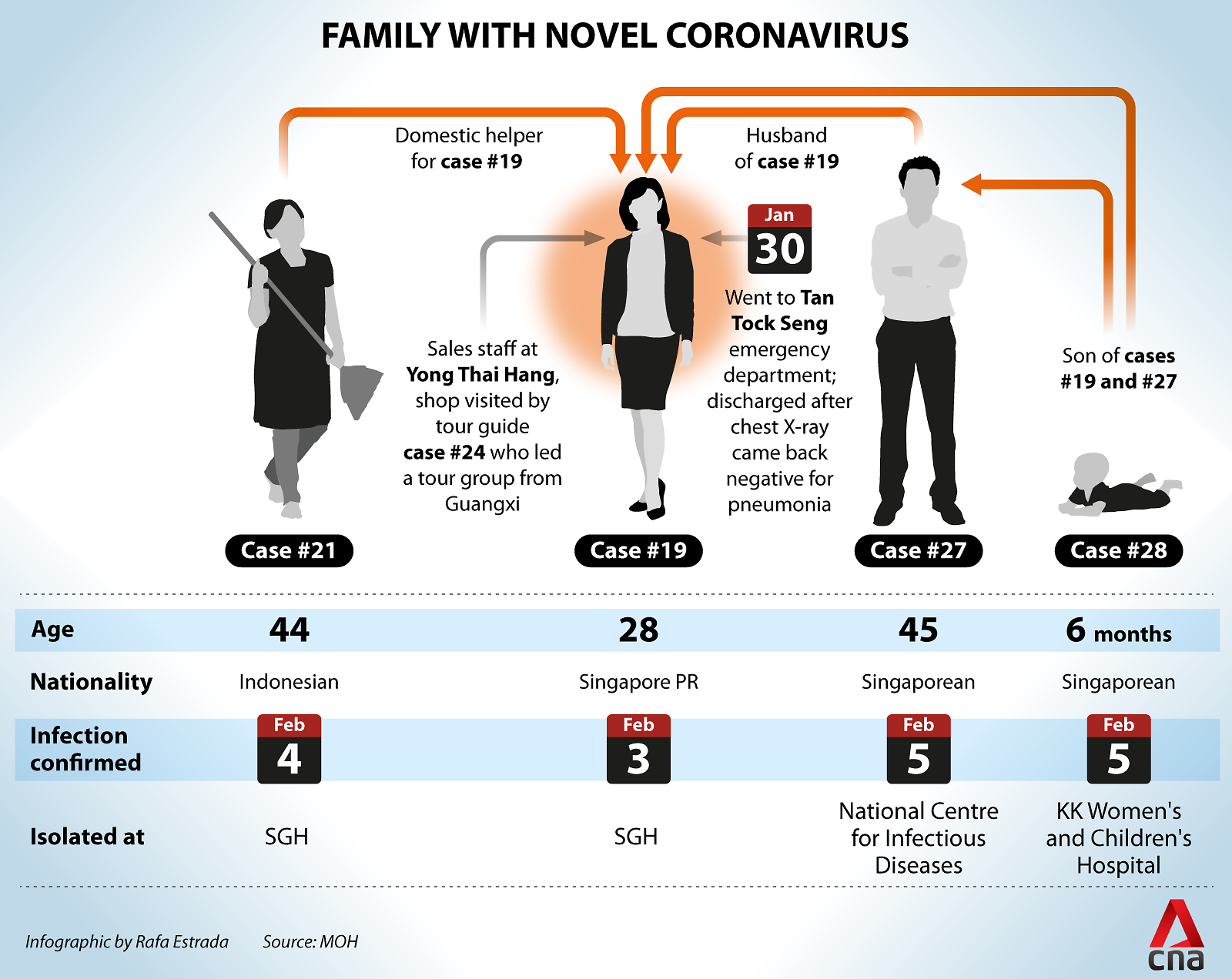
It includes a 6-month-old boy, who is the child of a couple who also came down with the virus. The family’s domestic helper also caught the disease.
Last Friday, it was announced that all new visitors with recent travel history to mainland China will not be allowed to enter Singapore. These visitors will also not be allowed to transit in Singapore.
Those with Chinese passports, with the exception of Singapore permanent residents and long-term pass holders, will also not be allowed to enter Singapore.
The novel coronavirus is believed to have started in Wuhan in China’s Hubei province but has since spread to more than 20 countries around the world.
It has killed nearly 500 people and infected more than 24,000 globally. The World Health Organization has declared the virus outbreak a global emergency.
READ: More Chinese cities shut down as novel coronavirus death toll rises
Most deaths have been in Hubei province and officials have noted that the death rate, at about 2 per cent, is below the mortality rate of the Severe Acute Respiratory Syndrome (SARS).
BOOKMARK THIS: Our comprehensive coverage of the Wuhan coronavirus and its developments
Download our app or subscribe to our Telegram channel for the latest updates on the Wuhan virus outbreak: https://cna.asia/telegram