Home Blog Page 484

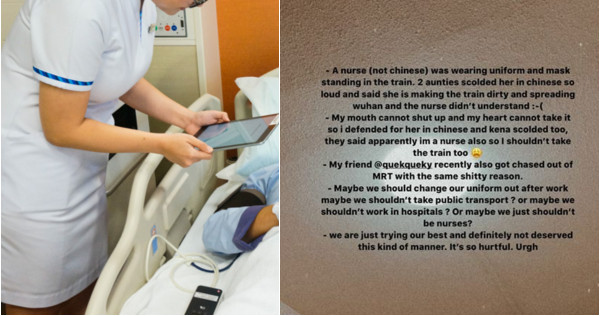
'You nurses always walk around with virus on you': Nurses shunned, ostracised for wearing uniform

0

[ad_1]

While there have been several displays of support for the unsung heroes working at the frontlines to combat the spread of the coronavirus, it would seem that the sentiment isn’t exactly shared by everyone.

Despite the long erratic shifts, frozen leaves and the mental toll that comes with working on the frontlines, several accounts of the discrimination faced by healthcare workers reveal just how much of a thankless job it is.

Hanna Wong, a healthcare professional in Singapore had her private-hire vehicle cancelled in the wee hours of the morning today (Feb 11), solely because she was headed towards the hospital.

The incident left a sour taste in her mouth. “Ostracised like lepers,” she lamented in a Facebook post. “This is the way you people bite the hands that tend to you.”

[ad_2]

Source link

Sembcorp to build Singapore's largest floating solar farm covering 45 football fields

0

[ad_1]

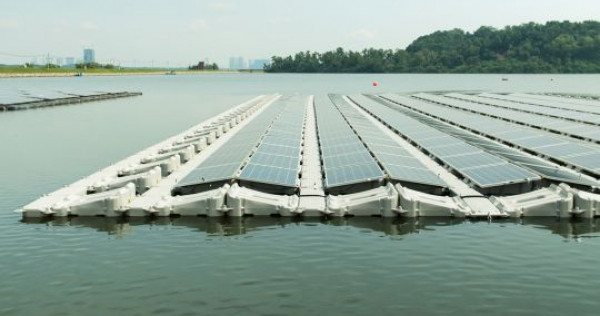
SINGAPORE – One of the world’s largest floating systems to convert solar energy into electricity – covering about 45 football fields – will be constructed here by Sembcorp Solar Singapore.

In a move announced by national water agency PUB on Monday (Feb 10), Sembcorp was appointed to construct the solar farm at Tengeh Reservoir in Tuas which, when completed in 2021, could generate enough energy to power about 16,000 four-room Housing Board flats.

It is also expected to reduce carbon emissions here by around 32 kilotonnes per year, the equivalent of removing 7,000 cars off Singapore’s roads.

PUB said Sembcorp’s proposal, which beat those by three other local and overseas companies, uses “highly efficient” panels and has a layout that maximises energy generation. It will have a capacity of 60 megawatt-peak, or 60 MWp, and will meet 7 per cent of PUB’s total energy needs.

PUB said in its statement that it will use the green energy converted from light at the panel in its water treatment processes.

[ad_2]

Source link

HDB launches 3,095 flats in Toa Payoh, Sembawang in first exercise of 2020

0

SINGAPORE: The Housing and Development Board (HDB) has launched 3,095 flats for sale under the February 2020 Build-To-Order (BTO) exercise, it said in a news release on Tuesday (Feb 11).

The flats, ranging from two-room Flexi to three-generation units, are located in the non-mature town of Sembawang and the mature town of Toa Payoh.

Canberra Vista is located next to Canberra MRT station and across the road from Canberra Plaza.

Prices for flats in Sembawang’s Canberra Vista start from S$89,000 for a two-room Flexi to S$355,000 for a three-generation flat, excluding grants. Three, four and five-room flats are also available.

Canberra Vista Perspective

Canberra Vista, one of the developments included in the February 2020 Build-To-Order exercise. (Image: HDB)

Kim Keat Ripples is bounded by Toa Payoh East and Kim Keat Avenue, while Toa Payoh Ridge will be located at the junction of Lorong 1 Toa Payoh and Toa Payoh Rise.

Three and four-room flats are on offer in Kim Keat Ripples and Toa Payoh Ridge, with prices starting from around S$351,000 and S$395,000 respectively, excluding grants.

Kim Keat Ripples Perspective

Kim Keat Ripples, one of the developments included in the February 2020 Build-To-Order exercise. (Image: HDB)

The two-room Flexi flats in Toa Payoh will have 40-year leases. They will only be offered to seniors aged 55 and above “in view of the eldercare services and facilities in the vicinity”, said HDB.

These flats will be subject to short leases of between 15 and 45 years, in five-year increments.

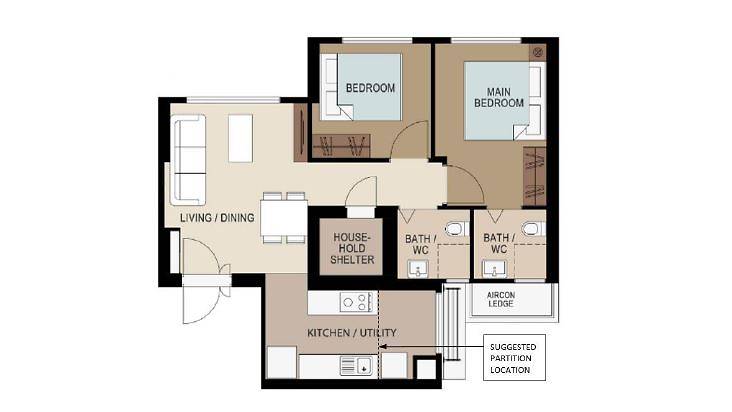
The housing board will also have three-room flats with integrated kitchen and utility space in Canberra Vista and Toa Payoh Ridge.

“The integrated kitchen/utility space is a contiguous space that offers home owners flexibility in configuring the area according to their preferred interior design concept,” it said. 

“Home owners who prefer to separate the kitchen from the utility space may add a partition during their renovations.”

Layout plan of a 3-room flat with a combined wet kitchen utility space at Toa Payoh Ridge.

Layout plan of a 3-room flat with a combined wet kitchen or utility space at Toa Payoh Ridge. Homeowners who wish to separate the yard from the kitchen can add a partition during renovations. (Image: HDB)

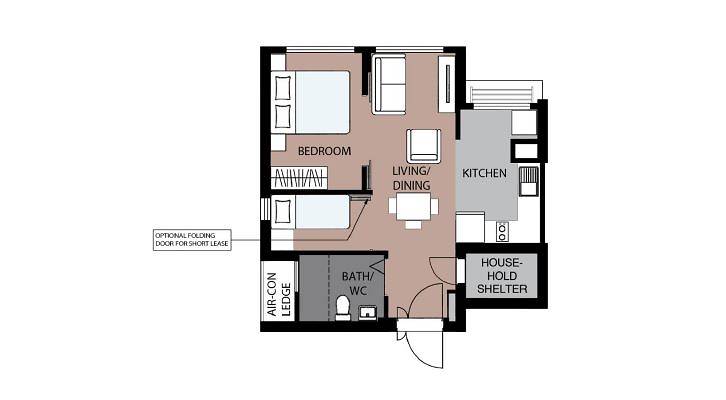
Two-room Flexi flats with flexible space will also be introduced in these neighbourhoods.

Elderly buyers who buy such flats may opt for the Optional Component Scheme. The scheme provides the flat with senior-friendly fittings such as a folding door, which allows them to use the space to accommodate a caregiver or to entertain visitors.

Layout plan for 2-room Flexi flat with flexible space.

Layout plan for 2-room Flexi flat with flexible space. Elderly flat buyers may opt for a folding door to be installed. (Image: HDB)

GENEROUS SUBSIDIES: HDB

The new flats are heavily subsidised, with prices “considerably lower” than the transacted prices of comparable resale flats in the vicinity, HDB said.

The two-room Flexi flats are priced according to the chosen lease, it added.

Eligible first-time families will also receive up to S$80,000 under the Enhanced CPF Housing Grant (EHG), which was announced last year. Under the grant, buyers can pay as little as S$9,000 for a two-room Flexi flat, S$102,000 for a three-room, S$212,000 for a four-room and S$350,000 for a five-room.

First-timer families will be given priority in flat allocation.

Couples can also apply for a 3Gen flat in Canberra Vista if they wish to live together with their parents, while those who wish to live near their parents or children in the same BTO project can submit a joint application under the Multi-Generation Priority Scheme.

Application for the newly-launched flats starts on Tuesday and will end on Feb 17. Information on the flats are available online and HDB advised applicants who are feeling unwell or on leave of absence to refrain from visiting HDB offices and branches.

“There is no Re-Offer of Balance Flats (ROF) exercise in February 2020 as HDB is reviewing the sale processes for balance flats to better serve the needs of home buyers,” HDB said.

The next BTO launch in May will offer about 3,700 flats in Choa Chu Kang, Pasir Ris, Tampines and Tengah. Another 4,100 flats in Ang Mo Kio, Bishan, Geylang, Tampines and Woodlands will be offered in August.

READ: HDB to build more new flats next year to meet greater demand

Up to 17,000 new flats will be launched in 2020 to meet demand, National Development Minister Lawrence Wong had announced last year.

Source link

'How to spread Wuhan': Youth puts drinks back on supermarket shelf after taking sips

0

[ad_1]

They did it for a laugh, but their prank video soon started making its rounds on social media last week.

In the clip, a youth was seen taking sips of drinks in an NTUC Fairprice supermarket, putting the caps back on, and placing the bottles back on the shelf in the chilled drinks section.

His friend, filming the act, was heard asking him how the drinks tasted.

The video was then posted on Instagram Story with the caption ‘how to spread Wuhan’, a reference to the coronavirus outbreak.

While the youth and his friend had thought that their prank would be fleeting, copies of the clip started to emerge on Facebook and Twitter.

Now, the police are on the lookout for more information about the clip.

[ad_2]

Source link

Number of travellers and cargoes cleared in 2019 highest in 5 years: ICA

0

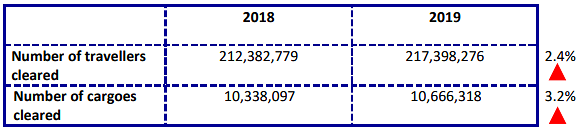
SINGAPORE: The number of travellers and cargoes cleared by the Immigration and Checkpoints Authority (ICA) in 2019 was the highest in five years, the authority said on Tuesday (Feb 11). 

In its annual statistics, ICA said it cleared more than 217 million travellers and 10.6 million consignments, containers and parcels last year. These are the highest figures for the past five years, said ICA Commissioner Marvin Sim. 

ICA statistics 2019 1

There has been a steady increase in the volume of travellers and cargoes clearing checkpoints in Singapore. Between 2015 and 2019, the number of travellers cleared by ICA increased by 10.2 per cent, while the number of cargoes cleared increased 20 per cent.

ICA attributed the increase in cargoes mainly to the increase in parcels, which grew 5.7 per cent from 6,141,276 in 2018 to 6,493,162 in 2019. 

“This reflects the growing popularity of e-commerce and online shopping, and the growth is likely to persist,” said ICA.

Mr Sim said the volume of travellers and cargoes is expected to increase further. 

In its annual statistics, ICA shared it would “continue to develop effective strategies and look for innovative ways to facilitate the movement of people and cargoes, while ensuring that our borders remain secure”. 

These include redesigning and enhancing workflows, investing in better technology to support these workflows and training ICA officers to harness such technologies, said ICA, citing recent efforts for smoother clearance. 

Since December 2016, ICA has installed 164 automated clearance lanes at the Woodlands and Tuas checkpoints, which has increased the clearance speed of motorcyclists by 30 per cent. 

ICA also began contactless clearance trials at Tuas Checkpoint in April 2019 and Changi Airport in November 2019 to enhance clearance efficiency and better authenticate travellers’ identities. 

READ: Increased border checks, leave of absence among new coronavirus counter-measures

READ: Systems running smoothly at Singapore checkpoints amid measures against coronavirus – Shanmugam

ICA officers have also had to “rise to the challenge” of dealing with the threat of the novel coronavirus, said Mr Sim. 

“ICA officers have been working tirelessly to implement and enforce tighter border control measures in response to the evolving situation, as they serve as the first line of defence against the spread of such infectious diseases.

“Whether in peacetime or times of crises, ICA will spare no effort to secure our borders and remain steadfast in our mission to keep Singapore safe and secure,” he said. 

FEWER IMMIGRATION OFFENDERS ARRESTED

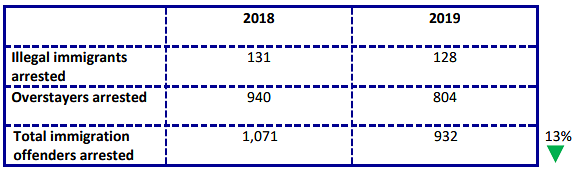
In 2019, ICA mounted more than 100 operations per month to detect and remove immigration offenders (IOs) from Singapore. The total number of IOs arrested last year – comprising of those arrested inland and at checkpoints – decreased by about 13 per cent, from 1,071 in 2018 to 932 in 2019.

ICA statistics 2019 2

There was a decrease in overstayers by 14.5 per cent and illegal immigrants arrested by 2.3 per cent.

ICA said that it has kept the IO situation under control through a combination of enforcement efforts and use of technology, with its biometric identification system scanning all travellers’ fingerprints to more effectively detect IOs who are attempting to use someone else’s identity or a false identity. 

“As ICA explores new technologies to enhance our immigration clearance, we are also enhancing our officers’ training to better equip them with the necessary skills and knowledge to assess and detect IOs at the checkpoints,” it said.

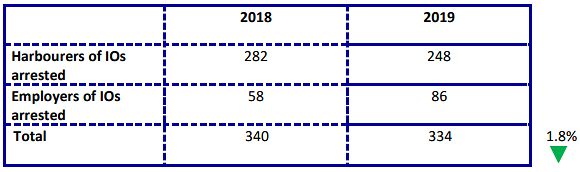
The total number of harbourers and employers (H/Es) of IOs arrested in 2019 decreased slightly overall by about 1.8 per cent, from 340 in 2018 to 334 in 2019.

However, the number of errant employers arrested increased from 58 in 2018 to 86 in 2019. The number of arrested harbourers of IOs decreased, from 282 in 2018 to 248 in 2019. 

ICA statistics 2019 3

Most of the H/Es arrested had failed to exercise due diligence to conduct the necessary checks on the foreigners’ immigration statuses before employing them or renting their premises to the IOs, said ICA.

The IOs employed by errant employers were mostly working in the maintenance and F&B industries.

“IOs pose a security risk and may turn to crimes to sustain their livelihood in Singapore,” said ICA. 

“We seek the public’s and employers’ cooperation to deny IOs shelter and jobs, and to report suspected cases quickly to ICA. ICA will continue to work closely with other enforcement agencies to conduct operations against IOs hiding in non-residential premises like forested areas or cemeteries.”

FEWER CONTRABAND CASES DETECTED AT CHECKPOINTS

The number of contraband cases detected at ICA’s checkpoints decreased by 14.4 per cent, from 107,771 in 2018 to 92,292 in 2019. Despite the decline, the quantity of contraband seized and referred to Singapore Customs has increased.

The average duty and GST that would have been evaded by offenders at the checkpoints per case increased by 13.2 per cent, from S$151 in 2018 to S$171 in 2019.

ICA statistics 2019 4

ICA said that in 2019, it thwarted a number of attempts to smuggle controlled items into Singapore through postal parcels and that it is monitoring this trend closely, given the increasing volume of parcels.

It also detected “huge” consignments of contraband cigarettes hidden within legitimate consignments at the land checkpoints.

In some of these cases, offenders used sophisticated methods of concealment to avoid detection including hiding the cigarettes in game machines, concrete blocks, paper rolls and in various modified compartments of vehicles, including in moving tyres. 

READ: Simulation training to enhance ICA officers’ response to major incidents at Woodlands Checkpoint

To address the challenges of inspecting consignments in large vehicles, ICA said it uses radiographic scanners to scan cargo vehicles. 

Bus scanners were also implemented at Tuas Checkpoint in 2018. These scanners allow ICA to detect secret compartments and contraband items more effectively and quickly.

ICA also works closely with the Home Team Science and Technology Agency (HTX)’s laboratory network, which has the analytical capabilities to effectively detect chemical, biological, radiological, nuclear and explosive (CBRNE) substances at Singapore’s checkpoints.

FEWER CONVICTIONS FOR MARRIAGE OF CONVENIENCE-RELATED OFFENCES

The number of people convicted for marriage of convenience (MOC)-related offences in 2019 decreased by 53.1 per cent, from 32 in 2018 to 15 in 2019.

ICA statistics 2019 5

Over the past three years, ICA has busted two elaborate webs of sham marriages organised by syndicates, with the first case involving six couples and two masterminds, and the second involving 17 people in total, including one mastermind who arranged seven fake marriages.

ICA said it takes a serious view of foreigners engaging in MOCs with Singaporeans to obtain immigration facilities in Singapore, with the penalties being a fine of up to S$10,000, a jail term of up to 10 years or both.

Members of the public are encouraged to report any suspected cases of MOC as well as any other immigration-related offences to ICA at 1800 391 6150 or via the ICA website (www.ica.gov.sg).
Source link

Mao Shan Wang durians in Malaysia now 50% cheaper due to coronavirus outbreak in China: Report

0

[ad_1]

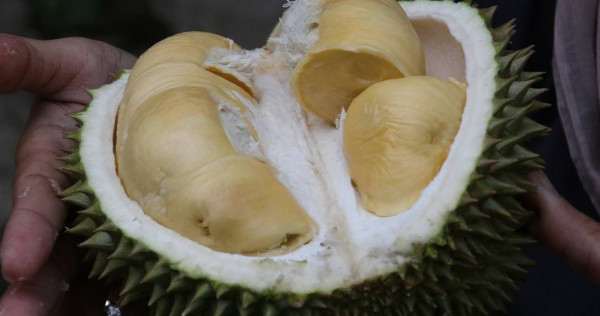
Durians from Malaysia may be about to get cheaper, thanks to a glut in supply there.

According to a report in Channel NewsAsia, prices for the fruit have fallen in Malaysia by up to 50 per cent over the past two weeks due to the coronavirus outbreak reducing the demand from China.

The report quoted plantation owner and durian expert Lim Chin Khee as saying that the price of the highly prized Mao Shan Wang (MSW) variety has dropped from RM60 (S$20) to about RM30 (S$10) per kilo in Raub Pahang, known to be Malaysia’s durian capital.

The country began exporting fresh whole durians to China from June last year, with the industry predicted to generate almost RM500 million to the country’s total export value.

[ad_2]

Source link

Coronavirus patients may be mildly ill for more than a week before condition becomes severe

0

[ad_1]

SINGAPORE – Several of the locally infected patients with no known links had seen a doctor two or three times before they were sent to hospital.

This is because the illness generally starts mild with non-specific symptoms such as cough, sore throat, slight fever and feeling tired, said Professor Leo Yee Sin, executive director of the National Centre for Infectious Diseases (NCID).

These are symptoms tens of thousands of people suffer from every day in Singapore alone, she added.

So it is difficult to identify those infected by the novel coronavirus if they have no links to China or to other patients.

She said they may be mildly sick for more than a week before the virus affects their lungs.

That is why those who feel unwell are advised to stay home, or if they need to go out, to wear a mask so they do not spread disease to others.

Professor Tan Chorh Chuan, chief health scientist at the Ministry of Health (MOH), said: “In today’s environment, be prudent. If you are feeling febrile, it’s better to stay at home.”

[ad_2]

Source link

Commentary: Singaporeans queued for toilet paper and instant noodles – there is no shame in that

0

SINGAPORE: A new face of the novel coronavirus has emerged on social media – that of a masked Singaporean aunty absconding with vast amounts of toilet paper and instant noodles.

Online backlash has been hilariously scathing. Many of us laughed really hard. How dare these inconsiderate people hoard more than their rightful share of toilet paper and instant noodles – a shared “national” resource? Then, we self-consciously went to check on our own toilet paper supply.

This was last Friday (Feb 7) evening around 7pm or 8pm.

Back up a few hours to around 5.30pm. My mobile phone began beeping. Even before I had time to read the news, my friends had messaged about the DORSCON Orange update, indicating that the disease is severe and spreads easily, though not widespread in Singapore. Concerned friends urged me to stay safe and avoid large crowds.

READ: Coronavirus outbreak: Singapore raises DORSCON level to orange; schools to suspend inter-school, external activities

Within 30 minutes, these sensible warnings morphed into pictures of supermarket sprees that got more and more hysterical with each passing hour. Panic became the new “virus”.

THE SYMBOL OF THE TOILET PAPER

Within that very Saturday, things got so bad that Prime Minister Lee Hsien Loong gave a speech to reassure the nation that Singapore had ample supplies. That was the first time I’ve ever heard our PM mention “instant noodles” and “toilet paper” in the same sentence.

Global news agencies quickly picked up the most absurd supermarket images, leading Trade and Industry Minister Chan Chun Sing to worry that other countries may infer that “Singaporeans cannot react well in times of crisis and could be taken advantage of in the future”.

Vocal netizens guffawed in agreement. A viral video of an aunty with a bomb shelter stockpiled with “goodies” like a “minimart” started circulating.

But are these characterisations a fair representation of Singaporeans and why we reacted in that manner?

READ: No need to rush for supplies, says Chan Chun Sing, amid reports of surge in demand

Customers wear masks as they walk past empty toilet paper shelves at a supermarket, following the o

Customers wear masks as they walk past empty toilet paper shelves at a supermarket, following the outbreak of a new coronavirus, in Hong Kong, China February 6, 2020. REUTERS/Tyrone Siu

THE SUPERMARKET PANIC VIRUS

When most people first learnt of the “Code Orange” alert, they probably intended to stock up for a couple of weeks. Frequent grocery shopping seemed impractical given the heightened risk of disease transmission.

Most of us have never experienced a disaster and are not exactly sure how to shop for one. But because preparedness is in our Singaporean blood, many took a leaf from Hong Kong and honed in on whatever seemed to be the scarcest commodity.

After all, orange is just one level away from red, and the drivers among us suspect it might not take long for us to get there, so we best to be ready.

Perhaps eerie images of “ghost towns” in Hubei, the lockdown of some 50 million people, and the empty shelves in Hong Kong seared themselves on our national psyche and triggered the protective instincts of many Singaporeans towards their family and friends.

READ: Commentary: Modern medicine, health systems have created illusion we have complete biological control over our fate

LISTEN: Novel coronavirus – the search for a cure (and a name experts can agree on) intensifies, a Heart of the Matter podcast

On Friday night, I would say one or two of 10 friends spent their precious pre-weekend evening at the supermarket. Those who were there doubled their shopping list because in times of chaos, there is comfort in preparedness. Yet unfortunately, this synchronised shopping led to a strain on the supermarket system.

When the queue-time went from minutes to hours, many decided that it simply made sense to buy more. Wanting to spare their family and friends from knee-numbing queues, they decided to multiply their shopping list.

I was still slogging away at work when I began to get unsolicited offers from friends to help buy certain items that have never occupied my mind space before – toilet paper, instant noodles and rice being three of them.

A customer pushes a cart with groceries at a supermarket, following the outbreak of a new coronavir

A customer pushes a cart with groceries at a supermarket, following the outbreak of a new coronavirus, in Hong Kong, China February 6, 2020. REUTERS/Tyrone Siu

At this point, many of my friends still could not believe what they were seeing – until the next morning when their elderly mothers went on their weekly grocery trip and encountered for themselves what they described as a “doomsday” scenario at their local wet market.

Two of my friends’ mothers activated them to help buy these highly coveted items. A nationwide quest for toilet paper had begun.

THE ETHOS OF PREPAREDNESS

I cannot speak for the people who bought 60kg of rice and 200 tins of canned food, and I am just as disgusted by those with try to profit from a public health crisis – these people and suppliers should be called out.

READ: Commentary: Looks like containment of novel coronavirus not as effective as we had hoped

READ: Commentary: Hot and humid weather may end the novel coronavirus – as well as the development of a vaccine

However, for most people, “stocking up” is not “hoarding”. Buying an extra sack of rice and some canned food is also quite a common response in times of crisis, and practised around the world.

If anything else, it speaks of a spirit of alertness and planning for an uncertain future – it is an ethos our pioneer generation share.

An aunty of mine who survived World War II always keeps one or two extra sacks of rice at home. As a child, I remember being tasked to sieve out weevils for her.

These memories also made me wonder whether we’re unfairly virtue-signalling and decrying Singaporeans in the queue for supplies and other essentials who might be badly misunderstood.

At the peak of the grocery crisis, an acquaintance pre-emptively posted on Facebook: “Saturday is my regular day for buying groceries for the entire family. If you see me on social media or in person with a whole cartload of groceries, please do not un-friend me.”

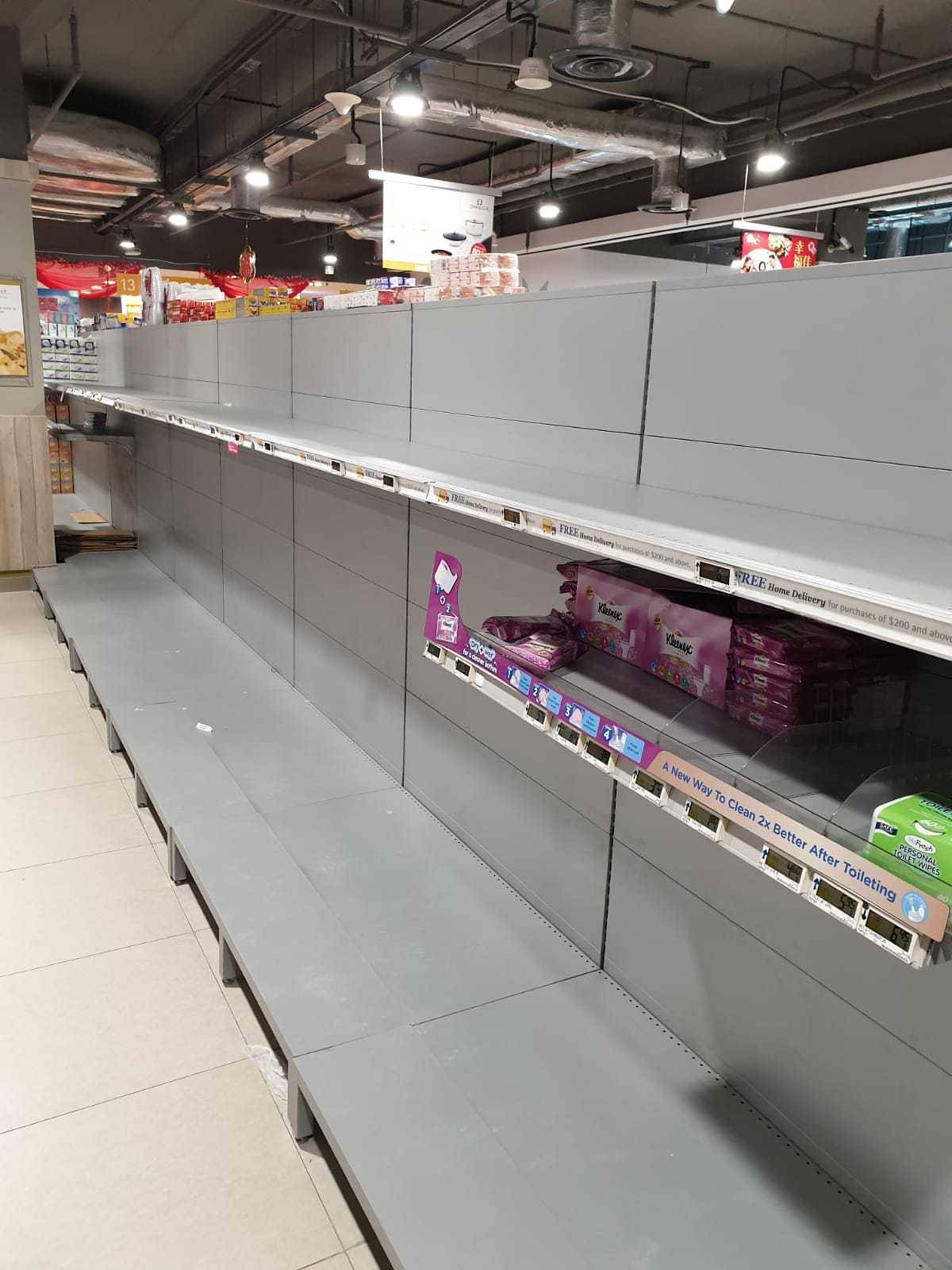
Singapore supermarket panic buying feb 7 (1)

Empty shelves seen at Bukit Timah Plaza NTUC. (Photo: Robert Low)

This struck a chord with me. Why should regular Singaporeans be subject to such scrutiny when grocery shopping, have their cart scrutinised, or be toilet-paper-shamed? What gives others the moral high ground to judge?

THE KAMPONG SPIRIT IS VERY MUCH ALIVE

In fact, a lot of people I know braved these crazy queues out of love for their family and friends.

After spending half a day hunting and queuing for toilet paper, one of my friends bought S$52 worth of supplies for her family of six. She got disdainful glares from other shoppers but tells me that she feels no shame.

Yet another one of my friends bought S$67 worth of toilet supplies and shared some with her elderly uncle staying alone.

READ: Commentary: SARS was scary, but the experience was invaluable in shaping our Wuhan virus response

READ: Commentary: Wuhan virus – when social media and chat groups complicate crisis communication

I think it is cool that as Singaporeans, we have the ability to hold a mirror up to ourselves and laugh at ourselves – as pictures of mask-donning Singaporeans with trolleys of instant noodles in queues stretching all the way to supermarket entrances saturated social media.

But instead of vilifying strangers in the supermarket, ask yourself if none of your family members, friends or friends’ mothers have braved the queues.

These are the same hardworking people who run their household tirelessly, the unsung heroes of each of our families, who offered to share their hard-fought food and supplies with other loved ones.

Singapore supermarket panic buying coronavirus feb 7 (3)

(Photo: CNA Reader)

Personally, I am both relieved and somewhat embarrassed that NTUC Fairprice had to go to great lengths to announce on Sunday limits on the purchase of rice, toilet paper, instant noodles and vegetables to quell the panic buying.

Hopefully in the weeks or months to come, sundries will not be one of our worries when it comes to fighting the virus.

Speaking for myself, I did not join the supermarket queues because I had already amply stocked up on milk and food for my toddler a week ago – what I considered to be true necessities.

And when it comes to toilet paper, I am down to my last two rolls at the point of writing.

But if it the toilet paper situation gets dire, I know I will not have to look far for someone to share their “reserves” with me.

We Singaporeans are kiasu, but we do watch out for one another.

BOOKMARK THIS: Our comprehensive coverage on the novel coronavirus and its developments

Download our app or subscribe to our Telegram channel for the latest updates on the novel coronavirus outbreak: https://cna.asia/telegram 

Annie Tan is a freelance writer.

Source link

OG cuts shopping hours, Honestbee temporarily closes grocery store over coronavirus fears

0

SINGAPORE: At least two retailers in Singapore have announced shorter business hours or temporary store closures in light of the novel coronavirus outbreak.

This comes after Singapore stepped up its risk assessment of the new flu-like virus last week and amid local transmission of the virus, which started in China and has since killed more than 900 and infected more than 40,000.

One of them is department store OG, which adjusted its store operating hours shortly after authorities announced the upgrade in the Disease Outbreak Response System Condition (DORSCON) level to Orange on Friday (Feb 7).

READ: Coronavirus outbreak: Singapore raises DORSCON level to Orange; schools to suspend inter-school, external activities

Its three stores, which used to be opened from 11am to 9.30pm daily, will now close at 8.30pm “until further notice”.

This is so that employees “can go home earlier … in this critical period of fighting the coronavirus outbreak”, OG said in response to queries from CNA.

In line with the heightened measures, OG said it has begun temperature checks for all employees and visitors to its office. Promoters, delivery personnel and other staff entering its department stores must also use masks at all times.

Prior to that, it had taken other measures such as increased disinfection of floors, toilets and frequently touched surfaces like railings, lift buttons and escalator.

It also said that only one out of its 26 employees from China had recently travelled back home. This employee is currently on a 14-day leave of absence until Feb 18.

On whether crowds have thinned at its department stores, OG’s spokesperson told CNA that it has been monitoring developments since reopening for business on Jan 27 after the Chinese New Year holidays.

Before that, even though Singapore confirmed its first infected patient on Jan 23, OG “did not see a distinct drop in customers yet, especially since it was still the pre-Chinese New Year shopping period”.

But after the Chinese New Year break and with the DORSCON level at Yellow, the mall “began to see a decline in footfall and business”, with stores becoming “very quiet after 7pm”.

In particular, its department store at People’s Park saw the biggest drop in walk-in traffic, the spokesperson told CNA.

BHG Holdings also saw a big hit in sales, with transactions across its six outlets dropping between 40 to 50 per cent since the first confirmed case on Jan 23.

The chain department store said it will not adjust opening hours at the moment, although it “may review again if the situation changes”.

Similarly at Robinsons, operating hours for its three stores remain unchanged for now.

Both BHG and Robinsons said they have put in place precautionary measures in line with guidelines from the authorities.

Mandatory temperature checks are being carried out, while surgical masks are on hand for employees who feel unwell, they told CNA.

They have also stepped up the cleaning of their department stores and commonly-used areas, with Robinsons having a cleaning schedule of sanitising every 2 hours.

BHG is also looking to split its front-end staff into two teams so as “to minimise the physical contact (and) lowering the risk of infection”. It added that it also has two employees who are on the 14-day leave of absence, after returning from China on Jan 27 and Feb 4, respectively. 

Metro and Isetan did not reply by the time this article was published, but a quick check with its customer service centres showed no change in opening hours.

HONESTBEE TEMPORARILY CLOSES HABITAT

Separately, retail start-up Honestbee has temporarily closed its tech-integrated grocery store Habitat from Monday until Feb 23.

The suspension of the grocery store, which is located in Pasir Panjang and also houses a dine-in area, “may be extended if necessary”, according to a company spokesperson.

honestbee's tech-integrated grocery habitat

Habitat, which is honestbee’s tech-integrated grocery store. (Photo: Facebook/honestbee) 

“We have chosen to temporarily suspend habitat by honestbee as a proactive approach to combat community transmission in light of the increase in novel coronavirus cases and the elevated DORSCON risk assessment status,” she said.

Since Singapore confirmed its first case of the coronavirus, footfall in the grocery store has fallen about 60 per cent, with the impact most noticeable during dinner time on weekdays, the spokesperson added.

Honestbee has stopped its food delivery and laundry services since May 2019, as it embarks on a court-supervised debt restructuring. 

It will continue to operate its online grocery delivery service, its announcement on Monday said.

BOOKMARK THIS: Our comprehensive coverage on the novel coronavirus and its developments

Download our app or subscribe to our Telegram channel for the latest updates on the novel coronavirus outbreak: https://cna.asia/telegram 

Source link

Singapore to slash toll charges at Causeway and Second Link

0

[ad_1]

JOHOR BARU – Singapore’s move to match Malaysia’s reduction of toll charges for cars, taxis and buses at the Causeway and Second Link has been welcomed by frequent travellers. Malaysian trainee chef Aow Ke Seng, 22, who drives from his house here to work in Singapore almost daily, said the reduction had reduced his daily expenses significantly.

“The reduction from the Malaysian side allowed me to save about RM6 (S$2) a week.

“The matching reduction from Singapore allows me to save even more, ” said Aow, who uses the Second Link.

Assistant chemist Farosdie Saufi, 23, who takes the bus to Singapore every day, said he hoped the price of bus tickets would be reduced following the reduction of toll charges.

“At the moment, there is no change in the price of bus tickets. I spend about $1.50 for a one-way trip from Singapore and about RM4.20 from Gelang Patah to Singapore, ” he said.

Meanwhile, taxi driver Zan Ahmad, 64, hoped the reduction would help lower the losses cabbies were suffering due to the lack of customers going to Singapore following the novel coronavirus outbreak.

[ad_2]

Source link