SINGAPORE – Nine new cases of the coronavirus disease, Covid-19, were confirmed on Friday (Feb 14), including a healthcare worker and six patients linked to the Grace Assembly of God church.
The cluster is now the largest in Singapore with 13 patients. The first two patients there tested positive on Feb 11.
None of the new cases has recent travel history to China and all nine are Singaporeans.
Meanwhile, two previously announced cases have recovered and were discharged on Friday, including a two-year-old girl who was one of 92 Singaporeans evacuated from Wuhan on a specially arranged Scoot flight on Jan 30.
The other is a 27-year-old man who attended a business meeting at the Grand Hyatt Singapore last month.
Here are the details of the new cases:
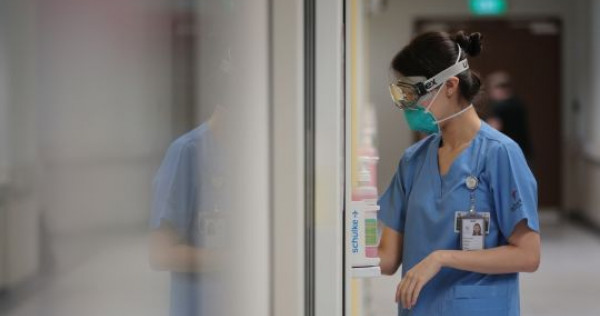
Case 59 is a 61-year-old doctor who works at a private hospital and fell sick on Feb 7.
He has not been to work since he fell ill and has no known interactions with past cases.
He sought treatment at Farrer Park Hospital’s emergency care clinic on Monday and at the emergency department at Mount Elizabeth Hospital on Wednesday.
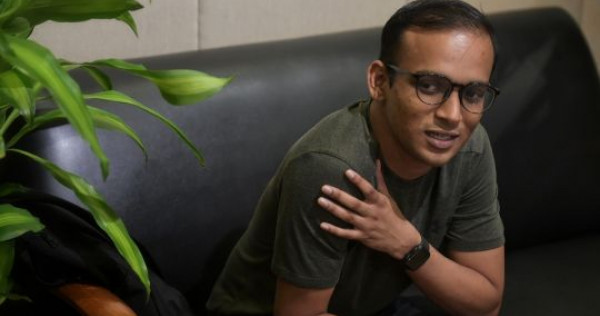
SINGAPORE – A nurse who cancelled his wedding reception earlier in February due to the coronavirus situation said on Friday (Feb 14) that this was the “responsible thing to do”.
Mr Benjamin Ong, 29, a senior staff nurse at the Department of Emergency Medicine at Tan Tock Seng Hospital (TTSH), said that he and his fiancee will still be planning a small celebration with close members of the family.
“We want to avoid large crowds during this uncertain period and take additional precautionary measures,” explained Mr Ong, who is ethnically Indian but was adopted by a Chinese family.
Though a difficult decision to make, the couple made the move as they did not want to risk a possible spread of the virus, which originated from China’s Wuhan city and, as of Friday evening, has infected 67 in Singapore, and infected more than 63,000 and killed over 1,300 in China.
Mr Ong, a Malaysian who came to Singapore in 2012 and has been working at TTSH for around eight years, had posted on social media on Saturday about his “battle scars” as a frontline healthcare worker.
SINGAPORE – The police have arrested a 26-year-old Singaporean woman believed to be the mother of the baby boy abandoned in a Bedok North rubbish chute in January.
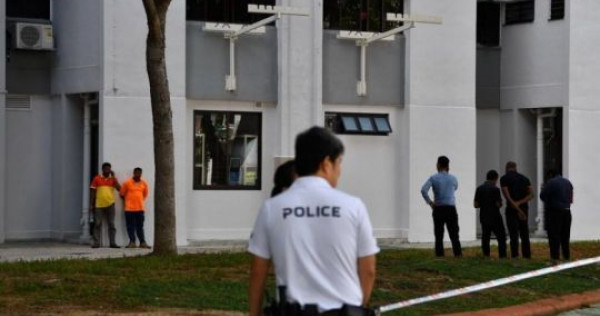
On Jan 7, two town council cleaners at Block 543 Bedok North Street 3 were collecting rubbish from the refuse chute when they heard crying from one of the bins.
They found to their shock a baby boy in a wet and bloody Sheng Siong supermarket plastic bag.
The police said on Saturday (Feb 15) that they arrested the woman on Thursday after looking through images from police cameras and other closed-circuit television footage provided by residents and businesses in the neighbourhood.
Residents had earlier said that the police had made their rounds on every floor of the block to ask them questions, and had called owners of vehicles parked at the open-air carpark near the block to ask for footage from their in-car cameras.
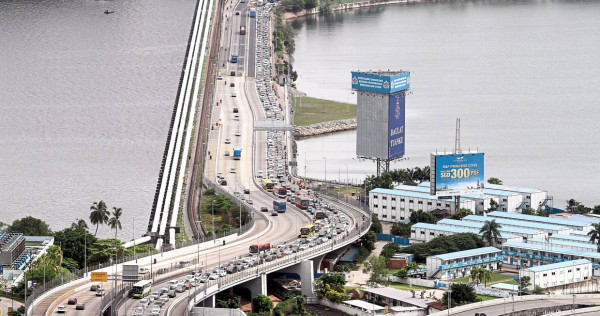
JOHOR BARU – The usual traffic congestion at the Causeway here has worsened due to the health screening at the entry points of both Johor and Singapore.
Frequent travellers passing through the Causeway have expressed their frustration over the congestion, which has gotten from bad to worse during peak hours, especially on Fridays and weekends.
Singaporean policeman Abdul Haniff Abdul Hamid, 38, who was passing through the Causeway to enter Johor at about 1pm, said that he noticed traffic started to build up at about noon on Friday.
“The Causeway would normally still be empty at that time and will only start to get congested at around 3pm on Friday,” he said.
Another traveller, Malaysian S.Sathia, 36, who works as a security officer in Singapore, said that temperature screening on those entering Malaysia started a few days back.
“After the temperature checks started, the traffic seems to be slower than usual.
“Previously you would only see three or four cars queuing up to enter Johor at 6am, but now I can see a lot more than that number,” he said.
SINGAPORE: When Andre and Vicky Cruz took their eldest daughter on a holiday to Jakarta in August 2009, the last thing they expected was a phone call from her concerned school teacher.
Crish, then 12, had missed the school’s extra revision class for the Primary School Leaving Examination (PSLE) – which was just weeks away. “We were surprised – we realised like, wow, that’s a really big deal!” recalled Andre of how clueless they were.
“I didn’t even know what the PSLE was, until three months before I was going to take it,” Crish added.
This is an amusing anecdote that the family of six, who moved to Singapore in June 2007, enjoy telling when people ask them about the differences between life in Singapore and their native Philippines.
The Cruzes have amassed a wealth of stories – many humorous, some challenging, others uplifting – about their experiences as migrants from a culturally different society making a home in Singapore. The latter was a process that took time, resolve, and open minds.
The Cruz family came to Singapore in 2007, after father Andre got a job here.
CULTURAL MISUNDERSTANDINGS
The Cruz family moved to Singapore when Andre got a job offer as a programmer at an investment bank. They thought it would be a great place to raise and educate Crish, Carl, Valerie and Alexandria, who were then aged 11, six, three and one respectively. They took up permanent residency within nine months.
What they didn’t expect, early on, was to read comments online about foreigners stealing local jobs. “It definitely was not our intention to take someone’s job,” said Ande, 44.
Another time, Vicky was pushing Alexandria in a stroller when a security guard asked her where her “mum” was. “I was thinking, oh, my mum is in the Philippines,” Vicky said – and then she realised, he’d assumed she was a domestic helper.
They resolved not to take such reactions and comments by a minority too personally. “We have to let go of these things,” she said. “Or it won’t help us in our stay here.”
The Cruz family in a photo from 2007. (Credit: Andre Cruz)
It took time to pick up local social norms. Once, the family even got a visit from a police officer: Unfamiliar with the communal etiquette of high-rise living, they had been a little loud in putting their children to bed, and a neighbour had complained.
Taken aback at first, upon reflection, Vicky said: “We accepted that fact that we were being noisy, and we didn’t get complaints anymore”.
They were tentative about socialising, as they didn’t always understand the nuances of the way Singaporeans talked, including in Singlish. “I’m sure they also had a hard time understanding us,” added Andre.
They also laughingly recalled other faux pas that must have puzzled onlookers. Like when Andre first took a public bus, not realising that those in Singapore halted only at designated bus stops, unlike buses in the Philippines.
“I kept pressing the button and expecting the bus to come to a halt at once, but it didn’t,” he said. “I had to walk a very long way back (from the bus stop).”
On a public bus. The family does not own a car, and uses public transport to get around.
THROWING PARTIES AND VOLUNTEERING
Understandably, the Cruzes at first hung out more often with other Filipinos. It might have been tempting to keep things that way. But they resolved to be “open minded” and learn the norms of their new home.
Said Andre: “We’re guests here, right? We can’t expect people to adjust to us, we have to adjust to them.”
And when they reached out to make Singaporean friends, that was a turning point, they said.
Stay-at-home-mum Vicky invited the neighbours over for barbecues and birthday parties during which, Filipino-style, there’d be singing and dancing; and the family also found a community of friends at Central Christian Church.
One of them, Agnes Tan, remembers the effort the Filipino couple made to reach out. “They were always very willing to explore and join us in all sorts of activities and trips,” she said. “And they’ve opened up their home to us a lot over the years.”
Andre and Vicky with their church friends on a nature walk.
It took about a year, said the Cruzes, to be fully comfortable around Singaporean friends, who helped them in many ways.
When Vicky had trouble finding a school for Crish – none of the 10 or so she approached had vacancies for international students – one of Vicky’s friends suggested that she try Canossa Convent. Crish secured a place there.
It was also a friend who encouraged the family to volunteer their time. Since then, for the past eight years, they’ve since been helping out with HOPE worldwide (Singapore).
Several times a year, they befriend and serve breakfast to rental flat residents in Punggol. They feel it’s opened their eyes to yet another facet of their adopted home. “It’s our own little way of giving back,” said Vicky, to which her husband added: “We can do more.”
The family has been volunteering with charity HOPE worldwide (Singapore) for eight years.
FEELING DIFFERENT
Oldest child Crish had the hardest time adjusting initially.
At an age where fitting in was all that mattered, a pre-teen Crish found herself an outsider from the minute she opened her mouth.
“It was very difficult to make friends because I could barely speak English, or even Singlish,” she said. Their brand of humor, “what they play, what they like to do … it was all so very different from my friends in the Philippines.”
Desperate to fit in, she found herself practising common Singlish phrases in front of the mirror, and watching local television shows to try to change her accent. At a low point, she even thought of begging her parents to send her back to the Philippines.
Carl and Valerie on their first day of school in Singapore. (Photo credit: Andre Cruz)
But in secondary school, things got better – she stopped feeling so different. “And I think it was because (my friends) didn’t treat me as someone who was different,” said Crish, now 23.
Meanwhile Carl, being younger, had found it easier to make friends from the start. “I don’t think the kids around me cared very much that I was different,” he said.
On occasion, friends make thoughtless jests. Once, Crish said, a good friend told her jokingly to “go back to her country”. “It affected me a lot more than I thought, because I felt more at home in Singapore than in the Philippines,” she said.
Carl, 18, got teased about being a “domestic helper”. He doesn’t see as an insult, but it annoyed him because “it’s like belittling the vocation of a maid”.
The friends apologised when Carl or Crish spoke to them about it; but the siblings also understand their friends don’t mean those comments, and take the teasing as a sign of how comfortable their friends are with them now.
Both siblings remain close to the friends who reached out to them early on. Said Crish: “If they had not, it would have taken me a lot longer to start mingling with Singaporeans.”
Crish, who is currently completing her university studies in Australia, is welcomed home by her friends after arriving at the airport.
THIS FEELS LIKE HOME
Last year, the family applied for Singapore citizenship – a measure of how much this place now feels like home.
What tipped their decision? “We came to the realisation that our children had no intention of going back to the Philippines,” said Andre.
Crish said: “We’ve build such a strong community here that it would be so difficult to leave… Definitely I’m planning to get married here, have my kids here.”
They list the ways they’ve become Singaporean-ised: Addressing older folks as “uncle” and “aunty”, living in the HDB heartlands, craving char siew noodles… and learning to freak out over PSLE results (six years after Vicky’s nonchalance over her daughter’s exam, “I cried when I got (Carl’s) results”, she joked.)
Carl singing karaoke with his school friends.
The change is most obvious when they’re abroad. When they visit the Philippines, said Andre and Vicky, Filipino relatives comment that they walk and talk too fast, and that their children speak with a Singlish accent.
Meanwhile Carl will soon be enlisting for National Service, a rite of passage he’s actually looking forward to. “I think it’s a good break from all the studying,” said the teenager who’s gotten advice from older friends about army life.
Andre is excited for him. “Many of my friends talk fondly about their NS days, and they always tell me stories,” he said.
“One day, my son will also have these stories.”
Carl getting fit for NS, which he’s looking forward to.
GRAPPLING WITH IDENTITY
While they see their future is in Singapore, it remains important to Andre and Vicky that their children treasure their Filipino roots and retain “important values” like being hospitable.
“Sometimes, my dad tests me on my Tagalog,” said Valerie, 16, laughing. “But it doesn’t usually go too well.”
It is ironic that the youngest, Alexandria – who was barely one year old when she came to Singapore – is perhaps the most attached to her roots. When the prospect of giving up their Filipino citizenship was first broached, she felt torn.
“Even though I couldn’t speak Tagalog, I wanted to maintain just a bit of my Filipino identity by keeping my passport,” the 13-year-old said. Now looking back, “I think it was because I just wanted to be different… I realised that if I moved to the Philippines, I would really miss Singapore, the food and my friends.”
Alexandria (left) and Valerie.
Yes, there are things the family dislike – keyboard-warrior snipes about “foreigners”, for instance, that make Crish wonder “what more we have to do to prove we’re ‘Singaporean enough’?”. There’s also how some Singaporeans treat their domestic helpers unfairly. “This strikes close to home for us,” said Andre, who respects the sacrifices his fellow Filipinos make for their families.
But no real love story is perfect, and make no mistake – this is one. “We have fallen in love with Singapore,” said Vicky simply.
How far are they willing to go to prove it? “I promised myself that if I were to be granted Singapore citizenship, I’ll eat durian,” quipped Andre.
This story by CNA Insider was done in collaboration with Gov.sg.
SINGAPORE: For every person with coronavirus disease 2019 (Covid-19), it seems that at least three or four others are going to be infected too.
That is how contagious the new coronavirus is — and that is a “very conservative” estimate, said Dr Asok Kurup, chairman of the Chapter of Infectious Disease Physicians, Academy of Medicine, Singapore. “The numbers are likely to be much more exponential.”
The outbreak may seem similar to the severe acute respiratory syndrome (Sars) epidemic in 2002-03, but it is becoming apparent to infectious disease specialists like him and Dr Leong Hoe Nam how the new coronavirus is different.
“(By) coming close or talking, you may spread the infection, not like Sars,” said Dr Leong, who practises at Mount Elizabeth Novena Specialist Centre.
WATCH: Just how contagious is Covid-19? (5:47)
In fact, Covid-19’s transmission mechanism is “closer to H1N1 or influenza” than Sars, Minister Lawrence Wong, co-chair of the Multi-Ministry Taskforce on Covid-19, said yesterday.
“Like influenza, (our researchers) have found that Covid-19 is infectious when the symptoms are mild. Because of this … it’s also the case that Covid-19, like influenza, can spread quite quickly.”
This ease of spread means not only that the virus is harder to contain than Sars, but also that the current scale of contagion could be more serious than thought, the programme Insight finds out. (Watch the episode here.)
‘UNPRECEDENTED SPREAD’
The Sars virus infected more than 8,000 people and killed 774 worldwide over nine months, but the novel coronavirus has infected more than 63,000 people — with over 1,300 dead — in barely two months.
WATCH: Covid-19 closer to H1N1 than Sars in terms of transmission: Lawrence Wong (5:24)
The thing is, the incubation period — the time between exposure and the onset of symptoms — is typically two to seven days for Sars patients.
And they are most likely to be contagious only when they have symptoms, such as fever or cough. “Infection … happens best in the second half of the illness, after the first seven days,” said Dr Leong.
But the novel coronavirus could possibly be spread by asymptomatic individuals, that is, those who are not showing signs of being ill. This means these people could be spreading the virus undetected, before the onset of illness.
“This allows the virus to propagate very quickly, across large swathes of area (with) many, many people. Hence we’re seeing these numbers … of infections,” said Dr Leong, who called it an “unprecedented spread”.
The patients whom doctors end up seeing and treating, however, are the sickest “10, 20 per cent”, he reckons.
The bulk who are asymptomatic or have minor symptoms that can be taken for, say, the common cold might be “(four) times more than (the patients) we’re seeing now”, he warned. “They’re active propagators of the virus.”
Another problem complicating global efforts to contain the virus is international travel. While there are flight suspensions and restrictions in place on travel to and from China, these may not be enough to contain the spread of infection.
“Even if you say, let’s not get people coming in from China … (there are) many people who are already affected outside of China. And these people are still travelling,” pointed out Dr Kurup. “So we’re still vulnerable.”
Dr Asok Kurup.
This means many of the asymptomatic people round the world may be travelling, and transmission is a possibility. “Now, how infectious and how transmissible they are, we don’t know,” he said.
HEARTLESS IN HUBEI?
While the number of coronavirus cases in China may be stabilising, this apparent slowdown in the epidemic’s spread should be viewed with “extreme caution”, World Health Organisation director-general Tedros Ghebreyesus said recently. “This outbreak could still go in any direction.”
To try to halt the spread of the virus, the Chinese authorities have resorted to measures like placing Wuhan city — with a population of 11 million — on lockdown, closing roads to the city and shutting down its public transport.
“The fact that the Chinese government officials did it tells me they were desperate,” said Dr Leong.
Dr Leong Hoe Nam with Insight producer Genevieve Woo.
It also told him many people were falling sick rapidly, “they were going to get out of Wuhan for the Chinese New Year festivities, and from there, the spread would’ve been even (more) unprecedented”.
“It seems very heartless, it seems unimaginable, but (the lockdown) was the right thing to do,” he added.
The city’s being sacrificed for the good of this nation and for the … world.
The lockdown was later expanded to other cities in Hubei, a province with nearly 60 million people. And even as efforts to contain the spread of the virus go into full swing, it remains unclear if the peak is near.
“If there’s a best-case scenario, it could potentially lead to a drop in numbers. But I haven’t seen that … We’re still seeing the cases (going) up and the mortality (too),” said Dr Kurup.
“Until and unless we see that number’s (being) mitigated, we can’t predict what’s going to happen in the region. So this is going to go on for a while.”
Watch the episode here. The programme Insight is telecast on Thursdays at 9pm.
SINGAPORE: Shanti* came to Singapore from Bangladesh thinking she was going to be a dancer at a Bollywood-style nightclub. The people she trusted the most abused her, stripped her freedom and forced her to “sell (her) vagina and earn money”.
She was among three Bangladeshi women who were trafficked into Singapore.
Indian nationals Priyanka Batthacharya Rajesh and Malkar Savlaram Anant were each sentenced to five years and six months jail and a S$7,500 fine on Tuesday (Feb 11) after they were found guilty of labour trafficking under the Prevention of Human Trafficking Act. They were the first such convictions under the legislation, which was enacted five years ago.
Building a case against Priyanka and Malkar was challenging.
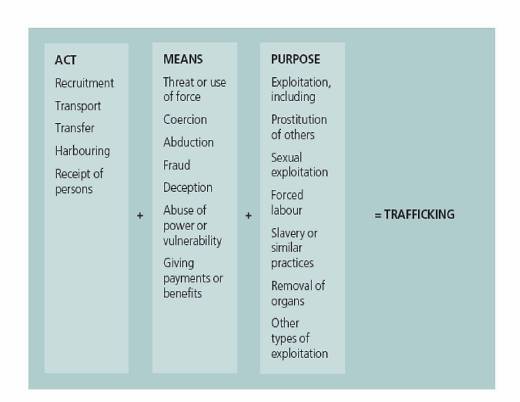
To prove someone has been trafficked, three aspects need to be covered – the act of recruitment, the means that might involve deception and it was done for the purpose of exploitation.
“Generally, proving the purpose is challenging for labour trafficking cases,” Shirley Lim, co-chair of the Singapore Inter-Agency Taskforce on Trafficking in Persons said.The taskforce, formed in 2010, is co-chaired by the Ministry of Home Affairs (MHA) and the Ministry of Manpower (MOM), and consists of nine agencies.
“We have to prove elements of the exploitation here. We have to say how was this person coerced and duped into performing certain acts, and that it is not something that they did willingly.
“Some of the things defence lawyers may use is to say that (the victims) could have escaped. Maybe (if) they did not escape, it means that they are not victims,” she explained.
(Image: UNODC)
Two challenges Ms Lim has identified when it comes to tackling cases of human trafficking are establishing culpability and relying on victim testimonies.
“One of the challenges is that (these cases) are very victim centric. A lot of it depends on the victims’ testimonies so we require the victims to be willing to come forward.
“The more coherent their testimonies are, the stronger our cases will be.
“Some of them could be quite traumatised and some of them just want to return home. Because they have been traumatised … they may have a mistrust in authorities.
“Our investigators have to work quite hard to earn their trust so they get the right testimonies they can use for the case.”
LEARNING TO TRUST PEOPLE AGAIN
The challenge of gaining the trust of someone who has been deceived, exploited and abused by people they placed their faith in is something that all those involved in this case had to face.
The three women were subjected to oppressive conditions by Priyanka and Malkar – the last people they thought would harm them.
The couple instead illegally harboured the women – locking them up at home and confiscating their passports.
If they complained customers violated them, the women were reprimanded. When they were sick, they had to work – sometimes seven days a week.
Against her will, Shanti had to provide sexual services to customers, and when she tried to return to Bangladesh, she was threatened with financial penalties.
“So imagine they trusted the person – this deceiver had a close relationship with the victim – and then this was broken,” said Fu Mingfeng, senior investigative officer from MOM.
“The person went through long periods of exploitation and is now passed over to this NGO and this group of people saying, ‘Look I’m here to help you.’
“It’s hard for them. People who have suffered the trauma from trafficking, slavery and abuse – it takes time for them to be able to invest in trusting relationships.
“We cannot expect them to trust us fully just because we have all the good intentions to help them because of what they have suffered … You really have to let them see you have actions instead of just words.”
Fu Mingfeng, senior investigative officer from the Ministry of Manpower (MOM).
He gave the women his phone number so they had a trusted contact to reach out to at all times. He stayed by their side for more than two years, accompanying them to court hearings.
It was the little things that helped build the trust, he said, as he shared about one woman who called him at 10pm for a ride home because she had lost her wallet.
“They will call me up and start telling me about their problems. Maybe they want a new job or they have problems with their current jobs and they aren’t happy,” Mr Fu shared.
This was part of a “victim-centric” investigation process that moved away from enforcement to caring for and empathising with their situation.
Building rapport with the women was pivotal in their case because it was only when they opened up about the abuse that a concrete case could be developed to bring Priyanka and Malkar to trial and secure a conviction.
Using the evidence that the authorities gathered – photos, log books, passports, phones and CCTV footage – and the consistent accounts from each woman, the investigation team pushed for prosecution.
The language barrier also proved to be an issue as the women were not fluent in English when they were first rescued. At the start of the process, interpreters had to be called in to help with translation.
“When you ask them a question they will only answer you with one word – yes or no – because language was a problem,” Mr Fu admitted.
As the building of the case continued, tackling the emotional trauma the women went through was crucial. Trafficking victims can sometimes find themselves caught up in a whirlwind of emotions during their road to recovery as they go through the cycle of grief.
“At the start they may be depressive, unmotivated and passive… (then) they become difficult,” said Lynette Lim, director of development and communications in Hagar, an NGO that deals with trauma recovery.
“I think that is when anger sets in … You think that the world owes you because it was so unfair.”
The women had come to Singapore hoping for a better life, but by the time they were rescued and referred to Hagar, one of them, Puja*, had suicidal thoughts.
“She kept saying she has no reason to live anymore and that she wants to die. She felt as if she had lost all reason to live,” said Ms Lim.
File photo of woman. (Photo: Try Sutrisno Foo)
Growing up in Bangladesh, the women were seen as second class citizens and not as important as men.
“Sometimes when they are abused, they accept that this is their fate. Because they are women. And they don’t think about of themselves as a person of value,” Ms Lim said.
The women built such strong defences to protect themselves that counsellors had to work out a way to break them down.
“They may reject you, they may seem ungrateful for all the things you have done, but just continue doing it because this is the right thing to do,” Ms Lim explained.
“That’s their way of coping.”
“WHERE’S THE MONEY?”
But even as they heal their emotional wounds and those who trafficked them brought to justice, a new set of problems has emerged.
“’Look, you’ve been in Singapore for so long – where’s all the money?’ their families would ask them,” Mr Fu said.
Ms Lim added: “They came to Singapore finding work because they were pressured by financial concerns. They have to feed their children back home or their parents.”
Being rescued means they no longer have a source of income. “When they had (money), they were exploited and abused, but for some of them at least they still are able to generate money to send back home,” she said, explaining that helping the women find job opportunities was an important step.
“When you are able to work with your hands, and you see that what you do produces income that you can use to support your family, that helps to restore the dignity and self-worth.”
Ensuring the women became independent was a challenging task and a race against time as the necessary support – emotional, educational or financial – had to be done within the few years the women were in Singapore.
Despite all the hurdles during investigations, Priyanka and Malkar were successfully convicted and sentenced.
This labour trafficking conviction is a “significant milestone”, Ms Lim said.
“We really hope that it sends a strong message to these criminals in this case who are eyeing to exploit vulnerable individuals.”
Mr Fu said: “To the (women), I really want to thank them for staying with us because, without them personally giving evidence in court, the case won’t be at this stage right now,” Mr Fu said.
“Most of the credit goes to them for the willingness to pour out – to give their accounts personally – and to revisit all these events.”
Although it was a challenging case, hope was a driving force.
“(The women) now dare to dream. In the past, they were not able to think about their future,” Ms Lim said. “Our setbacks in life do not have to determine our future.”
Two of the women have since found jobs in Bangladesh, and are hoping for overseas opportunities.
*Names have been changed to protect the women’s identities.
SINGAPORE: Singapore is no stranger to challenges.
Just over the past 25 years, we faced the post-911 terrorist threats, the haze, the SARS outbreak and the Asian Financial Crisis. And these are just the ones we remember well.
We were tested all round. We survived them all.
The arrival of the COVID-19 will test us yet again. In my mind, how well we pass this latest test of national resilience will depend on how well we respond and how cohesive and “steady” we are as a people.
The Government has raised the alert and imposed precautionary restrictions, building on the resources and capabilities in place since SARS hit our shores in 2003.
But the rest of society needs to come together and do what is needed to pull us through this period of uncertainty.
SOCIETY GETTING INTO ACTION
So how are we doing?
There will be fear. The bizarre rush to buy instant noodles, rice and toilet paper as soon as the DORSCON level was raised to orange is the clearest example of this.
We have also seen other problematic actions, by landlords evicting tenants on quarantine or leave of absence, in people panic-buying, hoarding and profiteering from the sale of masks, in others spreading falsehoods online for mischief, in members of the public shunning nurses and healthcare workers taking public transport and more.
But we have also seen many cool-headed Singaporeans rising above the fray and going about to keep our surroundings clean and take care of neighbours and friends.
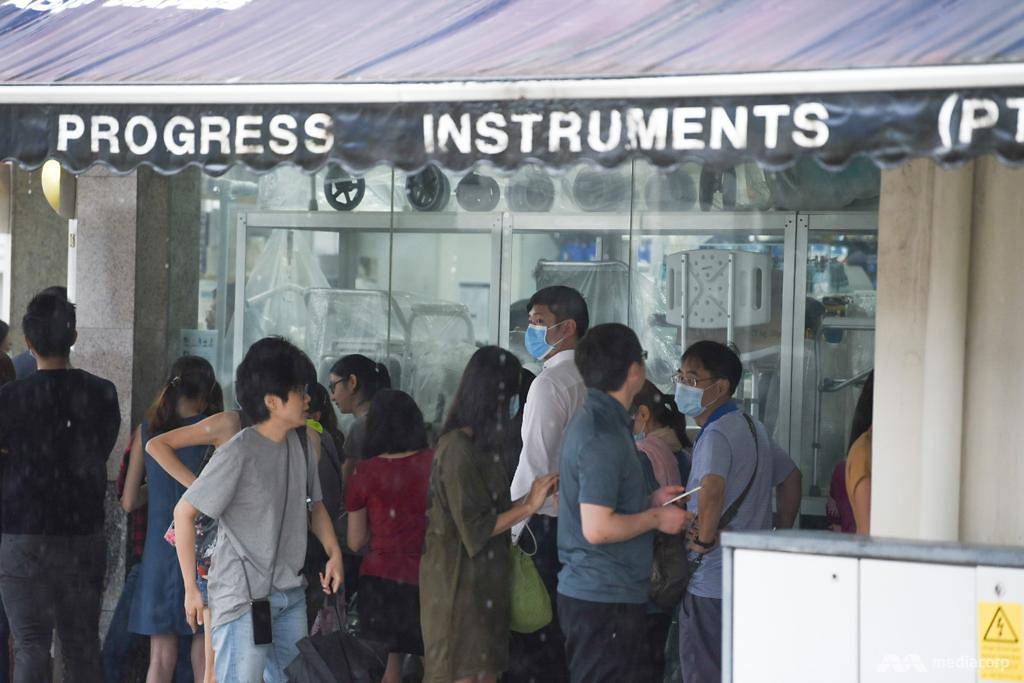
People queueing at a medical supply store in Singapore on Jan 29 to purchase face masks. (Photo: Gaya Chandramohan)
There are accounts of people who gave out masks to fellow Singaporeans who needed them more, and residents who left sanitisers and spare masks in common areas for others.
In another instance, a resident in Teban Gardens called for volunteers to help him disinfect all the lifts in the block he lives in, three times a week.
And then there are university students bringing food to their classmates on leave of absence. A most heartening response came from Grab drivers who offered to ferry healthcare workers to and from the hospitals.
The outbreak has also sparked expressions of hope, encouragement and appreciation for people working in the frontlines.
JJ Lin and Stefanie Sun showed the way with their song Stay With You. Local songwriting school The Songwriter Music College produced a song called Braver, Together. Students and many others have penned notes of encouragement for our frontline medical staff.
KEEPING THE ECONOMY MOVING
There are many businesses, organisations and people keeping the economy going – bus drivers and train operators, taxi and Grab drivers, airport staff, doctors and nurses in hospitals and private clinics, even bank tellers, supermarket check-out counter staff, stall-holders in markets and food courts – the list goes on.
Essential services are still being manned by frontline workers who could have chosen to stay home if they wanted to. Each day, they come into contact with thousands of people but do not let fear drive them into isolation.
Hidden behind the scenes are also suppliers, deliverymen and entire logistics chains working overtime to replenish shelves and ensure that Singaporeans have sufficient supplies of food and other essential items.
Companies and building managers are also stepping up precautionary and business continuity measures whether in implementing segregation or imposing restrictions to mitigate the risk of a spread.
Comfort taxis waiting in line at Singapore General Hospital amid the COVID-19 outbreak. (Photo: ComfortDelGro)
The queues in Suntec City will in time be gone, I hope, as people get accustomed to the new drill and find their rhythm.
Many Singaporeans intuitively understand the need for such actions despite the hassle. When I arrived at the RELC for Sunday service, I found that I could enter only through the front main entrance and I had to fill out a contact-tracing form. But I was heartened to see other visitors cooperating and not grumbling.
A friend was not able to attend a dinner because she had been working overtime to make sure her company’s staff complied with the government’s directives about travel itineraries.
Hopefully, more businesses will take similar steps but quickly get over this initial hump of activity needed to ensure business operations continue smoothly.
HOW WE THINK ABOUT THE SITUATION SHAPES HOW WE RESPOND
Looking ahead, fresh developments as the outbreak progresses may pose a bigger test. Our population is now so connected through social media and the Internet that we are bombarded with information and disinformation from myriad sources.
As we read about what is happening in China, Hong Kong and other parts of the world, how do we respond? Do we let fear overwhelm us and over-react? Do we panic and become irrational?
Is there going to be another rush for masks after news of Hong Kong being down to its last stock of masks? Do we adopt an “every man for himself” mentality? Or do we keep calm and evaluate the situation in Singapore?
A man pushes an elderly man on a wheelchair, both wearing masks, at Orchard Road, Singapore on Feb 3. (Photo: Gaya Chandramohan)
We all know the saying “it’s in the mind”. We can be strong in mind if we remember how we were able to survive recent crises.
What we need most is the will to carry on, to build strength and confidence in one another as individuals.
Remind each other of the bravery Singaporeans showed when SARS hit us. Point one another to reliable sources of information and do not allow fake news to confuse us. Above all, do not let the situation discourage us.
Life must go on. The Government is doing its part. We must do ours, at all tiers of society. Like a pair of scissors, both blades must be sharp.
Today (Feb 15) marks Total Defence Day, a day to remember that all Singaporeans, from government to businesses and individuals across society, play a part in whatever way they can to overcome a national challenge.
In the context of the novel coronavirus threat, Total Defence finds new resonance for me.
Singapore Armed Forces (SAF) personnel packs face mask for distribution to the public at SAFTI Military Institute in Jurong on Jan 31. (Photo: Try Sutrisno Foo)
Some call Total Defence a defence strategy but it is more than that. It is a national philosophy that encapsulates the Singapore spirit of rallying together, supporting one another and sticking it out when the going gets tough.
The Total Defence concept is not something alien. It is the essence of who we are. It brings out the instincts of survival that we as Singaporeans have had ever since we achieved independence as a nation.
Every time we faced a national challenge, we rose to the occasion, and we grit our teeth through the inconveniences and whatever losses we suffered.
And together we rode through the storm and came out of it with a spirit of gratitude that we survived.
As we live out the rest of these days facing the coronavirus outbreak, let’s remember this Total Defence philosophy. Older Singaporeans should pass it down to the generations coming after us.
It is only when we display these instincts will we be able to conquer our fears and win this national test against the coronavirus.
SINGAPORE – Major cruise lines are cancelling their sailings from Singapore or pulling out of Asia entirely for the remainder of the season, putting the brakes on one of the region’s fastest-growing tourism sectors.
Some cancellations have come within the last several days, as more ports in the region shut their doors to cruise ships amid fears over the spread of the coronavirus.
Celebrity Cruises told The Straits Times on Thursday (Feb 13) that it will be moving its Celebrity Millennium cruise ship to the United States three months earlier than planned.
“Up until today we had not intended to cancel the remaining season in Asia. However, due to continuous and unpredictable changes in travel restrictions and port closures, we feel this is the best decision for the health and safety of all,” a spokesman said.
Its Celebrity Constellation voyages on March 2 and 17, originally scheduled to disembark and embark in Singapore, will now make a round trip from Dubai instead.
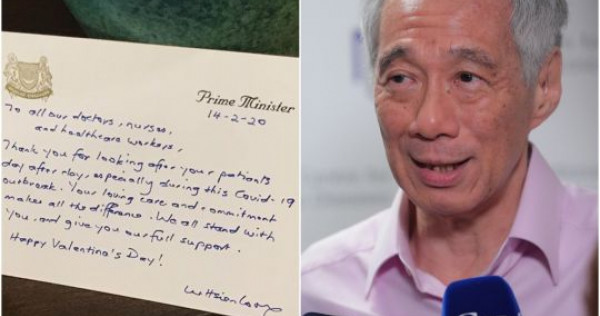
SINGAPORE – In a Valentine’s Day note, Prime Minister Lee Hsien Loong thanked all doctors, nurses, and healthcare workers for looking after their patients every day, especially during the coronavirus outbreak.
“Your loving care and commitment makes all the difference,” he said, sharing a picture of the note in a Facebook post on Friday (Feb 14). “We all stand with you and give you our full support.”
He added in his post that this group is “going above and beyond the call of duty to keep us all safe and well, and to keep Singapore going”.
The post was tagged #BraveheartSG, which is an ongoing movement inviting people to handwrite notes of encouragement to front-line medical staff and share pictures of them on social media with the hashtag.
Community group StandUp For.SG, which is spearheading this initiative, will print out these images and distribute them to staff at healthcare institutions across the island from Friday.