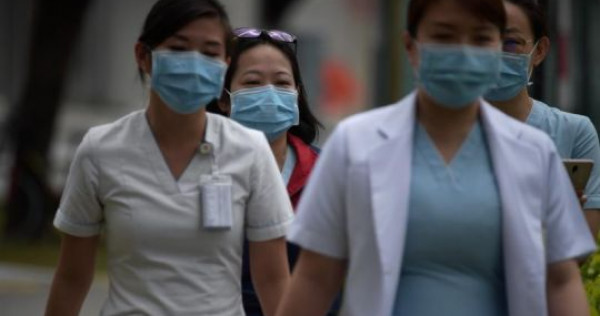
SINGAPORE – Nurses follow strict hand hygiene guidelines and use protective equipment such as gowns, masks, gloves and eye protection, said SingHealth group chief nurse Tracy Carol Ayre.
Those in high-risk areas don personal protective equipment and hospital-laundered scrubs rather than their uniforms, she added.
“With these measures, the nursing uniform is much like any other work outfit we wear to work, and not ‘contaminated’,” said Adjunct Associate Professor Ayre. The hospital environment and equipment are also cleaned and disinfected more frequently, according to protocol, she added.
A Dr Lim, who declined to give her full name, said she goes through a thorough disinfection routine before heading home from the public hospital where she works.
She uses alcohol wipes to clean items such as her phone, pen and name tag, and washes her hands with surgical handrub.
These are standard operating procedures she was following even before the coronavirus outbreak last month. Dr Lim now plans to shower as well before heading home after shifts.
SINGAPORE: A package to help households with the cost of living will be introduced as part of this year’s Budget, said Deputy Prime Minister Heng Swee Keat on Sunday (Feb 16), as he sought to reassure Singaporeans that the Government is mobilising its full resources to tackle the COVID-19 outbreak.
As of Saturday, 72 people have tested positive for the coronavirus in Singapore, with the Government earlier this month raising the Disease Outbreak Response System Condition (DORSCON) to Orange.
As Singapore deals with these challenges, the authorities are doing their utmost to fight the outbreak, said Mr Heng in his remarks.
“While dealing with the immediate challenges, I want to assure Singaporeans that we are doing our best, mobilising our full resources across Government and society, to fight the outbreak and to better protect you,” he said.
His remarks come after Prime Minister Lee Hsien Loong on Friday warned the ongoing COVID-19 outbreak could have a significant impact on the local economy.
Workers and firms are “understandably concerned” about the impact of the outbreak on the economy, said Mr Heng.
“Some sectors have been hard hit, such as tourism and transport, and we have already taken targeted measures to support them. But we can expect to see a broader impact on the economy,” said Mr Heng.
“As confidence is affected, businesses and consumers could cut back on spending,” he said. “The disruption to the global supply chain – a result of the interruptions to production in China – will also affect trade and manufacturing. Our workers and firms are understandably concerned.”
As such, Mr Heng – who is also Finance Minister – touched on a set of “broad-based measures” to be announced as part of Budget 2020 to support companies, workers and households.
“On Budget Day on Tuesday, I will set out a set of broad-based measures to support viable companies and help workers stay in their jobs,” he said.
This includes providing wage support to “help companies preserve jobs for local workers”, as well as tax rebates and rental waivers to help firms with their cash flow.
More support will also be given to sectors that have been harder hit by the outbreak, including food and beverage and retail sectors, said Mr Heng.
The Government will also support firms and workers “to make the best use of this period” to carry out restructuring, training and upgrading, in order to “emerge stronger when the eventual upturn comes”.
Help will also be given to households concerned about the cost of living, he added.
“In this time of uncertainty, I know that households are more concerned about their expenses,” he said. “So I will introduce a package to help households with their cost of living.”
People are seen wearing protective face masks at Orchard Road, Singapore on Jan 28. (Photo: Gaya Chandramohan)
He reiterated that the Government would do “all that is necessary” to help those affected by the COVID-19 outbreak.
“Never doubt that Singapore has the means to bounce back from this outbreak,” he said. “I assure you as Finance Minister that this Government will do all that is necessary to get workers and companies hit hard by this global health crisis back on their feet.
“With all these additional support measures, you have my assurance that we will rebound from this. Never fear.”
TURN FEAR, ANXIETY INTO “CONCRETE ACTION”
In addition to support for companies and workers, Singapore will also need to strengthen its “social and psychological resilience” in the fight against COVID-19, said the Deputy Prime Minister.
Mr Heng called for people to “turn our fears and anxieties into concrete action” to tackle the outbreak, including looking after themselves and taking care of others.
This means taking measures such as observing good personal hygiene, seeing a doctor and staying home if unwell and staying updated on the situation from credible sources.
“If you are well, carry on with normal life as far as possible,” he said.
After Singapore raised its DORSCON level to Orange, the country saw a surge in demand for groceries, with some stores reporting stock shortages.
Authorities moved to assure Singaporeans that the country’s supply chain remains robust and that there was no need to rush for essential supplies.
In his remarks on Sunday, Mr Heng urged people not to panic buy or spread rumours.
“We have enough supplies of food, and an adequate stockpile of masks and other essential items, if used responsibly,” he said.
“We are actively replenishing our supplies and stockpiles from a diverse range of sources.
“But if you hoard, this will deny others with real needs.”
He also praised examples of generosity and kindness shown by Singaporeans which “demonstrate the best of the Singapore spirit”.
“SG United is our rallying call for this outbreak in a whole-of-society effort,” he said. “The outbreak is a test of our social cohesion and our psychological resilience. We can all do more to help those around us, and we can speak and act with hope and care.”
The Deputy Prime Minister also expressed his gratitude to healthcare and frontline staff members.
“I would like to express my deep appreciation to all our healthcare and frontline staff for their dedication, hard work and sacrifice. You have our full support,” he said.
“I am also heartened by how our people have rallied together. Everyone has something to offer, and every action makes a difference.”
SINGAPORE CONTRIBUTING TEST KITS TO CHINA
Singapore has been able to mount “a swift response to this sudden outbreak” because it learnt from its past experiences, built up capabilities over the years and adjusted its approach as the situation develops, said Mr Heng.
The country has also mobilised new capabilities in its fight against COVID-19, he added.
Since the SARS outbreak in 2003, Singapore has built new healthcare capabilities such as the National Centre for Infectious Diseases and better healthcare infrastructure to deal with outbreaks.
The Deputy Prime Minister also singled out research and design capabilities as “essential” to mounting an effective response to the outbreak.
“Since the outbreak, our research community has been working hard behind the scenes in partnership with our healthcare community and companies and building on our strong networks with the international community, to collaborate with scientists from around the world,” he said.
Just over a week after the disease’s viral sequence was made available, local researchers developed a diagnostic kit for the virus, said Mr Heng.
“This has been very helpful in our screening efforts for suspected cases,” he added.
Singapore is contributing test kits for 20,000 tests to China, he said, noting that “all of us” would benefit from China’s success in overcoming the outbreak. Singapore and the global community must “do our part to contribute to this effort”, he added.
The local research community is also working with global partners to better understand the nature of the virus, develop faster diagnostic tests that are simpler to run and trial new treatments and potential vaccines.
SINGAPORE: Financial advisers in Singapore don’t have a great reputation.
A survey by the CFA Institute found that only 10 per cent of Singapore retail investors believe their investment advisers have their clients’ interests at heart.
Given Singapore’s reputation as a financial services hub, some may find this lack of trust troubling.
But if you’ve lived in Singapore long enough, you probably would have experienced the unique displeasure of being hounded at shopping centres and MRT stations to fill up “surveys” and listen to financial plan sales pitches.
Or you may have been contacted out of the blue by a long lost friend, who turned out to be more interested in the state of your investment portfolio than in how you’re doing.
Irritating prospecting methods aside, it also doesn’t help that we see posts on social media by consumers who expressed regret buying ultimately unsuitable financial products, interrupted by photos of yet another new car, incentive trip or gala dinner posted by financial advisers.
More recently, financial advisers were also found lurking on Tinder where lonely hearts try to find love, causing a heated debate over the merits of meeting people on false pretence, and the ethics (or lack thereof) of the industry as a whole.
Perhaps it’s worth taking some time to discuss what’s the best way (if not Tinder) for advisers and clients to cultivate a long-term, mutually beneficial and fruitful relationship.
FINANCIAL AGENTS HATE THESE TACTICS TOO
To be fair, many of the prospecting methods consumers hate so much are just as torturous for financial advisers.
Paying money to rent a booth and stand all day, only to be greeted with mostly rejections, is physically and emotionally draining.
File photo of workers outside an MRT station in Singapore’s Central Business District. (Photo: TODAY)
It also can’t feel good to have to call up your entire phone contacts’ list, alienating a large chunk of friends in the process.
Insurance agents might even feel uncomfortable swiping right on Tinder and leading people on, only to give the other party a rude shock when he or she pulls out a financial plan over what was supposed to be a date.
For the most part, those who get enough results to make it worth their while will continue doing it. You might think one out of 30 conversion rate seems poor, but it simply means that to get 10 sales, you just need to approach 300 people.
Anecdotally, many learn such methods from their mentors and peers.
Someone who joins an agency that values aggressive and unconventional lead generation as the chief way to climb up the sales charts and win a seat on the Million Dollar Roundtable, will be tempted to do the same, even if they don’t see initial results or have misgivings.
A man in the office. (Photo: Pixabay/caio_triana)
But these poor methods to get a customer to sign on the dotted line aside, I would argue we should distinguish these from the quality of financial advisory. You might just meet a competent financial adviser.
As with all relationships, trust is key in forging a productive relationship with one’s financial adviser.
There is no doubt such methods create poor first impressions. If someone needs to resort to deception, roadshow surveys or cold calling, they probably would not have a lot of referrals or repeat clients, the thinking might go.
You might be concerned that such a financial adviser would not be completely forthright in recommending products for you.
Even if the financial adviser strove to provide advice that were completely in your interest, the impression has been established and doubts will linger.
With a large life insurance and critical illness coverage gap, rising healthcare costs and increasing life expectancy, the work of financial advisers to help Singaporean prepare for retirement and have peace of mind is more crucial than ever.
It would be unfair to tar all financial advisers and insurance agents with the same brush just because of a few black sheep.
Every day, the majority of the roughly over 20,000 financial advisers go about doing important work with little fanfare – educating clients, helping customers with claims, and keeping themselves abreast of the latest developments in the market.
It is the small portion of bad apples who receive disproportionate outrage on social media.
Given the presence (and persistence) of this bunch, it wouldn’t be productive to simply point fingers at or resorting to blaming and shaming, if we want things to change for the better.
We can and should all take responsibility, whether we’re a consumer, financial adviser, or insurer.
Financial advisers can seek out positive role models whom you can learn from to build a sustainable, ethical business you can be proud of.
Financial advisers should have the courage to reject methods that don’t feel right, with the understanding that the single-minded pursuit of short-term gain is self-defeating, and the only way to build a successful, sustainable financial advisory practice is to build it right.
Annoying nine people just to find one person who might need your financial advice should not be seen as “success”.
Accepting such collateral damage devalues the financial advisory profession, and wouldn’t lead to establishing a virtuous cycle of finding suitable clients, ensuring they have a good experience and winning quality referrals – which leads to finding more suitable clients.
Towards this end, financial advisers today can’t merely be salespeople. They need to continually add tools to their repertoire, acquiring soft skills like written communication, active listening, social media literacy as well as hard skills like knowledge about various aspects of personal finance beyond products they sell, including the CPF system, estate planning, and debt management.
This ensures a steady stream of customers that don’t just come from good marketing, but from repeat clients and referrals because of quality, indispensable service rendered.
As consumers, we can do our part by reporting these unethical and illegal practices we encounter to insurance companies or the Monetary Authority of Singapore.
Conversely, we can support good financial advisers by genuinely sharing our good experiences with those around us who are in need of financial advice or are in the market for financial products.
(Photo: Unsplash/Oleg Magni)
Insurers and financial advisory firms can also do better to recruit the kinds of talent who not only have the aptitude for a career in the industry, but prioritise those who uphold consumer trust and have hearts in the right place.
All it takes is one errant representative to undo the trust painstakingly built up over the years.
GIVING YOURSELF A CHANCE
Just as the quote on marriage goes: “You shouldn’t marry someone you can live with – marry someone you cannot live without.”
Likewise, don’t buy an insurance policy or investment product just because an agent is pushing it.
The right financial adviser can help you identify your needs and find a suitable financial plan but you should always feel free to say no.
Sim Kang Heong is the co-founder and content lead at DollarsAndSense.sg, Singapore’s leading personal finance website.
SINGAPORE: When former national swimmer Tao Li flew to Wuhan to visit her family for Chinese New Year in January, she had no idea a potentially deadly virus was spreading in her hometown.
She arrived in Wuhan on Jan 22, a day before Chinese authorities ordered a lockdown of the city to stem the spread of COVID-19. The virus has now infected more than 68,000 people and killed more than 1,600 worldwide.
“We knew there was a virus going around, but everyone thought it was in the hospitals, not in the streets or the city. The airport was still busy when I landed,” said the swimmer, who was one of 92 Singaporeans eventually evacuated from the city on a Scoot flight on Jan 30.
She spoke to CNA on Saturday morning (Feb 15) by the poolside at Temasek Club, where she runs her Tao Li Swimming Club.
Two days earlier, she had finally been cleared to go home after serving a 14-day quarantine order at a chalet in Jalan Loyang Besar.
A VIRUS IN THE AIR
While in Wuhan, Tao was still optimistic that the lockdown would be lifted after a few days, and that she would be able to go back to Singapore on Jan 26 as planned.
But her initial calm gave way to anxiety as news and rumours flooded Chinese messaging app WeChat.
“You read, and you begin to suspect that everything is true,” she said.
Tao spent most of her time at home in Wuhan, except for some quick grocery runs. “I still have to buy my daily needs. When I step out of the door, I wonder, ‘is there a virus around me’? You get a fear deep in your heart,” she said.
Tao Li (back row, right), her cousin and her grandparents. (Photo: Tao Li)
She was eager to come home as she had coaching commitments in Singapore. On a friend’s suggestion, she contacted the Singapore Embassy in Beijing and was told to stand by for an evacuation flight on Jan 29 or 30.
Then, she was told that her mother, a Chinese national, would have to remain in the city. The 55-year-old had moved to Singapore to take care of her daughter in 2001.
Tao Li was told that her mother, a Chinese national, would have to remain in Wuhan. (Photo: Tao Li)
“Of course I miss my mum,” said Tao. “This house feels very empty. I miss her voice … I see my dad sending messages on WeChat, telling me they are safe. But deep in my heart, I worry for them.”
THE WAY BACK TO SINGAPORE
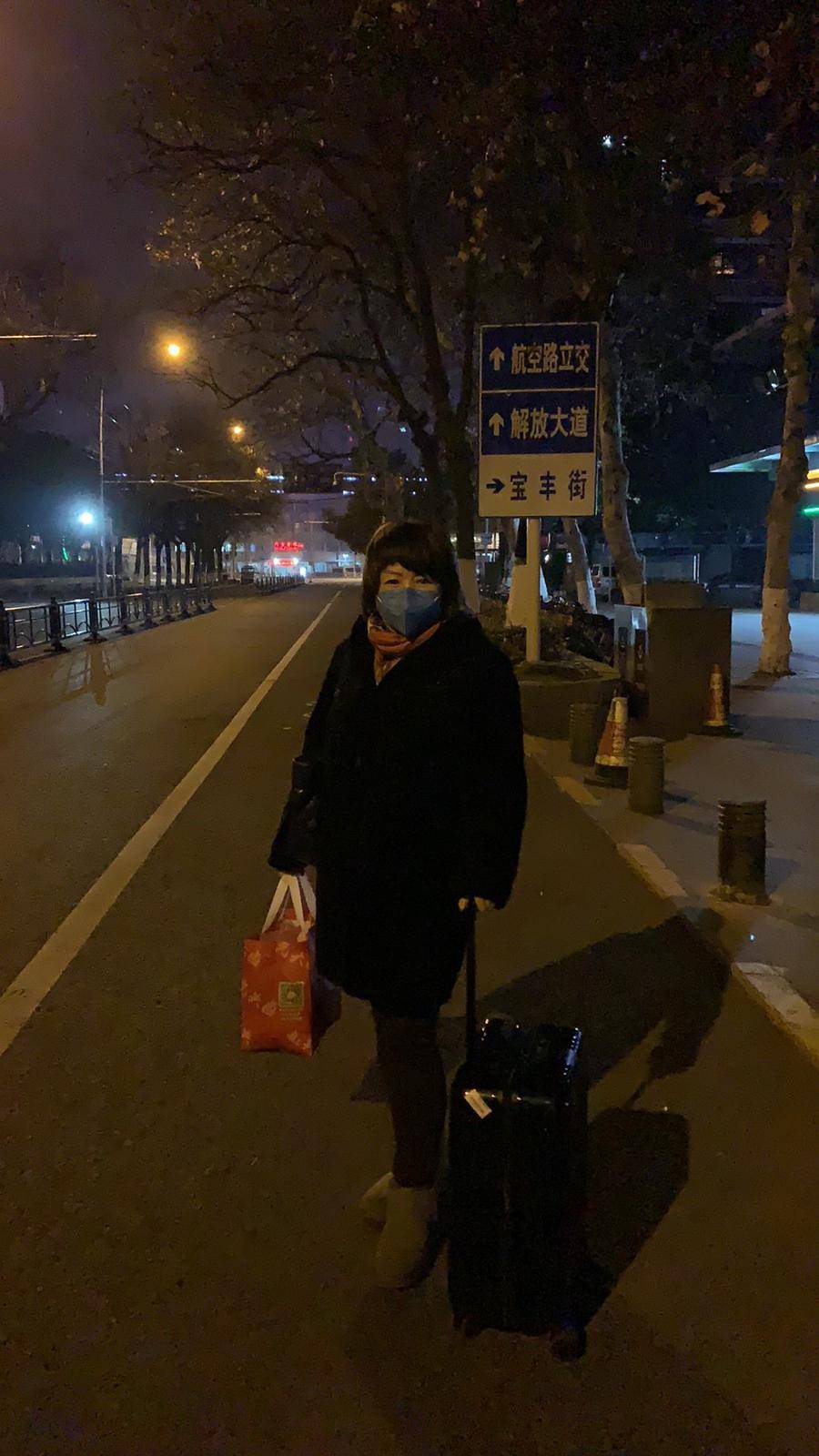
The night before her flight, Tao made her way to Wuhan Tian He International Airport decked out in a mask and gloves.
But she didn’t have to worry about passing an infected stranger on her way to the airport – the streets were empty, and only cars with prior approval could get on the major highway out of the city.
Workers disinfecting streets in Wuhan, China. (Photo: Tao Li)
The airport too, was similarly deserted, save for the other Singaporeans departing on the same flight.
“We were the only group of people there. There were maybe six airport staff helping us to check in, and take our temperatures … The atmosphere was very tense, everyone seemed to be scared of getting infected,” said Tao.
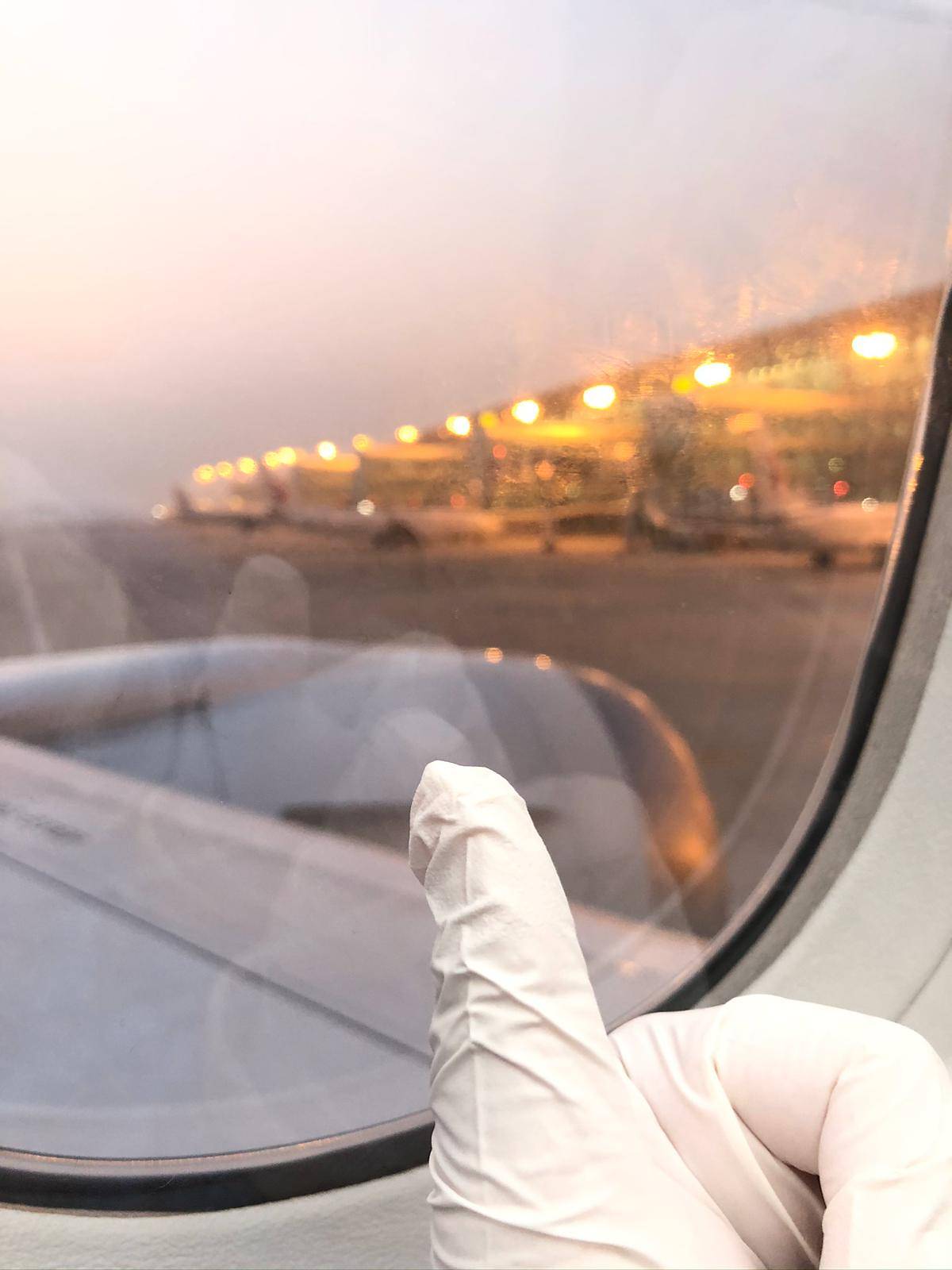
Tao Li eventually made it back to Singapore on a Scoot flight. (Photo: Tao Li)
The passengers went through multiple temperature screenings before being allowed on the Scoot flight. While the flight was scheduled for 3am, the passengers waited until 7am to board as the plane had to be disinfected.
The airline crew donned N95 masks and surgical gloves while attending to the needs of the passengers on board. Tao was full of gratitude for them.
“They knew the virus situation was getting worse, but they were still brave enough to fly us back to Singapore. I really want to thank them for their brave actions,” she said.
Tao was aware of the sacrifices frontline staff have to make – her aunt is among the army of healthcare workers battling the disease in a Wuhan hospital. She said she was upset to hear stories of discrimination against medical staff in Singapore.
“When I heard that nurses were asked not to board buses, I think this is very sad,” she said. “Without them, we can’t sit here and have a normal life. We could all be sitting in places like a quarantine centre.”
“We have to show appreciation for all those ambulance drivers, nurses and doctors.”
Tao Li’s aunt is among the army of healthcare workers battling the disease in a Wuhan hospital. (Photo: Tao Li)
THE QUARANTINE
When the Scoot flight landed in Singapore on Jan 30 at around 11.30am, Tao Li, along with the other passengers was screened before being sent to a Government quarantine facility at Aloha Loyang. The buses they were in were escorted by the police.
At the chalet, the Wuhan evacuees alighted from the bus one by one, and were given keys to their rooms. Initially apprehensive about the conditions of the quarantine centre, Tao was pleasantly surprised at the facilities provided.
“When I opened the door (to my room), I thought, wow. It’s a good life here. I told myself to just take this as a holiday,” she said.
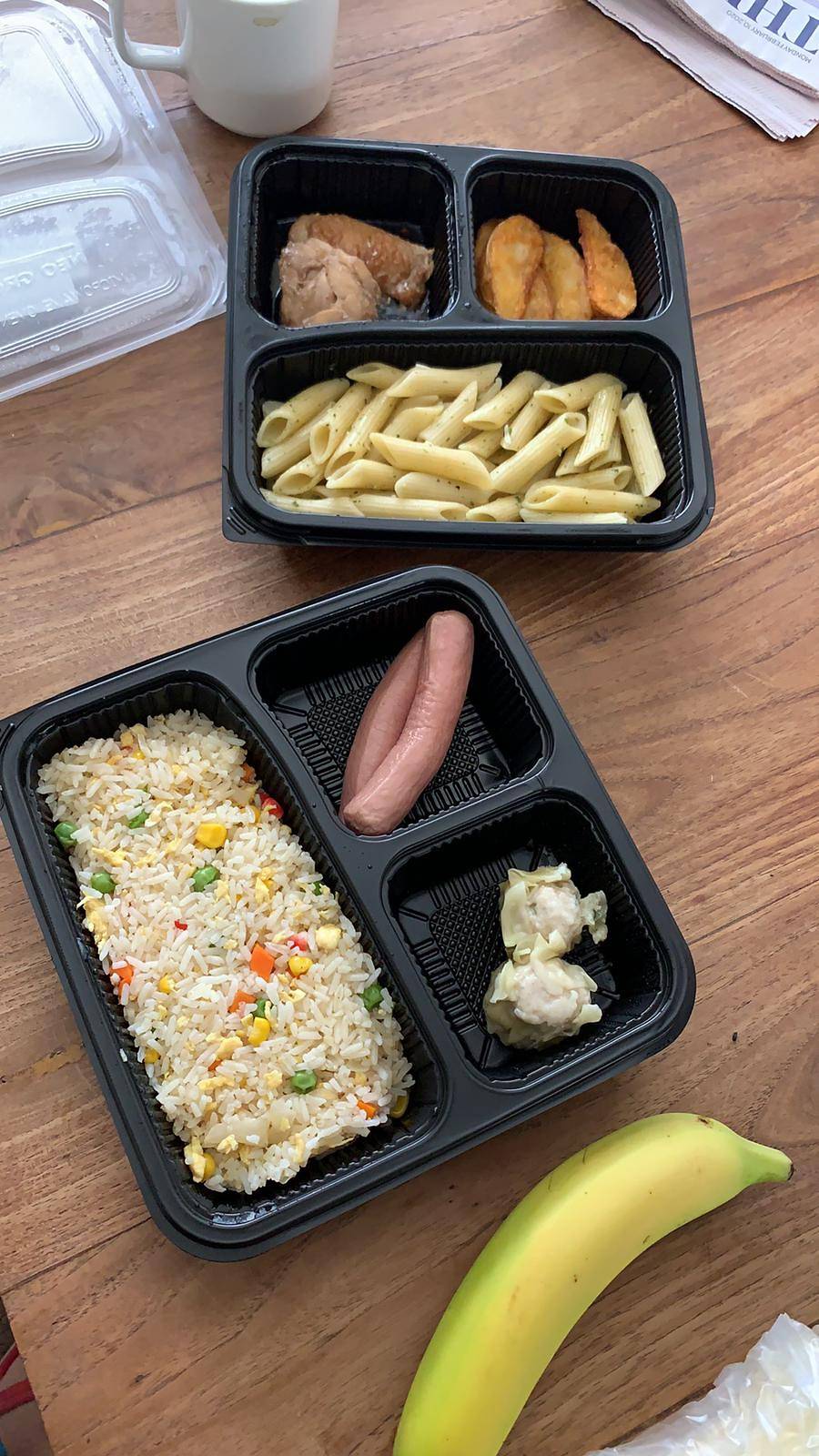
Tao said all her needs during the 14-day stay were taken care of. Masks and thermometers were provided, and all three meals were placed at her doorstep every day.
Some of the meals provided at the quarantine facility. (Photo: Tao Li)
Those under quarantine could even arrange for deliveries – which would be dropped off at the quarantine centre’s guard house, and later sent to their rooms.
Some of the food provided at the quarantine facility. (Photo: Tao Li)
Tao had a friend pack some lightweight clothes for her, as she only had winter wear in her luggage.
“You can order Grabfood, Foodpanda or bubble tea every day if you want,” she joked. “What a wonderful life.”
She said the two weeks were a mix of boredom, and sometimes, anxiety – especially after some passengers tested positive for the coronavirus.
The Wuhan evacuees had to undergo nasal swab tests twice to check for the coronavirus. During the procedure, a thin swab is inserted through the nostrils to the back of the nose to obtain a mucus sample.
Although the process took “only a few seconds”, Two described it as an uncomfortable experience.
“When they inserted the (swab) all the way in, I started crying. It’s very painful actually,” she said. Five of the 92 evacuees were eventually confirmed to have the COVID-19 infection.
Upon arrival, the passengers were screened and then taken to a Government quarantine facility. (Photo: Tao Li)
On Feb 13, the other 87 Singaporeans were finally cleared to go home.
“I was so happy, I couldn’t wait!” she said.
“Before this virus, I would think about being rich or famous … Of course I still have dreams, but that slows down … Now I think about my health, my family, and the ones I love – those are more important than anything else.
“And when they opened the gates (of the quarantine centre), I just thought – what a wonderful life,” she said.
A The virus is spread via droplets, and hands may touch surfaces contaminated with the virus. If you touch your eyes, nose or mouth with your contaminated hands, you can transfer the virus to yourself.
Washing your hands with soap and water will get rid of the virus if it is on your hands.
2. Q Should I just wear gloves?
A You can do so, but this is not practical. Also, if your gloves are dirty and you touch your face, you can still transfer the virus to your face.
3. Q Why must I cover my mouth or nose with a tissue when coughing and sneezing?
A The virus spreads via droplets. Covering your mouth and nose when coughing and sneezing prevents the spread of germs and viruses.
If you sneeze or cough into your hands, you may contaminate objects or people that you touch.
4. Q Masks can protect us. Why do the Government and the World Health Organisation say we should wear masks only when we are sick?
SINGAPORE: Rice, hot water and salt to taste. Shanger Pannerchelvam remembers a time when these were the only ingredients his family could afford for dinner. He was only 12 years old.
His mother had to stop work as a cleaner at a condominium when artery disease affected her legs. One year later, his father fell into clinical depression and left his fast-food job. Just like that, the family had no breadwinner.
Like most adolescent boys, Shanger had a burgeoning appetite – which a small bowl of porridge was unable to satisfy. “I was full of anger as I ate. I’d think to myself, why must I eat this?” he recalled.
After dinner, he’d go to sleep. “There was nothing I could do about it. I slept so that I wouldn’t feel any emotions.”
That was his only meal of the day. In the morning, he’d go to school with an empty stomach, fighting hunger pangs through recess because he’d given his S$1 school meal voucher to his 8-year-old brother.
“He had his own coupon but it wasn’t enough. He was always hungry also,” said Shanger, now 22.
This plain rice was what Shanger and his brother once had to survive on every day. (All photos: Goh Chiew Tong, Christy Yip, Rauf Khan)
The family of four was given help with the bills, and food rations. But the latter wasn’t enough. The brothers resorted to begging for money from strangers after school.
“We’d give the ‘poor thing’ face, say our Ez-link cards had no money and we couldn’t get home,” said Shanger.
“We would ask for a dollar each for transport. Then we’d use this to buy a plate of chicken rice to share.”
HUNGER IN A FOOD SECURE NATION
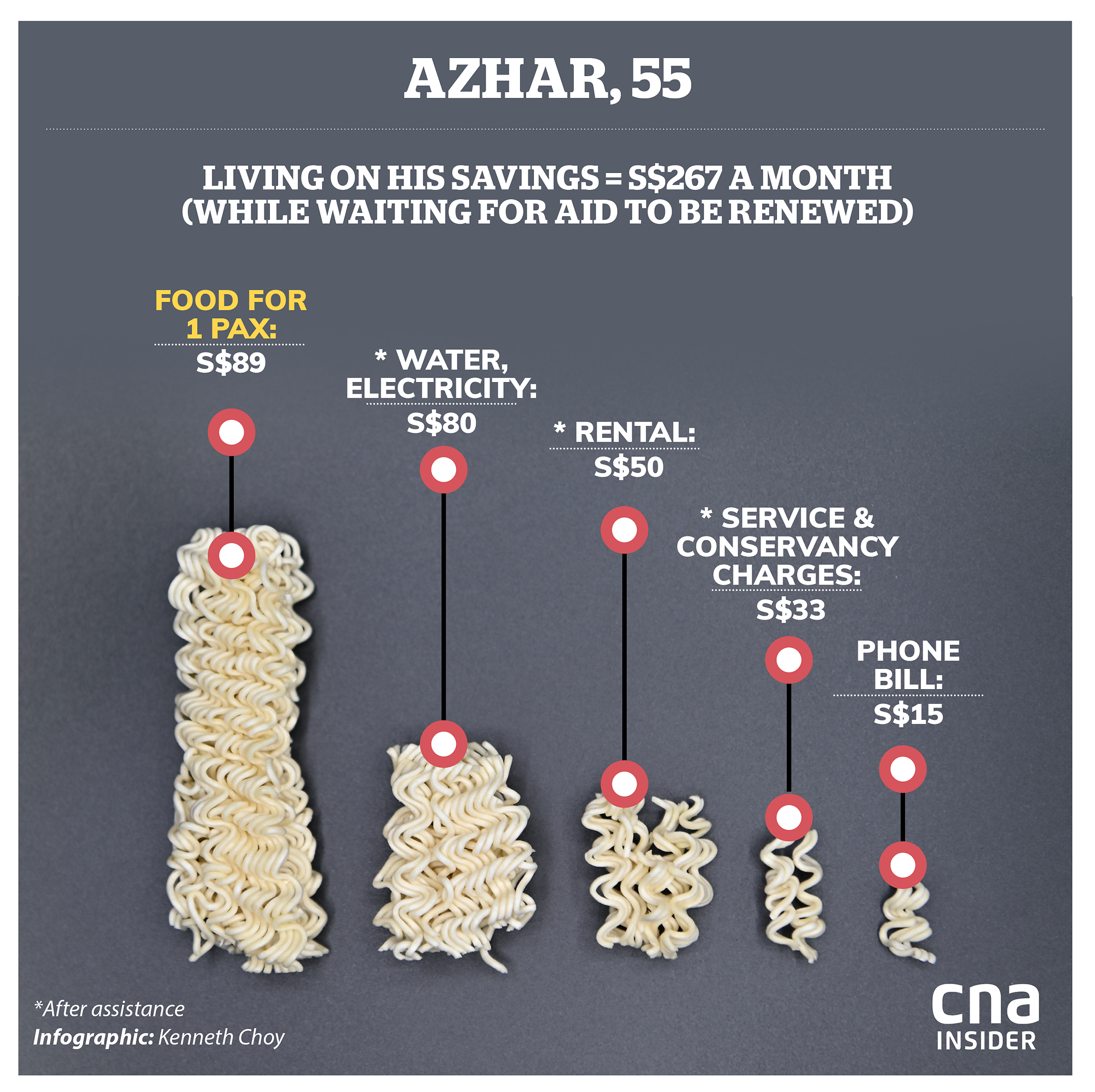
A simple dish like chicken rice is also a luxury to 55-year-old Azhar Ibad. It’s a S$2 meal he can afford to have only once a week.
The rest of the time, it’s instant noodles for the cleaning supervisor, who has been unable to work for a year due to growing weakness in his limbs that doctors suspect might be Parkinson’s disease.
While he waits for his ComCare assistance to be renewed, his kitchen cabinet is filled with packets of Maggi, cereal and Milo. “If I feel my stomach full, okay already. No choice,” he said. “I eat this to survive.”
In a food paradise like Singapore, where cheap eats abound around almost every street corner, why are instant noodles a staple and emblem of resignation for some?
What makes putting food on the table a struggle for them, in a nation ranked No 1 on The Economist Intelligence Unit’s Global Food Security Index in December 2019?
There is no national data on the extent of food insecurity in Singapore. But aside from the index (which used gauges like affordability, availability, quality and safety of food), there are at least two other indicative reports.
Some 4.1 per cent of Singaporeans faced moderate to severe food insecurity between 2016 and 2018, according to the State of Food Security and Nutrition in the World 2019 report by the United Nations.
The report took into account both survey responses and country-level data such as food consumption and availability. (By comparison, the figure was 5.4 per cent for South Korea, 8.1 per cent for Indonesia and 13.4 per cent for Australia.)
Locally, a study conducted by the Lien Centre for Social Innovation at the Singapore Management University (SMU) surveyed 236 Singaporeans in four low-income neighbourhoods being served by food support groups. It found that nearly 1 in 5 participants in these areas reported severe food insecurity in 2018.
“It was surprising because in a country like Singapore, where the stereotype is that there is no hunger, we were expecting to find just a handful of people,” said SMU associate professor of political science John Donaldson, while stressing that the findings didn’t represent Singapore as a whole.
Would you want to live on instant noodles everyday, for months? asks Azhar Ibad, 55.
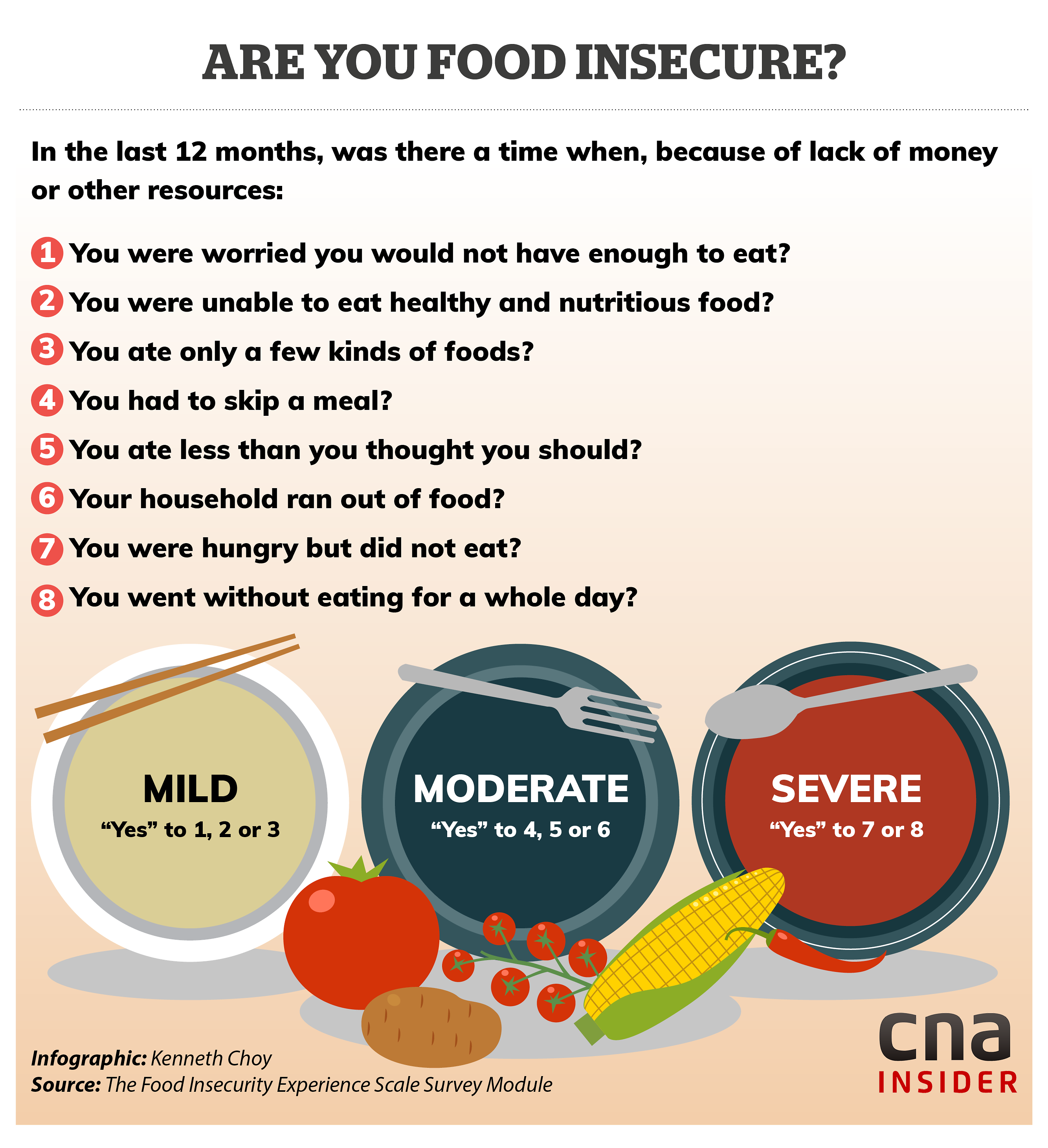
To be severely food insecure means being in the shoes of someone like Shanger – not knowing where your next meal is coming from, having to skip one, or even go an entire day without eating.
But more generally, food insecurity refers to cases like Azhar’s: The lack of access to sufficient, safe and nutritious food, due to financial or physical constraints.
In other words, being food secure “is not just about being fed, because you can eat instant noodles every day,” said Nichol Ng, co-founder of The Food Bank Singapore. “But that doesn’t provide you with the nutrition.”
As to why food insecurity exists – ‘poverty’ is the too-easy answer to give.
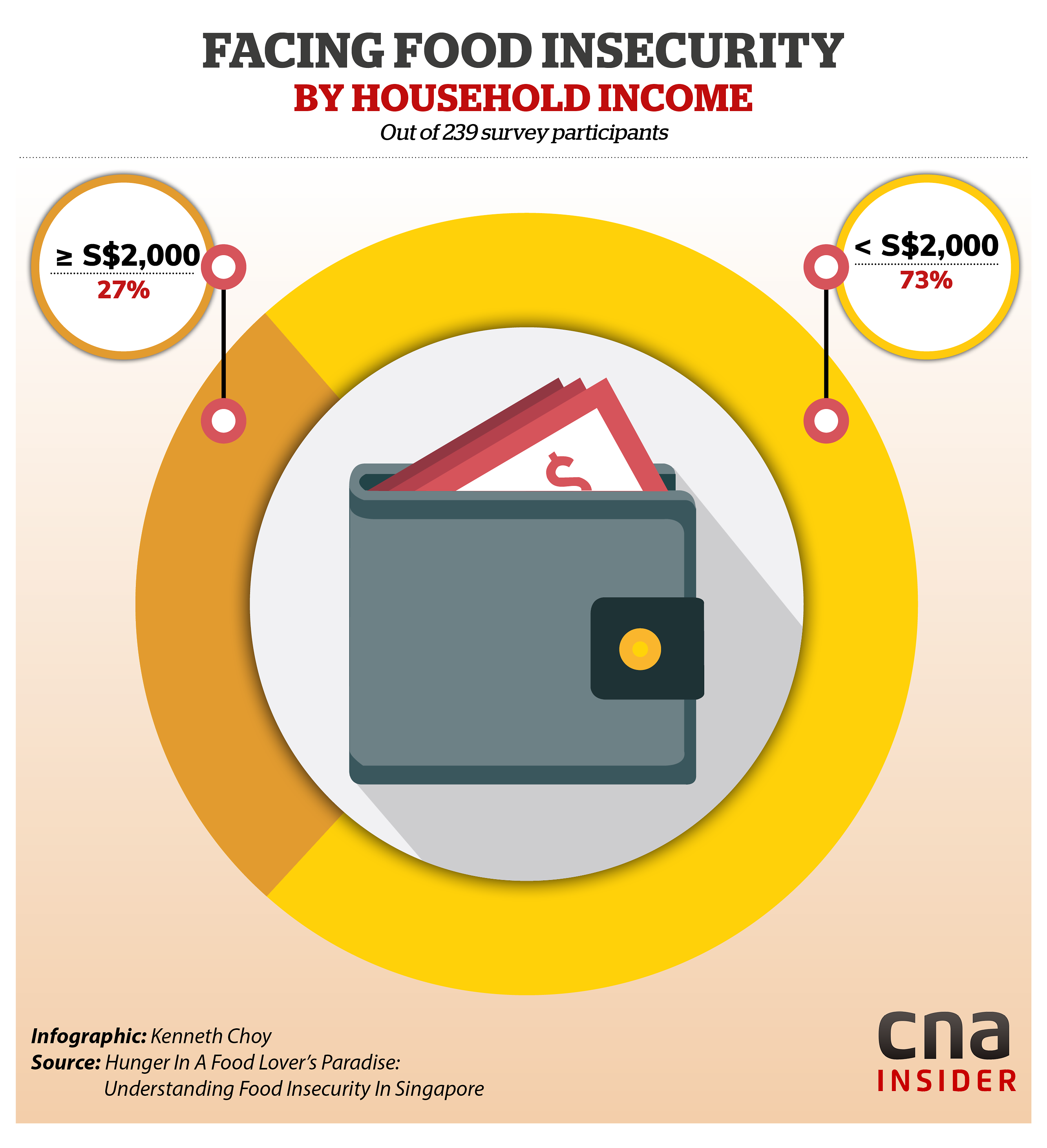
Yet, 27 per cent of participants in the Lien centre survey had household incomes of S$2,000 or more. (Eligibility for ComCare assistance cuts off at S$1,900 household income or S$650 per capita income.)
Nor is Singapore short of safety nets for those in need: From Government schemes such as ComCare and the Silver Support Scheme, to the efforts of a plethora of social service agencies, charities, religious organisations, grassroots groups, and community do-gooders.
So why, then, do some fall through the cracks? And who are they?
As CNA Insider discovered – after tracking vulnerable families and individuals over months, and speaking to researchers and assistance groups – those who experience food insecurity are a surprisingly diverse group: One that can’t be defined by housing type, family size, age, or income group alone.
WATCH: Hunger in Singapore – the documentary, part 1 (20:08)
BEYOND THE ELDERLY POOR
The elderly poor often spring first to mind as an at-risk group – and not just for the lack of savings or income.
Particularly for those who live alone, sickness, limited mobility and frailty pose a mammoth challenge to the simple act of cooking for themselves. “Some, because of physical or mental health, aren’t able to go downstairs and get food, even if it’s just a short distance from home,” said Sam Ngeow, centre manager of TOUCH Home Care.
Frailty contributes to food insecurity among the elderly living alone.
Fion Phua, the founder of volunteer group Keeping Hope Alive, recalls in June last year finding a famished 79-year-old man lying on the floor of his one-room flat in Marsiling, too weak to move.
The man – a former security guard who had not been working since April after being injured in a fall – had not eaten in three days, she said. “We had to send him to the hospital.”
But, the elderly poor are also high on the list of vulnerable groups that receive attention.
Not only has the Pioneer Generation package made a “real and important difference” in recent years, say many observers, the elderly are also the target of numerous social service agencies, volunteers and NGOs.
The resulting irony is, such seniors can end up over-served by multiple well-meaning groups. Indeed, most the elderly poor whom CNA Insider encountered in various neighbourhoods were receiving food rations or free meals.
Madam Tay Seok Har gets free packed meals to help feed her 70-year-old husband, mum and bed-ridden daughter.
The flip side of this, however, is that other food insecure groups whose needs may not be so plain to see, or so simple to ascertain, find themselves falling under the radar.
‘HIDDEN’ FIGURES
A stay-at-home mother of five, Fay* found herself going on Facebook to look for donors offering milk power or food. She had asked various organisations for help, only to be told: You’re not staying in a rental flat.
The 36-year-old and her husband had bought a four-room HDB flat, and after they moved in in April last year, she said, the floors started to crack and there were leaks everywhere – an unsafe situation for her children, aged two to 18.
To pay for the renovations, her husband, a technician, borrowed “a few thousand dollars” from licensed money lenders, a debt they are still now paying off.
“Living in a purchase flat does not explain our daily struggles,” she said.
Sometimes I see my friends staying in rental flats, they seem happier. They get more assistance.
The family is currently getting dry food rations from their Family Service Centre.
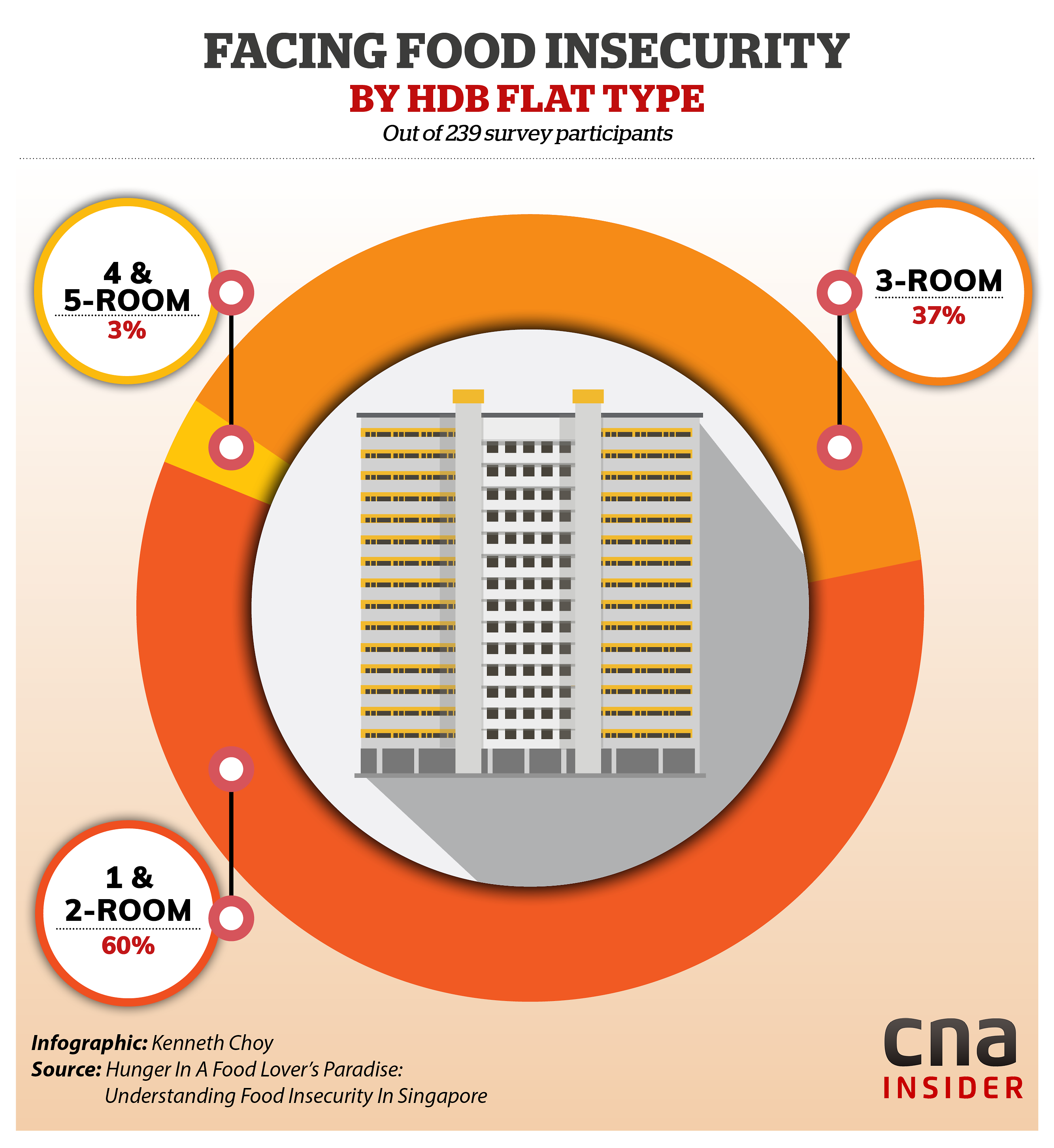
While the majority of food-insecure participants in the Lien centre study did live in one- and two-room flats, 40 per cent live in three-room flats or bigger. Food assistance groups say that, while rare, they’ve even encountered those living in condominiums or landed property who needed their aid.
These Singaporeans are overlooked as they are often not eligible for financial aid, observers noted.
To ensure that funds go to those who really need it, ComCare assistance, as well as aid disbursed by some larger welfare organisations, often involves some form of means testing. An applicant’s household income, number of household members and flat type are factors that can be taken into account.
But such data doesn’t always reveal the whole picture, others say. Sim Bee Hia, chief executive officer of Food From The Heart, has encountered struggling families with a household income of more than S$3,000.
“If you were to do a house visit, you’d see the wife bedridden and fed through a tube, three young children, and a mentally challenged nephew,” she said.
The danger in means-testing is that people who genuinely need help will fall through the cracks because they do not fit the criteria in one way or another, said economist Walter Theseira, an associate professor at Singapore University of Social Sciences.
“We often think people who stay in larger flats don’t need financial assistance since they could afford a big flat,” he said.
But many of them might be just one retrenchment or one serious illness away from a tight financial situation.
FEEDING MORE MOUTHS
For low-income families, the food situation can also get precarious with each new member.
Member of Parliament (MP) Lee Bee Wah, for one, sees more families than elderly residents coming to seek help at her Meet-The-People sessions in Nee Soon South.
These families, who are often already receiving assistance like Workfare, “face difficulty in getting three meals a day especially with the addition of a newborn,” she said. “They need to buy more milk powder and pampers, which means less money to put food on the table.”
The arrival of an infant can spiral some families into food insecurity.
Then, there are the unforeseen medical expenses and costs of transport to go see a doctor when the child falls sick. “These things can be a burden, especially when their income is not stable and when they are daily-rated workers,” said the MP.
Food Bank’s Nichol receives a number of desperate emails from young families. She recalls one in particular. “A single father with seven children got retrenched.
He wrote, ‘My children have not eaten for three days. Can you please bring food?’
Her team promptly delivered three cartons of food. When the man’s children saw them, they fell to their knees in tears, she said. “It’s really as though they hadn’t seen food for days. We started crying too.”
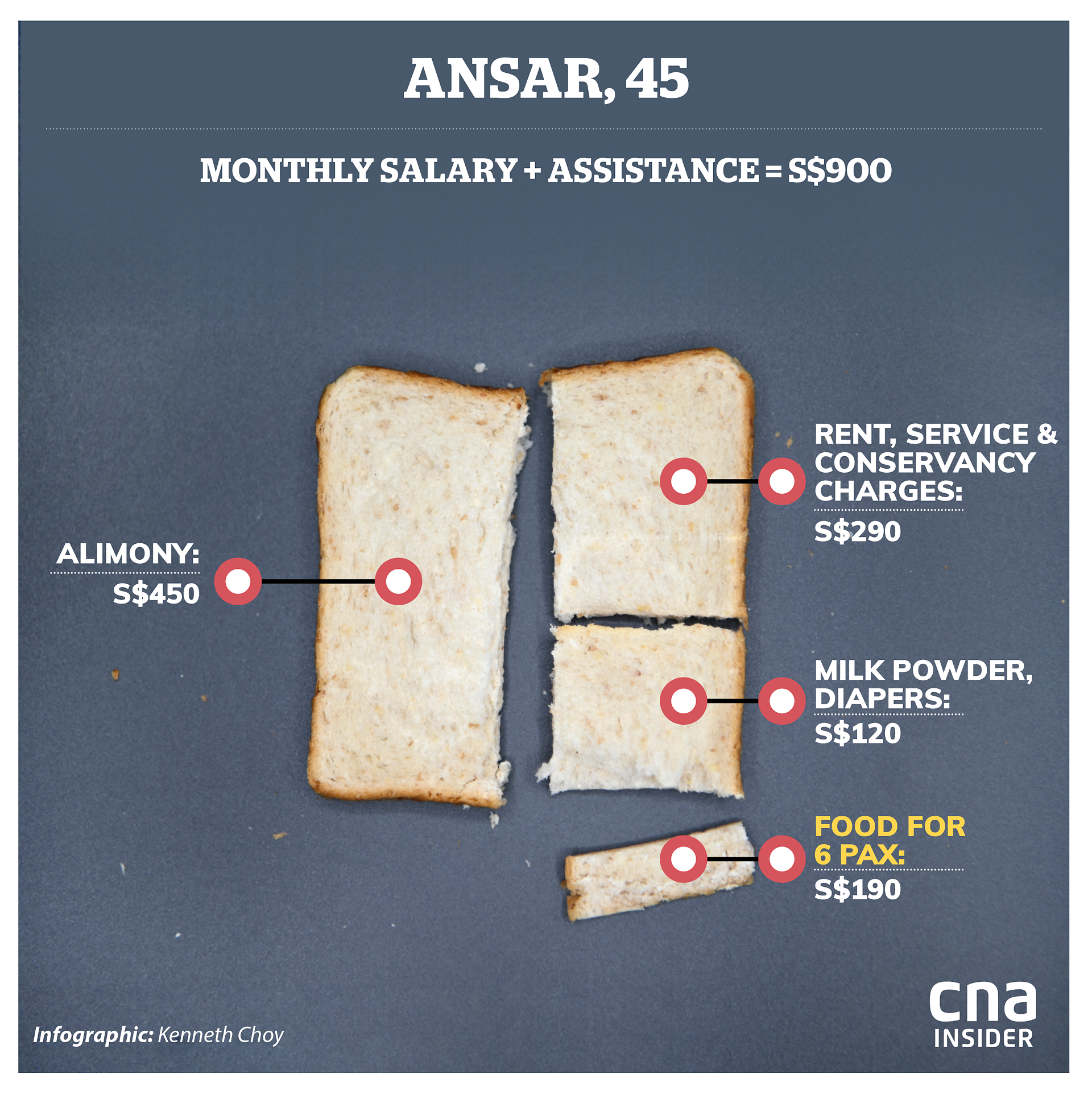
Then there’s Ansar, who has three children from his first marriage and four from his second.
The 45-year-old works as a security guard, but only part-time as the pain from an old spinal injury gets so unbearable some days that he struggles to leave his two-room rental flat.
Each month, he makes on average S$800, and gets S$200 in cash and S$80 in NTUC FairPrice vouchers from Darul Arqam Singapore. After paying his ex-wife maintenance for their three kids, and buying milk powder and diapers for his two-year-old, he hasn’t much left to feed six mouths.
Ansar gets by on one meal a day, chugging water to feel full. The children meanwhile get chicken nuggets, fries, bread and spreads. They receive food support from Food From The Heart, but when desperate, Ansar also turns to groups on Facebook where members donate milk powder or diapers to families in need.
SMU’s John Donaldson however, dismisses the stereotype that having many children is what keeps families in food insecurity.
“Often it’s people with two or three children, or who have elderly frail parents,” he said. In fact, families who are working hard yet still struggle to put food on the table are “much more common” among the food-insecure, than those with a large brood.
THE SINGLE-PARENT STRUGGLE
Even so, many low-income families seem to get along fine in terms of meals, with careful management of their expenses – until they lose a breadwinner.
More than half of the moderately-to-severely food insecure individuals in the Lien centre study were from families headed by single, divorced or widowed parents.
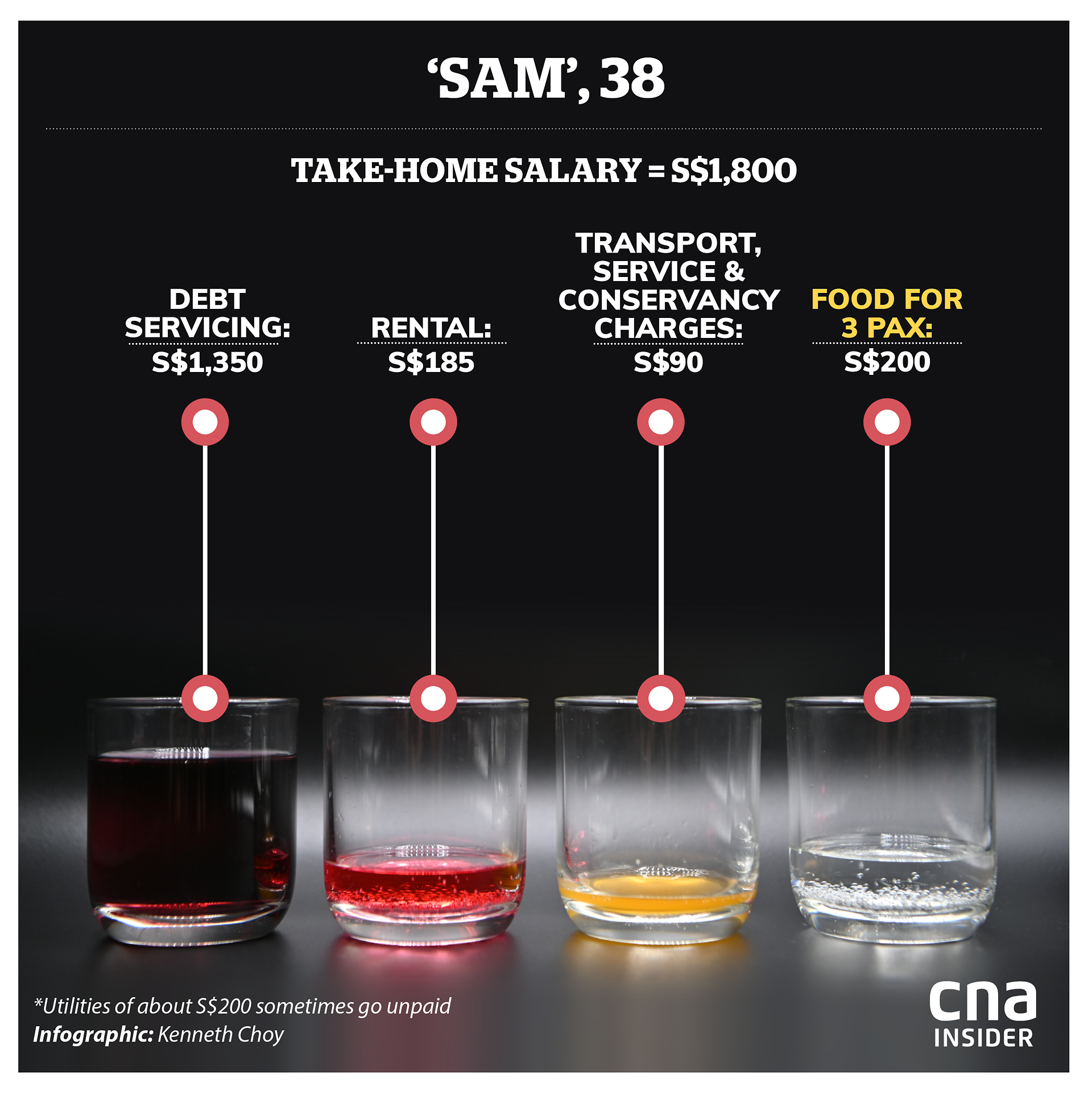
Three years ago, Sam* was embroiled in an emotionally tumultuous divorce. “I suddenly had to take care of my daughter alone,” said the 38-year-old. “I was very stressed, but I kept quiet and tried to cope by myself.”
‘Sam’, father of a hyperactive 8-year-old, struggled mentally and financially after his divorce.
It affected his concentration at work as a security guard. For a couple of months, he couldn’t report for work. So he borrowed money. The debt repayments snowballed. Before he knew it, there was simply not enough money to feed his daughter and his sister who stays with them.
Then there is Norashikin Mohd, 36, who was a housewife until her husband was jailed for several months. Then she had to start working as a school cleaner for S$600 a month, half of what her husband had made as a canteen stall operator.
“It was quite overwhelming,” the mother of four kids, aged 7 to 14, said in Malay. ”I was worried that when the kids return from school, there’s no one to take care of them.”
Norashikin struggled to find time to look after and cook for her 4 children on her own.
Norashikin tried to cook each day before leaving for work – a meal, usually of rice and just one dish, to be shared by all over both lunch and dinner. As the Lien centre study noted, food insecurity isn’t just caused by cash constraints, but also time constraints which leave little opportunity for shopping or cooking.
Since her husband’s release recently, the couple have been working at his canteen stall and they bring home the cooked food leftovers for dinner. Whether it’s enough or not, the family of six have grown used to making do.
THE CASE OF THE HUNGRY 8-YEAR-OLD
Learning to ‘make do’ is what many of the food insecure do out of resignation, and not knowing where to turn for help or not qualifying for it.
One afternoon last September, Fion from Keeping Hope Alive was visiting some elderly residents at a block of rental flats, when an 8-year-old girl came barreling down the corridor.
“She was in her school uniform, her hair was messy,” Fion recalled. She had some custard buns left over from lunch, which she offered the girl.
“Her reply was, ‘How did you know I am starving?’ Her earnestness really caught my attention.”
The girl, Katie*, lived in a one-room rental flat which was filthy and, in Fion’s view, not a suitable living environment for a child. She had bugs in her hair and no clothes other than the school uniform she was wearing.
Fion wondered, where were her parents?
The conditions that Fion found ‘Katie’ living in. The family’s fridge was nearly empty.
After getting a hold of Katie’s dad on the phone, Fion eventually met him. That’s how she got to learn about Sam – the single dad still struggling with the fallout from his divorce.
He got to see his daughter only briefly in the morning before heading out for his 12-hour shift as a security guard. Constantly tired and stressed, he seemed almost defeated by the never-ending cycle of paying off his debt only to borrow more to stay afloat.
Utilities bills went unpaid. On top of all that, he had to deal with his daughter’s hyperactive condition. “While I’m at work, her teacher keeps messaging me, ‘This is what your daughter did today, please do something about her’,” Sam said.
Under all this weight, Fion recognised his dogged determination to be a father. “He is actually very willing to look after her. But he has to work long hours, which takes up all his energy and strength,” she said.
Early on, Sam said, he’d tried applying for assistance and described his debt problems. But he was told his salary of S$2,000 a month before CPF deduction was “high”.
“They should really see the hours that people work. There are people who find it hard to cope. Instead they just look at the income to determine if we have a problem,” he said, frustrated.
The good thing is that during the school term, Katie, who is on financial assistance, gets one meal a day taken care of under the School Meals Programme. Dinner at home usually consists of rice and one dish cooked by her 56-year-old aunt.
When asked if she got hungry, Katie paused for a long time before saying in Mandarin: “It’s not like we’re super hungry. Aunty and I just go hungry together. Or I’ll just drink water.”
THE LIFELONG IMPACT OF HUNGER
But hunger isn’t just an ache to put up with for the day – or week, or months.
That’s because the effects of food insecurity can last a lifetime, even well after life circumstances improve.
When Shanger entered polytechnic, he started to get paid for his internship and for distributing flyers, while his younger brother had his National Service allowance. So regular meals became a thing again for his family.
Shanger no longer eats salted rice for his one meal of the day – quite the other extreme, in fact.
He now eats up to five meals a day, typically consisting of fried rice, chicken rice and fast food – all the food he never got to enjoy as a child.
Shanger, 22, making up for all the lost meals of his childhood.
“The past impacted me a lot because now that I’m able to do what I want, I just can’t let go,” he said. “I probably will get another illness, from eating too much.
But I told my doctor off; I don’t care, because I can finally eat.
The typical diet of a person who is food insecure – processed meals high in carbohydrates and sodium, low on nutritional value – puts them at higher risk of obesity, diabetes, cardiac disease, and other chronic illnesses.
When they get out of food insecurity, the shift to energy-dense foods can lead to high blood sugar levels. And psychological conditioning kicks in: Some like systematically overeat, because of an obsession to not waste food.
The lean years have also left another mark on Shanger. “For four years at least, I skipped breakfast and lunch. That’s why I have gastric now,” he said. “The stomach-ache is unbearable.”
He has to take medication for gastrointestinal disorder, which doctors tell him is for the long haul.
The medical cost of the years he went hungry – pills he now has to take for the long-term.
The cost of food insecurity is not just borne by individuals, but in the long run, by the country as well in the form of increased public healthcare spending.
A study by the Centres for Disease Control and Prevention has linked food insecurity to higher healthcare expenditures across the US, due to the higher rates of associated chronic illnesses like diabetes, heart disease, kidney disease and depression.
The study’s co-author estimates that food insecurity costs the US health system an additional US$53 billion a year.
HUNGER AND THE CYCLE OF POVERTY
Health problems aside, food insecurity exacts another grave cost on low-income families – it could exacerbate the struggle to break out of the poverty cycle.
A child who experiences hunger might fall sick more often, take longer to recover from illness, and suffer from poorer concentration in school, noted Goh Yiting, a senior dietitian at Tan Tock Seng Hospital.
The implications of all this – the inability to focus, more missed days of school – makes it much harder for the child to keep up with school work.
A 2017 US study showed that children who experienced food insecurity in their first five years of life were more likely to be lagging behind in social, emotional and, to some degree, cognitive skills when they began kindergarten. Other research has shown that if children enter kindergarten lagging behind their peers, they tend to stay lagging.
Serene Loh’s 8-year-old often experiences fatigue, which causes her to miss classes in school.
Indeed, The Food Bank’s Nichol shared her experience of providing food to a primary school that ran a daily breakfast programme for students from low-income families. By simply providing a well-balanced meal in the morning, the school saw a drastic improvement in the attendance rate, she said.
“I would like young children to eat better so that they can study and focus better. If they can do that, they really have an opportunity to break out from the poverty cycle,” she said.
As for food insecure adults, it’s been posited that when resources are scarce, it can affect the ability to make decisions or see the bigger picture.
Attention is focused on immediate needs, like what food to put on the table, while the stress of having to worry about this day after day can reduce bandwidth for long-term planning.
Serene Loh, 39, can certainly identify with this.
Serene, a mother of 4, preparing dinner. It’s often her only meal for the day.
When we first met her in September 2019, Serene had a budget of just S$10 a day to cook dinner for herself, her husband and her four children. To get the best bang for her buck, she walked to three different supermarkets in the vicinity to compare prices.
“I have to think every day, what can I cook today with the money I have? It’s very stressful,” she said. She ate only one meal a day herself, so that her children could have more food.
She wanted to get a job to supplement her husband’s income as a GrabFood rider, but didn’t have the headspace to look for one.
Asked at the time if she would go to the family service centre to renew her application for food rations – which had expired months ago in March 2019 – Serene’s face reflected helplessness as she muttered: “I don’t know.”
“I have to take public transport there, which needs money as well. And it’s hard for me to find the time when I have to cook dinner, do housework and take care of kids at home,” she said.
Frozen hash browns are a staple for Serene every week as they are cheap and can last the family for at least 3 days.
BREAKING THE CYCLE
Food From The Heart CEO Bee Hia points out that food support for parents like her doesn’t just fill the stomach; it also frees up mental bandwidth.
“Solving the food problem allows our beneficiaries to pay more attention to other things, such as upgrading themselves, paying bills, buying an extra storybook for their children, which are important,” she said.
Nor Ain is an example of how a little help can go a long way.
For almost a year, she and her five children had survived mainly on rice, fried eggs in soy sauce and instant noodles.
Nor Ain, 32, almost fell into depression, worrying how to feed her children. (Photo: Goh Chiew Tong)
“My kids would complain, why cannot eat meat? And I would have to explain to them that I didn’t have the money,” said the 32-year-old who was in the process of a divorce, and was bunking in with a friend.
“I cried every night, thinking about what tomorrow would bring. I really felt like a useless mum.”
Things turned around after the Housing Board expedited her application for a two-room rental flat, and Ain finally could focus on finding a stable job, with her social worker’s help, instead of part-time work.
What helped take some of the stress off her shoulders was assistance of S$1,070 a month from the Social Service Office (SSO), S$300 from the Islamic Religious Council of Singapore (MUIS), and food rations from the family service centre.
Now working freelance for a retail start-up, she makes up to S$900 a month, thrice what she used to. “We live happily now. We had a really hard time last year, but things are better now,” she said, smiling.
Nor Ain and her 5 kids are doing better now, with assistance. (Photo: Goh Chiew Tong)
PROBLEMS WITH ASSISTANCE
But does every family in need find assistance easy to get?
First of all, “we often assume that individuals or families will come forward for help,” said SUSS’ Walter Theseira. “The reality is that many households either don’t know about the welfare schemes, so they won’t come forward; or they may feel embarrassed about identifying themselves, because of the stigma associated with seeking help.”
Several families brought up the hassle of applying for aid at the SSO or bigger welfare organisations. They spoke with frustration of the need to need to fill up multiple forms, and to apply for renewal of assistance every few months with the re-submission of documentation.
“Many people feel that if they have to repeat their story over and over again for the amount of money that they’re receiving, it simply isn’t worth it,” said SMU’s John Donaldson.
That has been Serene’s experience. Since the first she spoke to CNA Insider, she has secured ComCare assistance through the SSO. But the process, she said, was “very troublesome”.
“The officer told me I need to print my CPF statement, but my printer at home has no ink already,” she said. “I already don’t have enough money to buy food, how to buy printer ink?”
Nor has she renewed her food rations assistance from the family service centre, as she found the need to resubmit documents a hassle.
Serene’s family of 6 gathers for dinner – which is often her only meal for the day.
A spokesperson for the Ministry of Social And Family Development (MSF) noted that ComCare short-to-medium term assistance (SMTA) helps those in temporary financial need to take steps towards gaining employment or higher-paying jobs, thus becoming self-reliant.
“Only documents relevant to the change of circumstances are needed during the reapplication. This provides an opportunity for SSO officers to provide timely assistance.”
The spokesperson added that efforts have been made to deliver social services in a more “comprehensive, convenient and coordinated manner”. For example, ComCare SMTA clients who need help with childcare fees need not submit the same documents for assessment.
But Serene is not the only one to feel put off from trying. Said Theseira: “In Singapore, the route to getting more assistance requires more application, more means testing, and hence more stigmatisation of the individual, compared to some other countries.”
Nichol from the Food Bank agrees: “In the US, many food pantries operate on a walk-in basis. There are no questions asked because there is already shame attached to walking into a food pantry to get help.”
Is there stigma in asking for assistance?
CAUGHT IN LIMBO
Meanwhile, those on ComCare assistance must apply for renewal every few months, and this can take an average of six weeks to process. That’s when folks like Azhar – the 55-year-old who has been medically unfit to work for a year – find themselves in transitory poverty.
He used the last of his S$400 from ComCare and MUIS to stock up on instant noodles and cereal for the wait.
When CNA Insider visited his apartment in September, three months after he’d reapplied for assistance, he had three packets of instant noodles left, while his fridge was barren apart from some eggs that he cooks with the noodles.
“The first month you can eat Maggi. The second month. you can eat. The third month?” he sighed.
SSOs do provide ComCare interim assistance for families that request urgent relief for their immediate needs. This can include those waiting for their SMTA applications to be renewed, said the MSF spokesperson. Azhar did not apply for this.
But, there are also other avenues of quick assistance, for those waiting in limbo.
MP Lee Bee Wah acknowledges the need for national social support schemes to practice “due diligence”. And while needy residents wait for their applications to be processed, she has a local welfare fund that can be tapped for immediate help, almost hassle-free.
“Sometimes before the end of the month, whatever the SSO has given them, some families have already spent,” she said. So they are given groceries and NTUC FairPrice vouchers to tide them over.
She also helps residents write to the SSO asking for the waiting time to be shortened. Most of the time, the office accedes, she said.
Dr Lee Bee Wah giving out rations at her Meet-The-People session. (Photo: Goh Chiew Tong)
MANY HELPING HANDS
That’s not all.
In her Nee Soon South ward, the charity Food From The Heart works with her grassroots team to distribute donated bread and groceries; the Lion’s Club delivers fresh vegetables and fish; while the Indian Muslim Social Service Association helps with groceries for Muslim households.
There’s also a community fridge that Singapore Food Rescue (and resident gardeners) helps to stock.
At Kampong Glam every day, elderly rental-flat residents and other beneficiaries are served free lunch at a new food hub built for them – a collaboration between MP Denise Phua, PeaceConnect Senior Activity Centre, and Willing Hearts. Nutritious all-day breakfasts could soon follow.
Across Singapore, efforts like these are replicated with many groups stepping up to help – and they have made a definite impact in recent years.
There are some 125 food support organisations with an online presence, according to the Lien centre study, and they range from non-profits and Institutions of a Public Character (IPC), soup kitchens and Meals-On-Wheels providers, to informal ground-up groups.
Volunteers sorting out donations at Food From The Heart’s Joo Seng Road warehouse. (Credit: Food From The Heart)
Started 16 years ago, Food From The Heart for example works with residents’ committees, senior activity centres and family service centres – people “on the ground who know who needs help,” said Bee Hia.
“We have grown because there’s a need – more people are requesting for food,” she added.
While it’s not clear how many of the 125 groups are actually active or regular in their outreach, they help fill the gaps that the Government’s social support network cannot cover. This is in line with MSF’s “many helping hands” approach.
“The Government can’t do everything for everyone,” said former academic Jenson Goh, who as part of a course he once taught at NUS’ Residential College 4, had looked at Singapore’s food system.
“It looks out for those living with the bare minimum, those really living day to day. For people who fall through the cracks, the NGOs on the ground try to serve them.”
These folks include Azhar, who while waiting for his application for assistance to be processed, has been receiving food support from Free Food For All.
And father of one, Sam, had a huge weight lifted off his shoulders when Fion and her volunteers at Keeping Hope Alive helped pay off his debts.
“We helped him so that he can focus his energy on taking care of his daughter and not be bogged down by repayments,” Fion said.
They also gave his home a fresh coat of paint and new furniture, while the refrigerator – once stocked with half-eaten junk food – has been transformed into what Fion laughingly calls “a rich person’s fridge”.
Sam and Katie’s fully-stocked fridge, thanks to volunteers of Keeping Hope Alive.
The volunteers keep it stocked with cereal bars and packets of Milo for Katie’s breakfast, fruits for snacks, and other groceries which her aunt can use to cook dinner.
“It’s better than eating potato chips or gummies when Katie is very hungry,” Fion said. “We want her to have strength so that she can concentrate in school.”
But the ultimate goal for the volunteers is to help the family become self-reliant. “Sending food can’t be a long-term solution,” Fion pointed out.
Similarly, Li Woon Churdboonchart believes it’s important for beneficiaries to feel a sense of responsibility.
She founded Volunteer Switchboard – a social enterprise which, among other things, makes monthly food deliveries to seniors in rental blocks at Jalan Kukoh. The estate’s younger residents who are in need of assistance are themselves encouraged to volunteer with the group, instead of having aid simply handed to them.
Otherwise, Li Woon said: “You’re teaching the younger generation that it is okay that you don’t go out to work, It’s okay that you just keep taking from the public.”
Volunteer Switchboard at work.
BUT STILL MISSING OUT
But here’s the rub: Despite the sheer number of food charity groups out there, more than half of the households reported as severely food insecure in the Lien centre study had infrequent or no food support at all. Yet, they all lived in areas that were being served by such groups.
What this highlights are the inefficiencies in this informal food support system, which has been growing rapidly and organically, without any kind of coordination between groups so far. The question is, can this change?
SUSS’ Walter Theseira, for one, is skeptical that food assistance should be a long-term solution to food insecurity. Something more fundamental, like a universal basic income, is needed, he believes.
While in some countries distributing rations make sense because food insecurity is a problem of “food deserts” – whole areas where affordable food isn’t available – this is not the case in Singapore. Here, he said, “it’s a problem of people not having enough income to get the food they want”.
A meal enough for a family of six?
The idea of a universal basic income is not without its detractors. There is, however, one other thing all agree on: Food insecurity is a problem that should concern Singapore as a society
“Ensuring no one goes hungry and has access to basic meals is fundamental,” said MP Denise Phua. “There is much to do. And I don’t believe there will ever be enough paid social workers to address the needs of a rapidly ageing society, and of those who may fall through the cracks because no one was alerted or who do not qualify due to technical reasons.
It will take a village to piece together a strong social safety net – each of us can play our part.
Said Theseira: “Singapore is a very rich and abundant society. And if you feel that you constantly have to make very constrained decisions, there’s going to be a long-term effect on your ability to feel like a regular member of society.”
“Food insecurity isn’t just a problem of nutrition,” he added. “It’s also a problem of whether people psychologically feel like they’re part of society, and whether they fit in.”
In Part 2 of CNA Insider’s special report: With so much food assistance out there, why are good intentions falling short?
SINGAPORE: Major cruise liners have changed their itineraries in Asia to avoid calling at major ports like Shanghai, Hong Kong and Singapore amid fears of COVID-19.
Concurrently, they have imposed restrictions on passengers and stepped up health checks as well as cleaning protocols to assuage fears.
When asked by CNA, British-American cruise line Cunard said that one of its ships, the Queen Mary 2, will skip a scheduled stop in Singapore this month.
Passengers who were due to embark in Singapore will have the option of joining them from Freemantle, Australia and set sail on an Australian itinerary.
Royal Caribbean and Celebrity Cruises have also reportedly cancelled sailings to Singapore in the coming weeks.
Additionally, for Regent Seven Seas Cruises, its ship the Seven Seas Voyager has removed Hong Kong from its Feb 12, Mar 1 and Mar 13 voyages.
Meanwhile, Princess Cruise Line has also modified the itinerary for at least two of its ships – the Sapphire Princess and Sun Princess.
For the Sapphire Princess, its voyages departing on Apr 16, May 2 and May 18 will arrive in Tokyo instead of Shanghai.
As for the Sun Princess, its scheduled calls to Hong Kong on Apr 28 and Jul 14, and Shanghai on May 1 and Jul 17, have been cancelled and replaced with calls to Seoul and Jeju in South Korea.
The cruise ship Diamond Princess is pictured beside a Japanese flag as it lies at anchor while workers and officers prepare to transfer passengers who tested positive for coronavirus, at Daikoku Pier Cruise Terminal in Yokohama, south of Tokyo, Japan, Feb. 12, 2020. REUTERS/Kim Kyung-Hoon/File Photo
Concerns over COVID-19 have been amplified by how one of Princess Cruise Line’s ship, the Diamond Princess, has become the largest single cluster of cases outside China.
The ship has been quarantined in the Japanese port of Yokohama and its 3,600 passengers and crew have been stuck at sea.
More than 200 people who were on board have been tested positive for the virus and they have been transferred to a local health facility for treatment.
Moreover, another cruise ship MS Westerdam carrying 1,455 passengers and 802 crew members was finally permitted to dock at the Cambodian port city of Sihanoukville after it spent the last two weeks at sea having been turned away by five counties over fears of the coronavirus.
Cambodia’s Prime Minister Hun Sen welcomes a passenger of MS Westerdam, a cruise ship that spent two weeks at sea after being turned away by five countries over fears that someone aboard might have the coronavirus, as it docks in Sihanoukville, Cambodia February 14, 2020. REUTERS/Soe Zeya Tun
These recent developments have prompted more measures by cruise liners to avoid an outbreak on board as this can lead to bad publicity and hurt them financially, said infectious diseases specialist Professor Sanjaya Senanayake.
“There’s a lot of incentive for cruises to look after and maintain a clean environment. We know that more than 20 million people in the world travel on cruises in a year and a lot of them have a wonderful time,” said Prof Senanayake, who is with the Australian National University.
RESTRICTIONS IMPOSED ON PASSENGERS
Beside making itinerary changes, cruises liners are restricting some passengers, based on their nationality and recent travel history.
Passengers wear protective masks aboard the World Dream cruise ship, being quarantined at Kai Tak Cruise Terminal amid concerns of coronavirus infections, in Hong Kong, China February 8, 2020 in this still image obtained from social media video. DR. PETER LO/via REUTERS
Regent Seven Seas Cruise said that guests who hold a Chinese, Hong Kong or Macau passport, regardless of where they reside, will not be allowed to board its ships until Apr 8.
Meanwhile, Cunard and Princess Cruises said that any passenger who has travelled through China, Macau or Hong Kong within 14 days of the start of the cruise will not be permitted to board the vessel.
As a further precautionary measure, Cunard said any passenger who has travelled from or through Taiwan, Thailand, Japan, South Korea, Singapore or Malaysia within 14 days of embarkation will be subject to enhanced pre-boarding screening to determine whether permission is given to embark.
ENHANCED DISINFECTION PROTOCOLS
Cruise lines have also intensified environmental disinfection on board, in addition to existing cleaning and sanitation protocols.
For Princess Cruises, a spokesperson told CNA that its ships and medical staff are well equipped to prevent and contain the spread of contagious illnesses, including coronavirus.
“We are taking extra precautions and are being guided in consultation with international and local health authorities,” the spokesperson said.
Passengers are seen on the balconies of their cabins of the cruise ship Diamond Princess at Daikoku Pier Cruise Terminal in Yokohama, south of Tokyo, Japan February 12, 2020. REUTERS/Kim Kyung-hoon
Among the precautions that are being taken include enhanced screening of guests and crew, as well as temperature checks for those with fever or respiratory symptoms.
When a passenger exhibits symptoms of the virus while onboard, Regent Seven Seas Cruises said they could be screened for the coronavirus and may be subjected to potential quarantine and disembarkation.
For passengers who were on board the Diamond Princess that have been under quarantine, Princess Cruise Line said that its guests will “receive a full refund of cruise expenses” considering the “extraordinary circumstances”.
These expenses include cruise fares, hotels expenses before and after the cruise and air transfers. Passengers will also receive a 100 per cent future cruise credit equal to the fare they paid for the voyage, redeemable before Feb 28.
Some cruise terminals have been shut for now, while others have stepped up screening measures.
A man wearing a facemask sits at the Kai Tak cruise terminal where the World Dream cruise ship is docked, in Hong Kong on Feb 5, 2020. (Photo: AFP/Philip Fong)
Hong Kong has closed off its two cruise terminals: Kai Tak and Ocean.
Ms Lam said the closures would reduce the number of Chinese mainlanders entering Hong Kong and allow officials to focus resources on two land entry points as well as the airport.
Over at Malaysia’s Boustead Cruise Centre in Port Klang, thermal scanners have been installed and authorities would check passenger manifests before allowing cruise passengers to disembark.
Malaysia’s Transport Minister Anthony Loke. (File photo: Bernama)
During a visit to the cruise centre on Thursday, Malaysia’s Transport Minister Anthony Loke said the cruise centre would not allow passengers from China to disembark.
He added that since Jan 25, more than 60,000 international cruise passengers have disembarked at Port Klang and measures have been put in place to ensure that all of them did not enter Malaysia if they were running a high temperature.
“This procedure is to gain confidence among people that we are taking steps to preserve the health of the locals Malaysians at large,” said Mr Loke.
PASSENGERS MUST COMPLY WITH QUARANTINE PROTOCOL: INFECTIOUS DISEASE EXPERT
While this could be an unpleasant situation for cruise passengers in a holiday mood, Prof Senanayake stressed that it is important for all passengers to comply with health protocols.
“The worst thing they can do is to surreptitiously get off the ship and go somewhere else because they might be sick. Then they wouldn’t be monitored and this could lead to an outbreak,” he said.
Passengers and crew on board the Diamond Princess cruise ship, docked in Yokohama, will be quarantined until Feb 19, 2020. (AFP/Charly Triballeau)
He added that if quarantine is being imposed, passengers and crew should comply and mostly keep to their rooms.
“Even when passengers come out to the deck to walk around, they must maintain certain distances (from other passengers) when they move,” he advised.
Prof Senanayake also warned that if an infected person has been in close contact with other people, this could reset the quarantine period, causing the passengers and crew to be stuck at sea for an even longer time.
“But if everyone on board is kept apart, even though new cases are diagnosed, there may not be a need to extend the quarantine period,” he added.
SINGAPORE: It looks like the 2019 novel coronavirus (COVID-19) will be with us for longer than we hoped.
These are uncertain times, but Singapore is facing the novel coronavirus outbreak more prepared than most.
Our government, medical institutions, and employers have applied lessons learned from previous outbreaks such as SARS and the H1N1 avian flu, and they continue to act decisively and with measured responses as events unfold.
An equally important concern is about a different kind of “health”– the health of our community bonds, what keeps us together as a community.
The health of our community is an essential weapon in the fight against this and any future viruses – how much we care for our fellow residents, rather than just family and friends.
Failing which, our individual actions may drive us apart precisely when we should be coming together. This could be detrimental and worsen the crisis that stares us in the face.
So while we fight the virus we should also be aware of some possible unintended consequences, and continue to look out for those may need more help than we realise.
LOW-INCOME FAMILIES
For instance, one unintended consequence could be that some low-wage workers might fall through the cracks should they be quarantined.
People are seen wearing protective face masks at Orchard Road, Singapore on Jan 28. (Photo: Gaya Chandramohan)
Home quarantine orders are undoubtedly necessary, and it is reassuring to know that, in the current scenario, the Government will give an allowance of S$100 daily to aid those affected, covering the employed and self-employed.
However, I am concerned that for some low-income families, their work to make ends meet might not be captured as formal work that is compensated by the allowance. Much low wage work is cash-based.
For instance, we know from Ray of Hope – one of The Majurity Trust’s grantees – that some families in need do freelance work paid in cash, or bake cookies and cakes. Being quarantined and the resulting loss of income, could be dire for such families.
So should a low-income family have to serve a quarantine, I hope the Government and community will together do our best to mitigate the financial impact for them, for instance via the Courage Fund.
AFFECTED PARENTS AND CAREGIVERS
Another group that needs more help are parents and caregivers who have to stay at home to look after their children or the elderly at short notice.
With the current outbreak, we may see longer medical leave for children with flu-like symptoms so that they have ample time to recover. This means longer work disruptions for parents.
There is also a distinct possibility that schools, childcare centres, and elderly day care centres may eventually close, if things get more serious than this.
During the SARS outbreak in 2003 for example, schools were closed for a few weeks.
In such a scenario, parents and caregivers would have to scramble to arrange care alternatives and reorganise schedules.
It would be helpful if employers could find ways to accommodate such affected staff during this period, for instance flexible work arrangements and telecommuting. This would go a long way to ease their burdens.
THOSE VULNERABLE TO THE DISEASE
Third, there are those who are more vulnerable to the outbreak itself. These include seniors, children and those with existing conditions such as diabetes and heart ailments.
A woman stands by the roadside with bags of surgical masks on Jan 29, Singapore. (Photo: Gaya Chandramohan)
While the Government will do its part, as a community we should also think more often about others in the community. For instance, we could ensure that we only buy or take what face masks we need, and use them only when needed. If we deprive those vulnerable to the virus – seniors, children, and those with existing conditions – of masks, then we also risk more people becoming infected.
STAYING UNITED, NOT DIVIDED
The fact is that viruses do not care about our race or nationality, and neither should we. Instead, we should focus on our shared sense of decency and humanity, no matter where we come from.
Recent days have seen some negative reactions, even vilification of those who were panic buying. This behaviour is not helpful and we should say so. However, some go too far in mocking or denigrating them.
Amid the negativity, I was heartened to read how those in the community went out of their way to help others in need. This includes people who brought food to frontline healthcare workers, helping provide transportation, and distributing free masks and hand sanitisers.
I am personally excited to see so many ground-up efforts blossoming in support of our community. The Majurity Trust is chipping in with our SG Strong fund for ground-up initiatives, and I hope we will see more such efforts as we come together to help one another.
Our best weapon against this virus – and future ones – is our ability to act as a community: to make sure no-one falls through the cracks, to grow our bonds with everyone who calls Singapore home, and face tomorrow together.
Martin Tan is the Executive Director of The Majurity Trust, a philanthropic organisation in Singapore.
SINGAPORE – Five more coronavirus cases have been confirmed here, bringing the total number of those who have been infected to 72, the Ministry of Health (MOH) said on Saturday (Feb 15).
Of the five new cases, three are linked to the cluster at Grace Assembly of God, one is linked to the cluster at Seletar Aerospace Heights construction site and the other case is linked to a previous case.
None of the new cases has recent travel history to China.
Meanwhile, one more patient, a 32-year-old woman who is case 24, has been discharged. In all, 18 have fully recovered from the infection and have been discharged from hospital.
Of the 54 confirmed cases who are still in hospital, most are stable or improving. Six are in critical condition in the intensive care unit.
As of 12pm on Saturday (Feb 15) MOH has identified 2,093 close contacts. Of the 1,959 who are still in Singapore, 1,697 have been contacted and are being quarantined or isolated. Efforts are ongoing to contact the remaining 262 close contacts.
On Friday (Feb 14), Gov.sg dropped a teaser showing a pair of yellow boots, and got everyone recalling lines from the 2003 song and getting excited about a new one.
Guess who’s back to support the fight against COVID-19.