Home Blog Page 471

Commentary: Disruptive tech is coming for COVID-19 threat, but needs more funding

0

SINGAPORE: There isn’t a conversation going around these days that doesn’t touch on the subject of COVID-19 – and the virus spreading to dozens of countries around the world.

People are in fear, rightly so. People are worried for their own safety and their loved ones.

Healthcare workers and policymakers are figuring out the best ways to contain the virus while the public does what it can. Non-profit and grassroots organisations come together offering assistance.

Grab recently piloted a programme that provides round-the-clock rides to healthcare workers, a show of camaraderie on the part of drivers in this trying time for Singapore.

In my recent Grab rides, drivers are offering the use of hand sanitisers for free, even though one driver told me he paid a fortune for a bottle.

grab app on phone

File photo of person using the Grab mobile app. (Screengrab: Grab)

HOW ARTIFICIAL INTELLIGENCE CAN HELP WITH EARLY WARNING AND DETECTION

A larger question that some people have pondered is whether a technology solution could have detected and prevented a large-scale spread of a contagious disease like COVID-19. There is precedence.

A Canadian start-up called BlueDot used its proprietary artificial intelligence technology and natural language processing to canvas a vast amount of information to look for signs and predict where an infectious disease will turn up next. BlueDot scoured through 100,000 news reports in 65 languages on a daily basis.

The result: BlueDot sent an alert to its clients to avoid Wuhan on Dec 31, 2019, two weeks before the official announcement from the World Health Organization on Jan 9.

Using global airline ticketing data, it also predicted that the virus would spread to Seoul, Bangkok, Taipei and Tokyo primarily. 

READ: Commentary: Novel coronavirus turns 2020 into a bleak year for Asian airlines

READ: Commentary: Singapore Airshow in a COVID-19 outbreak – smaller but not quite

BlueDot is not without a track record, it had also successfully predicted the SARS pandemic.

This is certainly an interesting usage of artificial intelligence and machine learning beyond the standard tools employed by e-commerce and social media to throw up shopping recommendations or provide better search results capabilities. The question is how to have this information readily available to the public and relevant organisations.

There is a similar early warning tool Ushahidi developed in Kenya by a non-profit organization headquartered in Nairobi. Ushahidi uses crowdsourcing for social activism and public accountability, combining citizen journalism and geospatial information.

Ushahidi allows people to submit reports through SMS, apps, social media and the Internet, creating a temporal and geospatial archive of events. The Ushahidi platform is often used for crisis response, human rights reporting and election monitoring.

In Singapore, AI has also been enlisted to aid with detection. AI-powered temperature screening equipment piloted at Serangoon North and St Andrew’s Community Hospital in Simei does away with the need for manual screening, often time-consuming and manpower-intensive, and can detect and alert staff to individuals with high temperatures even if they were wearing spectacles or headgear.

ithermo detects a person with a fever (1)

Ithermo detects a person with fever as they pass by the device. (Photo: Hanidah Amin)

RESEARCH INSTITUTES ARE ALSO PART OF THIS ECOSYSTEM

John Hopkins University is the leading institution leveraging the geographic information system (GIS) technology – this is a system designed to capture, store, manipulate, analyse, manage, and present all types of geographical data.

GIS technology uses data-mining to detect areas where people talk about the disease and creates heatmaps. These maps can help healthcare professionals and other key stakeholders in better tracking and zooming into a specific location to tackle the spread of a disease.

READ: Commentary: COVID-19 the new national test for Singapore. How are we doing?

READ: Commentary: Fighting fear is key part in battling COVID-19

Harvard Medical School professor and Chief Innovation Officer at Boston Children’s Hospital John Brownstein had his team build Healthmap after the 2003 SARS epidemic, which scrapes news reports, chatrooms and more to build a visual picture of how the coronavirus is spreading.

It supplements data-gathering techniques by governments around the world and is also used in the WHO’s Epidemic Intelligence from Open Sources Initiative.

TACKLING MISINFORMATION

Another area technology could help us in is to make sense of the misinformation spreading online fuelling unnecessary hysteria and fear – and in some cases xenophobia – sometimes pushed by bots to create the false impression of many people talking about a particular subject and launch coordinated campaigns.

People wearing mask at Orchard Road Singapore Feb 3

People were seen wearing masks at Orchard Road, Singapore on Feb 3. (Photo: Gaya Chandramohan)

The use of a Botslayer prototype in the 2018 mid-term elections aided the Democrats in investigating Tweetstorms, their content and promoters to identify and ultimately take down malicious accounts.

Such tools can help journalists discern trending topics from surges that appear related to bot activity.

It’s during these trying times that technology should be a force for good that brings humanity together. AI algorithms can sort through which web pages tend to be accurate, which are salacious, and most importantly which posts likely come from bots rather than reputable sources.

READ: Commentary: COVID-19 – when social media and chat groups complicate crisis communication

READ: Commentary: What to do with all these health rumours and forwarded messages in the time of COVID-19?

BUT BEWARE TECHNOLOGY’S HUBRIS

There is one caveat however. All of this data-driven technology is premised on the validity and quality of the information it’s built upon. There is an old saying and it is still true in this case: Garbage in garbage out.

We should take heed from past cautionary tales. In 2008, researchers at Google claimed they could predict the flu trend based on people’s searches.

The idea was based on the assumption that people would search for flu-related information on Google when they caught the bug. “We can accurately estimate the current level of weekly influenza activity in each region of the United States with a reporting lag of about one day,” the Google scientists wrote.

But then this project failed, missing the peak of the 2013 flu season and failing to predict the 2009 H1N1 pandemic.

File photo of a nurse preparing an H1N1 flu vaccine shot at a hospital in Budapest

A nurse preparing a vaccine shot. (File photo: Reuters/Karoly Arvai)

What this shows is — what Wired magazine calls “big data hubris” – garbage in leads to garbage out. Just because people searched for flu-like symptoms on Google doesn’t necessarily mean they have the flu. The vast majority of visits to the doctor for flu-like symptoms generally turned out to be other viruses.

In the same way, we can expect AI’s accuracy in detecting a virus to be less than desirable – but with machine learning, the hope is for each incident to provide constructive feedback to strengthen the algorithm in predicting future incidents.

A BRIDGE SINGAPORE CAN CROSS

Singapore with our strong push for AI and machine-learning development has an opportunity to harness and further support the development of such technological advancements that could determine how we anticipate and more effectively deal with the next health scare.

We have done a great job in coming together a society to fight a virus, but if we could leverage technology more pervasively to detect deceases early, understand it, and prevent mass hysteria – this would be a game-changer for us.

READ: Commentary: COVID-19 could redefine Singapore’s place in the global economy

LISTEN: Getting to grips with DORSCON orange in Singapore’s fight against COVID-19

But this is admittedly easier said than done. Building up these types of AI, machine-learning, and data-mining capabilities require a huge and concerted financial investment, and potentially further research, development and test-bedding in order to produce a technology policymakers, businesses and clinicians can use.

With the drawdown of the Research, Innovation and Enterprise 2020 fund, no doubt businesses will look to Budget 2020 to see if further investments in this area can be co-funded or offset by government grants.

It is unfortunate that the world is facing yet another health scare – but we can rise above this just like we have in the past.

Singapore could take advantage of our existing knowledge and know-how to use this outbreak to test out prototypes and collaborate across nations to address the current COVID-19 and prevent another the next.

BOOKMARK THIS: Our comprehensive coverage of the novel coronavirus and its developments

Download our app or subscribe to our Telegram channel for the latest updates on the novel coronavirus outbreak: https://cna.asia/telegram

Jonathan Chang is a tech entrepreneur, investor, advisor, and lecturer.  
Source link

Commentary: COVID-19 could redefine Singapore’s place in the global economy

0

SINGAPORE: Singapore is grappling with the economic symptoms of COVID-19, the acronym assigned by the World Health Organization to the virus which saw the outbreak begin in the city of Wuhan.

COVID-19 has resulted in dramatic reductions of Chinese tourism into the city-state, for example, which has put a sizeable dent in the earnings of the travel, hospitality and retail sectors.

A marked reduction in air cargo from China is crimping supply chains across a wide spectrum of the economy.

Labour flows have also been impacted. Some 30,000 Chinese nationals with Singapore work permits were put under quarantine lock-down in China and have struggled to return to their jobs, mostly in manufacturing or in small businesses.

Prime Minister Lee Hsien Loong has warned that COVID-19 will have a significant impact on Singapore’s economy.

GDP growth forecasts for the country have been revised downwards to -0.5 to 1.5 per cent, while the IMF has sounded the warning bells over the damage to the global economy this year.

READ: Commentary: Mask mania envelops world – as China is both outbreak centre and key manufacturer

READ: Commentary: COVID-19 the new national test for Singapore. How are we doing?

Given this backdrop, Deputy Prime Minister and Finance Minister Heng Swee Keat highlighted on Sunday (Feb 16) what businesses and households can look forward to for Budget 2020, when the Government will announce a package of measures including wage support for impacted workers and local businesses as well as cost-of-living assistance for households.

dpm heng swee keat feb 16 One-time use only in print, broadcast and or online platforms.

DPM Heng Swee Keat speaks to SCDF officers ar Kallang Fire Station on Feb 16. (Photo: Ministry of Communications and Information) 

More broadly, however, COVID-19 represents a defining moment for Singapore’s economic future, primarily because the spread of this global virus has accelerated two powerful trends: The de-coupling from China’s supply chains and the relocation of strategic manufacturing operations out of China.

Singapore’s importance as a regional financial, logistics and innovation hub puts it at the centre of a dramatically changing business landscape, and the world’s leading businesses will turn to the city-state to meet new economic needs.

THE CHINA CONUNDRUM

Like other Southeast Asian countries, Singapore is faced with a “China conundrum”. Singaporean investments in China have been growing steadily over the last few decades, but are now exposed to increasing levels of risk.

Since the 2003 outbreak of SARs, China’s economy has grown from approximately 4 per cent of global GDP to just shy of 20 per cent. Today, China represents Singapore’s largest non-oil export destination, at 17.3 per cent of the country’s overall exports.

China’s huge consumer market and its competitive edge as a manufacturing and assembly hub means it will remain a major trading partner for Singapore well into the foreseeable future.

But COVID-19 threatens to do further damage to an increasingly vulnerable Chinese economy already stung by the on-going US-China trade war and the negative consequences of a growing “systemic rivalry” with the West, especially in the technology sector.

READ: Commentary: Why China signed an unequal trade deal with the US

READ: Commentary: The US-China tech rivalry is fracturing the world and affecting trade, firms and jobs

Singapore, therefore, must safely manage existing trading ties with China, while simultaneously adjusting to the realities of de-coupling and restructuring of global value chains. This inevitably means turning to more diversified and well-balanced international strategies.

DECOUPLING AND DIVERSIFICATION

For more than a decade, multinational and Chinese firms have looked to escape rising labour costs in China by moving operations to new locations in Southeast Asia and beyond.

More recently the threat of rising tariffs and export controls have led to further de-coupling from China-centric supply chains and have resulted in the construction of new manufacturing and assembly facilities in, for example, Vietnam, Malaysia, and Thailand – even as far afield as Mexico.

COVID-19 is accelerating these trends.

China and the United States last month signed a deal that called a truce in their long-running trade

China and the United States last month signed a deal that called a truce in their long-running trade war. (Photo: AFP/STR)

As such, state and non-state actors experiencing this new demand are turning to Singapore for expertise and services. For example, Singapore’s world-class logistics ecosystems – such as the Port Authority of Singapore and its business partners – are in high demand for containerisation, warehousing and port operations around the region.

Singapore’s Networked Trade Platform (NTP), for example, is a model of efficiency for a trade and logistics IT ecosystem. NTP connects businesses, community systems, platforms and government systems. This kind of innovation must meet fresh demands to facilitate the growth of efficient, transparent global supply chains.

As COVID-19 forces companies to double down on de-coupling and value-chain relocation, Singapore-based tech start-ups, financial and professional services firms and logistics companies can become imbedded in these new capacity-building solutions.

AUTOMATED FACTORIES AND ROBOTICS

COVID-19 has highlighted the global economy’s vulnerabilities to diseases and pandemics. Could automated factories and intelligent supply chains reduce risks and enable more diversified, better coordinated supply chains?

READ: Commentary: COVID-19 the new national test for Singapore. How are we doing?

READ: Commentary: Looks like containment of novel coronavirus not as effective as we had hoped

This is a question that the Japanese automotive companies Toyota, Honda and Nissan are now asking, as they have had to suspend production, both in China and on some domestic production lines in Japan, because of over-reliance on single source suppliers in Wuhan.

Meanwhile, Canon, the Japanese company, has implemented fully automated, end-to-end camera manufacturing operations at a new plant in Japan – to which it is reshoring manufacturing previously done abroad.

Another leading company, Amazon, is combining cognitive AI with data analytics and robotics to manage highly automated, intelligent supply chains around the world.

Amazon and Sony are the latest major tech companies to announce they will skip the Mobile World

Amazon and Sony are the latest major tech companies to announce they will skip the Mobile World Congress in Barcelona this year owing to concern about the coronavirus. (Photo: AFP/Pau Barrena)

There is high demand in the market for next-generation, technology-enabled value chains. The Singapore Government, which has allocated US$19 billion under the Research, Innovation and Enterprise 2020 Plan (RIE), with the fund potentially topped up at Budget 2020, is well placed for participation in these advanced manufacturing and engineering areas. 

This will allow the city-state to become a prime destination for leading multinationals that are seeking an edge in this area.

Meanwhile because human capital is still hugely important, Singapore’s world-class universities and a rapidly growing ecosystem of start-ups, business incubators and funding initiatives will strengthen a renewed push for automated factory technologies.

THE ECONOMIC VALUE OF GOOD GOVERNANCE

Singapore has become a regional hub for many of the world’s top companies because of its ability to facilitate what I consider the 5 most important “T-words” in the modern business lexicon: Transparency, truth, trust, technology and talent. These are the backbone of corporate good governance and rules-based frameworks.

Even at time when the World Trade Organization is in existential crisis and the United States – the historic champion of open, rules-based trade – has become increasingly less engaged in international frameworks, a  significant bloc of the world’s trading nations still recognise the benefits of multilateral trade agreements.

READ: Commentary: Is low growth the new normal for Singapore?

READ: Commentary: The brewing discontent with trade and one step to restoring faith in globalisation

Singapore is a member of two highly progressive FTAs, including the EU-Singapore Free Trade Agreement and the Comprehensive and Progressive Trans-Pacific Partnership.

Both are based on “deep” rules-based frameworks that have standards, among other things, that address environmental sustainability, labour ethics, data privacy and other key values – all of which, in today’s world, are critical for the development of new trading ecosystems in Asia and beyond.

Singapore’s reputation as a champion of good governance and the “5 T-words,” combined with its designation as one of the world’s most innovative tech centres, provides a unique environment for companies to build transparent, truthful and trustworthy value chains around a set of progressive trade values – empowered by the right talent and technology.

Singapore has been expanding its high-tech sector and has convinced many of the world's top

Singapore has been expanding its high-tech sector and has convinced many of the world’s top companies to establish regional offices there. (Photo: AFP/Roslan RAHMAN)

In the near term, COVID-19 may bring challenging economic times to Singapore. These local challenges will most certainly be met and overcome by a proactive government.

But COVID-19’s lasting effects will be more pervasive and long-term, as Singapore adjusts to a new and promising role in a shifting economic landscape.

BOOKMARK THIS: Our comprehensive coverage of the novel coronavirus and its developments

Download our app or subscribe to our Telegram channel for the latest updates on the novel coronavirus outbreak: https://cna.asia/telegram

Alex Capri is Visiting Senior Fellow with the Department of Analytics & Operations at NUS Business School.

Source link

COVID-19 outbreak: What you need to know about the Public Health Preparedness Clinics

0

SINGAPORE: About 900 general practitioner (GP) clinics will be reactivated as Public Health Preparedness Clinics (PHPCs) starting Tuesday (Feb 18), to care for patients with respiratory symptoms in light of the COVID-19 outbreak. 

The Ministry of Health (MOH) said on Friday that it expects the number of confirmed cases in Singapore to increase, partly due to the enhanced disease surveillance. 

READ: Public Health Preparedness Clinics reactivated to reduce risk of COVID-19 spread

READ: Coronavirus cases in Singapore: Trends, clusters and key numbers to watch

“We are quite concerned that many of the local confirmed cases have remained in the community and some have gone back to work even when they were ill and even after they have seen a doctor. This is not helpful in our efforts to reduce the risk of community transmission,” Health Minister Gan Kim Yong had said on Friday

What makes these clinics different and where can you find them? Here’s what you need to know:

WHAT ARE PHPCS

The PHPCs are “an important line of defence” during public health outbreaks, Mr Gan had said.

The activation of PHPCs and polyclinics would allow the virus to be detected in patients earlier and reduce the risk of further transmission, according to the Health Ministry.

The PHPCs, which provide subsidised treatment and medication during public health outbreaks, were previously activated to deal with haze and the 2009 H1N1 influenza pandemic.

READ: COVID-19 threat could erode with time just as with H1N1, say experts

The clinics are familiar with the appropriate care protocols according to the assessed risk and diagnosis of each patient, and will be supplied with the necessary personal protective equipment, said the ministry.

From Tuesday, about 900 clinics will be “progressively activated” to care for patients with respiratory symptoms such as fever, cough, sore throat and runny nose. 

These clinics will also help refer patients to a hospital if they are suspected to have pneumonia. 

The PHPC logo

(Image: Ministry of Health)

WHERE ARE THE CLINICS?

The clinics can be identified by a PHPC decal, and members of the public can find an updated list of PHPCs at https://www.flugowhere.gov.sg from Tuesday. 

GPs undergo a “process of enrolment” when they apply to join the PHPC scheme, said MOH’s director of medical services Kenneth Mak on Friday. This includes teaching them the importance of infection control and training them to use personal protective equipment.

READ: Symptoms of novel coronavirus mild, similar to all respiratory viruses in early stage: Expert

“So, there is a little bit more work done in order to make sure they are better prepared to deal with patients that have infectious diseases,” added Associate Professor Mak.

“It is not that ordinary GPs cannot manage such conditions, but these GPs (PHPCs) have been given additional training, additional preparation that they’ve done such that in times like this, we have a ready group of doctors and their clinics who are able to stand up and then further support as we then manage an outbreak in a crisis.”

WHO SHOULD GO TO PHPCS

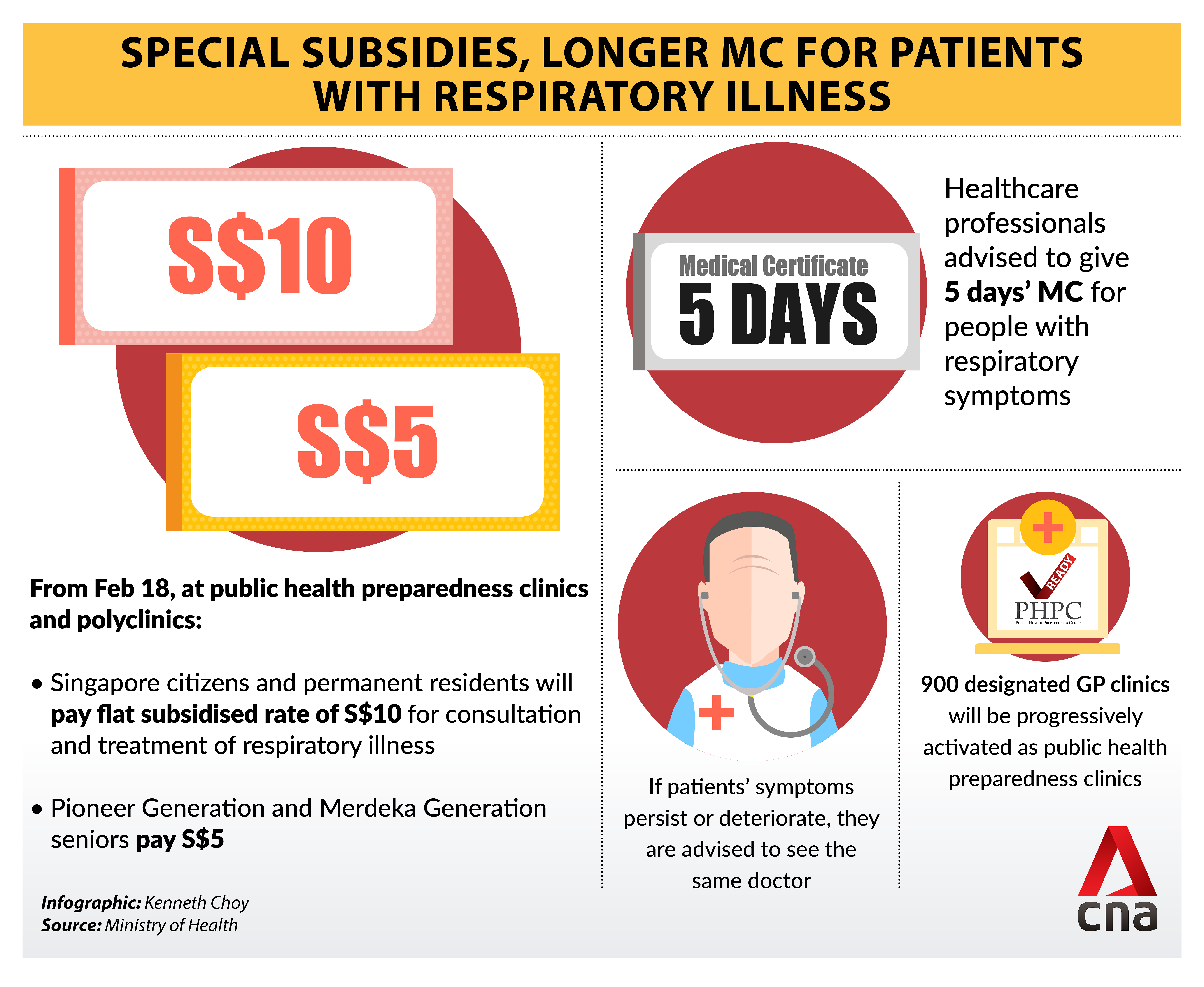
Patients with respiratory symptoms, such as fever, cough, sore throat and runny nose should visit PHPCs. These clinics will provide special subsidies for those diagnosed with respiratory symptoms, to encourage those who are ill to seek treatment, said MOH. 

Patients with such symptoms can also go to polyclinics, where the subsidies will also apply. 

singapore covid-19 public health preparedness clinics infographic

Singapore citizens and permanent residents diagnosed with respiratory illnesses at the PHPCs and polyclinics will pay a flat subsidised rate of S$10 for their consultation and treatment. Pioneer Generation and Merdeka Generation seniors will pay S$5.

The ministry also advised patients to return to the same doctor to seek further treatment if their symptoms persist or deteriorate. 

“Patients must recognise the importance of staying home when unwell,” it said in a media release on Friday.

“Mixing in large crowds, or continuing to go to work or school when ill, even with mild symptoms, will put others at risk.”

WHY THE NEED FOR 5-DAYS MC

In light of the COVID-19 outbreak, healthcare professionals have also been advised to provide medical certificates (MCs) of five days for patients with respiratory symptoms. 

Patients will be referred for further medical assessment and tests if they do not recover within five days, said the ministry. 

Most patients with respiratory symptoms are not infected with COVID-19, noted the health ministry, but extra precautions must be taken.

READ: COVID-19: Public advised to clean surfaces of commonly used items, including phones

MOH stressed that anyone with respiratory symptoms such as fever, cough, sore throat and runny nose should seek medical treatment early and stay home throughout their illness. 

“We urge all individuals and employers to cooperate and follow strictly the five-day MC regime that has been put in place.”

Addressing the five-day period, Assoc Prof Mak explained on Friday that the majority of patients with respiratory problems will recover within three to four days. 

“Most people with minor conditions would have recovered by then, and it (five days) allows us to look and determine whether there are other patients who are still not getting better, who might be getting worse, and we then want them to come back to the GP … to reassess – these are the patients that might be referred to the hospital for further testing,” he added. 

BOOKMARK THIS: Our comprehensive coverage of novel coronavirus and its developments

Download our app or subscribe to our Telegram channel for the latest updates on the coronavirus outbreak: https://cna.asia/telegram

Source link

Oil edges up as output cut hopes offset coronavirus concern

0

Oil prices inched up on Monday as concerns over the economic fallout from the coronavirus outbreak in China were offset by expectations that potential production cuts from major producers could tighten global crude supply.

A oil pump is seen at sunset outside Scheibenhard

FILE PHOTO: A oil pump is seen at sunset outside Scheibenhard, near Strasbourg, France, October 6, 2017 . REUTERS/Christian Hartmann

NEW YORK/LONDON: Oil prices inched up on Monday as concerns over the economic fallout from the coronavirus outbreak in China were offset by expectations that potential production cuts from major producers could tighten global crude supply.

Brent crude was at US$57.59 a barrel, up 27 cents, by 12:55 p.m. EST (17:55 GMT) after rising 5.2per cent last week, its biggest weekly gain since September 2019.

U.S. West Texas Intermediate crude was up 23 cents to US$52.28 a barrel, after a 3.4per cent gain last week.

Trading volumes were thin due to the U.S. Presidents Day holiday.

“Nothing goes down forever, as they say, and oil appears to have finally shaken off its bearish malaise,” said Stephen Brennock of oil broker PVM.

“Virus anxieties were put on the back burner. Investors cheered a salvo of stimulus measures from China’s central bank … sentiment was given a supportive jolt by expectations of a supply response from the OPEC+ producer alliance.”

The International Energy Agency (IEA) said last week the virus was set to cause oil demand to fall by 435,000 barrels per day (bpd) year-on-year in the first quarter, in what would be the first quarterly drop since the financial crisis in 2009.

Oil rose last week for the first time since early January on optimism that Chinese economic stimulus measures could lead to a recovery in oil demand in the world’s largest importing country.

There are some indications of prompt demand for oil as the front-month Brent futures market has shifted to a backwardation, when near-term prices are higher than later-dated prices, from a contango.

Investors are also anticipating that the Organization of the Petroleum Exporting Countries (OPEC) and its allies, including Russia, will approve a proposal to deepen production cuts to tighten global supplies and support prices.

The group, known as OPEC+, has an agreement to cut oil output by 1.7 million bpd until the end of March.

A technical committee earlier this month recommended the group reduce production by another 600,000 bpd because of the impact of the coronavirus, though oil prices’ first weekly gain since early January on Friday may give the producers pause.

“The more recent strength that we have seen in the market may also make OPEC+ complacent when it comes to taking action,” ING said in a note.

“Already the group has failed to bring forward the meeting that was originally scheduled for early March. And if the market consolidates around current levels, OPEC+ may see little need to rush a decision.”

(Reporting by Noah Browning and Florence Tan; Editing by Helen Popper and Marguerita Choy)

Source link

Contradictheory: When it comes to Covid-19, the heart often overrules the head

0

[ad_1]

Every year, I look forward to attending the EmTech conference in Singapore.

It showcases cutting-edge technologies and ideas from around the world.

More importantly, you get to hear the people involved speak with so much passion about what they do.

I still remember in 2018 when Shana Diez, director of build reliability at SpaceX, spoke so eloquently about what it meant to her to send a human being to Mars that I almost jumped up, raised my hand and shouted, “Send me!”

Of course, my head overruled my heart and I’m still Earthbound but I still look forward every year to getting carried away by these (sometimes not so) fantastical flights of fancy.

So you can imagine how disappointed I was when the organisers announced that this year’s event has been delayed by six months.

Colour me blue.

Though, given the context, perhaps I should use a warmer hue. Specifically orange.

Last week, Singapore raised its disease outbreak response system condition (Dorscon) level to “Orange”, which is like Dorscon Yellow except with additional control measures.

[ad_2]

Source link

Even illegal online betting spammers are telling you to stay safe from coronavirus

0

[ad_1]

Like death and taxes, receiving spam messages is a certain thing in this world. There’s just no escape from junk mail, telemarketing bulletins or messages from hungry loansharks.

Text messages about unlicensed loans and online gambling are especially annoying because the senders aren’t letting the Personal Data Protection Commission Act stop ‘em from going on a baiting spree. But when they start taking advantage of the current panic-inducing climate too? That’s pretty shrewd, despite the whole unlawfulness and all. 

An AsiaOne reader received earlier today (Feb 17) an anonymous message advertising an (illegal) online betting service with generous rebates. And why should we be interested? Signing off as “Hock”, the sender implies that we could gamble from the safety of our own home, away from a potential coronavirus infection. 

It’s either that, or spammers these days are just concerned about our wellbeing. They can’t rip you off if you’re in hospital, anyway. 

[ad_2]

Source link

We earn less than Singaporean men for the same amount of work. Here's why

0

[ad_1]

Always wondered if you’re drawing the same salary as your male counterparts for the same amount and type of work? Well, you’re probably paid less.

According to this The Straits Times article from last month, a study by the Ministry of Manpower (MOM) found that the unadjusted gender pay gap rose from 16 per cent in 2002 to 16.3 per cent in 2018.

That said, the adjusted gender pay gap has narrowed from 8.8 per cent in 2002 to 6 per cent in 2018. An adjusted gender pay gap takes into account the differences in age, education, occupation, industry and the number of hours put in between the genders.

Not that the existence of a gender pay gap in Singapore should be any surprise, though. Glassdoor, a job site that also provides insight on company working cultures, released a report in March last year about how men generally earn more than women here. It used a sample of 5,096 salaries of Singaporean employees with an average age of 33 and found that:

[ad_2]

Source link

Return of McGriddles, free meals for nurses at Pek Kio Market & other deals this week

0

[ad_1]

Not going to lie, we think McGriddles are an acquired taste, but we know the burger with syrupy pancakes for buns has its fans.

After almost a year, the breakfast item has once again returned to our shores from Monday (Feb 17), for a limited time only.

This time, the McGriddles will be available all day, so if you can’t get enough of the sweet-salty combination, it’s available for not just breakfast but lunch, dinner and even supper. You can even double up on the satisfaction with a McGriddles stack which consists of two chicken sausage patties, along with cheese, a sunny side up egg, and crispy bacon, all for $6.20.

[ad_2]

Source link

COVID-19, employment issues to be discussed in Parliament

0

SINGAPORE: COVID-19 and issues relating to employment are among the topics to be discussed in Parliament on Feb 18 (Tuesday).

The Public Utilities (Amendment) Bill will be introduced for the first time during Tuesday’s sitting. 

Deputy Prime Minister and Minister for Finance Heng Swee Keat will also deliver the year’s Budget speech at 3pm

READ: Package to help households with cost of living to be announced at Budget amid COVID-19 outbreak: DPM Heng

Members of Parliament have submitted more than 20 questions on a range of issues, with several such as Png Eng Huat and Desmond Choo asking about the Government’s measures to curb the spread of COVID-19, as well as the estimated economic impact of the outbreak. 

The virus, which originated in Wuhan, China, has killed nearly 1,800 and infected more than 70,000 worldwide. 

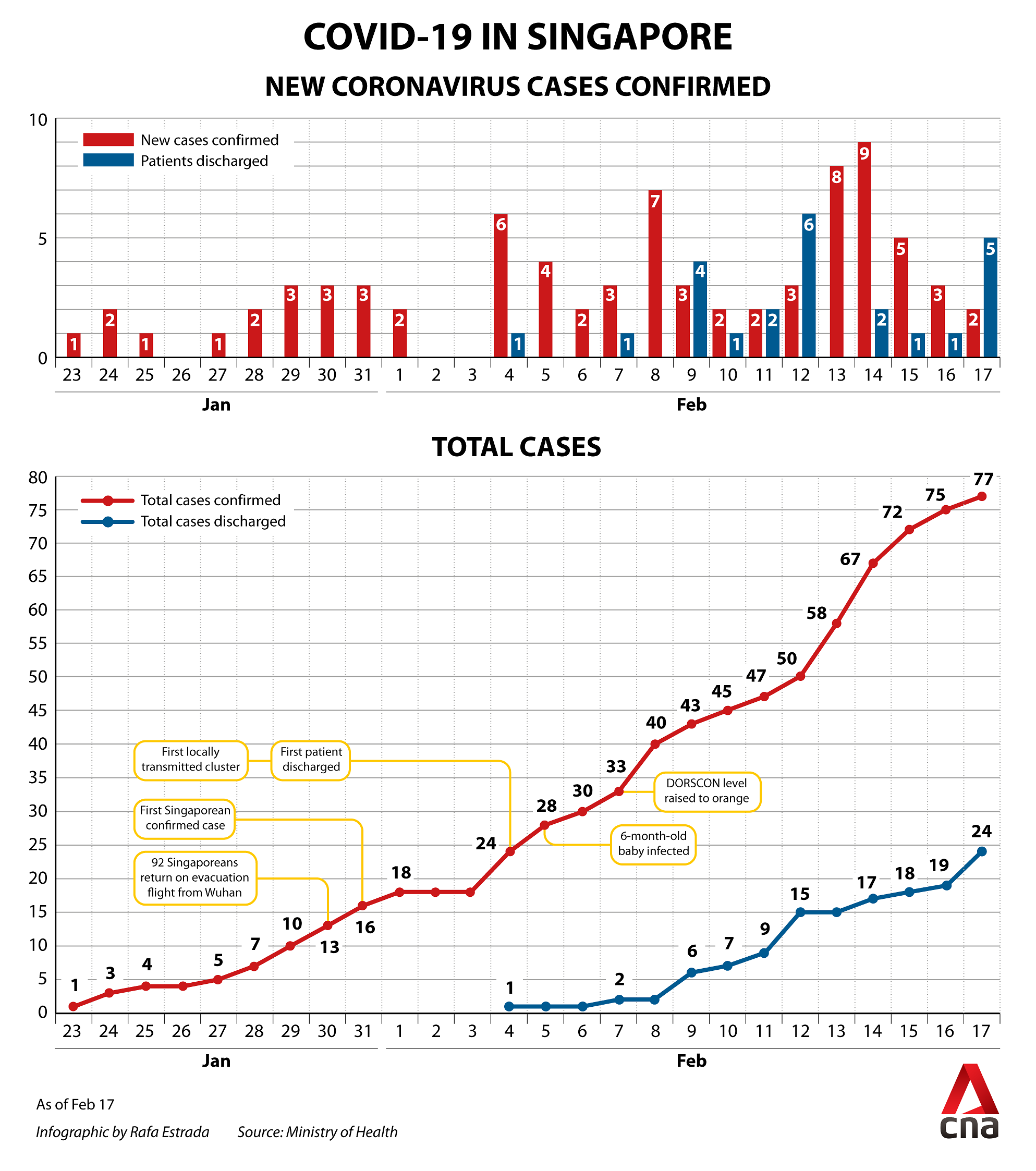
In Singapore, the Ministry of Health announced two new cases on Monday, bringing the total number of cases in the city to 77. A total of 24 who were infected with the virus have made a full recovery and have been discharged. 

READ: 5 COVID-19 patients in Singapore discharged from hospital, 2 new cases reported

singapore new covid cases feb 17

Amid concerns about the COVID-19 outbreak, the Ministry of Trade and Industry on Monday cut the year’s GDP forecast range to -0.5% to 1.5%.

Members of Parliament have also tabled questions about Singapore’s employment landscape.

MP Pritam Singh will ask the Manpower Minister about industries that find it difficult to attract or hire PMET Singaporeans, while MP Lim Biow Chuan will ask about the number of complaints received in the last three years regarding excessive foreigners working in financial institutions. 

Meanwhile, MP Foo Mee Har will ask about plans to help gig economy workers access group insurance, as well as save for retirement and home ownership.

READ: Budget 2020 includes new measures ‘not on the table’ a month ago, says Heng Swee Keat

MP Cheng Li Hui will ask whether a transport start-up without a moneylender license is allowed to offer loans to their drivers at a high administration fee, and whether there will be Government regulation on companies offering similar services operating within the grey area of the law. 

On other issues, MP Lee Bee Wah will ask about the number of complaints the Traffic Police have received about noisy vehicles and how many of these pertain to her constituency, while NMP Anthea Ong will ask about the percentage of Grassroots Advisors appointed by the People’s Association that are members of a political party, as well as whether the Government has plans to review sexual education in schools. 

MP Louis Ng will ask about the number of individuals and organisations that have been prosecuted due to shipments of elephant and pangolin scales seized at Singapore’s borders in 2019. 

Source link

Interracial dating: 'People still aren't used to an Indian girl with a Malay guy'

0

[ad_1]

Interracial relationships may be more common than ever. But just because they’ve become an increasingly familiar dynamic doesn’t mean they’re widely accepted in Singapore.

Halima binte Mohamed Yahuff, 26, and Muhammad Faris Bin Rusli, 28, have grown used to being judged for dating someone outside of their own race in the two years they’ve been together.

“We get plenty of weird looks when we go out for meals or hold hands on the train. While people here have warmed up to the Indian guy-Chinese girl combination, they still aren’t used to seeing an Indian girl with a Malay guy,” says Halima.

However, the disapproval from strangers wasn’t the toughest part of their relationship – at least not till recently. For a long time, they also didn’t have the full support of both their families.

“Faris’ mom struggled with the concept of having an Indian daughter-in-law initially. She’d ask him things like, ‘What is the wedding going to be like?’, ‘What are the traditions we have to comply with?’ and ‘What are the expectations the in-laws are going to have of us?'”

[ad_2]

Source link