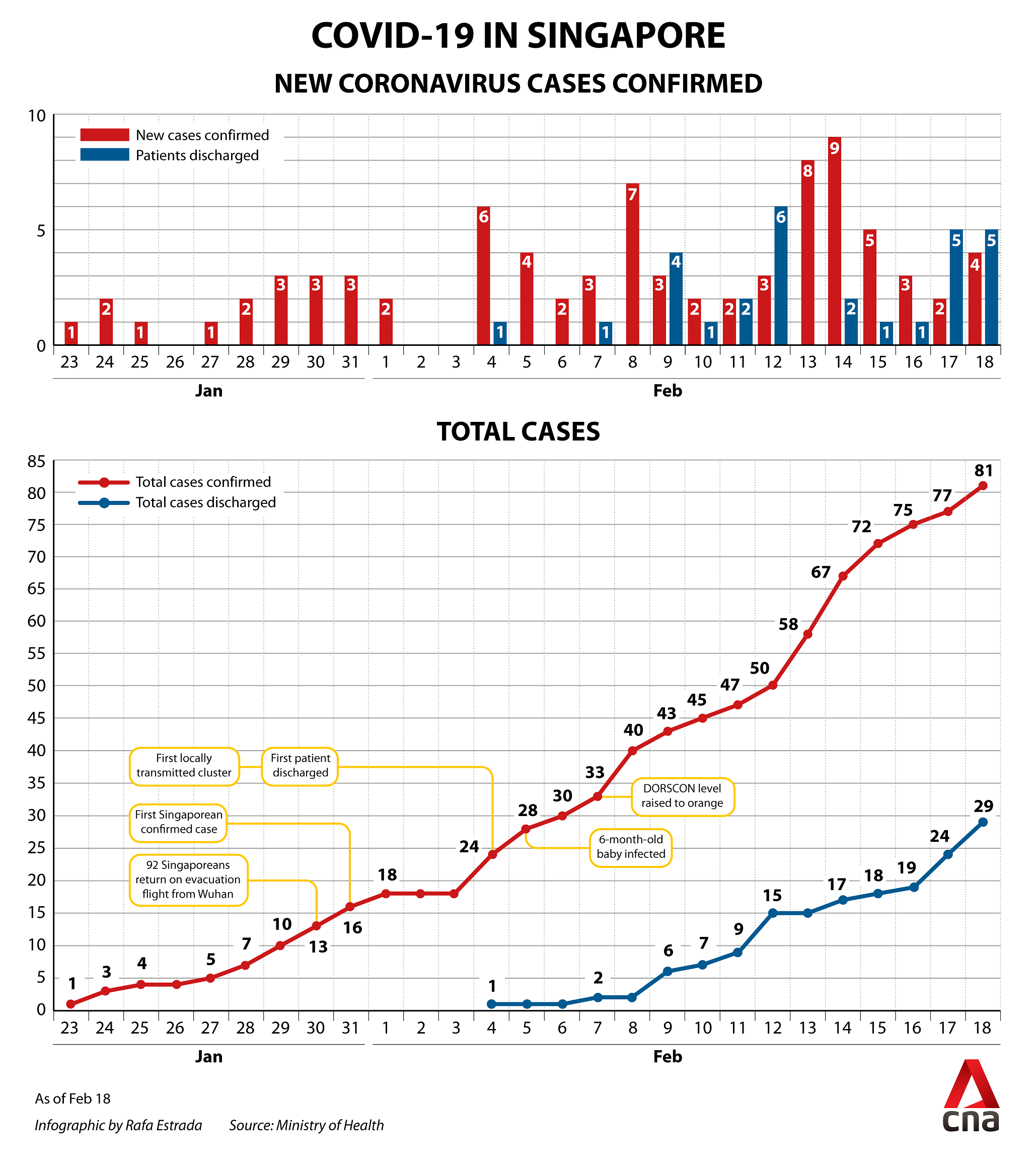
SINGAPORE: Five more COVID-19 patients have been discharged after making a full recovery, including a one-year-old baby, said the Ministry of Health (MOH) on Tuesday (Feb 18).
This means 29 cases have now been discharged from hospital. The one-year-old baby is Singapore’s 76th case. He was among the group evacuated from Wuhan on Feb 9.
MOH also announced four new cases on Tuesday, taking the country’s total to 81.
Three of the new cases are linked to the cluster at the Grace Assembly of God church, and one is the family member of a previous case.
Four patients are in critical condition in the intensive care unit.
ONE-YEAR-OLD DISCHARGED
The one-year-old baby was evacuated from Wuhan on Feb 9 and was without symptoms when he boarded the plane. He was quarantined upon landing in Singapore.
He was admitted to KK Women’s and Children’s Hospital and tested positive for COVID-19 on Sunday, before he was discharged on Tuesday.
The other patients discharged are cases 5, 8, 21 and 38.
Three of the new cases – 78, 80 and 81 – are linked to the cluster at the Grace Assembly of God church, which has 21 COVID-19 cases in total.
All of the three new cases have no recent travel history to China.
Case 78 is a 57-year-old Singaporean who reported the onset of symptoms on Feb 9 and sought treatment at two GP clinics on Feb 10 and Feb 17.
She was taken to the National Centre for Infectious Diseases (NCID) on Tuesday, and tested positive for the coronavirus the same afternoon.
Prior to hospital admission, she had gone to work at a VWO-run community hospital, MOH said.
“She performs an administrative function at the community hospital, and had not interacted with patients since onset of symptoms,” the health ministry added.
She stay at the Dairy Farm area.
Case 80 is a 38-year-old Singaporean who works at the National University Hospital (NUH) in an administrative function.
She is linked to case 66 – a 28-year-old Singaporean who works at Grace Assembly of God and attended God’s Kingdom Bread of Life Church at 37 Jalan Pemimpin.
She tested positive for the infection on Tuesday morning and is currently warded in an isolation room at NUH. The health ministry said she had not interacted with patients since the onset of symptoms.
Case 81 is a 50-year-old Singaporean who tested positive for COVID-19 on Tuesday morning. He is currently warded at NCID.
MALAYSIAN LINKED TO PREVIOUS CASE
The 79th case is a 35-year-old Malaysian who is a Singapore work pass holder. She is the family member of a 40-year-old Chinese national who was announced as Singapore’s 72nd case of COVID-19. The latter was a “non-medical contact” of case 59 – a 61-year-old anesthesiologist at a private hospital in Singapore.
The Malaysian woman reported onset of symptoms on Feb 12, and was placed under home quarantine from Feb 15 after she was identified as a close contact of case 72.
She was taken to NCID by ambulance on Monday, and tested positive for the coronavirus the same afternoon.
Before she was under quarantine, she had gone to work at FoodXchange @ Admiralty at 8A Admiralty Street.
“Her job function at FoodXchange does not entail handling of food,” MOH said.
She stays at Woodlands Crescent and has no recent travel history to China.
Singapore Airlines on Tuesday said it will temporarily cut flights across its global network in the three months to May as the COVID-19 outbreak hits demand for services to and through Singapore.
On Monday, MOH announced a new Stay-Home Notice for Singapore residents and long-term pass holders with recent travel history to mainland China outside the Hubei province.
From 11.59pm on Tuesday, such travellers will be required to stay home at all times during their 14-day leave period. This is stricter than the Leave of Absence measure, which allows them to leave their homes briefly, for example for meals or to buy household supplies.
Singapore on Feb 7 raised the Disease Outbreak Response System Condition (DORSCON) to Orange, prompting additional precautionary measures.
COVID-19 has killed more than 1,800 and infected more than 72,000, mostly in mainland China. It has spread to more than 25 countries, including Singapore, Japan and Thailand.
SINGAPORE – A slew of measures to deal with short-term challenges such as the coronavirus outbreak and long-term economic development were introduced by Deputy Prime Minister Heng Swee Keat on Tuesday (Feb 18).
Immediate measures included a $4 billion package to help firms with cash flow and retain workers, and $1.6 billion for household expenses amid the coronavirus outbreak.
More long-term help included $6 billion set aside to cushion the impact of a future goods and services tax (GST) increase, and $8.3 billion to be spent on growing and transforming the economy over three years.
SINGAPORE: Some lower- to middle-income Singaporeans aged 55 to 70 will get help from the Government to set aside the prevailing Basic Retirement Sum (BRS) in their Central Provident Fund (CPF) accounts, Deputy Prime Minister Heng Swee Keat announced in his Budget speech on Tuesday (Feb 18).
The Government will match every dollar of cash top-up made to the CPF Retirement Account of these members, up to an annual cap of S$600, from 2021 to 2025, said Mr Heng, who is also the Minister for Finance.
“This is a way of encouraging and augmenting family support for our seniors with fewer means in retirement,” he said. About 435,000 Singaporeans will be eligible for the initiative called the Matched Retirement Savings Scheme.
“Many Singaporeans want to top up their own, their spouse’s or parents’ CPF accounts,” Mr Heng said, adding that in 2019, such voluntary cash top-ups added up to about S$1 billion. “We would like to encourage more to do so, particularly those whose CPF balances are on the low side.”
BROADER ELIGIBILITY CRITERIA, HIGHER PAYOUTS UNDER SILVER SUPPORT SCHEME
Mr Heng also unveiled measures for a small segment of seniors, for whom CPF savings will not be enough. There will be a 20 per cent increase in the quarterly cash payouts for the elderly under the Silver Support Scheme, Mr Heng said.
For individuals living in smaller flats, this means that the cash payouts will increase from S$750 to S$900 per quarter, he said.
The scheme currently provides cash payouts to the bottom 20 per cent of Singaporeans aged 65 and above, with some support for those slightly above that. It was created almost five years ago.
“Some had low incomes during their working years, and currently have little or no family support,” he said.
Mr Heng said he will also broaden the eligibility criteria of the Silver Support scheme, to cover more seniors.
“I will expand the threshold for lifetime wages and per capita household income to cover more seniors,” Mr Heng said.
A new payout tier will also mean that seniors whose household incomes per person are above S$1,300 but not exceeding S$1,800 will be able to receive a payout. While it will be smaller than the payout in other tiers, this is the first time they will receive such a payout from the scheme.
Eligible seniors will be notified by the CPF Board and start receiving payouts under the enhanced scheme from December this year.
Overall, the Government expects about 100,000 more seniors to benefit from the enhanced Silver Support in 2021, Mr Heng said. The cost of Silver Support will nearly double, from today’s S$330 million, to around S$620 million in 2021.
Deputy Prime Minister and Finance Minister Heng Swee Keat delivers Budget 2020 in Parliament on Feb 18, 2020.
Of the new measures, Mr Heng said: “These enhancements underscore the Government’s commitment to provide seniors with greater assurance in retirement, and reflect the values we hold dear, such as taking care of our parents and seniors.”
INCREASE IN BASIC RETIREMENT SUM
Mr Heng also announced an increase in the BRS by 3 per cent per year for the next two years. The BRS will be S$93,000 for cohorts turning 55 in 2021, and S$96,000 for cohorts turning 55 in 2022.
Mr Heng said that the BRS has increased by 3 per cent per year since 2017, while household incomes per capita have risen by an average of 4.1 per cent, in nominal terms.
“These modest continuing adjustments are necessary for the payouts to keep up with basic retirement expenses,” Mr Heng said.
Even with the adjustments, the Government expects seven in 10 actively employed persons from the 2021 and 2022 cohorts to be able to set aside their BRS, “significantly” more than the four in 10 a decade ago, Mr Heng said. He noted that with continuing wage growth, each successive cohort has been able to save more.
The Ministry of Finance said the BRS provides CPF members with monthly retirement payouts that cover basic living expenses. BRS adjustments generally account for long-term inflation and some improvements in standard of living, it added.
The ministry said the CPF withdrawal rules remain unchanged. For example, members can still withdraw up to S$5,000 unconditionally from the Ordinary Account or Special Account savings even if their Retirement Account savings are less than their cohort BRS from age 55.
Members are not required to top up their CPF accounts in cash or sell their property if they have less their BRS, it added.
SINGAPORE: With the COVID-19 outbreak coming at a time of an uncertain economic outlook, 2020 has already seen its fair share of challenges – and it is only the second month of the year.
As Singapore ushers in a new decade marked by “major uncertainties”, Finance Minister Heng Swee Keat introduced a Budget aimed at helping local households, workers and businesses weather these challenges.
What do the measures announced on Tuesday (Feb 18) mean for Singaporeans and Singapore businesses?
Here’s a quick recap:
1. WE’RE EXPECTING A PRETTY LARGE OVERALL DEFICIT
First, the basics. Singapore is planning for a “more expansionary” Budget to boost the economy, with an overall deficit for FY2020 expected – the Government expects the overall budget balance to be a deficit of S$10.9 billion (or 2.1 per cent of GDP).
The Singapore economy faces “considerable uncertainty” in the coming years, said Mr Heng, citing heightened risks to the global economy and the rapidly evolving COVID-19 outbreak as examples.
2. THERE’LL BE MORE MONEY TO FIGHT THE COVID-19 OUTBREAK
As anticipated, the novel coronavirus outbreak was front and centre of the Finance Minister’s Budget speech. The outbreak will “certainly” impact our economy, said Mr Heng, affecting industries and disrupting supply chains.
As such, an additional S$800 million will be set aside in this Budget to support the frontline agencies fighting to tackle the outbreak.
Help will also be given to specific sectors especially impacted by the disease, such as aviation, retail, food services and point-to-point transport services.
3. HELP FOR LOCAL WORKERS TO KEEP THEIR JOBS
Given all these uncertainties, a special S$4 billion package was announced to help local workers stay employed and to support enterprises.
As part of this Stabilisation and Support Package, a temporary Jobs Support Scheme will be introduced to help firms retain local workers. Essentially this comes in the form of offset wages – for Singapore Citizen or Permanent Residents in employment, the authorities will offset 8 per cent of their wages, up to a monthly cap of S$3,600, for three months.
About 1.9 million local employees stand to benefit from this.
Companies will also get help with cash flow, in the form of a corporate income tax rebate as well as various enhancements for tax treatments under the corporate tax system.
4. GST INCREASE GETS PUSHED BACK
Remember that planned GST hike announced two years ago? It’s been pushed back, in consideration of the current state of the economy.
The 2-percentage point hike in GST to 9 per cent was originally meant to be rolled out sometime between 2021 and 2025. That will now change, said Mr Heng, and the rate increase will not take effect in 2021 – meaning that GST will remain at 7 per cent next year.
But just to clarify, the increase is still in the pipeline – Mr Heng said it would still be needed by 2025, and the authorities will “assess carefully” the appropriate time to implement the change.
When this eventually does happen though, there’ll be a S$6 billion package for Singaporeans to help ease the transition.
Under this Assurance Package for GST, every adult Singaporean will get a cash payout of between S$700 and S$1,600 over five years.
5. MORE $$$, ESPECIALLY FOR THOSE WITH KIDS, THE ELDERLY
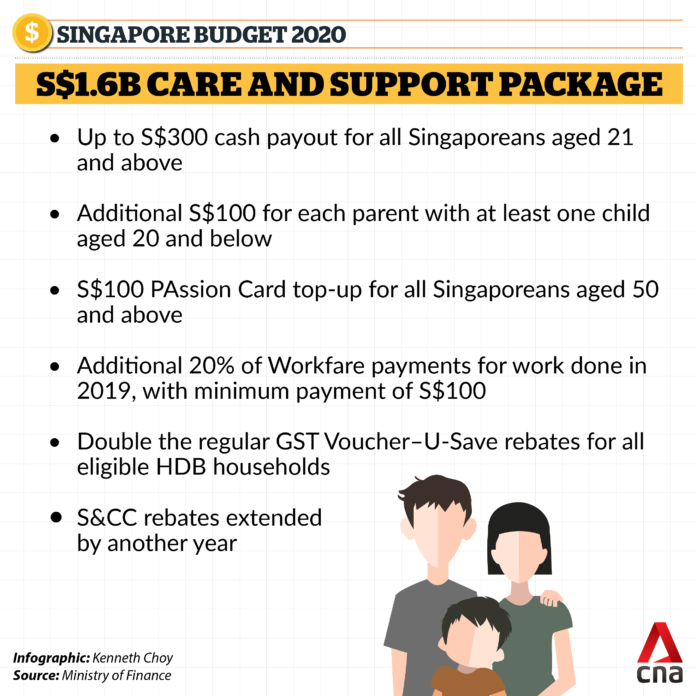
The Finance Minister also fleshed out details of the cost of living package he teased over the weekend. Under the S$1.6 billion Care and Support Package all Singaporeans can expect to get at least some cash to help tide them over.
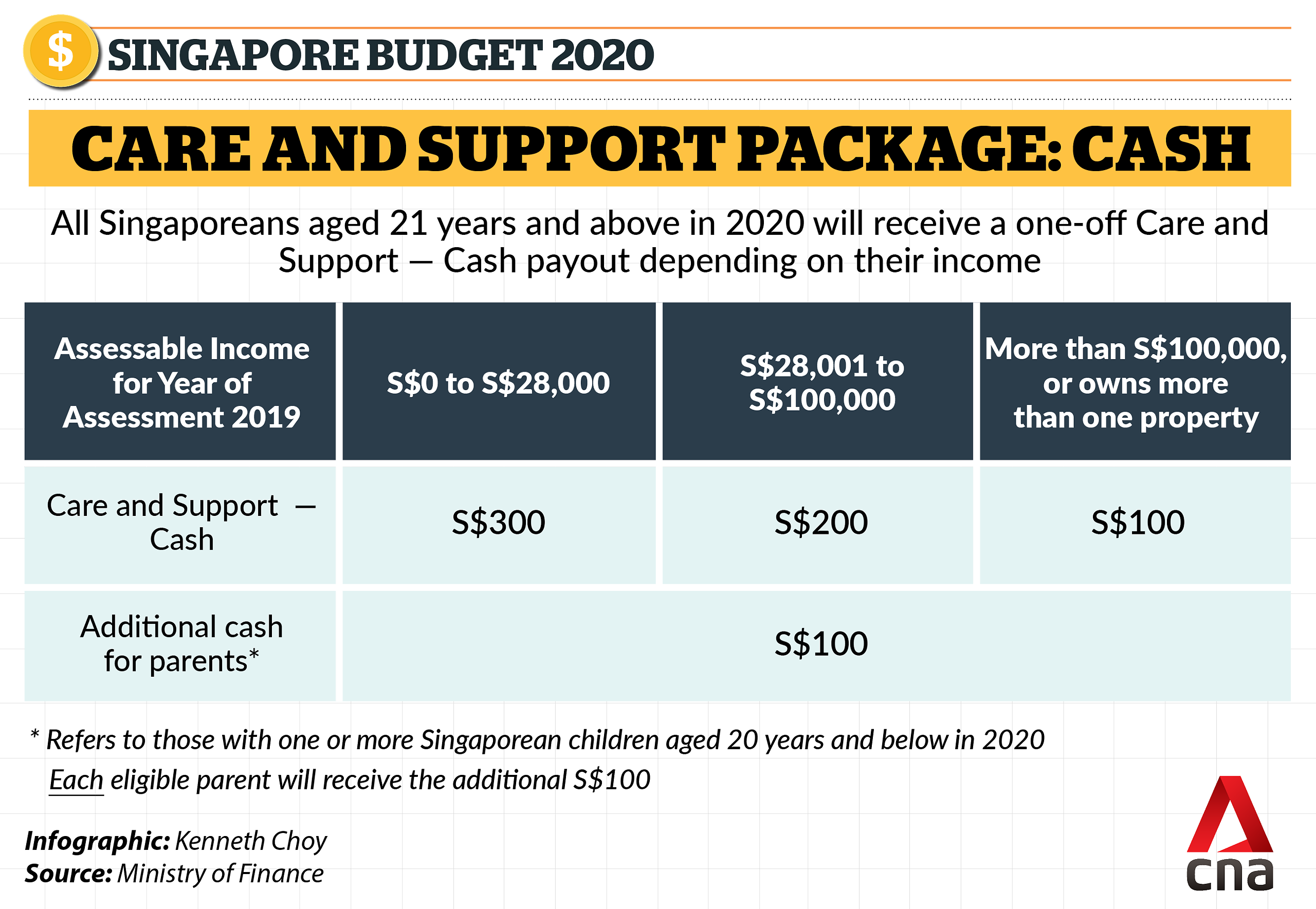
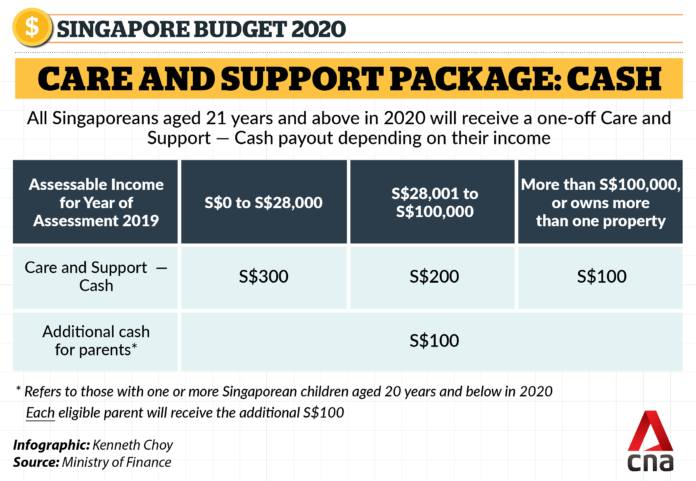
For those aged 21 and above: One-off cash payout of S$300, S$200 and S$100, depending on income and/or property ownership
For those with at least one child aged 20 and below: A further S$100 cash payout
For those aged 50 and above: S$100 PAssion Card top-up (you can get a card for free if you don’t have one yet)
There’ll also be other support measures, including grocery vouchers worth S$100 a year in 2020 and 2021 for qualifying Singaporeans, as well as enhanced GST Voucher-U-Save rebates.
6. NEW HORIZONS FOR STUDENTS
One of the main themes outlined in this year’s Budget Speech was the importance of personal development. This includes local students, who will be getting additional support to learn from other countries in the region.
The authorities have set a “70-70” target – they want 70 per cent of local Institute of Higher Learning graduates to have overseas exposure, and 70 per cent of the exposure to be in the Association of Southeast Asian Nations (ASEAN), China or India.
To hit this target, a new Asia-Ready Exposure Programme will be set up to support visits by young people to cities in ASEAN, China and India. Support for internships will also be enhanced under another existing programme.
7. … BUT REMEMBER, IT’S NEVER TOO LATE TO UPGRADE YOURSELF
Of course, learning doesn’t necessarily stop after you’ve left formal education. There’ll be increased support for those who want to develop new skills even as they develop their careers, with additional investment in the SkillsFuture programme.
First off, there’ll be a one-off SkillsFuture Credit top-up of S$500 for every Singaporean aged 25 and above, available from Oct 1 this year.
It’s a use-it-or-lose-it situation though – unlike the previous S$500 credit which had no expiry date, the new top-up will expire by the end of 2025.
If you’re a mid-career worker – i.e. those in their 40s and 50s – you get extra credit, with an additional S$500 top-up for every Singaporean aged between 40 and 60 (again, it’ll expire in about five years).
The authorities will also introduce additional measures to help these workers, including a salary support hiring incentive for employers to hire local jobseekers aged 40 and above.
8. … EVEN IF YOU’RE A “SENIOR WORKER”
And looking even further ahead, there will also be lots of support for older workers who want to work longer, in the form of a new Senior Worker Support Package.
As part of this, a new Senior Employment Credit will give employers wage offsets when they hire Singaporean workers above the age of 55. This replaces the existing Special Employment Credit and Additional Special Employment Credit schemes which are set to expire at the end of the year.
Other measures include money given to employers to offset CPF contribution rates for workers aged 55 to 70, after contribution rates go up next year.
9. HELP FOR LESS WELL-OFF SENIORS TO SAVE FOR RETIREMENT
Help will be given to support lower- to middle-income Singaporeans between the ages of 55 and 70, who might not be able to meet their retirement needs.
Those who have not been able to set aside the prevailing Basic Retirement Sum will be able to get extra support under a new retirement savings scheme. This will see the Government matching every dollar of cash top-up made to their CPF Retirement Account, up to an annual cap of S$600.
A small segment of seniors will also get enhanced cash payouts under the current Silver Support Scheme.
10. MAYBE TRADE IN YOUR GAS GUZZLER SOON?
Another big topic in this year’s Budget Speech? Climate change.
Last year saw the introduction of a carbon tax, and in a further bid to go green the Government is now targetting the domestic transport sector – specifically, vehicles with internal combustion engines (basically the ones that run on petrol or diesel).
These vehicles contribute to pollution and adversely affect people’s health and quality of life, said Mr Heng.
That’s why the goal is to phase them out, and have all vehicles run on cleaner energy by 2040. There will be a number of measures to make this happen: For example, an early adoption incentive will be introduced to reward those who buy fully electric cars and taxis.
The authorities are also looking to roll out way more charging points, with a target of up to 28,000 chargers at public car parks islandwide by 2030, up from the current 1,600 points.
SINGAPORE: Households in Singapore will receive about S$1.6 billion to help with their expenses as the country faces economic slowdown and uncertainties due to the COVID-19 outbreak.
“People often tell us that they are worried about job security and rising expenditures,” said Deputy Prime Minister and Finance Minister Heng Swee Keat as he announced on Tuesday (Feb 18) a Care and Support Package during his Budget speech.
A young family can expect to receive about S$1,300 from the package, while a three-generation family may receive about S$1,800. Lower-income Singaporeans will also get more help with their daily living expenses.
Here is a breakdown of the measures in the Care and Support Package:
1. CASH PAYOUT
A one-time cash payout of S300, S$200 or S$100 will be given to all Singaporeans aged 21 and above in 2020. The amount given will depend on the recipient’s income level.
A further S$100 will be given to every adult Singaporean with at least one Singaporean child aged 20 and below this year.
2. U-SAVE GST VOUCHER
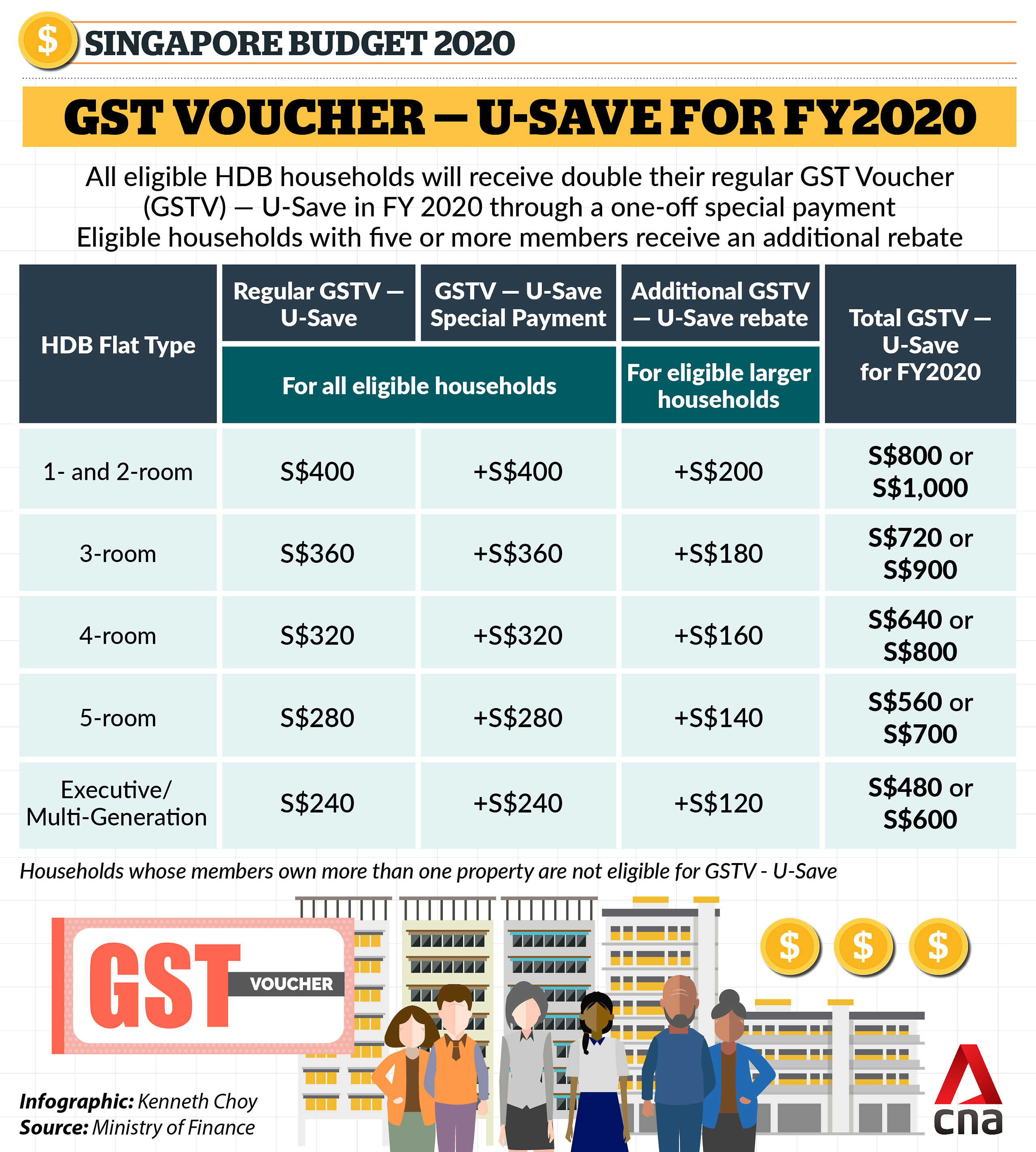
The Government will double the amount of U-Save rebates, meant to offset the utilities expenses, through a one-off GST voucher – U-Save special payment to all eligible Housing Board households.
Larger households with five or more members will receive an additional rebate on top of that, which adds up to 2.5 times their regular U-Save rebates.
The service and conservancy charges rebate will also be extended by another year. Eligible HDB households will get between 1.5 and 3.5 months worth of rebates.
3. FOR SINGAPOREANS AGED 50 AND ABOVE
A S$100 top-up to the PAssion Card will be given to Singaporeans aged 50 and above this year, including seniors from the Pioneer and Merdeka generations.
This can be used to pay for groceries, and activities and use of facilities at community clubs, among other things.
Those who do not have a PAssion Card can get one for free to receive the top-up.
4. GROCERY VOUCHERS, WORKFARE FOR LOWER-INCOME HOUSEHOLDS
Grocery vouchers worth S$100 will be given to needy Singaporeans in 2020 and in 2021, to be used at major supermarkets. “This directly helps needy households with one of their major cost-of-living items – food,” said Mr Heng.
Lower-wage workers on workfare will get 20 per cent more payment for work done in 2019, with a minimum payment of S$100, given in cash.
The Workfare Transport Concession Scheme and the Public Transport Voucher announced in October last year are also expected to help cushion the fare increase for lower-income households.
The scheme gives lower-wage workers 15 per cent off adult fares. Public Transport Vouchers worth S$50 were made available for one in five resident households last year.
5. THROUGH SELF-HELP GROUPS AND CDC
Self-help groups will be given a S$10 million grant over two years. These include the Chinese Development Assistance Council, the Eurasian Association, the Singapore Indian Development Association and Yayasan Mendaki.
The five Community Development Councils overseeing various parts of the island will also get S$20 million to “better meet the needs of their residents through local initiatives”, including helping vulnerable groups and “those with extra needs”.
Deputy Prime Minister and Finance Minister Heng Swee Keat delivering the Budget 2020 statement in Parliament on Feb 18, 2020.
These measures come on top of significant moves by the Government to help Singaporeans manage major life expenditures “through structural subsidies for education, housing and healthcare”, said Mr Heng.
“We are mindful that many families are facing greater pressures,” he added.
SINGAPORE – Armed with a $6.4 billion arsenal to fight the coronavirus and its fallout on the economy, this year’s expansionary Budget could run a historic deficit of $10.9 billion – the highest in 10 years.
Coming in at 2.1 per cent of Gross Domestic Product (GDP), it exceeds the projected deficit of $8.7 billion in 2009 during the global financial crisis, when the Government rolled out a S$20.5 billion Resilience Package to help Singaporeans and businesses.
That deficit was eventually pared down to $0.82 billion, or just 0.3 per cent of GDP.
But unlike 2009 when the government dipped into the past reserves, some powder has been kept dry this time around – thanks to a surplus of 18.7 billion accumulated over the current term of government.
Unveiling the 2020 Budget statement on Tuesday(Feb 18), DPM Heng said that Singapore is expected to have a $10.9 billion budget deficit this year.
This is a sharp climb from the $1.7 billion deficit chalked up last year, revised from the initial $3.5 billion deficit forecast a year ago.
SINGAPORE: A S$1.6 billion Care and Support Package for households to help them with expenses “during this period of uncertainty” was announced by Deputy Prime Minister Heng Swee Keat on Tuesday (Feb 18).
“This year, with the economic slowdown and the uncertainties of the COVID-19 outbreak, we are mindful that many families are facing greater pressures. During my fellow MPs’ and my own walkabouts, people often tell us that they are worried about job security and rising expenditures,” he said in his Budget speech.
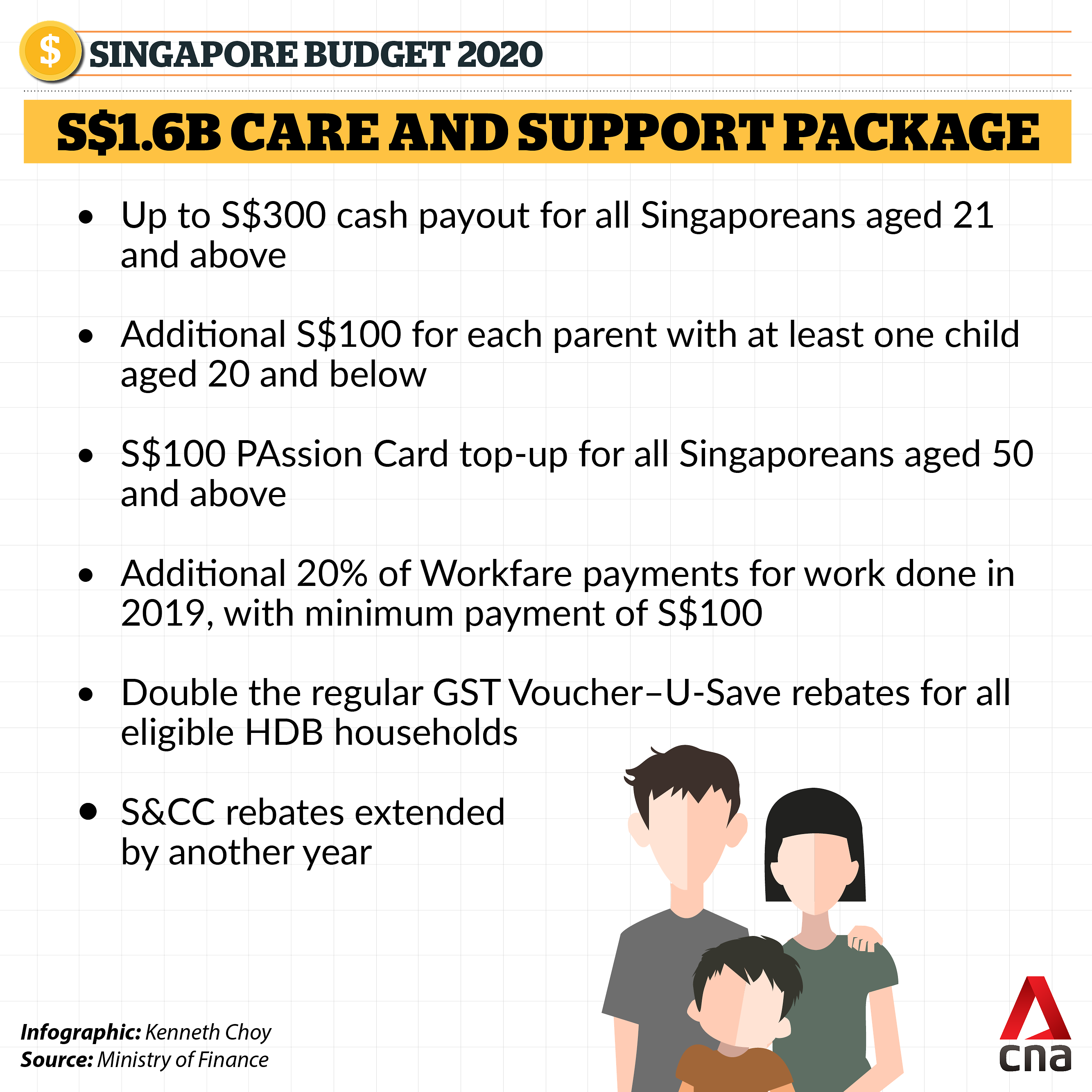
All Singaporeans aged 21 and above this year will receive a one-off cash payout of S$300, S$200 or S$100, depending on their income. Cash payouts will also be given to families with children and elderly parents.
Every adult Singaporean with a child aged 20 and below will receive another S$100 cash payout, while Singaporeans aged 50 years and above will receive a S$100 PAssion Card top-up.
All eligible Housing and Development Board (HDB) households will also receive a one-off Goods and Service Tax Voucher (GSTV) – U-Save Special Payment, which will double their annual GSTV – U-Save. Eligible households with five or more members will receive two-and-a-half times their regular GSTV – U-Save.
The GSTV – U-Save rebates are given out every three months to help HDB households with their utility bills.
Mr Heng added that the Service and Conservancy Charges Rebates will be extended by another year.
“Eligible HDB households will receive rebates of between one-and-a-half and three-and-a-half months,” he said.
Service and Conservancy Charges are fees payable to the town council each month to cover the cost of maintaining the HDB estate, with rates differing by flat type.
Lower-income Singaporeans will receive more help with daily living expenses, said Mr Heng.
Transport fare increases will be cushioned by a Workfare Transport Concession Scheme and a Public Transport Voucher announced in October 2019.
The Workfare Transport Concession Scheme gives lower-wage workers under the Workfare Income Supplement scheme 15 per cent discount of adult fares. Public Transport Vouchers worth S$50 were made available for one in five resident households last year.
The Government will also provide a Workfare Special Payment, with Singaporeans on Workfare receiving 20 per cent more for work done in 2019, in cash. The minimum payment is S$100.
Grocery vouchers of S$100 will also be given out to needy Singapore in 2020 and 2021, to be used at major supermarkets. ”This directly helps needy households with one of their major cost of living items – food,” said Mr Heng.
Funds will also be disbursed to Self-Help Groups and Community Development Councils (CDCs) to allow them to do more for the community.
Self-help groups will receive a S$10 million grant over two years, while CDCs will receive S$20 million.
“Together, the Care and Support Package will provide a young family with about S$1,300. A three-generation family can receive more – about S$1,800,” said Mr Heng.
SINGAPORE: Singapore will spend S$4 billion on a slew of new measures and enhancements to existing schemes to stabilise its economy amid the near-term uncertainties caused by COVID-19, announced Deputy Prime Minister Heng Swee Keat on Tuesday (Feb 18).
The special Stabilisation and Support Package will help workers to remain employed and aid companies with cash flow.
Sectors that have taken a direct hit from the coronavirus outbreak, such as tourism, aviation, retail, and food services, will receive additional help, Mr Heng said in his Budget statement.
Noting concerns about jobs amid the uncertainties, Mr Heng, who is also Finance Minister, said the Government wants to help workers stay employed and will do so by helping firms to defray wage costs in two ways.
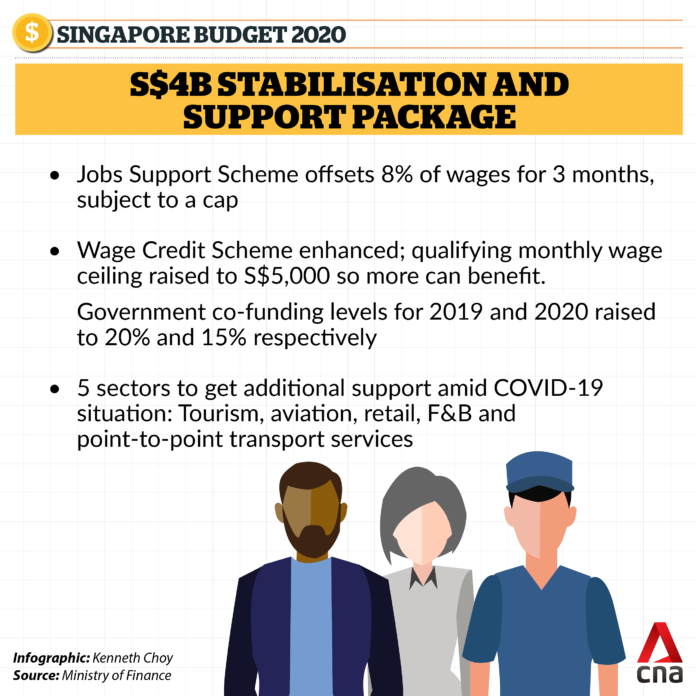
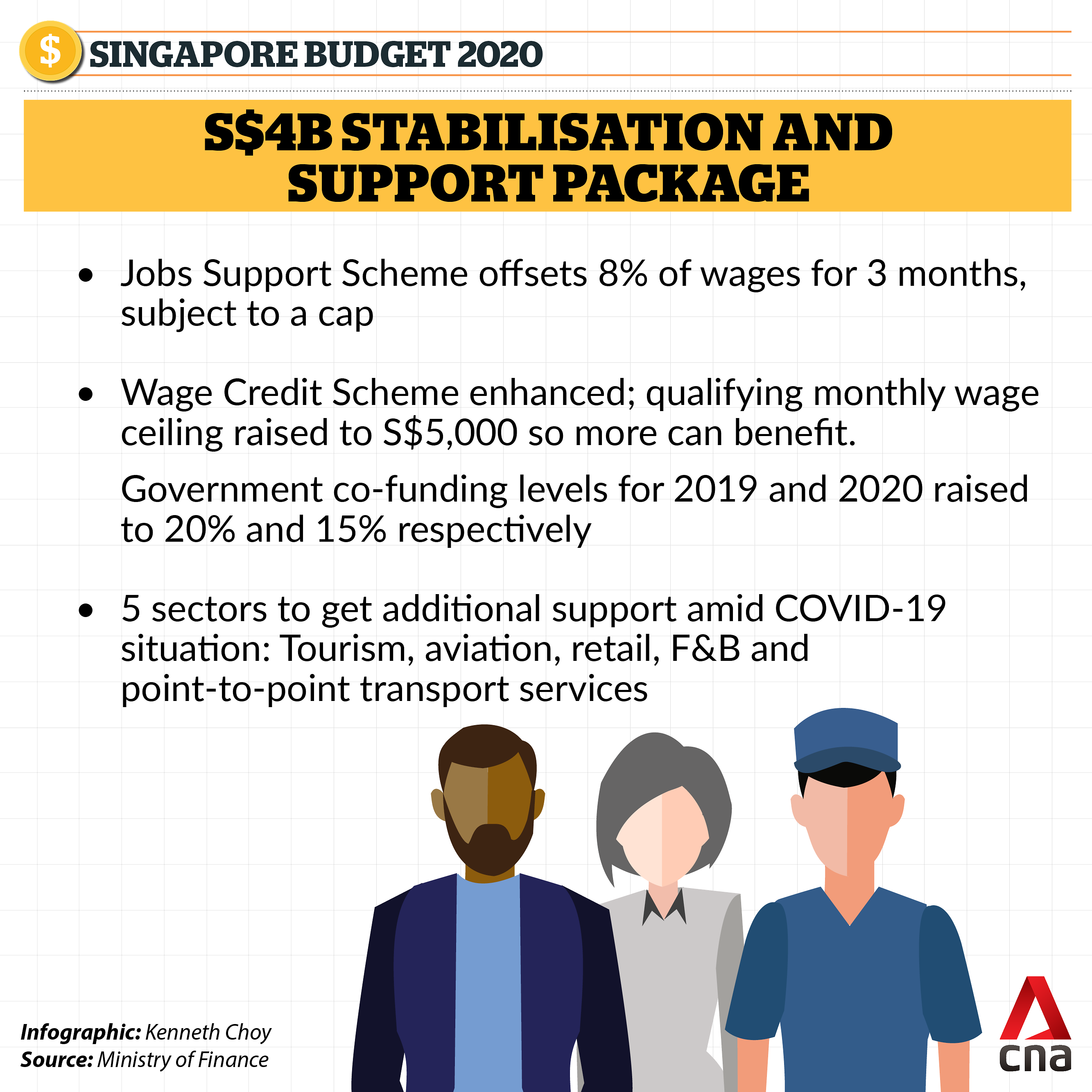
The first is through a Jobs Support Scheme worth S$1.3 billion. This aims to help firms retain local workers – more than 1.9 million Singapore citizens and permanent residents (PRs) – during this period of uncertainty.
Employers will receive an 8 per cent cash grant on the gross monthly wages of each local employee on their Central Provident Fund payroll for the months of October to December. This is subject to a monthly wage cap of S$3,600 per worker. Payment to the employers will be made by end-July.
The second is an enhancement of the Wage Credit Scheme, which supports enterprises embarking on transformation efforts and encourages them to share productivity gains with workers in the form of wage increases.
The scheme currently co-funds wage increases for Singaporean employees earning a gross monthly wage of up to S$4,000. This will be raised to S$5,000 for qualifying wage increases given in 2019 and 2020 to benefit more Singaporean workers.
The Government co-funding levels will also be increased by 5 percentage points to 20 per cent and 15 per cent for 2019 and 2020, respectively.
More than 700,000 Singaporeans employed by 90,000 enterprises will benefit from these enhancements to the Wage Credit Scheme worth S$1.1 billion, said Mr Heng.
HELP BUSINESSES WITH CASH FLOW
The special package also entails economy-wide support to ease business concerns about cash flow.
There will be a corporate income tax rebate for the year of assessment 2020 at a rate of 25 per cent of tax payable, and capped at S$15,000 per company. This move, which will benefit all tax-paying firms, will cost the Government about S$400 million.
Mr Heng also announced year-long enhancements for several tax treatments under the corporate tax system.
For instance, enterprises will be allowed a faster write-down of their investments in plant and machinery, and renovation and refurbishment, incurred for the year of assessment 2021.
This will put more cash in the hands of enterprises, said Mr Heng. Hotels, for example, can take advantage of this lull period to carry out upgrading work and be better prepared for the rebound, he suggested.
To help enterprises access working capital more easily, the Enterprise Financing Scheme’s Working Capital Loan component will also be given a boost.
For a year, the maximum loan quantum will be doubled from S$300,000 to S$600,000, while the Government’s risk-share will also be increased to 80 per cent, from the current 50 to 70 per cent.
The Government will also support tenants and lessees of Government-managed properties with more flexible rental payments, such as instalment plans. For this, each request will be assessed individually, taking into account the firm’s circumstances, said Mr Heng.
The outbreak of the novel coronavirus has directly affected sectors, such as tourism, aviation, retail, food services and point-to-point transport services.
To help firms in such sectors retain and reskill workers, the Adapt and Grow initiative will be enhanced this year, specifically through redeployment programmes.
For these sectors, the funding period for reskilling of workers will be extended from three months to a maximum of six months.
“Together with the Jobs Support Scheme, we will support employers in these sectors to retain and train more than 330,000 local workers,” said Mr Heng. “These workers can make full use of the downtime for training and upskilling to prepare for the recovery.”
The Government will also help affected sectors with their operating costs and cash flow.
Within the tourism sector, a property tax rebate of 30 per cent for the year 2020 will be granted to the accommodation and function room components of licensed hotels and serviced apartments, and three Meetings, Incentives, Conventions and Exhibitions (MICE) venues like the Suntec Singapore Convention and Exhibition Centre, Singapore Expo and the Changi Exhibition Centre.
International cruise and regional ferry terminals will receive a 15 per cent property tax rebate, while the integrated resorts will receive a 10 per cent rebate.
Firms in the tourism sector can also look forward to a temporary bridging loan programme for additional cash flow support.
Under this programme, eligible enterprises can borrow up to S$1 million with the interest rate capped at 5 per cent per annum from participating financial institutions. The Government will provide 80 per cent risk-share of these loans. The programme will start in March and will be available for a year.
For the aviation sector, the Government will grant a 15 per cent property tax rebate for Changi Airport, alongside a suite of measures including rebates on aircraft landing and parking charges, assistance to ground handling agents and rental rebates for shops and cargo agents at Changi Airport.
To support firms in the food services and retail business, the National Environment Agency (NEA) will provide a full month’s rental waiver to stallholders in NEA-managed hawker centres and markets.
Other government agencies, like the HDB, will provide half a month of rental waiver to its commercial tenants.
A 15 per cent property tax rebate will also be granted to qualifying commercial properties, said Mr Heng, who urged landlords to pass this on to their tenants by reducing rentals.
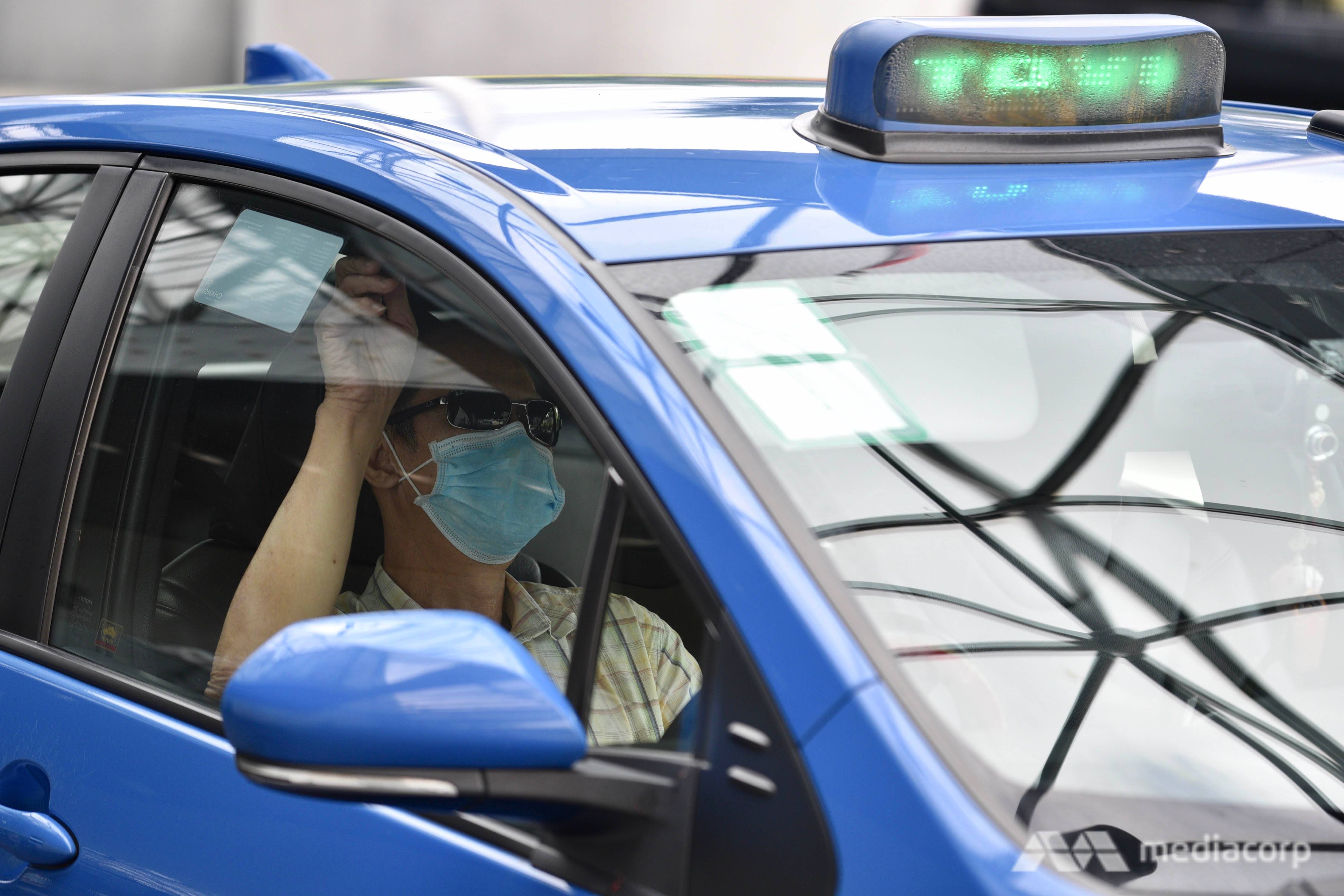
A taxi driver waits for passengers outside Swissotel The Stamford (Photo: Jeremy Long)
For the transport sector, authorities already announced a S$77 million Point-to-Point Support Package for taxi and private-hire car drivers last week. The Government will contribute S$45 million towards the package, with the remaining provided by taxi and private-hire car operators.
“We will continue to monitor the situation closely,” said Mr Heng. “If needed, we can and are prepared to do more.”
The outbreak of COVID-19 comes after a difficult 2019 where the Singapore economy posted its weakest growth since the 2008 financial crisis.
“The outbreak will certainly impact our economy,” he said, noting that the tourism and aviation industries are most affected due to declining visitor arrivals to Singapore, air traffic through Changi Airport and a decline in hotel occupancy rates.
The outbreak has also disrupted supply chains and created ripple effects on other sectors, with the economy “so much more integrated with China’s”.
Mr Heng said the duration and severity of the COVID-19 outbreak and impact on the global economy are still unclear.
Referring to an earlier downgrade in growth forecast by the Ministry of Trade and Industry, he said: “While MTI’s baseline is for GDP growth to come in at 0.5 per cent for the full year, we must be prepared that the economic impact may be worse than we projected.”
Noting that the Government will put in every effort to slow down the spread of the virus, Mr Heng said he will set aside an additional S$800 million in this Budget to do so, with the bulk set to go to the Ministry of Health.
At the start of his Budget statement, he also expressed gratitude to all frontline workers who have been working tirelessly to fight against the outbreak.
“I am confident that together, we will stay strong and get through these trying times,” he said.
SINGAPORE: More support will be given to enterprises and workers in their transformation journey in the midst of major structural changes in the global economy.
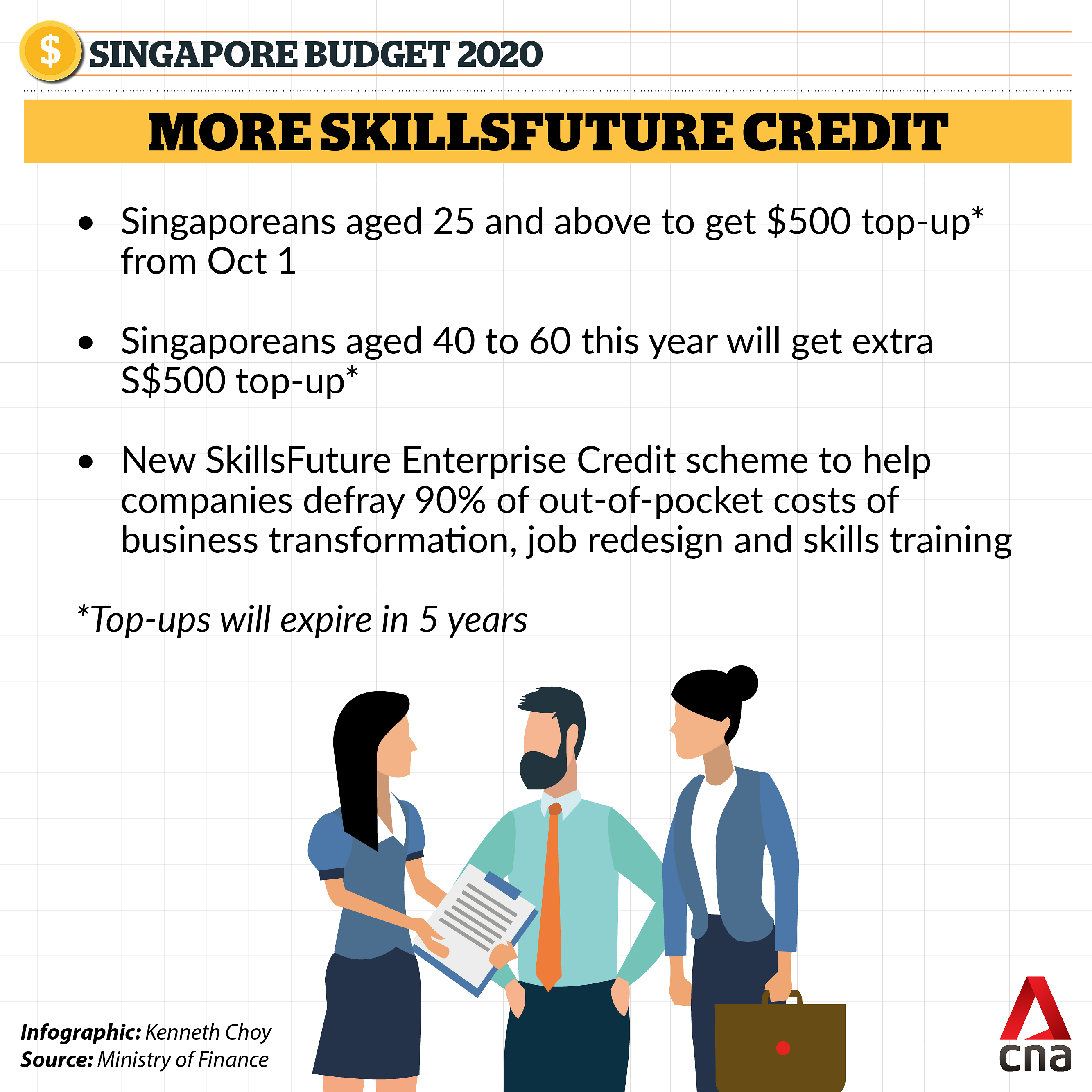
A one-off S$500 SkillsFuture top-up will be made available for every Singaporean aged 25 and above, as part of the Government’s efforts to support workers to develop new skills.
The top-up will be available for use from Oct 1 this year, and will remain valid for five years, until Dec 31, 2025.
“This is to encourage Singaporeans to take action early to learn new skills, and to make the best use of this period of economic slowdown,” said Deputy Prime Minister Heng Swee Keat, as he delivered the Budget statement in Parliament on Tuesday (Feb 18).
Enterprises will also benefit from the Government’s investment into the “Next Bound of SkillsFuture”, with a new SkillsFututre Enterprise Credit.
Meant to “encourage employers to embark on the transformation of their workforce and enterprise in tandem”, each enterprise will receive S$10,000 to “defray 90 per cent of out-of-pocket costs of business transformation, job redesign and skills training”, said Mr Heng, who is also the Minister for Finance.
To encourage employers to transform their workforce, S$3,000 out of the S$10,000 will be reserved for workforce transformation programmes.
This is expected to benefit about 39,000 enterprises, and there will be four qualifying windows up until Mar 31, 2021 for employers to apply. After qualification, employers may make claims on supported programmes from Apr 1, 2020 until Jun 30, 2023.
Job redesign will get a boost as the Government will expand the Productivity Solutions Grant to include job redesign consultancy services. Currently, the grant supports companies to adopt long-term technology investments to enhance their business processes.
The Government also aims to train sectors and value chain partners of up to 40 large anchor enterprises.
“Anchor enterprises are supported by many SMEs (small and medium enterprises). By helping raise the skills of workers in these SMEs, the entire supply chain benefits,” Mr Heng said.
Deputy Prime Minister and Finance Minister Heng Swee Keat delivers Budget 2020 in Parliament on Feb 18, 2020.
About 4,000 small- and medium-size enterprises (SMEs) will benefit from the initiative over the next five years.
The capacity of SkillsFuture Work-Study programmes will more thandouble by 2025.
“Our aim is to make this a mainstream pathway, with 12 per cent of each cohort going through these pathways, up from 3.5 per cent today,” said Mr Heng.
Mr Heng added that the Government will “deepen workplace learning capabilities”. The National Centre of Excellence for Workplace Learning at Nanyang Polytechnic will expand to two more Institutes of Higher Learning, and benefit more than 1,200 enterprises.
“In line with our focus on the role of industry in SkillsFuture, we will also recalibrate government funding towards training providers and courses with a stronger link to job and wage outcomes,” said Mr Heng.
MID-CAREER WORKERS
A SkillsFuture Mid-Career Support Package aimed at Singaporeans in their 40s and 50s will be introduced.
This will “help them stay employable and move on to new jobs or new roles”, said Mr Heng. The aim is to double the placement of locals in their 40s and 50s, to about 5,500 by the year 2025.
More workers will also be able to apply for reskilling programmes, as the Government plans to increase capacity for the Professional Conversation Programme, career transition programmes by Continuing Education and Training (CET) centres, and Place-and-Train programmes for rank-and-file workers.
To support reskilling, each Singapore aged 40 to 60 in 2020 will also receive an additional S$500 SkillsFuture Credit this year, in addition to the S$500 offered to all Singaporeans. This will also expire in five years, “to encourage early action”, said Mr Heng.
This can be used from Oct 1 on about 200 career transition programmes by CET centres.
The Government will assemble a group of volunteer career advisors to provide career guidance to mid-career workers.
Employers will also have to “step up to recruit, retain and retrain our local mid-career workers”, said Mr Heng.
Companies which hire Singaporeans aged 40 and above through reskilling programmes will receive 20 per cent salary support for six months, capped at S$6,000 in total.
“As enterprises restructure, the nature of jobs has changed … At the same time, with broader global shifts, exciting jobs will emerge. Our mid-career workers can seize these opportunities and do better for themselves and their families,” said Mr Heng.
SENIOR WORKERS
To ease the impact on employers and workers from the expected increase in retirement and reemployment ages and higher CPF contribution rates for workers aged 55 to 70, a Senior Worker Support Package will be introduced.
It comprises four measures.
A Senior Employment Credit will replace the Special Employment Credit and the Additional Special Employment Credit from 2021. Employers will receive wage offsets when they employ Singaporeans 55 years and above, with support “tapering down over time” as the Government raises the Retirement and Re-employment ages.
When employer CPF contributions increase next year, the Government will offset half of the increase with a CPF Transition Offset for the year.
Employers who raise their ownretirement and re-employment ages ahead of the stipulated deadline will receive a Senior Worker Early Adopter Grant from Jul 1, 2020 to Jun 30, 2023.
To encourage enterprises to “formalise part-time re-employment provisions”, there will also be a Part-Time Re-employment Grant, for companies who commit to offering part-time re-employment to eligible older workers who wish to take on such positions.
FOREIGN WORKERS
The S-Pass sub-Dependency Ratio Ceilings (DRCs) of the Construction, Marine Shipyard and Process sectors will fall to 15 per cent this year.
The DRC is the maximum permitted ratio of foreign workers to the total workforce that a company is allowed to hire.
The cuts will be in two steps. The first, from 20 per cent to 18 per cent on Jan 1, 2021; and subsequently to 15 per cent on Jan 1, 2023.
There will not be any reduction for the manufacturing sector, “given the economic uncertainties”, said Mr Heng. But the Government intends to tighten the ratio in time.
“At the same time, we recognise potential concerns of enterprises about the availability of skilled manpower in these sectors,” said Mr Heng.
He added that SkillsFuture Singapore and Workforce Singapore will match local graduates and older local professionals with employers, and enterprises with specific needs “can continue to apply for additional manpower flexibilities in exceptional cases”.
Foreign worker levy rates will remain the same for all sectors for 2020.
“The growth in S Pass holders must be sustainable. The Government has been working closely with industry and educational institutions to build up a pipeline of local manpower, including mid-career workers,” said Mr Heng.
“We want them to have fair opportunities to grow, while supporting the manpower needs of enterprises.”