March 19, 2016 2:24 PM
SINGAPORE – Residents in Choa Chu Kang can now enjoy a variety of hands-on IT courses and green facilities at a newly upgraded community club in the neighbourhood.

March 19, 2016 2:24 PM
SINGAPORE – Residents in Choa Chu Kang can now enjoy a variety of hands-on IT courses and green facilities at a newly upgraded community club in the neighbourhood.
Mindef is conducting an SAF open mobilisation today.
The following codewords are being activated: Glass Cone, Single Layer, Rice Bowl and Cargo Dock

Well-known local undertaker Roland Tay hit the big 70 two days ago, but he spent the day the same way he has spent his days for over 40 years since entering the death trade.
Aside from a birthday lunch with his family, it was business as usual for the founder of Direct Funeral Services.
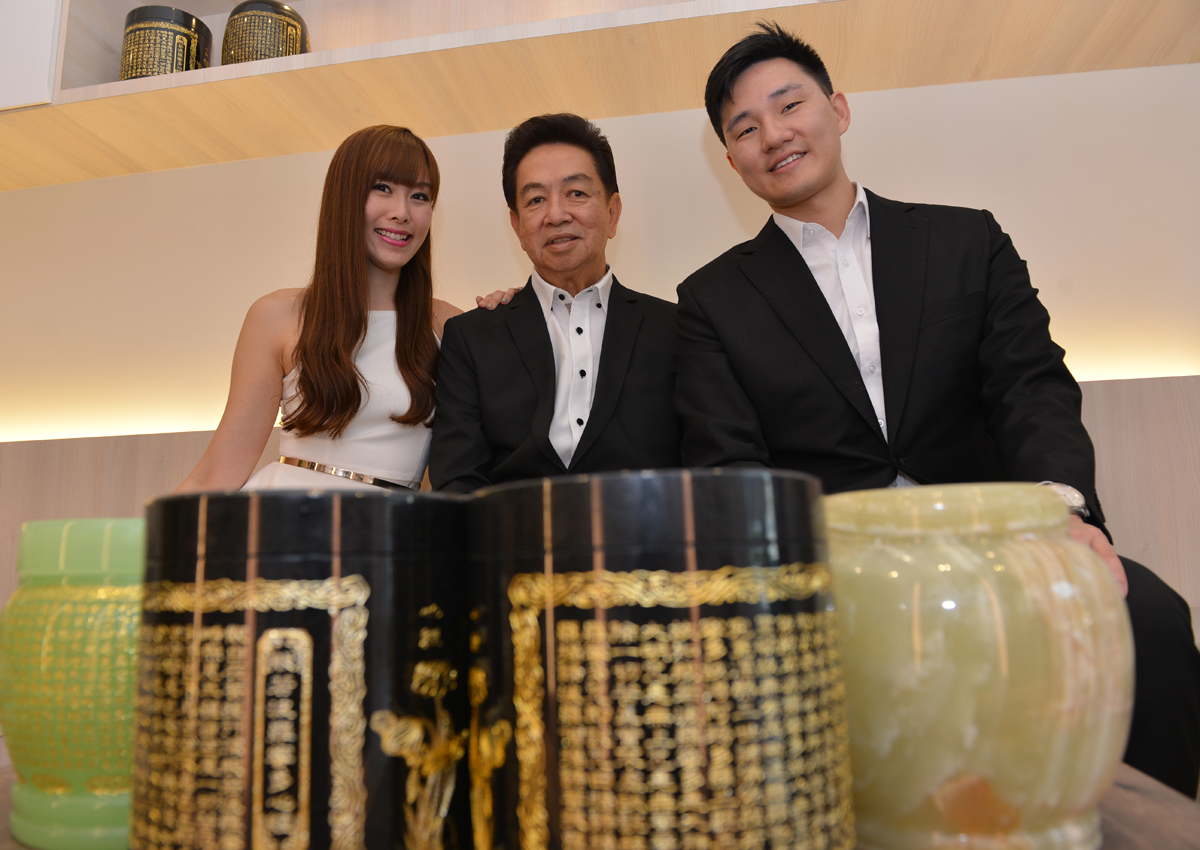
Mr Tay, his daughter Jenny Tay and her husband Darren Cheng are always on call due to the unpredictable nature of their job.
Now, in a new TV series called Death Is Our Business, viewers will be able to get a glimpse of the highs and lows of their profession, the dynamics in their personal relationships as well as Ms Tay and Mr Cheng’s wedding last year.
The six-episode reality TV docu-series, which will debut on Channel 5 on April 2 at 10pm, offers behind-the-scenes access that will shed light on the funeral services industry.
Filming took place over two months between September and November last year, when the production crew trailed the trio as they attended to the families of the deceased, made funeral arrangements, oversaw the embalmment of corpses, scattered ashes in the sea and more.
It took Ms Tay, 30, the company’s managing director, a while to get used to the cameras.
“You’ll see some of our arguments, or moments where my father cooked his famous pig’s trotters for us, which he also offered to the crew,” she told The New Paper.
Mr Tay, who said he is not camera-shy, to knowing laughter from Ms Tay and Mr Cheng, added: “Sometimes I can’t sleep because there’s a (cameraman) standing there watching me. It’s a very weird feeling.”
Meanwhile, the calls from affected families just keep on coming.
Mr Tay, who mans the company’s hotline, has three mobile phones and never misses a call.
Two Nokia 105 mobile phones – one in hot pink and the other in black – have the dedicated functions of making outgoing calls and answering incoming calls.
Sometimes, Mr Tay is on both mobile phones as he attends to an incoming call on one while placing an outgoing call on the other.
His third phone, a Samsung Galaxy Note 3 smartphone, serves all other purposes.
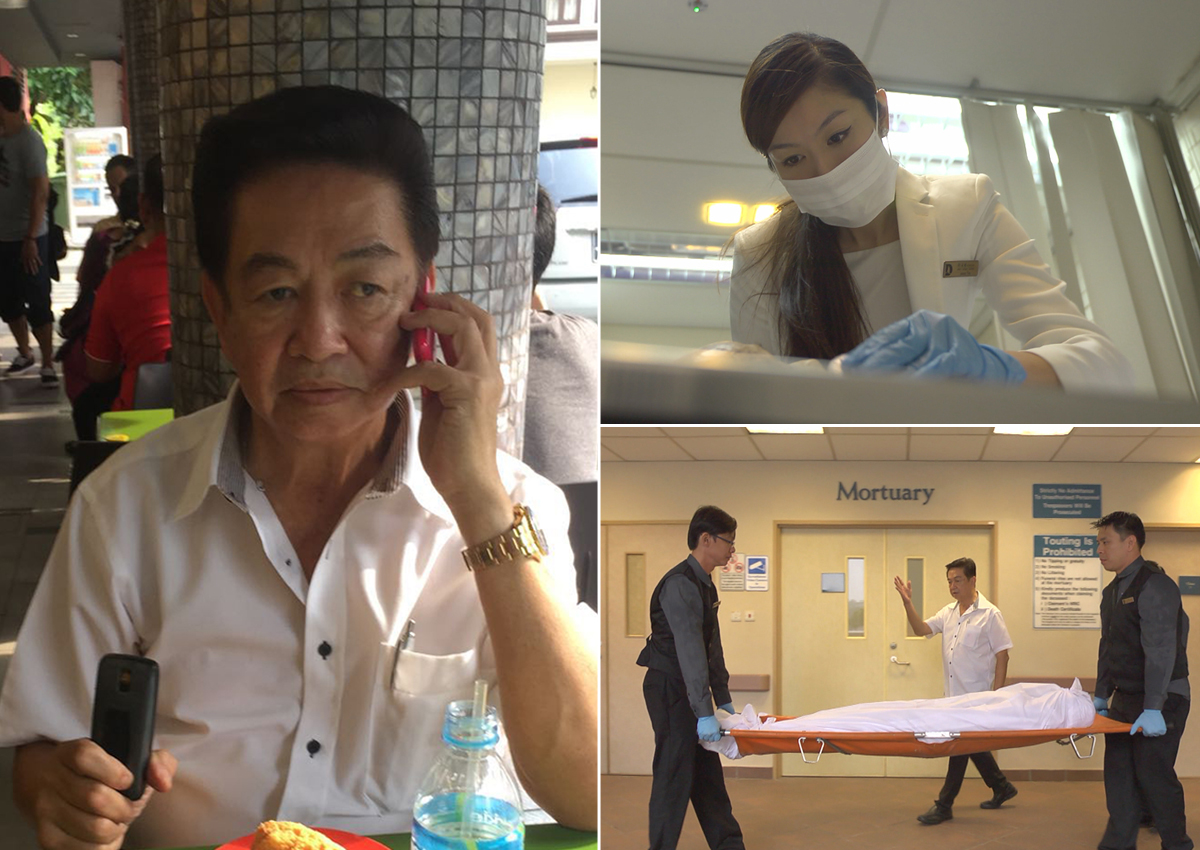
AT WORK: (Clockwise from left) Undertaker Roland Tay using three mobile phones to man the company’s hotline; Mr Tay’s daughter, Ms Jenny Tay, applying make-up for a deceased. (Bottom right) Mr Tay directing his staff on where to transport the body. Photos: Courtesy of Darren Cheng, Mediacorp
DEDICATED
Mr Tay is so dedicated to his job that his black Nokia mobile phone has a Velcro strip attached to its casing.
Said Ms Tay: “He answers his phones anywhere, so he’ll stick them to the bathroom wall, the bed frame or the steering wheel. Even when he showers, his phone follows him.
“He told us he was having trouble sleeping for three days when we tried to take over.
“He likes the personal touch of talking to the families himself and these families are familiar with him.
“Even in the middle of the night, he picks up the calls, sleeping about three or four hours each night.”
The trio insisted there is nothing “eerie or creepy” about their jobs.
Still, as Mr Tay put it, the dead do follow him – literally.
“For cases of the poor or destitute who have no families, I collect all their ashes and keep 20 to 40 urns in my car or bedroom if I forget to bring them up to the shop.
“I believe they know we’re just doing our best to help them so it’s all okay,” he said.
The trio also find themselves sometimes being the bereaved families’ pillars of strength.
On the show, Mr Tay was forced to break the news to a family that their grandmother, who was in her 70s, had died in Genting Highlands.
He had been informed about her death before the family through his contacts there.
But thinking he was a con man out to scam them, the family called the police to intervene.


DELICATE
“I don’t blame them. It’s tough being the bearer of bad news. You have to do it in a very delicate manner and try your best to console them after,” said Mr Tay.
Emotions do get the better of them, but they have to try their best to be strong for the families.
Mr Cheng, 31, the company’s operation and business development director, recalled one of his earlier cases where an only son, a 26-year-old man, chose to end his life.
He recalled: “When the eulogy was delivered at his funeral, the master of ceremonies wrote one that helped the boy say goodbye to his parents.
“After that, his parents held onto each other and wept as they said goodbye.
“I couldn’t take it, I had to go to the toilet to wipe away my tears.”
Direct Funeral Services is especially known for its pro bono work, arranging free funeral services for murder victims, the poor or the destitute.
Mr Tay often tries his best to fulfil all requests and he approaches cases with a “never say no” attitude.
When a sickly 84-year-old man named Mr Wee, who was living alone in French Road, asked that Mr Tay handle his funeral when he dies, Mr Tay was worried that he would not know when that would be.
So he signed up for Singtel’s Home LIVECam service to monitor Mr Wee through his mobile phone daily.
“He told me he doesn’t want to die and decompose like his neighbour.
“We came up with this plan so I will know if he falls or if anything happens to him,” said Mr Tay, who occasionally pays Mr Wee a visit with Ms Tay.
While Mr Tay believes in karma, he has a stronger belief that the deceased deserve a dignified and proper send-off.
“Race, wealth or nationality never matters… As long as they were once breathing, once alive, I’ll do my best to help them,” he said.
ashikinr@sph.com.sg

This article was first published on March 19, 2016.
Get The New Paper for more stories.
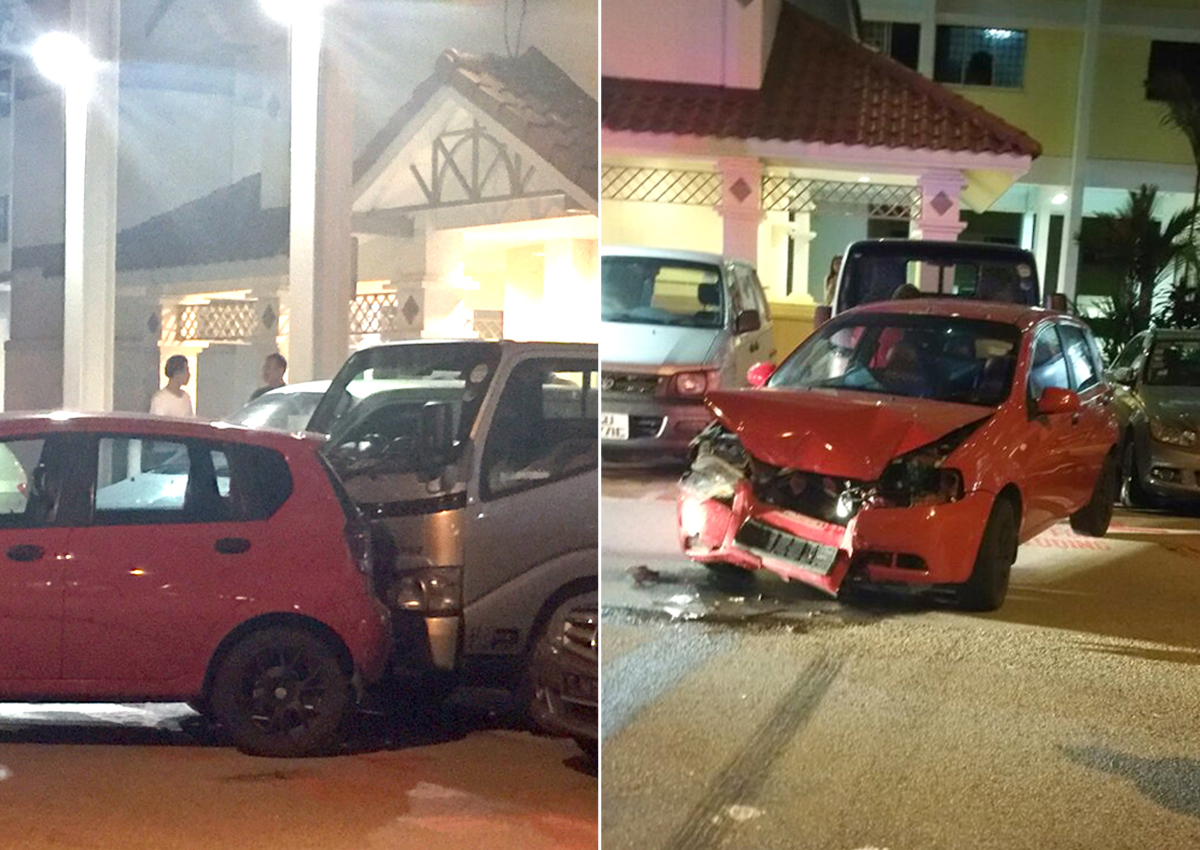
She looked out from her second-storey flat and saw the back of a red car slam into the front of a white lorry in the carpark on Thursday night.
She then saw a blue ComfortDelGro taxi reverse and vanish under her HDB block in Bedok Reservoir after it ran over and flattened a small tree.
“Suddenly the taxi flew into the void deck,” said the resident, a supermarket worker who wanted to be known as Mrs Liang.
She had turned to look out her window after hearing the screech of tyres and several loud bangs.
Mrs Liang, who is in her 50s, rushed down and saw a damaged taxi in the void deck.
Across the carpark, there was a red car with its front crumpled and its back against a lorry.
Black tyre marks scarred the tarmac and metal debris and glass shards were scattered all around.
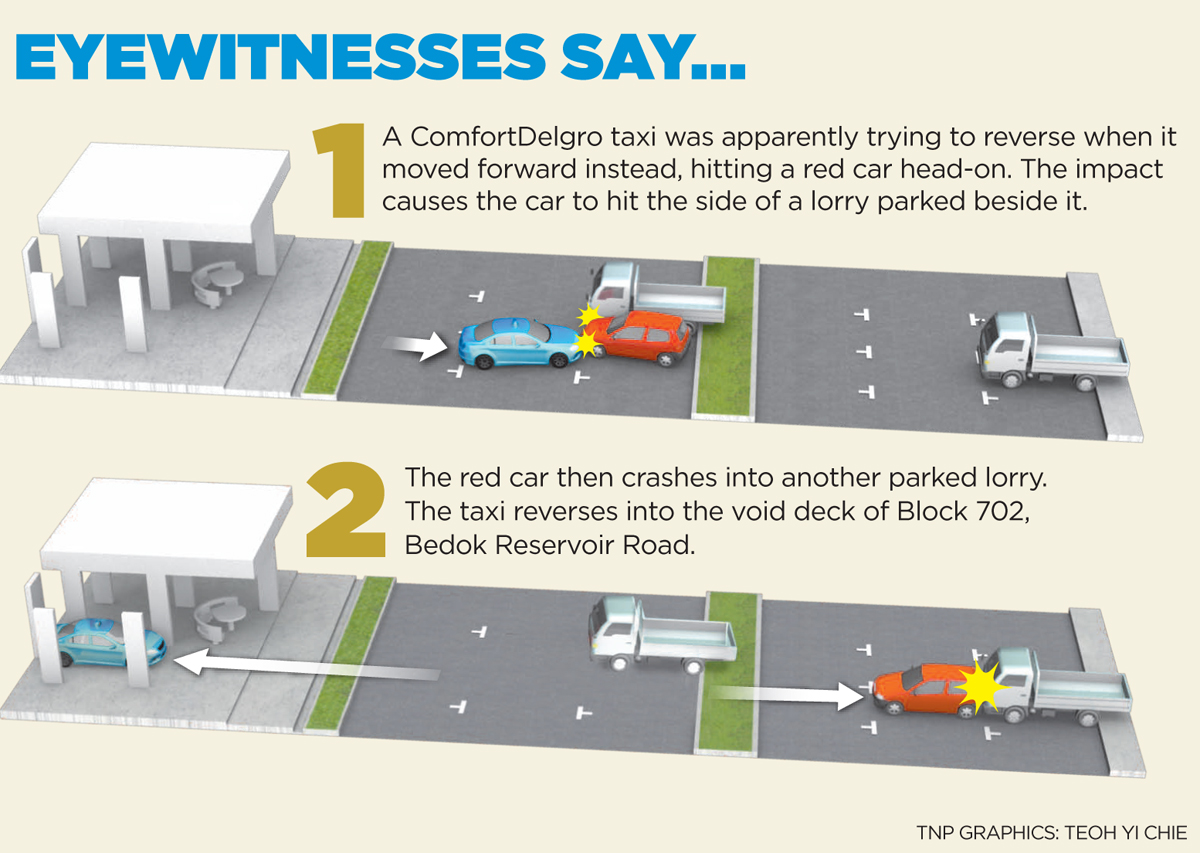
The taxi, the red car and two lorries were involved in the accident that took place near Block 702, Bedok Reservoir Road, at around 11.30pm on Thursday.
Aside from the taxi, the other vehicles were parked.
Madam Sandy Goh, 48, a volunteer at the neighbourhood’s Senior Care Corner, rushed to the scene after receiving calls from senior citizens about the accident.
Madam Goh, a tentage clerk, said she spoke to some senior citizens who had witnessed the accident.
SLAMMED
They told her the taxi was trying to reverse into a parking lot when it moved forward and slammed head-on into the red car, which was parked a few metres away.
The impact was so great that the red car shifted to its right and scraped the side of a blue lorry parked next to it.
“The red car then travelled backwards, up and over the kerb, all the way into the other side of the carpark, hitting the front of the (white) lorry,” she said.
Madam Goh said there had also been a close call involving some teenagers.
The taxi had reversed towards three male teenagers sitting at a table at the void deck.
She said the mother of one the teenagers told her they saw the car coming and managed to run out of the way.
She added that the taxi driver, who looked like he was in his 60s, escaped injury.
“He looked quite confused. I heard the police officer asking him what had happened, but he said he didn’t know,” Madam Goh said.
Mrs Liang said: “Luckily it happened at night, around 11pm. There are a lot of elderly who like to walk around our neighbourhood.
“If it had happened at 6pm or 7pm, that would have been terrible.”
Mr Quah Seng Hong, driver of one of the affected lorries, said the damage to his lorry was minor.
The cleaner, who was working part-time delivering goods with the lorry, told The New Paper: “It was just a simple scratch… I just called my boss to see what I should do.
“He came to see the lorry today and made a report to the company.”
No injuries were reported.
A ComfortDelGro spokesman said it is assisting the police in their investigations.
chooxh@sph.com.sg
This article was first published on March 19, 2016.
Get The New Paper for more stories.

Starbucks: Free freshly brewed coffee from 830pm to 930pm today (19 Mar). Bring your own tumbler
Starbucks Free Coffee from 830pm to 930pm 19 Mar 2016 | SINGPromos.com
Starbucks embraces Earth Hour with a special promotion from 830pm to 930pm on 19 March. Bring your own tumbler & be rewarded with a FREE tall-size freshly…
Some 1,800 more people were diagnosed with cancer in 2014 than four years earlier, new figures reveal.
The latest cancer report released by the National Registry of Diseases Office shows that there were 13,241 cases in 2014 and also estimates that one in four men and one in five women here are likely to get cancer by the time they are 75 years old.
The disease remains Singapore’s biggest killer and the deadliest type remains lung cancer, which killed more than three people a day from 2010 to 2014. In those five years, a total of 6,899 people were diagnosed with lung cancer and 5,732 died of it.
The most common cancer type for men is colorectal (4 per cent will get it by the age of 75); for women, breast (7 per cent by age 75).
A total of 9,320 people were diagnosed with colorectal cancer between 2010 and 2014, and 3,723 died.
The report said that while it is the most commonly found cancer here, the number of cases appears to have plateaued since 1995 and has been decreasing gradually in recent years.
This cancer generally hits people over the age of 40 years and rises sharply from around the mid-60s.
Related: Latest treatment for lung cancer
More than half the colorectal cancer cases were discovered in later stages when the tumour is no longer contained within the colon or rectum.
But with better treatment, about 10 per cent more people survived for at least five years from 2010 than they did from 2005.
The report said there was an overall increase in the survival rate for colorectal cancer for both genders. This was seen almost across the board for all ethnicities, age bands and stages of the disease.
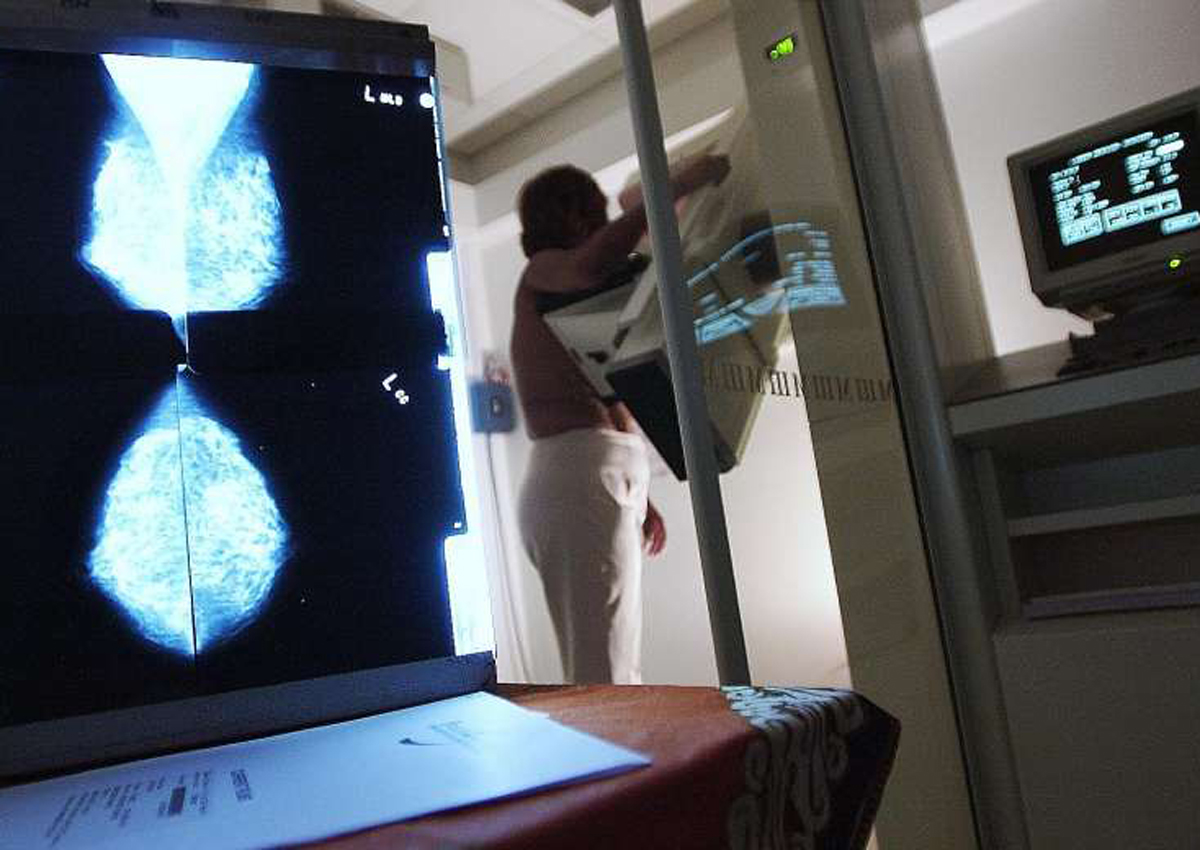
The next most common cancer is breast cancer, which accounts for almost one in three cancers in women. In the five years from 2010 to 2014, a total of 9,274 women were diagnosed with breast cancer.
More than seven in 10 breast cancer patients survived at least five years in this period. The survival rate was 67.5 per cent in the previous five-year period.
The highest survival rates of 80 to 90 per cent were among women who discovered the cancer early, before it spread beyond the breasts. More than 400 women a year die of breast cancer.
Professor Chng Wee Joo, director of the National University Cancer Institute, said, “Cancer incidence is rising because of an ageing population … (with) better treatment cancer patients are surviving longer.”
He added that the focus of doctors now has shifted somewhat. In the past, it was centred on how long they can extend survival – “now it is how to make these patients feel less like cancer patients”.
salma@sph.com.sg

This article was first published on March 19, 2016.
Get a copy of The Straits Times or go to straitstimes.com for more stories.




























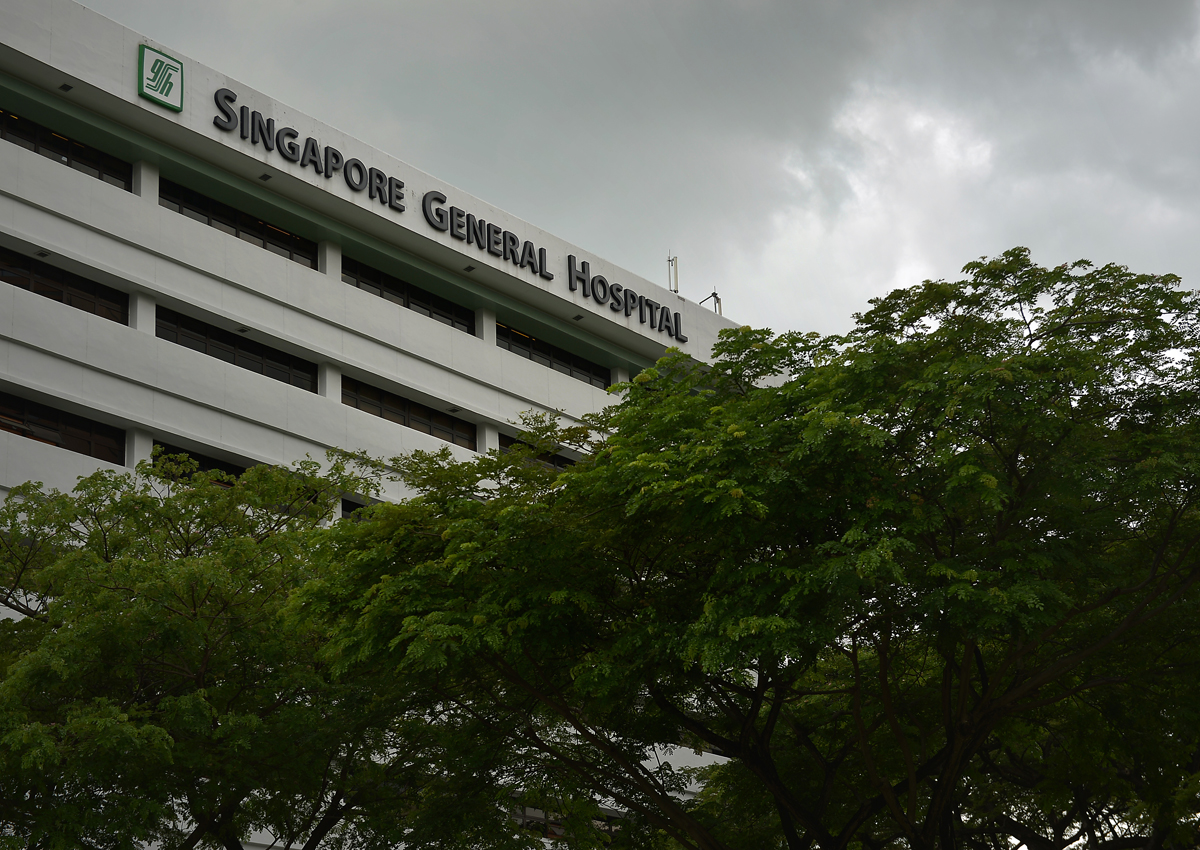
Why do I feel let down by the press releases from the Ministry of Health (MOH) and the Singapore General Hospital (SGH) that should have provided closure to the Hepatitis C outbreak at the hospital?
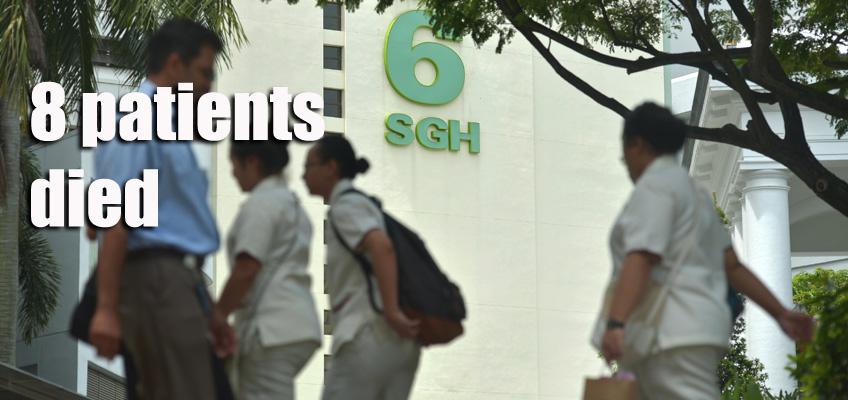
That outbreak infected 25 patients over several months last year. Eight patients died, and seven of those deaths were possibly linked to the infection.
The findings of the two teams looking into the action of people at MOH and SGH had been long awaited. The public had expected to know whether anyone was at fault, and if some of those infections and deaths could have been prevented.
The findings should have gone a long way towards restoring the badly dented reputation of SGH, which describes itself on its website as “Singapore’s flagship tertiary hospital with a history and tradition of medical excellence spanning two centuries”.
Instead, all we were told this week was that disciplinary action has been taken against 16 (unidentified) senior-level people, and that the action included “warnings, stern warnings and financial penalties”.
That tells us there were people at fault. In fact, 16 of them in positions of power could have done better.
But it does not tell us who these people were, how they were at fault, and what disciplinary action has been taken against each of them.
When asked for details, the MOH spokesman said: “Adhering to staff and patient confidentiality norms, we would like to assure the public that the staff who were involved in the incident have been disciplined accordingly.
“The disciplinary actions were decided based on the specific roles, responsibilities and job nature of the officers, as well as the nature of the incident and the impact of their actions in this episode.”
Patient confidentiality, one can understand. But staff confidentiality?
The public had expected transparency and accountability.
Instead, what it got was roughly: “We’ve looked into it and taken action. You don’t need to know anything more. Just trust us to do the right thing.”
Just as those 25 patients trusted SGH to do the right thing by them when they sought treatment there.
Staff confidentiality has no place when people have died because of something those 16 people did or failed to do.
Patients go to a hospital to be cured, not to get an avoidable infection because staff were cavalier, or negligent, or inept.
Yes, hospital-acquired infections are unfortunately common, and people do catch them and die as a result. But this was not a case of an airborne bug which spreads easily.
This, according to the Independent Review Committee set up by the MOH, was likely due to “gaps in infection prevention and control practices”.
The most likely scenario was the blood-borne virus was spread, as a result of actions of hospital staff, from one patient to another, and another, and, well enough “others” for 25 patients in all to be infected.
Then, when the hospital realised something was wrong in May, it took them a long time to stop the spread, with the last infection believed to have taken place in June.
The committee concluded that “the outbreak was not investigated and managed optimally”.
If the outbreak had been dealt with “optimally”, how many lives could have been saved?
People in senior positions are expected to deal with problems when they arise. Obviously, some did not live up to their responsibilities. Should they still remain in those positions?
If the answer is yes, and it is always possible that it is, then at the very least, explain why it is so. That would also be fairer to those involved, for otherwise, they will always live under the shadow of – at the very least – incompetence.
Furthermore, by keeping the names of people at fault a secret, doubts are now cast on innocent people at the MOH and the SGH – which is totally unfair on them.
Staff confidentiality has no part to play when there is such a serious breach of patient care. It casts doubt on the value placed on the seven lives lost.
When Private Dominique Sarron Lee died in a training session, the officers in charge of the training were named and their actions leading to the death were made public. However, Mindef did not reveal the disciplinary action taken, leading to an outcry from the public.
This time, even the question of whether SGH’s chief executive officer was one of the 12 “staff in leadership positions” who were disciplined, was not answered.
When doctors are hauled up before the Singapore Medical Council and found guilty, not only are the doctors named and their actions spelt out, the tribunal also takes the time to explain how and why they arrived at their decision.
This includes all extenuating circumstances.
Doctors hold people’s lives in their hands. They must be held accountable for their actions if they fail to uphold this. The same goes for senior ministry officials.
It bears repeating: 25 people were infected and seven deaths were possibly caused by the outbreak.
Tell us, was it caused by laziness, negligence or ineptitude – or something else altogether. Tell us also that this incident is viewed seriously by spelling out the actions taken.
If people are left with the impression that doctors and ministry officials get special protection no matter what they do, then confidence in the system will be badly eroded.
salma@sph.com.sg
Related: Hep C ’caused or contributed’ to deaths of 7 kidney patients
This article was first published on March 19, 2016.
Get a copy of The Straits Times or go to straitstimes.com for more stories.
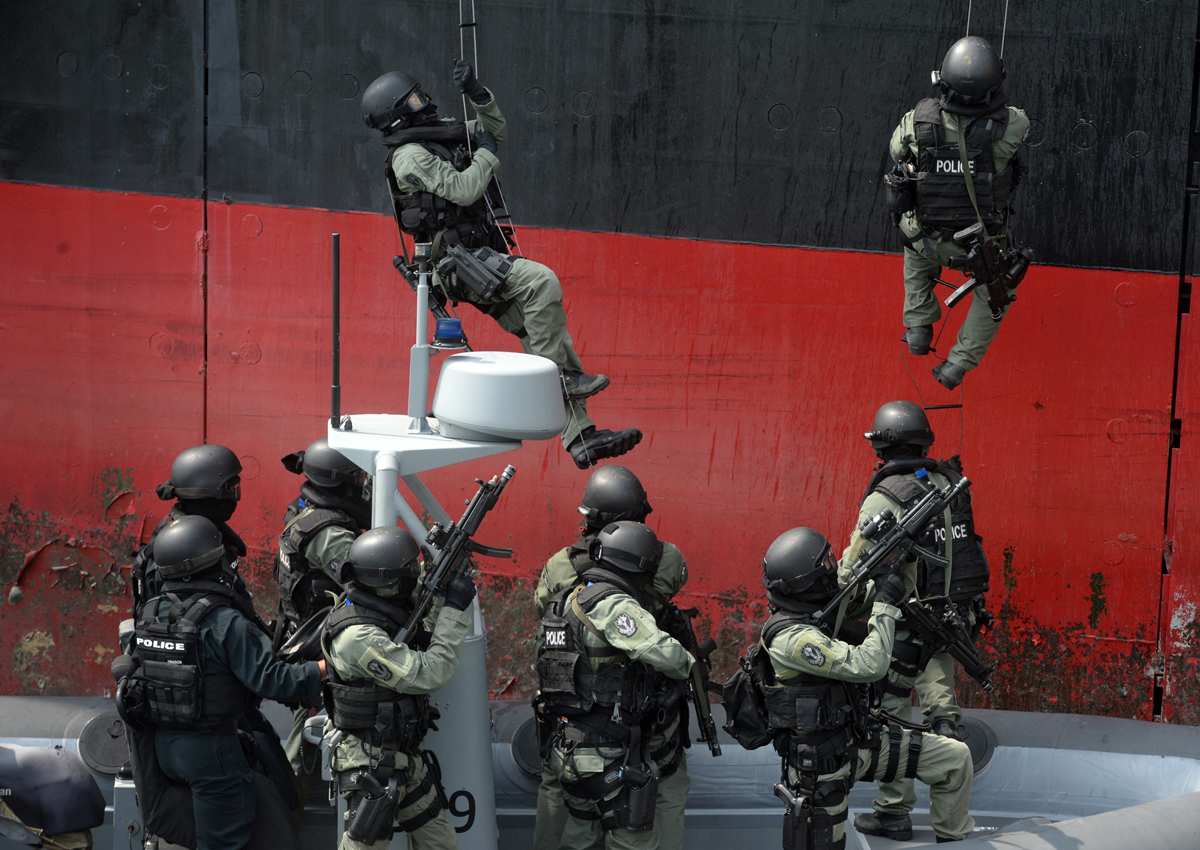
A surveillance dragnet of 314 CCTV cameras will be built around Singapore’s shoreline from this year, part of the Police Coast Guard’s (PCG) efforts to boost its detection of intruders.
It will add to its multi-layered defence of the island’s maritime borders, already watched over by advanced electro-optic cameras, radar systems and boat patrols.
“We want to look out at our waters so we can spot enemy vessels early, as this gives us time to respond,” said PCG head of operations and security Ang Eng Seng.
The closed-circuit television (CCTV) cameras will be fully deployed by 2018.
Superintendent Ang said these detection systems would not only pick up smugglers, but also potential terrorist elements, who use the same routes to enter or leave the country.
Just last November, an electro- optic camera detected a man trying to swim away from Singapore. One of 27 wanted Bangladeshi workers who were radicalised, he was nabbed and later deported.
Home Affairs Minister K. Shanmugam said the PCG had a “very important role” in detecting terrorist elements that might try to sneak into Singapore.
“The threats can come from self-radicalised individuals inside… it can also come from a Molenbeek equivalent around Singapore,” said Mr Shanmugam, referring to the district in Brussels, Belgium, where the Paris attacks last year were planned.
Speaking during a visit to the PCG headquarters yesterday, Mr Shanmugam said attackers could try to gain entry to Singapore via the sea, just as the terrorists who carried out the 2008 Mumbai attacks, that left 166 dead, did.
To strengthen Singapore’s maritime borders, the PCG is rolling out more advanced surveillance systems, such as new panoramic electro-optic sensors on the north and south coasts, each with a 360-degree view of its surroundings. The system can even analyse its video footage and flag suspicious activity so officers can act upon it, said the PCG.
Two types of unmanned vehicles are also in the pipeline.
The first, a tethered unmanned aerial vehicle (UAV), is a drone carrying an electro-optic sensor that can be deployed from the decks of coastal patrol craft. Flying at a height of 50m, it gives officers a bird’s eye view of the surrounding waters. It will be put into operation from 2019, said Supt Ang.
The second, an unmanned surface vessel (USV), can patrol an area autonomously, and is equipped with search-lights, loudhailers and other surveillance systems.
Trials will begin late this year. And while it would not be possible to replace manned patrol vessels completely – for instance, USVs would not be able to do boat checks – it could potentially replace some, said Supt Ang.
dansonc@sph.com.sg
This article was first published on March 19, 2016.
Get a copy of The Straits Times or go to straitstimes.com for more stories.
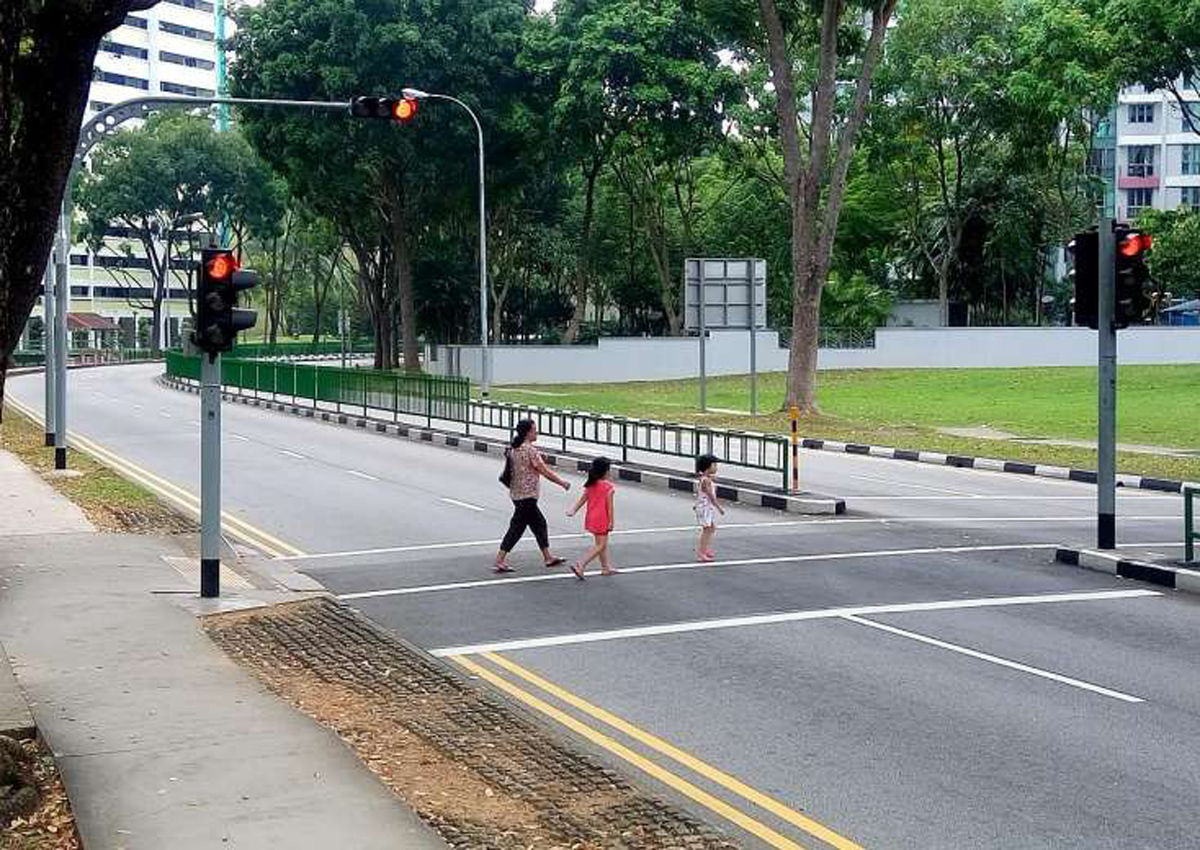
Even if the lights are in their favour, pedestrians still have to check for oncoming traffic.
This was held in a rare 2-1 Court of Appeal decision in which the Chief Justice dissented.
Judge of Appeal Chao Hick Tin and Justice Quentin Loh, who were in the majority, explained their reasoning by highlighting a Highway Code rule that requires pedestrians to be on the alert.
“Pedestrians should take charge of their own safety,” the court said in judgment grounds issued on Thursday, and decided the injured victim in the case before it was 15 per cent to blame despite having the right of way.
Chief Justice Sundaresh Menon, who wrote a separate view explaining his objections, said the ruling means “that pedestrians will no longer be able to take comfort in the fact that they are crossing at a point controlled by a police officer or by traffic lights”.
“They will have to safeguard themselves in precisely the same manner in such circumstances as if they were jaywalking.”
In Oct 2014, the High Court had found taxi driver Asnah Rahman, who was being sued by the victim, fully to blame for the accident which seriously injured then 21-year-old national serviceman Li Jianlin at a pedestrian crossing in Bukit Batok West Avenue 5.
On June 2, 2011, at about 10pm, the lights were green in his favour when he was knocked down. He suffered serious head and hip injuries, and was hospitalised for three months.
For dangerous driving, Madam Asnah, 59, was also fined $2,400 and disqualified from driving for six months by a district court in 2012.
The cab’s insurer appealed, with lawyer Anthony Wee arguing that Mr Li should be 35 per cent to blame for failing to check for approaching traffic as he crossed the second half of the dual carriageway which had a centre divider.
Mr Wee cited rule 20 of the Highway Code, which states: “Where a pedestrian crossing has a central refuge, each half is a separate crossing and you should treat it as such.”
Mr Li’s lawyer Eric Liew countered that the pedestrian had no duty to continuously look left or right when the signal lights were in his favour. The victim, who also suffered amnesia, could not recall if he was on the lookout when he crossed the second half of the road.
At issue was whether Mr Li, now a polytechnic student, had a responsibility to take care of his own safety.
The court’s majority pointed to rule 22 of the Highway Code.
It requires pedestrians at a light controlled crossing to wait on the footway until the traffic in front has come to a standstill. This means those on foot should keep a lookout for errant motorists regardless of how long the lights have turned in favour of the pedestrian, wrote Justice Chao. This was because there was risk of the motorist having fallen asleep from fatigue, driving while drunk and using a mobile phone.
The court noted it takes no more than a split second to see if it is safe to cross the road. But it was also stressed that this does not mean motorists should be less vigilant.
“All we are saying is that a pedestrian should bear a small portion of the shared responsibility,” said Justice Chao.
The Chief Justice argued the litmus test should be whether Mr Li acted reasonably, with the amount of self-care that a normal person would have exercised in his case.
He asked if it was reasonable to expect Mr Li to guard against a driver who drove “as if there was no traffic light and no controlled pedestrian crossing there at all”. Only if the answer was “yes” could one consider if there were extra steps Mr Li could have taken.
He pointed out there was no footway in the middle of the road as a divider, making rule 20 and rule 22 irrelevant. He also found Madam Asnah had not shown that Mr Li failed to check for traffic when he approached the centre of the crossing.
The judgment means that when the case returns to the High Court in September to assess the damages payable to Mr Li, the sum will be discounted by 15 per cent.
vijayan@sph.com.sg
This article was first published on March 19, 2016.
Get a copy of The Straits Times or go to straitstimes.com for more stories.

March 19, 2016 12:25 PM
SINGAPORE – Balancing family and work were listed as the top issues faced by married couples in a poll by a group that champions strong families.




