Home Blog Page 4497

Slingers' devotion to fans an ideal reason for wide-scale support

0

The game is over, the match is lost and the sweaty Slinger is on his knees. “Hi,” says the folded giant to the tiny boy who clutches his grandfather’s leg. Forty minutes of Friday-night feistiness is over, four quarters of feet squeaking, coaches squawking, elbows banging is done, but still the Slingers are working.

They’re down 1-2 in the series but they pose, they shake hands, they grin. They haven’t yet digested defeat but they mingle, they sign bandaged arms, they smile some more.

“Thank you,” says the Slingers captain – whose name has been turned on a poster into Desmond Oh My Goodness – to a Slingers fan.

“Thank you,” says Xavier Alexander to another.

Thank you?

From athletes? To fans? In an entitled era?

You should watch them today only because you might never have seen anything like them before.

It’s not just Oh and Alexander, both of whom have spiritual tattoos inscribed on their bodies; this entire team is devout when it comes to their fans. They sign after every match, they – says assistant coach Michael Johnson – do 80-odd school clinics a year, they do 50 community events.

In an EPL-infatuated, local Lions-loving, Schooling-supporting nation, these basketballers are just trying to find a little place for themselves and their game in the Singapore sporting sun.

Chasing an elevated game in a bonsai sporting nation is a tall order.

It’s why a taxi driver, probably dreaming of Yao Ming’s seven-foot cousins, asks Johnson: How many imported Chinese do you have? None, says Johnson, we have mainly locals (to be precise 10 locals, three imports).

No, says the driver, Singaporeans are too small, they can’t play basketball.

Actually they can.

Let us be clear, this is not the NBA. Out here imported players don’t get a limo and a penthouse, but an MRT card and a shared condo. Out here the only dunking concerns a doughnut shop.

The average height of an NBA team is roughly 201cm, here it is 188cm. But as guard Wong Wei Long, at a mighty 174cm, says: “Even if you’re short you can play. You got to show heart, you got to work harder than taller people.”

When basketball was first invented, the basket had no bottom and a ladder was brought on court and the ball poked out. It took time; the Slingers, at their best, play as if they’re running out of time.

They break towards opposing baskets with the speed of a scattering flock of surprised crows.

They crash and collide and occasionally are run over by a medium-sized truck named Reginald Johnson, the Dragons’ amiable centre who is 208cm and 132kg. They fake, feint and drive to the basket much like darting thieves through a crowd. On Friday, they couldn’t get through.

Music pounds. When Johnson, the assistant coach, is annoyed with a referee or a player he leaps with furious indignation from his chair as if his ancestors have just been insulted.

A grandmother wields clappers, a middle-aged woman yells, a baby is dressed in Michael Jordan’s red 23.

It’s theatre. Really.

Turn up. Actually, it might be a full house, so maybe just tune in.

The Slingers need to win today but it’s impressive that they got as far as today. Coach Neo Beng Siang says he has only two full-time players when other teams are stuffed with them.

They have three foreign imports, Malaysia has four.

They travel for league games with 10 players, two coaches one trainer, but other teams have a group of 20. If they win the league somehow, it will be history wrought on a lean budget.

Friday night was tense. Today will be jittery.

On Friday the basket they were shooting at seemed too small. Today they can’t afford to miss. On Friday, when they were losing, some fans left the stadium. Today, people must hang on.

To stay is to show faith. To stay is to believe in basketball. To stay is to get an autograph from players. Who – win or lose – never leave early.

rohitb@sph.com.sg


This article was first published on March 20, 2016.
Get a copy of The Straits Times or go to straitstimes.com for more stories.

Image: 
Category: 
Publication Date: 
Monday, March 21, 2016 – 04:00
Send to mobile app: 
Source: 


Story Type: 
Others

Source link

Drought exacts toll on crops in region

0

Amid Thailand’s worst drought in decades, Prime Minister Prayut Chan-o-cha last week visited the north-eastern region grappling with parched farmlands and low water reserves.

Parts of the country are so dry that roads lining empty canals have collapsed. National park officials have built ponds to sustain wildlife, while irrigation officials are pumping water from the dregs of a dam.

Bangkok’s administrators last week announced they were cutting short April’s Songkran festival – which normally draws hundreds of thousands of tourists to one of the world’s biggest water fights.

But the brunt of the drought has been borne by farmers, who have been forced to put off dry season crops while the region is battered by unusually warm weather brought on by the El Nino phenomenon. Already, this climate cycle has taken its toll on the production of rice in Thailand, sugar in India, as well as palm oil in Malaysia, with no respite expected until the later part of the year.

Much of the drought is a “carry- over effect” from reduced rainfall during last year’s wet season, says Dr Anond Snidvongs, a climate change expert on Thailand’s national water policy committee. There was not enough rain to fill the reservoirs and tributaries that feed farmlands this time of the year.

Thailand, the world’s second largest rice exporter, registered a 4.6 million tonne or 14.5 per cent drop in paddy production in the current crop year compared to the previous year. A December report from the Office of Agricultural Economics shows paddy plantations have also shrunk by 10 per cent.

In Vietnam, rising salinity of water in the Mekong delta has already destroyed more than 200,000 tonnes of rice, reported Radio Free Asia. Water levels of the Mekong River are at their lowest since 1926, partly because of dams built upstream by countries like China and Laos.

In response to Vietnam’s request, China last Tuesday sped up the discharge of water from the Jinghong hydropower station in Yunnan province and said it would continue doing so until April 10.

In Malaysia, arid conditions have dented palm production. Statistics from the Malaysian Palm Oil Board show palm yields have slipped, while the output of crude palm oil was just 1.04 million tonnes in February, down from 1.12 million tonnes in the same period last year .

Meanwhile, India’s Department of Agriculture, Cooperation and Farmers Welfare expects sugar cane production in this current season to drop by 16 million tonnes. India is the world’s biggest producer of sugar cane after Brazil.

But while sugar cane-growing states face a rainfall shortage, other parts of India have been hit by persistent rain and hail storms, cutting the country’s wheat crop by possibly 14 per cent, the Associated Chambers of Commerce and Industry of India has said.

This could lead to the world’s second largest wheat producer having to import the grain for the first time in 10 years, said the industry body.

Some other Asian countries are faring better. Indonesia’s production of milled rice last year grew by 6.4 per cent, and that of corn and soybean also rose.

The Agriculture Ministry’s secretary-general Hari Priyono attributes this to good preparation. “We anticipated its effects as early as 2014,” he told The Sunday Times.

“We also carried out various programmes to mitigate the effects in a massive way. For example, we rehabilitated irrigation networks, provided machines like tractors to farmers during the harvesting and post-harvesting period, and supplied a lot of water pumps so they could optimise available water sources during the extended drought.”

Such long-term planning is unfortunately uncommon, say agriculture experts. Dr Leocadio Sebastian, a Vietnam-based regional programme leader for the Consultative Group On International Agricultural Research, says governments tend to be reactive. “They tend to favour relief intervention.”

Despite the drop in global rice production, analysts do not expect prices to rise significantly because stockpiles have bloated in recent years. The Thai government, for example, was sitting on 12 million tonnes of rice last month, while Indonesia holds 1.6 million tonnes.

Palm oil prices will rise but be reined in by subdued import demand from China and the European Union, notes BMI Research firm in a report published this month.

Meanwhile, a good Brazilian sugar cane crop this season will moderate prices increases, says BMI’s head of commodities Aurelia Britsch.

The bigger impact for now will be felt in rural communities. Thai economist Witsanu Attavanich estimates the drought would cost the country 62 billion baht (S$2.4 billion) in damage.

In the Philippines, EL Nino has already wiped out at least 3.6 billion pesos (S$105 million) from agricultural production. And some farmers have taken to hunting or eating rats to survive.

tanhy@sph.com.sg

Additional reporting by Arlina Arshad and Raul Dancel


This article was first published on March 20, 2016.
Get a copy of The Straits Times or go to straitstimes.com for more stories.
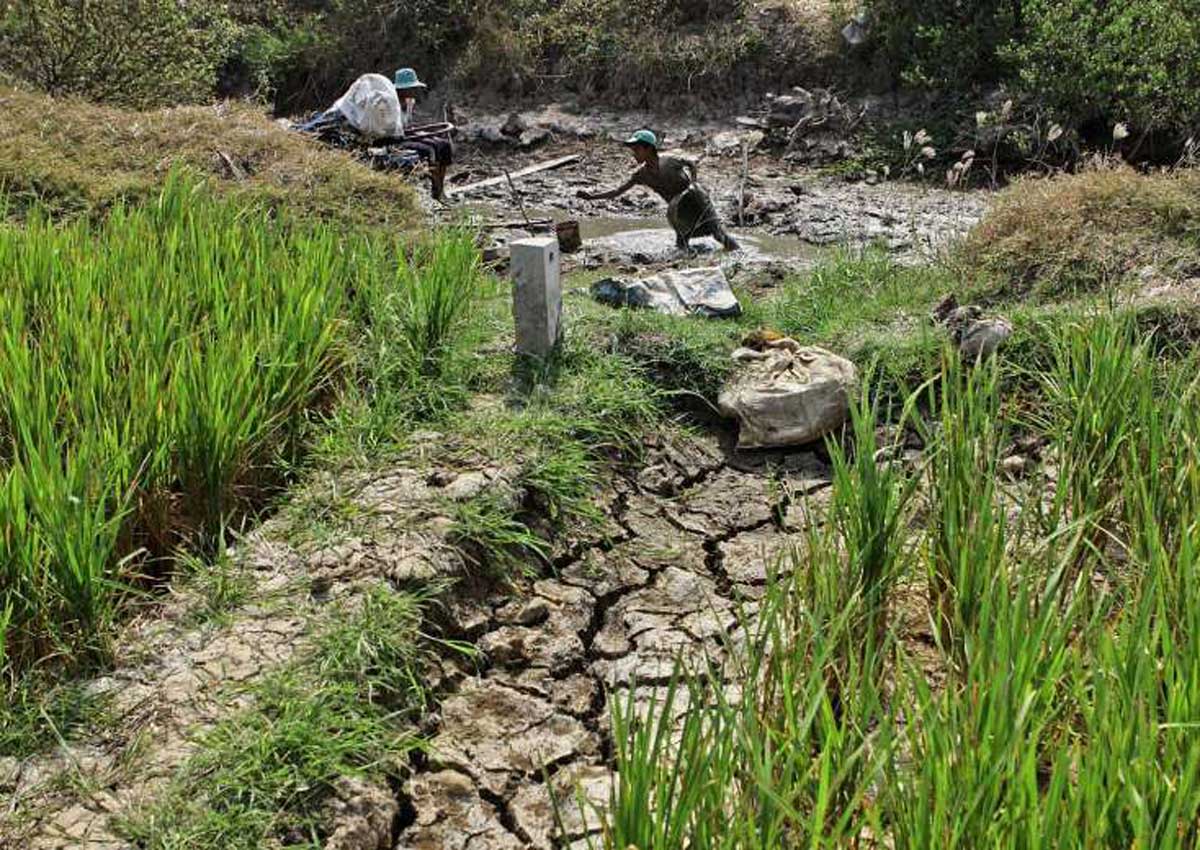

Image: 
Category: 
Publication Date: 
Monday, March 21, 2016 – 06:00
Send to mobile app: 
Source: 


Story Type: 
Others

Source link

Kasi Spicy Villa $6.90 All-You-Can-Eat Prata Buffet @ 2 Outlets 21 Mar – 30 Apr 2016 |…

1

PRATA BUFFET: Kasi Spicy Villa now offers $6.90 All-You-Can-Eat Prata Buffet at AMK & Yishun!

Choose from 16 varieties of prata including onion prata, egg onion prata, pepper prata & more.

Kasi Spicy Villa $6.90 All-You-Can-Eat Prata Buffet @ 2 Outlets 21 Mar – 30 Apr 2016 |…

Kasi Spicy Villa is offering Prata Buffet for just $6.50/pax. Try 16 varieties of pratas including onion prata, egg onion prata, pepper prata & more at their Yishun…

Source

President plants tembusu tree in Istana and pays tribute to Mr Lee

0

The sprawling grounds of the Istana were of particular interest and affection for founding Prime Minister Lee Kuan Yew, and where his vision of a City in a Garden first took root.

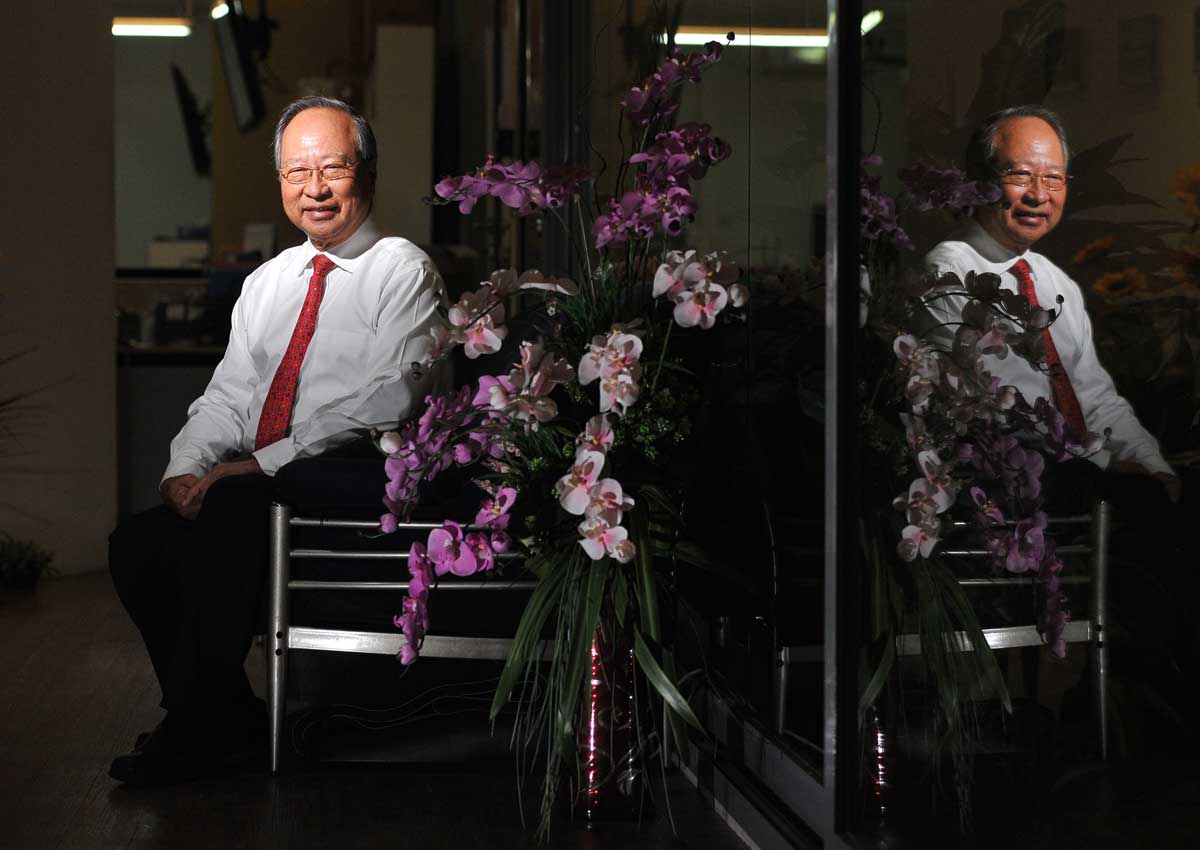
Yesterday, President Tony Tan Keng Yam and his wife, Mrs Mary Tan, planted a young tembusu tree on those grounds to mark the first anniversary of Mr Lee’s death on March 23 last year.

Dr Tan paid tribute to Mr Lee’s contribution to the Istana gardens and beyond, saying: “Making Singapore a City in a Garden was his great vision and foresight.

“And Mr Lee pursued this initiative with his usual tenacity, meticulousness and persistence.”

The tembusu was one of Mr Lee’s favourite trees as it is known for its strength and robustness, said senior curator Wong Tuan Wah, who worked closely with Mr Lee on various garden projects for 19 years.

Mr Lee took a liking to a particularly majestic 150-year-old tembusu tree on the Istana grounds and noted how it lived through many important events in Singapore, said Mr Wong.

Remembered by many as the Istana’s chief gardener, Mr Lee would also use the grounds as a testing bed for new flora and fauna that he encountered around the world.

If successful, he would later introduce them in the Botanic Gardens and parks throughout Singapore.

An example is the foxtail palm, a name inspired by bushy fronds that look like the tail of a fox. Mr Lee had come across the palm while on a visit to Australia and asked for it to be planted in the Istana. “Now, they have become a very attractive feature of the Istana gardens, beside the swan pond,” said Dr Tan.

Constructed in July 1968, the swan pond is the largest of five ponds on the Istana’s 40ha grounds.

It is also home to a pair of mute swans, which both Mr and Mrs Lee would visit and feed during their evening walks. Over the years, other birds such as whistling ducks and magpie robins were also introduced.

Mr Wong said at Mr Lee’s request, chemical fogging of the grounds was not carried out as he feared it would kill the insects the birds feed on.

Mr Lee would also often display a glimpse of his romantic nature during the evening walks, he added.

He would sometimes pick a cluster of fragrant white flowers, more commonly known as the breadflower. A favourite of Mrs Lee’s, the flowers have a sweet pandan fragrance.

He also started the country’s tree-planting initiative, first in his Tanjong Pagar constituency.

“It was a symbolic reminder to Singaporeans of the importance of making sure that Singapore is not a concrete jungle, but a liveable city.

“The best way to remember him is to keep Singapore going for the next 50, 100 years,” said Dr Tan.

nghuiwen@sph.com.sg


This article was first published on March 20, 2016.
Get a copy of The Straits Times or go to straitstimes.com for more stories.

Image: 
Category: 
Publication Date: 
Sunday, March 20, 2016 – 17:00
Send to mobile app: 
Source: 


Story Type: 
Others

Source link

Singaporeans celebrate life, legacy of LKY

0

Singaporeans from all walks of life yesterday gathered at events across the island to celebrate the life and legacy of founding Prime Minister Lee Kuan Yew, ahead of the first anniversary of his death this week.

Mr Lee died on March 23 last year, at the age of 91.

Some said the show of unity was testament to the enduring impact Mr Lee and his policies had on their lives.

Quality manager Jimmy Lian, 42, who lives in Radin Mas, said Singaporeans “will always remember Mr Lee, whether it is one year or 10 years down the road”.

Others said they were thankful to Mr Lee for his vision of a clean and green city, building it up, enforcing a meritocratic system for all people regardless of race, language or religion, and enabling social mobility.

These aspects that define Singapore must continue to be upheld, they said.

Tanjong Pagar resident N. Sudha Nair said it was “poignant” how Singaporeans have come together to mark the occasion.

“A year has gone by very quickly. It was not long ago when we were waving goodbye to him on a rainy day,” said the lawyer.

“We will never forget what he’s done for us and he will continue to live in our hearts and minds.”

Mr Lian and Ms Nair were among 1,500 people who gathered at Tanjong Pagar – which Mr Lee represented from 1955 till his death – to witness the launch of a pottery artwork by members of Tanjong Pagar Community Club’s pottery club.

Titled Everlasting Love, it is a tribute to the rich love story of Mr and Mrs Lee Kuan Yew. And for two weeks, orchid hybrids named after the couple will be exhibited at Tanjong Pagar Plaza .

Tanjong Pagar GRC MPs attended the launch, and also moved on to Duxton Plain Park, where they planted seven Mempat trees, the species of tree that Mr Lee planted in 1963 – the year of Singapore’s first tree-planting campaign.

Said Senior Minister of State for Finance and Law Indranee Rajah: “Mr Lee’s passing marks the handing over of a baton from one generation to another. It is our duty to take Singapore into the next chapter, to build a future that is bright for everyone. That’s what Mr Lee’s legacy is.”

Minister in the Prime Minister’s Office and labour chief Chan Chun Sing said: “Mr Lee and his team handed over to us a great country. It is upon our shoulders now to unite and take this country forward and to leave behind a better place for the future generation.”

Some 3,000 residents also gathered at Bishan-Ang Mo Kio Park to remember Mr Lee.

Among them was IT security consultant Kelvan Siew, 35, and his daughter Gwyneth, three, who he also took along to events during the week of national mourning when Mr Lee died last year.

Mr Siew said his daughter is still too young to understand the impact of what Mr Lee has done for Singapore, but added: “I want her to eventually know who Mr Lee Kuan Yew is, and to never forget our roots.”

Prime Minister Lee Hsien Loong, an MP for Ang Mo Kio GRC, penned a note in which he pledged to be caring by “looking after our residents as best as I can”.

At Tanjong Pagar and Bishan, grassroots volunteers distributed badges bearing the now-ubiquitous logo “Follow That Rainbow”, a reference to Mr Lee Kuan Yew’s call for Singaporeans to chase their dreams.

These were but two of at least a dozen events held yesterday to remember Mr Lee.

In Toa Payoh Central, a remembrance ceremony was held in conjunction with a ceremony to welcome new citizens.

In wards like MP Heng Chee How’s in Jalan Besar GRC, banners were laid out at residents’ committee centres and community clubs to commemorate Mr Lee and for residents to pen their messages.

Yesterday morning, the Singapore Taxi Academy also hosted a panel discussion at the Lee Kuan Yew School of Public Policy moderated by former Ang Mo Kio GRC MP Seng Han Thong.

Engineering firm Koh Brothers chairman Koh Tiat Meng spoke of how difficult life was in the years leading up to independence, and thanked Mr Lee for building a country where hard work is key to success, regardless of background.

He noted that he was poorly educated, but now runs the company behind projects such as Marina Barrage and Punggol Waterway.

Filmmaker Jack Neo did not shy away from pointing out policy missteps under Mr Lee’s prime ministership, citing the “Stop at Two” campaign. “Mr Lee is not God. There are areas he got wrong,” he said in Mandarin. “But if you look at the big picture, it is undeniable he has left too immense an impact on Singapore.”

One of those for whom the impact remains indelible is 97-year-old Ong Teng Huat, a resident of Tanjong Pagar for more than 50 years.

Asked how Mr Lee changed his life, Mr Ong could only manage to say “good, very good” as tears began welling up in his eyes.

waltsim@sph.com.sg


This article was first published on March 20, 2016.
Get a copy of The Straits Times or go to straitstimes.com for more stories.

Image: 
Category: 
Publication Date: 
Sunday, March 20, 2016 – 17:00
Keywords: 
Send to mobile app: 
Source: 


Story Type: 
Others

Source link

Tan Cheng Bock: 'When I want to do something, I will do it'

0

When Dr Tan Cheng Bock spoke at a local university forum sometime after his narrow loss in the 2011 Presidential Election (PE), some in the audience said he should have raised bread-and-butter issues during his campaign.

But he said that he could not.

It would have amounted to giving Singaporeans false hope.

Had he done so and won, he would then be accused of failing to deliver on his promises.

“I felt I would not be truthful if I promised people I could do this and that just to get their votes,” said the 75-year-old medical doctor, who lost to Dr Tony Tan Keng Yam by 7,382 votes, or 0.35 percentage points, in the four-way contest for the post.

Dr Tan, who announced his intention to make a second bid for the presidency on March 11, told The Sunday Times he would rather stick to his guns and lose honourably.

on Facebook

Find out some interesting facts about Dr Tan Cheng Bock that he shared at the press conference earlier today. We think he’s quite a funny fella.

Posted by AsiaOne on Friday, March 11, 2016

Parliament and the presidency have very specific roles, said the former People’s Action Party (PAP) MP, who served in Ayer Rajah from 1980 to 2006.

He said: “Parliament makes all the laws, the rules and so on. The president is there to make sure he looks after the reserves, and that they are managed by people of integrity and of the highest quality, and that there is transparency.”

Asked how he felt about coming within a whisker of winning the highest office in the land in 2011, he said: “To say I was not disappointed is not telling the truth.”

The grandfather of six also says he harbours no resentment towards Mr Tan Jee Say and Mr Tan Kin Lian, the other contestants in the 2011 PE. Many pundits believe that they split the votes and cost him the election.

Dr Tan said: “We all did our best and it was a fair fight. Whoever feels that he’s capable to run this place, I’m not going to say you shouldn’t come… No, it’s not my style.”

With a grin, he acknowledged he had caused a stir after declaring his decision to contest again.

Many wonder at the timing, especially since a nine-member Constitutional Commission is reviewing the Elected Presidency framework, including the eligibility criteria for candidates. Emeritus Senior Minister Goh Chok Tong described Dr Tan’s announcement as a “calculated political gambit”.

Netizens wondered if he was kiasu (Hokkien for scared to lose) for staking a claim when the next PE is not due until August next year.

“It’s hard work. When I won one election, I would tell my men how we were going to plan for the next one. So 17 months is really too short for me,” Dr Tan said with a laugh.

“Anyway, let them interpret. I will just make my move, step by step. Chok Tong knows that when I fight, I fight. And that when I want to do something, I will do it,” he said, referring to his former classmate at Raffles Institution and friend of 55 years.

In past interviews, Dr Tan had said one reason which first prompted him to run for president in 2011 was public resentment against the Government, which he had felt at political rallies during the general election held in May the same year.

It made him want “to heal the divide”. So, have his views about wanting to be head of state changed, with the PAP Government winning 83 out of 89 seats and nearly 70 per cent of the votes in last year’s general election? On the contrary, he replied.

“I think now it’s more important that they should pick somebody who actually checks on the Government. When you’re holding such a strong mandate, there’s a tendency that you might go overboard in some of the things you have to do,” he said. “And a responsible president should be able to tell them, ‘Look, let me tell you this is what’s happening.'” He admitted he was surprised by PAP’s strong mandate.

While he thought the opposition might win a few more seats, he also felt that many of their candidates were not prepared. Dr Tan said: “You cannot just come and say, ‘I want to be an MP.’ People who want to go into elections and be politicians must make an effort and put in a lot of groundwork.”

Many friends have asked him why he is seeking office again when he could be pottering in his garden, playing his ukulele or crooning with friends at karaoke sessions.

He said: “I believe this country is really worth protecting and I believe that our political system could do with change and improvement. I cannot say that our system is the best, but I believe that we will evolve into a very good system.

“So if you believe in something, you must do it.”

kimhoh@sph.com.sg


This article was first published on March 20, 2016.
Get a copy of The Straits Times or go to straitstimes.com for more stories.

Image: 
Category: 
Publication Date: 
Sunday, March 20, 2016 – 15:00
Keywords: 
Send to mobile app: 
Source: 


Story Type: 
Others

Source link

PAP set to unveil Bukit Batok candidate 'whom we are very confident of': DPM Tharman

0

SINGAPORE – The ruling People’s Action Party (PAP) will soon unveil a candidate “whom we are very confident of” for the upcoming Bukit Batok by-election, Deputy Prime Minister Tharman Shanmugaratnam told reporters on Sunday (March 20).
His comments came…

Source link

Foreigners file police reports over jobs that did not materialise

0

Asia Recruit, Asiajobmart and UUBR International – firms with names which hint at a global reach .

Operating out of office buildings such as the Singapore Land Tower in Raffles Place, they claim on their websites that they market resumes of job seekers to “head- hunters from the world over, creating maximum exposure to millions of job opportunities”.

But behind the veneer, lies broken dreams and controversy.

Two businessmen own and run these firms despite their employment agency licences having been suspended or revoked by the Ministry of Manpower (MOM). And around 20 foreigners have reported to the ministry and police, claiming they handed the firms thousands of dollars but the jobs did not materialise.

Confirming that reports were made against the firms, the MOM said: “As investigations are ongoing for Asia Recruit, UUBR International and Asiajobmart, we are unable to reveal details.”

Company records show that Asia Recruit was set up by 37-year-old Terry Tan-Soo I-Hse in March last year with a paid-up capital of $1. UUBR International was set up by Mr Clarence Lim Jun Yao, 28, last July with a paid-up capital of $500. These two companies changed their names to Alliance Recruit and Connectsia at the end of last year.

Asia Recruit’s employment agency licence was suspended by the MOM. The ministry declined to say when it was suspended or why.

Mr Lim also owns Career Central, an employment agency that was convicted last November for overcharging two foreigners seeking jobs here.

The agency was fined $6,000, had its licence revoked and Mr Lim was banned from setting up new employment agencies.

Mr Lim said the court conviction and licence revocation are not related to his current businesses.

“That was very long ago,” he said.

Around 15 foreign job seekers who spoke to The Sunday Times told similar stories.

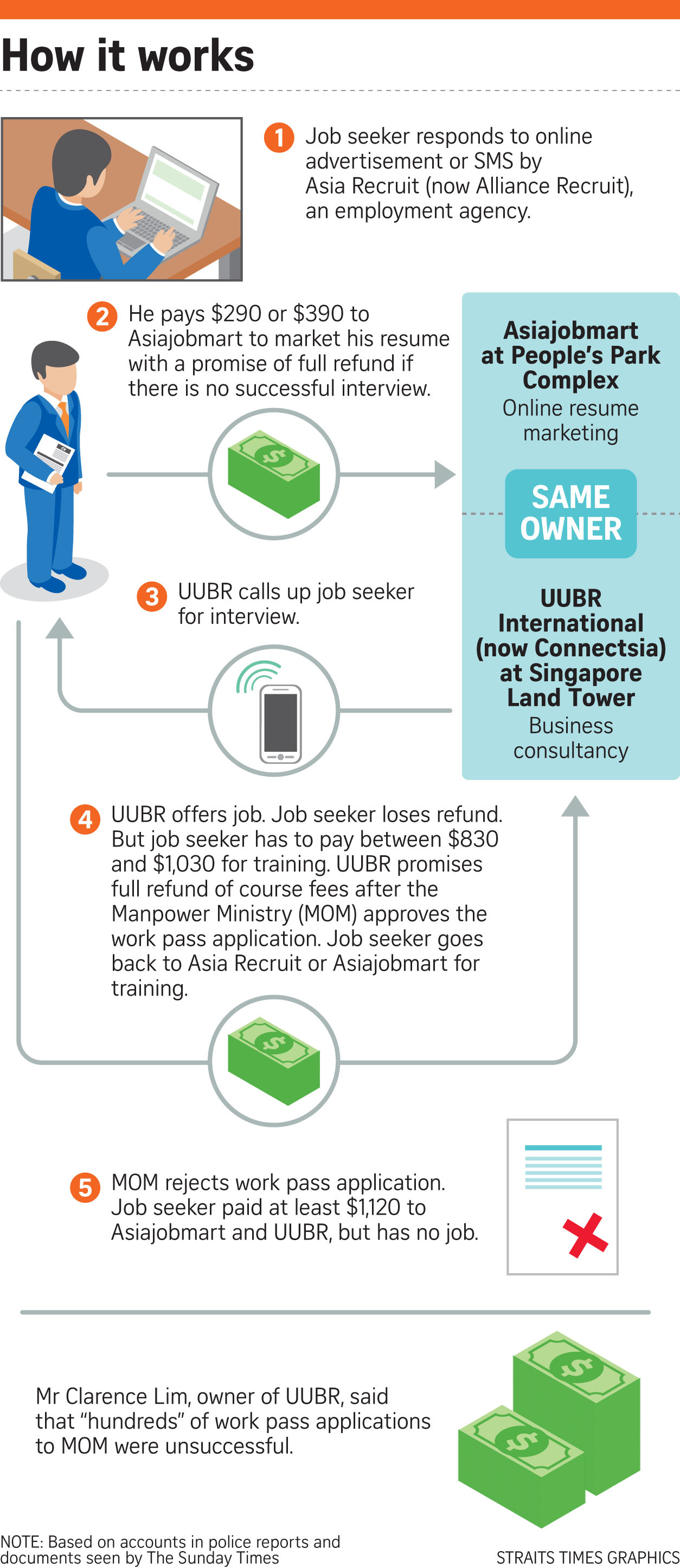
At the start, they would pay $290 or $390 to market their resumes on Asiajobmart.

They were told they would get their money back if they failed to get a “successful interview with an employer” within a period of time. Invariably, they would get a call from UUBR International for interviews and would be offered jobs.

But there was a catch.

They had to pay up to $1,030 in training fees, of which $850 would be refunded once they get a work pass. In nearly all cases, the work pass application was rejected. Mr Lim admitted that out of “hundreds” of applications to MOM, only “one or two” were successful.

The Sunday Times saw three applicants – two from India and one from the Philippines – during a visit to Asiajobmart’s People’s Park Complex office last week.

A person named Mr Lee, who declined to give his full name, was conducting a training session. When asked if he was aware of complaints, he said: “If a person buys an iPhone and returns it later, does it mean that the iPhone is not good?”

At Connectsia’s office at the Singapore Land Tower, The Sunday Times met another job applicant there to pay her training fees.

“They said if I didn’t pay today, they won’t hold the position for me,” said the Indian national who was offered an administrative position for $2,000 a month.

Both Asiajobmart and Connectsia did not have their company names displayed at the premises.

“Signs or not, if the job applicants think that it is something shady, they can not sign up,” said Mr Lim.

When The Sunday Times searched the job applicants’ listings on Asiajobmart’s website, not one applicant was available for placement. But Mr Lim insisted that he has “a few hundred” resumes, but made them unavailable to public searches after the Personal Data Protection Act kicked in in 2013.

Some clients said they had turned to the Small Claims Tribunal (SCT) for help, but their claims were rejected due to insufficient evidence.

“If I am a scam company, why would the SCT claims be dismissed?” reasoned Mr Lim.

He defended his firms’ practices. “The process that clients go through, we did not force it on them. I also told them that the EP (Employment Pass) is not easily approved.”

Mr Tan-Soo refused to be interviewed for this report.

The clients say they are hoping for MOM and the police to do more. When contacted, police said that the ministry had referred the complaints to them last week.

Widow from India who paid $1,320

Ms Soni Sonal came to Singapore from Chennai last October with a suitcase, $3,000 in savings and the hopes of finding a new job before her tourist visa expired.

“I wanted my sons to have a better life,” said the 40-year-old Indian national, who holds a master’s degree. Her sons, aged 17 and 20, are in school and her clothing business was struggling.

The widow, who lost her husband in 1998 in an accident, rented a bed at a Lavender Street boarding house for $27 a day.

After posting on several online classifieds, she received a call from UUBR offering her a job interview. But she was first asked to register with Asiajobmart for $290.

She paid and after the interview, was offered a $3,500-a- month job as a customer service representative. She was then asked to pay $1,030 in training fees. She paid in full on Oct 22. Training lasted two hours.

She was asked to wait while the firm applied for an Employment Pass (EP) for her. When no news came after more than a month, she got worried, then depressed.

But “it was too shameful to go back to India”. A security agency here decided to hire her and successfully applied for an EP. “They didn’t ask me to pay anything.”

In December, she started working as an assistant operations manager in the security firm.

She went to UUBR several times to recover her money but was turned away. She found around 30 other foreigners who had similar experiences with the firms.

They keep in touch through a smartphone chat group called JusticeForUs.

The Filipina who paid $1,030

It was the morning before last Christmas and Ms Donah Grace Requino was on her way to People’s Park Complex, thinking her worries were over.

The 36-year-old Filipina had been in Singapore for the past eight years on an S Pass, working in the oil and gas industry, when her company told her she would be retrenched on Dec 31.

“I was desperate to find a job,” she said.

On Dec 23, UUBR International offered her a post as an admin executive, earning $3,500 a month.

She was told she had to go for a training course, which she paid $1,030 for, the next day at People’s Park Complex.

But seeing a staff member – who had attended to her at Asia Recruit, where she did not pay any fees – at the training session triggered doubts. She searched for “UUBR International” online and found complaints from previous clients. Ms Requino said she raised the matter with staff.

“When I was leaving, one said, ‘You’re just a foreigner here, you can’t do anything to me.'”

Ms Requino has heard no news from the company since then. Unable to get a refund, she has since gone to the Manpower Ministry, the police and lawyers in the hope of getting help. “But the lawyers told me my claims can’t even cover their fees,” she said.

She said she has been a witness at the Small Claims Tribunal for four others who shared her experience.

“But every time, the judge says insufficient evidence,” she said. Last Thursday, she bought a one-way ticket back to the Philippines.


This article was first published on March 20, 2016.
Get a copy of The Straits Times or go to straitstimes.com for more stories.

Image: 
Category: 
Publication Date: 
Sunday, March 20, 2016 – 14:00
Keywords: 
Send to mobile app: 
Source: 


Story Type: 
Others

Source link

Employers' HR policies should not work against women: Ong Ye Kung

0

March 20, 2016 1:03 PM

SINGAPORE – Employers must ensure that human resource policies and practices do not work against women, said Acting Minister for Education Ong Ye Kung.


Source link

6-year-old Singaporean heads to Paris for beauty pageant

0

Like a veteran model, she works the camera.

Lauren Natasha Campbell has done auditions, photoshoots and pageants.

Now Europe beckons and she is heeding the call, missing a few days of kindergarten.

Lauren is six but is already a regular of the dozens of local pageants for children here.

Her proud mother, Mrs Hani Crystal Campbell, says: “I can see her potential and she has the interest. If she has this interest and enjoys being on stage, I’ll support it.”

The 44-year-old housewife and her husband, Mr Claude Norman Campbell, 61, have lost count of the amount of money they have spent on Lauren and their two older daughters. But it has been worth every cent, says Mrs Campbell.

Lauren has taken classes in ballet, Tahitian dance and Chinese art theatre. In 2014, she attended modelling classes in Malaysia, where she was trained for a week by Malaysian model-actress Amber Chia.

A check on the Amber Chia Academy website reveals that a 12-week course costs RM1,500 (S$503).

Mrs Campbell knows pageants are not without controversies – critics claim girls are objectified and some wear make-up to look older.

She is also all too familiar with the cattiness.

Mrs Campbell says she raises her daughters to be conservative and not to bother with looks.

“I tell the girls that this is just for fun. I don’t want them to dress provocatively in case people get the wrong idea,” she adds.

Her 10- and 12-year-old girls prefer to be in jeans while Lauren loves to dress up as a princess. She is a little girl after all.

In an upcoming pageant in which Lauren will compete, children below 11 are not allowed to put on any make-up.

Next month, Lauren will be leaving for London and Paris for Mini Face Of The Globe, her first international pageant.

She says: “I’m very excited because I will go there to do modelling. I’m looking forward to meet Minnie Mouse (at Disneyland)!”

Mrs Campbell was unwilling to say how much she has to pay but provided The New Paper on Sunday a breakdown of costs.

They included air tickets for three, eight nights’ stay in London and Paris, travel from London to Paris, registration fees for the beauty pageant, sightseeing and tickets to a ball and awards ceremony.

There’s also the public relations company hired for Lauren, which Mrs Campbell says costs between $2,000 and $5,000.

“I do now know much about public relations, so I hired a company to help me with it,” she says.

The public relations company helped Lauren with her charity work at an orphanage in Batam, Indonesia.

LOOKING FORWARD

While Mrs Campbell is looking forward to the Mini Face Of The Globe pageant, her husband isn’t as sure.

She says: “Her father prefers her not to take part in pageants because there’s too much attention. But, for me, it is to build her confidence and to get exposure, meet other children.”

Mr Campbell, chief technology officer of a UK-based international company, needed some convincing but relented.

“The one good thing about it is that it builds up her self-confidence – she’s not afraid to speak in front of people, which is very useful in life later on,” he says.

“It exposes her to, especially in going over to Europe, people from different parts of the world, to get a more worldly view.”

How does one guard oneself from becoming pushy? Children’s pageants can bring out the worst in mothers.

Mr Campbell says: “Depending on which group it is, some pageants can get way too competitive. We don’t want to see Lauren in situations where the pageant is more about the parents than the children.

“At the moment, she enjoys it, she’s not stressed about it. She’s now in Kindergarten 2.

“It will be a bit different when she starts primary school. I don’t want her to get overstressed.”

The Campbells’ older daughters have wound down their modelling activities due to school commitments.

For Lauren, her mother sees to it that her auditions and photoshoots are held after school hours.

Mrs Campbell says: “I divide her time so she doesn’t get too tired. After the photoshoots, she has her own time to play and go swimming.”

And what of Lauren?

Like other children her age, she can be cheeky and chatty but she is well-behaved.

She’s proud of her wardrobe filled with dresses – about 10 of them frilly. Her most expensive pageant dress, with hand-sewn beads and crystals, costs US$280 (S$380).

Another cupboard in the living room is filled with nine tiaras and seven trophies she won from the 10 pageants she has competed in since she was three.

The Campbells have a nine-year-old son but he prefers his computer to pageants.

Mrs Campbell says: “He tried pageants and didn’t like it. When he approached me to say that he didn’t like it, I was okay.

“I let all my four children taste the entertainment industry. If it is not what they want, it is fine with me.”

As for Lauren, Mr Campbell says that as long as the pageants complement her schooling and not overstretch her, he is happy to let her do it.

“The best thing in life is if you are happy in what you do – that makes it a lot easier,” he says.

Pageant mum: ‘Crazy element is definitely there’

As with all beauty and talent pageants, there’s a dark side.

From narcissistic mothers to those who get their six-year-old to put on breast pads for the competition, some parents would do anything to help their girls snare the tiara.

Singer and boutique owner Maia Lee, 33, says that the “crazy element is definitely there”.

The pageant mum of seven years says: “If a mother forces the child to do it and then lies to people that the kid wants to do it, and if she pays out of her pocket to better the chances for the kid to win or gain fame instead of putting the money to good use, I think it is crazy.”

Other mums wonder if money helps.

Alice (not her real name) says: “Some pageant mums gain extra points through buying pages in the organiser’s internal magazine.

“Even before the competition, people can predict the winners by looking at the pages of the magazine.”

SMALL GROUP

She adds that pageant mums are a small group and they know one another.

Alice agreed to be interviewed but not to be identified, because she wants to protect her daughter who has won more than 40 titles.

Ms Lee claims that international pageants accept anyone who is willing to fly to the host country and pay the high entry fees.

She says: “There are parents willing to fork out thousands of dollars to send their children overseas to compete, in the hopes of bragging rights that ‘their child is the representative of Singapore’, when in reality, it is because they are the only ones willing to pay to sign up.”

But is this envy talking?

Ms Hani Crystal Campbell, 44, says she has heard her fair share of nasty remarks and criticism about her daughter.

She recalls the time when Lauren Natasha Campbell won four titles in the Little Cinderella And Manhunt pageant last year.

Ms Campbell says: “I heard comments like, ‘She is not talented or pretty, how can she win?’

“‘Her mother knows the judges, that why she won.’

“I didn’t do anything wrong. It was my daughter on stage putting in effort. As a mum, I have to protect her by not letting her hear any of these negative remarks.

“She is still young and she doesn’t even know what it is to compete against other children.

“I just want her to enjoy her time on stage and not hate other children.”

Ms Lee, who has three children, says her seven-year-old daughter, Julka Phoenix Lee-Zidov, has won more than 140 titles.

So Ms Lee is familiar with the nastiness, too. But she says parents should also watch their own children and guard against them thinking fame is the ultimate reward.

“Use the pageants to teach children to be kind and not be charitable only when the media is around,” she says.

Image: 
Publication Date: 
Sunday, March 20, 2016 – 14:00
Keywords: 
Send to mobile app: 
Source: 


Story Type: 
Others

Source link