March 31, 2016 10:43 AM
SINGAPORE – Priority queues will be implemented at all MRT stations, at platform screen doors and passenger lifts, soon.
March 31, 2016 10:43 AM
SINGAPORE – Priority queues will be implemented at all MRT stations, at platform screen doors and passenger lifts, soon.
 SINGAPORE – Priority queues will be rolled out at platform screen doors and passenger lifts of all MRT stations to cater to needy commuters – the elderly, pregnant and parents travelling with strollers – and allow them to enter the trains and lifts first,…
Source link
The queues, which will be implemented at six stations for a start, will cater to commuters most in need such as the disabled, elderly, pregnant and parents with strollers.
Source link

Some 1 billion people in Asia could be without water by 2050, according to new research.
A group of researchers at the Massachusetts Institute of Technology says there is a “high risk of severe water stress” across large patches of Asia, home to a big chunk of the world’s population.
The primary driver of this water stress will not necessarily be climate change, according to the study published Wednesday in the peer-reviewed journal PLoS One.
“We find that water needs related to socioeconomic changes, which are currently small, are likely to increase considerably in the future, often overshadowing the effect of climate change on levels of water stress,” the researchers wrote in their study.
Without mitigating the effects of industrialization and population growth, an additional 1 billion people across Asia could face critical shortages of water by 2050, the study said.
The team focused on densely populated river basin regions in China, India and Southeast Asia. The region they examined is, in whole, home to roughly half of the world’s population, two of the world’s largest (and still growing) economies, and several smaller nations at various levels of development and population growth.
Different needs will drive stresses in different regions, according to the study. Industrial demand for water will likely dominate in China, with lesser needs in India and Vietnam. India, on the other hand will see household use rise, as its population grows.
“We simply cannot ignore the fact that growth in population and the economies can play just as or more important a role in risk” as climate change, said study co-author C. Adam Schlosser. That does not mean climate change does not matter, he added. In some cases, climate change will magnify the effects of growth, while in others, it may have less of an effect.
So what will this water stress look like?
It will not be an entirely new type of event, Schlosser said. “The events are going to be similar to what we are seeing today,” he said, only they will be more intense, more frequent and will have more severe effects on people.
That includes such things as deep, multiyear droughts, in the vein of what’s been occurring in California and the southwestern U.S; deliberate overdrawing of surface water supplies, such as the Aral Sea; or overdrawing groundwater, which in some areas has already caused land to sink.
The team relied on previous data sets and models, such as the Integrated Global System Modeling framework, a data analysis tool developed by MIT researchers for studying human activity and the climate system; the MIT Economic Projection and Policy Analysis model for economic projection; and data sets detailing water use in different regions in Asia, among others. They clustered the simulations into three groups – one looking only at the effects of climate change, another at the effects of growth and a third combining the two. Combined, the team ran hundreds of possible scenarios.
Schlosser cautioned that future projections are always uncertain, and the model the team developed is asking what would happen if growth and climate change continue their current course unabated.
He added that the research concluded that “there is a 1 in 3 chance, that if we do nothing, China and India will be in an unsustainable water condition.”

GURMIT Singh’s back in showbiz. The popular Singaporean actor-host has taken up his first TV project since he bid Mediacorp goodbye nearly two years ago and will host its newest game show, Don’t Forget To Remember.
When he retired from his full-time career in November 2014, the 51-year-old dove straight into making up for lost time with his wife of 21 years and three children after two decades of missing out.
But for fans of the funnyman, who soared to fame as contractor Phua Chu Kang, it is best not to get their hopes up too high.
His new hosting gig does not mark a permanent return to the limelight.
Don’t Forget To Remember, a quiz show based on memory and observation, premieres on May 9 on Channel 5.
Contestants vie for the chance to win over $10,000.
Singh told The New Paper yesterday at a media session for the show: “I still draw the line. I left because I wanted to focus more on my family and I’m not going back on my word. There was, and still is, so much to catch up on.”
He has savoured the break.
He spends time with family members, from visiting the zoos with daughter Mikaela, three, and watching TV series The Mentalist with eldest child Gabrielle, 18, to father-son vacations with Elliot, 14.
In July, he and his wife Melissa Wong, 46, will go on a diving trip sans children to attain their advanced diving certificates.
Singh recalled an emotional time last year that proved he had made the right decision to leave Mediacorp.
He was at a theme park in Bali with Elliot, whom he felt missed out the most during his years as a full-time entertainer.
He said: “We were having so much fun when he suddenly turned to me with a grave expression.
“He then said: ‘Dad, this is nice… Thank you.’
“I’ll remember that until the day I die. My hair stood on end and I was almost in tears.
“As a father, I felt like I did something right for once.
“I hope to do more of that because that is what’s important. On my deathbed, my accolades and achievements won’t matter but my family will be there by my side”.
Still, switching gears and slowing down was difficult at first.
Singh admitted: “I wasn’t sure what was happening. It was a shock.
“Ask my wife and she would tell you I was walking around like a zombie.”
But the initial adjustment was worth the sacrifice.
“My wife told me she could see that my children were happier people… that they were different,” he said.
These days, Singh continues to be a freelance host at events both here and across the Causeway, where his Phua Chu Kang character is still very much in demand. He will also star in upcoming cosplay-themed local film Young & Fabulous.
When approached for bigger projects like Don’t Forget To Remember, he makes sure to consult his family to ensure there are no clashes with precious family time.
On why he agreed to host the show and accept a lower fee due to its budget constraints, he said: “I love memory games.
“I’m a bit of a geek myself. I have a diploma in computer programming and if I weren’t (in showbiz), I would be a systems analyst or computer programmer.
“Sometimes, you do things, not because of the money, but because of friendship (with the production crew) and other important, intangible things like that.”
Being on set, he said, felt “familiar”.
“It’s like learning to cycle and then cycling again after 10 years,” he said.

Get MyPaper for more stories.

Local stand-up comedian Fakkah Fuzz will perform his first-ever solo show on April 26 at 9.30pm at the School of the Arts (Sota) Drama Theatre.
The R18-rated…
Source link
CUSTOMER satisfaction levels fell for the first time in four years last year after hitting its highest in 2014.
Results released by the Institute of Service Excellence (ISES) at the Singapore Management University yesterday saw the overall score dip from 71.1 out of 100 in 2014 to 70.2 last year.
This was due in part to a poorer performance by the finance and insurance as well as healthcare sectors.
ISES executive director Neeta Lachmandas said the finance and insurance sector carries more weight in the index, due to its higher contribution to Singapore’s gross domestic product, and its performance contributed substantially to the national score.
While the study did not capture complaint types, a common observation from companies in the sector was lower customer satisfaction with touchpoints such as bank branches, personal bankers and financial advisers.
The life insurance sub-sector saw the biggest fall with a decline of 4.1 per cent, followed by health and medical insurance, which dropped 3 per cent. The banks sub-sector dropped 1.6 per cent, and the motor and other personal insurance sub-sector fell 1.4 per cent.
Maybank, which leapt from seventh place to first for bank customer satisfaction, attributed its improvement to reducing waiting times, among other initiatives.
The decline in the healthcare sector’s score came primarily from decreased satisfaction with general practitioners and the “other healthcare” sub-sector, which comprises specialist providers, dental and traditional Chinese medicine clinics.
The private education sector fell 2.5 per cent, while the info-communications, retail and tourism sectors did not register substantial changes, ISES added.
The food and beverage and public education sectors, however, registered gains of 2 per cent and 1.6 per cent respectively.
The air transport, land transport and logistics sectors, previously lumped into a single category, were introduced last year and do not have a benchmark comparison.
The 2015 study polled 42,501 locals and departing tourists and covered 2,330 companies in the 11 measured industry sectors.
Professor Jochen Wirtz of the National University of Singapore Business School said: “Customers are getting very impatient .
“Especially for banking and insurance, more is done now online and on apps. When you call your bank, there’s usually a problem so a lot rests on how good they are at dealing with service issues.”
tiffanyt@sph.com.sg
Get MyPaper for more stories.

A PROVISION store owner printed his own barcode stickers, then went to supermarkets and fixed them on various items to obtain them at lower prices, a court heard yesterday.
Zhang Bobo, a 27-year-old Singaporean, was sentenced to six months’ jail after admitting to four charges of cheating Giant supermarket of $2,354.
Another seven similar charges and two attempted cheating charges were considered in sentencing.
The total amount he cheated between September and November last year was $4,282.
He has since made full restitution.
Deputy Public Prosecutor Sanjiv Vaswani said that Zhang had some financial problems in August last year.
After observing self-checkout counters at various supermarkets, he hatched a plan to make money by re-selling baby milk powder that he bought there on the cheap.
He printed barcode stickers using his store’s label printer for a price lower than it was meant to be, then stuck them on the products he wanted before scanning them at the self-checkout counter.
He would scan them as Marigold evaporated milk at $1.25 each.
In the four proceeded charges, he cheated the Giant store at Tampines of a total of $2,354 last November.
He would sell the milk powder tins online to make up for the losses he had suffered in running his provision shop business.
He was caught at Cold Storage supermarket at Eastwood Road on Nov 5 last year when he tried to pay $6 for three tins of milk powder worth $493.
DPP Sanjiv said this was a brazen offence, given the fact that he went on to commit the offence even after being caught.
“A strong signal needs to be sent by way of general deterrence to members of the public that this (self-checkout) system is there for their convenience, and not for their abuse,” he said.
Zhang’s lawyer Michael Han said his client was very remorseful for what he had done.
He added that the shop Zhang was running was financed by his father who was pressuring him to return a debt.
District Judge Low Wee Ping, who allowed Zhang to defer sentence until April 27, noted that the offences were committed with sophistication.
Zhang, who is trying to sell his business, could have been jailed for up to 10 years and fined on each charge.
elena@sph.com.sg
Get MyPaper for more stories.

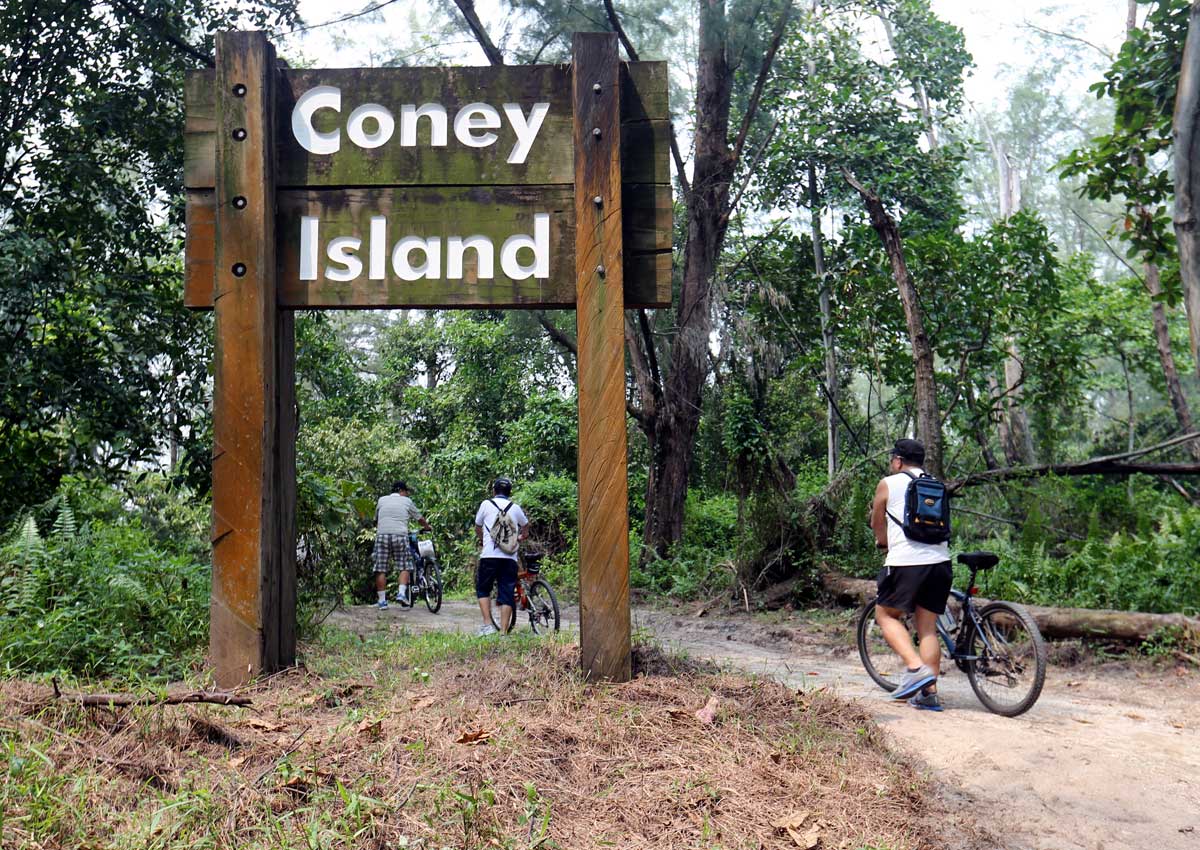
THE new Outward Bound Singapore (OBS) campus will occupy about 10 per cent of Coney Island’s land area and the number of students who will go through OBS will triple to 45,000 every year by 2020.
Minister for Culture, Community and Youth Grace Fu announced this yesterday afternoon during a visit to the OBS campus on Pulau Ubin.
The area occupied by OBS @ Coney is equivalent to 12ha, or about 14½ football pitches. It will be situated on the south-eastern end of Coney Island, close to the bridge that connects the island to Pasir Ris.
The rest of the island will remain open to the public.
“Every youth will have an opportunity to go through an OBS camp at least once in their schooling years,” said Ms Fu, adding that the campus will be nature friendly and co-exist with other visitors of Coney Island.
She said all OBS participants should develop “a keen sense of how the environment supports us, and what we can do to keep it lush and thriving”.
“We are looking around the world now for ideas for the most advanced facilities and programmes that will challenge participants either individually or as part of a team.”
Pointing to the possibility of recent terrorist attacks in Jakarta and Brussels happening in Singapore, Ms Fu stressed the need to build up youth to work as a team, with ruggedness in their minds and bodies.
She said: “Our future remains uncertain. We live in a more diverse society. We face the threats of terrorism. What happens in Brussels or Jakarta recently could well happen here.
“When the going gets tough, we will be resilient and hardy enough to overcome it together, to bounce back.”
Finance Minister Heng Swee Keat announced in his Budget speech last week that OBS @ Coney will be built at a cost of $250 million. This includes infrastructure costs of $130 million, “first mover” costs of $45 million for the installation of basic utilities, and $75 million for increased manpower, programming and equipment.
The current Pulau Ubin campus is about 9ha. The Government spent $250,000 on the conversion of a holiday camp into the first OBS in 1967. In 1995, a second campsite was added at a cost of $25 million.
Currently, about 14,000 students go through OBS every year. When the Coney Island expansion is completed in 2020, this number is expected to triple to 45,000.
OBS @ Coney aims to be “rustic and blend in as much as possible with the surroundings”, Mr Heng said in his Budget speech. Its connectivity to the mainland will allow OBS to conduct more programmes and expeditions around Singapore, using the country’s green and blue spaces.
yuensin@sph.com.sg
kenggene@sph.com.sg
Get MyPaper for more stories.
The second part of local director Jack Neo’s nostalgic kampung film is here to elicit laughs and wring out tears.
It continues the story of widow Zhao Di’s (Aileen Tan) family. After the 1960s nationwide floods, she takes…
Source link




