The S$40 million centre will address emerging areas such as predictive data analytics, industrial cyber security and smart infrastructure.
Source link
Germany's TUV SUD opens centre of digital expertise in Singapore
Zara Mid Season Sale From 31 Mar 2016 | SINGPromos.com
ZARA mid season sale has started with 50% off selected items
Zara Mid Season Sale From 31 Mar 2016 | SINGPromos.com
Zara Singapore has started their mid season sale. Enjoy 50% off on selected items for a limited time. Find your nearest Zara outlet here
Needy commuters to get priority to enter trains and lifts at all MRT stations
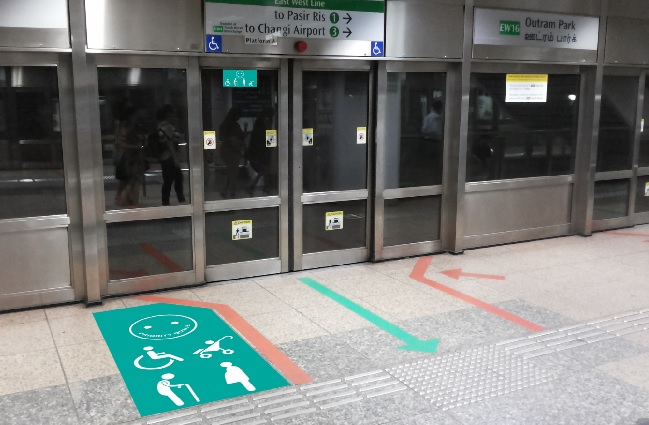
Needy commuters such as the elderly, pregnant and parents travelling with strollers will soon get to enter trains and lifts first at all MRT stations, in a move towards a more gracious society, the Land Transport Authority (LTA) said on Thursday (March 31).
Priority Qeueus will be implemented at platform screen doors and passenger lifts to complement the current queue lines provided for commuters to wait to let passengers alight from trains before entering.
LTA said it has worked with transport operators SMRT and SBS Transit to first implement the Priority Queue stickers at six MRT stations.
These are namely: Novena (North-South Line), Outram Park (East-West and North East Line), Chinatown (North East Line), Sengkang (North East Line) and Kent Ridge (Circle Line).
The stations were chosen for their close proximity to hospitals and high usage by seniors, and the stickers have already been put in place.
The locations at the platform screen doors correspond with the wheelchair parking space allocated in train cars and they are also generally closer to the lifts and away from escalators where human traffic is heaviest.
A survey will be conducted over two months to gather public feedback.
Based on the feedback received, LTA said it may modify the design of the Priority Queue before calling a tender to roll out the markings at all MRT and LRT stations.
At LRT stations, the Priority Queue stickers will be placed only at passenger lifts. Stickers will not be installed at platform edges due to the limited number of train doorways at LRT stations, added LTA.
sujint@sph.com.sg

'Our house feels empty,' says wife of man who died after fall in Sembawang
For the last eight years, she would return home to see her paralysed husband lying on his bed, yet always with a smile on his face.
But when Mrs Angeline Aw went home last Saturday, the bed was empty.
Her husband, Mr Aw Kian Chow, died in hospital after suffering breathing difficulties.
“The house felt empty all of a sudden. It is so difficult for me to look at his bed,” said the 47-year-old mother of two children, aged 15 and 18.
Mr Aw, 59, was in the news in 2011 when he sued the Sembawang Town Council for negligence and breach of duty.
The former freelance accountant had slipped and fallen at a sheltered walkway near his home in Sembawang Drive on a rainy day on Aug 26, 2008.
The fall fractured Mr Aw’s spine, causing him to be paralysed from the neck down.
Since the fall, Mrs Aw, who works in a bank, became the sole breadwinner. She also had to hire two full-time caregivers to look after Mr Aw, who was bedridden.
“For the first few years, he was in and out of the hospital, but it had been close to four years that he hadn’t been hospitalised. That’s why his demise is still a shock,” she said.
Mrs Aw described her family as a happy one.
“At night, we would set up mattresses in the living room so that we could sleep beside him. My husband and I wanted our children to know that we would always be a family, no matter what happens.
“Even though my husband couldn’t walk and talk, he was a good listener.
Whenever my daughters and I had a rough day, we would look forward to coming home to him.”
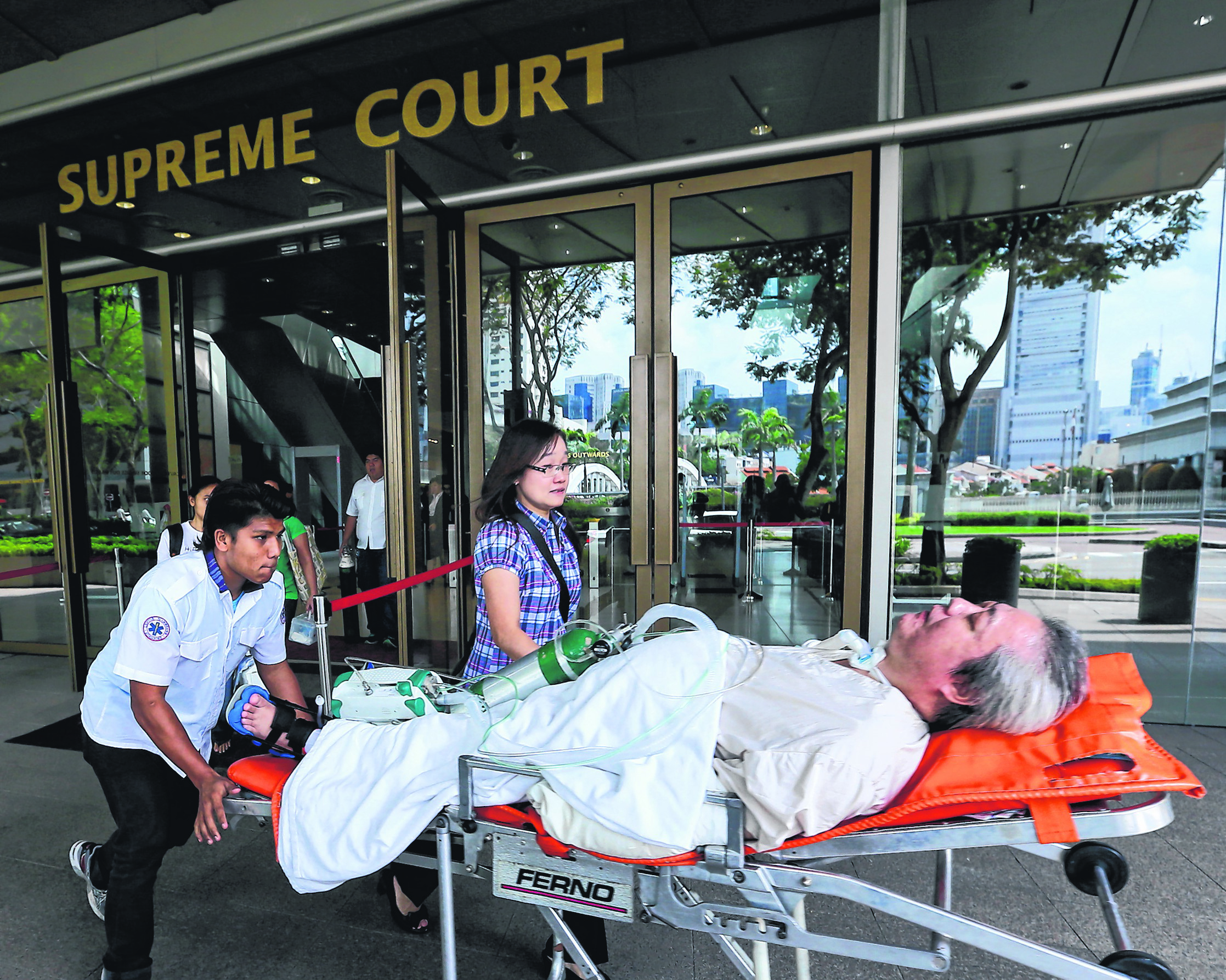
Mr Aw Kian Chow leaving court in January 2013. He had testified from a stretcher while hooked up to life support equipment. According to a report then, he laboured to speak in court and became breathless at one point. Photo: The New Paper
LEFT HOME
However, they did not expect their time with him to be up so soon.
At about 10am on Saturday, Mrs Aw attended a volunteer programme with her youngest daughter. Before leaving home, the pair kissed Mr Aw on his cheek, something they always did.
Mrs Aw’s older daughter had gone to church that morning.
Said Mrs Aw: “He looked well that morning, so I left him in the care of his two caregivers.”
But after the programme ended at about 2pm, she received a call from the hospital telling her that her husband had to be resuscitated.
“I was shocked, but I was still calm because he had been in hospital for breathing difficulties just a month ago. I didn’t think it would cost him his life,” she said, adding that Mr Aw had spent 22 days in the intensive care unit in February.
Mrs Aw then checked her mobile phone and realised there were missed calls from the caregivers.
Sensing that something was wrong, she rushed to the hospital.
“The doctor came out of the room and sat me down. She had a sombre look on her face so I knew that something terrible must have happened,” said Mrs Aw.
Choking back tears, she added: “When the doctor told me my husband had died, I was furious at first.
“I felt like he had a fighting chance to live if they hadn’t given up on him so easily.
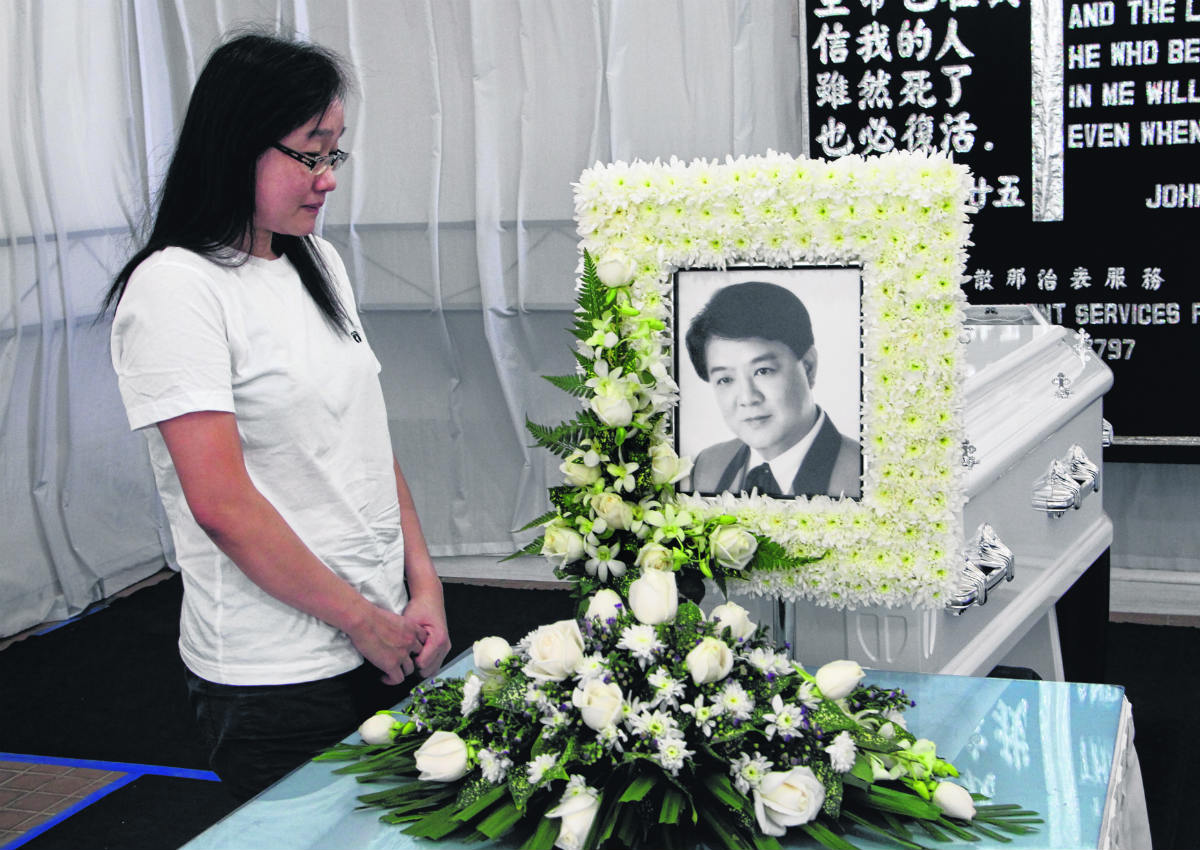
“When I saw my husband’s body cleared of all the life-support equipment, I felt lost for the first time in my life. At least when he was paralysed, I could still see his face and feel his presence beside me.
“I regretted not being by his side in his last moments.
“He was such a good husband and a loving father. I don’t know what to do now that he’s not around.”
Mr Aw was cremated yesterday morning.
“My daughters hated attending his wake because they hated to see their father’s body just lying there. It’s unusual for them to see him so expressionless,” said Mrs Aw.
“We are still struggling to cope with the loss. It’s so hard coming home to his empty bed in the living room.”
Even though my husband couldn’t walk and talk, he was a good listener.
– Mrs Angeline Aw
fnawang@sph.com.sg

This article was first published on March 31, 2016.
Get The New Paper for more stories.

dnata Singapore breaks ground for S$17m maintenance base
AIRPORT-services provider dnata Singapore has broken ground on the site of its S$17 million maintenance base at Changi Airport, which will enable it to triple its capacity for its repairs and maintenance activities.
With the aid of new equipment and technology, dnata will boost its handling capacity beyond 9,000 repairs and maintenance activities per year as it eyes future growth in line with the upcoming Terminals 4 and 5. Its existing facility, which was launched in 1981, can handle 3,000 maintenance and repairs activities annually.
The 6,900 sq m maintenance base, slated for completion by the first quarter of 2017, will be sited next to the dnata Cargo Centre within the Changi Airfreight Centre.
Mark Edwards, chief executive of dnata Singapore, said: “We need to be prepared for the future today and we are taking this opportunity to expand the maintenance base infrastructure.
“The maintenance base is an important facility to keep our fleet of ground-service equipment (GSE) operating smoothly and efficiently, so that our teams can rely on the GSE to deliver the service we promise to our airline customers.”
dnata Singapore’s current fleet of over 320 motorised and 1,200 non-motorised pieces of GSE will be serviced at the new maintenance base.
Mr Edwards added: “As our reliance and usage of the GSE increase, the demand for repair and maintenance of the GSE will also go up. I want to be sure that the maintenance team is ready and prepared for this increased demand.”
Meanwhile, new technology will be introduced to boost the efficiency of its staff. These include underground diesel tanks with dispensing pumps, high overhead cranes with bigger capacity and a dumb waiter lift for spare-parts movement to maximise storage space, as well as a centralised oil-dispensing and collecting system.
The Middle-East headquartered airport-services provider also plans to adopt green technology and equipment, starting with fast-charging bays for electric tractors at the new maintenance facility.
dnata offers services such as ground and cargo handling, travel, technology solutions and in-flight catering.
In Singapore, it employs 1,800 staff and provides passenger and ramp handling, flight catering, cargo handling and security services to more than 40 international airlines.
nishar@sph.com.sg

This article was first published on March 31, 2016.
Get The Business Times for more stories.

Cab smashes into her twice
Despite her advanced age and having money, she insisted on collecting cardboard.
So much so that she had been a familiar sight in her neighbourhood for more than 20 years.
But tragedy struck yesterday afternoon when Madam Poh Ah Gin, 78, was looking for cardboard behind a coffee shop at Block 123 next to an open-air carpark at Bedok North Street 2.
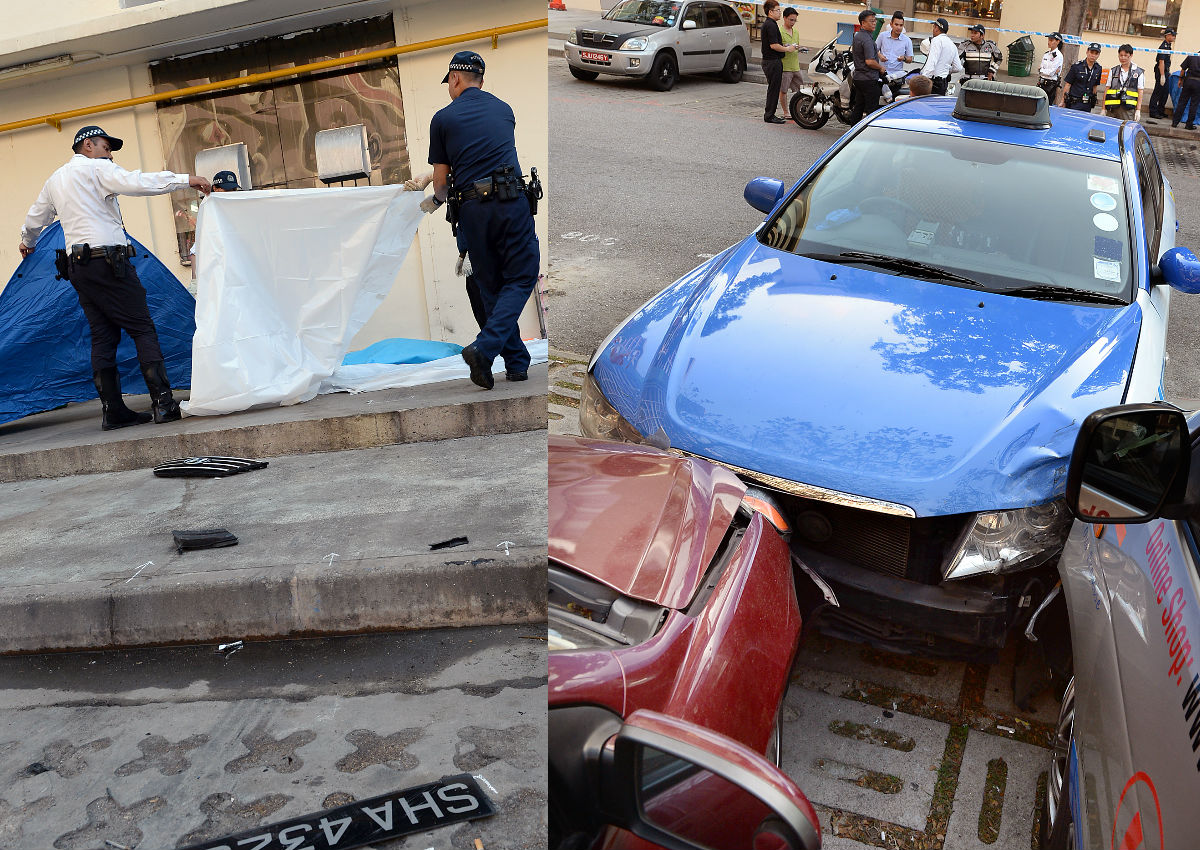
A Comfort taxi trying to reverse into a parking space suddenly mounted the kerb at high speed and rammed into her.
She died at the scene despite attempts to save her by doctors from a nearby clinic, a witness told The New Paper.
CAR ALARM
Madam Ismail Meera, 64, said she immediately ran out of her shop when she heard the shrill of a car alarm.
She noticed that a blue taxi had hit vehicles on the other side of the carpark. The impact was so great that the vehicles had mounted the kerb and other hit vehicles behind them.
When she had a closer look, she realised that two people were trying to resuscitate the elderly woman lying in a pool of blood on the walkway.
That was when Madam Meera recognised her as the neighbourhood’s cardboard collector.
“People started to crowd around her within seconds. When I went closer, I saw two women who looked like doctors from a nearby clinic attending to her,” she said.
Madam Meera, who owns a nearby Internet cafe, saw one of them performing cardiopulmonary resuscitation, while the other put an oxygen mask on Madam Poh.
She then ran back to her cafe to check on it before going out again about 10 minutes later.
By then, Madam Poh had died.
Another witness, Madam Rohana Ramlan, 28, was outside her shop when she saw the accident.
Describing it as horrifying, the owner of Atok Mart provision shop said: “I heard a bang and saw that the taxi had mounted the kerb.
“After that, he lurched back and forth at a high speed twice before hitting cars in the lots opposite his.”
Then she saw Madam Poh on the ground and the taxi driver out of his cab, wobbling to the side of the road.
“His face was pale and he looked very shaken,” said Madam Rohana.
Mr Lim Kah Hong, a 35-year-old tow truck driver, told The Straits Times Online that he ran towards the taxi after hearing a deafening screech, followed by a crash.
“I shouted at the taxi driver to stop because I realised he had hit the woman. But his car continued to lunge back and forth, and he hit her again,” he said.
He said he instinctively reached out to open the taxi door and grab its key, but was unable to do so as the taxi was moving at a high speed.
SISTER
Madam Poh’s younger sister (right) told TNP that Madam Poh had money but stubbornly insisted on collecting cardboard.
“She lives alone so my brother and I take turns to check on her and buy her food,” she said.
Her brother revealed that Madam Poh was the third of 11 children.
Madam Wee Goh Lian, 80, said that since she moved into the neighbourhood more than 20 years ago, she had seen Madam Poh collecting cardboard.
“She was a very quiet person and kept to herself. There was one time when I told her not to dirty the void deck with her cardboard. She listened to me and never did it again,” Madam Wee said.
Other residents said that Madam Poh was well-known in the neighbourhood for “not only collecting cardboard but keeping the neighbourhood clean as well”.
Madam Wee said: “I will miss her. It will feel unusual to not see her around any more.”
A Singapore Civil Defence Force spokesman said they was alerted to the accident at 3.15pm and sent an ambulance. Madam Poh was pronounced dead by paramedics at the scene.
Police said they had arrested a 64-year-old taxi driver for causing death by a negligent act.
Investigations are ongoing.
MY DAD SOUNDED TERRIFIED WHEN HE CALLED ME ABOUT CRASH
The cabby’s son said his father was about to end his shift and hand over the taxi, a Hyundai Sonata, to the next driver when the accident happened.
“My father told me that he was trying to park his cab when it surged backwards, mounted the kerb and hit the woman. He then switched gears and the cab rushed forward and hit the vehicles in front,” said the 27-year-old (above, in yellow), who wanted to be known only as Sam.
“Almost every day, my father parks at the same stretch of parking lots so the fact that he hit someone really shocked him.
“He repeatedly told me that there was something wrong with the cab, but there’s nothing we can do about it now. We just have to wait for further instructions from the police.”
He described his father as an experienced driver who did not have any traffic offences.
CHOKED UP
“When he called to inform me about the accident at about 4pm, he sounded so terrified over the phone,” he said.
“It was the first time in my life that I’ve ever heard my father’s voice all choked up.”
fnawang@sph.com.sg

This article was first published on March 31, 2016.
Get The New Paper for more stories.

OBS set to be rugged new melting pot
As Singapore moves into the next 50 years of its development, Outward Bound Singapore (OBS) is set to play a critical role in toughening up its young people and providing them with a common experience in its rugged environment.
By 2020, all young Singaporeans will have the opportunity to go through an OBS camp at least once in their schooling years, announced Minister for Culture, Community and Youth Grace Fu at the OBS campus on Pulau Ubin yesterday.
Noting how the path ahead for Singapore may not be an easy one, she said that OBS – originally mooted in 1967 by then Defence Minister Goh Keng Swee to “develop youth with a spirit of derring-do” – can be a “common experience for all young Singaporeans”.
“Our future remains uncertain. We live in a more diverse society. We face the threats of terrorism… We need to continue to build up our youth… so that when the going gets tough, we will be resilient and hardy enough to overcome it together, to bounce back,” said Ms Fu.
With the $250 million expansion of OBS to Coney Island in Punggol, announced by Finance Minister Heng Swee Keat last week, the capacity of OBS will be tripled by 2020. Some 45,000 young people will be able to attend an OBS camp every year, up from the current 14,000. This includes students at the secondary and tertiary levels, as well as young working adult
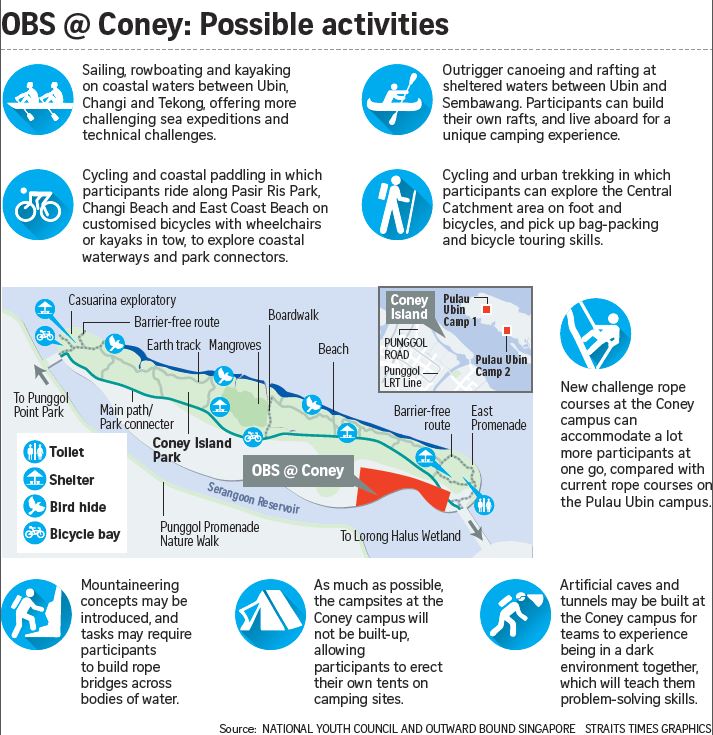
The area occupied by OBS @ Coney is equivalent to 12ha, or about 14½ football pitches. It will be situated on the south-eastern end of Coney Island, close to the bridge that connects the island to Pasir Ris. The rest of the island will remain open to the public.
Mr Ng Chun Pin, deputy chief executive of the National Youth Council (NYC), which OBS is part of, said the new site on Coney Island was picked because of its proximity to the mainland, serving as a gateway for new activities. For example, participants may be able to go on multi-element expeditions on customised bicycles, with kayaks or canoes attached, to explore Singapore’s coastal waterways and park connectors.
While the structure of the typical five-day camp has not changed, programmes will now have a greater focus on problem-solving as a team, and pay attention to social integration and diversity. OBS will work with the Ministry of Education (MOE) to ensure that there will be more “deliberate mixing” of students from various types of schools in the camps, and also craft different expeditions to cater to those with different physical abilities.
MOE said it will announce more details about making OBS available for more students soon. NYC and OBS also said they may hold public consultations, given that OBS may pan out to become “more like a national institution” in the future.
Said Mr Ng: “Today, you have your national service, which benefits only the guys… (OBS can be) a rich and meaningful programme for all our youth to take Singapore to the next level.”
Ms Denise Phua, chairman of the Government Parliamentary Committee for Education, applauded OBS’ emphasis on inclusivity.
“Students with special needs can also partake in all or part of the OBS with the right needs assessment, training and support. (They) must be included in the main chapter of the Singapore education story,” she said.
Mr Chan Wei Guan, 44, who has two sons and a daughter, said attending OBS should be made compulsory. “OBS is a good place to build up physical and mental resilience, even if it’s for only a few days.”
Sociologist Paulin Straughan, however, cautioned against making the OBS programme compulsory. “Social integration needs to be done by choice. If they feel that it needs to be done out of compulsion, this misses the point completely.”
yuensin@sph.com.sg
Additional reporting by Ng Keng Gene

This article was first published on March 31, 2016.
Get a copy of The Straits Times or go to straitstimes.com for more stories.

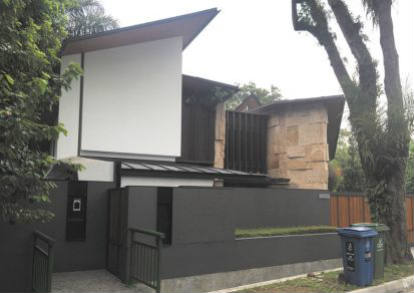
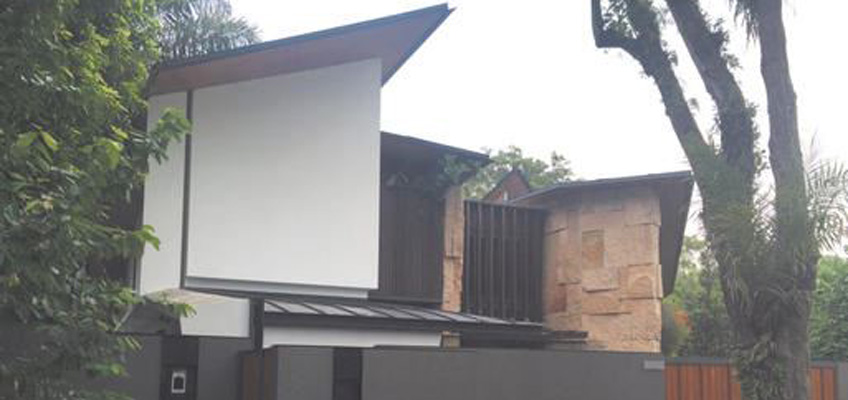
Famous hotpot chain founder pays $27 million for Good Class Bungalow


Famous hotpot chain founder buys GCB

Questions on tax reliefs, more targeted grants
A cap on the amount Singapore’s top earners can claim in tax reliefs and the reduction of a productivity grant for small businesses were the two main issues discussed at a public forum on the Budget yesterday.
Some participants wanted to know if the cap on tax reliefs at $80,000 could be expanded to cover more taxpayers, to generate more tax revenue.
Others wondered if the Government was sending mixed signals by stopping the Productivity and Innovation Credit (PIC) at a time when there is a push for companies to innovate and boost productivity.
Mr Bay Meng Yi, 32, who works in the environmental sector, commended the Government for taxing top earners more, but felt the criteria could be expanded to include a bigger proportion of taxpayers.
“An inclusive Budget is not just about giving subsidies to people, it also means getting money from elsewhere. If you are in the fortunate position of being wealthy, you should pay more taxes,” he said.
If he were rich, he would gladly pay more taxes, he added.
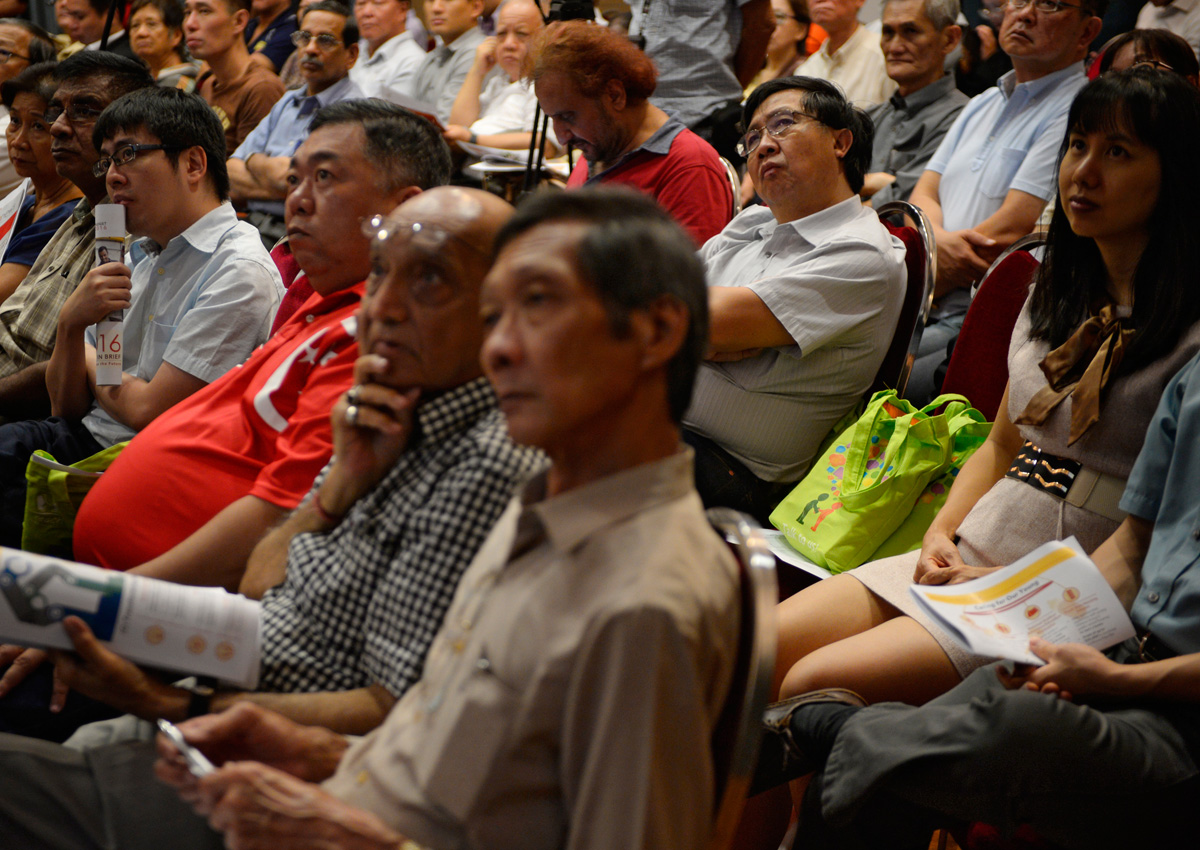
Mr Bay was among 100 people attending a dialogue on the Budget, announced last Thursday by Finance Minister Heng Swee Keat.
The forum, organised by government feedback unit Reach, was chaired by Senior Minister of State for Finance and Law Indranee Rajah and Minister of State for Manpower Sam Tan, who heads Reach.
Responding to Mr Bay, Ms Indranee said the cap on personal income tax relief may affect just 1 per cent of Singaporeans, but it will yield the Government an additional $100 million. This is why the criteria are such that only a small proportion of workers are affected, she added.
As for the PIC scheme, Ms Indranee said its broad-based nature meant some companies were buying equipment they may not really need. Under the scheme, businesses receive cash grants of 60 per cent of the money they spend on innovation and productivity improvements. But the grants will be lowered to 40 per cent from August this year. The Government, she added, is moving to replace broad-based measures with more targeted support for companies.
Newly announced schemes, like the Industry Transformation Programme and the Automation Support Package, will encourage companies to consider measures that are more targeted, she said.
Later, she told reporters it is only natural that companies are also concerned about the expiry of the PIC in 2018, as many businesses have come to rely on it to augment their processes. “But it is not that you are taking away something that supports productivity. This is a misconception,” she said. “Rather, you are taking out something that is a broad-based measure and replacing it with more targeted measures.”
At a separate forum on Malay TV channel Suria last night, Communications and Information Minister Yaacob Ibrahim said the Budget’s key messages were partnership and transformation.
This is “not just about the Government doing things, but everybody playing their part – industry, workers, families, the individual”.
Businesses also have to change the way they operate through innovation, and workers have to learn and relearn new skills, he added.
“That is how we can prepare ourselves for SG100,” he said.
Parliament will sit for two weeks, from Monday, to debate the Budget as well as the plans and policies of various ministries and key government agencies for the new financial year.
leepearl@sph.com.sg

This article was first published on March 31, 2016.
Get a copy of The Straits Times or go to straitstimes.com for more stories.