Home Blog Page 4198

KFC Breakfast Set Deals fr $3 Weekdays From 12 Apr 2016 | SINGPromos.com

0

KFC breakfast deals from $3, valid on weekdays till 11am

KFC Breakfast Set Deals fr $3 Weekdays From 12 Apr 2016 | SINGPromos.com

Enjoy breakfast at KFC from just $3. Choose from Twister Meal (Choice of 1 Original Recipe/ American Twister), Charger Meal, Brekkie Meal or Riser Meal

Source

Malaysia, Singapore PMs to discuss congestion at the Causeway

0

Malaysia and Singapore are expected to discuss the congestion problems at the Johor Causeway, during a meeting between leaders of the two countries.

Malaysian International Trade and Industry Minister Mustapa Mohamed said the issue would be one of the main topics during the meeting.

He said Prime Minister Najib Razak would meet Singapore’s Prime Minister Lee Hsien Loong at a retreat in Putrajaya next month, although no date has been fixed.”Both countries have to come up with solutions to improve traffic flow at the link,” Datuk Seri Mustapa said at the launch of a global business services hub at Iskandar Malaysia Pinewood Studios here on Saturday (April 16).

He said he met with Singaporean businessmen in the Republic last month and they had raised the problem to him.

While the Iskandar Malaysia development project was attractive to Singapore-based companies and investors, the traffic crawl at the Causeway has caused much inconvenience, he said.

The 1.05km Causeway links Johor Baru to Woodlands in Singapore.

Image: 
Category: 
Publication Date: 
Sunday, April 17, 2016 – 12:01
Keywords: 
Send to mobile app: 
Source: 


Story Type: 
Others

Source link

83 prisoners pardoned in Myanmar on country's New Year's Day

0

Myanmar President Htin Kyaw signed a pardon for 83 prisoners on the country’s New Year’s day, his office said in a statement on Sunday (April 17), though it was not immediately clear if the amnesty included political prisoners.

“The 83 prisoners will be freed by amnesty… on the first day of Myanmar’s New Year,” read the President’s statement, which was posted on Facebook on Sunday morning.

The pardon was intended to “make people feel happy and peaceful, and (promote) national reconciliation during the New Year”, it added.

In a New Year’s Day speech broadcast on television, Mr Htin Kyaw stressed his government’s determination to release political prisoners, who were routinely jailed under the military leaders that strangled free expression in Myanmar for decades.”We are trying to set the political prisoners, political activists and the students who face trials concerned with politics free,” the President said in his first lengthy public address since taking office.

Mr Htin Kyaw was tapped earlier this year to become the country’s first civilian leader in decades by Ms Aung San Suu Kyi, the veteran democracy activist who still controls the administration but is barred from the presidency by a junta-era charter.

Her National League for Democracy (NLD), which is packed full of former political prisoners jailed for their activism under military rule, ended nearly half a century of army domination when they took power in a historic transition in March.

Ms Suu Kyi, who spent some 15 years under house arrest, pledged in a statement earlier this month to make releasing prisoners of conscience a priority of her administration.

Since the NLD took power, the authorities have dropped charges against nearly 200 political activists, according to the police, including dozens of students who spent more than a year in jail over an education protest.

Mr Htin Kyaw was little known outside his home country before taking office, but is a longtime friend and close aide of Ms Suu Kyi.

Despite being blocked from the presidency, she wields formal power over the government through her newly fashioned role as state counsellor, which the NLD created for Ms Suu Kyi through their hefty majority in Parliament.

She has also taken on several cabinet posts, including foreign minister.

The jailing of dissidents was one of many repressive policies by the former junta that garnered global support for Ms Suu Kyi’s democracy struggle.

Watchdog groups in Myanmar say there are still hundreds of activists facing trial or being held in the country’s notorious prisons, many of them arrested under the quasi-civilian government that stepped down last month after five years of transitioning the country from junta rule.

Myanmar’s New Year’s holiday, a Buddhist celebration known as Thingyan, falls in mid-April and sees most offices close while people line the streets to douse each other with water to wash off the past year’s sins.

Image: 
Category: 
Publication Date: 
Sunday, April 17, 2016 – 11:08
Send to mobile app: 
Source: 


Story Type: 
Others

Source link

Going beyond grades: Evolving the Singapore education system

0

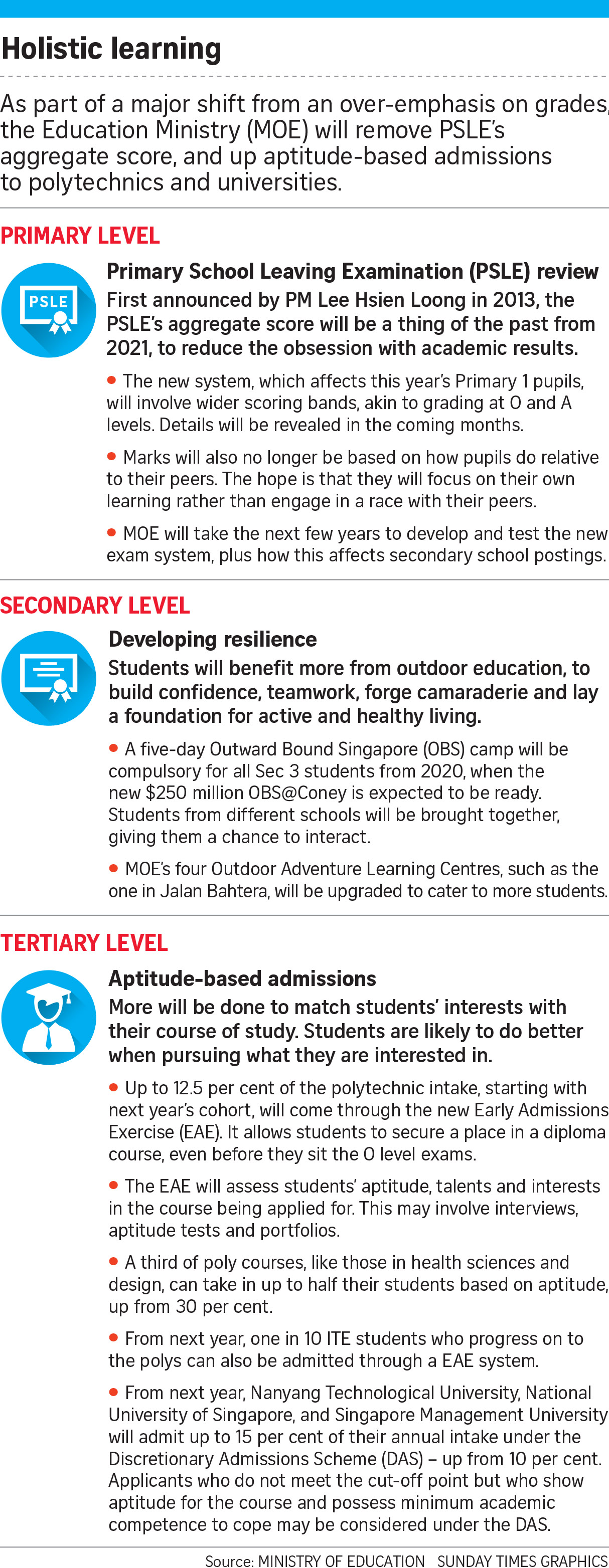
Pupils in Primary 1 this year will be the first cohort to take the Primary School Leaving Examination (PSLE) and receive a new set of results.

In 2021, the national examination will do away with the aggregate score – often criticised for being the cause of excessive stress among pupils and parents. With the change, children will no longer be graded relative to one another.

In its place will be wider scoring bands such as A, B, C and D – similar to the scoring system used in the O- and A-level examinations.

But this is only the most obvious change to what has been a steady overhaul of a pressure-cooker system which has had a strong focus on marks instead of a child’s holistic development.

Already, in the early stages of primary education, exams have become a thing of the past. Pupils are increasingly being encouraged to express themselves. Applied learning is in, along with the development of character and life skills.

At Primary Four or Five, pupils take part in a three-day cohort camp and learn to prepare simple meals, adapt to the outdoors, and build resilience and camaraderie.

In the coming years, primary school leavers will have more choice to go to secondary schools offering niche programmes in robotics, environmental issues, the arts and music, for instance, where they can develop their interests beyond the three “R”s – reading, writing and arithmetic.

As Acting Education Minister (Schools) Ng Chee Meng explained in Parliament earlier this month when he announced the changes: “Let’s help our children make good use of their time to branch out to explore other interests and passions and to pursue what they want to do in life.

“Let’s help them make good choices about their educational and career pathways based on their aptitudes and aspirations.

“Let’s help them to be ready for the future.”
CHANGING THE LANDSCAPE

Singapore’s education system has gained a reputation for being highly competitive and overly focused on grades and book smarts.

But this is changing, very deliberately, at every level – from primary schools to tertiary institutions.

Results for national exams, such as the PSLE and A levels, are released without the top scorers being highlighted any more.

While schools do still recognise their best performers – as a group instead of individually – they also celebrate the achievements of those who show improvement, overcome challenges such as a disability or illness, or excel in areas such as volunteer work and sports.

More schools now also include programmes to nurture interests beyond books, such as drama and dance. Manjusri Secondary School principal Low Chun Meng said: “With a better match of the child’s interest to the school’s programmes, the school will be able to develop the child better.”

Schemes to admit students based on their non-academic talents have been introduced. The Direct School Admission (DSA) scheme, which started in 2004, allows secondary schools to admit students based on not just grades but their sporting and artistic merits.

All five polytechnics and three of the local universities – Nanyang Technological University, Singapore Management University and NUS – will be expanding their aptitude-based admissions, allowing students who do not quite make the grade academically but show passion and interest to get into the course of their choice.

Educators said the shift in emphasis is to help arm students with life skills. Old-school rote learning and memorising have given way to applying textbook knowledge to real-world scenarios and more current content. Language lessons and assessment now place more weight on communication skills to help students converse in English and mother tongues more confidently.

MOE is also placing a stronger emphasis on outdoor education. Under a physical education syllabus introduced in 2014, 10 to 20 per cent of curriculum time in primary and secondary schools is set aside for outdoor education.

As part of a new National Outdoor Adventure Education Masterplan, all students from 2020 will also take part in three cohort camps during their school years, including a five-day Outward Bound Singapore camp for Secondary Three students.

PARENTS’ SUPPORT

But there is a big caveat as to whether such moves will allow students and pupils to “not just study the flowers, but also stop to smell the flowers, and wonder at their beauty”, as Minister Ng put it.

Will parents also change their mindsets?

Scoring well in the PSLE is a national obsession, to ensure entry into a good secondary school.

Some parents have taken extreme measures, from moving homes to enter primary schools which supposedly produce top PSLE performers regularly, to sending children for Gifted Education Programme training and enrichment classes from a young age to help build DSA portfolios.

When MOE stopped releasing the list of top PSLE scorers, parents on websites such as Kiasuparents put together their own.

The shadow education industry, or tuition, is worth more than a billion dollars annually here, almost double the $650 million spent in 2004. Some parents spend several thousands of dollars on tuition for their children each month, on top of religiously buying past-year examination papers of various schools, especially the top ones.

Jalan Besar GRC MP Denise Phua, who heads the Government Parliamentary Committee for Education, said: “(Broader grade bands) will not take away the pressure completely as the underlying mindset – that academic achievement is all that matters, that students with higher grades have a higher chance to enter schools of their choice – will take a long time to change.”

Some parents, like housewife Lydia Tan who has a six-year-old son, pointed out that their generation was brought up with the idea that grades determine future success. The 38-year-old said: “Our parents and teachers would tell us to study hard, work our way into a university, and we would then get good jobs.”

Added National Institute of Education don Jason Tan: “Many parents still think the choice of school does matter. So for those vying for the top schools, it’s still about fighting for scarce places.”

THE NEED FOR CHANGE

Changes to the education system go beyond trying to reduce stress on children. They are a response to the needs of a rapidly changing world.

A report last year by the World Economic Forum titled New Vision of Education said that to thrive in today’s innovation-driven economy, employees need a different mix of skills than in the past.

“In addition to foundational skills like literacy and numeracy, they need competencies like collaboration, creativity and problem-solving, and character qualities like persistence, curiosity and initiative,” the report said.

“In countries around the world, economies run on creativity, innovation and collaboration. Skilled jobs are more and more centred on solving unstructured problems and effectively analysing information.”

As Mr Ng put it in his speech to Parliament during the debate on his ministry’s budget: “We want to cultivate a generation of young people who grow up with a sense of curiosity and a love for learning… asking both the ‘whys’ and the ‘why nots’.”

This ties in with the broader SkillsFuture initiative, which advocates mastery of skills over just collecting qualifications. Part of this involves getting students to explore their interests and passions from a young age. Said Acting Minister for Education (Higher Education and Skills) Ong Ye Kung: “It starts with schools, laying the foundation for our young.

“Then Higher Education – ITE, polytechnics, universities – takes over to help our young discover their interests and aspirations, impart knowledge in them, hone their skills and prepare them for the real world. From there, a lifelong learning system takes over, where they embark on a continuous journey of learning, updating or even finding a new path.

“Along the way, they will persevere, improve and achieve mastery in their chosen fields, and maybe teach the next generation.”

It is education not for the sake of grades, but for the joy of learning – a point that Singapore educators advocate.

Said Madam Sharma Poonam Kumari, principal of Changkat Changi Secondary School: “Education is moving beyond the transactional approach of sitting and clearing exams, to imbuing that love for learning. The future we are preparing children for is going to be very complex, and textbook knowledge will not always get them through.”

Qifa Primary School principal May Wong added that when students eventually apply for jobs, employers “are not going to look for the person with the highest aggregate score”. Instead, they value skills like teamwork and creativity, and traits such as resilience and empathy, she said.

Ms Phua believes there is room to go even further, suggesting that the PSLE could be done away with entirely. She said: “There may be a need to think out-of-the-box and try bolder models such as a 10-year or 12-year through-train model without the need for a high-stakes PSLE whilst retaining academic rigour, amongst other goals.”

Still, she firmly believes MOE is going in the right direction with the latest changes, although she cautioned: “The devil of course is in the detail.”


This article was first published on April 17, 2016.
Get a copy of The Straits Times or go to straitstimes.com for more stories.

Image: 
Category: 
Publication Date: 
Sunday, April 17, 2016 – 10:05
Send to mobile app: 
Source: 


Story Type: 
Others

Source link

Yaacob: Reading books in mother tongue crucial

0

There is a risk that languages such as Malay, Chinese and Tamil might be lost here if Singaporeans do not read books in these languages.

Minister for Communications and Information Yaacob Ibrahim said that this was a scenario that the country should avoid.

“As much as we want to promote bilingualism, we also want to promote interest in your mother tongue beyond just examinations, and also in terms of understanding the culture, the history,” he said.

He was speaking yesterday at an SGFuture engagement session, organised by the Ministry of Communications and Information (MCI) and the National Library Board (NLB), to gather ideas on how to encourage more people in the Malay community to read Malay books.

About 30 people, including students, teachers and Malay language authors, took part in the event at Bedok Public Library.

The MCI announced last week in Parliament that the NLB will be ramping up efforts to get more people to read in their mother tongue languages, as part of its larger push to get more people here to read.

Efforts include doubling mother tongue language reading clubs here from five to 10 by this year.

NLB will also conduct a nationwide survey on reading habits to better understand how to promote reading.

It will also be launching a National Reading Movement, with a two-month campaign in June and July to get people to “read more, read widely and read together”, as well as Singapore’s first National Reading Day on July 30.

At yesterday’s event, participants threw up ideas, such as rolling out mobile libraries at youth hangouts or introducing more genres, like travel, adventure and history, in Malay.

Other ideas included curating books for different age groups and developing “video trailers” to introduce good books to the public.

Muhammad Syahir, 16, a Secondary 5 student who joined the discussion, likes the last idea especially, saying that this might be useful, as young people today seem to be more attracted by the visual medium.

“If we can catch their attention on one medium, it might entice them and move them along to pick up books,” he said.

Another participant, children’s book author Jumaini Ariff, 37, suggested that NLB do more storytelling in Malay for young and teenage readers.

“Storytelling is a great tool that can help bring words to life. It helps to make reading exciting,” she said.


This article was first published on April 17, 2016.
Get a copy of The Straits Times or go to straitstimes.com for more stories.

Image: 
Category: 
Publication Date: 
Sunday, April 17, 2016 – 10:02
Send to mobile app: 
Source: 


Story Type: 
Others

Source link

Warship launched to tighten S'pore security

0

The second of eight new made-in-Singapore warships was launched yesterday, as Deputy Prime Minister and Coordinating Minister for National Security Teo Chee Hean stressed the importance of a strong Navy to keep the country’s maritime borders safe.

With more than 1,000 vessels passing through the Singapore Strait every day, the country sits astride one of the world’s busiest waterways, he highlighted.

This also makes it vulnerable.

“The security of sea lines and our port is affected by piracy, sea robberies, and the emergent threat of transnational maritime terrorism,” he said.

Explaining that the sea will continue to be part of Singapore’s lifeline, he added that “the interruption of sea traffic or a threat coming from the many vessels sailing through these waters will have a serious impact on us here in Singapore”.

The latest addition to Singapore’s Navy is a littoral mission vessel (LMV) called Sovereignty.

DPM Teo said LMVs are faster and more versatile, boosting the Navy’s effectiveness.

At 80m long, the new ship is 21/2 times bigger than the Fearless-class patrol vessel it will replace.

It can also sail further and faster – hitting top speeds in excess of 27 knots and sailing up to 3,500 nautical miles. Powered by four engines, it can last 14 days at sea.

The new vessel’s integrated command centre combines the combat, engineering and navigation teams, allowing faster and seamless coordination among sailors.

“The ability to build and design our own ships with a lot of indigenous technology indicates the importance of engineering for Singapore,” said DPM Teo.

He added that the Singapore Armed Forces (SAF) will also have to work well with the Home Team and other maritime agencies, such as the Maritime and Port Authority of Singapore, to ensure seamless operations in defending the country’s maritime entryways.

For security and defence needs, DPM Teo said, Singapore has to ensure it is more effective and efficient in its use of manpower, with the help of technology as there are fewer and better-educated servicemen in the SAF and Home Team.

Minister for Defence Ng Eng Hen and Senior Minister of State for Defence Maliki Osman also witnessed the launch of Sovereignty at Singapore Technologies Marine’s Benoi Yard in the west of the island.

Sovereignty is expected to be operationally ready by next year, after it installs combat systems and undergoes sea trials. The first warship, LMV Independence, which was launched in July last year, is going through sea trials now and is expected to be battle-ready by next year. The other ships are expected to be operational by 2020.

The eight warships will do the work previously done by 11 patrol vessels, which have been in service for about 20 years. The new ships will result in a manpower saving of at least 10 per cent.

The new warships are the first to be entirely designed and built here since the first Endurance-class Landing Ship Tank was launched in 1998.


This article was first published on April 17, 2016.
Get a copy of The Straits Times or go to straitstimes.com for more stories.

Image: 
Category: 
Publication Date: 
Sunday, April 17, 2016 – 09:58
Send to mobile app: 
Source: 


Story Type: 
Others

Source link

Rescuers race against landslides to reach Japan quake victims as death toll reaches 41

0

Rescuers were racing against the weather and the threat of more landslides Sunday to reach people still trapped by two big earthquakes that hit southern Japan.

At last 41 people are known to have died in the double disaster, with at least six still missing – feared buried in shattered houses or under torrents of mud.

Heavy rain was lashing the area around Kumamoto, where officials have warned quake-loosened hillsides could be at risk of collapse as aftershocks continued to roil the ground.

The weather was also bringing further misery to those who survived Thursday’s initial quake and the bigger, more powerful tremor that hit early Saturday.

In the badly-affected town of Mashiki, few of the traditional style wooden houses remained intact, and their occupants described the hardships of surviving in the destruction.

“I sleep in a car and stay in this tent during the day,” Seiya Takamori, 52, told AFP, gesturing to a shelter made from a blue plastic tarp.

“In this area, we all knew there was an active fault running underneath the town of Mashiki, but no one really cared about it.

“We always said to each other that a big quake would hit at some point, but not really taking it seriously.” Neighbour Masanori Masuda, 59, was also fending off the weather in a makeshift tent.

He said many houses were in reasonable shape after the first tremor, but had suffered badly when the second quake struck, leaving occupants without basic necessities.

“I need batteries to charge my mobile phone. Also, I need a toilet. I am afraid of going into the battered house, but I cannot help it. I take a bucket of water with me and have to use the toilet in the house,” he said.

The two quakes triggered enormous landslides that swept away homes, roads and railway lines, and reduced even modern buildings to rubble.

More than 90,000 people have been evacuated, including 300 from an area near a dam thought to be at risk of collapse.

Isolated villages in mountainous areas near the city of Kumamoto were completely cut off by landslides and damage to roads. At least 500 people were believed trapped in one settlement.


Aerial footage showed a bridge on a main trunk road had crashed onto the carriageway below it, its pillars felled.

The government said Saturday that there were “multiple locations where people have been buried alive” as it sent in 25,000 troops, firefighters, medics and other rescue personnel.

Around 400 aftershocks have rocked Kumamoto and other parts of central Kyushu, an area unaccustomed to the powerful quakes that regularly rattle other parts of Japan.

Thursday’s initial quake affected older buildings and killed nine people, but Saturday’s brought newer structures crashing down, including a municipal office in the city of Uto.

The combined death toll remained at 41 and six people are unaccounted for, local officials said Sunday.

Nearly 1,000 people have been hurt, 184 of them seriously.

Around 80,000 households were still without electricity, Kyushu Electric Power said, while about 320,000 homes were reportedly without water.

Japan, one of the world’s most seismically active countries, suffered a massive undersea quake on March 11, 2011 that sent a tsunami barrelling into its northeast coast.

Some 18,500 people were left dead or missing, and several nuclear reactors went into meltdown at the Fukushima plant in the worst atomic accident in a generation.

Japan’s only working nuclear plant, southwest of Saturday’s epicentre, was unaffected by the quakes, the government has said.

Image: 
Category: 
Publication Date: 
Sunday, April 17, 2016 – 08:57
Keywords: 
Send to mobile app: 
Source: 


Story Type: 
Others

Source link

PM Lee meets Singaporean students, tours Petra in Jordan

0

Prime Minister Lee Hsien Loong, who is on his first visit to Jordan, met about 100 Singaporean students studying there.

Source link

Singaporeans studying in the Middle East have role to play in nation building: Masagos

0

AMMAN – Singaporean students who are studying in Middle Eastern universities have an important role to play after they graduate, as the Republic is in need of strong religious leaders who can contextualise Islam in line with the country’s multiracial…

Source link

'I wish I could give my son a conventional family'

0

She was 19 when she learnt that she was five months pregnant.

It was too late for an abortion.

And her 20-year-old boyfriend decided he wasn’t going to stick around.

“I was doing a polytechnic internship at the…

Source link