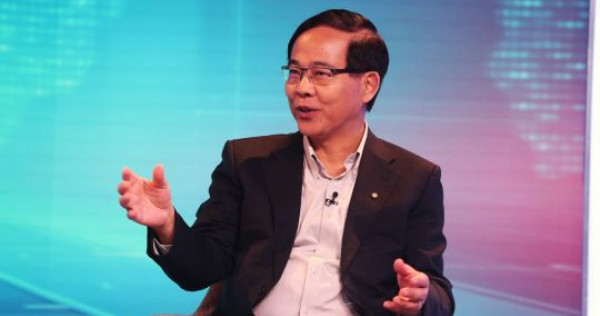
SINGAPORE – As a scientist who studies infectious diseases, Professor Wang Linfa knows all too well the importance of social distancing and personal hygiene to not becoming sick during a pandemic.
In fact, the director of the emerging infectious diseases programme at Duke-NUS Medical School has been practising such measures long before the Government started issuing recommendations for people to keep their distance from others, so as to reduce the chances of more people being infected with the virus causing Covid-19.
For example, after visiting Wuhan, China – the first epicentre of the current outbreak – as part of a team of scientists learning more about the virus in mid-January, Prof Wang put himself on home quarantine, even though there was no requirement for him to do so then.
He was a member of the Emergency Committee convened by the World Health Organisation (WHO) that debated the WHO’s stance on the coronavirus during the early stages of the outbreak.
Even now, he is also trying to put into practice new habits – such as avoiding contact with people, even family members, and reducing time spent outside his home or laboratory.
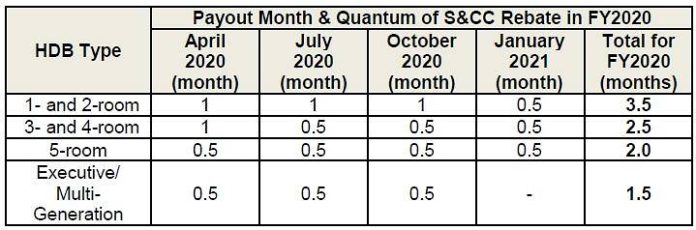
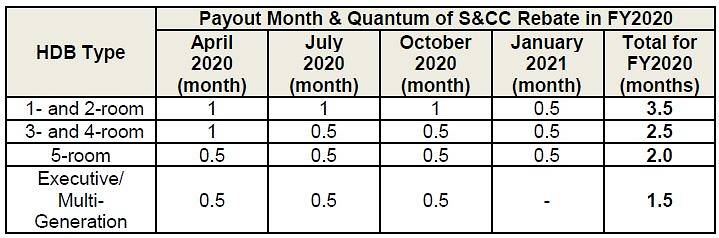
SINGAPORE: Around 940,000 Singaporean Housing and Development Board (HDB) households will receive S$134 million worth of Service and Conservancy Charges (S&CC) rebates in the 2020 financial year (from April 2020 to March 2021).
This is part of the Government’s Care and Support Package announced as part of Budget 2020 to help households with their expenses.
In a news release on Wednesday (Mar 25), the Ministry of Finance said that in total, each eligible household will receive 1.5 to 3.5 months of S&CC rebate, depending on flat type.
It will be disbursed every three months, starting in April.
(Image: Ministry of Finance)
Eligible households will receive a letter from the end of March with more details.
The S&CC rebate has been paid out annually by the Government since 2013, and is used to offset a household’s S&CC payment directly.
For households who pay their S&CC through GIRO, their Town Councils will make the necessary arrangement with their banks.
During his Budget speech in February, Finance Minister Heng Swee Keat announced the S$1.6 billion Care and Support Package for households to help with their expenses, during this period of uncertainty given a slowing economy and the ongoing COVID-19 outbreak.
Other measures included a one-off cash payment for eligible Singaporeans, a one-off Goods and Service Tax Voucher (GSTV) – U-Save Special Payment and help with transport expenses.
One animal advocacy group’s inquiry into the alleged abuse of a pet dog took a bizarre turn when the owners euthanised the animal the next day to “solve” the problem.
The Animal & Veterinary Service (AVS) is investigating after a pet owner put his Jack Russell down on Monday (March 23) following a visit from Chained Dog Awareness in Singapore (CDAS) volunteers, reported Lianhe Wanbao.
CDAS was alerted to the dog’s situation after a Facebook user posted a video of the dog lying beneath a cabinet on the compound of a house in Holland Village, lethargically eating food off the floor.
The user also alleged that the dog had been kicked and shoved beneath the cabinet by a woman.
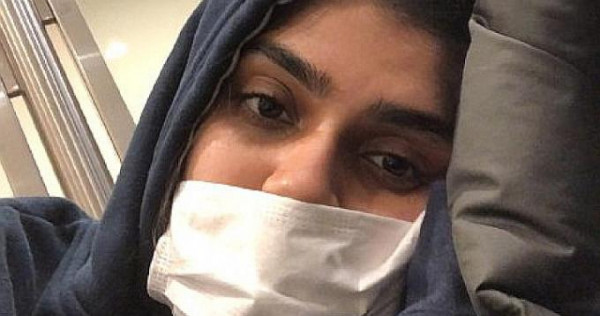
When she returned to Singapore at 2pm on March 21, Miss Sejal Bagaria felt a dry cough developing.
She and a friend, who also felt unwell, wanted to get screened at Changi Airport.
“We had symptoms and we wanted to get tested. It was the socially responsible thing to do,” the Nanyang Technological University (NTU) student told The New Paper in a telephone interview yesterday.
Miss Bagaria was one of the students recalled from exchange programmes overseas. She had been at the University of Sussex for her exchange programme since Jan 21.
At the airport, a doctor assessed her symptoms and said she has to be taken to the hospital for further tests.
She was not allowed to leave.
But it was not until midnight that she and her friend were taken by an ambulance to the National Centre of Infectious Diseases (NCID).
Miss Bagaria, a year two student at the Wee Kim Wee School of Communication and Information, said: “By night time, I felt even more sick. I had a dry cough and shortness of breath and I knew something was wrong.”
Working from home and drastically cutting down on socialising IRL got you down? Beat that cabin fever with a hearty injection of retail therapy, and Lazada is more than ready to play doctor.
Southeast Asia’s top online shopping destination is turning eight this year, but it seems like it’ll be everyone’s birthday come March 27. The Lazada Birthday Sale promises 88 million deals on the e-commerce portal with up to 90 per cent discounts across product categories, including technology, fashion, parenting, beauty, home and lifestyle.
The thing is, you don’t really have to wait until Friday to get started on the shopping spree. Lazada has a pre-sale campaign going on right now where folks can digitally chope their spots for the best deals by placing a (non-refundable) deposit on a product at early-bird prices.
SINGAPORE: With the exception of a gig in April, lighting designer Jim Chan’s work calendar is now completely blank as a result of the COVID-19 outbreak.
“Ever since the Chinese New Year period, a lot of things have been cancelled,” he told CNA. “Around that period, I started looking for other things to do. But I realised some people still wanted to carry on their shows, so I didn’t commit to any other job because I still had to do these shows.
“Then when the Government announced that there would be a ban on events over 250 (people), everything got cancelled. That was just last week, so now I have to rethink (my plans) again.”
While Mr Chan also had another role editing sports broadcast content, opportunities have also dried up as sports events have been largely postponed or cancelled.
“The main thing is the uncertainty – when this will end. I feel like if it ended in a month, I’d be fine, I’d be prepared enough and keep my finances in order,” said Mr Chan, who estimates he has lost more about S$4,000 in earnings.
“But if this goes on for six months, then I will be in some trouble, I need to find something (else) to do.”
With the COVID-19 outbreak impacting many freelancers such as Mr Chan, a Facebook group for freelancers in the arts and culture and creative sectors has ben set up.
Mr Chan has helped with the lighting for performances at festivals such as Textures 2020. (Photo: The Arts House at The Old Parliament Facebook page)
The group, which has over 3,800 members, aims to rally these individuals, allow them to share job postings, and collect feedback which then can be shared with various stakeholders.
The idea is also raise the profile of a sector which is often overlooked, said Mr Nicholas Chee, who created the group last month.
“What we’ve done is essentially to come together and say, look, there’s a whole group of freelance professionals, self employed persons that are in this industry in these various sectors,” he said. “And a lot of them have have been affected by COVID-19 just like any other industry, because it’s always (been talk) about tourism, hotels, things that you can see.”
Mr Chee, who works in the media sector, estimates that the COVID-19 outbreak has cost him upwards of S$50,000.
“I think the most important thing is that this is the very first time … that this sort of self organisation is happening,” he added. “I would say that if the group didn’t exist, then everybody would just be venting on (their) home page.
“But what the group does is actually to give everybody a sense of emotional and mental support as well, to know that I’m not the only one in this terrible state … When you have support from people around which are in the same in the same state, there’s a lot of encouragement going on. And there’s a lot of positive things going on and people are trying to make things happen in spite of the situation.”
“I’ve found some interesting things that I didn’t know about,” he said. “You get to read stories about how different people are handling it, how different people are coping with it – whether they try something new, or take their business online.”
Actress and writer Jo Tan is another freelancer who has been hit hard by the COVID-19 outbreak. She has seen productions, as well as hosting gigs cancelled, resulting in losses of around S$15,000.
“I might be writing a script and then at the next moment, nobody is going to see it, I could be rehearsing and developing a piece of work and nobody might be able to see that, I might not get paid as well,” she said.
“I’m always fully aware that it might amount to nothing.”
And while she tides over this difficult period, the Facebook group has been a help, whether it be providing support or starting projects that eventually can be monetised.
“It always helps when you know that you are not alone. And you can just rant. I do feel that there is solidarity,” she explained. “When you are the lone freelancer, it can feel like it’s you against the world. But when you have a community then you know you have these people to back you up.”
Earlier this month, the Government unveiled measures to help freelancers affected by the coronavirus outbreak. These include an allowance of S$7.50 an hour for self-employed persons when they attend courses under the SkillsFuture Series over the next three months.
There is no cap to how much training self-employed persons can sign up for under the scheme, which will be administered by NTUC.
“I’m grateful for the SkillsFuture credits and the training allowance, but I also think there are some flaws,” said Ms Tan, who pointed out that some courses are expensive.
“Everybody has no income now and needs to spend their training credits wisely. And we certainly can’t afford to top up any deficiency in the credits with cash,” she explained.
“Also, there is a training allowance for certain SkillsFuture courses which is great, but the current courses available for the allowance are really extremely limited and are in areas that would be a massive leap for many people to jump into.
“Like looking at these subjects, even if I went for like a full course, I’m still so distant from most of them that I would be far from qualified to work in that industry.”
More resources needs to be allocated to support the arts industry, added Ms Tan.
“For the arts industry in Singapore, It’s been such a long slow journey to get to where are are today, where people from different parts of the world know of and respect our work,” she explained. “But if we don’t have the resources to get through this period, we may have to start from zero again.”
In conjunction with the Facebook group, the website Ilostmygig.sg was launched on Monday (Mar 23). Inspired by similar efforts in the US and Australia, the website collates information on the losses suffered by those within such industries and hopes to give a sense of the scale of income lost.
Ms Jo Tan performing in a production. (Photo: William Low)
As of 6.33pm on Tuesday (Mar 24), the tally of lost income on the website stands at about S$18 million.
“Now their losses are not invisible, there’s a tangible number put to it,” explained Mr Keith Tan, who was part of the team that helped to spearhead the website. “It’s real people submitting their numbers.”
Users who enter the site can make use of a form to provide information, and moderators help to collate this information and form an overall tally. Checks are also done, to make sure that the numbers declared are in line with what is reasonable.
“When you engage with the Government, trade organisations, you can’t just go to them and say: ‘We’re hurting and we’re bleeding.’ They will say: ‘How much?’,” said Mr Tan.
“Nick has already gone through several town hall meetings and conversations with the Government and trade organisations. So I think in the next dialogue, we have some data to bring to them,” said Mr Tan. “This is not a crowdfunding campaign – there’s no intent to fulfil the tally, but it’s to make aware that this is a real thing and this is the gross losses on the table. Now how do we tide this industry over till times are good again?”
There are also various tabs for easy access to resources and the latest news. The website provides an “I want to help” tab, which is aimed at connecting external parties with freelancers in order to provide possible job opportunities.
“There are people who want to get involved and want to help. But the thing is that they don’t know how to get involved,” said Mr Tan. “It’s very important for people who want to help to have a channel to voice out how to want to do so, so that we can direct them to the relevant parties.”
SINGAPORE: “An unprecedented crisis” – those were the words of National Development Minister Lawrence Wong, who co-chairs Singapore’s COVID-19 taskforce, in announcing tighter border restrictions to combat the coronavirus outbreak on Sunday (Mar 22).
An unprecedented crisis, the ongoing global pandemic has changed all our lives. And among those who have felt the brunt of the rush to contain COVID-19, are students in higher education all across the world.
At home, the Ministry of Education on Mar 15 announced a recall of students on official overseas placements, including all internships and exchange programmes. In addition, institutes of higher learning will suspend all overseas placements until the end of July.
Relatedly, Singaporean students studying overseas have been encouraged to return home soon, with the Government liaising with airlines to facilitate return flights.
Meanwhile, Singaporean students studying locally have had to rapidly adjust to new academic arrangements, whilst dealing with a suspension of their planned trajectories for 2020 and possibly beyond.
As it becomes increasingly clear that the COVID-19 outbreak will last a year, even more, a difficult realisation is starting to dawn for my generation of youth: This is only the beginning. To borrow the title of a 2014 book associated with the McKinsey Global Institute, this is no ordinary disruption.
NO ORDINARY DISRUPTION
On the economic front, a brewing economic storm will likely cause tightened hiring and reduced job vacancies, carrying the prospect of underemployment fresh out of graduation.
Internships will also be in shorter supply, while competition rises due to higher demand from returning students and students whose summer overseas placements have been suspended. The risk of a gap in one’s resume looms.
Furthermore, most major events that make for prime networking events for graduating students will likely be cancelled for the foreseeable future. Increasingly stringent social distancing measures will inevitably disrupt the activities of social causes that define this generation; even one’s social life will likely take a hit.
National University of Singapore graduates at a commencement ceremony. (Photo: Lionel Lin)
Less tangibly, significant milestones such as commencement and graduation trips will never materialise in the ways they were supposed to, the finishing line of a decades-long race suddenly disappearing just as one approaches.
Against the backdrop of an already uncertain future stemming from technological changes and trade tensions, the changes brought about by the coronavirus add up.
Day by day, they add up to a gradual, persistent disruption of previously planned rising trajectories – there’s no denying that the world has been dealt a bad hand.
A once-familiar equilibrium has been disturbed, and the race is on for students, graduates and workers to quickly find a new one, to regain control over our plans and lived experiences.
THE FIGHT FOR CONTROL
It is here that I must switch to the first-person, “I”, for the above was a product of intensely personal reflection over the past few weeks, as I felt many familiar routines slipping away and a gradual erosion of my plans for the year.
The late economic historian Peter L Bernstein wrote: “The ability to define what may happen in the future and to choose among alternatives lies at the heart of contemporary societies.”
Choice, preparedness, control – a global pandemic seems to challenge all these. It emerged from nowhere, and now that it’s here, it is easy to feel somewhat lost, vulnerable and strung along through the days.
How does one regain that sense of control? I have three pieces of advice for all my peers reading this, wondering about their disrupted futures in a time of coronavirus.
First, switch from being reactive to being proactive.
Youths walking after a class has finished. (Photo: TODAY)
The reason why I felt “strung along” was because I was constantly reacting to what the COVID-19 situation threw at me; I was not in control of the narrative. What I needed to do was to get ahead of developments, to take back control by finding a new destination to head to when the route to old ones now seem increasingly murky.
So I decided that I would finally pursue a dream of mine of writing a book about writing skills for young adults.
Embarking on this project will allow me to take back the wheel in my 2020 journey. Plus, should I decide to take on a writing-related or research career in future, this could stand me in good stead.
The question you should ask is: What is something that I have always wanted to do, but have never been able to as I was always too busy? It need not be career-related, but if it is, a second piece of advice is in order.
The second piece of advice is this: Focus not on getting through this “downturn”, but being ready to ride the upturn when it comes.
If such language seems familiar, it’s because Deputy Prime Minister and Finance Minister Heng Swee Keat used it in his Budget 2020 speech.
One month on, the phrase that stuck with me most from Mr Heng’s speech is “when the upturn comes”.
The exact sentence was: “We want to help our workers retain their jobs, and use any lull period to upgrade their skills, and be ready when the upturn comes.”
That sentence was about workers, but it equally applies to those of us who are still studying and have yet to enter the workforce. This lull period is an opportune time to plug skill gaps that may limit the attractiveness of potential job applications and to seek out mentorship on how to improve ourselves.
We could research and be more in tune with emerging trends in the job market which will come to bear when the upturn comes.
More radically, in this lull period, we have the capacity to take a good hard look at where we are heading professionally, and ask if that is where we truly want to go. We can then make necessary adjustments to our planned trajectories which we can realise once the upturn arrives.
AND NOW, A TWIST
Underlying these two pieces of advice is a call to do something you may not have normally done. Will this guarantee that things will work out for the best in the end? Of course not.
View of the central business district in Singapore. (File photo: AFP/Roslan Rahman)
The final piece of advice is thus one of mindset – be ready to take a risk.
Here’s a twist: The quote from Peter L Bernstein which sparked this discussion was from a book titled Against The Gods: The Remarkable Story Of Risk.
According to Bernstein, the word “risk” comes from the early Italian word risicare, meaning “to dare”.
To be proactive, and to be ready for the upturn, we must dare to do what we typically might not have considered, explore potential new paths, seek out opportunities in industries beyond those we originally set our sights on, collaborate with others to work on novel projects and start new initiatives.
Think of it this way: We already have nothing to lose, and thus, everything to gain.
No matter what, of course, there is no denying that an unprecedented crisis dealt us a bad hand. This wasn’t what we planned for, this wasn’t what we wanted.
But make no mistake, whether we’re studying, about to graduate, or in the job market, we can retake the wheel; we can regain control; we have agency.
And perhaps, if we play our cards right, we can also make this an unprecedented opportunity.
Download our app or subscribe to our Telegram channel for the latest updates on the coronavirus outbreak: https://cna.asia/telegram
Ng Chia Wee is a second-year student at the National University of Singapore’s Faculty of Arts and Social Sciences and Tembusu College. He is also part of Access, a social mobility non-profit organisation.
SINGAPORE: Sumon Nuam wakes up at 6am in a daze, his body clock rousing him on automatic. At this time on a usual day, he’d be waiting for the school van with his two daughters, aged 9 and 17, at the foot of their apartment block in Johor Bahru, before beginning his two-hour motorcycle ride to work in Singapore.
Instead, this morning, he’s holed up at a budget hotel in Geylang, restless and awake two hours before he has to be anywhere.
Work is now just a five-minute ride away. But in the grand scheme of things, it’s hard to see that as a blessing, when the family he’s missing might as well be on the other side of the planet.
Sumon getting ready for work. He left Malaysia with only a few sets of clothes and bought toiletries after settling down in Singapore. (Photos by Christy Yip)
Three nights ago, on March 17, the 45-year-old technician joined thousands of fellow Malaysians rushing to cross the Singapore-Malaysia land border before a two-week lockdown took effect the next day, as part of Malaysia’s efforts to slow the spread of COVID-19.
When news of the movement control order broke, Sumon was faced with a painful choice: Stay home with his family and forgo two weeks of salary (or possibly more, if the shutdown were to be extended) – or be separated from them for an unprecedented length of time.
Sumon and his daughters Cherry, 9, and Christina, 17.
It really was no choice at all. With the lockdown in effect, his wife’s mamak stall would have to shutter. The family needed his income.
“I haven’t finished paying the installments on my house. There’s also electricity bills,” he says.
As 8am finally swings around, Sumon gets ready for work in his hotel room. He nips down for breakfast at a coffee shop. The bread and coffee cost him three times more than the usual beehoon he buys on the way out of Malaysia.
Leaving his temporary lodgings in Geylang for his workplace in Kallang.
9AM-12PM: STARTING THE DAY’S WORK
Sumon is a senior technician at OTO Wellness, where he has been handling after-sales service – such as fixing and maintaining the company’s massage and sporting products – for the last 20 years. His current team of three attend to an average of five customer requests a day.
He parks his motorbike, and picks up the company van, the day’s order forms and the required equipment, before setting off for his first home visit.
Sumon and his partner en route to a customer’s home.
At the client’s place, Sumon works on the faulty machines swiftly. He knows instinctively where problems may lie and wields his tools with the efficient familiarity of someone in the skilled trade for two decades.
It’s no wonder that when the Malaysian lockdown was announced, company service manager Ng Kok Keong got anxious. “I was worried for (Sumon) but also for our work. If he went back, we would not have enough people to keep our operations running,” the 58-year-old said.
Sumon is among four of their Malaysian staff who chose to stay in Singapore following the travel restrictions (a fifth had to return home to care for an ailing father). The others quickly found relatives or friends to put them up – but Sumon had no one.
So Kok Keong drove around to look for a nearby hotel, and found him a room at Hotel 81 at S$80 a night, which the company is paying for. “We want our staff to be well-rested so that it does not affect their work,” said Kok Keong.
“After all, they have left their family behind, so this is one worry we can take off their minds.”
Working with the experience of 20 years at his trade.
What’s uncertain is whether Malaysia might extend its lockdown, and for how long, given the country’s growing number of infections. Sumon’s company will review accommodation arrangements if the time comes. So far the Singapore Government’s S$50 allowance per worker per night, to help companies offset costs incurred during the two weeks, has helped.
Back in the office after the morning round, Sumon sneaks in a quick video call on his Oppo phone with his youngest daughter, Cherry. She turns nine today – and not being there for her birthday wrings an emotional moment from the normally phlegmatic Malaysian.
Tears welling in his eyes, he says: “I feel sad thinking about her. We’re very close.”
Indeed, on March 17 even as he was rushing home from work in order to pack his things and get back to Singapore before the deadline, the first thing Sumon did when he entered JB was to stop and buy a birthday cake for Cherry.
“My daughter told me, ‘You cannot leave’. But I know she understands,” says the doting father. “They waited until today to cut the cake.”
Soon after their lunch break, work beckons again and Sumon and his partner set off for several more home visits. While he has never been this long away from his wife and two daughters, he considers himself lucky that he still has an income stream.
From March 24, Singapore barred all short-term visitors from entering, save for work-pass holders providing essential services such as healthcare or transport.
On days he didn’t have to work overtime, Sumon would start his journey back to JB at around 6pm, making it home by 7.30pm for dinner if there was little traffic at the checkpoint.
This evening, he gets back to his empty hotel room in no time at all, and with no meal waiting for him. He winds down as he waits for one of his few friends here to finish work, so that they can have dinner together.
Sumon on a video call with Christina, 17, before dinner.
While idling, Sumon makes another video call home to his wife and daughters. It’s a Friday, and if he were back in JB, he’d be watching TikTok videos with the girls. On an ordinary weekend, he’d take them out shopping, or watch as Christina helped Cherry with homework.
For now, though, watching them on a 6-inch screen will have to do.
8pm comes around and his friend, who packs powder at a factory in Jurong Island, can finally meet him. Mohd Fadli Tarzan, 27, stays just two streets away at another budget hotel arranged by his company.
Sumon and Fadli at Geylang, where they are both staying for now in budget hotels.
Fadli’s family lives seven hours away in Terengganu, so unlike Sumon he’s used to having been away from them for a long time.
The two Malaysians talk until 10pm – after all, they have nowhere else to be. Finally, when tiredness creeps in, Sumon returns to his room and counts down the days yet again – to when he might, hopefully, finally, go home again.
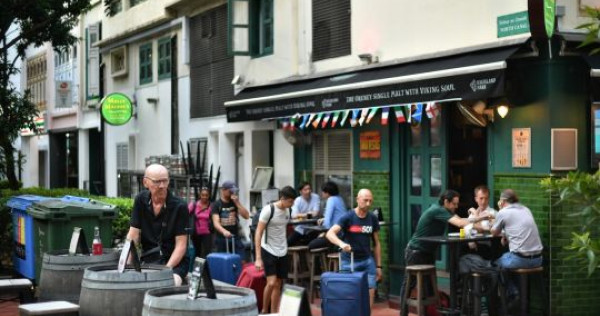
SINGAPORE – Bars, cinemas and all other entertainment outlets will be closed from Thursday (March 26) 11.59pm till April 30, as Singapore’s fight against Covid-19 enters a new phase amid a wave of imported cases to the country.
In announcing its strictest measures yet, the multi-ministry task force also said on Tuesday (March 24) that:
* All centre-based tuition and enrichment classes will be suspended to reduce the intermingling of students from different schools and enhance the safety of students.
* All religious services will be suspended.
* Malls, museums and restaurants must reduce crowd density to stay open.
* All Singapore residents returning from Britain and the United States from Wednesday (March 25), 11.59pm, will have to stay in hotels to serve their 14-day stay home notice (SHN).
* Those who breach the SHN will face enhanced fines of less than $10,000 or jail of less than six months or both.
* Any Singapore resident or long term pass holder who leaves Singapore from March 27 will be charged unsubsidised rates should they be hospitalised in public hospitals for Covid-19 treatment.
SINGAPORE: Mosques will be closed until further notice amid a “heightened risk” of COVID-19 transmission in the community, the Islamic Religious Council of Singapore (MUIS) announced on Tuesday (Mar 24).
“As the risk to the community remains high, the Fatwa committee has recommended the continued closure of mosques and the suspension of Friday prayers until further notice, until the situation improves,” MUIS said in a statement.
The committee, chaired by Mufti Nazirudin Mohd Nasir and comprising senior religious scholars and leaders, provides religious opinions on important Islamic matters in Singapore.
As for the congregational Friday prayers, which is obligatory for Muslim men, MUIS said the committee observed that Muslim law recognises illness and fear for one’s safety as valid reasons to not hold or attend the prayers.
“There is also no issue of missing three consecutive Friday prayers, as it is not obligatory under these circumstances,” it added.
Following the announcement, Minister-in-charge of Muslim Affairs Masagos Zulkifli said in a Facebook post that he supported the committee’s decision.
Mr Masagos also added that MUIS will resume essential services such as social and zakat assistance at selected mosques, and ramp up religious programming online and on radio.
He also thanked Muslims in Singapore for their support and cooperation.
The latest announcement by MUIS comes after the Ministry of Health said last Friday that all events and gatherings, including religious ones, must be limited to fewer than 250 participants to reduce the risk of local COVID-19 transmission.
Mosques were supposed to open on Friday after MUIS had announced a first round of closures on Mar 12 for at least five days for cleaning, after infected persons returning from a religious event in Malaysia – later found to be the source of a large COVID-19 cluster – had visited several mosques in Singapore.
Four days later, MUIS announced that it would extend the closure to break the cycle of transmission, after contact tracing revealed that five infected individuals had visited at least 10 mosques in Singapore.
Dr Nazirudin said on Tuesday that the number of COVID-19 cases in Singapore has more than doubled since the first announcement, showing that the situation “clearly has not improved, but as it stands, worsened”.
“The situation is much more dire in other parts of the world, where both the number of infections and deaths have risen in sharp spikes, including in the Sri Petaling mosque in Selangor,” he said, referring to the venue of the religious event in Malaysia.
“There is a need for mosques to remain closed and for congregational prayers to remain suspended until there are significant improvements as advised by the Ministry of Health.”
When asked for an indication as to when MUIS might re-open mosques, Dr Nazirudin said “we need to see that this trend (of a rising number of cases) is no longer the case”.
“We must be prepared for all scenarios, whether it’s a very prolonged or short closure. What is important for us is to prepare the community as well as to adapt to these changing circumstances,” he added.
“MUIS will consult various parties to make that assessment (on re-opening), and as to whether all the necessary precautions can be implemented so that we can ensure the safety of all our congregants.”
MOSQUE CLASSES CLOSED
Meanwhile, MUIS said the weekly part-time madrasah classes at mosques will continue to be suspended, adding that lessons will shift online for home-based learning.
Mosques will continue to provide “essential services” to the community while closed, MUIS said. For instance, it will make more mosque programmes and talks available on online platforms.
Safe distancing maintained between each individual during prayers at Al-Istighfar mosque on Mar 23. (Photo: Hanidah Amin)
Social development officers and mosque befrienders will also continue to reach out to low-income households and the elderly who are recipients of zakat financial assistance.
“Zakat financial assistance will remain available at the 31 social development mosques,” MUIS said, adding that new applicants can still call in to make an appointment.
“Necessary measures are put in place to protect the health and safety of both clients and mosque staff. For instance, all client interviews for the application of zakat financial assistance will be done through telephone.”
PRECAUTIONARY MEASURES UPON RE-OPENING
When mosques eventually re-open, MUIS had said on Mar 16 that some mosques will trial having two congregational Friday prayers, instead of one.
The duration of these prayers will be limited to 30 minutes, with shorter sermons delivered. Technology will be used to inform congregants of overcrowding at certain mosques.
Additional measures include contact tracing, requiring congregants to bring personal prayer items, and conducting physical health checks like temperature taking.
MUIS had also revealed on Sunday that it will open up small spaces for individual day-time prayers at 19 mosques across the island. This is to cater to working Muslims like taxi and private hire drivers as well as delivery drivers and riders who need to pray on the go.
The spaces have been open since Monday.
“These spaces also allow the mosques to build up their precautionary capabilities in preparation for eventual reopening, as well as encourage the community to practise the new normals of safe distancing, reduced duration, bringing your own prayer items and not shaking hands,” MUIS said on Tuesday.
SURVEY INDICATES ACCEPTANCE OF MEASURES
According to a community readiness survey of 32,000 respondents conducted by MUIS, majority said they were open to measures like having their contacts traced, stopping all physical contact and being turned away if unwell.
In particular, 47 per cent agreed that vulnerable groups should refrain from visiting mosques. Thirty-six per cent said they were neutral and 12 per cent disagreed.
Not more than 20 people at a time performing their two afternoon prayers are seen at Darul Ghufran mosque on Mar 23, to minimise the spread of COVID-19. (Photo: Hanidah Amin)
“MUIS will take this opportunity of mosque closure to embark on a public education campaign over TV and radio to socialise new normals in the community … to prevent further transmission of the virus,” it said.
MUIS chief executive Esa Masood said it was important to gain the community’s acceptance of these measures and over time achieve a shift in mindsets.
“Many may not be used to queuing up or waiting a few minutes to clear the various procedures,” he added, noting that mosques have always been open spaces where people can come and go. “There are also segments of the community like the elderly and less IT-savvy (that need more help).”
Dr Nazirudin said the Fatwa committee stands with the Muslim community “in feeling a deep sense of loss and longing for congregation, because being together in worship is a very important part of our religious lives”.
“Indeed in times of uncertainty and crisis, many draw closer to religion as a form of comfort, but we do not have a choice in this regard. We must adapt to the difficult circumstances that we are in,” he added.
“I hope the community does not see this decision as denying them the opportunity to pray in our mosques, but instead as part of their social responsibility to help keep everyone safe.”