 SINGAPORE – Welcome to the world, baby “Saw Jet Star”.
A mother who gave birth on a flight from Singapore to Yangon last Friday (April 22) has decided to name her son after the airline to show her appreciation for the care she received.
Jetstar Asia flight…
Source link
Mother names baby ‘Jet Star’ after giving birth on flight from Singapore
London overtakes Singapore as 2nd biggest offshore yuan clearing centre

HONG KONG – London has overtaken Singapore as the second-largest offshore yuan clearing centre in terms of payments processing volumes, just behind Hong Kong, the global transaction services organisation SWIFT said on Thursday (April 28).
Singapore…
Source link
Fewer workers laid off in Q1 2016: Manpower Ministry
Between January and March, 4,600 workers were made redundant, compared to the 5,370 that were laid off between October and December. However, the number was higher compared to the same period a year ago, according to figures from the Manpower Ministry.
Source link
Koreans born to US soldiers lead hard lives
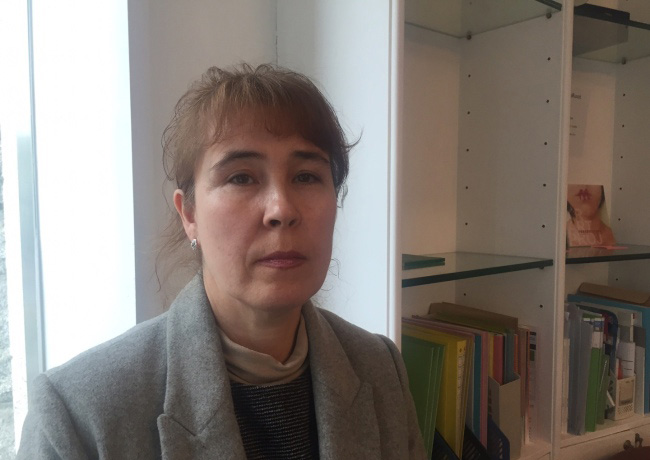
More than 50 years after her American solider father left South Korea, Jang Yeon-hee still longs to meet the parent who she has never known.
“Whenever I take the subway I see a lot of foreign tourists en route to Incheon International Airport,” Jang said in an interview with The Korea Herald.
“When I see such visitors I’d break down in tears. There are so many people coming in and out of this country, and yet the person who gave me my life left before I was even born and never bothered to visit again to see me.”
Now 51, Jang last week took a DNA test at KoRoot, a Seoul-based adoptee advocacy organisation, in hopes of finding her American father. The father left her Korean mother when she was pregnant with Jang in 1964.
Jang is one of some 40,000 mixed-race Koreans born in South Korea from 1955-1969, many of whom were born to American soldiers who were temporarily stationed here. Many of the Korean women who gave birth to such mixed-race children were those who were trafficked by Korean brokers to work as prostitutes for the US military.
Many fathers simply went back to the US and never returned. Mothers relinquished their children, as many of them had no financial means to raise them, while suffering from severe social stigmatization for being sex workers. Most of the children were adopted into American families. For those who remained in Korea, like Jang, life was filled with a sense of alienation, racist attacks and longing for her birth parent.
Jang’s DNA test kit was donated by Thomas Park Clement, a mixed-race adoptee, and brought to Korea by 325Kamra, a non-profit group comprised mainly of mixed-race Korean adoptees in the US Many of the group’s members were born in Korea to American soldier fathers and Korean mothers throughout the 1950s and 60s.
The free DNA testing was launched to help all Korean adoptees learn more about their Korean heritage. They also help those with positive DNA matches to potentially reunite. Katherine Kim Bradtke, one of the representatives of 325Kamra, said as a mixed-race adoptee she feels deeply for Jang, and hopes that her DNA will be able to give her answers.
“She has a heartbreaking story, but it is likely the story that many of us mixed-race adoptees had,” Bradtke said.
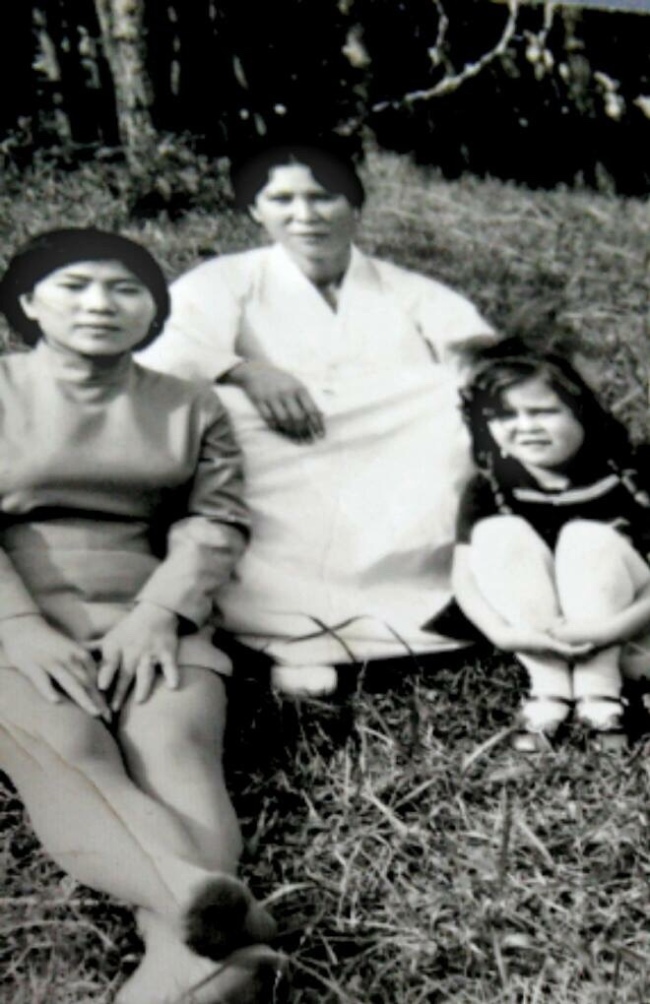
Young Jang Yeon-hee (far right) and her mother Jang Boon-soon (center) (Photo: Jang Yeon-hee/Korea Herald)
‘All I know is either his middle or last name is McDonald’
Jang was born in 1964 in Pyeongtaek, Gyeonggi Province, near Camp Humphreys, a US garrison in the region. Her mother, named Jang Boon-soon (born 1938), was from a poor family in Geojedo Island, South Gyeongsang Province. She was brought to the base by an elderly woman in her hometown, at age 18.
Before leaving Geojedo, Jang’s mother was told by the woman that she would be doing laundry. She was 26 when Jang was born. The father, an American soldier who was stationed in Korea at the time, returned to the US before she was born and never spoke to her mother again.
All Jang knows about her father is that either his last or middle name is McDonald or MacDonald.
Jang’s mother lived a lonely and impoverished life until her death 18 years ago. She drank heavily throughout her life, was never married and spent her last years in Seonghwan, a small town in South Chungcheong Province where she knew nobody. Jang never met her grandparents.
“My mother purposely moved to a town where nobody would recognise her,” Jang said. “She suffered too much in Pyeongtaek. Her life was just filled with sadness.”
Jang had to financially support her family by working at different factories right after graduating from elementary school. She also worked as a housemaid for several households. Jang was told by her mother’s friends that her father was aware of her mother’s pregnancy, but returned to the US nonetheless. Her mother rarely spoke of him, even when Jang asked her questions. “I think it was just too painful for her to talk about him,” she said.
Both Jang and her half-brother — he was born from their mother’s relationship with another American soldier — financially struggled throughout their lives. They were often discriminated for being mixed-race in South Korea. Jang was often bullied in school for her appearance. Her brother dropped out of middle school and worked as a factory laborer. “Even my own husband once told me during a fight, that I come from the lowliest roots,” she said. “I still hear racist slurs like twigi (a derogatory Korean term for mixed-race people).”
Jang became a Christian when she was 25. The reason was simple. “Finally, I had someone to call as my father,” she said.
‘One nation, one people’
While interracial marriage was legally banned in parts of the U.S until 1967, the very first children from Korea who were sent overseas for international adoption in 1954 were mixed-race children born to American soldiers and Korean women.
According to the National Human Rights Commission of Korea’s 2003 report on mixed-race Koreans, South Korea’s ministries of justice, welfare and foreign affairs collaborated with private adoption agencies to send mixed-race children to the US and other countries in the 1950s.
“It was one of then-President Syngman Rhee’s ‘one nation, one people (ilguk, ilmin)’ policies, which emphasised on ethnic homogeneity,” said pastor Kim Do-hyun, a director of KoRoot.
“The Korean government systematically sent out mixed-race children overseas. One cannot say which may have been better for them in the 1950s – living in poverty and discrimination in Korea or being raised by someone else in the US But one thing that is clear is that the Korean government got rid of the children instead of taking it as an opportunity to fight racism.”
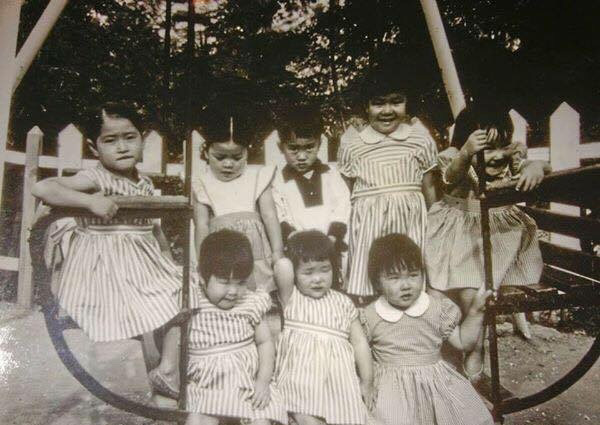
Katherine Kim Bradtke (far right), at age 2 or 3, at an orphanage in Korea before she was sent to the U.S. for adoption in 1961. (Photo: Katherine Kim Bradtke/Korea Herald)
Bradtke, who was born in 1957 in Bupyeong district of Incheon, stayed at an orphanage until she was sent to the US for adoption in 1961. She was recently reunited with relatives of her late birth father, an American GI, through DNA testing. “It wasn’t until I read Bertha Holt’s book, ‘Bring my Sons from Afar,’ in which my orphanage was referenced, that I learned that the place was built by World Vision with the intention of housing mixed-race kids who were to be sent to the West for adoption,” she said.
According to the NHRCK report, a large number of mixed-race Korean children and adults moved to the US as adoptees and immigrants in the early 1980s, after the US congress in 1982 approved its “Amerasian Immigration Act,” which prioritized US immigration to children born in 1950-1982 and fathered by US soldiers in Asian countries, including South Korea and Vietnam.
In order to “encourage” mixed-race Korean men to leave the country, the South Korean government in the 1970s started running job training programs specifically for them. The classes offered tips on how to get employed overseas. In 1972, the government even introduced a special law that exempted them from serving mandatory military service — which is required for all able-bodied male South Korean nationals – so that they would leave the country at an earlier age, according to experts. The law was in fact in effect until 2010.
In 1982, 95 per cent of surveyed mixed-race Koreans in Korea said they wished to move to the US, according to the report. Some children even volunteered to be adopted by US parents even if it meant being separated from their birth mothers. The main reason was social alienation and racism.
Life as a half-black Korean
Like Jang, Kang Hwa-sim has never known her father. Born in 1951 to a Korean mother and African-American father in Uijeongbu, Gyeonggi Province, she was constantly bullied and physically attacked for her appearance for the first 19 years of her life in Korea.
Her mother was attending a nursing school in Hamgyeong Province in today’s North Korea before she was brought to the region by South Korean soldiers a year before the Korean War.
She started living with Kang’s father, after suffering a scam marriage to a Korean who turned out to be a married man with children.
Not long after, however, Kang’s father drove a truck carrying explosives to the demilitarized zone and never came back. Her mother was pregnant with Kang at the time.
To this day, Kang doesn’t know if her father died that day or simply decided to leave her mother for good. After her father went missing, Kang’s mother had a number of live-in relationships with American soldiers, who supported her financially.
Her mother soon started working as a dancer for the US military, moving from one base to another. Kang lived in almost every Korean city that had active US military bases, including Dongducheon, Osan, Paju, Pyeongtaek and Uijeongbu. During these years, Kang witnessed many teenage girls being trafficked or forced to work as prostitutes by Korean pimps and brokers.
“Those brokers should still be tracked down now and jailed. … It’s not too late,” she said.
Her mother had two more children with two other American soldiers. She died in 1970 at the age of 37, after suffering from another marriage scam.
That year, Kang decided to leave Korea for good. She married an African-American GI and moved to the US with him. “I’d had enough. I was so done with that country,” said Kang, who now lives with her husband in Killeen, Texas.
Like Jang, Kang also left her middle school after suffering constant abuse. “There wasn’t a single day when I was not attacked either verbally or physically,” she said.
“Kids would spit on my face. They’d hit me for no reason and call me a nigger. Even my mother was told by her acquaintance that she should just throw me into the river when I was born, because I was half black. I heard there were many half-black babies that were just relinquished in the mountain or the river shortly after they were born.”
Katherine Kim Bradtke said both Jang and Kang’s stories echo other painful stories of mixed-race Korean adoptees. Among many cases, Bradtke knows adoptees whose Korean mothers gave up their children so they could marry Korean men. She said these mixed-race individuals involved in rampant cases of unruly relationships, failed marriages, abandonments and adoptions — they could all be someone’s half-sibling.
“This is entirely plausible. … If my mother or someone else’s mother remained in Korea and remained in the ‘industry,’ it is very likely that they may have had more children. So who is to say that Jang isn’t an adoptee’s half-sister?” she said.
Bradtke is also still searching for her Korean mother. All she knows is that her name is Kim Chang-soo, although it may not be her real name as many adoption documents have been fabricated by agencies here since the 1950s.
‘A life-long wish’
Jang is also looking for her younger half brother’s biological father, a US soldier who returned to the US while her sibling’s mother was pregnant in 1974. Her brother, whose blood type is RH B+, was born the following year.

A photograph of Jerry Thomas Collins, who is said to be the biological father of Jang Yeon-hee’s younger half-brother. Jang believes he left Korea in 1974, after living with her and her mother for about 2 years. His son was born about a year after he returned to the U.S. (Photo: Jang Yeon-hee/Korea Herald)
Jang has more information and memories about her brother’s American parent than about her own father. She said his name is Jerry Thomas Collins, and he served three years at Camp Humphreys in the early 1970s. During his stay here, he had a live-in relationship with Jang’s mother for about 2 years, she said.
“I remember he enjoyed painting,” Jang said, recalling her days living with Collins and her mother. “He had an oil painting easel at home. On his last day with us, my mother and I said ‘bye’ to him at Pyeongtaek Bus Terminal.”
Jang said her mother had sent him a photograph of her half-brother taken on his 100th day birthday. He also wired funds from the US for about a year, and eventually sent an invitation for Jang and her mother to live with him in the US For whatever reason, her mother decided not to go. They lost touch since then.
“It’s been our life-long wish to meet our fathers,” Jang said. “It’s a universal desire to know one’s roots. I hope my father understands that.”
Jang still has an address which is assumed to be Collin’s parents’ in the ’70s. It is: 1539 W 228th street. Torrance, CA. 90501.
Image:
Publication Date:
Thursday, April 28, 2016 – 09:38
Keywords:
Send to mobile app:
Source:
Story Type:
Others
China's tallest building now open to public

China’s tallest building, a 127-storey super skyscraper in downtown Shanghai costing 14.8 billion yuan (S$3.07 billion) to build, opened its first doors to the public on Wednesday.
The opening ceremony for the Shanghai Tower’s basement, which will house an exhibition on skyscrapers, and a five-story annex signify the upcoming completion of a building that has taken nearly eight years to complete.
At 632 meters, it is the world’s second-tallest building, after the 828-meter Burj Khalifa in Dubai. The Shanghai Tower will house offices, a hotel, museum and art gallery, and will be a venue for conferences and exhibitions.
“Tens of thousands of people are expected to work, visit and shop in the building when it is fully open,” said Jian Danian, deputy head of Shanghai’s Pudong New District.
Ge Qing, deputy general manager of Shanghai Tower Construction and Development Co, the building’s owner and developer, said an observation deck on the 119th floor will open in a few months, ahead of the building’s official opening later this year.
The world’s fastest elevators, which can travel at speeds of more than 18 meters per second, will carry tourists to the observation deck in less than 55 seconds. Ticket prices for the deck, which will provide a bird’s-eye view of the city, have yet to be set, Ge said.
The building’s five-story annex is designed for conferences.
The Shanghai Tower will also house China’s highest restaurant on the 120th floor, the highest hotel lobby on the 101st floor, and the highest swimming pool, with a view from the 84th floor. More than 20,000 pieces of glass covering 220,000 square meters were used on the building’s exterior.
It is the tallest green building in the country. The energy automation system has a real-time electricity consumption monitoring function that can save up to 10 per cent of total energy use.
The building is the latest among a cluster of super skyscrapers in the city’s Lujiazui Financial Area, which also houses the 468-meter Oriental Pearl Television Tower, the 421-meter Jin Mao Tower and 492-meter Shanghai World Financial Center.
Image:

Publication Date:
Thursday, April 28, 2016 – 09:54
Keywords:
Send to mobile app:
Source:
Story Type:
Others
Malaysian singer Yuna chosen to perform Olympics song

US-based Malaysian singer Yuna is one of the five singers for the 2016 Olympics promotional song, including Grammy award-winner Lenny Kravitz, reported Kosmo!
Titled The Fire, the song will also feature singers Diogo Nogueira from Brazil, Nneka from Nigeria and Corrine Bailey Rae from Britain.
Sharing the news on Facebook, Yuna said she was proud to be part of it.
“I am excited to work with everyone on this song,” the 28-year-old wrote.
Yuna, whose full name is Yunalis Mat Zara’ai, has recorded campaign songs for International Women’s Day, for designer Diane von Furstenberg and the theme for Visit Malaysia Year 2014.
Image:
Publication Date:
Thursday, April 28, 2016 – 09:40
Keywords:
Send to mobile app:
Source:
Story Type:
Others
Rise of cybercrime 'still a big challenge'
The rise of cybercrime remains an “enormously big challenge” for law enforcement agencies in Singapore and around the world due to the borderless nature of the Internet, said President Tony Tan Keng Yam yesterday.
Perpetrators can work from locations outside the country to target Singaporeans, resulting in greater difficulty in bringing the culprits to justice, added Dr Tan, who was speaking on the sidelines of his inaugural visit to the Criminal Investigation Department (CID).
His comments echoed points raised by Senior Minister of State for Home Affairs Desmond Lee at the Committee of Supply debate earlier this month, when he pointed to a “clear uptrend” in cybercrime, with the total number of online cheating cases doubling from 2014 to last year.
Said Dr Tan: “Singapore has done well. We compare favourably with other cities in the world in containing crime, but it does not mean we do not have challenges.”
The threat of terrorism remains an ongoing concern for the Singapore Police Force too, he added.
Dr Tan first toured the Forensics Division Training Lab, where he learnt how ultraviolet light can be used to search for evidence in a crime scene. Later, he proceeded to the Technology Crime Forensics Lab. He was accompanied by Parliamentary Secretary for Home Affairs Amrin Amin and Commissioner of Police Hoong Wee Teck.
At the end of his visit, Dr Tan stressed the importance of the community in ensuring domestic security. He said: “We have to be vigilant. Everyone has a part to play to keep Singapore safe, such as by being observant.”
He also thanked officers from various branches of the CID for their contributions.
nghuiwen@sph.com.sg

This article was first published on April 28, 2016.
Get a copy of The Straits Times or go to straitstimes.com for more stories.
Image:

Publication Date:
Thursday, April 28, 2016 – 09:42
Keywords:
Send to mobile app:
Source:
Story Type:
Others
Nicholas Tse denies marriage to Faye

China Press reported that Hong Kong artiste Nicholas Tse has denied getting married to Canto-pop queen Faye Wong.
Tse told reporters: “No, this one must be answered,” when asked about rumours of the marriage.
He was speaking to reporters after a ceremony to mark the start of production on Emperor Motion Pictures’ 250 million yuan (S$52 million) Cook Up a Storm, “the first 4D cuisine film”, in Foshan.
Asked if he had thought of marrying Wong, Tse declined to answer.
He also did not respond when asked if it was true that his five-year-old son Quintus was refusing to see him.
Faye Wong and Nicholas Tse in love again after 11 years
Click on thumbnail to view photos. Source:
Lollipop















































Image:

Publication Date:
Thursday, April 28, 2016 – 09:14
Keywords:
Send to mobile app:
Source:
Story Type:
Others
Call to make the most of limited labour supply
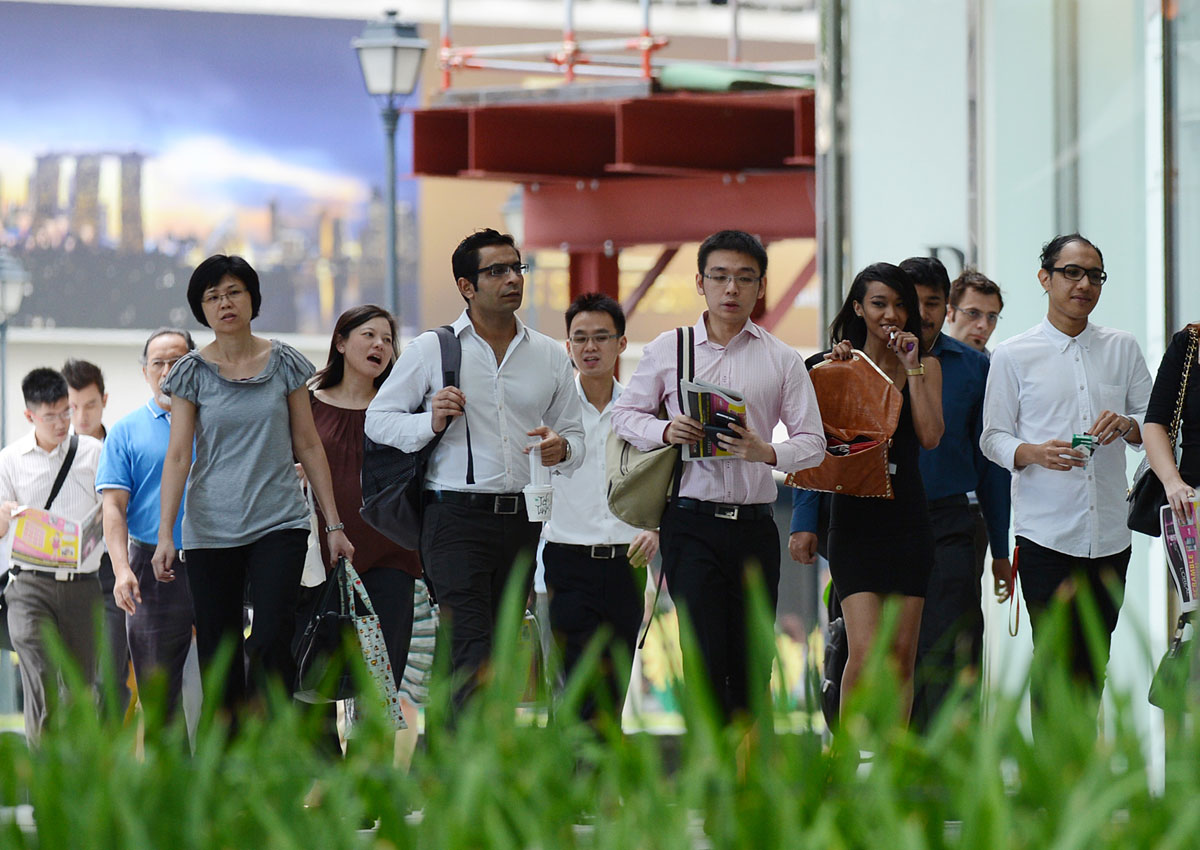
The Manpower Ministry (MOM) and the Singapore National Employers Federation (SNEF) have both stressed the need to make the most of limited labour supply, in their May Day messages ahead of Sunday.
In their messages yesterday, both stressed the need for productivity growth, which averaged only 0.4 per cent per year between 2010 and 2015.
“Manpower could become the bottleneck of our future growth unless we speed up efforts to become a more manpower-lean economy and a more productive workforce,” said Manpower Minister Lim Swee Say, in his first May Day message since taking on the portfolio. He was previously labour chief for eight years.
“This is the only way to ensure that businesses can continue to grow (and) unemployment can stay low while wages… keep moving up,” he said.
“We can succeed if every employer learns to value every worker more, and every worker likewise learns to value every job better.”
Good people will always be in short supply, so tripartite partners – employers, unions and the Government – should work together to harness that resource, said Mr Lim.
Companies and unions should do their part to help workers develop their skills to their fullest potential. The Government will also strengthen policies for companies and workers, as well as beef up resources to support them.
Addressing the economic uncertainty, he said: “Working in unity, our tripartite partners have led the economy and labour force through downturns and emerged stronger and more vibrant each time, every time. I believe we can do it again.”
Singapore’s slower economic, employment and productivity growth were also highlighted by SNEF president Robert Yap in his May Day message.
Calling the need to raise productivity “urgent”, he said employers and unions must tackle three workforce demographic challenges in order to do so.
First, businesses must change their processes, use more automation and upgrade workers’ skills to counter the slowing of workforce growth to 1 per cent per year and plateauing from 2020 onwards.
Second, human resource practices should change to account for an ageing workforce – the proportion of the resident workforce aged 55 years and above rose from 13.4 per cent in 2006 to 22.3 per cent last year. Older workers should also be prepared to pick up new skills and roles.
Third, rising education levels in Singapore underline the need for better quality jobs for Singaporean professionals, managers and executives, who must also take ownership of their skills development, he said.
Dr Yap said bosses and workers will also have to contend with rapid technological advancements and new business models.
“Companies must be alert and nimble so that they can adapt to these changes and new competitive pressures.
“They must also invest in their workforce so that their workers have the capabilities to respond quickly to changing business requirements,” he said.
Calling the need to raise productivity “urgent”, Singapore National Employers Federation(SNEF) president Robert Yap in his May Day message said employers and unions must tackle three workforce demographic challenges in order to do so.
- Businesses must change their processes, use more automation and upgrade workers’ skills to counter the slowing of workforce growth to 1 per cent per year and plateauing from 2020 onwards.
- Human resource practices should change to account for an ageing workforce – the proportion of the resident workforce aged 55 years and above rose from 13.4 per cent in 2006 to 22.3 per cent last year. Older workers should also be prepared to pick up new skills and roles.
- Rising education levels in Singapore underline the need for better quality jobs for Singaporean professionals, managers and executives, who must also take ownership of their skills development.
joseow@sph.com.sg
This article was first published on April 28, 2016.
Get a copy of The Straits Times or go to straitstimes.com for more stories.
Image:
Blurb:
Lim Swee Say, SNEF stress need to raise productivity in May Day messages; latter highlights three challenges. -The Straits Times
Publication Date:
Thursday, April 28, 2016 – 09:40
Keywords:
Send to mobile app:
Source:
Story Type:
Others
Recession unlikely but gloom may deepen: MAS
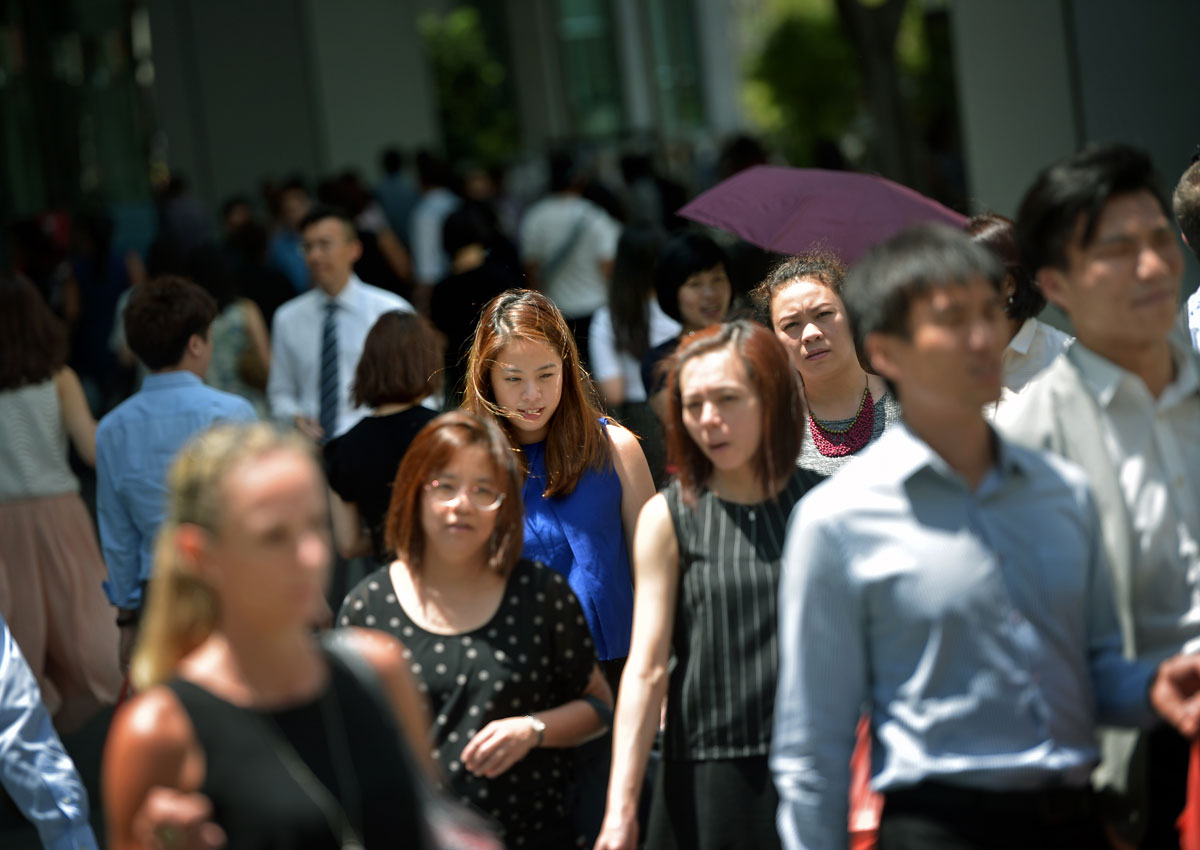
The gloom blanketing Singapore’s economy is likely to deepen but an outright recession remains unlikely, the central bank said yesterday.
The Monetary Authority of Singapore (MAS) said negative business sentiment has become more pervasive and unemployment is expected to rise even as wages moderate.
However, signs of weakening business activity remain confined to certain industries and the slowdown is not as dire as it was during the global financial crisis, it said in its latest macroeconomic review.
The twice-yearly review gives MAS’ analysis and assessment of macroeconomic developments affecting the Singapore economy.
The outlook for the country’s key trading partners such as the United States and Japan has weakened discernibly this year, meaning the Singapore economy will likely see “a protracted period of modest growth” in the quarters ahead, said the central bank.
MAS noted business sentiment has worsened this year, though layoffs in the past few quarters were largely contained within trade-related industries such as electronics and precision engineering.
With lower labour demand and supply, total job creation this year is expected to stay modest. As such, overall and resident unemployment rates are likely to rise slightly, MAS said. Redundancies could also continue to rise in sectors facing weak external demand and undergoing restructuring.
Economists warned of more weakness ahead. DBS economist Irvin Seah said first-quarter numbers were bolstered by a lift in pharmaceutical output, but this is unlikely to spill over to other sectors.
UOB economist Francis Tan said: “People are expecting a long winter. So they’re holding back on investments and spending, and as a result the weak outlook can become self-fulfilling. It’s a vicious circle.”
chiaym@sph.com.sg
This article was first published on April 28, 2016.
Get a copy of The Straits Times or go to straitstimes.com for more stories.
Image:
Publication Date:
Thursday, April 28, 2016 – 09:35
Keywords:
Send to mobile app:
Source:
Story Type:
Others


