Home Blog Page 4054

SDP to hold third rally on Tuesday

The next rally by the Singapore Democratic Party (SDP) will be on Tuesday, May 3.

It will be held at the field along Bukit Batok Industrial Park A from 7pm.

The police said in a statement today that the Police Elections Permits Office (PEPO) has issued a permit for the rally.

This will be the third rally that SDP has held in the running for the by-election for Bukit Batok SMC.

The People’s Action Party (PAP) have, so far, held only one rally, that was on April 29.

SDP had their second last night (May 1), and their first was also on April 29.

SDP party chief Dr Chee Soon Juan is contesting for the single-seat against PAP’s candidate Mr Murali Pillai.

spanaech@sph.com.sg

Image: 
Category: 
Publication Date: 
Monday, May 2, 2016 – 16:23
Send to mobile app: 
Source: 


Story Type: 
Rewritten Story

Source link

I'll burn Singapore flag, says Philippine presidential hopeful Duterte

A Philippine presidential candidate known for making profanity-laced campaign speeches has said he will burn Singapore’s flag after the island state’s diplomatic mission in Manila said it will seek legal advice over a “misleading” Facebook post.

On The Maharlikan blog site and in a post on the Facebook page of GMA News, Mr Rodrigo Duterte has been quoted as saying: “Look for a flag of Singapore. I’ll burn it.”

He was speaking during a rally in Daet town, Camarines Norte province, 330km south of the capital Manila.

The Maharlikan said Mr Duterte, the front runner in the five-way race for the presidency, used an expletive and raised his middle finger.

Mr Duterte purportedly made the remarks after he was told the Singapore embassy in the Philippine capital was seeking legal advice over a “misleading” Facebook post that claimed Prime Minister Lee Hsien Loong was endorsing Davao mayor Duterte for president.

The post, which surfaced last week and has been circulating via social media, had a photo of Mr Lee with the caption: “Mayor Rodrigo Duterte is the only presidential candidate that could make (the) Philippines like Singapore.”

The Singapore embassy, in a post on its website on April 22, said: “This is untrue. Singapore does not endorse any candidate. The choice is for Filipinos alone to make. We wish the Philippines well in the conduct of its elections.”

A second embassy post said it is “seeking legal advice”, and added: “We also request the immediate removal of the post, which is a clear misrepresentation.”

After GMA News reportedly sought further comments, the embassy said in a text message: “We decided to put up a second clarification… because we view this incident seriously, and we want it to be taken down. It is still being shared around, so we will not let go of the matter.”

Related: S’pore denies claims Davao mayor has PM Lee ‘s vote

‘Cursed’ Pope Francis

The 71-year-old Mr Duterte is no stranger to controversial statements.

Last November, he “cursed” Pope Francis for causing traffic jams in Manila during his visit to the Philippines in January that year.

Offended US and Australia

Last month, a YouTube video showed Mr Duterte joking that he should have had the first turn at an Australian missionary who was brutally raped and killed during a prison riot 27 years ago.

After the ambassadors from Australia and the United States criticised him for the rape joke, the front runner in the presidential race said he was prepared to sever ties with the two countries if he won the May 9 election .

Capitalising on an image he has been building since he was a street-smart teenage thug, Mr Duterte has been leading in surveys on who Filipinos want to be their next president.

rdancel@sph.com.sg

Read also:

How did Duterte get 41 properties?

I have 2 wives, 2 girlfriends: Duterte

Foul-mouthed Davao mayor wants to be president

Image: 
Publication Date: 
Monday, May 2, 2016 – 15:29
Keywords: 
Send to mobile app: 
Source: 


Rotator Headline: 
I'll burn S'pore flag says Philippine presidential hopeful as he raises middle finger
Story Type: 
Others

Source link

22-year-old man arrested while attempting to swim into Singapore

SINGAPORE – A 22-year-old man has been arrested for unlawful entry into Singapore after he was caught swimming from Malaysia to Singapore in the early hours of Monday morning (May 2).
The Police Coast Guard first detected the man at about 12.46am in the…

Source link

Exotic animals in Bangkok cafe – cute or cruel?


A Facebook video introducing an exotic animal cafe in Bangkok has recently garnered mixed reactions from netizens.

Fennec foxes, raccoons, owls and meerkats are some of the critters that can be found in the glass rooms in the Little Zoo Cafe, which opened in Muangthong Thani last September.

While some netizens expressed a desire to visit the cafe to play with the adorable animals, others said that confining wild creatures in a cafe setting is cruel and prone to stress them out.

The cafe is furnished in the style of a barn with a pine wood interior, white-washed walls and a high ceiling.

Bangkok Post reported that the cafe does not collect entrance fees, and guests may interact with the fluffy creatures by ordering something from the menu.

While the animals are its biggest draw, the cafe serves a wide range of brunch offerings, desserts, and beverages that start from 85baht (S$3.30).

According to Shout.sg, guests are required to sanitize their hands and remove their shoes before entering the glass rooms where the animals are kept.

Only six people are admitted at a time and they cannot disturb the animals when they are taking naps. Staff reportedly supervise customer interaction with the animals.

Photos shared on the cafe’s Facebook page show patrons cuddling animals, feeding them treats and posing for photos with them.

However, concerned netizens commented that they have watched other video clips that show cafe guests disturbing tired animals. Some of them have also been spotted hiding in corners.

Animal lovers also highlighted the proliferation of illegal wildlife trade in Thailand. The cafe is an extension of the exotic pet shop Mini Zoo Cafe which claims that its animals are imported and come with identification papers, reported Coconuts Bangkok.

Do wild animals belong in a cafe? Let us know by taking our poll.

minlee@sph.com.sg

Image:
Category:
Publication Date:
Monday, May 2, 2016 – 15:31
Send to mobile app:
Source:

Rotator Image:
Story Type:
Rewritten Story

Source link

Bukit Batok by-election: SDP to hold rally on Tuesday

The Singapore Democratic Party will hold a third rally at the field along Bukit Batok Industrial Park A on May 3. 

Source link

US hit satire show's Ronny Chieng used to live in Jurong

Half a year into his job as a correspondent on top-rated American news satire programme, The Daily Show With Trevor Noah, Malaysian comic Ronny Chieng is still feeling the high.

And it is not just because the 30-year-old will have this coveted position on his resume but also that it is election year in the United States, which means the work pace has been non-stop.

“It’s crazy. America’s presidential elections are so intense and they last for so long, especially with all the cable news channels covering it 24/7. It’s the reality show that never stops,” he says in a telephone interview from New York.

“And The Daily Show pokes fun at politics in a very important way, so everything we do has to be of that standard. Doing the show is challenging, but it’s a privilege to do it. It’s the best job in comedy.”

On the show, Chieng is one of several correspondents who do parody news segments in the field, before reporting to South African host Trevor Noah in the studio.

His comedy persona is intelligent, but also sarcastic and angsty.

The gig, which he got after he submitted an audition tape, is certainly the biggest one yet for the Johor Baru native, who had previously been known for working the stand-up comedy circuit in Australia.

After all, The Daily Show is one of the most well-reviewed and popular comedy TV programmes globally, not least because it used to be helmed by the very sharp comic Jon Stewart from 1999 to last year.

Does Chieng think that the new host measures up?

“I think Trevor is doing an amazing job and I’ll share with you a story which puts it best. Jon had asked Trevor to put on his size 8 shoes, but Trevor’s feet are like size 12, so he couldn’t. And Jon said to him, ‘That’s right, you can’t put on my shoes’.

“The point is that they are two completely different hosts. They’re separate comics doing comedy from different perspectives. So do you see a Jon Stewart clone in Trevor? No. But does he carry the torch? That’s a definite yes.”

As for Chieng’s own brand of comedy, a big part of what makes his jokes work is the very international – and some would say, confused – perspective he brings to the table.

Although the bachelor was born in Malaysia, he had spent his childhood in New Hampshire in the US, before moving to Singapore for secondary school and junior college and then Melbourne, Australia, for university.

He had moved to the US when his parents went there to pursue master’s degrees and followed them to Singapore when they found jobs here.

His retiree father used to be a corporate executive, while his mother is working as a financial controller. They still live in Singapore. Chieng’s 33-year-old sister is a doctor in Sydney.

He says: “This comes up as a bit in my stand-up comedy, but I always feel like I belong everywhere, but also nowhere.

“When I was in Singapore, I lived in Jurong East for 10 years and I feel like I know everything there. But I also lived in Australia for 10 years after that and I feel like I know everyone there too. It’s the third-culture kid feeling.”

He had studied law at the University of Melbourne, but he knew that comedy was his true calling after winning a college comedy competition in 2009.

Since then, he has been racking up numerous comedy awards across Australia, including the Directors’ Choice Award at the Melbourne International Comedy Festival and Best Show at the Sydney Comedy Festival, both in 2014.

“I’ve been very lucky in comedy. I can sell out theatres and I got to open for some of my comedy heroes such as Bill Burr and Dave Chappelle, and I’m on The Daily Show.

“If I were to die tomorrow, I’ll definitely feel like I’ve accomplished some things.”

Are his comedian friends jealous of his success?

He laughs and says: “Well, I can’t speak for American comics, but I know quite a lot of the comics in Australia and they’ve all been very good to me. I think there’s envy, but not jealousy. No one has messaged me to ask for a job on The Daily Show – not yet, anyway.”

yipwy@sph.com.sg


This article was first published on May 2, 2016.
Get a copy of The Straits Times or go to straitstimes.com for more stories.

Image: 
Category: 
Publication Date: 
Monday, May 2, 2016 – 17:00
Send to mobile app: 
Source: 


Story Type: 
Others

Source link

Candidates outline job plans in response to residents' concerns

With jobs a key concern for Bukit Batok residents, the candidates vying in the May 7 by-election responded by outlining programmes after walkabouts yesterday.

Singapore Democratic Party (SDP) chief Chee Soon Juan reiterated his call for retrenchment insurance and gave details of how such a scheme would work.

Separately, the People’s Action Party’s (PAP) Mr Murali Pillai described how his job placement programme would tap contacts and a network of people in the community to help retrenched workers and others who are not employed.

Dr Chee’s plan would see workers pay a fee to be included in the system. If retrenched, they get 75 per cent of their last drawn salary for the first six months that they are without a job. They then get 50 per cent for the next six months, and 25 per cent the six months after.

He did not say what the buy-in fee would be, but said the plan would give those out of work peace of mind while they look for a new job, as well as help pay the bills.

Dr Chee, 53, spoke after his walkabout and called on employers to let go of foreigners first and axe Singaporeans only as a last resort, if retrenchment was needed.

Both he and Mr Murali said their respective plans were necessary, given that residents have been concerned about the economy.

Mr Murali, who visited bus captains at Bukit Batok bus interchange, has already piloted his programme on an informal basis to help several residents. The programme is a key plank of his manifesto. It entails “leveraging on community contacts within the pool of community volunteers and Bukit Batok residents, and also my own business contacts”, said the 48-year-old lawyer.

The campaign is “a tough fight”, he said. “The ‘by-election effect’ is real. Every day, I need to do what I need to do – to persuade Bukit Batok residents of the plans I have for them and seek their support.”


This article was first published on May 2, 2016.
Get a copy of The Straits Times or go to straitstimes.com for more stories.

Image: 
Category: 
Publication Date: 
Monday, May 2, 2016 – 15:04
Keywords: 
Send to mobile app: 
Source: 


Story Type: 
Others

Source link

Pricier childcare services not always better

When it comes to childcare services, are pricier ones better?

This question has become more pertinent, with the variation in childcare fees higher than before.

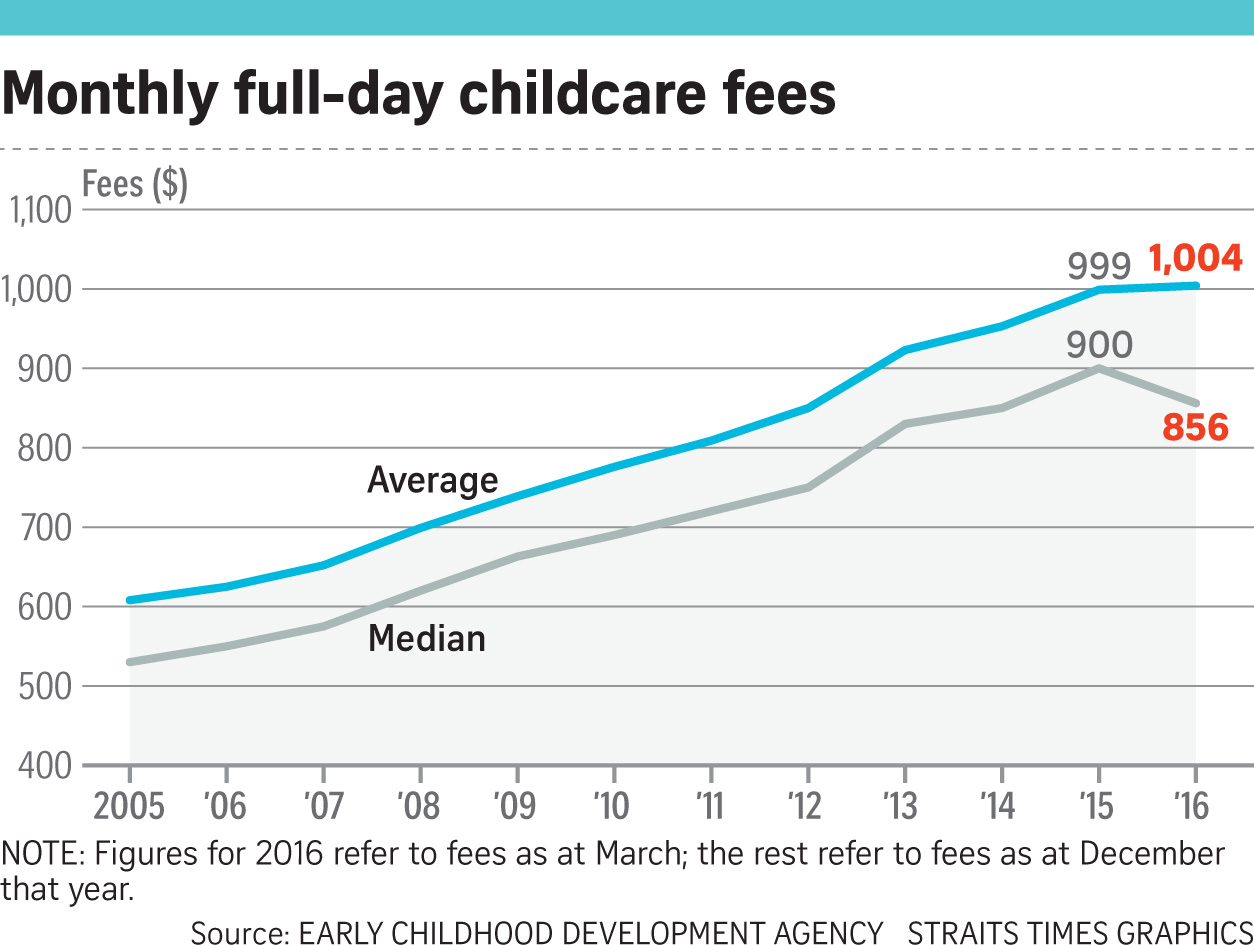
As of March, the difference between the average and median monthly fee for full-day childcare was $148 – the widest gap in at least a decade. The median fee was $856, and the average was $1,004.

The median fee separates the cheaper half of the 1,300 or so centres from the rest. The average fee is higher as the high costs charged by some centres – which can be over $2,000 – skew the data.

Experts said higher fees generally imply pre-school operators have more funds to offer better facilities and higher pay to attract more qualified teachers, but they added that parents should also consider other factors when looking for a quality centre. These include school leadership, interactions between teachers and children, and the centres’ engagement with parents.

Dr Christine Chen, president of the Association for Early Childhood Educators (Singapore), said: “Leadership is crucial as it determines the structure under which the teachers are working, and the centre’s culture of working as a team for the children’s development.”

Research shows effective principals lead to lower staff turnover rates – and this is also an indicator of quality, said SIM University senior lecturer Dora Chen, who specialises in pre-school education.

The quality of interactions between teachers and children is important too, she added. “What is the adult language like in the classroom? Is it mainly involving the use of close-ended questions, calling for expected answers? Or is it focused on higher-level thinking, encouraging kids to come up with ideas and solutions?”

Pre-schools’ engagement with parents is also vital, said experts.

Dr Christine Chen said: “Both the centre and parents must be open and be willing to discuss dissatisfaction openly, instead of just writing to the authorities.”

Meanwhile, Preschool for Multiple Intelligences founder Khoo Kim Choo, who has been in the sector for more than 25 years, acknowledged that centres which charge low fees may still have good quality.

This is because under the anchor and partner operator schemes, they get government grants but must keep fees low and have stricter quality requirements, she said.

The Government has been introducing such schemes since 2009 so that the mass market can benefit from quality childcare.

There had been concerns that the childcare sector could have a “luxury good problem” in which parents perceive more expensive programmes to be better.

In 2012, Mr Chan Chun Sing, then Acting Minister for Community Development, Youth and Sports, said: “We should be most concerned if the value-add of a programme is commensurate with the price. We will need to help parents distinguish things that are important and core for a child’s development and other things that are good to have.”

One way for parents to do a background check is to visit the Child Care Link website (www.childcare link.gov.sg) and check a centre’s licence tenure. All centres have to be licensed, and the tenure can last six, 12 or 24 months. Centres with a 24-month tenure are considered to have “exceeded” requirements.

Besides considering various quality indicators, some experts suggest parents take their children along when visiting centres.

Dr T. Chandroo, chairman of the Association of Early Childhood and Training Services, said: “See how the child responds to the teachers. Does he seem interested in getting to know them? Does he enjoy the activities?

“By watching how he reacts, you’ll have a better idea of whether the pre-school is a good fit.”

goyshiyi@sph.com.sg


This article was first published on May 2, 2016.
Get a copy of The Straits Times or go to straitstimes.com for more stories.

Image: 
Publication Date: 
Monday, May 2, 2016 – 17:00
Keywords: 
Send to mobile app: 
Source: 


Story Type: 
Others

Source link

Chee: No racist comments by SDP

Singapore Democratic Party (SDP) chief Chee Soon Juan yesterday rejected suggestions that his party was a racist one.

SDP members have not made racist comments – unlike members of the People’s Action Party (PAP), he said at a rally.

He was responding to comments that race has surfaced as an issue in the Bukit Batok by-election.

During a PAP rally last Friday, Minister for Culture, Community and Youth Grace Fu said “some people” have been “asking Chinese residents to vote for Chinese only” – not PAP candidate Murali Pillai.

“I hope this is not the position taken by SDP and hope they will clarify this position,” she added.

Last night, Dr Chee challenged residents to find something SDP has said that is remotely racist.

“Do a search on the Internet and tell us if we’ve said anything racist,” he said, charging that Ms Fu had “tried to paint (the SDP) as racist” while ignoring “her own party’s racist statements”.

Dr Chee brought up former PAP MP Choo Wee Khiang, who quipped in Parliament in 1992 that Little India was “in complete darkness”. He also cited the case of PAP member Jason Neo, who in 2011 on Facebook labelled a bus of Malay kindergarten pupils “young terrorist trainees”.

He also noted that PAP MP Denise Phua had to apologise after her comment last month that crowds of migrant workers were “walking time bombs”. He said: “Even the late Lee Kuan Yew made disparaging remarks about the Malays, for which he had to apologise. And yet Grace Fu can stand there with a straight face and insinuate that SDP is racist.”


This article was first published on May 2, 2016.
Get a copy of The Straits Times or go to straitstimes.com for more stories.

Image: 
Category: 
Publication Date: 
Monday, May 2, 2016 – 14:52
Keywords: 
Send to mobile app: 
Source: 


Story Type: 
Others

Source link

What childcare centres offer for $600 to over $2,000 a month

Imparting values through incidental learning

Under $600/month

The pre-school is in an HDB void deck, but has open-concept classrooms on the second floor of the block too.

The walls inside are filled with things such as the children’s artworks or posters, vastly different from the mostly bare ones at the Brighton Montessori centre that ST also visited.

For instance, there are 20 to 30 clear folders stuck on the walls in an area where the Nursery 2 (N2) class is held. Each holds a worksheet – or “activity sheet” as the teachers call it – of every child in the class.

Examples of activity sheets include one in which children pasted drinking straws of different lengths on paper, to learn what is considered long or short; another in which children pasted the tags found on packs of bread, and they had to count the number of tags and write the corresponding number.

Said principal Nyo Cheng Cheng: “The activity sheets are meant to document their learning journey.

Kids also take pride in their work and take ownership of their class environment when their work is displayed.”

Also on display are children’s artworks and an ST article, put up under a “current affairs” section.

The article is about how more parks are being set up to save an endangered monkey species from extinction; and next to the article are pointers such as “Do not scare the monkeys”.

Everyday items in the class – such as the air-conditioner, the fan and the clock – are labelled too, in English and Chinese. Class rules – such as a poster with a picture and words to tell children to sit cross-legged – are also pasted on the wall.

Children in the N2 class seemed to have learnt the class rules well. Many raised their hands before answering the teacher’s question of what English words start with “G”.

A Malay teacher did the English lesson with 15 children, with a Chinese teacher sitting nearby.

Later on, when some children rushed forward to get their chance to take part in an activity, a teacher praised a pupil at the back who raised her hand while waiting quietly for her turn.

Ms Nyo said: “We emphasise core values, like respect and integrity, through incidental learning, and the current affairs lessons held every two weeks, for instance.

“The topics discussed are usually those in which we can impart values and good habits such as recycling.”

PCF SPARKLETOTS

WHERE: Block 115, Bedok North Road

FEES: $578.50/month for full-day childcare, after GST, from July

RUN BY: PAP Community Foundation, an anchor operator which gets government grants

STAFF: 16 teachers, including 14 with a diploma in pre-school education and two with a degree or higher in the same field

CAPACITY: 126 childcare places

Priority admission for kids from needy families

$600/month

In this pre-school in the void deck of a Housing Board block, only a few resource rooms have air-conditioning, and the other areas have only fans. But the children do not seem to mind.

Like most centres sited in void decks, it has about 100 places, including 20 for infantcare.

It is one of two childcare centres run by the United Indian Muslim Association, a charity which gives annual education bursaries and runs community programmes such as cross-cultural dialogues.

Most of its teachers are Indians or Malays, and they speak English during lessons, though they sometimes say “sayang” (Malay for “dear”) when calling the children.

The centre has children of all races and religions, and offers mother tongue lessons in Chinese, Malay and Tamil.

Children mainly live nearby, and those from low-income families get priority admission.

Principal Noor Basriah Abdul Khader said: “We want to give the child a place first, so if the mother is not working, it is more convenient for her to look for a job.”

When The Straits Times sat in on a Nursery 2 (N2) class recently, it was noisy, with children talking or singing. At times, a few N2 children were distracted and looked at another class nearby that was singing. There were two teachers with 16 children in the N2 class.

While there are rooms within the centre, it adopts an open concept, with classes separated by shelves.

It has four themes for the curriculum each year.

When The Straits Times visited, the theme was on food. The N2 children learnt to identify different types of food as part of language and literacy, and craft lessons were related to food too.

The curriculum also covers motor skills, music and movement, and numeracy.

At one point, the class was divided into smaller groups for different activities.

Five children had a craft lesson on how to make a “burger mobile”, or a paper burger with different layers. A circular piece of paper coloured green was used to represent lettuce, for instance.

There are toys on the shelves, such as a game that required players to match words with pictures.

Ms Basriah said: “Good-quality programmes are not about high- end toys, but about how teachers engage children with the toys.”

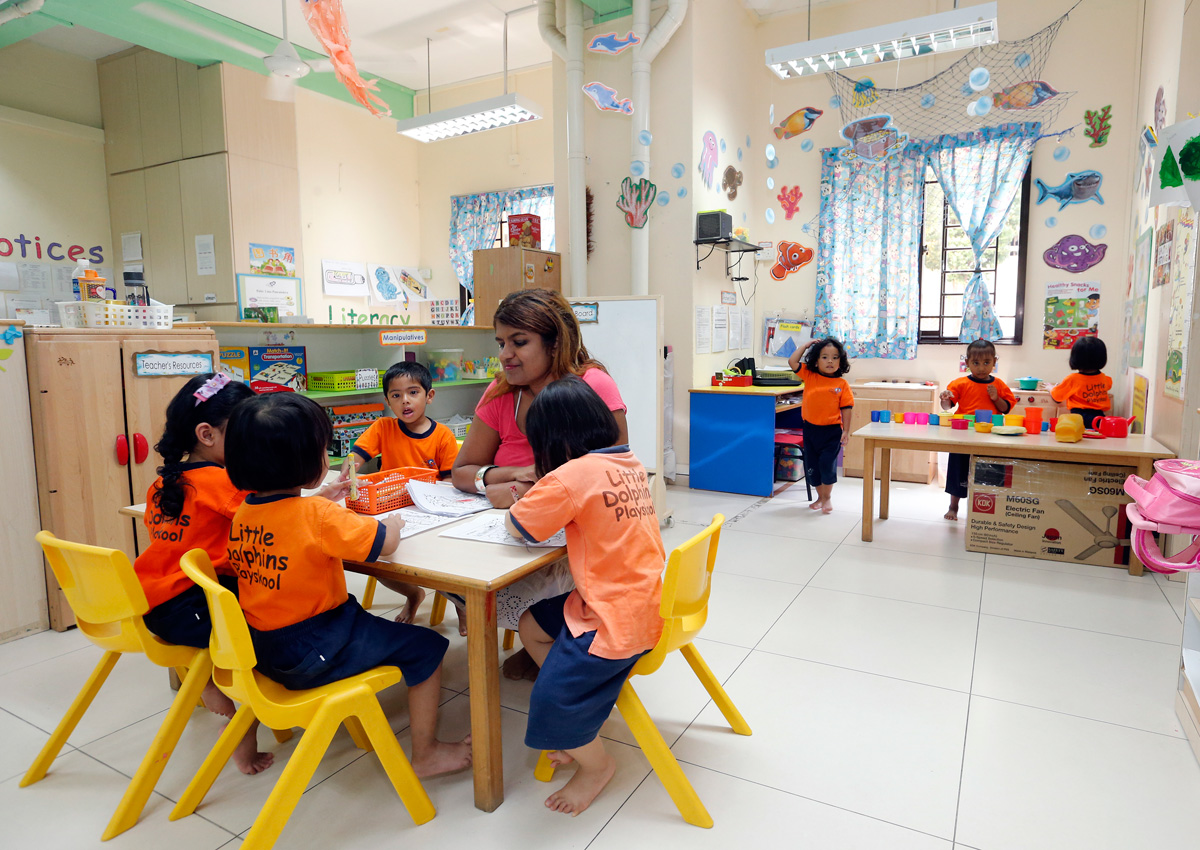
LITTLE DOLPHINS PLAYSKOOL

WHERE: Block 714, Clementi West Street 2

FEES: $600/month for full-day childcare, no GST charged

RUN BY: A charity

STAFF: 15 teachers, including seven with a diploma in pre-school education

CAPACITY: 80 childcare places

Teaching how to focus and tune out distractions
Over $1,500/month

The walls have large posters of children in Brighton Montessori uniforms, but are otherwise quite bare.

Resource materials, such as coloured beads and number boards, are neatly kept on shelves and look new. Some are kept in labelled plastic containers; others are in light brown, wooden boxes.

The materials are Montessori’s, and the bare walls are part of the Montessori approach too, said principal Hairumbiyah Ghabi, better known as Ms Biyah.

The Montessori education method for children was founded in 1907 by Italian early childhood pioneer Maria Montessori. It uses a tailored approach to develop a person’s unique abilities.

Part of the Montessori approach involves dividing classes into small groups for activities. There is more individualised learning when teachers guide children in using the Montessori materials.

On the somewhat sterile look of the centre, Ms Biyah said: “We want the children to be focused. If the environment is too cluttered, they get distracted.”

Generally, the younger children are in rooms within the centre, with N2 and K2 pupils in open areas.

The rest of the centre has a more open concept, with classes being separated by shelf partitions.

The N2 class that The Straits Times visited was supposed to have 26 children, though about 10 of them were not around – some had gone overseas for a holiday and others were foreigners who had gone back to their countries for a visit.

There were three teachers who taught in English and one in Mandarin, with the N2 class divided into three groups.

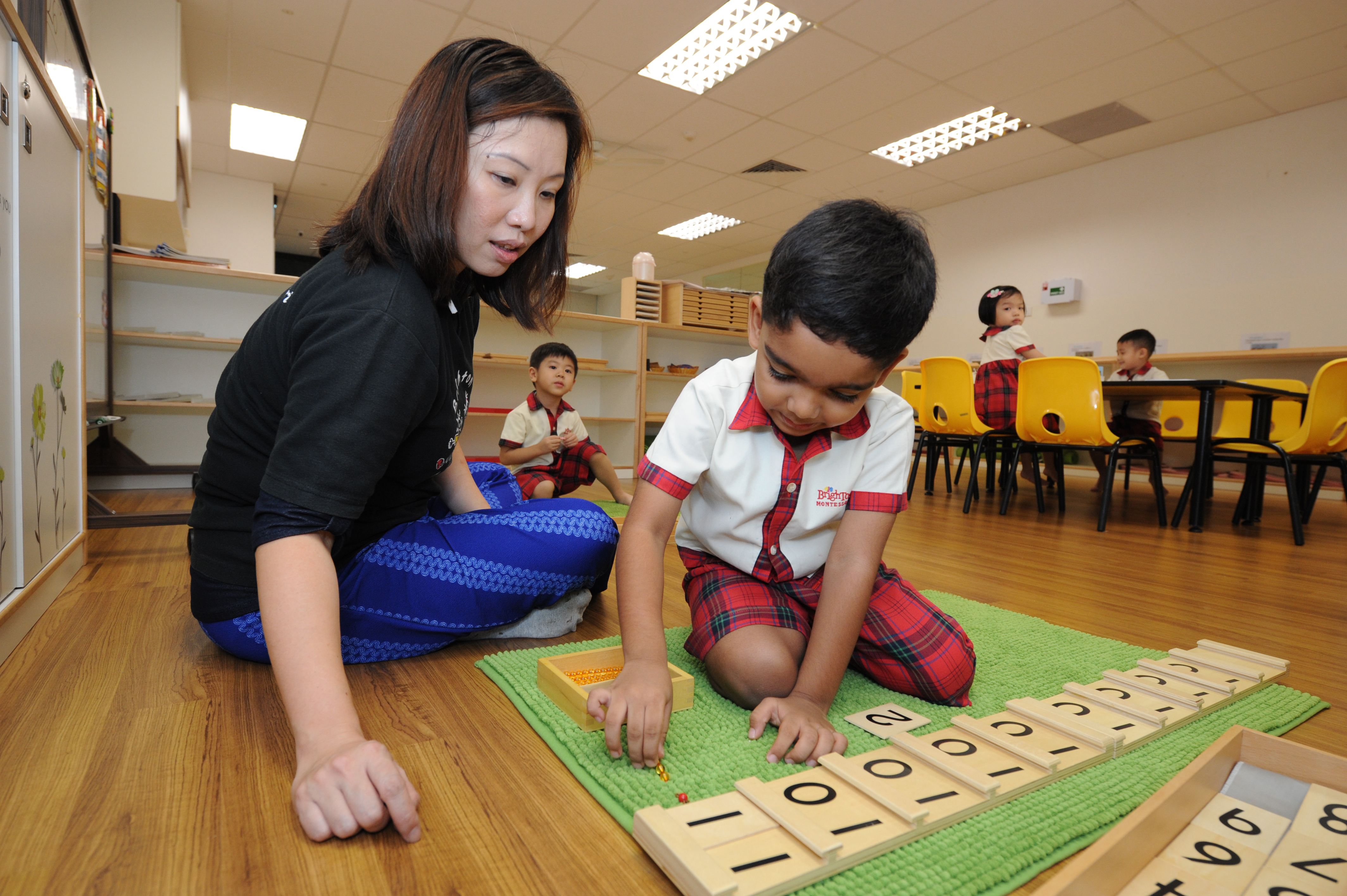
Senior teacher Pauline Yong, who was teaching seven children, focused on two children who each used a Montessori material called a Seguin board. This is a board with numbers on it to teach children the concept of tens and ones for two-digit numbers.

For “11”, for instance, they would count 11 beads, place them near the top of the board, and slot a piece with “1” on it in the ones place at the top of the board.

“They move from doing something concrete with counting beads to the abstract of recognising the numeric symbols,” said Ms Yong.

The other five children were independently, quietly tracing the letter “p” on worksheets, to revise the alphabet letters they had learnt.

All through the visit, even if a nearby class was loudly reciting Chinese words or singing, the N2 group focused on the task in front of them.

“They know our system. They know I’m with the children using the Montessori materials and they’ll have their turn later. When they’re focused, they can also tune out noise from other classes,” said Ms Yong.

BRIGHTON MONTESSORI

WHERE: The Grassroots’ Club in Ang Mo Kio

FEES: $1,605/month for full-day childcare, after GST

RUN BY: A commercial operator

STAFF: 21 teachers, including 13 with a diploma in early childhood education

CAPACITY: 144 childcare places

Language immersion at Chiltern House
Over $2,000/month

At Chiltern House, every class has its own room and there is an indoor playground, which may not be the case at most pre-schools.

When ST visited its Nursery 2 (N2) class recently, no noise from outside could be heard.

Said principal Iris Lim: “We allow the kids to speak up and express themselves. If the centre had an open concept, it’d be difficult to focus on what the children are talking about.”

Its N2 class was exceptionally small – there were just six children with two teachers in class.

The pre-school sets a ratio of one teacher to seven children, and there are 14 places for the N2 full-day programme, but only seven are filled. One was absent when I visited.

Ms Lim said parents are more keen on its half-day programme.

The pre-school is in an exclusive club – only around 1 per cent of centres here charge more than $2,000 a month. Most pupils at the pre-school, which is on the second floor of the SLF Building in Thomson Road, are from the nearby Newton or Thomson areas.

The Chinese teachers, mostly from China, have lived here for several years so their mainland accent is not too strong.

Ms Lim said there is much communication between parents and teachers. “The teachers talk to the parents, sometimes every day, so there’s rapport built.”

The pre-school is under the Julia Gabriel Education group and named after Chiltern, in south central England, where Ms Gabriel’s parents’ home is.

Visiting specialist teachers from Julia Gabriel Centre conduct speech and drama and music sessions once a week with each class.

It values children’s learning of Mandarin too. For the full-day programme, children spend half the day with English-language teachers, and the other half with Chinese-language ones.

Said Ms Lim: “If children can choose to go to either the English or Mandarin teacher, they often end up going to the English teacher.”

There were two Chinese teachers in the N2 class when ST sat in.

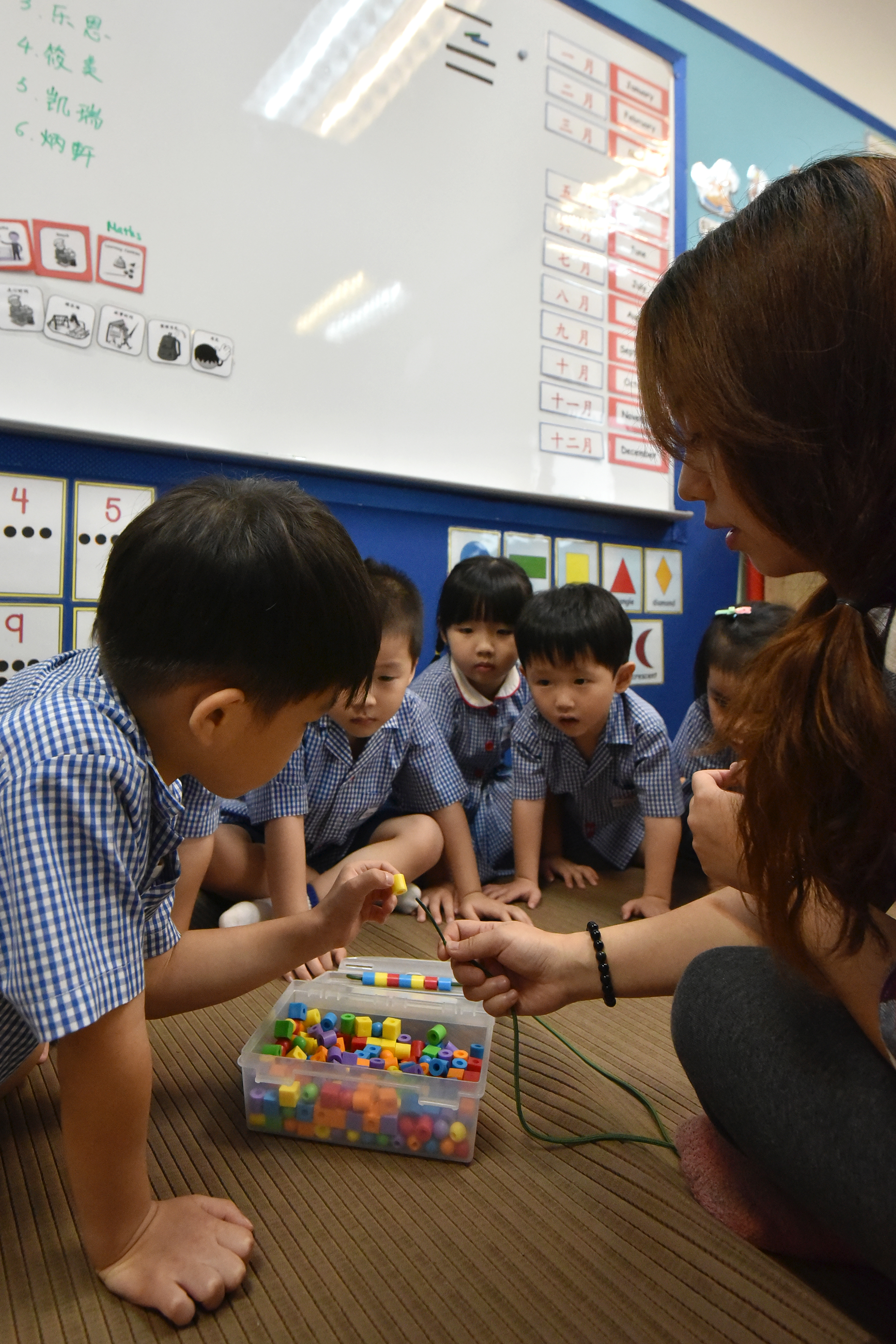
As the theme that week was pastries, pupils learnt words such as “biscuit” and “jam”. They also read stories, did art and craft, and learnt about patterns when making a necklace with beads – all in Mandarin.

Teachers and children spoke to one another in Mandarin in every instance, even when talking about going to the toilet.

Said Ms Lim: “In a way, the children are ‘forced’ to use the language, so it becomes more effective for the children to learn Mandarin.”

CHILTERN HOUSE PRESCHOOL

WHERE: SLF Building in Thomson Road

FEES: $2,113.25 /month for full-day childcare, after GST

RUN BY: A commercial operator

STAFF: 22 teachers, including 12 with a diploma in early childhood education and two with a degree or higher in the same field

CAPACITY: 189 childcare places, mostly for half-day programmes


This article was first published on May 2, 2016.
Get a copy of The Straits Times or go to straitstimes.com for more stories.


Image: 
Publication Date: 
Monday, May 2, 2016 – 17:00
Send to mobile app: 
Source: 


Story Type: 
Others

Source link