 SINGAPORE – With the majority of young mothers, or about eight in 10, remaining in the workplace after having children, the Government wants to see companies here offer better support to this group, said Senior Minister of State (Prime Minister’s Office)…
Source link
Govt wants SMEs to give working mums more support: Josephine Teo
Chee blames ‘state machinery’, media for Bukit Batok loss

SINGAPORE – The Singapore Democratic Party (SDP) will sit down and go through the results of the Bukit Batok by-election in the coming days, and it will also continue its work in the constituency, reiterated party chief Chee Soon Juan yesterday.
Dr Chee lost…
Source link
S’pore phase of regional maritime counter-terror exercise begins
SINGAPORE – The Singapore phase of a regional maritime security and counter-terrorism exercise took place yesterday, with teams from various countries taking part in a sea-based drill involving a hijacked ship.
The 11-day Association for South-east Asian…
Source link
More tried to escape road blocks in first 3 months of the year

SINGAPORE – The number of cases of motorists trying to make a dash past road blocks has increased in the first three months of the year, compared to the same period a year ago.
The police yesterday said this in a media release on the cases of three men who…
Source link
The holy sandhu who loves Shakespeare

An auspicious night with a giggly 70-year-old leads to finding understanding on Shiva’s night, when thousands of pilgrims converge to worship the Hindu god’s holy phallus.
At the age of 70, Arun dropped out. He sold his house, gave away his money and his possessions, traded in his long trousers for a loin cloth, and set out on a new career as a sadhu or holy man, travelling between the temples of South India in the search of enlightenment and alms.
Despite his new ascetic life, Arun was an erudite and worldly fellow with an Anglophile bent. After Shiva, he worshipped Shakespeare. His archaic English was full of antiquated colonial colloquialisms. Coming from a bearded sadhu, the phrase “jolly good” had a surreal flavour. So too did his sense of chronology, as if he had already entered some timeless plane, too busy chatting to the gods to notice the passage of decades and centuries. He spoke with great concern about the 1666 Great Fire of London as if we were still picking through the embers. He hoped I had not been too disappointed when Churchill lost the 1945 election.
I met Arun in the Temple of Arunachaleswarar at Tiruvannamalai, where he was perched on a wall among a flock of saffron-robed sadhus. Some were smeared with ash as a sign of their abandonment of the material world. Others had confined themselves to elaborate tilaka marks on their foreheads. Arun had a bald polished head, a white beard, a small bag that contained all his remaining possessions and the kind of giggly sense of humour that seems obligatory for Indians of a philosophical bent. He told me about the god Shiva.
“Have you seen his phallus?” Arun asked.
This was Shiva’s night and his lingam was hard to avoid. Beneath a full moon, all South India seemed to be converging on Tiruvannamalai to worship Shiva’s phallus. In countless shrines through the temple it appeared in the form of a short stone pillar.
Read the full article here.
Publication Date:
Monday, May 9, 2016 – 01:52
Send to mobile app:
Source:
Story Type:
Others
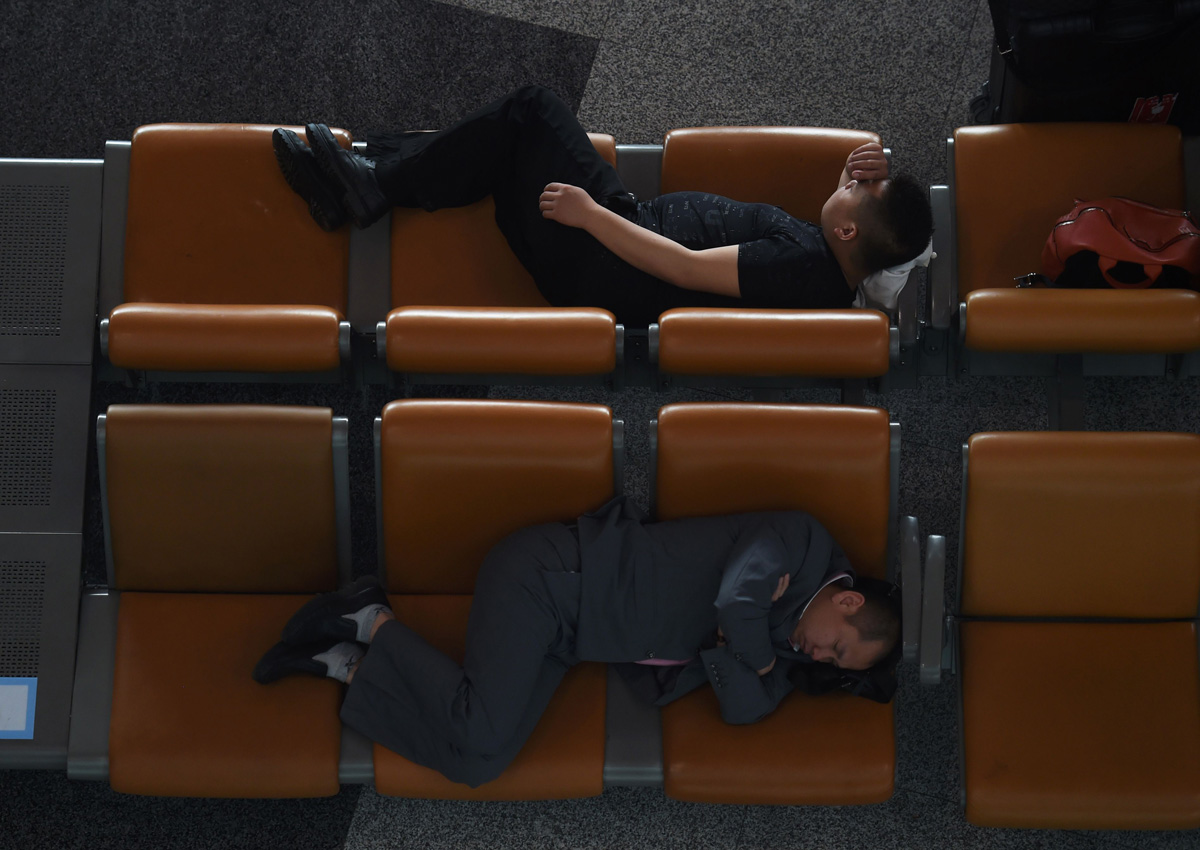
This is why China's airports are a nightmare

You’ve never truly been late until you’ve travelled China’s unfriendly skies. And that’s a problem for those doing business in the Middle Kingdom.
Danny Armstrong is used to dealing with flight delays and cancellations.
As general manager of China Banking at National Australia Bank, he travels for business around China a couple of times a month. At the mercy of the nation’s notoriously unpredictable flight system, Armstrong has had to become adept at contingency planning: booking on a certain carrier he believes has better on-time performance and switching to the high-speed train during times of the year when delays are common.
On occasion, he’s taken even more drastic measures to be punctual, including the time when he hired a police escort from the airport to get the CEO of his company, on a visit from Australia, to a high-level meeting after flight delays from Shanghai to Beijing. “We just did it by the skin of our teeth,” he said. “It cost us a fair bit of money, as well.”
Armstrong’s frustrations are common among business travellers in China as air travel has become increasingly chaotic and unreliable in recent years due to the country’s chronically – and well-chronicled – overcrowded skies. China’s airports are the worst in the world when it comes to punctuality. Airport statistics website FlightStats last year ranked 188 midsized and large airports around the world according to how many flights departed on time.
Of the bottom 20, 14 of them were in China, Hong Kong or Taiwan – all of which had on-time ratings of less than 60 per cent. The least punctual Chinese airport was Hangzhou’s at an on-time rating of 41 per cent, second only to Jakarta globally. Shanghai’s Pudong Airport (52 per cent), Hong Kong (59 per cent) and Beijing (64 per cent) fared only marginally better. By comparison, Tokyo’s busiest airport, Haneda, which handles more flights annually than Shanghai-Pudong, had an on-time rating of 92 per cent last year, among the best in the world.
Read the full article here.
Image:
Publication Date:
Monday, May 9, 2016 – 01:13
Send to mobile app:
Source:
Story Type:
Others
The drink that costs more than gold
China’s ancient bushes of Da Hong Pao produce one of the most expensive teas in the world, astonishingly costing more than 30 times its weight in gold.
In 2002, a wealthy purchaser paid 180,000 yuan – almost US$28,000 – for just 20g of China’s legendary Da Hong Pao tea. Even in a culture that’s valued tea drinking as an art form for around 1,500 years (and has a system of tea classification that makes French wine look simple), the price was astonishing.
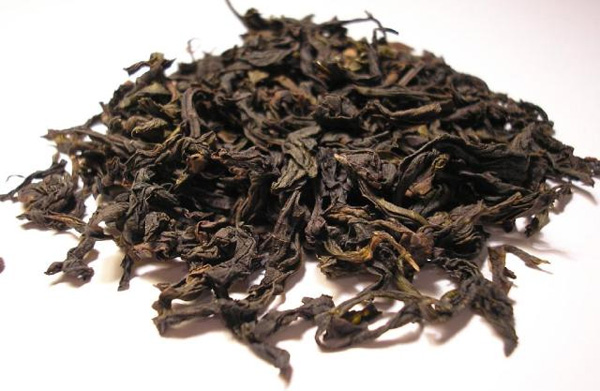
Original Da Hong Pao doesn’t just cost its weight in gold – it costs more than 30 times its weight in gold: almost US$1,400 for a single gram, or well over $10,000 for a pot. It’s one of the most expensive teas in the world.
“It looks fit for a beggar, but it’s priced for an emperor and has the heart of the Buddha,” said Xiao Hui, a tea maker in Wuyishan, a misty riverside town in Fujian, southern China. She showed me the dark, tangled, unfinished-looking Da Hong Pao leaves from her family’s tea gardens in Wuyishan. Xiao and her family, tea makers for many generations, still go into the mountains every spring to call on the tea god, Lu Yu, to bring new shoots.
Wuyishan’s startling karst landscape has been famous for tea for centuries. The rain that pours down the limestone gorges and karst pinnacles, flooding the narrow mountain streams and tumbling waterfalls, is heavy with minerals that impart flavour. Today, every other shop in Wuyishan has a tea-tasting table set for the ritual of gong fu cha (kung fu tea) – the closest China comes to the Japanese tea ceremony -and shelves stacked with a gaudy selection of tea leaves.
Travelling to Wuyishan, I discovered that many Da Hong Pao teas are surprisingly affordable. Though aged or antique versions can sell for extremely high prices, a Da Hong Pao of reasonable quality can cost around US$100 per kilo in Wuyishan.
Read the full article here.
Image:
Publication Date:
Monday, May 9, 2016 – 00:52
Keywords:
Send to mobile app:
Source:
Story Type:
Others
TODAY’s brief, Monday, May 9

Murali sworn in as Member of Parliament
Fresh from winning the Bukit Batok by-election on Saturday, the People’s Action Party’s Murali Pillai is expected to be sworn in at Monday’s Parliament sitting. Mr Murali, 48, a lawyer, beat the Singapore Democratic…
Source link
Bukit Batok by-election: After halo effect of SG50, a return to the norm?
Two weeks ago, I wrote about “Five things to watch out for in the Bukit Batok by-election”. So what do the results show of those issues?
First, that Singaporeans do not vote simply along racial lines. The People’s Action Party (PAP) candidate, lawyer Murali Pillai, 48, an Indian, got 61.2 per cent of the vote. He beat Singapore Democratic Party (SDP) chief Chee Soon Juan, 53, who is Chinese and has a higher national profile, and who got 38.8 per cent. The winning margin was a high 5,286 votes.
To be sure, a candidate’s race – and age, gender, occupation or lack thereof, even mien and likeability – can all swing individual voters. But at the aggregate level, it is highly significant that a heartland constituency with 74 per cent Chinese, 13 per cent Malay, 11 per cent Indian and 2 per cent of other races, can hand such a decisive victory to a minority candidate. It suggests that Singaporeans are, if not totally race-blind, then at least race-neutral in their vote. Race may matter to some, but not all voters, and not decisively in most cases.
Second thing to note: How much might voters “punish” the incumbent PAP for having an adulterous MP? In the 2013 Punggol East by-election sparked by incumbent PAP MP Michael Palmer’s resignation over an extramarital affair, the vote swing against the PAP was 10.8 percentage points.
This time, Bukit Batok voters deserted the PAP with a swing of 11.8 percentage points, just eight months after the PAP’s Mr David Ong got 73 per cent of the vote last September. He quit in March over an extramarital affair.
If one can parse such things, one is tempted to say PAP voters hand out a 10 percentage point penalty for such misconduct.
This is in contrast to Workers’ Party (WP) voters. In Hougang, WP’s Mr Yaw Shin Leong got 64.8 per cent in the 2011 General Election. Then, he was sacked over an extramarital affair. WP’s Mr Png Eng Huat defended the party’s stronghold in the 2012 by-election, getting 62.1 per cent. The drop: 2.7 percentage points.
Is the large difference in penalty due to innate differences between voters of different constituencies, or to the different expectations of their MPs held by WP and PAP voters? One wonders.
Singaporeans vote in Bukit Batok by-election
Click on thumbnail to view photos. Source:
The Straits Times, AsiaOne





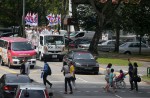

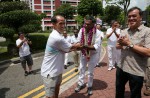





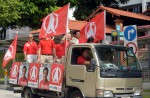





























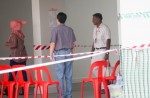

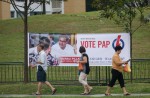
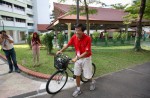





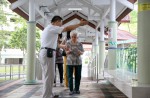

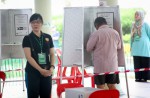




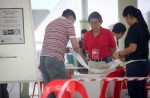







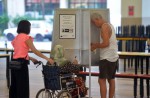




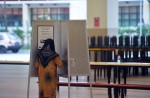






Third, this by-election’s result is consistent with the belief that voters respond better to candidates with grassroots appeal.
Again, a comparison with Punggol East is apt. There, WP candidate Lee Li Lian garnered 41 per cent of the vote in GE2011. In the 2013 by-election, she won the seat with 54.5 per cent against PAP candidate Koh Poh Koon, a surgeon who the PAP said was of ministerial calibre. But he was new to the area and lost to Ms Lee, a by-then familiar face to residents.
In Bukit Batok this time, the PAP chose Mr Murali, with 16 years of grassroots experience in the estate. Both candidates campaigned on municipal issues, coming up with social and community plans. The result suggests the grassroots strategy works.
The fourth issue was what the result says about voters’ acceptance of the controversial
Dr Chee, who has fought not only with the PAP but also his former mentor, but who has worked hard to build up the SDP and change his image in recent years.
His reception by Bukit Batok voters suggests Dr Chee is making inroads into the hearts and minds of heartland voters. The 38.8 per cent he managed is his personal best, nearly double the 20 per cent his team got in Jurong GRC in 2001. No wonder he said, minutes after the official count was released : “This doesn’t feel like a defeat.”
His vote share is 5.4 percentage points higher than the 33.4 per cent his team got in GE2015 in Holland-Bukit Timah GRC, where about 45 per cent of voters live in private housing. That Dr Chee, standing alone in a seat with 95.7 per cent who live in public housing, can better his GRC team’s result, flies in the face of conventional belief that he appeals more to the middle class. Perhaps that Hokkien music video Dr Chee starred in had some marginal impact. A 5.4 percentage point increase is hardly the huge swing Dr Chee would have needed for a win. Still, the result will embolden Dr Chee and trouble some in the PAP, which considers Dr Chee the kind of opposition politician Singapore does not need.
The fifth issue: This by-election shows that yes, the opposition is capable of unity. Leaders from the other major parties did not enter the fray, to allow this straight fight between the PAP and SDP.
One final point about that 11.8 percentage point swing against the PAP. That might be due in part to the “adultery penalty” theory alluded to earlier. But I think a large part is due to the loss of the halo effect from SG50 and the Lee Kuan Yew factor, that had buoyed the PAP to its 69.9 per cent win in GE2015.
Stripped of those factors, the vote share this time is probably a better gauge of heartlanders’ sentiments towards the PAP on the ground.
Assured of a PAP government in power (this is just a by-election after all), and freed from a sense of showing loyalty to Singapore’s founding Prime Minister and his party, voter sentiment seems to have reverted back to past norms.
In other words, 70 per cent in 2015 was likely a blip. The PAP will have to contend with the vote share dipping back to the low to mid-60s – and work very hard to keep it up.

This article was first published on May 8, 2016.
Get a copy of The Straits Times or go to straitstimes.com for more stories.
Image:

Publication Date:
Monday, May 9, 2016 – 09:00
Keywords:
Send to mobile app:
Source:
Story Type:
Others
In Duterte's Davao, Filipinos ready to share their maverick mayor

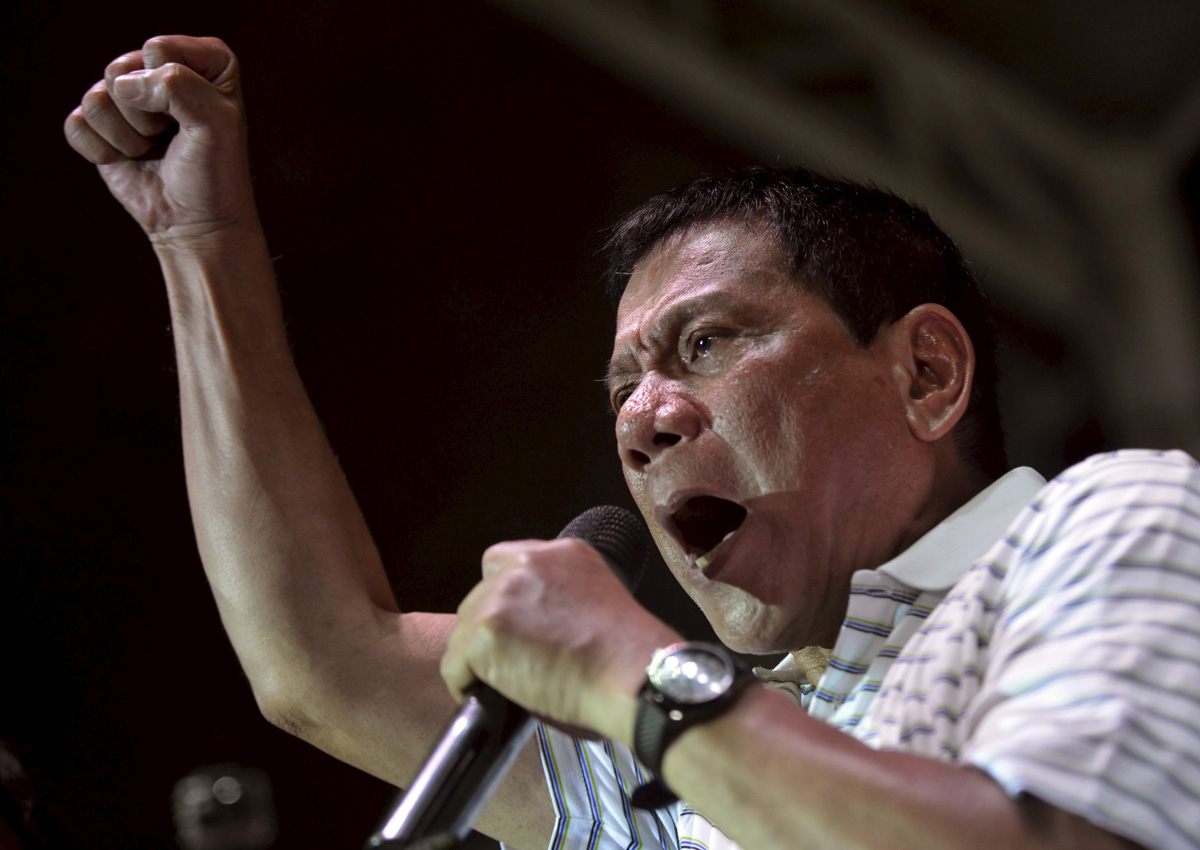
DAVAO, Philippines – After 22 years with Rodrigo Duterte as its crime-busting mayor, the Philippine city of Davao is coming to realise that it might have to share him with the rest of the country after Monday’s presidential election.
Duterte is the undisputed hero and patriarch of Davao and his touting of extreme measures to bring order to a once-lawless city has resonated on a national scale and put him on the cusp of winning the presidency.
The no-nonsense former prosecutor enjoys a cult-like following as a de facto sheriff who transformed a Wild West town fraught with drugs and gangs into a buzzing, modern city with a population proud of its rise from obscurity. “Davaoanians”, as they call themselves, feel it is time the rest of the country got a taste of Duterte’s rule.
“We want to share him. We’re happy with him being a mayor but we also want the Philippines to experience it,” said taxi driver Dax Dela Rosa, 42.
“You are safe everywhere … Here the criminals are scared, unlike in Manila (where) it’s the people who are afraid.”
Criticism of Duterte is almost unheard of in Davao and its people say he is a man of action whose sweeping promises of thwarting criminals and rooting out corruption are not hollow.
The streets of Davao are festooned with campaign posters bearing images of a stern-looking Duterte, and there are giant banners and car bumper stickers of a clenched fist accompanied by bellicose slogans and his most famous quotations.
T-shirts emblazoned with Duterte are ubiquitous, many with the “DU-30” code for his name that became iconic as the mayor’s popularity standing in opinion polls surged, making him the clear frontrunner.
Click on thumbnail to view photos. Source:
AFP, Reuters

















SOFT SIDE
“There will be no corruption and he can help the poor when he becomes president,” said ice cream vendor Rio Roxas. “He won’t change his attitude.”
The common narrative of Duterte is of a thuggish, crass candidate with a single-policy platform that has won him nicknames like “Duterte Harry”, “the punisher” and – among his presidential rivals – “the executioner”.
It is an image Duterte has himself cultivated with boasts of scaring off and shooting criminals, making him the target of rights groups and rival candidates who accuse him of sanctioning hundreds of extrajudicial killings on his watch.
But those who have known no other mayor talk of his softer side, like his push for clean governance, a city-wide smoking ban, and setting up a childrens’ cancer ward, vaccination programmes and a modern 911 emergency services facility.
Duterte has personally intervened in countless situations, according to residents, from property disputes to joining raids on drug dens, finding jobs for homeless and ordering taxi drivers to spend more time with their wives.
“I’ve seen what Mayor Duterte has done for the city. His passion, his dedication, everything he has done for the city and how selfless he is,” said businesswoman Lezita Go, 38, who wears Duterte wristbands. “He is not just a myth, or hearsay.”
Image:
Publication Date:
Sunday, May 8, 2016 – 22:20
Send to mobile app:
Source:
Rotator Headline:
Crime busting mayor Duterte on cusp of Philippines presidency
Hermes ID:
2 276 122
Hermes ID String:
SY_DUTERTE_0508
Story Type:
Others


