Home Blog Page 3955

Fallen hero: How the tide turned for Taiwan's Ma

TAIPEI – He won Taiwan’s largest ever landslide victory, a safe pair of hands promising prosperity and stability – but president Ma Ying-jeou leaves office this month caricatured as incompetent, aloof and wildly out of step with public sentiment.

Coolly coiffed with a sweep of jet-black hair, urbane Ma was seen as a reliable “Mr Clean” when he stormed to victory for the Kuomintang party in 2008, replacing an outgoing opposition government mired in corruption.

However, as he prepares to hand the reins of power to opposition leader Tsai Ing-wen on May 20, Ma faces possible court action and leaves a legacy fraught with division.

Relations with Beijing had sunk to a low under Ma’s predecessor President Chen Shui-bian of the Democratic Progressive Party.

Ma banked on friendlier ties for Taiwan to thrive. A rapprochement and a slew of trade deals followed, culminating with a historic handshake with Chinese President Xi Jinping last year.

But while Ma may have fulfilled a personal ambition, the public felt short-changed and increasingly saw him as a mainland puppet jeopardising Taiwan’s sovereignty. China still views self-ruling Taiwan as part of its territory, with reunification as its ultimate aim.

During student-led protests against a China trade pact in 2014, rally posters portrayed Ma with a Hitler moustache.

Other banners showed him with antlers growing out of his ears – a pointed jibe after Ma had mistakenly said that deer antlers used for Chinese medicine were actually hair from the animal’s ears.

At their worst, his popularity faded to nine per cent – earning him the nickname “nine-per cent president” among opponents.

Ma was “unable to reach out to the local Taiwanese”, said Jean-Pierre Cabestan, political science professor at Hong Kong Baptist University, instead making relations with Beijing his priority.

He also failed to bridge divisions within his own party.

“He lacks leadership and charisma,” said Cabestan.

“He was unable to lead and control the KMT, his ministers, and gave the impression of being soft with China and hard with the opposition.” After his presidential immunity lapses, Ma will face possible lawsuits from political rivals relating to the alleged leaking of political secrets and failing to declare assets.

It is an ignominious sign-off for the Harvard-educated former justice minister and Taipei mayor, and son of a senior KMT official.

Beleaguered Ma has admitted his government could have done better to meet the demands of a public stretched by high rents and low salaries – but he staunchly defends his China policy as having brought peace to the region.

“Ma’s policies have painted him as for the one per cent and China, at a time when society at large is fed up with both,” said Jonathan Sullivan, associate professor at the University of Nottingham’s School of Contemporary Chinese Studies in Britain.

“Adding to these policy outcomes is Ma’s personal reputation for aloofness, indecisiveness – but paradoxically with an authoritarian streak – incompetence and inability to balance the interests of his party, Taiwan and his own personal objectives,” added Sullivan.

Even staunch KMT supporters have turned their backs, with the party in tatters having lost its majority in parliament for the first time under Ma.

“We had high hopes, but we saw our faith in him fading away,” said Sun Chieh-yi, 59, a retired watch shop owner who comes from a traditionally pro-KMT family.

“People do not feel their lives are any better than before.” However, observers say history may look back more kindly on Ma as China relations are set to cool once more under Tsai and the traditionally pro-independence DPP, with concerns cross-strait friction may surge.

“At least he showed disputes between the two former rivals could be solved in a peaceful manner,” said Liao Da-chi, political science professor at Taiwan’s National Sun Yat-sen University.

In some ways, said Sullivan, Ma could never win.

“He was caught between two stalls: China calls him weak for failing to push rapprochement further. The majority of Taiwanese feel he went too far too quickly, and against their wishes.”
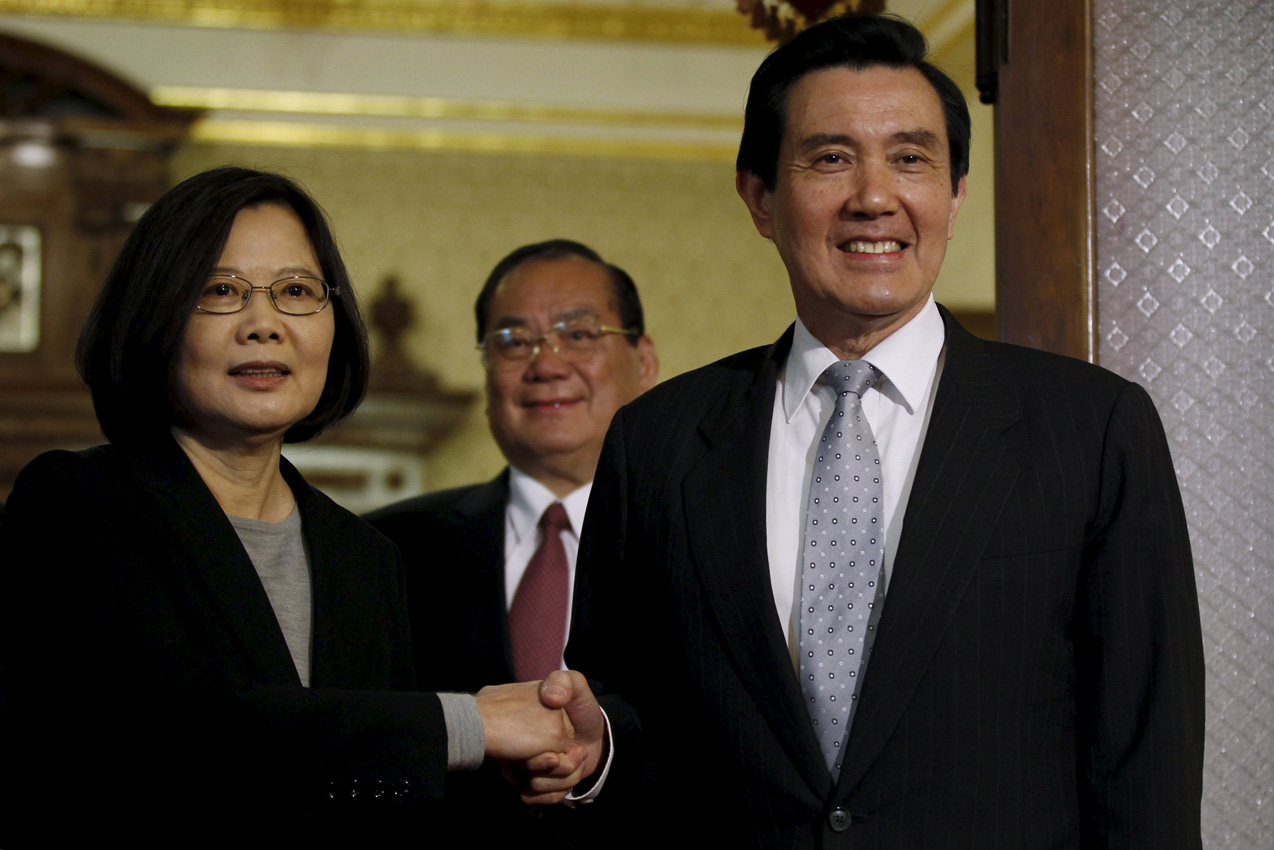

Image: 
Category: 
Publication Date: 
Friday, May 13, 2016 – 15:05
Send to mobile app: 
Source: 


Story Type: 
Others

Source link

Singapore says helping French with Olympic payment probe

French investigators say two payments were made by Japan’s Olympic bid team to an account held by Black Tidings, a Singapore-based company linked to Papa Diack, son of disgraced athletics supremo Lamine Diack.

Source link

New programme offers social entrepreneurs S$100,000 to carry out ideas

Leap for Good, spearheaded by the Singapore Centre for Social Enterprise (raiSE), aims to inspire innovation while addressing social needs. 

Source link

ABS tightens due diligence guidelines for SGX listings

The new guidelines apply to the due diligence process required of issue managers of mainboard listings and full sponsors of Catalist listings, the association said.

Source link

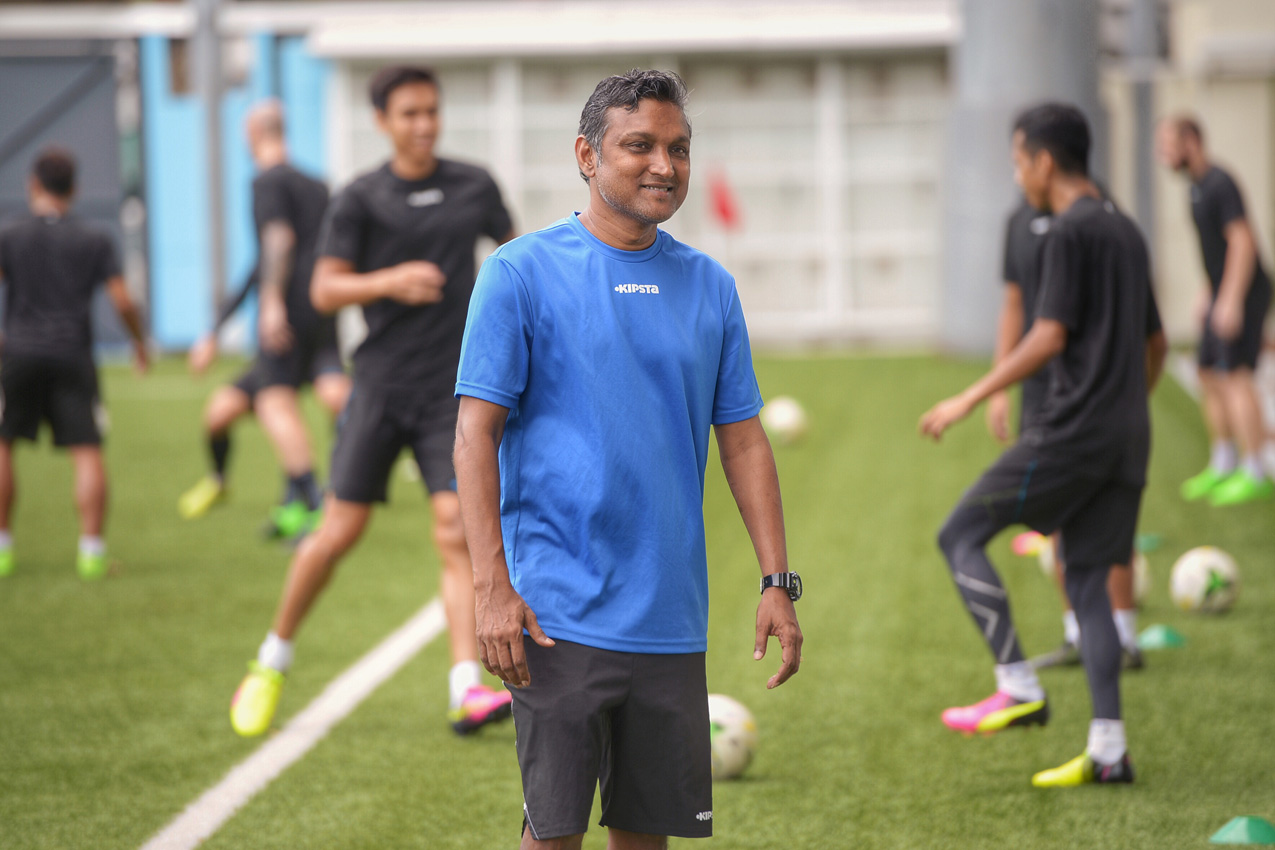
Football: Sundram tipped to be new Lions coach

After almost 16 years, the Singapore national football team could be led by a local coach once again.

The Straits Times understands that Tampines Rovers’ head coach V. Sundramoorthy, 50, has emerged as a front runner for the job vacated by German Bernd Stange last month.

The last local to coach the Lions on a permanent basis was Vincent Subramaniam, who held the job from 1999 to 2000.

Sundram, who on Tuesday guided Tampines into the Asian Football Confederation (AFC) Cup round of 16, was interviewed by the Football Association of Singapore (FAS) last week. Both parties are expected to meet soon to finalise terms, including job scope and expectations.

Responding to queries from ST, an FAS spokesman would only say: “We are finalising the appointment and we expect to make an announcement within the next two weeks.”

The new coach’s contract will possibly be only till the end of the year, with a foreign coach the likely long-term option.

That said, a good showing at November’s ASEAN Football Federation Championship, which Singapore have won four times, could sway the mind of selectors.

It is also unclear where this leaves current national assistant coach Fandi Ahmad, reportedly one of the leading candidates for the job.

Reports in March said he was set to leave the FAS fold although it is understood he had interviewed for the national coaching job.

Sundram, who has previously stated his desire to coach the national team one day, said he is focused on the Stags’ game against Home United today and declined to comment.

Tampines chairman Krishna Ramachandra said he had given Sundram his blessings to interview for the Lions job as “the national agenda has always been the key”, but reassured fans that the club would not be hit hard should Sundram depart.

Krishna added: “Sundram’s coaching style is such that he institutionalises the style of play. We have coach Akbar (Nawas) who’s a very astute and supportive assistant and would be a good coach in the wings.”

Known for his tactical acumen and defensive nous, Sundram is not new to the national set-up. He had assisted Stange, along with Fandi, for national team matches since June last year.

The former national player had also coached the Lions for the AFC Asian Cup 2015 qualifying match against Jordan in 2013 after Raddy Avramovic stepped down.

His first taste of coaching came in 1999 when he was appointed player-coach for Jurong FC, a post he held till 2003.

Thereafter, he held numerous appointments within the national set-up before being appointed coach of the LionsXII in 2012.

His crowning achievement came a year later when he led the LionsXII to the Malaysian Super League title.

If appointed, his first assignment is a quadrangular football tournament next month in Myanmar. Vietnam and Hong Kong are the other teams involved.

The Lions play the hosts in a semi-final on June 3. The final and third-place play-off is on June 6.


This article was first published on May 13, 2016.
Get a copy of The Straits Times or go to straitstimes.com for more stories.

Image: 
Category: 
Publication Date: 
Friday, May 13, 2016 – 15:00
Send to mobile app: 
Source: 


Story Type: 
Others

Source link

Minister of State for Manpower Sam Tan to attend ASEAN meeting in Laos

Mr Tan, accompanied by senior MOM officials, will also discuss labour initiatives with ASEAN labour ministers and his counterparts from China, Japan and South Korea at the 9th ALMM Plus Three Labour Ministers Meeting on May 15.

Source link

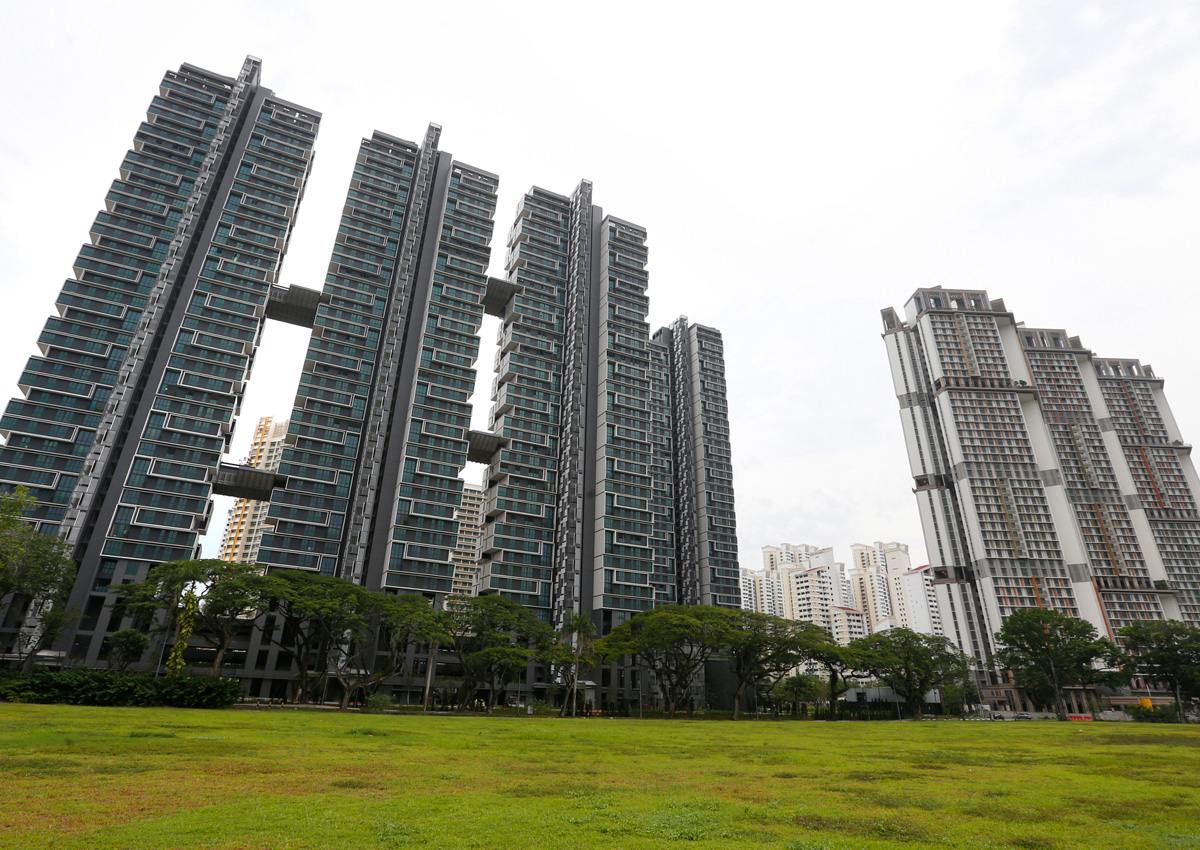
Dawson estate bags inclusive design prize

From ramps incorporated into main routes around the estate to large light switches that are easy to reach within flats, Housing Board project SkyVille@Dawson has many user-friendly features.

These have helped the estate in Dawson Road, Queenstown, become the first public housing project to clinch the Building and Construction Authority’s (BCA) highest award for inclusive design.

SkyVille@Dawson is one of three Platinum winners of the BCA Universal Design Mark this year and among 25 winners in all – ranging from homes to malls to parks – announced by the BCA yesterday.

“Universal design is about addressing the needs of as many people as possible, including those with disabilities and the elderly,” said Mr Teo Orh Hai, the BCA’s acting group director for building plan and management.

That includes ramps and corridors wide enough for wheelchairs, as well as facilities catering to people of all ages, such as playgrounds that incorporate fitness stations for older adults.

But universal design also extends to subtler touches, such as large, clear signs to help people find their way around, and adequate seating.

At Bedok Mall and Bedok Residences – a Gold Plus winner – plenty of seating is available throughout the integrated mall and private apartments, giving shoppers and residents places to rest. The development is one of four projects by developer CapitaLand that received Universal Design Mark awards this year.

Another is CapitaGreen, the first stand-alone office development to achieve a Platinum award.

“Universal design is not only about hard physical features, but it’s also about taking users into account,” said Mr Tan Jwu Yih, director of the BCA’s universal design department and one of the assessors for the awards.

Citing SkyVille@Dawson’s use of sky gardens to create community spaces in each block, he said: “The designer has understood how users can enjoy and use the space.”

The third Platinum winner is the refurbished Enabling Village, a community space with retail, lifestyle and training services for people with disabilities. Its features include an interactive directory that can be adjusted in height to suit wheelchair users, for instance.

The awards will be presented at the BCA Awards ceremony on May 26 at Resorts World Sentosa.


This article was first published on May 13, 2016.
Get a copy of The Straits Times or go to straitstimes.com for more stories.

Image: 
Category: 
Publication Date: 
Friday, May 13, 2016 – 15:00
Send to mobile app: 
Source: 


Story Type: 
Others

Source link

Retail sales up 5.1% in March on surge in vehicle sales

Sales of motor vehicles surged 41.3 per cent in March compared to the previous year, the highest increase across all sectors. Telecommunications apparatus and computers fell the most at 15.1 per cent.

Source link

Piracy in SE Asian waters rises; attacks off Somalia fall sharply

SAN FRANCISCO – Southeast Asia is rising as the new epicenter for ocean piracy, according to a new report.

Attacks on shipping by pirates in Southeast Asia are on the rise and the region is now responsible for about 60 per cent of worldwide attacks, according to an Allianz Global Corporate & Specialty piracy study, as reported by Hellenic Shipping News.

Vietnam’s waters are the most dangerous in Southeast Asia, according to The Allianz report, accounting for 147 or 55 per cent of attacks last year, up from 37 per cent in the previous year.

The southern port of Vung Tau in Vietnam was the site of more than half of the hijackings that took place in 2015.

Piracy along Indonesia’s sea border with the Philippines is another concern, with Indonesian authorities said to be worried that pirate attacks could reach recorded Somalian levels.

While sea piracy in Southeast Asia has risen, as attacks off Africa’s east coast, long considered the hub of global piracy, have fallen sharply as ships moving through the area have stepped up their defences.

And while pirates off the coast of Somalia often held vessel crews for ransom, Asian pirates tend to hijack ships to rob oil from slow-moving tankers, while usually leaving workers unharmed. The stolen oil is sold on the black market.

An Allianz Global manager said pirates are using hi-tech software to hack information on cargoes and movements of vulnerable ships.

Australian vessels are reportedly especially at risk because of heavy shipping traffic from Australian ports through the South China Sea and the Strait of Malacca.

Image: 
Category: 
Publication Date: 
Friday, May 13, 2016 – 13:00
Keywords: 
Send to mobile app: 
Source: 


Story Type: 
Others

Source link

Some find new Singlish terms in Oxford dictionary 'ridiculous'

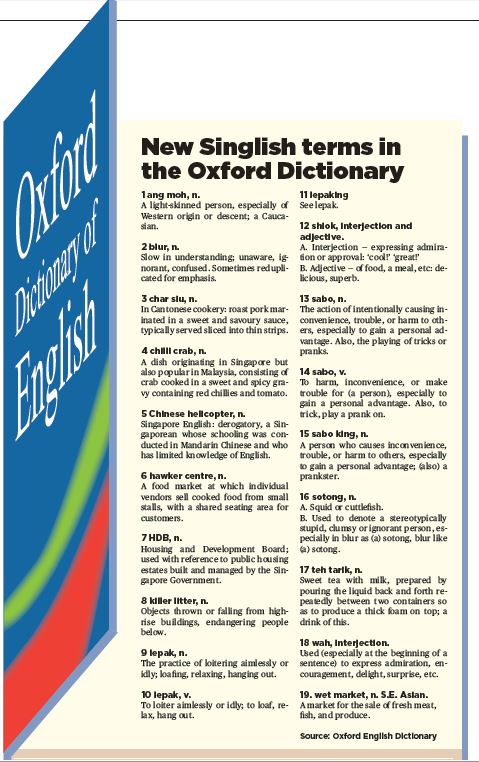
An ang moh and a Chinese helicopter have landed in Oxford. Well, the Oxford English Dictionary (OED).

Feeling blur like sotong? Don’t. Get yourself a teh tarik at the hawker centre and celebrate.

Those are just a sample of the Singlish terms that have been accepted into the esteemed publication. Wah, you say. No, Oxford said so themselves.

In a media statement on Wednesday, the English dictionary stated that oft-used colloquial items like “ang moh”, “Chinese helicopter”, hawker centre, “wah” and “sabo” are now part of its lexicon.

According to Oxford, the terms are “new senses of common English words”, “loanwords from Chinese… and Malay”, and “formations in English that are only used in Singapore”.

Dr Kirpal Singh, associate professor of English literature at Singapore Management University, said there are “good qualities” to Singlish and the recognition means it has earned respect.

He said: “The pity is that we in Singapore have often tended to deride our own and place value when others (especially the Westerners) say it’s okay.

“I have firmly stood by the fact that one day (Singlish) will become integral to the way or ways in which we use English.”

This is not the first time Singapore English terms have been added to the dictionary.

When the online version of OED was launched in March 2000, the words “lah” and “sinseh” made it to the list. In 2007, the word “kiasu” was added.

Most local celebrities The New Paper spoke to were more than happy to share this part of the Singaporean identity with the rest of the world.

Rapper Shigga Shay, whose hit songs like Lion City Kia and LimPeh are liberally sprinkled with Singlish, said the inclusion of the Singlish terms is music to his ears.

“It will open more doors for me when reaching out to audiences around the world,” he said.

The 23-year-old added: “I don’t think this means the death of speaking proper English because the use of Singlish is all about time and place.

“You don’t just suddenly forget to speak good English when new words are added.”

Actor and host Chua Enlai agreed: “English is all about the grammar and if you can find substitute words (in Singlish) and still use it with proper grammar, then you’ll be fine.

“It’s just like how some French words are also English words,” said the 37-year-old, whose favourite Singlish phrases include “wah lau eh” and “jialat”.

For film-maker Jack Neo, Singlish has always been a feature in his works and will continue to remain so.

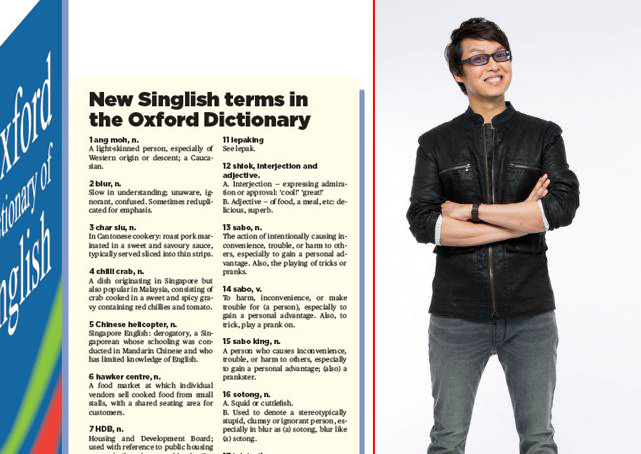
“I am disappointed whenever Singlish is deemed improper or uncouth. Now the international experts are recognising Singlish as proper. You should probably ask those who put down Singlish how they feel about this topic,” said Neo, 56.

‘BAFFLING’

ONE FM 91.3 DJ Glenn Ong, who confesses to not being pro-Singlish, said the fact that OED recognises these terms as English words is “baffling”.

“I have no problem with the fact that these terms were included, but I’m not sure if we can consider them English since some words were borrowed from the Malay language or Hokkien dialect.

“The OED sets the standard for English and I am surprised that Singlish words are included,” the 46-year-old said.

Ong said: “I feel that Singlish is sometimes used as an excuse for bad English and I don’t like that. Maybe OED resorted to this because people are not paying attention to dictionaries any more and they are trying to stand out.

“It would be wonderful if OED can explain themselves… in English.”

Ms Sylvia Toh Paik Choo, who popularised Singlish through her books Eh, Goondu! (1982) and its sequel Lagi Goondu! (1986), said the additions are “nothing to be proud of”.

“I feel that it’s ridiculous. The words are so esoteric and I find (this addition) very peculiar. Have they run out of words? I highly doubt anyone beyond this region will grow to use it.”

Other Singlish terms for Oxford? Celebs say…

FILM-MAKER JACK NEO (ABOVE), 56

1. Wah lau

2. Pek chek

3. Sia

RAPPER SHIGGA SHAY, 23

1. Wah lau

2. Limpeh

3. Tak boleh tahan

ONE FM 91.3 DJ GLENN ONG, 46

1. Brudders

2. Fuyoh!

ACTOR, HOST AND RADIO DJ DENNIS CHEW, 43

1. Rojak (as a noun and adjective)

2. Laksa

3. Pasar malam

ACTOR-HOST CHUA ENLAI, 37

1. Abuden

2. Orbi good

3. Jialat

ACTOR WANG WEILIANG, 28

1. Steady!

2. Nap shot

3. Swee

– Additional reporting by Constance Goh

ashikinr@sph.com.sg


This article was first published on May 13, 2016.
Get The New Paper for more stories.

Image: 
Category: 
Blurb: 
While some are delighted that more Singlish terms have just been accepted into the Oxford English Dictionary, others find it ‘ridiculous’. -TNP
Publication Date: 
Friday, May 13, 2016 – 17:00
Send to mobile app: 
Source: 


Story Type: 
Others

Source link