Home Blog Page 3946

Men fought with chopper and saw over money

Last July, two men – one with a saw and the other with a chopper – attacked each other in an open-air carpark in Boon Lay over a money dispute, with both inflicting cuts on each other’s arms.

Yesterday, one of the two, Joseph Tan Chee Meng, 49, pleaded guilty to hurting the other man with a dangerous weapon. He was sentenced to eight months in jail.

Two other charges – one of criminal intimidation and the other of causing hurt – were taken into consideration during sentencing.

The two offences were committed by Tan four months before the July incident and charges were initially withdrawn with a warning.

Court documents say Tan, who works in a car workshop, met 38-year-old Kua Cheow Wah on July 1 at the carpark beneath Tan’s Boon Lay flat over a money-related disagreement.

Tan was armed with a saw, and Kua had a chopper.

On seeing each other, the two men ran at each other and began fighting.

Tan struck Kua’s arms, leaving abrasions and bruises, while Kua slashed Tan’s right wrist, leaving a deep cut.

Kua was sentenced to five months’ jail in February for his role in the fight.

Deputy Public Prosecutor Goh Yi Ling said an aggravating factor was Tan’s many brushes with the law since 1983, with past offences including possession of drugs, causing hurt and participation in an unlawful society.

In mitigation, Tan’s lawyer Hilda Foo said Kua had provoked her client by driving to his house to confront him, that Tan had engaged Kua only to disarm him, and that the saw was for self-defence.

District Judge Liew Thiam Leng said that Tan had reoffended despite the warning given, and noted his tendency to commit offences of a violent nature.

For causing hurt with a dangerous weapon, Tan could have been jailed for up to seven years, fined, caned or sentenced to a combination of these punishments.


This article was first published on May 14, 2016.
Get a copy of The Straits Times or go to straitstimes.com for more stories.

Image: 
Category: 
Publication Date: 
Saturday, May 14, 2016 – 15:56
Keywords: 
Send to mobile app: 
Source: 


Story Type: 
Others

Source link

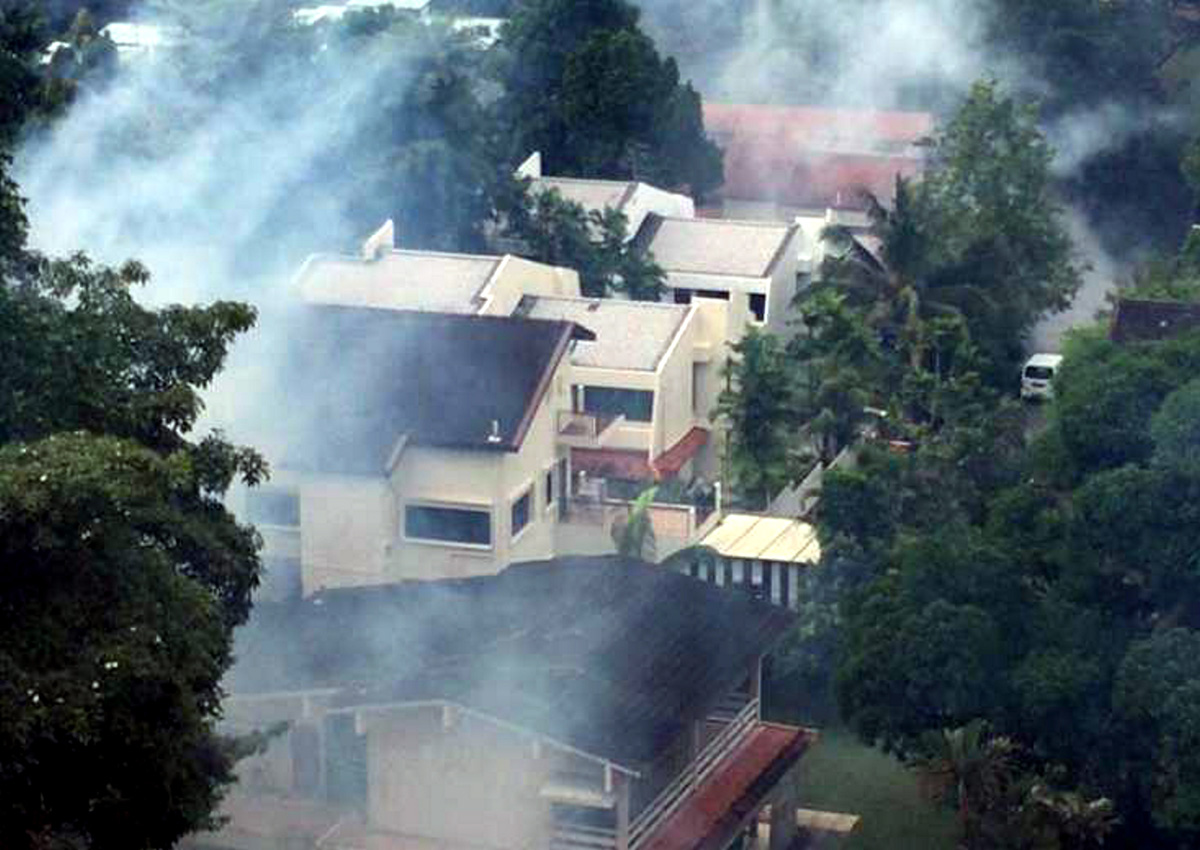
NEA steps up mosquito checks in Watten Estate after Singapore's first Zika case

Image: 
Publication Date: 
Saturday, May 14, 2016 – 15:20
Keywords: 
Send to mobile app: 
Source: 


Rotator Image: 
Story Type: 
Rewritten Story

Source link

New tech fuelling global boom in child sex tourism: study

Bangkok – Technology is transforming the global sex trade and making it easier than ever for travellers to prey on children, a landmark study on paedophiles warned Thursday.

The UN-backed report shines a light on the rampant spread of child sex tourism, a scourge that touches every corner of the world and is outpacing all efforts to contain it.

Researchers say the spread of communications technology is facilitating abuse at every step — by helping offenders groom and procure children on the Internet before they arrive, network among themselves and share or even livestream images of abuse.

“With the click of a button, offenders can have children ‘delivered’ to their hotel room or anywhere else they choose,” the report says.

Paedophiles can now speak directly to victims, using social media channels, with an immediacy “that was impossible 20 years ago,” it adds.

In a country like South Korea, where advanced communication technologies are widespread, more than 95 per cent of commercial sexual exploitation of children is arranged over the Internet, according to researchers.

Related: Cambodia police crack down on foreign paedophiles

Shadowy digital spaces are also offering abusers thicker layers of anonymity, with tools like cloud computing and encryption reducing their visibility and risk of arrest.

“Thanks to the increasing use of the so-called ‘darknet’, predators can securely post, view and exchange child abuse materials produced during their trips through networks that are difficult to detect”, the report said.

New inventions in tech have also transformed the nature of abuse itself.

In the Philippines, identified as a key hub in Southeast Asia for organised cybersex, tens of thousands of children are believed to have been exploited by “webcam child sex tourism”, which involves children performing sexual acts in front of a camera directed by the abuser.

The take-off of the “sharing economy” has also freed up new, more private places for travellers to abuse children, with sites like Airbnb inadvertently offering further insulation from the public eye.

The report writers called on tech companies to “take a lead” in developing solutions to undermine online business deals, such as programs that can track or block payments.

The “Global Study on Sexual Exploitation of Children in Travel and Tourism” was compiled by more than 70 child protection agencies, charities and academics.

It bills itself as the most comprehensive review of how child sex tourism has evolved in the last two decades.

Image: 
Category: 
Blurb: 
Publication Date: 
Saturday, May 14, 2016 – 15:25
Send to mobile app: 
Source: 


Story Type: 
Others

Source link

Zika can be contained with intensified operations and public cooperation: MOH

SINGAPORE – The authorities here have assured that it is possible to control local transmission of the Zika virus with intensified control operations and public cooperation, a day after the Republic saw its first imported case of the disease.
The Ministry…

Source link

I am trying to eliminate every possible risk

For the past two months, Madam Cindy Chan has been reminding her grandchildren to check for new mosquito bites on their bodies after reading about the Zika virus.

The 62-year-old retiree told The New Paper yesterday evening: “My daughter sat the two kids down and explained what the Zika virus was, what causes it and so on.

“We told them to tell us immediately when they see a new bite on their body, but thankfully, they haven’t had any.”

The children are aged nine and 12.

And Madam Chan had every reason to be careful.

Yesterday, news broke that Singapore had its first Zika virus case.

In a joint press release by Ministry of Health (MOH) and National Environment Agency (NEA) yesterday, it was revealed that the “patient is a 48-year-old male Singapore permanent resident who had travelled to Sao Paulo, Brazil from March 27 to May 7 this year.”

Brazil alone had some 1.5 million infections out of an estimated global total of 2 million in more than 40 countries.

The joint statement said the patient, after his return, had “developed a fever and broke out in rashes” on Tuesday.


ISOLATED

The man, who lives in Watten Estate in Bukit Timah, was admitted to Mount Elizabeth Novena Hospital on Thursday and was isolated. MOH and NEA said “he will be transferred to the Communicable Diseases Centre at Tan Tock Seng Hospital for treatment and isolation to minimise the chances of being bitten by mosquitoes and spreading the infection in the community”.

The patient, who is well and recovering, will be discharged only after he tests negative for the virus.

Madam Chan, who occasionally stays with her daughter’s family in Watten Estate, was shocked when she heard the news.

The Watten Estate area is not a dengue cluster, MOH and NEA said, which Madam Chan found out after reading the news online.

“I am definitely concerned. Plus, the patient is someone who lives in this area.

“I don’t even dare to have plants or ponds because of this virus,” she said.

“But I guess all we can do now is to continuously make sure that this area remains a dengue-free cluster.”

Madam Chan added: “I constantly tell the maid to make sure the buckets are all overturned and everything is dry. I’m trying to eliminate every possible risk and I think it’s important that everyone does their part.”

Another resident in the area, Mr Daniel Teo, 56, said: “Generally, we don’t have a mosquito problem in this area so I’m not as worried.

“But I will need to see how the government bodies deal with this first case for me to really be at ease with the situation,” the banker said.

“After all, he is from this area. I hope NEA and MOH step up their precautionary measures to make sure that the one patient has not transmitted the virus to anybody else.”

The Straits Times had previously reported that Dr Lim Poh Lian, head of the infectious diseases department at the Institute of Infectious Diseases and Epidemiology at Tan Tock Seng Hospital, said: “When Zika arrives here, it is likely to have a similar effect as chikungunya.”

The first transmission of chikungunya – another virus transmitted to people by mosquitoes – in Singapore was in 2008, but numbers remained low, peaking in 2013 with 1,059 cases.

Last year, 42 people were infected.

Dr Lim had said: “To prevent Zika’s spread, anyone with a confirmed infection will be hospitalised until tests show he no longer harbours the virus in his blood.”

In the meantime, given the present situation, MOH and NEA advised residents of Watten Estate, Hillcrest Arcadia, The Arcadia and Watten Hill Condominium to monitor their health.

It is a precautionary measure because symptoms do not always appear instantly.

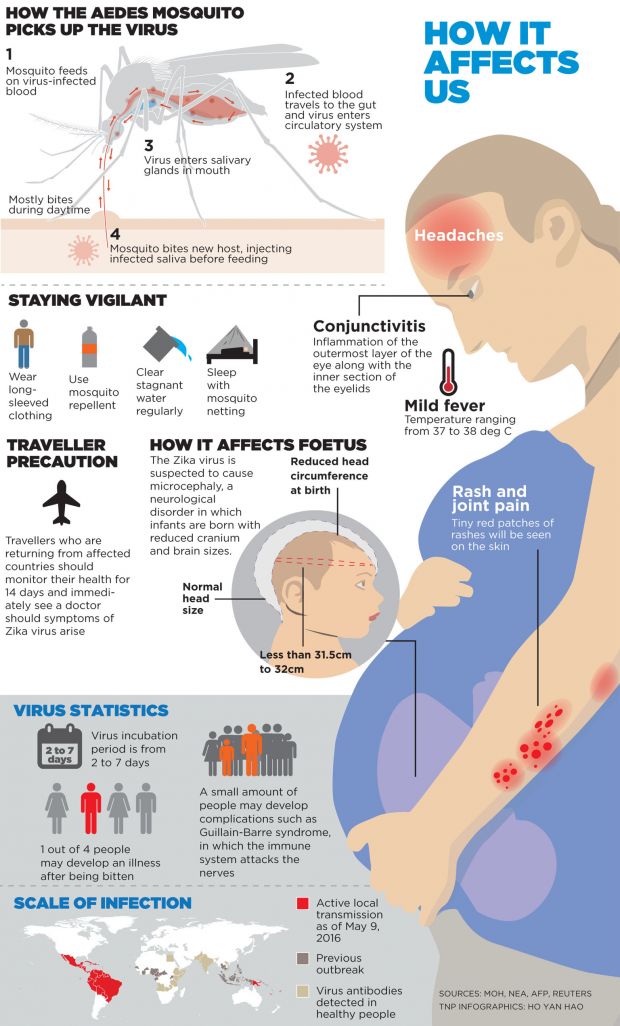
Zika infections can appear similar to dengue infections as they share similar symptoms such as rash, headache and muscle pain.


EYES AFFECTED

But those infected by the Zika virus also tend to have conjunctivitis, more commonly known as red eyes. (See infographics on right.) Those exhibiting symptoms should see a doctor immediately.

MOH and NEA are advising residents to practice the five-step Mozzie Wipeout, which includes turning over all water storage containers and changing water in vases and bowls on alternate days.

Senior Minister of State for Health Amy Khor said at a seminar organised by the People’s Association last month that it is “almost inevitable” that the Zika virus will find its way here.

Dr Khor, who is also Senior Minister of State for the Environment and Water Resources, attributed the likelihood of imported Zika cases to the vast number of foreign visitors that Singapore plays host to.

The MOH and NEA had put preventative measures in place long before the first case was announced yesterday.

These measures included admitting confirmed cases to a public hospital, issuing circulars to doctors to teach them how to test for and deal with suspected cases, and issuing health advisories to travellers on how to avoid being bitten by mosquitoes.

Last month, the World Health Organisation warned of the potential for a “marked increase” in the number of Zika infections in the coming months and its spread to new parts of the world even as the outbreak declines in Brazil.

Largely contained to Latin America and the Caribbean, Zika’s range is likely to expand as summer arrives in the northern hemisphere – and with it the virus-transmitting mosquitoes.

Cases have been reported in the region including neighbouring countries like the Philippines, Thailand and Malaysia.

Early last month, Vietnam reported its first two cases of the virus.


This article was first published on May 14, 2016.
Get The New Paper for more stories.

Image: 
Category: 
Publication Date: 
Sunday, May 15, 2016 – 06:00
Send to mobile app: 
Source: 


Story Type: 
Others

Source link

Almost 60 but still as sexy

Can women still be sexy at 60?

Of course, said 59-year-old Taiwanese actress-host Chen Meifeng, who is often dubbed “Taiwan’s Most Beautiful Obasan (Japanese for auntie)” by Taiwanese media.

Chen, best known for her leading roles in Hokkien soap operas Love and Night Market Life, was speaking from personal experience.

In 2014, she made jaws drop when she uploaded a photo of herself on her Facebook page wearing a hot pink bikini that showed her D-cup chest and firm abs.

Chen’s figure had netizens raving, with some remarking that she “puts young girls to shame”.

In town yesterday to launch the Mary Chia MU.Vtivate collagen drink limited edition bottle which she designed, Chen told The New Paper in Mandarin: “In the past, people had preconceived notions of how a 60-year-old should dress. But that is not the case any more.

“Who says obasans must look dowdy and ugly? We can choose to be beautiful obasans. Nobody can defy the ageing process, but we can grow beautiful as we age.

“I think I sent a good message to all mature women out there. Your mums who are around my age should be able to don swimwear and be happy and comfortable in them.”


NO TOUCH-UP

Chen, a divorcee with no children, is not without her insecurities and reservations though.

“The bikini was a present from a friend which I didn’t dare to wear at swimming pools,” she recalled. “So the next best thing would be to just take a picture in my bathroom.”

She claimed the image was “natural, with no Photoshopping done and no filters added”.

“I didn’t work out or go on a diet beforehand,” she said. “In fact, I was initially hesitant about posting the picture online, as I felt a bit fat wearing the bikini. But if I didn’t do it (then), who knows? I might pile on the pounds and not be able to fit into it later.”

Chen, who is 1.67m and weighs 55kg, maintains her svelte figure through regular strolls after meals, massages, hot showers, mental relaxation and beauty sleep.

She is game to show everyone another bikini shot in the future, “so long as it is a posed photo”. “If you ask me to saunter down the streets in a miniskirt now, no way,” she said.

Mary Chia’s local brand ambassadors, actor Li Nanxing and actress Constance Song, who appeared alongside Chen yesterday, had nothing but praise for the veteran star.

Li, 51, said: “I saw that bikini picture and I must say that Feng Jie (Mandarin for sister) has done a fantastic job at upkeeping herself. All guys will take a second look at her.”

Song, 40, who called Chen “an inspiration to women”, agreed.

But Chen has her share of detractors who criticise her for “not acting her age”.

She said: “I take all comments, good or bad, in stride. That is part and parcel of being in showbiz.

“If someone tells me that I am ‘acting cute’, I’d simply retort, ‘I am young at heart’.”


This article was first published on May 14, 2016.
Get The New Paper for more stories.

Image: 
Category: 
Publication Date: 
Saturday, May 14, 2016 – 21:00
Keywords: 
Send to mobile app: 
Source: 


Story Type: 
Others

Source link

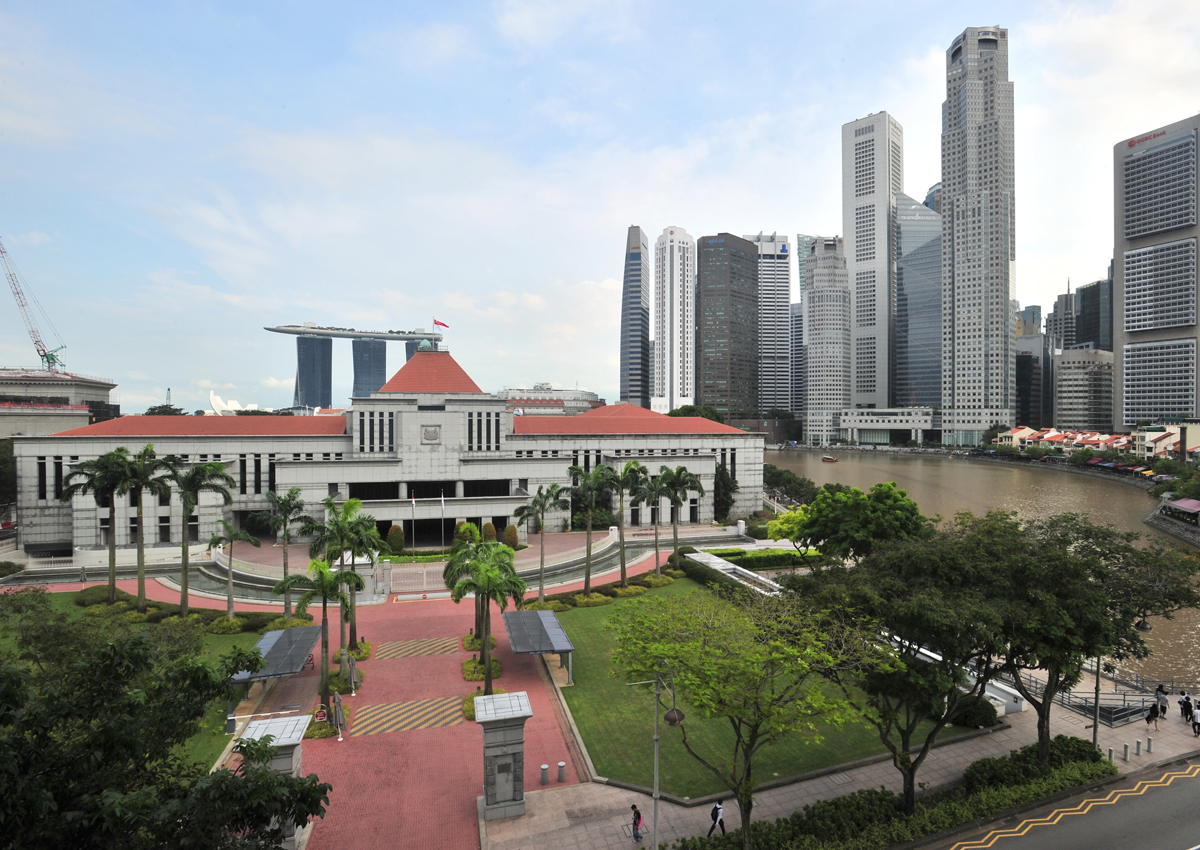
Fight against corruption: Singapore's experience

In an essay for an anthology compiled for the inaugural Anti-Corruption Summit held in London this week, Prime Minister Lee Hsien Loong identifies four factors key to the Republic’s share of success on this score.

Corruption is a scourge that can never be tolerated. Countries have tried all ways to combat it. They create anti-corruption agencies.

They pass strong laws. They promulgate codes of conduct for public officials. Companies pledge to conduct business cleanly. Yet often corruption remains endemic, a cancer in the society. How then has Singapore achieved some measure of success in eradicating corruption? I put it down to four factors.

First, we inherited a clean and working system from the British colonial government. We had many compelling reasons to want to end colonial rule and to be masters of our own destiny. But to their credit, the British left Singapore with a working system and sound institutions – English laws, a working civil service, and an efficient and honest judiciary. Importantly, the Colonial Service officers upheld high standards. People like Sir William Goode, our last governor and first head of state, had a sense of duty and stewardship. After Singapore, Goode served as Governor of North Borneo, now the state of Sabah in Malaysia. He left an impression in North Borneo, as in Singapore. Even a generation later, the people of Sabah still remembered him fondly.

Second, when the British left, our pioneer leaders were determined to keep the system clean. The People’s Action Party (PAP) first came to power in 1959, when Singapore attained self-government. However, it was by no means a no-brainer for the PAP to fight to win the 1959 General Election.

The country faced a myriad of problems: poverty, poor public health, an acute housing shortage, a stagnant economy and an exploding population. Did the PAP want to inherit these overwhelming problems? Why not become a strong opposition party and let another party govern and fail?

In the end, what decided the issue for Mr Lee Kuan Yew, our founding Prime Minister, and his team was the overriding need to prevent the public service from going corrupt. One term of an incompetent, corrupt government and Humpty Dumpty could never be put together again. So the PAP fought to win and formed the Government. When they took their oath of office, Mr Lee and his PAP colleagues wore white shirts and white trousers. It symbolised their determination to keep the Government clean and incorruptible. That has set the tone for Singapore ever since.

Third, with strong political will, we institutionalised a robust, comprehensive anti-corruption framework that spans laws, enforcement, the public service and public outreach. We enacted the Prevention of Corruption Act (PCA), which puts the burden of proof on the accused to show that he acquired his wealth legally. Any unexplained wealth disproportionate to known sources of income is presumed to be from graft and can be confiscated.

The PCA provides for extra-territorial jurisdiction, so that the actions of Singaporean citizens overseas are treated the same as actions committed in Singapore, regardless of whether such corrupt acts have consequences for Singapore.

Our anti-corruption agency, the Corrupt Practices Investigation Bureau (CPIB), is well resourced and independent. It is empowered to investigate any person, even police officers and ministers, and conducts public outreach to raise public awareness and shape social norms. We pay public servants fair and realistic wages benchmarked to private sector earnings and, in return, demand the highest standards of integrity and performance.

Fourth, we have over time developed a society and culture that eschews corruption. Singaporeans expect and demand a clean system. They do not condone giving or accepting “social lubricants” to get things done. They readily report corrupt practices when they encounter them. Singaporeans trust that the law applies to all and that the Government will enforce the laws without fear or favour, even when it may be awkward or embarrassing. Businesses have confidence that, in Singapore, rules are transparent and fairly applied. The story is told of a businessman who visited Singapore from an Asian country used to different operating norms. He left puzzled and disturbed that he could not discover the going rate for bribes to officers at different levels of government. He concluded wrongly that the prices must be very high.

Singapore has achieved some success eradicating corruption, but we are under no illusions that we have permanently and completely solved the problem. Corruption is driven by human nature and greed. However strict the rules and tight the system, some individuals will sometimes still be tempted to transgress. When they do, we make sure they are caught and severely dealt with. Two years ago, we charged an assistant director from the CPIB itself with misappropriating $1.7 million.

We keep our system clean not just for ourselves, but also to uphold our international reputation. Thus we deal strictly also with those who use financial institutions in Singapore to launder money or transact ill-gotten gains from corruption. We are zealous in protecting the integrity of our financial centre and business hub.

There is a Chinese proverb: “If the top beam is askew, the bottom beams will be crooked.” Keeping a system clean must start at the very top. A Singapore Armed Forces officer, on a course overseas, was once asked by his classmate how Singapore kept its system clean. He explained our arrangements and the central role of the CPIB. His classmate asked a follow-up question: But to whom does the CPIB report? The Singaporean ingenuously replied that the CPIB reported directly to the prime minister. This elicited further puzzlement. Much later, the Singaporean understood why. The real question he was being asked was, who guards the guardian?

There is no formula to solve this ancient riddle, but we are determined to uphold the highest standards of integrity from the top level of the Government down. In 1996, rumours spread that Mr Lee and I had received improper discounts on property purchases. The then Prime Minister, Mr Goh Chok Tong, ordered a full investigation, which found that there had been nothing improper. He brought the issue to Parliament, which held a full debate lasting three days.

Both Mr Lee and I spoke. In his statement, Mr Lee said, “I take pride and satisfaction that the question of my two purchases and those of the Deputy Prime Minister, my son, has been subjected to, and not exempted from, scrutiny… It is most important that Singapore remains a place where no one is above scrutiny, that any question of integrity of a minister, however senior, that he has gained benefits either through influence or corrupt practices, be investigated.”

Trust is slow to build, but fast to lose. We have spent more than 50 years building up confidence in Singapore. The integrity of the Government, the system and the men and women in charge has been key to Singapore’s success. We are determined that that integrity and reputation must never be undermined and will long remain a competitive edge and a source of pride for Singapore.


This article was first published on May 14, 2016.
Get a copy of The Straits Times or go to straitstimes.com for more stories.

Image: 
Publication Date: 
Saturday, May 14, 2016 – 17:00
Send to mobile app: 
Source: 


Story Type: 
Others

Source link

When private cars go the way of horse carriages

When driverless cars become the norm, they will cause a redrawing of the transport map so major it will make the changes due to Uber and GrabCar look like a few pencil marks.

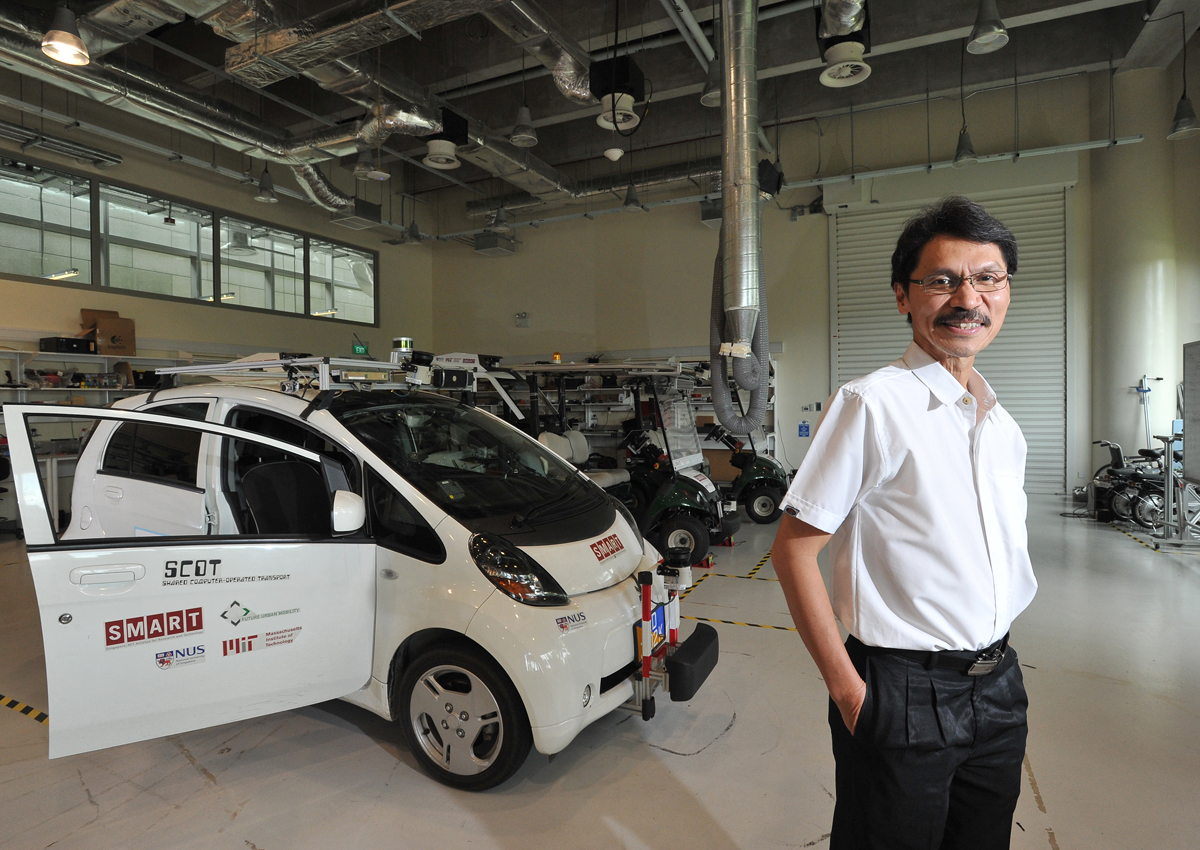
A Massachusetts Institute of Technology (MIT) study has predicted that combining self-driving cars with car-sharing means Singapore’s mobility needs can be met with just 30 per cent of the current one million vehicles.

Imagine the scale of the disruption to the billion-dollar car industry, thousands of driving jobs and miles of space now reserved for roads and carparks.

The Transport Minister himself thinks this remapping of land transport is inevitable.

Last month, when Parliament debated his ministry’s budget, Mr Khaw Boon Wan predicted that “private cars will likely start to go the way of horse carriages, if not in 15 years, definitely in 20 or 25 years’ time”.

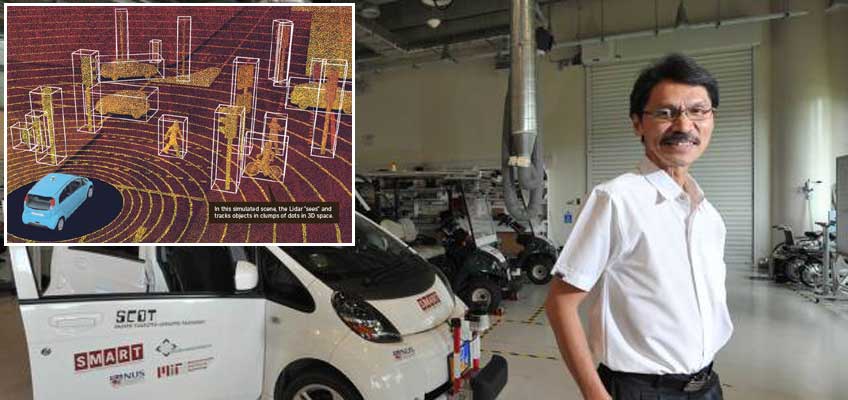
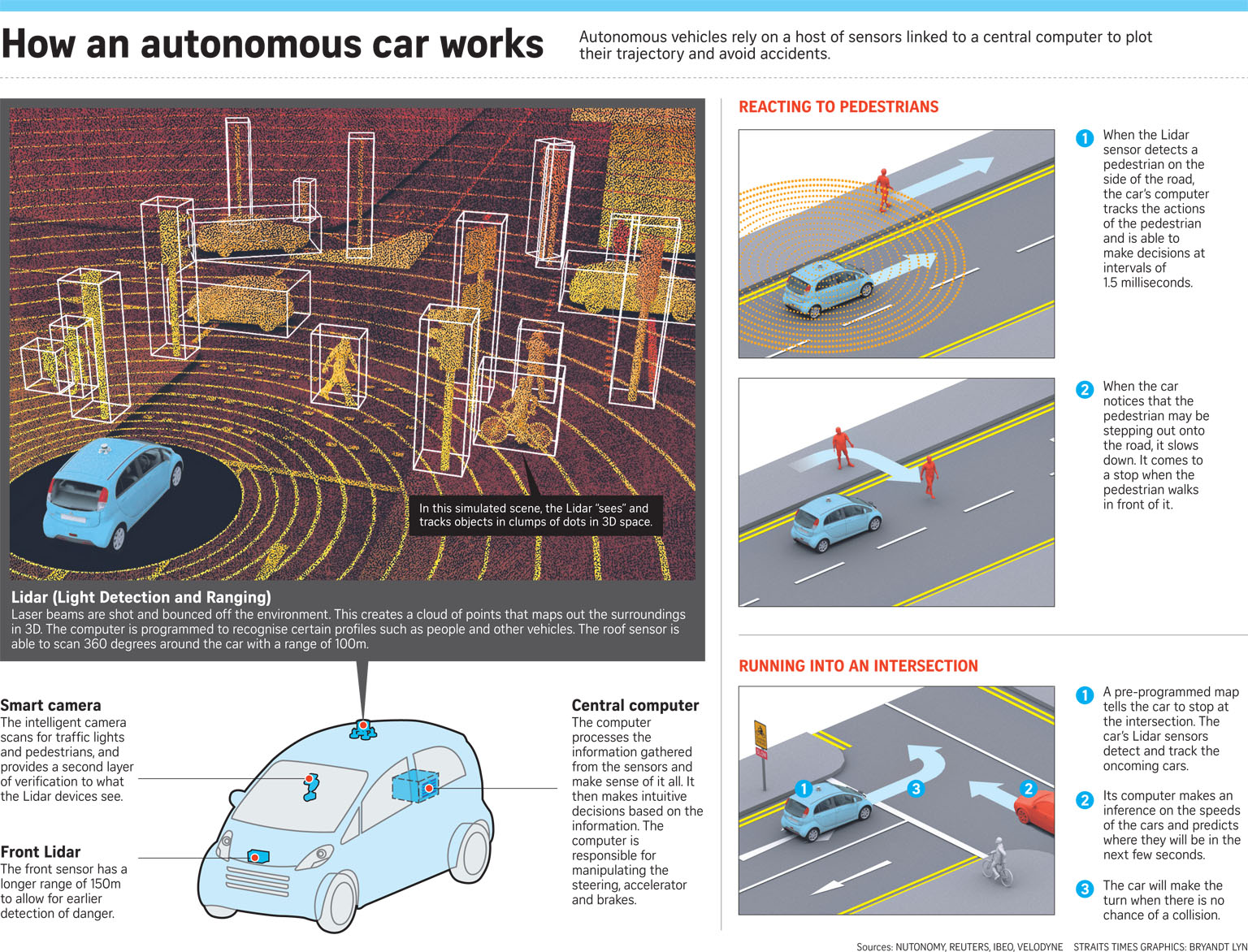
Between now and then, experts predict a steady shift towards autonomous vehicles, starting in controlled environments such as container ports, airports and education campuses. That will happen within the next five years, they reckon, because existing driverless technology – which employs sensors, cameras, laser-light scanners and mapping systems – is ready for use in such spaces.

Professor Wang Danwei, director at the Nanyang Technological University’s Centre for System Intelligence and Efficiency, says: “Drivers and other (human) users in these areas can be educated on how to behave towards these new systems.”

In fact, from the middle of this year, self-driving vehicles will be plying Gardens by the Bay. In just over two years’ time, on-demand driverless shuttles are expected to ferry visitors about on Sentosa.

Prof Wang believes that self-driving public buses can be deployed if the road infrastructure is equipped with transponders to guide the vehicles, and bus lanes are reserved primarily for their use.

For commuters, though, the big change will come when they can summon driverless pods via an app to help them travel the first and last miles to a transport node such as an MRT station, and when self-driving taxis take to the roads to ferry people from point to point.

But those disruptions could still be at least 10 to 15 years away, or even longer. That’s because more research and development are needed to enable self-driving cars to safely go onto crowded public roads with other human drivers, experts say.

THE LEAP TO PROACTIVE DRIVING

In February, a Google self-driving SUV (sport utility vehicle) collided with a bus in Mountain View, California, after the SUV’s computer wrongly assumed that the bus driver in an adjacent lane would slow down.

To be fair to autonomous cars, it must be said that that was the first accident involving a Google self-driving car after the company’s fleet had clocked more than 2.25 million km on the roads, a feat many experts consider impressive.

But for driverless cars to make the leap to being truly robust, safe, and reliable, the software algorithm used to drive them needs to shift from thinking “reactively” to thinking “proactively”, says Dr Marcelo Ang, acting director at the National University of Singapore’s Advanced Robotics Centre.

What’s the difference?

At a road intersection without traffic lights, for example, a “reactive” self-driving car will use a set of parameters to “decide” when to go, Dr Ang says. These are based on how far away oncoming traffic is and whether such traffic is in the car’s “safety zone” – a computer-defined radius around the car that tells it to stop.

“But a proactive algorithm will predict, (for example) whether the oncoming car has an aggressive driver, and will know in the next one to five seconds how the environment will change and plan the action accordingly.”

More importantly, however, such an algorithm is constantly learning from experience – akin to humans.

“After the action is made, the algorithm rates itself – how well did it perform? If it crashed, it won’t make the same prediction and action again,” says Dr Ang, who is also a co-investigator at the Singapore-MIT Alliance for Research and Technology’s (Smart) Future Urban Mobility unit.

If the process of “deep learning” – mimicking a human brain’s ability to recognise patterns through huge data sets and make predictions – can be programmed in self-driving cars, it would propel them to the next level.

But that could take around a decade more, Dr Ang reckons.
SEEING THROUGH THE RAIN

Driverless cars also have to overcome some very real physical shortcomings that currently limit their usefulness.

This may come as a surprise but researchers have yet to work out how to get such cars to work reliably in bad weather. Heavy rain, for example, is not something such cars can deal with. That needs to be fixed if driverless cars are to become a true point-to-point, on-demand mobility solution which can be relied on at any time of the day, says Prof Wang.

Explaining why these smart cars struggle with a weather phenomenon that humans take in their stride, Prof Wang says: “When it rains, human (drivers) can (visually) ‘lock in’ the yellow road markings, and consider the rain drops as disturbances.

However, the laser scanners and cameras on the driverless cars are affected by the poor visibility.”

To tackle this, Prof Wang together with researchers at the ST Engineering-NTU Corporate Laboratory are experimenting with signal-processing techniques so the car’s computer can “remove” the rain, in the same way that a human does.

An alternative solution is to change the frequency at which the car’s cameras capture the road images to account for the intervals between raindrops. “When the frequency is right, we can see through the rain,” Prof Wang says.


READY, GET SET, GO!

While the road to a driverless future is still fraught with challenges, governments, carmakers and tech companies around the world are already paving the way for its eventual acceptance.

In anticipation of these vehicles hitting the streets, lawmakers in American states such as Nevada and California have enacted regulations to allow autonomous cars on the road.

In Singapore, the Government formed the Committee on Autonomous Road Transport in Singapore (Carts) two years ago.

Last October, Carts identified four main tracks along which the Government will encourage the use of self-driving vehicles: mass transport on fixed and scheduled services for travel within and between towns; shared services for point-to-point and first- and last-mile travel; freight; and utility operations, such as road sweepers.

Other countries are more ambitious: China has plans for a draft road map to put autonomous cars on streets and highways within three to five years.

The British government has said it will allow driverless car trials on highways by the end of next year, and has committed £150 million (S$296 million) to harness new technologies, including a “Wi-Fi road” that could see cars and infrastructure wirelessly connected.

The key to making driverless cars a reality in Singapore will be private sector-led trials.

Singapore has given the green light for three groups to carry out such trials along a 6km test route in research-cum-business park one-north – a real-world environment with heavy and light traffic situations, and motorists and pedestrians on the roads.

The three organisations with approval to test-bed their vehicles there are the Institute for Infocomm Research under the Agency for Science, Technology and Research; the Singapore-MIT Alliance’s Smart; and start-up nuTonomy, an MIT spin-off.

Associate Professor Park Byung Joon of SIM University says that, given Singapore’s dense road network and heavy vehicular traffic, care must be taken to mix self-driving cars with human-operated ones as the technology is, in his view, not mature yet in this respect.

“In the future, when every car is autonomous and driven by a computer, it’s not a problem. But now, there will be some issues – how computers and human drivers mingle. Driverless cars drive by the book and law, but humans don’t,” he says.

But when the technology matures, Prof Park says, Singapore can be an ideal test-bed for research firms precisely because of its traffic density, and the Government should open more road spaces to attract such companies here.

“Even the quietest heartland area in Singapore is going to be a far more complex environment than what Google is testing in, in the US,” Prof Park says.

CONSTRAINTS AS FUEL

Singapore’s constraints, including its land and manpower shortage, may well fuel its drive to automate driving sooner rather than later.

The city state has close to a million motor vehicles on the roads, and the 12 per cent of land space set aside for roads is close to being fully utilised.

“Building more train lines,” says Dr James Fu, nuTonomy’s director of Singapore operations, “will eventually lead to a marginal increase in transport efficiency.”

That’s because “people will say they don’t live near a station, and they want more stations. But more stops will just lead to longer end-to-end travelling time for everyone,” he adds.

Dr Fu is hopeful that as the authorities open up more road estate – such as that in one-north – the technology powering today’s driverless cars will evolve in sophistication.

“Driving in an urban environment with other human drivers – that’s the biggest challenge. But people are confident of solving this,” he says.

“People’s driving behaviours are different in Orchard Road, the CBD and Jurong East, for example. So the more access you have to different kinds of public roads, you can see the limitations of the current algorithms, what situations they can and can’t handle. Right now, we don’t know what we don’t know, ” he adds.

Besides roads, driverless cars have the potential to alter city infrastructure by reducing the need for carparks. In a sharing economy, autonomous vehicles will not need to be parked as they can drop off their passengers and proceed to the next destination.

Road space can also be yielded to pedestrians and cyclists as autonomous cars will have the ability to travel closer to one another, and at road speeds which are constant, and less erratic than their human counterparts.

Perhaps the greatest gain and the one most espoused by its proponents is safety. Studies have shown that around 90 per cent of road accidents are due to human error, and driverless cars – whose computers are never tired or distracted – are touted to be safer.

“The driverless car,” says Dr Ang, “is not affected by emotions. When you overtake it, it doesn’t get angry. It’s not affected by tiredness, is more objective and has the potential of exceeding a (human) driver’s capabilities.”


This article was first published on May 14, 2016.
Get a copy of The Straits Times or go to straitstimes.com for more stories.
Image: 
Publication Date: 
Saturday, May 14, 2016 – 17:00
Keywords: 
Send to mobile app: 
Source: 


Rotator Headline: 
Self-driving cars must "learn to see and think like humans"
Rotator Image: 
Story Type: 
Others

Source link

Chinese political 'tiger' charged with corruption

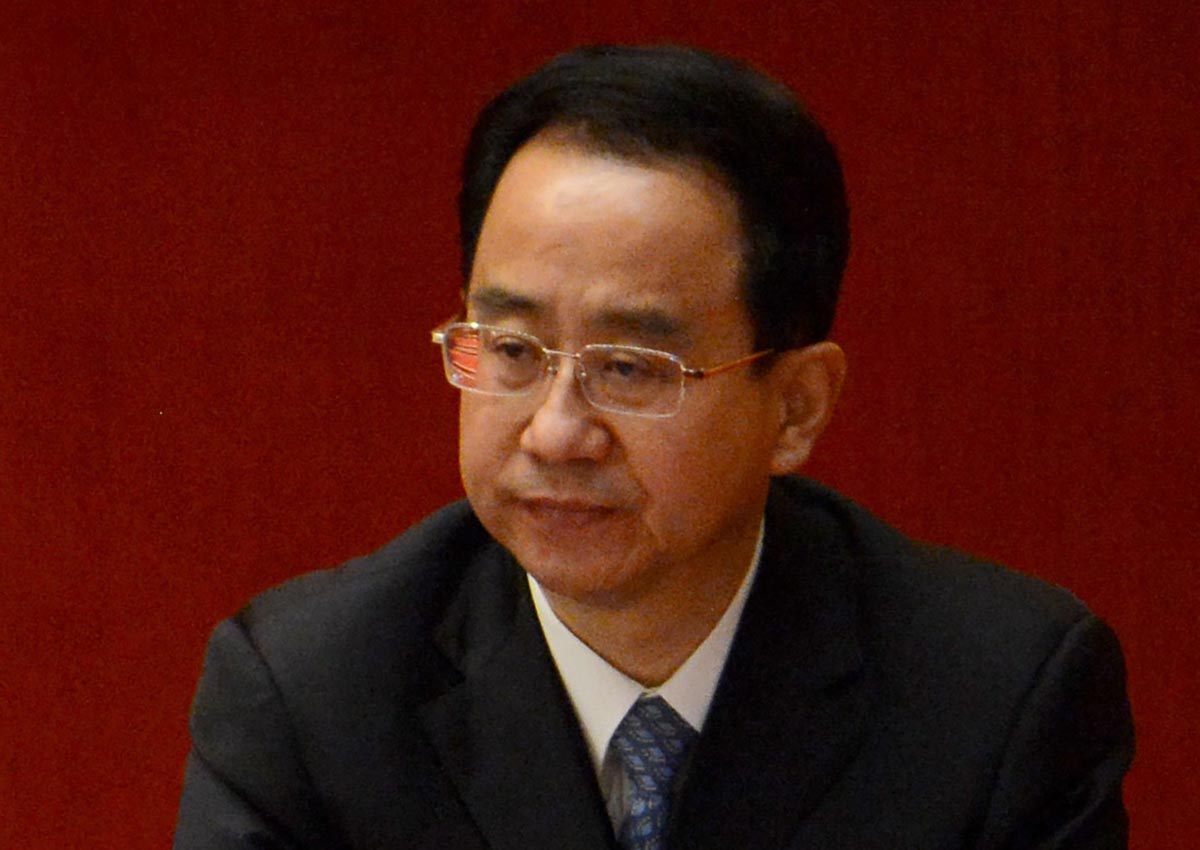
Former Chinese presidential aide Ling Jihua has been formally charged with corruption, and analysts say the lengthy investigation underscores the sensitivity of his case.

Ling was accused of taking bribes, illegally obtaining state secrets and abuse of power, state news agency Xinhua reported yesterday .

According to a statement by China’s state prosecutor, Ling, 59, used his many high-ranking positions in government to solicit bribes, seek favours for friends and illegally obtain state secrets.

It added that the circumstances were “extremely serious” and that his actions had resulted in major loss to public property and hurt national and public welfare. Ling, who served ex-president Hu Jintao, will face trial at a court in Tianjin.

One of the “tigers” or political heavyweights ensnared by China’s sweeping anti-corruption campaign waged by Mr Hu’s successor Xi Jinping, Ling was the head of the Communist Party’s General Office of the Central Committee.

Like fellow “tiger” and top politician Zhou Yongkang, Ling will be tried in Tianjin because it is a neutral location where he has no past links, said East Asian Institute senior research fellow Chen Gang.

Ling had been tipped for a position in the party’s elite Politburo but he was demoted in 2012 for allegedly trying to cover up a car crash in Beijing that killed his son.The younger Ling was found dead in a Ferrari with two semi-nude women.

The authorities announced in December 2014 that Ling was being investigated and the relatively longer time taken for him to be formally charged compared to other “tigers” was because of Ling’s position in the general office, which has been described as the “nerve centre” of the party, Dr Chen said.

“Ling Jihua’s corruption case is one of the most complicated to try because of the access he had to sensitive personnel and security material,” Dr Chen said. “Still, the authorities are keen to wrap this up so it doesn’t drag on too long.”

Ling’s corruption case took on additional political and diplomatic sensitivity after reports emerged alleging that he had handed state secrets over to his younger brother Ling Wancheng, who later left for the United States, where he is still residing.

In January, the Chinese authorities confirmed they were “handling the matter of Ling Wancheng” and were “in talks with the US”, without offering further details. A month later, however, Mr Ling Wancheng issued a statement through a lawyer in the US denying allegations that he had defected and turned informant.

Hong Kong-based political analyst Willy Lam said yesterday’s announcement could mean that a settlement had been worked out behind the scenes between the two countries about Mr Ling Wancheng’s case.

But he added the announcement could also be timed as a way for President Xi to reassert his authority over the party, after rumours had emerged in recent months of internal dissent about his leadership.

“It would be good timing for Xi because this case can be used to re-establish his prestige as someone who has done better than his predecessors in enforcing discipline,” Professor Lam said.

“At the same time he can intimidate his enemies, to remind them that he’s still in control with his anti-corruption campaign.”


This article was first published on May 14, 2016.
Get a copy of The Straits Times or go to straitstimes.com for more stories.

Image: 
Category: 
Publication Date: 
Saturday, May 14, 2016 – 17:00
Keywords: 
Send to mobile app: 
Source: 


Story Type: 
Others

Source link

Defenders of 'kiausu-ism' have got it wrong: NMP Kuik Shiao-Yin

NMP Kuik Shiao-Yin speaks to 938Live’s Bharati Jagdish on the kiasu culture in Singapore, why she wants to hear more emotion in Parliament, how Singaporeans can work towards having more moderate public debate, and the one conversation that changed her life. 

Source link