Home Blog Page 3637

Heavy rain causes commuters to be stranded in flooded bus

0

SINGAPORE – The Singapore Civil Defence Force (SCDF) had to be called in after waist-high flash floods caused some bus commuters to be stranded at Enterprise Road on Friday (June 17) afternoon.

Facebook user Thessa Huiying, who was travelling on bus service 252 at the time, wrote that water rose rapidly within a span of 10 minutes.

She posted photos of the flooded bus and road, as well as videos that show lorries driving through the murky water despite being partially submerged.

In her post, she thanked the bus captain for choosing to stop the vehicle, adding that he apologised to commuters for the delay even though he did not need to.

on Facebook

[Can someone please help me tag SBS and SCDF? I suck at this ? Thanks!]

This is another video I took of the flood…

Posted by Thessa Huìyīng on Friday, 17 June 2016

She also thanked the SCDF for checking on the commuters and reassuring them. One Malay officer even joked with an elderly man in Chinese to lighten the mood, she said.

on Facebook

I’m stuck in the bus flooded by the heavy downpour. Now bus is on stationary and water is rising rapidly.
I hope I make it out alive ???

Posted by Thessa Huìyīng on Friday, 17 June 2016

In a Facebook post, SCDF said that other vehicles were also stalled in the flood.

After receiving an alert on the floods at 4.30pm, the SCDF helped to evacuate a total of 11 people in life vests.

There were no reported injuries.

ljessica@sph.com.sg

Image: 
Category: 
Publication Date: 
Saturday, June 18, 2016 – 12:54
Send to mobile app: 
Source: 


Rotator Image: 
Story Type: 
Others

Source link

Lured by fast cash, more youths get involved in loanshark activities

0

The advertisements online and on social media promise fast cash for part-time work.

Invariably, young people who apply for these jobs find out that they must carry out loansharking activities, including harassment of debtors. Many of them, attracted by the easy money on offer, still sign up.

Invariably, most get arrested for breaking the law and could end up doing hard time in prison.

Even first-time offenders can face up to five years in jail, a fine and caning.

This new trend can be seen by the huge increase in the number of arrests for unlicensed moneylending harassment in just a year. From January to April last year, there were just 10 arrests. For the same period this year, the number jumped to 61.

Assistant Superintendent (ASP) Mohamad Farhan Anas told The New Paper yesterday that a lot of young people were recruited mainly through social media sites such as Facebook and online classified sites such as Gumtree.

The advertisements are usually vague, where the nature of the job scope is never specified, added ASP Farhan, who heads the police’s unlicensed moneylending strike force.

Young people, including students, are attracted by the amount of money offered – up to $200 per job or a day’s work. “When these youth contact the advertisers, the unlicensed moneylender would then give them details. The main lure is the fast cash,” said ASP Farhan.

RISE

The switch from traditional methods of recruitment such as flyers or word of mouth, to more sophisticated platforms such as social media, with its wider reach, could be one reason for the rise in youth joining the illegal trade.

ASP Farhan said: “This is the year where we really saw a jump. In some cases, the youth were recruited through social media.”

An example of a Facebook post unlicensed money lenders would use to hire unsuspecting youths. Usually, the nature of the job is very vague, but the amount of money offered is enough to attract them. 

None of the 61 youth arrested this year were debtors who became loanshark runners to pay off their debts. Instead, they were unsuspecting youth targeted through recruitment advertisement, said ASP Farhan.

Depending on the severity of the methods used to harass the debtors, loanshark runners can sometimes be paid up to $400 to $500 per job.

They are usually given specific instructions by their bosses, especially if it is their first time.

They could be instructed to go to a hardware shop to buy kerosene and lighter fluid to set fire to the door of a targeted flat.

They even take videos of the fire, which are later used to harass the debtor living there.

ASP Farhan said one of the worst cases his team had seen was a fire at a Woodlands flat in March.

A 46-year-old woman, who was trapped in the flat during the fire, was taken to Singapore General Hospital for smoke inhalation.

A 19-year-old was later arrested for allegedly setting fire to the flat.

To prevent more youth getting involved in unlicensed moneylending harassment, the Community Policing Units from the 35 Neighbourhood Police Centres use a set of PowerPoint slides to help raise awareness among youths during their patrols.

More long-term plans include school talks, usually done by the CPUs, after the June school holidays.

They will spread awareness through social media as well.

An 18-year-old currently at the New Charis Mission halfway house, told TNP that he got involved in loansharking activities because of his friends.

The teen, who cannot be named, said: “I knew I was doing something wrong, but I chose to continue because I needed the money.

“Depending on what kind of job, sometimes I get paid $100 to $200 per job.”

While he was never charged for his offences, he regrets what he had done.

ASP Farhan said it can be disheartening to see youths being arrested for unlicensed moneylending harassment.

“For me, it’s disappointing because the nature of the offence is very serious. And they had done it by choice.

“It’s disheartening because they have to be charged in court and end up with a criminal record despite their young age.”

CONSEQUENCES

Agreeing, Congruence Counselling Services counsellor John Vasavan, 56, said that youths who are attracted to easy money might not realise the consequences of their actions and they can get caught.

“Once you have a criminal record, you’ll find it difficult to get a job. Even if you can, it might not be a good job,” he added.

First-time offenders found guilty of assisting in the business of unlicensed moneylending can be fined between $30,000 and $300,000, be jailed up to four years and caned up to six strokes.

First-time offenders found guilty of acting on behalf of an unlicensed moneylender, committing or attempting to commit any acts of harassment can be jailed up to five years, fined between $5,000 and $50,000, and caned between three and six strokes

Former teen loanshark runner: ‘Watching them spray homes with paint made me want to join in’

Former convict Ezekiel Seah, 31, knows only too well how getting involved in criminal activities such as loansharking can lead to pain and regret.

He started as a loanshark runner at 16 after dropping out of school in 2001.

Mr Seah (in white) uses his own experiences with drugs and loan sharking to help mentor and guide the youth. He says: ” I feel satisfied, especially when you’re see they’re doing well.”

“I wanted to fool around. I was not interested in my studies,” he said.

Becoming a loanshark runner gave him a sense of belonging, he added.

“I had a very messy upbringing. My older brother was involved in drugs and gang activities and my parents were divorced,” said Mr Seah.

“I wanted people to recognise me, and seeing my brother do those things felt cool. I wanted to have a group of friends as well.”

He spoke of how he would accompany his friends to the homes of debtors and act as a lookout for them as they vandalised the homes.

He said: “It was exciting, and watching them spray the homes with paint made me want to join in.”

For the next four years, Mr Seah splashed paint on doors or scribbled on walls to demand payment from debtors.

But he drew the line at setting fire to homes, which he felt went against his moral code.

He said: “I was never involved in setting fire to homes. Even when I was told to padlock someone’s door, I wouldn’t do it.

“I was afraid they couldn’t run out of the flat if something happened, like a fire.”

Mr Seah later got involved in drugs – consuming as well as selling – and his life began to spiral out of control.

In his darkest days, a money dispute over drugs led to his older brother’s death. In February 2008, Mr Seah and his brother Seah Boon Lye were attacked by eight people at Geylang Lorong 10.

His brother was slashed to death while Mr Seah escaped with bruises.

“I didn’t know what to do. I felt very remorseful because my brother had a wife and three children,” he said, adding that he wanted to change his life after his brother’s death, but “didn’t know how to”.

“Nobody wants to be a bad person, but I just didn’t know how to change,” he said.

The turning point came after Mr Seah was sent to jail for more than three years for consuming “Ice”.

While behind bars, he resolved to put his life of crime behind him.

MENTOR

Since October, he has been with The New Charis Mission halfway house, where he is a mentor to an 18-year-old who was involved in drugs and loanshark activities. “It helps because my own experiences help them see what we have been through. It also encourages them not to go down that path,” said Mr Seah.

Though his programme will end next month, he plans to stay on as a counsellor to help other former offenders at the halfway house.

“I’ll be going for a basic counselling course after this, but my long-term plan is to counsel youth at risk.”

Urging youngsters to stay away from illegal activities, he said: “Don’t be rebellious, love yourself and your family, because it’s a tough journey to get back on the right path once you stray.”

lwenqi@sph.com.sg


This article was first published on June 18, 2016.
Get The New Paper for more stories.

Image: 
Category: 
Publication Date: 
Saturday, June 18, 2016 – 21:00
Send to mobile app: 
Source: 


Rotator Image: 
Story Type: 
Others

Source link

Cancer did not stop Singapore's rhythmic gymnastics coach

0

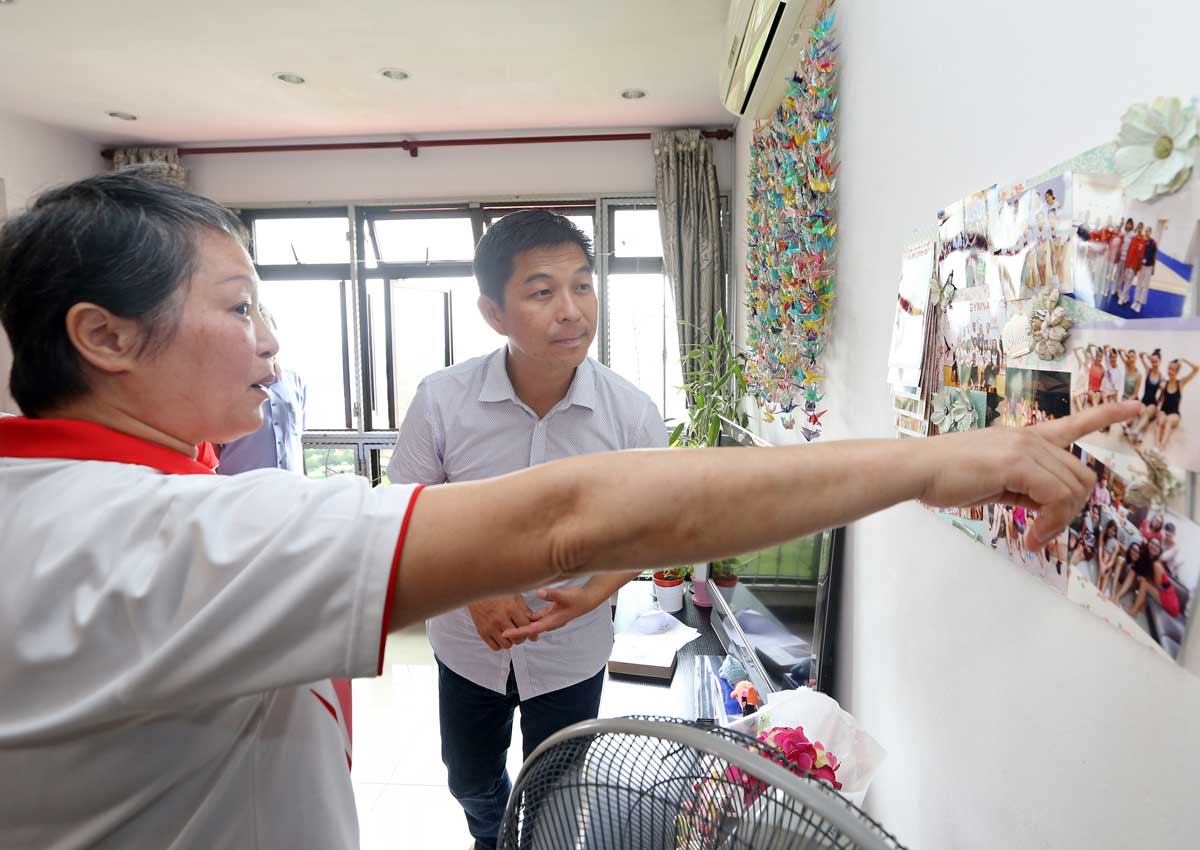
Taking pride of place in the living room of a four-room flat in Sengkang are a thousand paper cranes strung and hung over a television.

Painstakingly made three years ago by Singapore’s rhythmic gymnasts, the origami cranes were meant for their coach Zhu Xiaoping, or “Zhu lao shi”, as she is affectionately known.

Unrelenting in her training, authoritative yet not authoritarian, she is beloved by her gymnasts. The cranes, or senbazuru, have their roots in a Japanese legend that grants a wish from the heavens to one who folds a thousand cranes.

Today, Zhu is unsure if there will even be a tomorrow. Suffering from Stage 4 colon cancer, her doctor could not tell her if she will recover or how much time she has left.

But even as she grew weak from the illness, her dedication and commitment to her sport never wavered as she guided the Singapore team to a first-ever gold in last year’s SEA Games group all-around competition.

“I’m not somebody who can tell when my body needs to rest, and I’m very focused, so I find it difficult to slack off. It’s as if I’ve sold my life to the sport,” said the 56-year-old in Mandarin, whose hair is thinning from chemotherapy but still sounded full of energy.

For her selfless dedication, Zhu will be one of two recipients – along with marathoner Ashley Liew – of a special award at the Singapore Sports Awards next Thursday.

Minister for Social and Family Development and Singapore National Olympic Council president Tan Chuan-Jin visited Zhu at her home yesterday morning and praised her.

He said: “Coach Zhu Xiaoping put her athletes and Singapore Gymnastics’ interests above her own health and served selflessly to help them prepare for the 28th SEA Games. Her dedication to sport is admirable.”

When Zhu was first diagnosed with cancer, it had already spread to her liver and lymph nodes. But she felt compelled to help the gymnasts when their coach left abruptly in December 2014 for personal reasons as it was only six months to go before the Games.

Unfazed by the task of preparing the athletes within a short span of time, the Jiangxi native led the girls in training up to six times a week in the lead-up to the Games.

The intensive sessions bore fruit when the historic gold was won and she was given the job permanently.

However, the cancer spread to parts of her womb and stomach lining last July.

“How could I be happy? I felt that my condition had worsened so I was prepared for it. I decided to treat it like the flu. Now I live every day like it’s my last,” said Zhu.

Ann Sim, who was part of the gold-winning team and had been trained by Zhu since 2007, remembers how the coach tried her best not to let her condition affect her handling of the team.

“Her stamina during training was different, but the standards she demanded from us remained the same,” said the 21-year old student.

“Her style and attitude did not change, and she was always very dedicated to the sport and strict with us during training.”

Zhu’s love for the sport and her athletes is apparent when one walks around the Sengkang flat she shares with husband Lin Zhenqiu and their 28-year-old daughter.

Lining multiple walls of the flat are numerous photographs from her time as a coach, from the beginning of her career in China at the age of 20, to her arrival here in 2007, and to the first Youth Olympic Games in 2010, when she led Singapore to a fifth-place finish in the group all-around event.

Lin was the national coach of Singapore’s men’s artistic gymnastics team, but his contract was not renewed upon expiring last month.

“It pains me to see him at home without anything to do, because he was doing a fine job coaching the men’s team and they won five medals at last year’s SEA Games. Now we have no income so we have to rely on our savings,” she lamented.

Choy Kah Kin, the president of Singapore Gymnastics, said the association is “exploring job opportunities” for Lin to assist the couple as they “have contributed a lot”.

Zhu will be undergoing a more intensive round of chemotherapy in two weeks.

To pass her time, she plays with her neighbours’ children every morning while occasionally knitting plush toys. Despite not coaching them any more, she also meets her gymnasts for meals.

She said: “It’s difficult for me now that I cannot work, and my days are probably numbered.

“For us coaches, the sport is always the most important. But at the end of the day, there’s nothing you can do without a healthy body. All your dreams will be meaningless without it.”

kenggene@sph.com.sg


This article was first published on June 18, 2016.
Get a copy of The Straits Times or go to straitstimes.com for more stories.
Image: 
Category: 
Publication Date: 
Saturday, June 18, 2016 – 17:00
Send to mobile app: 
Source: 


Story Type: 
Others

Source link

RSAF participates in air combat exercise with US, Japan Air Forces

0

For the exercise held at Eielson Air Force Base, Alaska, RSAF deployed 10 F-16C/D aircraft and 105 personnel from its Peace Carvin II Detachment in Arizona, United States.

Source link

Cycling back to the past

0

SINGAPORE – As one of the most well-known acrobatic cycling troupes in Singapore in the 1980s, the Kong Chow Clan Acrobatic Cycling Troupe had to perform jaw-dropping, sometimes dangerous, stunts, some of which involved balancing on a bicycle like a pyramid…

Source link

Local firm wins $418m MRT contract

0

The contract to build the Sungei Bedok MRT station and its associated tunnels was awarded yesterday to local firm KTC Civil Engineering and Construction for $418 million.

KTC is also involved in the construction of Tampines station on the Downtown Line 3, and Orchard Boulevard station on the Thomson-East Coast Line (TEL).

The Sungei Bedok station is the last major civil contract for the 13km East Coast stretch of the 43km-long TEL, said the Land Transport Authority (LTA).

With this contract, LTA “has appointed contractors for all the nine stations of the East Coast stretch of TEL, at a total cost of approximately $2.73 billion”, said its chief executive Chew Men Leong. ” Works will now be in full swing.”

Located in Upper East Coast Road near Bedok Food Centre, the Sungei Bedok station is expected to be completed in 2024, and will be an interchange station connecting the TEL and the Downtown Line.

“This will help redistribute and relieve train loading on the East-West Line, resulting in more comfortable rides for commuters,” said the LTA.

The station will also serve as one of seven civil defence shelters on the East Coast stretch of the TEL, joining stations such as Bayshore, Marine Parade and Siglap.

The East Coast stretch of the TEL will be completed in two stages, with the first seven stations from Tanjong Rhu to Bayshore expected to be ready by 2023, while the remaining two stations will be completed the following year.

The 30km-long Thomson stretch of the line, covering 22 stations between Woodlands North and Gardens by the Bay, will open in three stages from 2019 and is expected to be completed by 2021.

Six stations along the stretch, including Woodlands and Orchard stations, will intersect with other MRT lines and serve as interchanges.


This article was first published on Jun 18, 2016.
Get a copy of The Straits Times or go to straitstimes.com for more stories.
Image: 
Category: 
Publication Date: 
Saturday, June 18, 2016 – 16:00
Keywords: 
Send to mobile app: 
Source: 


Story Type: 
Others

Source link

Meet-the-people sessions shouldn't just be about personal grouses: Jolovan Wham

0

HOME Executive Director Jolovan Wham speaks to 938LIVE’s Bharati Jagdish about what’s needed to make Singaporeans and the Government do more to improve the lives of migrant workers, and the need for Singaporeans to care about issues beyond just the personal. 

Source link

Fewer MRT disruptions in first quarter, LTA data shows

0

Singapore’s rail system continued to improve on the whole in the first quarter, even if the absolute number of major breakdowns remained high.

According to statistics released by the Land Transport Authority (LTA) yesterday, the MRT network had one disruption for every 159,000 train-km clocked – compared with one every 133,000 train-km at the end of last year.

Incidents are tallied if they delay journeys by more than five minutes.

As for the absolute number of longer disruptions – in particular those lasting more than 30 minutes – there were four on the MRT network in the first three months, and another four on the LRT network, bringing the total to eight.

For the whole of last year, there were 29 incidents for the entire rail network, which worked out to an average of 7.25 per quarter.

On this front, operator SBS Transit scored well, with no major disruption on its North-East and Downtown lines.

However, the North-East Line was the worst performer when shorter delays were included. The line chalked up one incident for every 93,000 train-km in the first quarter – up sharply from one in 213,000 train-km as of end-2015.

Its Downtown Line fared much better, chalking up one incident per 171,000 train-km – down from one in 45,000 train-km at the end of last year. This was largely because Stage 2 of the line opened in December, leading to longer distances clocked by brand-new trains, which are less likely to break down.

On the LRT front, the overall network clocked one incident for every 43,000 car-km travelled – down from one every 42,000 car- km at the end of last year. The LTA said it uses car-km as a measure for the LRT as the system uses a mix of one- and two-car trains.

National University of Singapore transport researcher Lee Der-Horng said the rail system is facing “new challenges” from its power systems, which have lately contributed increasingly to major breakdowns. “I do not know if there are even deeper root causes (of breakdowns) in our system which may prevent us from having a reliable MRT,” he said.

Commuters interviewed, however, said they had noticed a slight improvement.

Finance analyst Kat Lee, 30, said she now encounters a minor glitch every two to three weeks on average – down from once a week.

Typical glitches, she said, would include trains stopping “in between stations for around five minutes”.

Remisier Thomas Tay, 56, said he had noticed fewer incidents involving train doors that open and close several times before they are finally closed. “It still happens, but not as often,” he said, adding that he was caught in only one major disruption in the first quarter.

In comparison, Hong Kong’s MTR had three major glitches in the first quarter. Including minor glitches, it had one incident for every 520,000 train-km.


This article was first published on Jun 18, 2016.
Get a copy of The Straits Times or go to straitstimes.com for more stories.

Image: 
Category: 
Publication Date: 
Saturday, June 18, 2016 – 15:00
Keywords: 
Send to mobile app: 
Source: 


Story Type: 
Others

Source link

AMK patient had latent TB but stopped preventive treatment

0

When Mr Effandy Rahmat was diagnosed with latent tuberculosis (TB) in May last year, he was told to go to a polyclinic every day for preventive treatment.

But his work shifts as a waiter made the clinic visits challenging. Worse, the medication had side effects – it gave him rashes and made him cough up blood. He stopped going after two weeks.

That proved to be a costly mistake. In October, the 25-year-old was diagnosed with multi-drug-resistant TB and is still in hospital getting treatment.

He is one of six people living in a housing block in Ang Mo Kio Avenue 3 who were diagnosed with the same strain of drug-resistant TB over a four-year period.

“At that time, I had no clue what TB was,” said Mr Effandy, explaining why he stopped going for treatment.

“They told me that the symptoms are weight loss, appetite loss and a prolonged cough, but I had none except the cough. My body was totally normal.”

Even the cough was not a concern, he noted, since he had been a smoker from the age of 18.

Latent TB is not uncommon here and is estimated to affect between 2 per cent and 29 per cent of Singaporeans. Someone with a latent infection does not have symptoms or feel sick, and cannot spread TB to others.

But one in 10 will eventually develop an active form of the disease.

Chinese evening daily Lianhe Wanbao reported that Mr Effandy’s mother and brother have been screened for the disease and cleared.

Madam Susi Nander, Mr Effandy’s mother, said he was allowed to return home for three hours last month to celebrate his younger brother’s birthday.

The 49-year-old cleaner added: “Hari Raya is coming, I want to celebrate together (with him), but I don’t know (whether) can or not.”.


This article was first published on Jun 18, 2016.
Get a copy of The Straits Times or go to straitstimes.com for more stories.

Image: 
Publication Date: 
Saturday, June 18, 2016 – 15:00
Keywords: 
Send to mobile app: 
Source: 


Story Type: 
Others

Source link

First case in TB outbreak also part of older cluster

0

The first person found to have drug-resistant tuberculosis in the recently discovered Ang Mo Kio outbreak was also the first to be diagnosed in an older TB cluster, the Ministry of Health (MOH) revealed yesterday.

The man was the index case in that drug-resistant TB outbreak reported in 2013, which was traced to three cybercafes in Parklane shopping mall. In a statement yesterday, an MOH spokesman said the man had been coughing for four months before he was diagnosed in 2012.

However, he defaulted on treatment shortly after his diagnosis.

“Efforts were made by the TB Control Unit and MOH to locate him, but he was not residing at his registered address and was uncontactable for about five weeks,” the spokesman said.

When the authorities located him, he was served an order under the Infectious Diseases Act and isolated for treatment at Tan Tock Seng Hospital’s Communicable Diseases Centre.

He was discharged to continue his treatment as an outpatient only when he was deemed no longer infectious.

The TB Control Unit also screened the man’s close contacts, including users of the cybercafe, as well as two flatmates.

“There is currently no evidence to suggest that there was similar spread to persons outside of the close contacts,” said the MOH spokesman.

In the earlier cluster he was involved in, six people were treated for multi-drug-resistant TB after falling ill between February and December 2012.

Five of them had frequented cybercafes at Parklane shopping mall in Selegie, while the last was a family member.

This week, MOH revealed it had identified another cluster of multi-drug-resistant TB cases at Block 203, Ang Mo Kio Avenue 3.

Unlike the previous cluster, however, this was a “highly unusual occurrence” as the four households involved did not know or interact with one another.

Typically, TB requires “close and prolonged” contact between two people to spread.

But one of the six, Mr Effandy Rahmat, told The Straits Times he used to frequent a cybercafe at Parklane four or five times a month, though he has not been back there for years.

“That was when I was 18 – I would spend maybe 12 hours there each time,” recalled the 25-year-old. “But my NS (national service) health check-up didn’t find any problems.”

MOH had screened 147 residents and former residents for TB by 5pm yesterday.

Eleven children were given appointments at the TB Control Unit, as the tests were different.

MOH officers and grassroots volunteers have also reached out to more than three-quarters of the 160 households to inform them of the situation.

One resident who had screening was retiree Hong Zhai Sun, 66, who said: “I thought why not, since it’s free. I also want to make sure that my health is good.”


This article was first published on Jun 18, 2016.
Get a copy of The Straits Times or go to straitstimes.com for more stories.

Image: 
Publication Date: 
Saturday, June 18, 2016 – 15:00
Keywords: 
Send to mobile app: 
Source: 


Story Type: 
Others

Source link