SINGAPORE: A recall has been issued for two brands of bamboo fungus, Xiong Mao Pai and Fei Long Pai, after an unsafe level of sulphur dioxide, an allergen, was detected in samples of the product, said the Singapore Food Agency (SFA) on Thursday (Apr 30).
Sulphite is commonly used as a food additive and is typically tested for as sulphur dioxide.
The two brands of bamboo fungus were imported from China by Guangdong Import and Export and Teck Sang respectively.
SFA has directed both importers to recall the affected products.
All batches of Xiong Mao Pai bamboo fungus are affected while the affected batches of Fei Long Pai bamboo fungus have best before dates before Nov 18, 2021.
Excessive levels of sulphite could result in allergic reactions in individuals who are hypersensitive to the allergen.
“Symptoms include hives, itchiness, stomach ache, diarrhoea and vomiting,” said SFA.
BATCHES OF PURE TASSIE FRUIT JUICE RECALLED
Meanwhile, a further recall has been issued for various batches of Pure Tassie Organic Apple and Raspberry Juice and Pure Tassie Organic Apple and Blackcurrant Juice after an unsafe level of a toxin called patulin was detected in samples of the products.
Unsafe levels of patulin were detected in various batches of two types of Pure Tassie fruit juice. (Photo: Singapore Food Agency)
Being cooped up at home during the circuit breaker can be unsettling but we all have a part to play to keep Singapore safe! Not sure how to pass time during this period? We’ve got your back!
In true Japanese-tradition, Japan has managed to even turn excrement into something Instagrammable and cute. Opened in Yokohama last year, the Unko Museum or literally Poo Museum, is dedicated to all things poop-y.
While visitors would originally have to travel to Japan and pay 1800 yen (S$24) to check out the museum, you can now view select displays for free, starting from May 1. The museum can be accessed online from 12pm.
Virtual guests can use poo backgrounds for their video calls or check out some very crappy drawings by local celebrities or contribute their own with the template attached to this tweet.
It’s not just movie and game releases that got affected by the Covid-19 outbreak, but live performances as well. It has just been announced that the Singapore showing of the Final Fantasy VII Remake Orchestra World Tour will be delayed from its original July 4, 2020 showing to Jan 23, 2021.
The announcement was made on a Facebook post by <a href="
Dear FINAL FANTASY fans,
We are excited to announce that the new date for FINAL FANTASY VII REMAKE Orchestra World…
But unsuspecting shoppers found themselves jumping through more hoops than usual to enter the NTUC FairPrice at Orchard Grand Court on April 29 when two employees took to pranking them by asking them for a “chop” for entry.
FairPrice told AsiaOne it has fired the part-timers and made a police report against them after a video of the incident was posted on Facebook page All Singapore Stuff today (April 30), where it quickly drew widespread criticism.
The video, which has since been removed, appears to be a screen recording of one of the pranksters’ Instagram Story.
The 20-second-long clip shows a man in a surgical mask stopping shoppers at the entrance of the supermarket.
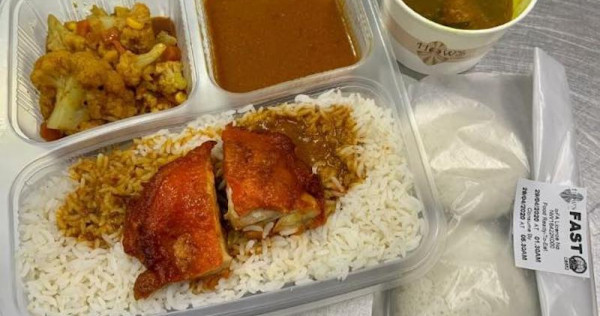
If you’ve been keeping up with online posts about the ongoing situation concerning Singapore’s migrant labourers, you might have noticed some chatter about the allegedly substandard quality of food they’ve been receiving in quarantine.
Images of food packets have been circulating on social media, accompanied by captions that allege that the recipients were not satisfied with the quality of their meals.
With a significant portion of the workforce Muslim, it’s taken on a more perturbing note right now during Ramadan, when the workers have to make do with whatever they’re served to break their fast and fill themselves up before dawn.
Minister of State for Manpower Zaqy Mohamad, however, has since tried to allay the concerns in a Facebook post yesterday (April 29), assuring members of the public that the situation is progressively improving.
How many of us play an instrument? And out of that group, how many actually have jam sessions with their dads?
Award-winning bartender Peter Chua is truly blessed to enjoy such a relationship with his dad (also named Peter Chua), a musician and a winner of the super retro local talent show Talentime.
Recently, Peter Chua Junior posted a video of the two of them strumming their guitars and doing an impressive and heartwarming cover of All I Have To Do Is Dream by The Everly Brothers (best enjoyed at full volume and full screen).
All I Have To Do Is Dream (Cover)
The old man and I doing another Everly Brothers cover. (We filmed 2 on the same day😉)…
Nurserywaty “Sery” Rahim, 37, had been relying on her home-based baking business as her main source of income for the last eight years.
That is, until it all came to an abrupt halt with recent circuit breaker tightening measures.
The single mum lives with her five children in a 2-room rental flat, which also doubles up as her workplace. From her kitchen, she churns out goodies ranging from cookies to elaborately decorated cakes.
The Hari Raya period is an especially busy time for her, when she can produce up to 150 bottles of cookies and other confections, but production has since been curtailed.
On Saturday (April 25), a joint statement by the Ministry of Trade and Industry, Ministry of Environment and Water Resources, Housing and Development Board and the Urban Redevelopment Authority stated that home-based business (HBB) operators cannot leave their homes to operate their businesses.
Customers or third-party delivery services are also not allowed to collect or deliver the goods from their residences. Those who flout the ruling may face a fine of $1,000.
SINGAPORE: When Tina’s husband Seth, 37, lost his income as a kitchen assistant at a night market stall in March, it was a blow in more ways than one.
His job took him from location to location – “Joo Chiat, Tampines, wherever there’s a night market”, said Tina – but it was at the annual Geylang Serai bazaar that he would typically double his income.
This year, with the COVID-19 outbreak, the physical bazaar and other events were cancelled. Seth was put on no-pay leave. “When we normally hope to get more, now we’re getting nothing at all,” said Tina, 38, a home-maker. (All names in this story have been changed.)
“I was thinking, what about tomorrow, and the day after? If there is (no work) for one month, that’s okay, we can be patient.
If it is for months, how? If there is nothing at all, how?
Living expenses weigh on her mind. The couple live with eight children, aged 15 months to 19 years, in a two-room public rental flat. And since full home-based learning (HBL) kicked in on Apr 8, the children have not been to school, where three of them would have gotten free meals under the Financial Assistance Scheme (FAS).
“Right now everyone is home, so a lot of money is flowing out,” Tina said.
Since Apr 8, Tina’s children have been home everyday in their two-room public rental flat.
Then there’s Jeff, 50, who has four children and one grandchild to support. He used to make a living ferrying schoolchildren as a bus driver, but then the schools closed.
All that weight on his shoulders, plus the constant noise of the children in the confines of their two-room rental flat, sometimes pushes him to lose his temper.
“Working to make money for my family, that’s my responsibility. Because of the virus, everything is stuck. I’m so stressed every day,” he said.
The family has been getting ComCare assistance of S$1,470 cash a month, along with help with rent, utilities and conservancy charges. They also get S$160 a month from a religious organisation, and wife Eva, a part-time cleaner at a nearby Social Service Office (SSO), continues to be paid S$320 a month despite having to stop work.
Even so, they can’t help but worry about how long they can go on without work. Said Eva, 47: “One month was still okay, but now it’s two months. We are so stressed. We cannot just stay at home, so my husband has been trying to find a job.”
ENOUGH ASSISTANCE?
In Singapore, some 52,000 households like Tina’s and Eva’s live in government-subsidised rental flats. Volunteer group Beyond Social Services (BSS) has been actively reaching out to this group since the pandemic began, and has started a COVID-19 Family Assistance Fund.
A block of public rental flats in Singapore.
It notes that 84 families received help in March, while 170 applications are being processed for the month of April. The group disbursed financial aid to 57 families in its network in the whole of 2019.
“Many beneficiaries are daily wage workers,” said BSS assistant director Lim Shaw Hui. The moment the “circuit breaker” was announced, some of them really had no work, so there was a need to provide emergency funds for them.”
She added that they have been “actively calling members”, and about 75 per cent of those contacted indicated they need financial assistance. “A lot of people may not know how to access the government schemes, or may not be eligible. This is where we fill in the gap,” she added.
“We do think that ComCare may not be sufficient at this point in time… It was supposed to supplement what they have, but now they have lost their jobs or there is reduced income.”
This was the case for Tina’s family. They have been receiving S$1,600 a month in ComCare assistance, and S$400 monthly in cash and vouchers from a religious body. But when Seth’s income dried up completely, this assistance was no longer enough, they said.
Tina can no longer do her monthly shopping in Batam as she used to, because of travel restrictions. There, supplies like milk powder and toothpaste were much cheaper.
Said her daughter Ella, 19: “Previously, we didn’t really have to fork out so much on food at home, because the only time my mum had to cook was for dinner. Now … (paying for) groceries is one of the biggest financial worries.”
The family’s fridge. Tina is now constantly preparing three meals a day plus snacks for their family of 10.
BSS beneficiaries have also shared that the cost of basic foods has increased, and it appears that panic buying could be the reason, said Stephanie Chok, the assistant director of research and development.
“If the nearest supermarket is not well stocked, then the more affordable items will be gone,” said the 46-year-old. “So even if they receive NTUC (FairPrice) vouchers, they can’t use it to buy the items they need.
“And if they go to a provision shop to find it, they can’t buy because they don’t have the cash.”
WATCH: Life 24/7 In A 2-Room Flat (9:22)
A BIGGER LIFELINE
Out of worry, Tina’s husband tried applying for the Temporary Relief Fund (TRF), a one-off scheme for those who had lost their jobs or substantial part of their income due to COVID-19 – not realising it wasn’t open to those on ComCare assistance.
The Ministry of Social and Family Development (MSF) notes that those on ComCare are “generally supported over a longer period of time” while the TRF provides “interim support”.
But, its spokesperson added, “families whose circumstances have changed during this period” may approach the SSOs “to review, and potentially increase” their ComCare Short-to-Medium Term Assistance support.
That is what has happened with Tina’s family.
Just today (Apr 30), an elated Tina told CNA Insider she’d been informed that the family would be getting S$2,510 a month from May to October – an increase of about S$900 – along with other help with rental and household bills.
Said Tina: “I’m not lacking to the point that I cannot eat. The government here, thankfully, is helping us sufficiently. They give us food, they give us money… If I am out of cash, I phone the family service centre, and they’ll give me vouchers to buy milk and food for the children.”
A new cupboard for the family of 10 is one of the first things Tina hopes to buy, when the increased assistance money comes in.
The MSF spokesperson noted that new ComCare beneficiaries will, generally, receive at least six months of assistance.
As for existing clients, assistance will be extended “without review, waiving the need for submission of new documents and signatures”, said MSF. This addresses a hassle that some have griped about in the past.
Noting that the help ComCare offered was “holistic”, and in addition to Budget measures such as a Solidarity Payment and GST vouchers, the MSF spokesperson said: “Our SSOs and community partners are proactively reaching out to lower-income families to ensure their daily needs are met.”
Nora, 47, operates a school canteen stall with her husband. Since the circuit breaker, they have been reduced to operating just three days a week, providing food for the several students still attending school.
The couple, their five children and one grandson had last received S$500 a month in ComCare Assistance up until March. They had not gotten around to applying for an extension, before their SSO reached out to them.
It will be reviewing their situation which Nora describes as “very, very stressful”. “Now, income almost zero. Everybody is at home so we have more things to spend on, and everything is so expensive,” she said.
“We are blessed that we can apply for some funds… both of us can try to make do with this for now.”
Food rations from Food From The Heart, given to families CNA Insider profiled.
COMMUNITY SOURCES OF HELP
For families in rental flats, there also other sources of help, especially with food essentials.
Students under the Education Ministry’s FAS can tap the subsidies disbursed to their School Smartcards, to spend at food courts and supermarkets, for instance. Tina can withdraw up to S$80 each for her two primary school children, and up to S$120 for Max, her 16-year-old, for the four weeks of HBL which ends on Monday.
The children can also register for S$55 worth of Grabfood e-vouchers, under the Community Development Councils’ Student Meals Scheme.
Non-profit ReadAble has gone beyond literacy classes for Nora and Eva’s children, to arranging for groceries or NTUC FairPrice vouchers. Meanwhile Tina’s family, along with other BSS clients, is benefitting from a daily dinner delivery service by Project Makan, launched by Social Kitchen @ YMCA and SHINE Children and Youth Services.
Tina, Nora and Eva’s families – already receiving food rations or groceries from BSS or other help groups – have also been linked up with food charities Food From The Heart and Free Food For All.
Today, the Temasek Foundation announced that more than 300,000 free meals would be provided to vulnerable families and individuals over the next six months.
Tina’s family gets food rations from Free Food For All.
STILL, UNCERTAINTY AHEAD
But none of this has fully allayed the longer-term fears of the families, with the COVID-19 pandemic riddling the future with uncertainties.
For Tina husband’s Seth, finding work is still the main imperative. “He’s looking for jobs, even if it’s just part-time. We will need to fund our daily expenses. For food, for transport to go to school, to go for therapy,” said Tina, whose three younger sons attend behavioural therapy classes.
Even if he finds work and circuit breaker measures are eased in the short term, there is still the possibility of such measures being re-introduced intermittently over the months.
Said BSS’ Stephanie: “If their jobs do not provide an option for working from home, if they don’t get paid leave, childcare leave or medical leave, every time there’s a disruption, (these families) have to make many types of arrangements just to make sure their lives carry on as smoothly as possible.”
Some might not even get their jobs back, or find new jobs after the measures have been lifted, she added.
Even though single father Sam – who lives with his daughter in a one-room flat – is one of the luckier ones who continues to work as a security guard, he’s afraid it might not last.
His salary now is enough able to cover the bills and groceries. But, he said, “The company I work for is on a yearly contract. I’m not sure if the condominium management will renew my boss’ contract.”
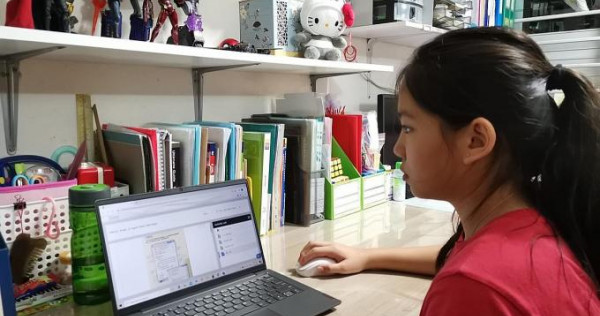
She has prepared herself to face a challenging school year, but Japhanie Tan Yan Ting is now worried she is not learning enough for PSLE because of home-based learning (HBL).
The Primary 6 pupil from Jing Shan Primary School is concerned she may not be able to meet her academic targets.
“I am not sure if I would be able to do as well because we learn less from home now as compared to when we were in the classroom because of the shorter lessons during HBL,” she said.
“When I have questions, I cannot get them answered immediately and after a while, I may forget the questions. This makes it harder to understand the topic completely,” she added.
To motivate herself, the head prefect thinks about getting to secondary school and tries her best to stick to revision schedules she has set for herself.
Madam Lee Suet Fong, the lead school counsellor at the Education Ministry’s guidance branch, said a healthy state of mental well-being is important for a student as it promotes a spirit of resilience during the growing years and especially during this period of time.



.jpg "ntucprank-1.jpg")