From mascots and campaigns to dishing out reward points and charging for tray use, much has been done to encourage people to return their trays after using them at food centres.
Yet, the message still does not seem to have really gotten through.
In May, the Public Hygiene Council gave a four out of 10 rating for tray return, the lowest compared with the six or seven marks given to other areas such as personal hygiene, litter disposal and toilet cleanliness.
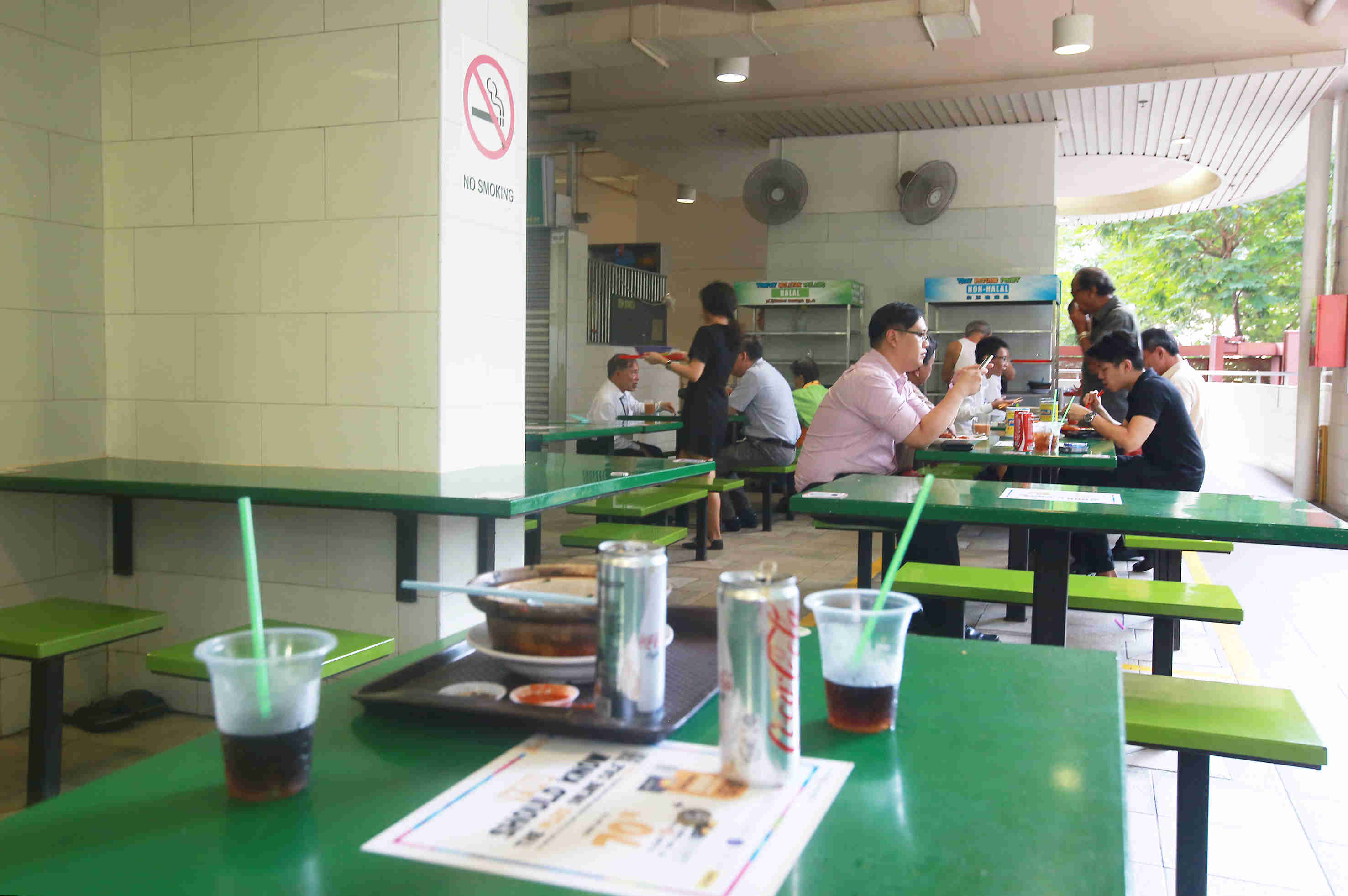
In food courts and hawker centres, patrons often carry the food they buy on a tray to their tables. After eating, many leave their trays – complete with leftovers – lying around, messing up tables. They expect cleaners to clear the trays when they should be returning the trays to tray-return stations at the centres.
The poor rate of tray return is not for want of trying to get people to do so. Singa – the mascot of the Singapore Kindness Movement (SKM) – was roped in in 2008 when the SKM threw its support behind a tray-return initiative at the now defunct Suntec Fountain Food Terrace. Fliers were also given out during lunchtime to spread the message.
In 2008, The Straits Times launched a tray-return campaign called Goodness Gracious Me! – complete with posters, table stickers and volunteers to guide diners. Tray returns rose at first, then lapsed.
Since 2013, when the NEA launched its Tray Return Initiative, all 109 hawker centres have had tray-return points installed. Close to 700 food outlets, including food courts and quick service restaurants, also have such facilities.
But the response from patrons leaves much to be desired. Tray-return stations have been found to be mostly empty even during busy lunch hours, and of the few who returned their trays, they did so because they needed a table for themselves.
In one case, a bicycle was even found to be secured to a tray-return rack at a local hawker centre.
“When the initiative was first launched, people were questioning ‘Why should I return my tray?’,” said Mr Edward D’Silva, chairman of the Public Hygiene Council. “I don’t think the situation has really improved much. People still have the same mindset today.”
WHY THE RELUCTANCE?
Ask people why Singaporeans do not return trays after using them, and they will give many reasons. One is that they are worried about cleaners losing their jobs.
“People may think that we are stealing their jobs,” said one diner, even though tray-returning is only a small part of a cleaner’s work.
Some diners have also shared how cleaners had chided them for trying to make them “look bad” if they returned their own trays.
Another key point raised was how many extend the expectation of service they receive in restaurants to that in hawker centres and food courts.
Besides, there’s the common excuse of “I don’t want to get my hands and clothes dirty”.
Singapore’s maid culture also does not help. Dr William Wan, general secretary of the SKM, believes people here have become a “victim of (their) affluence. We are used to maids picking up after us”.
Talking to cleaners gives credence to this. One part-time cleaner, aged 60, said her job is “to sort the cutlery and clean the tables. But there are still customers who will wave me over, asking me to clear their trays”.
WHAT HAS WORKED
It was reported this week that the recently revamped ABC Brickworks Market and Food Centre in Bukit Merah is trying to encourage tray-returning with a buffet of measures.
There are standees with the images of a stallholder and cleaner imploring diners to return trays, and murals and TV broadcasts to serve as reminders. The number of tray-return points has also been increased from eight to 12, while students from nearby schools will help spread the message during monthly tray-return “exercises”.
That so much effort is needed to push for something that should be common courtesy shows how tough it has been to convince the public to embrace this etiquette.
But some measures seem to have worked, and these involve either a financial penalty or a reward.
At eatery Timbre+, located at One-North, customers pay $1 for each tray they use, and they can get back the money only when the trays are returned to the washing point. The trays are radio-chipped, allowing them to be tracked.
The system, which started around three months ago, has worked well so far. Mr Edward Chia, Timbre Group’s managing director, said that over 95 per cent of trays are returned.
He believes campaigns will not be as successful because of people’s short attention spans, honed by living in the age of social media and YouTube where short is sweet. “We have to be a bit more direct and clear when we want to change attitudes,” he said.
Instead of penalising patrons, Kopitiam has been incentivising them to return their trays. Last year, it launched its Return Tray for Reward scheme at Kopitiam Food Court at Changi Airport Terminal 3.
Patrons have two hours after purchasing their food to return their trays. Doing so will allow customers to accumulate points when they tap their Kopitiam cards on the electronic reader situated at the tray-return stations. These points can be exchanged for free coffee or toast set.
Mr Yip Keng Soon, director of operations at Kopitiam Investment, said the initiative has proven to be satisfactory enough that it has since been expanded to two food courts at Ng Teng Fong General Hospital and Yishun Community Hospital.
Kopitiam operates more than 70 food court outlets and coffeeshops.
Dr Dianna Chang, a lecturer in SIM University’s marketing programme, believes such incentive-based systems will “work wonders” in producing the desired outcome, but warns “the behaviour change will disappear once the incentive is gone” unless a habit is formed.
But Dr Wan believes it is at least a start, and hopes that over time such carrot-and-stick methods will motivate more Singaporeans to make tray-returning a norm.
“It is said that Singaporeans will queue for freebies. It is also said that we have become a market society – everything is monetised,” said Dr Wan. “There is some truth in that, so monetary or in-kind incentives seem to work. It can only be an initial way to habitualise a good practice… Only ownership of the problem can create a successful tray-return culture.”
EDUCATING THE YOUNG
There are other suggestions on how to improve the rate of tray returns, for instance, placing tray counters at more convenient locations and making them more visible.
Mr D’Silva points to the Kopitiam food court at the National University Hospital. Trays can be slotted easily into pigeonholes, which also makes it easier for cleaners to retrieve used utensils. This improves productivity and efficiency.
Ideally, people should return trays not just because it gives flies, pigeons and other pests less chance to feed off leftovers, and helps clear some space for other diners, but because it is a social grace.
And starting young may be the best way to inculcate this.
Ms Neeta Lachmandas, executive director of the Institute of Service Excellence at Singapore Management University, said education should start at a young age, similar to how children are taught to brush their teeth.
But it is the home where such values are best taught.
Children should be educated to bring their plates and cutlery to the sink after every meal, even if the family has a domestic maid. If such table manners become second nature at home, then children would not think twice about returning trays when they get older.
In the Brickworks example, it is ironic that schoolchildren are the ones playing the role of tray-return advocates when one would normally expect adults to be the ones to set an example for others.
After all, clearing up one’s own mess is what an adult does, isn’t it?

This article was first published on July 7, 2016.
Get a copy of The Straits Times or go to straitstimes.com for more stories.