Home Blog Page 333

Commentary: Arts and humanities can set you up for life in post-coronavirus world

ANN ARBOR, Michigan: The COVID-19 pandemic has changed many things about the world and our lives in it. 

As more places reopen from shutdowns, preparing for the post-pandemic future has taken on new urgency, not least for those concerned about education and employment prospects in a reshaped world economy that may take years to recover from the deepest recession in nearly a century.

It might seem obvious Singaporeans should increase our longstanding focus on STEM (Science, Technology, Engineering, Mathematics), given the pandemic’s origins and solutions in these fields.

Yet it is the involvement of humanities scholars that is being credited with enabling the German government to reopen its economy.  

Philosophers, historians, theologians, jurists and pedagogical experts outnumbered scientists and medical specialists on an advisory group convened to decide reopening issues relating to ethics, law, human and social behavior, political power and the role of government in balancing the needs of health, the environment and the economy. 

This has not happened in the United States, which has not been notably successful in combating the pandemic.

Yet here the arts and humanities are becoming increasingly important to technological advance, business, tech employment, and STEM education itself. 

As Microsoft President Brad Smith, and Executive Vice President of Artificial Intelligence (AI) and Research Harry Shum wrote in 2018: “Skilling up for an AI-powered world involves more than science, technology, engineering, and math. As computers behave more like humans, the social sciences and humanities will become even more important.”

“Languages, art, history, economics, ethics, philosophy, psychology and human development courses can teach critical, philosophical and ethics-based skills that will be instrumental in the development and management of AI solutions.”

Microsoft's President Brad Smith speaks at the Web Summit, in Lisbon

Microsoft’s President Brad Smith speaks at the Web Summit, in Lisbon, Portugal on Nov 6, 2019. (Photo: REUTERS/Pedro Nunes)

HUMANS AT THE HEART OF A WORLD OF ADVANCED TECHNOLOGY

COVID-19 will accelerate trends toward digitalisation, automation and AI.  We already know that in the future workspace, humans and machines will work together as a team, collaborating intelligently to enhance each other’s complementary strengths.

Humans are good at solving problems requiring adaptability, creativity, and social skills. Machines can analyse large amounts of data at a high speed impossible for humans, and can outperform humans on well-defined questions — for example, enabling much faster analysis of the COVID-19 virus and development of treatments for it.

For the human-machine partnership to function optimally, we should understand how the two agents can most effectively augment each other, and how to redesign the interaction process to support this.

READ: Commentary: Alibaba makes a whopping US$28 billion bet on its next breakthrough act

READ: Commentary: This COVID-19 outbreak, corporate leaders should acknowledge they don’t have all the answers

Take automated vehicles, which have huge economic and safety benefits. According to the Society of Automotive Engineers (SAE), vehicle automation ranges from level 0 (no automation) to level 5 (full automation).

Almost all automated vehicles on the road are at level 2 (partial automation), where the vehicle can control steering, accelerating and decelerating but the human driver is responsible for monitoring the environment and retaking control from the automated vehicle if it reaches its performance limit.

At level 3 (conditional automation), the vehicle will have “environmental detection” capabilities, but still require human override in corner cases. In level 4 (high automation), the vehicle can perform all driving functions under certain conditions and in certain areas.

For other conditions and areas, humans still need to drive, which hinges on the design of novel human-machine interfaces.

Can we expect a human driver who has been watching movies or texting friends in a level 3 automated vehicle to quickly move attention to the driving task, comprehend what is happening in the environment, and perform an appropriate maneuver, all within seconds?

How do we design better interfaces to help the human driver negotiate takeover transitions? To answer such questions, we need to better understand humans, their cognitive, physical and emotional capabilities, for which the arts and humanities are necessary.

ECONOMICS AND BUSINESS

According to Northwestern University professors Gary Saul Morson and Morton Schapiro, economic models fail when they lack human understanding, specifically culture, stories and ethical considerations.

A trader works on the floor of the New York Stock Exchange shortly before the closing bell as the m

A trader works on the floor of the New York Stock Exchange shortly before the closing bell as the market takes a significant dip in New York, U.S., Feb 25, 2020.  (Photo: REUTERS/Lucas Jackson)

They recommend studying literature, since novels help develop empathy by requiring readers to see the world as their stories’ characters do. 

Nobel prize-winning economist Robert Shiller also argues that popular stories which affect individual and collective economic behavior are what move markets.

For example, fear of “technological unemployment” — a narrative that robots were taking people’s jobs — created panic which exacerbated the stock market plunge during the Great Depression of the 1930s.

On the personal career front, top executives interviewed by the World Economic Forum in 2016 identified ten essential skills for business success: complex problem solving, critical thinking, creativity, people management, coordinating with others, emotional intelligence, judgment and decision making, service orientation, negotiation skills and cognitive flexibility. 

READ: Commentary: Humanities at the heart of a holistic education in a tech-driven world

READ: A liberal arts education in Singapore and the usefulness of ‘useless’ knowledge, a commentary

Academic commentator Richard Greenwald concluded that these skills are rooted in liberal arts education, explaining that so many Fortune 500 and tech startup CEOs have liberal arts degrees because “the liberal arts alone provides the basis for leadership, lifelong learning, and a meaningful life.” 

The late Steve Jobs famously said at a 2011 Apple product launch: “It’s in Apple’s DNA that technology alone is not enough — it’s technology married with liberal arts, married with the humanities, that yields us the results that make our heart sing.”

Along the same lines, a 2018 Linked-In survey found that 57 per cent of leaders said that soft skills like leadership, communication and collaboration were more important than hard skills. 

A 2015 British Council study in 30 countries found that 55 per cent of the 1,700 corporate, non-profit and government leaders surveyed had either a social sciences or humanities bachelor’s degree, more common among younger leaders (aged under 45).

A technician works at a genetic testing laboratory of BGI, formerly known as Beijing Genomics Insti

FILE PHOTO: A technician works at a genetic testing laboratory of BGI, formerly known as Beijing Genomics Institute, in Kunming, Yunnan province, China December 26, 2018. REUTERS/Stringer

Other US labour market surveys show liberal arts graduates’ employment in STEM fields in the US has grown much faster than that of computer science and engineering graduates; and that liberal arts graduates make up a larger percentage of today’s tech workforce than technical graduates do. 

This is because STEM companies need employees who can understand and communicate with diverse users and partners, and contribute to the creative and ethical processes of developing technology for the market. 

Most jobs in STEM fields are non-STEM, from sales and marketing, to people and product management, training and support services. Among humanities graduates, the biggest group go on to management positions (15 per cent), followed by office and administrative positions (14 per cent), sales (13 per cent), education (12 per cent), business and finance (10 per cent).

READ: Commentary: Science goes viral, thanks to COVID-19. But there are roadblocks along the way

READ: Commentary: COVID-19 could make remote working a permanent feature. That has several implications for firms

Rapid technological change and increased volatility, uncertainty, complexity and ambiguity mean most people will change jobs, perhaps frequently, during their careers. Liberal arts education helps provide the broad disciplinary preparation, flexibility and adaptability, critical and imaginative thinking, that will facilitate the constant reskilling required. 

THE IMPLICATIONS FOR SINGAPORE     

Singapore comes second only to the US in the Swiss business school IMD’s 2019 world digital competitiveness ranking. 

Yet without developing greater competencies in the arts and humanities, we risk losing out as higher levels and ever greater portions of global tech value chains are increasingly accounted for by activities and skills derived from them, and “hard” skills become obsolete or more readily automated.

A 2019 Brookings Institution study forecasts that computer programmers, financial advisers, and certain types of engineers and software developers are among those whose jobs are most likely to be displaced by AI. More of the jobs which remain will require more durable “soft” skills, which engagement with the arts and humanities can develop.

Student studying for a test.

(Photo: Unsplash/Lonely Planet)

But the arts and humanities are also desirable for their own sake, both as expressions of our humanity, and as a valuable consumption good. 

The COVID-19 lockdown experience saw an explosion of arts activity online, with choirs, orchestras, bands, dance concerts, play readings, art lessons and the like spontaneously self-organizing, even across national boundaries.

“Streaming wars” among “hard” tech companies like Amazon and Apple as they venture into the entertainment space, chasing an “old-line” company like Disney, illustrate the growing importance of arts content in the world of tech, and of tech in the world of the arts, something already familiar to millions of video gamers the world over.

READ: Commentary: Reading can be a useful escape from the circuit breaker in more ways than one

LISTEN: COVID-19: Aviation and flying never ever the same again

The arts and humanities are also necessary for understanding consumer behavior, since the consumer is a human being evolving in particular historical, sociological, psychological and cultural contexts that they study and express.

It is impossible to serve her without understanding these contexts, for example through “design thinking”, increasingly viewed as a core business capability.

Machine learning and data analytics can yield patterns of consumer behavior, but interpreting them relies on insights gleaned from the arts and humanities.  Thus employers’ demand for such graduates has increased as developments in data analytics and AI progress.

For Singapore, the unique value we can deliver to the nearly all-encompassing world of global tech is our understanding of people and societies in our own regional neighborhood. For this, we will need to expand our competencies beyond STEM and the Western world of digitalisation to include the humanities, and the visual, performing and literary arts of our Southeast Asian neighbors. 

In education, the arts and humanities provide a means of engaging students with STEM disciplines and with business. There are STEAM (A for Arts) programmes in many American K-12 schools, and in Singapore.

student laptop

(Photo: Unsplash/Dan Dimmock)

The professional theater company Shakespeare-in-Detroit collaborates with Detroit Public Schools educators to teach “the Science of lighting production, the Technology of sound design, the Engineering or construction of a form or costume, the Art of classical performance, and the Mathematics of building a set … along with development of soft skills such as communication and confidence” and increased literary competencies.

Oxford University’s Said Business School uses the performing arts to teach business leadership in its MBA programme.

The US’ National Academies of Sciences, Engineering and Medicine 2018 report on The Integration of the Humanities and Arts with the Sciences, Engineering and Medicine in Higher Education concluded that integrating arts and humanities with STEMM education (the second M standing for Medicine) is strongly associated with improved written and oral communications skills, teamwork skills, ethical decision making, critical thinking and deeper learning, strong content mastery, general engagement and enjoyment of learning, empathy and resilience, ability to apply knowledge in real-world settings and science literacy.

All of these have labour market, job performance and broader economic payoffs. 

READ: Commentary: How to sabotage your child’s future – five dangerous notions about life, careers and education

READ: Commentary: Singaporeans more adaptable than they give themselves credit for

One example is the University of Michigan’s Integrated Product Development course jointly taught by an art and design, and a business professor, in which students from engineering, design and business explore together the creative, technological and business-related questions involved in developing new products from ideation and prototyping to production and bringing to market. 

Finally, arts practitioners are often at the frontier of unearthing and examining social issues. 

The COVID-19 crisis among foreign workers reminds us of the Singapore arts community’s proactive role in highlighting and creating empathy for their dilemma in our midst, through numerous plays, poetry, stories, photography exhibitions, and films which have won showings and awards at international festivals, like Ilo Ilo (Cannes, 2013), I Dream of Singapore (Berlinale, 2016) and A Land Imagined (Locarno, 2018). Heeding their efforts could have pre-empted our current crisis.

To advance in technology, which requires human engagement, we need to also advance in the arts and humanities.  Transition to a post-COVID-19 world more heavily dependent on technology, and more aware of both the shortcomings and potentials of human society under crisis, is a good time to do this.

LISTEN: Disruption 101: How COVID-19 is revolutionising work

BOOKMARK THIS: Our comprehensive coverage of the novel coronavirus and its developments

Download our app or subscribe to our Telegram channel for the latest updates on the coronavirus outbreak: https://cna.asia/telegram

Linda Lim, Gunalan Nadarajan and Jessie Yang are Singaporean professors at the University of Michigan. This is an abridged version of a commentary first published on Academia.SG.

Source link

Mother's Day chaos: Angry Singaporeans say restaurants ruined their celebrations

[ad_1]

With the mad rush to secure one last cup of bubble tea last month and dramatic fights at several fast-food outlets, the circuit breaker period hasn’t exactly been the smoothest ride for many in the food industry.

Unfortunately, Mother’s Day was no exception.

Aggrieved Singaporeans took to social media yesterday (May 10) to air their complaints about long waiting times, unfulfilled orders and radio silence from many restaurants, derailing their celebrations and leaving their families scrambling for last-minute alternatives.

One local F&B company that had netizens fuming was Paradise Group, which helms several popular chains including Canton Paradise and Paradise Dynasty.

[ad_2]

Source link

COVID-19: Former Chancery Court site to house healthy foreign workers

SINGAPORE: The former Chancery Court site at 36 Dunearn Road has been designated as an alternative accommodation to house healthy foreign workers in essential services.

In a statement to CNA, the Singapore Land Authority said that the site can house up to 1,200 workers. Some foreign workers moved in last Friday (May 8).

Far East Organization, which owns the Chancery Court site, had offered it for the Government’s use to “support its efforts in containing the virus outbreak”, said SLA.

SLA did not confirm how many workers are currently residing there.

READ: The Big Read: Solving Singapore’s foreign workers problem requires serious soul searching, from top to bottom

In its statement, SLA said that Chancery Court will be used to house healthy foreign workers in essential services, with all necessary measures in place, including on-site amenities and meals provided.

Employers will also provide transport and workers are expected to observe circuit breaker measures.

Singapore has reported 23,787 coronavirus cases to date, the majority of which are linked to foreign worker dormitories. Twenty-one patients have died from complications arising from COVID-19 infection.

Minister for National Development Lawrence Wong announced last month that foreign workers who are not sick and working in essential services will be housed separately from those in dormitories, in a bid to curb the spread of the outbreak.

Military camps, Changi Exhibition Centre, vacant HDB flats and offshore floating lodgings have been identified as potential accommodation.

Chancery Court 1

File photo of Chancery Court. (Photo: Jeremy Long) 

READ: Singapore reports 486 new COVID-19 infections, number of discharged cases hits new daily high of 504

Chancery Court, which is located across the road from Anglo-Chinese School (Barker Road), has a site area of almost 260,000 sq ft, comprising a 16-storey tower block and seven blocks of maisonettes.

The privatised Housing and Urban Development Company (HUDC) estate was sold for S$401.78 million in an en bloc sale in 2018.

According to Far East Organization, residents vacated the site around the middle of last year.

The developer also said that none of its other properties is being used for COVID-19-related accommodation, aside from a company under Far East Hospitality, which is offering hotels to provide accommodation.

READ: Employers must pay foreign workers isolated in dormitories even if work passes are cancelled: MOM

Chancery Court 4

A security post at Chancery Court. (Photo: Jeremy Long) 

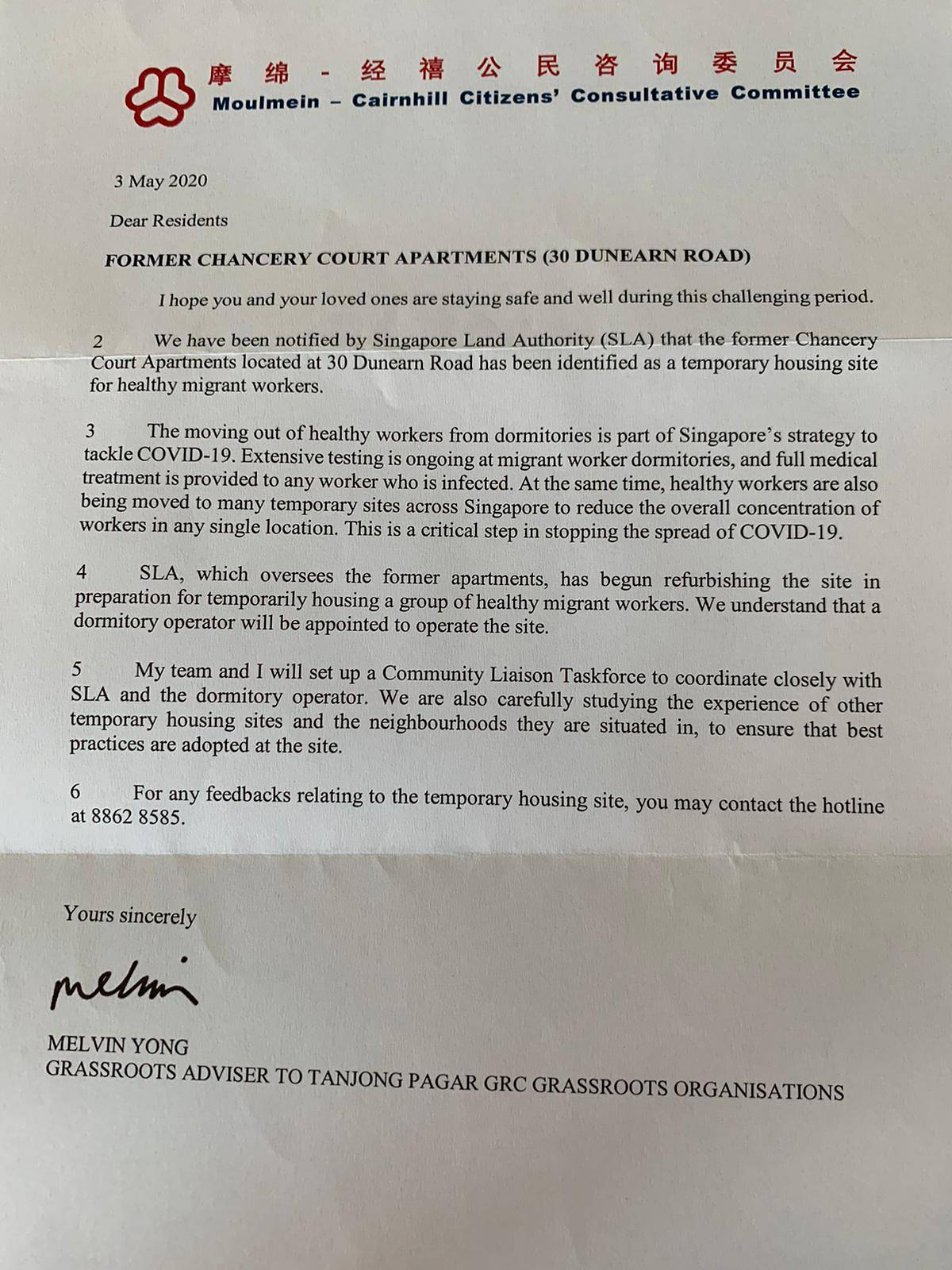
Grassroots adviser to Tanjong Pagar GRC Melvin Yong said that residents living around the Chancery Court site were informed of the developments in a letter, which included key background information on the temporary housing facility.

Chancery Court letter PA

In the letter, dated May 3, Mr Yong said that a dormitory operator will be appointed to operate the site.

In the meantime, a community taskforce has been formed to work with relevant stakeholders and a hotline has also been set up for residents if they have queries. 

BOOKMARK THIS: Our comprehensive coverage of the coronavirus outbreak and its developments

Download our app or subscribe to our Telegram channel for the latest updates on the coronavirus outbreak: https://cna.asia/telegram

Source link

Man dies of heart attack caused by blood clot; confirmed to have COVID-19 after death

The man is the fourth COVID-19 case since the start of April to have died from heart issues and whose cause of death is not linked to the coronavirus. His death was not added to Singapore’s official COVID-19 death toll.

Sengkang General Hospital

Google Street View of Sengkang General Hospital. 

SINGAPORE: A 53-year-old man who died of a heart attack due to a blood clot was confirmed to have COVID-19 after his death, the Ministry of Health (MOH) said on Monday (May 11).

The Indian national was taken to the emergency department of Sengkang General Hospital on Saturday after suffering a cardiac arrest, MOH said in its daily update.

READ: Singapore reports 486 new COVID-19 infections, number of discharged cases hits new daily high of 504

He died on Saturday and was confirmed to have the coronavirus on Sunday after his death.

“The cause of death is ruptured myocardial infarction due to coronary thrombosis,” the health ministry said.

He is the fourth COVID-19 case since the start of April to have died from heart issues and whose cause of death is not linked to COVID-19. His death was not added to the official death toll.

READ: COVID-19: Why 3 positive cases who died from heart issues were not added to Singapore’s official death toll

“Only cases where the attending doctor or pathologist attributes the primary or underlying cause of death as due to COVID-19 infection will be added to the COVID-19 death count,” MOH said.

“This is consistent with international practice for classifying deaths.”

Coronary thrombosis is the formation of a blood clot inside a blood vessel of the heart, restricting blood flow. This can lead to myocardial infarction – the medical term for a heart attack – which occurs when blood flow slows or stops to part of the heart.

It is different from a cardiac arrest, which is when the heart cannot pump effectively, resulting in a sudden loss of blood flow.

“In 2018, 86 male foreign workers aged 25 to 59 passed away due to heart disease in Singapore,” MOH said on Monday.

Reports from doctors in China, Europe and the US have noted a dangerous complication of COVID-19 – blood clotting.

These “thrombotic events” occur for a variety of reasons among intensive care patients, but the rates among COVID-19 patients are far higher than would be otherwise expected, AFP reported.

READ: Mysterious blood clots are COVID-19’s latest lethal surprise

 A recent paper from the Netherlands in the journal Thrombosis Research found that 31 per cent of 184 patients suffered thrombotic complications, a figure that the researchers called “remarkably high” – even if extreme consequences, like amputation, are rare.

ONE COVID-19 DEATH

MOH reported a 21st fatality due to COVID-19 on Monday.

Case 1305, a 68-year-old Singaporean, died from complications due to COVID-19 on Monday.

He was confirmed to have the coronavirus on Apr 5 and had a history of hypertension and hyperlipidaemia, MOH said.

READ: Singapore reports 486 new COVID-19 infections, number of discharged cases hits new daily high of 504

The man is linked to two other COVID-19 patients – Cases 1660 and 3984.

Case 1660 is a 65-year-old Singaporean woman who tested positive for COVID-19 on Apr 8. She is warded at the National Centre for Infectious Diseases.

Case 3984 is a seven-year-old Singaporean boy who was confirmed to have the coronavirus on Apr 15. He has been discharged after making a full recovery.

BOOKMARK THIS: Our comprehensive coverage of the coronavirus outbreak and its developments

Download our app or subscribe to our Telegram channel for the latest updates on the coronavirus outbreak: https://cna.asia/telegram

Source link

53-year-old man tests positive for Covid-19 after death

[ad_1]

A 53 year-old Indian national was confirmed to have Covid-19 on May 10 after he died in Sengkang General Hospital on Saturday (May 9), the Ministry of Health said in a statement on May 11.

He was Case 23550 and had been admitted to the hospital after suffering from cardiac arrest.

MOH said the cause of death was ruptured myocardial infarction due to coronary thrombosis.

Only cases where the attending doctor or pathologist attributes the primary or underlying cause of death as due to Covid-19 infection will be added to the Covid-19 death count, MOH added. 

In its update, MOH reported another death.

Case 1305, a 68 year-old male Singapore Citizen passed away from complications due to Covid-19 on May 11.

He was confirmed to have the virus on April 5, and had a history of hypertension and hyperlipidaemia.

The National University Hospital has reached out to his family and is extending assistance to them.

[ad_2]

Source link

Family of otters spotted on a day trip to KK Hospital

[ad_1]

There’s no such thing as staying home or social distancing, at least not for these critters out for a stroll over at KK Women’s and Children’s Hospital.

In a video uploaded onto Facebook last Friday (May 8), a family of seven otters could be seen scampering about the hospital lobby.

But even otters had to abide by the no-visitor rule, and they were quickly shooed away from the premises by the person behind the camera.

A security guard on standby also helped to stop oncoming traffic from accidentally hitting the otters, before directing them down a pedestrian path instead.

[ad_2]

Source link

COVID-19: Gaming firm Razer to give out about 5 million free masks to Singapore residents

SINGAPORE: Tech firm Razer will be giving out free surgical masks to all Singapore residents aged 16 and above, through a network of vending machines across the island, the company said on Monday (May 11).

Twenty vending machines will be set up across Singapore, including at all malls under Frasers Property Retail and JustCo co-working spaces, by Jun 1. 

READ: Razer’s face mask manufacturing line begins production, able to produce 5 million masks a month 

The firm estimates that about 5 million masks will be dispensed, and hopes the initiative will complement recently-announced plans by the Government to provide more reusable masks for households.

Razer vending machine

About 20 of Razer’s vending machines will be deployed at “high traffic” locations. (Photo: Razer) 

“There are times potentially where you leave your house and you realise, ‘Oh no, I don’t have the mask’. We think that this is something that we can do … to ensure that society stays safe,” said Mr Lee Li Meng, chief strategy officer of Razer.

To redeem the masks, users must register for the mobile wallet app, Razer Pay, to verify their identity.

When beta testing begins in the coming days, the app will issue a QR coupon code — which will be valid for three months — to be scanned at vending machines for mask collection.

Razer vending machine scan

A QR coupon code will have to be scanned at vending machines for mask collection. (Photo: Razer) 

All machines will also be progressively installed by Jun 1, before “circuit breaker” measures are expected to be lifted.

READ: Gaming firm Razer to set up face mask manufacturing line in Singapore amid COVID-19 shortage

Razer said that the exercise would be rolled out in phases to ensure that safe distancing measures can be adhered to. For example, users will get their codes progressively. 

Mr Lee said it would be a “very quick process” because the masks are dispensed via vending machines.

Razer vending machine closeup

Around five million masks will be dispensed, estimates Razer. (Photo: Razer) 

“But obviously, we will encourage people, ‘If you see a long line, please don’t hang around. Come back and get the mask when the line is shorter’.”

The tech firm said the surgical masks are to be used in conjunction with reusable masks.

“Razer’s mask vending machines would ensure that the public always has access to masks when out and about,” the company said. 

“For example, if anyone has forgotten or misplaced their reusable masks, they will be able to purchase a single use Razer surgical mask anytime from the conveniently located network of vending machines.”

Mr Lee added that although Razer plans to add more locations to its offerings, it is still trying to find enough vending machines amid current supply chain disruptions.

DOUBLING PRODUCTION CAPACITY TO 10 MILLION MASKS A MONTH

Razer is working with local manufacturer Sunningdale Tech to develop a fully automated mask production line in Singapore. 

“At full capacity, the production line can produce up to 5 million masks a month and together with Sunningdale, Razer expects to expand production to up to 10 million masks a month soon,” Razer said.


Razer face mask line

A photo of Razer’s face mask manufacturing line in Singapore. (Photo: Facebook/Min-Liang Tan) 

Mr Lee said he believes there is enough demand for masks, as Razer has received interest from firms “not just in Singapore, but in the region and in fact, globally”.

He said that manufacturing masks for Singapore’s needs would be the first priority – and only excess supply would be allocated beyond its borders.

When asked if mask manufacturing and dispensing would become a core part of the firm’s business, Mr Lee said it is “still early days”.

“I think we are focusing on making sure that the first reason why we’re doing this is to make sure that we are able to supply the masks,” he said.

“We will see and observe the situation.”

BOOKMARK THIS: Our comprehensive coverage of the coronavirus outbreak and its developments

Download our app or subscribe to our Telegram channel for the latest updates on the coronavirus outbreak: https://cna.asia/telegram

Source link

No new cases linked to Singapore’s biggest COVID-19 cluster for first time since Apr 1

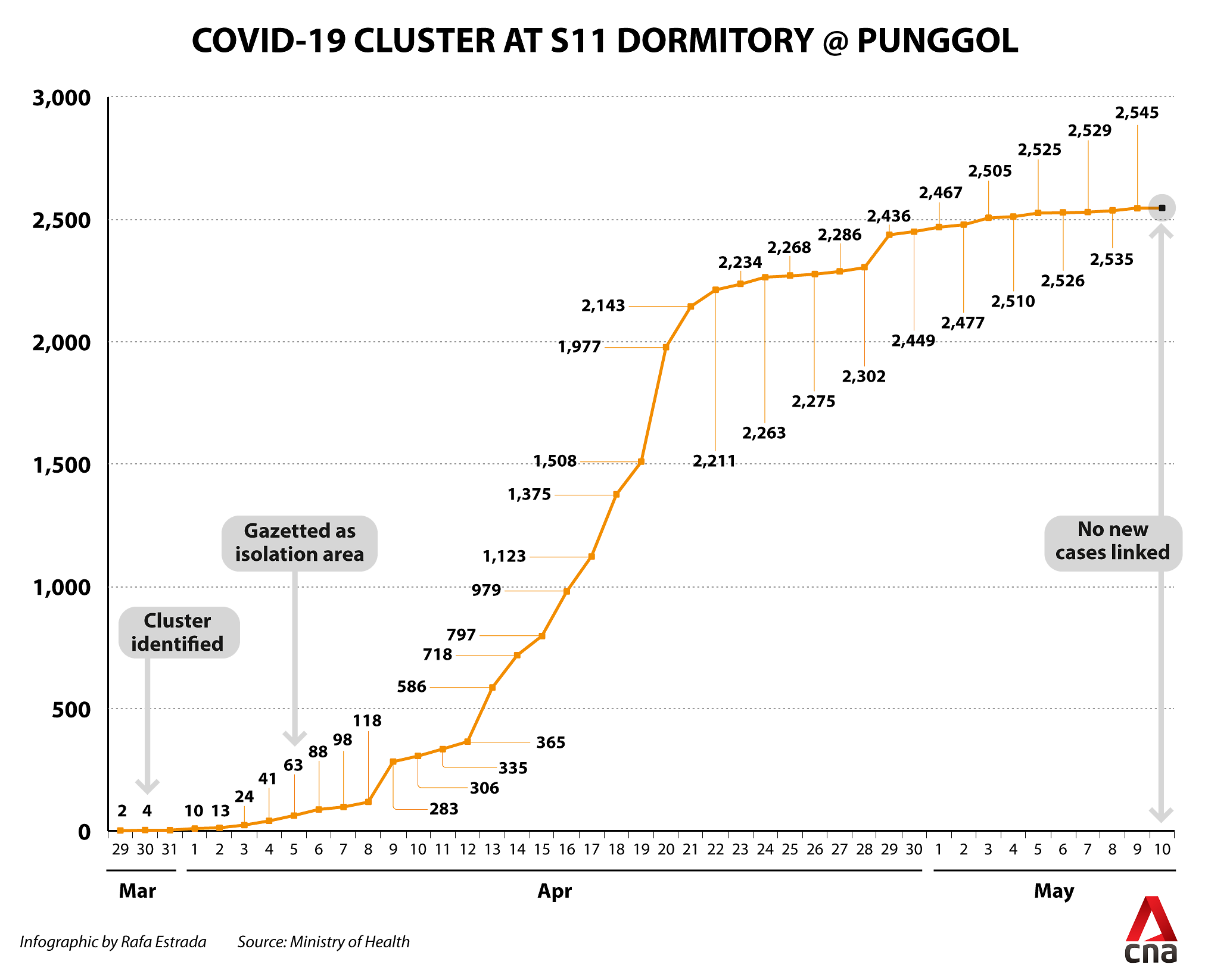
SINGAPORE: No new COVID-19 cases were linked to the cluster at the S11 @ Punggol foreign worker dormitory for the first time since Apr 1, according to the Ministry of Health’s (MOH) update of daily figures on Sunday (May 10).

The cluster – the largest in Singapore, with 2,545 cases as of Sunday – was among the first to be identified at dormitories.

Since then, more than 20,000 cases have been linked to dormitories across the country, forming nearly 90 per cent of COVID-19 cases in Singapore.

READ: COVID-19: Why 3 positive cases who died from heart issues were not added to Singapore’s official death toll

HOW THE S11 CLUSTER GREW TO SINGAPORE’S BIGGEST

The first two linked patients – Cases 826 and 829 – tested positive for the coronavirus on Mar 28.

Case 826, the first in the cluster, was a 48-year-old Bangladeshi national and long-term pass holder who was admitted to Sengkang General Hospital. Case 829, a 34-year-old Indian national and work pass holder, tested positive for the coronavirus on the same day and was admitted to Khoo Teck Puat Hospital.

On Mar 30, two more cases were linked and MOH identified S11 @ Punggol as a new cluster.

No new cases were linked to S11 the next day, but on Apr 1, six new cases were added, taking the total at the dormitory to 10.

S11 Dormitory @ Punggol

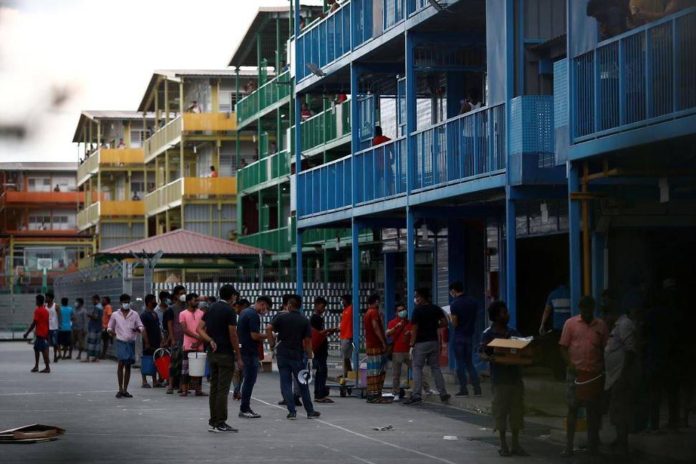
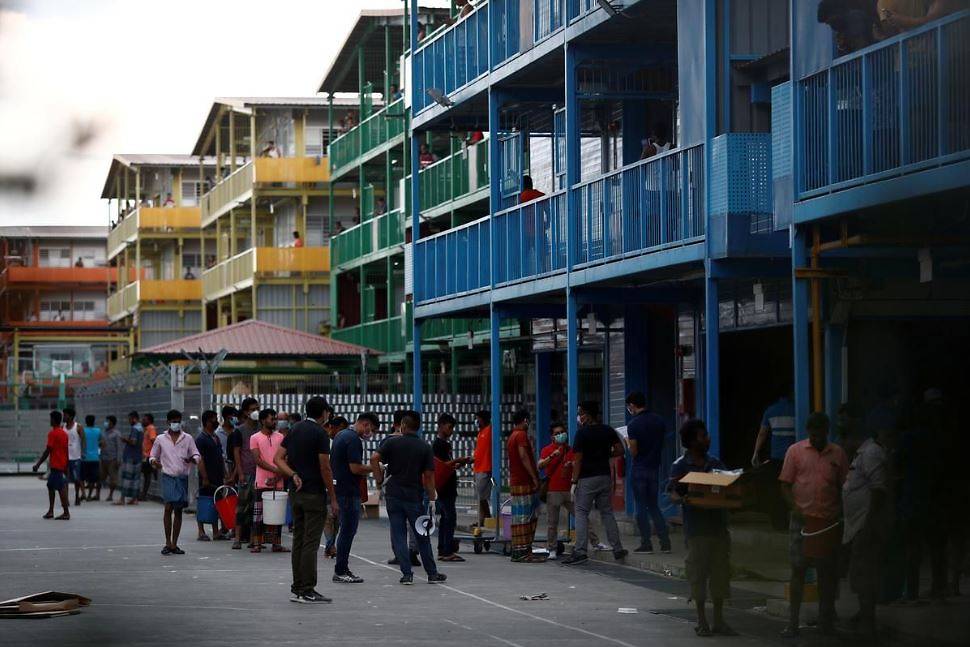
Workers queue for food at S11 Dormitory @ Punggol on Apr 6, 2020. (Photo: Reuters / Edgar Su) 

On Apr 5 – the third day of double-digit increase at the cluster – S11 was gazetted an isolation area, together with Westlite Toh Guan dormitory. They were the first two dormitories to be gazetted.

That meant nearly 20,000 workers had to stay in their rooms for 14 days.

S11 COVID-19 cluster from Apr to May 10

READ: COVID-19: Nearly 20,000 foreign workers in quarantine in S11 Dormitory, Westlite Toh Guan

Manpower Minister Josephine Teo said then: “The key objective of all these measures is really to ensure the health and well-being of everyone.

“Not just Singapore citizens, but also foreign workers who are here, helping our economy, and their employers.We want to give foreign workers the assurance that these measures are taken in their interests, and their well-being.”

The number of cases at S11 crossed the 100 mark on Apr 8, a day before it saw its first triple-digit increase.

On Apr 9, 166 more cases were linked to the cluster, which by now had 283 confirmed cases.

A “dedicated strategy” involving testing and moving healthy workers to other places was introduced on Apr 9 by the multi-ministry task force.

A link between a growing cluster at Mustafa Centre shopping mall and several dormitories, including S11, was established as well.

READ: Singapore reports a record 287 new COVID-19 cases with more than half linked to dormitory cluster

More clusters have since been discovered in other dormitories.

S11 dormitory Singapore

View of the S11 Dormitory @ Punggol in Singapore on Apr 17, 2020. (Photo: AFP/Roslan Rahman)

NUMBER OF CASES AT S11 GROWS

The cases at S11 continued to climb steadily in the second week of April.

On Apr 13, another 222 cases were linked to the dormitory, taking the total past the 500 mark to 586 cases.

A day later, MOH announced that medical teams would be deployed to all dormitories, as authorities increased testing among migrant workers.

READ: COVID-19: All foreign worker dormitories to have medical teams of doctors and nurses from hospitals, polyclinics

At S11, the number of cases continued to grow quickly, with triple-digit increases for nearly every day over the following week.

On Apr 17, the count at S11 crossed the 1,000 mark.

A day later, 252 additional cases were added to the cluster – the biggest spike there yet.

On Apr 20, the cluster saw yet another daily high, with 469 new cases, taking its total to 1,977 cases.

That would turn out to the peak in cases.

Ng Eng Hen at S11 Dormitory @ Punggol (1)

SAF Medical personnel attending to a foreign worker at S11 Dormitory @ Punggol on Thursday Apr 9, 2020. (Photo: MINDEF)

A man wearing a protective face mask fumigates outside of S11 Punggol dormitory, as the outbreak of

A man wearing a protective face mask fumigates outside of S11 Punggol dormitory amid a COVID-19 outbreak on Apr 7, (Photo: Ministry of Manpower Singapore handout via Reuters)

From then on, the number of cases took a sharp dip. It crossed the 2,000 mark on Apr 21, with 166 cases, and was followed by 71 new cases on Apr 22.

After two days of double-digit increases, six new cases were linked on Apr 25 – the first single-digit increase in nearly three weeks.

The increase at the S11 cluster stayed stable, with small spikes over the next week, bar a 134-case jump on Apr 29.

Health Minister Gan Kim Yong said on Apr 27 the rate of testing for migrant workers had not slowed.

“Our testing capacity for migrant workers is about 3,000 a day. We have not reduced it. Instead, we have been increasing the capacity of testing of our migrant workers,” he added.

READ: COVID-19: ‘Not true’ Singapore has reduced testing among migrant workers, says Gan Kim Yong

S11 was still, by far, the largest COVID-19 cluster in Singapore.

Mrs Teo told Parliament on May 4 the situation within larger dormitories was mostly stable for now.

Six days later, on May 10, MOH reported no new cases were linked to S11 – the first time since the start of April. 

BOOKMARK THIS: Our comprehensive coverage of the coronavirus outbreak and its developments

Download our app or subscribe to our Telegram channel for the latest updates on the coronavirus outbreak: https://cna.asia/telegram

Source link

The (moderate) rush back to McDonald's, as depicted on social media

[ad_1]

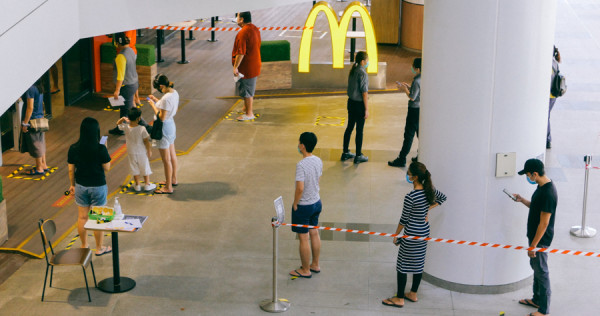
McDonald’s is officially open for business islandwide after three weeks of closure, and considering our peculiar obsession with the fast-food chain, it’s safe to presume that Singaporeans will be making a beeline to its outlets today (May 11). 

Knowing this, the Golden Arches urged customers not to make a mad rush back for its delivery, takeaway and drive-through services. 

“We hope you’ll understand as this allows us to reduce the number of crew members in our restaurants and lets our more senior staff stay safely at home,” wrote McDonald’s Singapore in a Facebook post yesterday.

[ad_2]

Source link

Bank and pharmaceutical giant among firms that returned or donated Jobs Support Scheme wage subsidies

SINGAPORE: British bank Barclays and German pharmaceutical company Boehringer Ingelheim are among the businesses that have returned or donated the Jobs Support Scheme (JSS) payouts.

A total of 32 companies returned the wage subsidies worth a combined S$35 million, the Ministry of Finance said on Sunday (May 10).

Another 29 firms that received the funds for April have pledged to decline future payouts from the Government. 

The wage subsidy programme, which was first announced during the Budget statement in February, had been enhanced in subsequent budgets to help firms retain their workers as businesses take a hit from the impact of COVID-19.

For the month of April and May, the subsidies cover 75 per cent of the first S$4,600 of each local employee’s salary. 

Barclays returned the money because it believes the Singapore Government is in the best position to ensure that the funds are well-used within the various communities here, said Mr Bal Bagary, country manager of Barclays Singapore and chief financial officer of Barclays International Asia Pacific.

He did not reveal the amount returned. 

The bank has about 1,000 employees in Singapore, a majority of them Singaporeans and permanent residents, Mr Bagary pointed out.

“Despite the macroeconomic downturn caused by the COVID-19 situation, the bank’s position remains robust,” Mr Bagary said, citing its strong corporate and investment bank business. 

“In line with our global guidelines and to keep our support to the local community and our stakeholders, we made the decision to withdraw from the JSS in favour of the broader community in Singapore,” he said, adding that the bank will also work with some charities. 

READ: COVID-19: 75% wage subsidy for firms in all sectors to be extended till May, measures to cost S$3.8 billion

Boehringer Ingelheim donated S$500,000 of its payouts to five organisations: The Migrant Workers Fund; Sayang Sayang Fund; Invictus Fund; SG Red Cross and the Society for the Prevention of Cruelty to Animals (SPCA).

The amount makes up the majority of its JSS payments, said its country managing director Gerrard McKenna, adding that the decision to donate came after “considering the immediate needs of the Singapore community”. 

The pharmaceutical company, which has more than 200 employees locally, has not been immediately negatively affected by the pandemic, he noted.

Medicine orders have recently gone up as some customers request “additional quantities to ensure uninterrupted supply during these uncertain times”. 

“In the short-term, we expect our revenue to be resilient,” said Mr McKenna, who is also the head of human pharma for the Southeast Asia and South Korea regional operating unit. “However, there is a possibility that there will be a medium to long-term impact due to COVID-19.”

It intends to refuse future payouts too, if business in Singapore and the region is not adversely affected.

Another corporation that donated the money is Dutch multinational DSM Nutritional Products. 

Its Asia-Pacific president Pieter Nuboer said the company is fortunate that its business model globally has proven to be “relatively resilient”. 

In a Facebook post on Sunday, Finance Minister Heng Swee Keat lauded such companies for their “sense of responsibility and shared community”.

“Some companies have coped better than others. I am heartened that a number of them have come forward to return the first payment of JSS they received and to decline future payments,” said Mr Heng.

“I hope their exemplary action will inspire other companies that are doing well to consider doing the same.”

Mr Heng also said he hopes companies will also show recognition and appreciation for workers who have stepped up during the “circuit breaker” period. 

Singapore’s largest supermarket chain, NTUC FairPrice, is using the government funds for an existing “special package” that it had put together for its employees. About 80 per cent of its 10,000-odd workforce are Singaporeans or permanent residents.

“The additional support provided by the Government for all local workers in Singapore will go towards augmenting an existing special package that we had put together to recognise and show appreciation to our staff for their invaluable contributions and efforts during this challenging period,” said a FairPrice spokesperson.

The company declined to elaborate on what the “special package” is. 

NTUC FairPrice (2)

Customers wait in line to pay for their groceries at NTUC FairPrice in Hougang 1 shopping centre, Apr 22, 2020. 

FairPrice noted that it has provided employment for about 3,500 temporary and casual workers to support higher transaction volumes in April.

According to retail sales figures, supermarkets and hypermarkets saw higher sales of 35.9 per cent year-on-year in March, as demand for groceries went up during the COVID-19 outbreak.

Sheng Siong reported a first quarter net profit of S$29 million, a jump of 49.9 per cent compared to a year ago. The supermarket player had said it would give its employees an additional one month of salary

READ: COVID-19: Minimarts, provision shops see brisk business but need additional manpower

When asked whether it accepted the JSS payouts, Sheng Siong declined to comment, saying it is “commercially sensitive”. 

Dairy Farm International, which owns Cold Storage, Giant, Market Place and Jasons Deli, similarly declined to respond to queries. 

In a statement issued on Apr 28, the publicly-listed retail operator said that while its grocery sales profits went up, its health and beauty and convenience business, as well as subsidiary Maxim’s saw sales weaken in the first quarter of 2020.

BOOKMARK THIS: Our comprehensive coverage of the coronavirus outbreak and its developments

Download our app or subscribe to our Telegram channel for the latest updates on the coronavirus outbreak: https://cna.asia/telegram

Source link