Razer’s streak of goodwill continues. The gaming hardware company — known for slapping blinking multi-coloured lights on everything — has been making good on its promise to manufacture face masks in Singapore and donate millions of them worldwide amid the coronavirus pandemic.
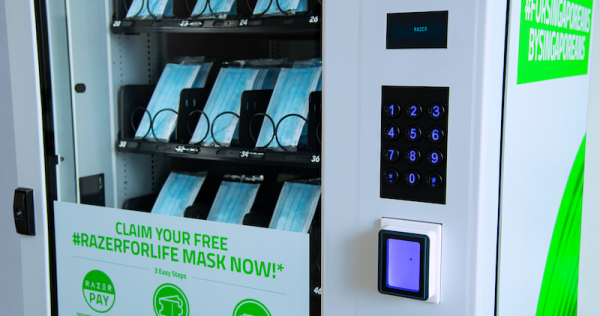
After Razer CEO Tan Min-Liang calmly refuted a Singaporean who accused him of not prioritising his fellow countrymen, the company now plans to sponsor surgical masks to Singaporean adults and residents through their newly established network of vending machines.
The company declares that its triple-layered, single-use face masks are designed for comfort and boast the highest standards of protection recommended by health authorities.
It’s an ambitious project for sure — the company estimates that five million masks will be given out via its 20 vending machines to be deployed island-wide before the expected end of the circuit breaker on June 1.
SINGAPORE: From haircuts to Happy Meals and desserts, people across Singapore were out on Tuesday (May 12) as stores reopened after weeks of closure during the “circuit breaker” to curb the spread of COVID-19.
Among the first to be allowed to reopen were hairdressers and barbers. Quick-cut salons in particular saw snaking queues, with people waiting for their first haircut in weeks or even months.
People queuing up outside a hairdressing salon on May 12, after some circuit breaker measures were eased. (Photo: Gaya Chandramohan)
People queue up outside a hairdressing salon on May 12, following the easing of some circuit breaker measures. (Photo: Gaya Chandramohan)
Temperatures had to be taken, and all staff members and customers at the salons had to keep their masks on at all times.
A barber attends to a customer on May 12, following the easing of some circuit breaker measures. (Photo: Hanidah Amin)
Outdoors, the sweltering heat didn’t deter people from joining similar queues outside neighbourhood hair salons, like this one in Ang Mo Kio.
People queue outside a hairdressing salon on May 12, following the easing of some circuit breaker measures. (Photo: Gaya Chandramohan)
People queue outside a hairdressing salon on May 12, following the easing of some circuit breaker measures. (Photo: Gaya Chandramohan)
People queue outside a hairdressing salon on May 12, following the easing of some circuit breaker measures. (Photo: Gaya Chandramohan)
At full-service hair salons, the pace was slower and less frantic.
Hairdressers were seen tending to two or three customers who had booked appointments in advance.
A customer getting a blow-dry inside a hairdressing salon on May 12, following the easing of some circuit breaker measures. (Photo: Gaya Chandramohan)
Regardless, all hairdressers and barbers were allowed to offer only basic haircut services, which must be completed within an hour.
A customer getting his hair cut on May 12, following the easing of some circuit breaker measures. (Photo: Gaya Chandramohan)
A customer getting a haircut on May 12 2020, following the easing of some circuit breaker measures. (Photo: Hanidah Amin)
Shops selling confectionery and desserts were also allowed to reopen on Tuesday, and saw their first queues after weeks of closure.
People in masks waited in line patiently, keeping a safe distance from each other.
People queue up at an outlet selling pastries on May 12, following the easing of some circuit breaker measures. (Photo: Gaya Chandramohan)
People queue up at a dessert outlet on May 12, following the easing of some circuit breaker measures. (Photo: Gaya Chandramohan)
Opticians, like the one next to this dessert shop, are still not allowed walk-in customers, although those with an appointment can pick up their contact lenses or prescription glasses.
People queue up at a dessert outlet on May 12, following the easing of some circuit breaker measures. (Photo: Gaya Chandramohan)
There were also long queues outside the various McDonald’s outlets that CNA visited.
People queue outside a McDonald’s outlet on May 12, a day after the fast food chain resumed operations. It closed for three weeks after workers at several of its other branches in Singapore tested positive for COVID-19. (Photo: Gaya Chandramohan)
It had been allowed to reopen on May 4 but decided to extend its closure until Monday.
The queue outside a McDonald’s outlet on May 12, a day after the fast food chain resumed operations. It closed for several weeks after several of its other branches in Singapore were identified as a COVID-19 cluster. (Photo: Gaya Chandramohan)
People queue outside a McDonald’s outlet on May 12, a day after the fast food chain resumed operations. (Photo: Gaya Chandramohan)
Pet supply stores were also allowed resume business, and saw a steady stream of patrons stocking up on consumables for their pets.
People shopping at a pet supplies store on May 12, following the easing of some circuit breaker measures. (Photo: Gaya Chandramohan)
Shoppers at a pet supplies store on May 12, following the easing of some circuit breaker measures. (Photo: Gaya Chandramohan)
Many were seen filling their baskets to the brim with pet food and treats, as well as buying toys to keep their animals entertained at home.
People shopping at a pet supplies store on May 12, following the easing of some circuit breaker measures. (Photo: Gaya Chandramohan)
A man leaving a pet supplies store with several bags of pet food on May 12, following the easing of some circuit breaker measures. (Photo: Gaya Chandramohan)
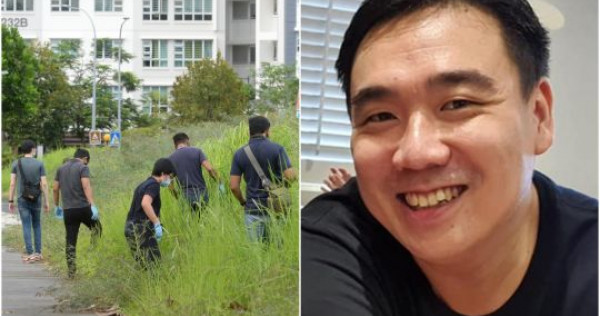
SINGAPORE – The family of the man who was fatally stabbed on Sunday night in Punggol Field arrived too late to catch his last words in hospital.
The man has been identified as Mr Tay Rui Hao, 38.
He is believed to be married and lived a few streets from where he was found stabbed.
According to Mr Tay’s posts on social media, he worked in the local branch of a sportswear company.
His father told Chinese dailies Lianhe Wanbao and Shin Min Daily News on Tuesday (May 12) that the family is shocked by what happened.
The father was quoted as saying that his son had texted him earlier in the day to tell him he was heading out for a run as he was feeling cooped up at home due to the circuit breaker measures.
That was the last he heard from his son, Mr Tay’s father reportedly said.
He said Mr Tay left home at about 10pm and was brutally attacked just two streets away from his flat.
Mr Tay is understood to live with his wife and their dog.
Nearly a month since it became mandatory to wear a mask while out, some are still getting in trouble (and achieving internet notoriety) for refusing to comply.
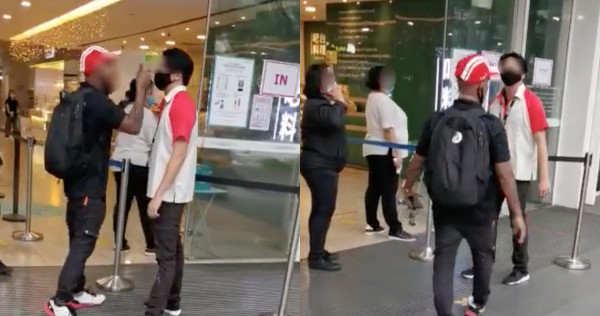
The latest in a string of mask-related confrontations, a man was caught on camera on May 11 challenging a Square 2 employee to a fight after being told to put his “bloody” mask on, Lianhe Zaobao reported.
A video of the heated exchange made its rounds on Facebook this afternoon (May 12), gaining over 600 shares in an hour.
Filmed at one of Square 2’s entrances, the 20-second-long clip showed a man, who had his mask pulled down to expose his nose and mouth, shouting at one of the mall’s employees.
“What are you going to do to me?” The man asked.
The employee replied: “Can you put on the bloody mask or not?”
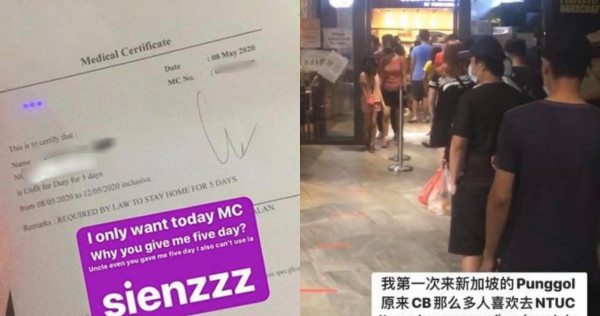
The Ministry of Health (MOH) is looking into reports of a man who allegedly flouted a five-day sick leave to visit Waterway Point with his friends and posted about it on Instagram, the ministry told AsiaOne on May 12.
The man’s transgressions first gained attention online after screenshots of his Instagram Story were posted on the Facebook page All Singapore Stuff on May 10.
According to the screenshots, which have since been removed, the man was issued the medical certificate (MC) on May 8 at Health First Family Clinic in Jalan Membina.
Seemingly unhappy about being issued a five-day MC, he wrote: “I only want today MC. Why you give me five day? Uncle even you gave me five day I also can’t use la [sic].”
Additionally, in the picture that the man posted, the MC stated that he was required by law to remain home.
SINGAPORE: Hairdressers and barbers across Singapore took out their scissors for the first time in weeks on Tuesday (May 12), snipping off the overgrown locks of an endless stream of customers, as the Government relaxed some “circuit breaker” measures.
After three weeks of suspension amid enhanced circuit measures announced on Apr 21, certain shops and services were allowed to resume operations on Tuesday – albeit with certain restrictions and precautions.
Basic haircuts at hairdressers and barbers have been allowed to resume, but this must be done within an hour.
Long queues formed early on Tuesday outside no-frills outlets that offer quick haircuts, CNA observed on Tuesday.
A line of 11 people had formed at the QB House outlet at PLQ Mall in Paya Lebar even before the opening time at 10.30am.
Mr Allen Yeo, 56, who started queuing at at 10am, said he wanted to get his hair cut before getting lunch.
“Since I’m the first customer, the equipment must be quite clean,” the retiree joked.
People queue up outside a hair salon on May 12, 2020, following the easing of some circuit breaker measures. (Photo: Gaya Chandramohan)
At SingPost Centre, more than 10 people waited in line for a trim at EC House.
Ms Carina Tan, who was there with her eight-year-old son, said that her child badly needed a haircut.
“It’s important for the children’s hygiene, it’s been so warm!” she said.
At the no-frills outlets CNA visited on Tuesday, most of the people waiting in line were men.
The queues were shorter at full-service hair salons, with most customers calling ahead to make appointments.
ONLY HAIRCUTS
One customer waiting for his turn at Apgujeong Hair Studio in Tiong Bahru Plaza said his wife had made an appointment for him.
The 55-year-old man, who requested to be identified as Mr Cheng, said his last haircut was early last month.
“I haven’t cut my hair in a long time and it’s getting ugly, so I thought it might be better to come for a haircut as soon as possible,” Mr Cheng said in Mandarin.
A customer getting a haircut on May 12 2020, following the easing of some circuit breaker measures. (Photo: Hanidah Amin)
At Kimage Hair Salon in Tiong Bahru Plaza, appointments were fully booked for the week, said salon manager Chris Tan.
But Mr Tommy Chin, manager at Shinka hair Salon at Nex shopping mall in Serangoon said that while customers were returning after reopening, business “has fallen by a lot”.
“It’s only for haircuts, we can’t do rebonding, perming and other treatments,” he said.
PET SHOPS, TCM HALLS & CAKES
Besides hairdressers, pet shops and shops selling confectionery and desserts that have been closed since Apr 22 also reopened on Tuesday.
People queue up at an outlet selling pastries on May 12, following the easing of some circuit breaker measures. (Photo: Gaya Chandramohan)
Bakery chain Bengawan Solo reopened on May 12, following the easing of some circuit breaker measures. (Photo: Gaya Chandramohan)
Traditional Chinese medicine halls and home-based food businesses were also back in business, while other shops that were suspended, including bubble tea kiosks, remained closed.
Singapore’s extended circuit breaker period remains in force until Jun 1, and selected activities and services are expected to resume in stages over the next few weeks.
Pet supplies stores reopened on May 12, following the easing of some circuit breaker measures. (Photo: Hanidah Amin)
Customers also returned to pet shops for supplies they had trouble getting online, with a steady stream of patrons at stores CNA visited.
There was a small queue at Pet Lovers’ Centre in JEM on Tuesday morning but it soon subsided, said area supervisor Grashia Chan.
“For us the home delivery is too overwhelming … so they (customers) have no choice but to come down to the store to purchase (supplies),” said Ms Chan.
One customer, Ms Karina Lim, 19, told CNA that she was at The Pet Safari at Nex to purchase food for her terrapin, as it was hard to order that online.
Ms Jady Ng, who was at Pet Lover’s Centre at Ang Mo Kio, had stopped by after grocery shopping to buy treats for her rabbits.
People shop in a pet supplies store on May 12, following the easing of some circuit breaker measures. (Photo: Gaya Chandramohan)
Customers also stocked up on items such as pet food, cat litter and pee pads, said Pet Lovers Centre marketing manager Christine Tan.
Pet stores are still restricted from providing grooming services but Ms Tan said their shops have been getting queries from customers.
“Those (dogs) with long coats need to be groomed quite regularly, if not their hair gets matted,” she said.
People queue up outside a traditional Chinese medicine (TCM) hall on May 12, following the easing of some circuit breaker measures. (Photo: Gaya Chandramohan)
At traditional Chinese medical shops, some outlets reported healthy foot traffic.
There were about six people waiting to enter Hock Hua Tonic at Tiong Bahru Plaza when CNA visited the store on Tuesday.
Hock Hua Tonic had put in place several precautionary measures, including limiting the number of people in the store at a time and directing traffic flow within the shop.
Only two to three customers were allowed inside at a time, and they had to walk in one direction around the store, leading up to the cashier, CNA observed.
Like other stores that are open during the circuit breaker period, Hock Hua had SafeEntry digital check-in QR codes at its entrance to record the details of all customers who visited.
Product manager Steve Teng said that some elderly customers had trouble scanning the SafeEntry QR code, but store managers were around to assist them.
“(They) usually (buy) the herbal tea stuff, some medication, dried shrimp and dried scallops,” said Mr Teng.
Malls that CNA visited also had such precautions in place. Customers had to either scan their identity cards or scan the SafeEntry QR code with their mobile phones when entering and leaving the building.
The time of entry and the particulars of each shopper is captured to help in contract tracing in case of a COVID-19 infection. This is one of the technological solutions authorities have implemented to curb the spread of coronavirus in the community.
SINGAPORE – More than 85 per cent of patients with Covid-19 since January have yet to be discharged, remaining in hospital or isolation facilities.
As of Monday, only 13.5 per cent of patients or 3,225 of the 23,787 people infected have recovered and gone home.
21 have died.
Not all those who have yet to be discharged are still sick though. Some have recovered, but are not allowed to go home because they may still transmit the coronavirus, which causes Covid-19, to others.
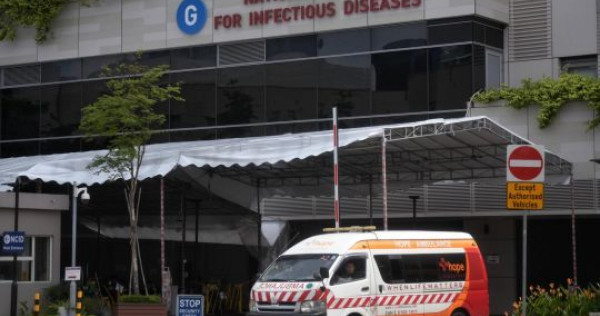
The National Centre for Infectious Diseases (NCID) said four in five patients become only mildly ill, displaying upper respiratory tract symptoms but no lung infection.
They usually remain sick for about two weeks, but might need almost another fortnight before they stop shedding the virus.
So the majority of patients will be discharged after about four weeks.
Professor Leo Yee Sin, executive director of the NCID said the viral load is higher at the start of illness and declines over the first week.
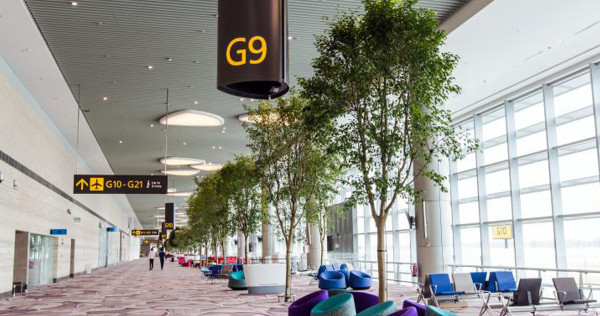
With global travel coming to a near standstill around the world, Changi Airport has announced that it will be temporarily suspending all operations at Terminal 4 (T4) from May 16.
This includes all flights, which will operate out of Terminals 1 (T1) or 3 (T3) instead, as well as stores and restaurants. Affected airlines include Cathay Pacific and Korean Air, which will be operating from T1 in the meantime.
The shuttle bus service to T4 will also be suspended.
While the Terminal 2 closure that was announced earlier was given a fixed time frame of 18 months from May 1, T4’s closure looks to be indefinite.
“This will depend on when air travel demand picks up and on the requirements of airlines seeking to relaunch flights at Changi Airport,” according to a press release from Changi Airport Group.
For now, essential service businesses and food and beverage outlets continue to operate in T1, T3 and Jewel, in accordance with circuit breaker measures put in place.
SINGAPORE: At 8pm on Thursday (May 7), 33 key Singapore landmarks across the island lit up in blue as part of the global campaign #SeeItBlue.
It was a heartening sight to see action taken to highlight the importance of mental well-being during this difficult period of COVID-19 and raise awareness for mental health.
The nationwide light show will run every Thursday at 8pm until the end of the circuit breaker on Jun 1, as a display of solidarity.
Yet, just the day before, a musical video on YouTube made by a local artist went viral, mocking the unmasked woman in Shunfu who uttered the word “sovereign” when asked why she wasn’t wearing one.
No one would disagree the woman should be taken to task for posing a threat to public health and breaching coronavirus restrictions. Swift action was taken. She was charged just two days after the incident on one count of being a nuisance and three counts of violating the COVID-19 (Temporary Measures) rules.
Singapore city skyline. (Photo: Unsplash/Mike Enerio)
But where the court had decided she should be remanded at the Institute of Mental Health to assess if she is fit to plea, the video made by the artist and the praises heaped by scores of people who shared it widely on social media now sit awkwardly.
If anything, it speaks volume of the prejudice and ignorance of mental health we still have as a society.
SINGAPORE WANTS TO END THE STIGMA OF MENTAL ILLNESS
“End the stigma of mental illness” is a phrase we have heard numerous times in recent years as Singapore awakens to the discrimination and disadvantages people with mental health conditions face.
Underlying problematic public attitudes have been exposed by surveys conducted by the National Council of Social Services (NCSS).
We have made big strides to tackle mental health at the national level. An anti-mental health stigma campaign Beyond the Label was launched by NCSS in 2018 to combat these sentiments.
Prominent figures have come forward to lend their voice. Speaker of Parliament Tan Chuan Jin addressed this issue at the Beyond the Label Fest in September last year.
Singapore was also the first country in Asia to host the Together Against Stigma Global Conference in October 2019 where President Halimah Yacob stressed more must be done to support those with mental health issues.
Negative attitudes towards mental health conditions are “sad” and reflect a “gross ignorance about what this illness is all about”, she had said.
BUT IS SINGAPORE WALKING THE TALK?
The word stigma means a mark of shame. In the mental health sector, this typically refers to the unfair mark of shame others assigned to those who live with different mental health conditions.
There’s also self-stigma, the shame people with such conditions assign to themselves when they feel there’s something “wrong” with how their brains work.
This goal of “ending the stigma” may only be scratching the surface of the real shame, acts of discrimination and microaggressions people who live with mental conditions still face on a daily basis.
(Photo: Unsplash/Volkan Olmez)
Yet circle back to the YouTube video, which ridiculed the woman with words like “lunatic”, “thick in the head” and “crazy”, and you cannot help but go away with the sense that this is the type of bigotry that perpetuates misguided perceptions and peddles the narrative that those with poor mental health are “crazy people” who act out.
This is sadly turning the other way from our national vision of going beyond the label endorsed by our leaders and Singaporeans.
THE FEAR AND ANXIETY
Those who live with mental health conditions have expressed their fear and anxiety regarding this insensitive act of public shaming, made many times worse by the complicit chorus of compliments to the talent and entertainment value of this public shaming.
One of them shared with me: “If I ever had a public breakdown, I would be absolutely mortified if my episode was plastered all over social media, and turned into fodder for further public amusement by an artist.”
Another also shared with me in anguish: “This perpetuates a false association between mental health and social irresponsibility/deviancy … It has justified public shaming of mental health as fair game, and even as a kind of moral righteousness.”
The COVID-19 crisis has turned every aspect of normal life upside down with strict safe distancing and circuit breaker measures to protect life.
With no end in sight, the mental health consequences of COVID-19 are starting to manifest – fuelled by the devastating mix of uncertainty, isolation, grief and economic despair.
We cannot pretend to know how these consequences will manifest in each individual, including those with no pre-existing mental health conditions.
Spending time in isolation and following safe distancing measures may slow the spread of the disease, but it may also be linked to an increase in depression, anxiety, drug and alcohol abuse, domestic violence and child abuse, according to many recent studies including the highly-regarded journal The Lancet Report.
We think of the coronavirus as a physical health threat but forget this is also a mental health crisis needing attention, a concern I have raised repeatedly in Parliament recently, given that one in seven of Singaporeans already live with a mental health condition before COVID-19.
THE STORIES WE DON’T HEAR
We have underestimated the silent toll on our mental health COVID-19 is taking on us because such stories have remained behind closed doors for fear of stigma.
A senior business leader recently shared her mounting mental and emotional struggles with having to support her young children with their home-based learning (and now on holiday) as well as her employees with their own challenges remotely.
An acquaintance almost killed himself after losing all gigs as an event emcee some weeks back, while he could not have his weekly sessions with his therapist until recently.
A 20-year-old man hung himself in his room in mid-April due to challenging family circumstances.
A 15-year-old marriage is now on the brink of a complete breakdown just five weeks into the circuit breaker.
These are just but a small sample of stories of mental struggles I have come to know of personally.
WALK THE TALK
Even before the pandemic, two-thirds of adults with mental health conditions did not seek treatment in Singapore, according to the NCSS Public Attitudes Survey in 2017. Public shaming will exacerbate poor mental health for those already struggling.
Experts have long cautioned against public shaming, warning that it can have a lasting and negative psychological impact on those who are singled out.
At first glance, we might fall into the trap of thinking being shamed on social media is an experience anyone can easily shrug off and recover from. However, many who have been the target of Internet shaming face lasting and damaging consequences.
The mental health curve from COVID-19 is going to have a very long tail. So leave errant individuals to the authorities, that’s the rule of law order that we are proud of.
Let’s channel our influence, talents and energies during this trying time towards looking out for each other, and our mental well-being – and not perpetuate the stigmatisation of mental health.
We must go beyond merely a display of solidarity to truly walk the talk of empathy and inclusion when the next sea of blue light shines from our gleaming skyscrapers.
Download our app or subscribe to our Telegram channel for the latest updates on the coronavirus outbreak: https://cna.asia/telegram
Anthea Ong is a Nominated Member of Parliament, a social entrepreneur (founder of Hush TeaBar, A Good Space, WorkWell Leaders Workgroup), leadership coach and author of 50 Shades of Love.
The National CARE Hotline provides emotional and psychological support for all who are impacted by the COVID-19 pandemic and is manned 24/7 by trained volunteers. If you need someone to talk to, please call the Hotline at 1800-202-6868
SINGAPORE: Twenty buses from transport operator SMRT have been retrofitted to help with the mass transfer of COVID-19 patients between places such as hospitals, migrant worker dormitories and the various community recovery and care facilities.
The buses, dubbed COMET MAXIs (COVID-19 Multi-Passenger Enhanced Transporters), can take more than 30 passengers at each time.
There is an airtight partition separating driver and passenger compartment, as part of measures to minimise the risk of transmission.
“Each compartment has its own independent air-conditioning system, which allows air circulation within both cabins to be separated,” announced SMRT on Tuesday (May 12) in a joint media release with Temasek Foundation, Singapore-based engineering firm HOPE Technik and Sheares Healthcare.
“The passengers’ compartment is equipped with a Negative Pressure System with a HEPA filter which will help ensure that only clean air is filtered out from the passengers’ compartment.”
One of 20 SMRT buses which have been retrofitted to transport COVID-19 patients. (Photo: SMRT)
The driver’s section includes seats for two additional passengers, if paramedics or escort officers are needed.
Drivers do not come into contact with passengers, and vehicles are decontaminated after each deployment.
TRIGEN Automotive, the special function vehicle division of HOPE Technik, was responsible for the engineering design and conversion work for the buses, which have been in operation since May 6.
It took about two to three days to retrofit each bus, noted the head of TRIGEN Automotive Vic Naidu, adding that the work done is reversible.
Speaking to the media on Tuesday, president for SMRT Roads Tan Kian Heong said that the buses have low floors, which make them wheelchair accessible.
“We have chosen relatively new buses to make sure they are reliable on the road,” he said, adding that the buses are from SMRT’s “operational spare pool” to minimise the impact to public bus services.
Sheares Healthcare owns the COMET MAXI fleet, which will be used to complement the Health Ministry’s patient transport services, while SMRT subsidiary STRIDES Transportation is responsible for overseeing the operations, driver training and maintenance of the vehicles.
COMET MAXI drivers are not drawn from SMRT’s pool of bus drivers, but are specifically recruited for the job and must have a Class 4 drivers licence.
COMET MAXI drivers are required to wear personal protective equipment while on duty. (Photo: SMRT)
They will first go through 20 hours of training conducted by SMRT to familiarise themselves with the vehicles, said STRIDES Transportation general manager Kelvin Soon.
In addition, there was an additional two hours of training from the Singapore Civil Defence Force on the proper use of personal protective equipment, which they are required to put on while on duty.