Home Blog Page 330

For mum of 7 with husband fighting COVID-19 in ICU, home quarantine is an anxious but tight-knit affair

SINGAPORE: It was still dark on Thursday morning (May 7) when Mrs Sharifah Radiah Ameer, 42, was jolted awake by her son, only to find her husband sitting against a wall looking pale and breathless.

For the previous few days, Mr Efendi Abdul Rahman, 43, had been dry coughing and slowly losing his sense of taste and smell.

Mr Efendi had visited a clinic the previous Saturday with similar symptoms and a 40-degree Celsius fever, but the doctor had checked his throat and lungs and said there was no suspicion of COVID-19.

To be productive earlier on during the “circuit breaker”, Mr Efendi had worked for three nights in an ad-hoc security role at a foreign worker dormitory in Tuas, Mrs Sharifah told CNA on Tuesday.

So that Thursday morning, there was little time to think.

Mrs Sharifah called the ambulance and her husband was rushed to Ng Teng Fong General Hospital, where he was admitted to the intensive care unit (ICU). He would later be tested for the virus too.

“The doctor said the test would take at least a day or so,” she said. “But I was surprised it came back earlier. I got a call from them at 2pm that day with the bad news. It’s not been the same for us at home since then.”

Life for the full-time homemaker and her family has since been one of home quarantine. She cares for her seven children and 87-year-old father with Alzheimer’s and early-stage dementia, and she worries she may not see her husband again.

Mr Efendi is still in the ICU in an induced coma. “As of Monday not much had improved, honestly,” Mrs Sharifah said. “His situation is still critical.”

ON QUARANTINE

With Singapore’s circuit breaker measures still in place and only daily updates from the ICU to rely on, Mrs Sharifah acknowledged that quarantine has been a “roller-coaster”.

“Other than being confined at home all the time, I am also bothered by the fact I can’t see my husband,” she said. “I have anxiety, so it’s really not great.”

She also has to deal with the thrice-a-day temperature taking and reporting. Thankfully, nobody in the family has shown symptoms so far. The youngest two of her children have tested negative too.

“I remember what I saw in my husband, so I would know and would immediately send (any of the kids) to the hospital for early care,” she said.

She has also had to deal with the occasional video and telephone calls from the authorities, to check if they are at home, or to conduct contact tracing.

“When we’re in such a situation, it gets irritating when people ask you the same questions so many times,” she said. “But I try my best to stay calm. I know they’re just doing their job.”
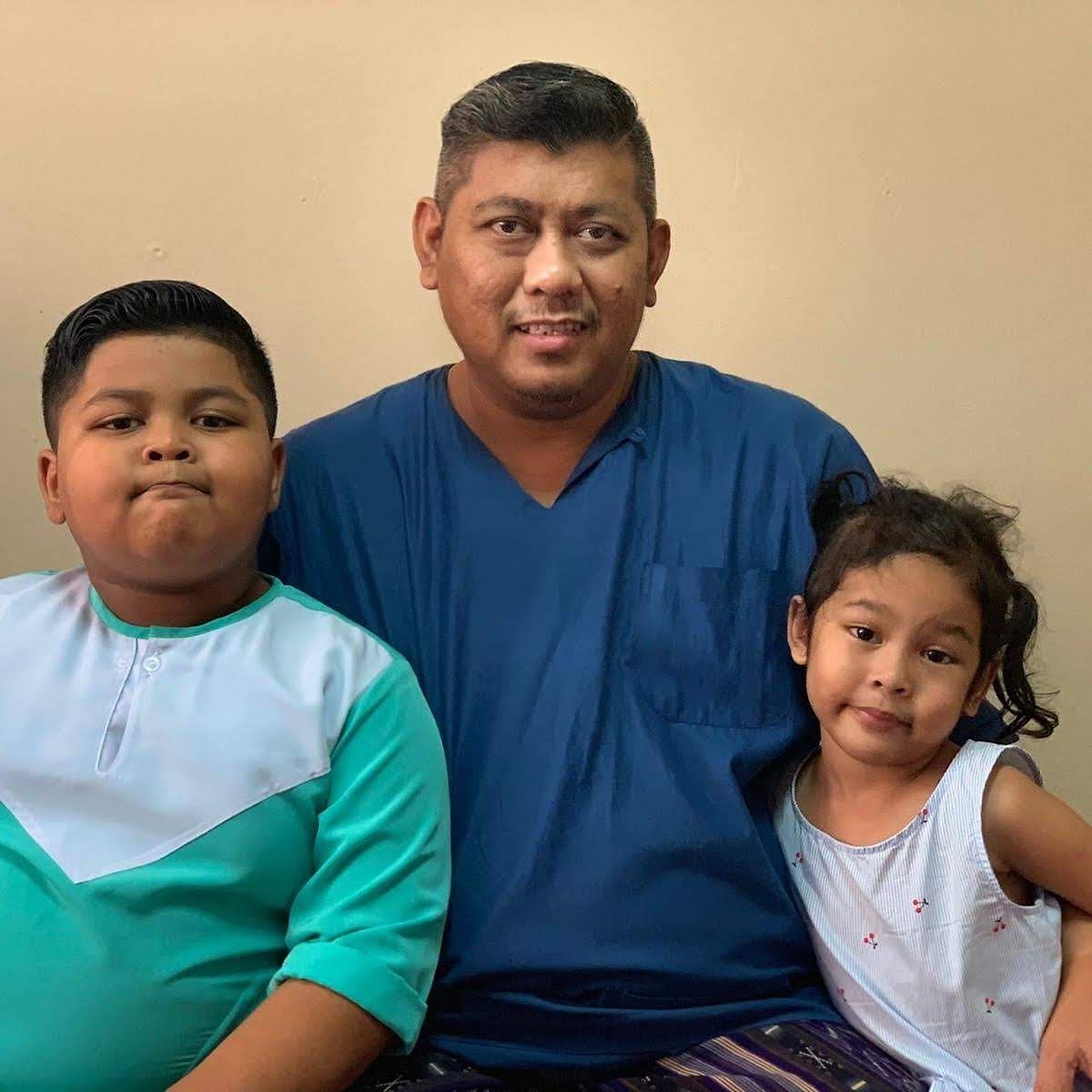
Efendi Abdul Rahman COVID-19 husband ICU quarantine

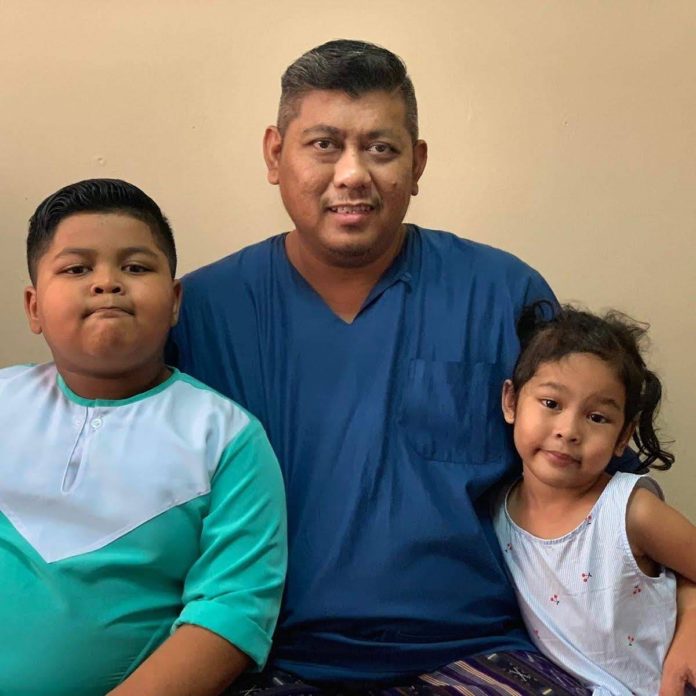
Mr Efendi Abdul Rahman with the youngest two of his children. (Photo: Sharifah Radiah Ameer)

But perhaps the biggest challenge is explaining their father’s condition to the children. Mrs Sharifah has five sons and two daughters aged 24 to six.

His absence is palpable. During the weekends before the circuit breaker, the family would go on brisk walks to the Chinese Garden in Jurong. Then they’d have breakfast together.

“I am very transparent about their father’s condition, especially to the older ones,” Mrs Sharifah said, stating that she shares every single detail. “The younger ones have a vague idea. But how do you explain mortality to children aged eight and six?”

The younger ones are also closer to their father. On some weekends, they would follow him to his office at an international school, where he works full-time as a safety and security supervisor. “His colleagues know them so well,” Mrs Sharifah said.

Mrs Sharifah acknowledged she sometimes breaks down, but tries to hide it from her children. Perhaps the children are also putting on a brave front, she said.

“My kids are pretty resilient,” she said. “They don’t really show their emotions. I don’t know why but it’s hard to break them. My girls are a lot different though. We do share more, and we kind of cry together.”

BANDING TOGETHER

The children have stepped up in bigger ways too. They help with the household chores, tidy up the kitchen, and have a “teamwork thing going on where they do the dishes turn by turn”, Mrs Sharifah said.

“They actually have become more united as siblings,” she added. “They help each other, they have no issues, no arguments. It wasn’t always like this I tell you, but I suppose in these times they realise ego needs to take a step back or two.”

With most of her children off from school – the eldest just finished full-time national service and the second eldest quarantined from her job as an auxiliary police officer – Mrs Sharifah sometimes plays games with them. They’re currently hooked on Uno.

The rest of the day is for doing the laundry and the extra chore of disinfecting. She washes clothes, especially those that have been in contact with her husband, in hot water. Then she sprays disinfectant around the house.

She also has to prepare her father’s meals and twice-daily medicine. He’s a bit fussy with his food, she says, so breakfast is usually Milo and bread with butter. Other than that, Mrs Sharifah says he doesn’t really need much attention.

And with most of the family fasting during the ongoing holy month of Ramadan, cooking has taken a back seat. Breaking fast is usually with rice and chicken or fish; the pre-dawn meal is normally cereal or leftovers from the previous day.

Mrs Sharifah said she doesn’t have to worry about these too as her son’s secondary school has been providing meals. Mr Efendi’s colleagues have pulled together to buy food for the family to break fast. Anonymous donors have come forward as well.

She’s “overwhelmed” by the outpouring of support. “I didn’t know how well-loved my husband was and how much impact he made to people’s lives,” she said. “I hope he can rest well knowing his family is well taken care of.”

AGONY AND REGRET

Mrs Sharifah admits, however, that she has trouble resting easy.

She depends on the calls from the ICU to find out how her husband is and what to expect, and even then she feels like she’s “in limbo”.

“The little information we get is basically like a repetition, almost like a broken record,” she said. “I cannot stand it anymore.”

She plans to ask doctors for an “honest prognosis” so she and her children can better prepare mentally. She said she spends every minute of her time worrying about him, “and not a minute goes by that he is not in my mind”.

“To be honest, I do worry about my husband not waking up. The prognosis isn’t promising, but I always try to make myself believe that he will fight this,” she said.

“But I won’t lie and say that I don’t think about how I would handle it if he passed on. Things trigger me; little things he did before he was hospitalised.”

Mrs Sharifah thought about how her husband, on the night before he was admitted, made soy sauce beef for breaking fast, even though she was never a fan of his cooking.

“I’m diabetic and his cooking is too sweet, but that night I had the beef and I can honestly say it was so heavenly,” she said. 

“The same night he stood a while outside the room by the door watching me and my youngest two. He never did that before. Then he switched off the lights.”

Mrs Sharifah said she felt a “sense of foreboding” about her husband.

“I saw the red flags, and I did my best to get him medical attention, but I felt my best wasn’t good enough,” she said. “If anything happens, that is the regret I will live with for the rest of my life, I guess.”

“I NEED TO KNOW”

For now, Mrs Sharifah said it’s a case of wanting to do more for him but not being able to, especially as hospitals have barred most visitors due to the circuit breaker.

She had wanted to follow him to the hospital in the ambulance, but the attendant said the visitor lounge would be closed anyway.

“At the same time, it’s also a blessing because I don’t know how I’d react seeing him being tube-fed and everything,” she said.

“Because I’m so used to seeing the different side of him. He never showed his vulnerability to me. So if I saw him like this, I would probably break down.”

Still, she said there will come a point when she will insist on visiting him.

“For the sake of seeing him and my sanity, I need to know,” she said. “The idea of a COVID-19-related death is sad. The person is all alone. At most maybe a video call.”

Mrs Sharifah is concerned that she might never see him again, but said that Islam has taught her the concept of acceptance: “If that time comes, I will be okay.”

“He was my rock just as I was his,” she continued. “We had a difficult and imperfect marriage, but we were beautifully imperfect. And I miss him terribly.”

BOOKMARK THIS: Our comprehensive coverage of the coronavirus outbreak and its developments

Download our app or subscribe to our Telegram channel for the latest updates on the coronavirus outbreak: https://cna.asia/telegram

Source link

S'pore's Covid-19 circuit breaker measures have shown promise, could be further eased on June 1

[ad_1]

SINGAPORE – Singapore’s circuit breaker measures have “shown promise” in bringing down the number of coronavirus cases in the local community, and the country is on track to further ease these restrictions on June 1, said Health Minister Gan Kim Yong on Tuesday (May 12).

The number of new cases in the community has continued to fall, from an average of over 30 new cases daily in mid-April, to eight new cases daily in the past week. The situation in the migrant worker dormitories is also stabilising, from a high point of an average of more than 1,000 new cases per day in late April, to an average of about 700 cases per day in the last week.

Mr Gan added that the first step of easing will focus on essential services, with more details to be announced next week.

“We don’t expect that by June 1 we’ll open everything, and everything goes back to normal, we begin to celebrate and have parties,” Mr Gan said. “We need to do so in a very calibrated, careful way.”

[ad_2]

Source link

9 suspects arrested for rioting at Chinatown apartment block following police manhunt over 3 days

[ad_1]

SINGAPORE – Nine more suspects – eight men and one woman – were arrested on Tuesday (May 12) for rioting at a Chinatown apartment block on Sunday.

Aged between 18 and 28, they were nabbed following a police manhunt over three days by officers from the Criminal Investigation Department (CID), Police Intelligence Department and Central Police Division.

Police had earlier arrested three persons at the riot scene on Sunday.

On Tuesday, a police spokesman told The Straits Times that preliminary investigations found that two groups of men, one armed with parangs, had clashed following a relationship dispute over a woman.

[ad_2]

Source link

Fancy a FaceTime photoshoot? Photographers get creative amid circuit-breaker measures

SINGAPORE: “Uncle, you look to your right,” said Nicky Loh, with his camera in hand, ready to fire a shot.

His subjects for the day: A couple in their 70s, all dressed up – Mr John Chua in a neatly pressed shirt and tie, with his wife Theresa in a bright, fashionable cheongsam.

“This is very In The Mood For Love,” said Mr Loh, referencing the iconic Hong Kong romantic drama film by Wong Kar Wai. 

“Uncle, you cover aunty’s arm – it looks big in the shot!” His comment drew laughs from his models, who gamely obliged. 

Satisfied with the pose, Mr Loh went shutter-happy, like any photographer would. Except, this was no ordinary photoshoot. The Chuas were having their portraits taken – via a Zoom meeting. 

Ever since the implementation of circuit breaker measures where only essential businesses are allowed to operate, photographers are now employing new ways to create images from home.

READ: ‘Don’t rush to go out’ after businesses reopen, COVID-19 circuit breaker to ease gradually: Lawrence Wong

From Zoom to Skype and FaceTime, virtual photoshoots can be conducted anytime, anywhere, with the help of teleconferencing applications. 

“When the circuit breaker kicked in, I thought about concepts and I realised that families don’t get to be together very often, despite staying in the same house,” said Mr Loh. 

“I saw this as an opportunity to take family portraits of my friends and strangers, to document this very unique time.” 

NEW WAYS TO CREATE

Photographers that CNA spoke to had various methods of producing images – for Mr Loh, it was a deliberate move to use his professional camera to photograph his phone or desktop screen during a call. 

“I didn’t want to do screen grabs because I still wanted to have the camera in my hands to stimulate an actual shoot,” the 38-year-old explained. 

“It’s also a very nice way of documenting how I captured them. For example, I had to use a puppet to entertain kids and get kids to smile for the camera.” 

(ct) facetime photo 2

Mr Loh (top right) holding up a puppet to draw smiles from kids. (Photo: Nicky Loh) 

Ever since he posted his concept on Facebook a week ago, Mr Loh has received requests from friends, strangers – and even Singaporeans who are overseas and unable to return home – to have their portraits taken. 

He has since taken portraits of 76 families. 

“I plan to share these photos online to let people see how others are spending time this circuit breaker period and hopefully take their minds off the bad news every day.”

Samuel Ng, a wedding photographer, also started taking virtual portraits of couples at home during this circuit breaker period. He has tried various platforms and settled on FaceTime due to the “quality of images” he can get. 

“FaceTime on the iPhone has a function called Live Photo, which has a long exposure effect. I can get a wider variety of shots, which I can’t get with Zoom and Skype,” Mr Ng said. “And it’s very convenient, you just have to press one button.”

The 29-year-old, who runs a wedding photography company Pixioo with two other photographers, said that taking virtual portraits started out as a way to keep himself occupied.

“If not we will go crazy at home,” he said with a guffaw. 

(ct) facetime photo 3

Mr Samuel Ng working from home. (Photo: Pixioo) 

“We also love meeting people and couples, which is something we used to do a lot before the circuit breaker period. The purpose of doing virtual photoshoots is also to reconnect with couples who have shot with us before, and those whose upcoming weddings have been postponed.” 

Ever since stricter safe-distancing measures were imposed, many weddings have been postponed – which translates into a loss of income for wedding photographers like Mr Ng. Each month, his company shoots about four to five weddings and they bring in over S$10,000. 

READ: COVID-19: Couples due to get married postpone weddings, livestream small celebrations

“It’s really a lot of money lost so it’s a tough period for everyone,” he said. While he is charging an hourly rate of S$80-100 for the virtual photoshoots – which is about 70 per cent below the usual rates – Mr Ng said that money is not his main motivation.

“At the end of the day, I want to do something meaningful for couples and families. In the future, kids might not have a memory of what happened during this period, so it’s important to document these moments and experiences.” 

“Plus, it’s really fun to virtually meet different people from all walks of life. The great thing is they feel really comfortable because they’re at home. They can wear anything they like and just chill.”

MORE THAN SNAPSHOT

Virtual photoshoots might seem like less work for photographers, who typically go out and about while carrying an assortment of camera equipment, both Mr Loh and Mr Ng said there is still merit in their work. 

“Of course you can also take family portraits with a timer at home but you are anticipating the shot. I was still shooting as if I was right there with them, waiting for nice surprises,” said Mr Loh. 

The difference is the creation of “expressions and moments” that are birthed out of interactions with the photographer.

“Most people will be like, this is just like taking screen grabs! But It’s not that simple – you want to get people to do spontaneous stuff with you.” 

Mr Ng agrees. “It’s like pre-wedding photos – couples can choose to take a tripod, put a camera on it and take the photos themselves. But our shots primarily capture interactions.”

“For example, I will ask them questions that help evoke emotions – what’s one thing you like or don’t like about each other? Some would say things like, ‘Your fart’ and everyone has a great laugh.”

(ct) facetime photo 4

Mr Ng directing his clients through FaceTime. (Photo: Pixioo)

There are still preparations which he has to do before a shoot, such as video-calling the couples to get a virtual tour of their home to find a few suitable spots. 

“Some of them will say, my house is very messy – there isn’t a nice spot. But I’ll tell them that we should keep it as real as possible because this is your home. It’s not about how it looks, but about creating something sentimental.” 

Mr Ng admitted that the process is definitely tougher for the couple, who have to prepare things like an iPhone stand and take directions on-the-go.

“If I can hold a camera, I can just move around however I want. But with virtual photoshoots, there’s a lot of trial and error – you might get frustrated if the couple doesn’t get the angle you visualised.” 

“It requires a lot of communication and you just need to be patient.”

Detailed planning was also the way to go for those who resorted to more extreme measures to conduct photoshoots, while adhering to safe-distancing measures.

Vivien Tan, the photographer and creative lead for local online retail store, Love & Bravery, had to organise camera equipment, outfits, props and make-up to be couriered to her model for a lifestyle shoot from home.

The job of shooting photographs was delegated to the model’s roommate, who is not a professional photographer.

“Everything from the styling, to marking out where the model should stand and where the photographer should position herself was pre-planned virtually,” the 27-year-old said.

(ct) facetime photo 5

Ms Vivien Tan planning for the photoshoot with her creative team in a Zoom meeting. (Photo: Vivien Tan) 

Ms Tan and her team took three days to plan, which was longer than the time they usually take for normal photoshoots.  

“We tried to give them everything they needed to make the process as seamless as possible. Usually on shoot we have the whole team, but it was just the two of them then,” she added. 

“The day before the shoot, we even had a call with them to teach them how to use the camera.”

While Ms Tan was tele-communicating with the two-man team throughout the photoshoot, she had “to really trust them” to deliver the photographs. 

“I couldn’t be too perfectionistic about it because they made the shoot possible. It could have been a very frustrating experience, but they had no complaints, which I really appreciate.”

‘THE PIXELS REPRESENT ME’ 

The quality of images produced in a virtual photoshoot may never match up to those taken in a conventional setting, but it is a small compromise to the photographers. 

“I’ll always tell the couples that the quality of the images will be acceptable if you want to post it on social media but probably not if you want to print it on a big canvas,” said Mr Ng. 

“These photos are really for their keepsake.”

Finding new ways to photograph in this period has also been a learning process for Ms Ng. “I realised there are always ways around things and we can be more flexible with our thinking.”

“Because of the limitations, we have become more open to doing things differently and really collaborating with each other,” she added. “This is an attitude I hope to have even when the circuit breaker period is over.

As for Mr Loh, taking family portraits virtually was a cathartic experience, after having recovered from stage two lymphoma cancer in March this year.

(ct) facetime photo 6

Mr Loh conducting a virtual photoshoot from home. (Photo: Nicky Loh) 

“When I had cancer, I realised that I was so out of touch with life in general. I realised how much I actually cared for my friends, my family and the people who have passed through my life.”

Some friends whom he photographed did not even have kids when they last met, he said. 

“If you ask me, the pixelation and the blurriness of the images don’t matter. In some sense this is a new way of reaching out to people around me, as well as strangers to show some kindness.”

“The pixels represent me, slowly piecing back my relationships with people.”

BOOKMARK THIS: Our comprehensive coverage of the coronavirus outbreak and its developments

Download our app or subscribe to our Telegram channel for the latest updates on the coronavirus outbreak: https://cna.asia/telegram

Source link

‘The whole of Singapore coming together’: Local firms team up to distribute 100,000 COVID-19 care packs to vulnerable households

SINGAPORE: For courier David Lee, who has to leave his house daily to deliver items, hygiene products are invaluable during the COVID-19 “circuit breaker” period.

Both he and his wife work in essential services, which means that their two daughters have also been travelling to school to be under the care of their teachers.

All this adds up to many face masks, hand sanitisers and antibacterial wipes being used – which is why a hygiene care pack delivered to their doorstep by Ninja Van’s couriers could not have come at a better time. 

“The items inside the care pack are really essential during this period – like hand sanitiser, face masks, they’re all in high demand now,” said Mr Lee, 52, adding that he was “very touched” by the gesture.

These care packs are part of an initiative called SGPaySitForward, which was launched on Apr 22 by local companies Ninja Van and Night Owl Cinematics as a way of giving back to the community.

People are encouraged to buy a S$25 care pack which will then be delivered by Ninja Van couriers to the doorsteps of vulnerable individuals and families. The founders of the campaign hope to deliver up to 100,000 care packs by the end of the circuit breaker period on Jun 1.

Apart from lower-income families, recipients include migrant workers in dormitories and the elderly in nursing homes. 

As of Tuesday (May 12), more than 23,300 care packs have been bought, more than a fifth of the campaign’s goal.

SG Pays it Forward 2

Ninja Van CEO Lai Chang Wen is one of the founders of the SGPaySitForward initiative. (Photo: Ninja Van)

“(Seeing the impact of COVID-19 on the community) prompted a bit of introspection as well as thinking about our strengths – how can we leverage that to give back to the community?” Ninja Van CEO Lai Chang Wen told CNA in a phone interview.

WORKING “NON-STOP” TO PUT THE CAMPAIGN TOGETHER

While Mr Lai initially thought of doing the campaign on his own, he realised that teaming up with marketing experts would help to “amplify what we could do on our own”.

While delivery company Ninja Van focused on building the back end of the site, the packing and the delivery of the care packs, local production house Night Owl Cinematics used its expertise in social media and marketing to publicise the SGPaySitForward campaign.

“So we decided that by teaming up together with these social folks, influencers, media personalities, they could help spread the word a lot better so that we can focus on doing the logistical work while they focus on spreading the word,” he said.

This is where Night Owl Cinematics comes in. Initially, the production company was also working on their own care pack campaign with Guardian, with an initial goal of donating 5,000 care packs, said CEO Sylvia Chan.

“I think why we decided to come onboard is because we already have a one month worth of research and prototype and all the kind of things that we need to coordinate the care pack. With (Ninja Van) onboard, it’s just about scaling it up,” she added.

SG Pays It Forward 3

Ninja Van dropping off care packs for migrant workers. (Photo: Ninja Van)

They also roped in other local firms, including social media company GoodStuph, online marketplace Carousell and cashback reward programme ShopBack, to help with the campaign.

Ever since Mr Lai and Ms Chan decided to start the campaign one week before its official launch, work has been “non-stop” for them, said Ms Chan.

“In fact, some members of Night Owl Cinematics and Ninja Van were actually packing the care pack until three (in the morning), because we’re trying to save costs so that people can buy this care pack at the lowest possible price,” she said.

“We have worked non-stop since the start, and will continue to work non-stop until the 100,000 packs are shipped.”

WHY CARE PACKS?

When Mr Lai first started thinking of how best to contribute, he spoke to organisations including grassroots organisations, NTUC and the unions.

“Two areas people always think about are foreign workers and dry goods or food. We realised that these two sectors are actually quite well-served, that they are very focused,” said Mr Lai, adding that he found hygiene and sanitation to be uniquely important during the COVID-19 outbreak.

READ: ‘We want them to know they’re not alone’: New scheme to distribute food vouchers to more than 12,000 disadvantaged students

“These products are actually quite expensive … So is there a way we can garner support for these inventory suppliers, get them at cost price and then distribute them? It’s probably not top of mind for a lot of vulnerable households. But it should be,” he said.

“We wanted a care pack that embodies this motto that we have internally, which is stop COVID, save lives. So we put in things that are actually going to help stop the spread of COVID-19,” said Ms Chan.

SG Pays it Forward 4

Night Owl Cinematics CEO Sylvia Chan is one of the founders behind the SGPaySitForward campaign. (Photo: Sylvia Chan)

And with Ninja Van’s extensive fleet, packing and distributing the care packs seemed a lot more useful than simply donating money, said Mr Lai.

“Why not leverage on our fleet to do (the work of packing and distributing) and allow people to contribute just in the comfort of their home and allow us to transform the monetary donation to something more tangible and efficient?” he said, adding that Ninja Van was distributing between 3,000 and 5,000 care packs a day.

READ: ‘If no work at all, how?’ Low-income families grapple with zero income, higher expenses amid circuit breaker

“ASPIRATIONAL” GOAL TO DELIVER 100,000 CARE PACKS

When asked about the goal of 100,000 care packs, Ms Chan laughed and said: “This is quite a crazy figure and this is a funny story. On the phone with (Mr Lai), I said that Night Owl Cinematics wanted to do 5,000, and then he said, why 5,000, we must do at least 100,000. We just came up with this figure very arbitrarily.”

But later, when they checked with the Ministry of Culture, Community and Youth (MCCY) as well as the National Youth Council (NYC), they found that there were indeed 100,000 – and more – beneficiaries who needed the care packs.

“So that was a random number but when we fact-checked, it was also a good starting point,” said Ms Chan.

When it came down to distributing the care pack to each beneficiary, the team received a list from MCCY and NYC. They called up every beneficiary to ask if they needed the care packs and how many, Ms Chan said.

The goal of distributing 100,000 care packs is also “aspirational”, noted Ms Chan.

“As with every goal, we always aim to achieve it, but the reality is, every care pack is a household,” said Mr Lai.

“I don’t think we’re overly focused on the numbers because then it becomes a vanity metric. A hundred thousand is a goal which keeps us going, keeps us motivated.”

Although the current plan is to end the campaign on Jun 1, Ms Chan said there is potential to go beyond that if they manage to sell more than 100,000 care packs.

“In the event that we sell a lot more, we’re just going to continue until COVID-19 is over,” she said.

And to the beneficiaries of their care packs, Mr Lai said: “Stay safe, we hope that every little bit counts. We hope you take heart in the fact that it is the whole of Singapore coming together to make a little difference in your life.”

BOOKMARK THIS: Our comprehensive coverage of the coronavirus outbreak and its developments

Download our app or subscribe to our Telegram channel for the latest updates on the coronavirus outbreak: https://cna.asia/telegram

Source link

Commentary: Were you fired or retrenched? Your employer may not tell you the difference

SINGAPORE: The COVID-19 pandemic has had an unprecedented impact on trade, supply chains and financial markets, with a particularly devastating impact on certain industry sectors such as aviation, tourism and services.

This will have an inevitable knock-on effect on employment figures, with massive global job losses on the horizon.

More than 20 million Americans lost their jobs in April 2020. 

General Electric is looking at reducing 25 per cent of its aviation workforce, and American luxury department store chain Neiman Marcus has filed for bankruptcy with another US-based retailer JC Penney expected to follow suit in the coming days.

READ: Commentary: Get ready for the great American bankruptcy

READ: Commentary: Life after COVID-19 — fashion’s excesses curbed, shopping habits forever changed

Closer to home, in April 2020, fashion e-commerce start-up Zilingo laid off 30 per cent of its staff, and Deliveroo announced a 25 per cent staff lay-off due to the COVID-19 economic downturn.  

In addition, 8,663 business entities in Singapore closed shop in April 2020, double the numbers from March 2020.

With job losses in Singapore in 2020 projected to range from 45,000 to 200,000 by various analysts, the issue of disguised retrenchments will come sharply into focus as employers consider drastic cost-cutting measures to survive the circuit breaker and wider disruption inflicted by the pandemic.

This is in spite of the various support measures introduced by the government in the three budgets in 2020 to protect the jobs of Singaporeans and permanent residents.   

The signage outside the Neiman Marcus store is seen in New York

FILE PHOTO: The signage outside the Neiman Marcus store is seen during the outbreak of the coronavirus disease (COVID-19) in New York City, U.S., April 19, 2020. REUTERS/Jeenah Moon

In an initial poll by the Ministry of Manpower (MOM) in March, only 16 per cent of companies in Singapore said they will lay off employees. 

The same poll in mid-April demonstrated that 23 per cent of companies anticipate reducing their workforce in the next two months, which is echoed in a separate report by Aon.

WHY EMPLOYERS MAY DISGUISE RETRENCHMENTS

The uncertainty of the scope and duration of the pandemic is fuelling business concerns about the ability to maintain current headcount levels, given that manpower costs can account for a fairly large proportion of business costs, depending on how labour-intensive the industry sector is.

Unfortunately, this can lead to “disguised retrenchments” – which are designed to look like anything but what they are in substance.

A retrenchment is defined as termination of a permanent or contract employee’s (minimum six-month term) contract of service due to redundancy or reorganisation of the employer’s profession, business, trade or work, which would include mergers, restructuring or downsizing whether due to cash flow issues or otherwise, and judicial management.

READ: Commentary: Arts and humanities can set you up for life in post-coronavirus world

READ: Commentary: People cannot just be ordered back to work and to spending

Disguised retrenchments gained wider attention during parliamentary debates in 2016 where it was observed that employers were terminating employment without paying retrenchment benefits.

Pressure was placed on the government to introduce measures to prevent such exploitation of employees.

In response, mandatory notification requirements were introduced via the promulgation of the Employment (Retrenchment Reporting) Notification 2019.

Employers with businesses registered in Singapore with at least 10 employees are required to notify the MOM if at least five employees are notified of retrenchment – including permanent employees and contract workers – within any six-month period.

As this notification requirement compels employers to furnish information on whether retrenchment benefits were paid, employers are under pressure to ensure that retrenchment exercises comply not only with contractual obligations and agreements with unions if any, but also with the Employment Act, mandatory retrenchment notifications and the Tripartite Advisory on Managing Excess Manpower and Responsible Retrenchment (Tripartite Advisory).

File photo ministry of manpower MOM

The Ministry of Manpower building. (File photo: Calvin Oh)

The mandatory notification regime has imposed accountability on companies to some degree. 

It has also cast a brighter spotlight on employers mischaracterising retrenchments to circumvent the reporting requirement and to avoid paying out retrenchment benefits.

WHAT DOES A DISGUISED RETRENCHMENT LOOK LIKE?

Given the stark economic landscape, the issue of responsible retrenchment deserves attention to ensure that employees aren’t disadvantaged and given the short end of the stick. Retrenchment should only be a last resort, and should be conducted fairly and without discrimination.

READ: Commentary: Even Richard Branson isn’t immune to this coronavirus collapse

A genuine retrenchment typically occurs when a company undergoes major structural changes – for example through drastic cost cutting measures, downsizing, diminishment of existing roles, or if the employer is otherwise entering into mergers, liquidation or judicial management.

That said, the absence of such major change may not be conclusive of there being no retrenchment.

Cynically, some of the more common pretextual disguises for retrenchment include companies strongly suggesting to employees that they should resign, failing which the company would be compelled to dismiss them.

This has been traditionally viewed as helping the employee “save face” and to receive positive or neutral references for future job applications.

As for the company, when an employee resigns, it falls outside the purview of reporting obligations to MOM.

Employers must however note that this may give rise to constructive dismissal claims, with employees arguing that the company’s conduct compelled a forced resignation.

Mischaracterising a retrenchment as a sacking is another common strategy.

Employees who have had neutral to positive performance reviews are informed of poor performance out of the blue, or without discernible basis. The onus of establishing poor performance falls on the employer, and the employer should be able to demonstrate justification for the same if challenged.

In 2017, Surbana Jurong purported to dismiss 54 employees for poor performance, insisting that no one had been retrenched.

Surbana Jurong came under the MOM’s scrutiny, and the Surbana Sackings Saga was labelled as “unacceptable” in Parliament. With union involvement, a settlement agreement was eventually reached with the employees.

Employees may also be accused of misconduct out of the blue, without any due inquiry being conducted.

Misconduct is the only legitimate ground for employers to avoid having to provide notice or pay salary in lieu of notice, quite apart from not paying retrenchment benefits.  

DISGUISED RETRENCHMENT REARING ITS UGLY HEAD

Many law firms, such as ours, may already be seeing an uptick in legal queries from both employers and employees about lay-offs and retrenchments, with employers seeking to reduce their cost exposure to the maximum extent, and employees fighting tooth and nail to get the most equitable separation packages possible.

Singapore crowd file

People crossing a street in Singapore’s central business district. (File photo: Reuters)

In the past two months, we have encountered several cases of employees being abruptly terminated, without being offered retrenchment benefits by their employers.

In one particularly egregious example, a senior executive in a technology company was let go a week after she notified them of her pregnancy in March.

This termination came on the heels of a pay raise offered to her just a month prior. She was informed that she was being let go on the basis of downturn in economic conditions, but that she would not be paid retrenchment benefits.

In another example, a senior employee at a hotel was informed that her employment was being terminated contractually, with salary in lieu of notice. When she requested for retrenchment benefits to be paid, she was informed that her role was not being made redundant.

As an employee who would soon be out of the organisation, she has no means of independently verifying if this is a retrenchment, such as if her role is being phased out or if the hotel has complied with the mandatory retrenchment reporting obligations.

We have seen cases of expatriate senior executives lose their jobs on account of them drawing some of the highest salaries in an organisation, without attracting wage support offered by the government.

We are also seeing companies retrench low-wage manpower that they believe can be easily replaced, whether by automation or rehiring at a later stage.

READ: Commentary: Alibaba makes a whopping US$28 billion bet on its next breakthrough act

RECOURSE FOR DISGUISED RETRENCHMENT

The Employment Act provides that employees with two years’ service or more are eligible to retrenchment benefits, without specifying the quantum of such benefits.

If the employment contract or collective agreement provides for the quantum of retrenchment benefit, the company would be bound by it. For collective agreements, this is typically pegged at one month of retrenchment benefits per year of service.

In the absence of such provision, the employer and employee are to negotiate the quantum. Those with less than two years’ service should be granted a retrenchment payment out of the employer’s goodwill

The Tripartite Advisory urges companies to pay employees retrenchment benefits benchmarked at two weeks to one month per year of service, though this can be varied depending on a company’s financial position and industry practice.  

We anticipate that given the current economic headwinds, companies will be relying on these caveats to downplay their ability to pay out retrenchment benefits.

READ: Commentary: In Singapore, laws are necessary for trickle-down policies to work

READ: Commentary: The heavy lifting needed to get Singapore through the COVID-19 slump

Failure to comply with the Tripartite Advisory can lead to penalties including the curtailment of the offending company’s work pass privileges.

Employees who have been wrongfully retrenched under the guise of a pretext should in the first instance attempt negotiations with employers, failing which they can file a claim at the Tripartite Alliance for Dispute Management (TADM), followed by the Employment Claims Tribunal, for wrongful dismissal.

In our experience, the TADM is closely scrutinising COVID-19-related unfair employment practices and wrongful termination claims.

The option of a civil suit is also available. There are also avenues that offer assistance to retrenched workers, such as Workforce Singapore’s career support programme.

Most importantly, employers should be transparent with their employees about the reason for termination, and should conduct the retrenchment in a non-discriminatory manner.

A key element of this involves employers acting in good faith and being fair to employees in terms of retrenchment pay-outs.

This reduces confusion and dissatisfaction, which is important in ensuring continuing employee engagement and averting reputational damage to the company’s brand in a crisis.

LISTEN: COVID-19: Aviation and flying never ever the same again

BOOKMARK THIS: Our comprehensive coverage of the coronavirus outbreak and its developments

Download our app or subscribe to our Telegram channel for the latest updates on the coronavirus outbreak: https://cna.asia/telegram
Amarjit Kaur is a Partner at Withers KhattarWong in its litigation and arbitration team. She has been noted for her expertise in labour and employment law in the 2020 edition of The Legal 500: Asia Pacific.

Source link

Covid-19 in Singapore: A timeline of triumph

[ad_1]

It’s been 110 days since our lives were turned upside down by Covid-19, or, to be precise, since a 66-year-old Chinese national (a man who had travelled from Wuhan) tested positive for Covid-19 in Singapore on 23 Jan 2020 – and became “Case 1”.

But in spite of the social and economic upheaval, there have emerged tales of triumph and kindness that have continually restored our faith in humanity.

From inspiring healthcare workers to everyday heroes helping their community, we pay tribute to those who put the “extra” in the “ordinary”, and chronicle the most heartwarming stories and key moments of the pandemic so far.

January 2020

PHOTO: Lianhe Zaobao

23 Jan: The first Covid-19 patient in Singapore is confirmed. The 66-year-old (above, in mask) fights the virus in hospital for 28 days before being discharged on 19 Feb 2020.

[ad_2]

Source link

9 more people arrested for armed brawl in Chinatown

SINGAPORE: Another nine people have been arrested following an armed brawl in Chinatown over the weekend, in which a man was taken to hospital.

Eight men and one woman, aged 18 to 28, were arrested after a manhunt in connection to a case of rioting between two groups at People’s Park Centre, the police said in a news release on Tuesday (May 12).

Three other men were arrested at the scene on Sunday.

Preliminary investigations show that the brawl was sparked by a relationship dispute between a member of each group over a woman, the police said.

Chinatown gang fight arrests

The police are seeking two more men to assist with investigations. (Photo: Singapore Police Force)

A video circulating online of what appears to be a CCTV clip of the incident at about 3.30am on Sunday showed four people in black outfits and masks waiting along a corridor before six others rush in and begin fighting with them. 

Officers from the Criminal Investigation Department, Police Intelligence Department and Central Police Division conducted several islandwide raids between Sunday and Tuesday.

They arrested the nine suspects for being members of an unlawful society and for unlawful assembly and rioting armed with deadly weapons.

Chinatown gang fight arrests (2)

The armed dispute took place at People’s Park Complex. (Photo: Singapore Police Force)

If found guilty of rioting armed with deadly weapons, they each face an imprisonment term of up to 10 years and caning.

They also face up to two years’ jail, a fine, or both, if found guilty of unlawful assembly.

The offence of being a member of an unlawful society carries a penalty of up to three years’ jail, a fine of up to S$5,000, or both.

The police said they are also investigating one of the men for harbouring two of the arrested men.

All of those arrested will also be investigated for breaching safe distancing measures under the COVID-19 (Temporary Measures) (Control Order) Regulations 2020.

The police are also appealing for information on the whereabouts of two men to assist with the investigations.

They are Muhammad Syukri Muhammad Iskandar and Muhammad Ilham Noordin.

Chinatown gang fight arrests (3)

The police are searching for two individuals – Muhammad Syukri Bin Muhammad Iskandar (left) and Muhammad Ilham Bin Noordin (right) – to assist with investigations. (Photos: Singapore Police Force)

Anyone with information is requested to call the CID hotline at 6435 0000 or the police hotline at 1800-255-0000. All information received will be kept strictly confidential. 

Source link

31-year-old Indian national tests positive for Covid-19 after dying of heart attack; 626 more cases discharged

[ad_1]

Case 24013, a 31 year-old male Indian national, who died on May 10, was confirmed to have Covid-19 on May 11, the Ministry of Health (MOH) said today (May 12).

He had collapsed after complaining of chest pain while at his dormitory. The cause of death was coronary thrombosis. 

MOH also confirmed the death of another Covid-19 patient, a 50-year-old Thai man. 

The man, Case 23908, died on May 12 from a cerebral haemorrhage.

He had been sent to the emergency department at Ng Teng Fong General Hospital after suffering respiratory arrest on May 10. He was confirmed to have Covid-19 on May 11. 

MOH reported 884 new coronavirus cases in Singapore today. Out of these, there are four cases in the community, three cases involving work permit holders residing outside dormitories, and 877 cases of work permit holders residing in dormitories.

Of the cases in the community, three are Singaporeans or Permanent Residents and one is a Work Pass holder.

[ad_2]

Source link

Man accused of flouting 5-day MC, visiting Waterway Point

[ad_1]

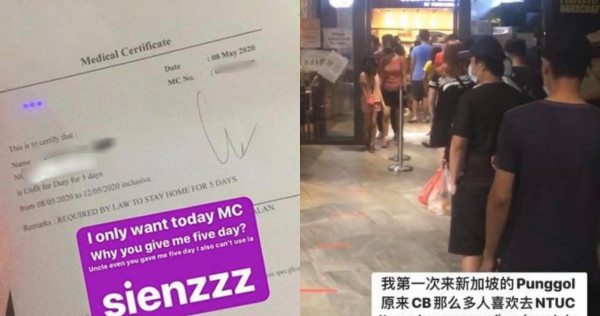
A report has been filed against a man who allegedly flouted a five-day sick leave to visit Waterway Point with his friends and posted about it on Instagram, the police told AsiaOne on May 11. 

The man’s transgressions first gained attention online after screenshots of his Instagram Story were posted on the Facebook page All Singapore Stuff on May 10.

According to the screenshots, which have since been removed, the man was issued the medical certificate (MC) on May 8 at Health First Family Clinic in Jalan Membina.

Seemingly unhappy about being issued a five-day MC, he wrote: “I only want today MC. Why you give me five day? Uncle even you gave me five day I also can’t use la [sic].”

Additionally, in the picture that the man posted, the MC stated that he was required by law to remain home.

Since February, doctors have been advised to issue five days’ medical leave to patients with respiratory symptoms such as fever and cough.

[ad_2]

Source link