Home Blog Page 328

Cocktail bar, Italian restaurant call it quits amid COVID-19 challenges for F&B sector

SINGAPORE: From S$1,726 in February to S$1,545 in March and then S$723 in April. The average daily sales at downtown cocktail bar Jekyll & Hyde steadily dropped as the COVID-19 pandemic hit business.

By April, sales were down by 70 per cent compared to five months ago in November, as the bar could only do deliveries and takeaways once dine-ins were off limits under the “circuit breaker” measures that started on Apr 7. 

Even before that, its owner Mr Chua Ee Chien had been busy negotiating with the real estate management company that represents the landlord to reduce rent. Companies in the central business district had begun directing workers to telecommute, and the number of customers he could serve was limited by safe distancing protocols.

(rp) Jekyll & Hyde owner

Mr Chua Ee Chien is the owner of downtown cocktail bar Jekyll & Hyde, which will close after its tenancy ends in June. (Photo: Rachel Phua).

After weeks of e-mails and phone calls, his landlord agreed to cut his monthly rent from S$14,000 to S$5,750 for either the rest of the year, or until Singapore returned to the DORSCON green level, whichever arrived earlier.But there was a catch – Mr Chua had to sign a personal guarantee, meaning he would become personally liable for payments to the landlord if the business was unable to fulfil them.

READ: COVID-19: Delivery and takeaway models unsustainable, say restaurant owners

Mr Chua said that he found the personal guarantee order unwarranted, since the landlord was already holding on to a S$42,000 deposit. And with the uncertainty over how long the COVID-19 situation will last, Mr Chua chose to cut his losses and will close shop once his tenancy ends on Jun 14.

“It’s a terribly unfortunate situation we’ve been placed in,” said Mr Chua, who bought over the six-year-old bar in 2018. 

“I’ve poured a lot of time and effort into this over the past two years, and sacrificed a lot, including money and countless hours with the team, (who have) slogged away to carry the bar (this) far.” he said. 

This request for a personal guarantee came only after Mr Chua had made one more appeal –that if he failed to settle his rent on time at the start of each month, he would pay 5 per cent interest on top of the S$5,750 rent. However, the landlord’s condition was that he should pay the full S$14,000 if he did not meet the stipulated monthly deadlines.

From the landlord’s perspective, the tenant’s request to pay 5 per cent interest instead of the original amount had “set off alarm bells”, a spokesperson from the asset management firm representing the landlord said.

There was also the risk that the S$42,000 deposit would not be enough to cover the cost to renovate the shophouse and unpaid rent if the bar folded before the end of the year, the spokesperson added. She asked that her company not be named as it would jeopardise their relationships with other tenants.  

(rp) Jekyll and Hyde tras street bar

Jekyll & Hyde is one of two known food and beverage outlets that will close as business goes south due to the COVID-19 pandemic. (Rachel Phua).

Now that Jekyll & Hyde’s closure is drawing near,one of Mr Chua’s three full-time employees is now looking for another job in a new industry, he said. 

Mr Chua has been working with the other two to scout for a small joint where he can continue to sell bottled cocktails and keep them on the payroll until he finds a permanent space when the virus blows over. 

“(But) there are no certainties,” Mr Chua said. 

HARSH TIMES AHEAD

Even with financial help such as wages subsidies and a property tax rebate from the Government, the F&B industry faces huge uncertainties.

Aside from circuit breaker measures, the lack of tourists and safe distancing rules will batter the industry, said restaurant operators and analysts, as relief measures can only help players shore up cash flow in the short-run.

Many independent restaurants operate in tight liquidity conditions and high overheads as rental rates have continued to rise in recent years, said Pua Wee Meng, a consumer industry leader at Deloitte Southeast Asia.

He expects the industry’s outlook to remain in the doldrums, particularly among eateries heavily reliant on the dine-in crowd, as consumers continue to practice safe distancing for some time. 

READ: ‘It’s about trying until our last breath’: New F&B players cook up survival plans for COVID-19 crisis

Restaurant operators also face the challenge of managing food costs during this difficult time, Mr Pua said, having to gauge the amount of ingredients to procure against uncertain demand, while balancing wastage and the risk to food quality. 

It would be even harder for those with “low-loyalty patrons”, such as those that cater to the mass market or tourists.

And though many restaurants have introduced online delivery services during the circuit breaker, this strategy squeezes their already-tight margins with higher costs in packaging, resources to manage the orders, transportation and high commission payments to third-party delivery platforms, Mr Pua added. 

Even before the circuit breaker came into play, a survey published at the end of March among 174 F&B business owners representing 249 establishments found that 93 per cent had seen a decline in revenue.

The study by restaurant booking platform Chope also reported that 80 per cent of those polled said they were reducing staff to cut costs and a third had imposed compulsory leave for full-time employees.

Nearly four in five businesses then said they were not prepared to last longer than six months if the situation did not improve. 

The industry’s workers are also on shaky ground. In its latest macroeconomic review published on Apr 28, the Monetary Authority of Singapore (MAS) noted that the food and beverage (F&B) industry is one of the sectors where workers are “most vulnerable” to lay-offs as competitive pressures among F&B operators were already acute.

Many of these firms tend to be small and could face significant credit constraints, which would limit their ability to hold on to their workers, MAS added.

Two-and-a-half weeks ago, Ashok Melwani broke the bad news to his team of 50, some whom had been with him for more than 20 years, that he was calling it a day at both of his Modesto’s restaurants.

After 17 years at The Elizabeth Hotel, Modesto’s@Elizabeth ceased its dine-in service when April came to a close, although its kitchen will run till the end of May to cater to guests serving their stay-home notice. 

And in June, Modesto’s@Orchard at Orchard Rendezvous Hotel will shut its doors after 23 years. 

Mr Melwani chose to wind things up after predicting that he would bleed for the rest of the year if he continued, he said. The tourist clientele, which the restaurants are heavily reliant on, has all but dried up. 

In March, he lost about S$200,000, he said, while April’s earnings are still being calculated. Both outlets were only able to keep going by relying on what he accrued last year, when profit margins were between 6 to 7 per cent, he said.

(rp) Modesto's Orchard Rendezvous Hotel

The Modesto’s Orchard Rendezvous Hotel branch will close in June after being in business for 23 years. (Photo: Ashok Melwani).

“I cried at home the night I gave out the (retrenchment) letters,” said Mr Melwani, who laid off the first batch of 15 at the end of last month. 

“I (would) rather the affected staff get on with looking for new jobs as soon as possible, (since they) probably need to look at (other) industries at this time,” Mr Melwani said. 

To help his retrenched staff members, Mr Melwani is looking for job leads among his friends and acquaintances. So far, three of them, including two who are foreigners, have managed to secure a position elsewhere.

He also launched a mini-fundraising campaign, setting aside 40 per cent of takeaway sales proceeds in May to help former employees who are in between jobs. 

READ: More companies announce wage cuts, no-pay leave amid COVID-19 economic downturn

The employees have been understanding, he said. Some of the longer-serving ones have sent him messages to say they appreciate whatever support he is trying to give.

Former customers have also sent their regrets. One told him how he had, without fail, celebrated his birthday with his extended family at the Orchard Road branch every year – now that tradition would be broken. Another said: “My daughters are going to cry when they hear this.”

“I think I’ll cry too, when this is all over,” Mr Melwani said. “Now I’m just focused on ending the business well.” 

BOOKMARK THIS: Our comprehensive coverage of the coronavirus outbreak and its developments

Download our app or subscribe to our Telegram channel for the latest updates on the coronavirus outbreak: https://cna.asia/telegram
Source link

COVID-19: Singapore records more discharged cases than new patients in a day

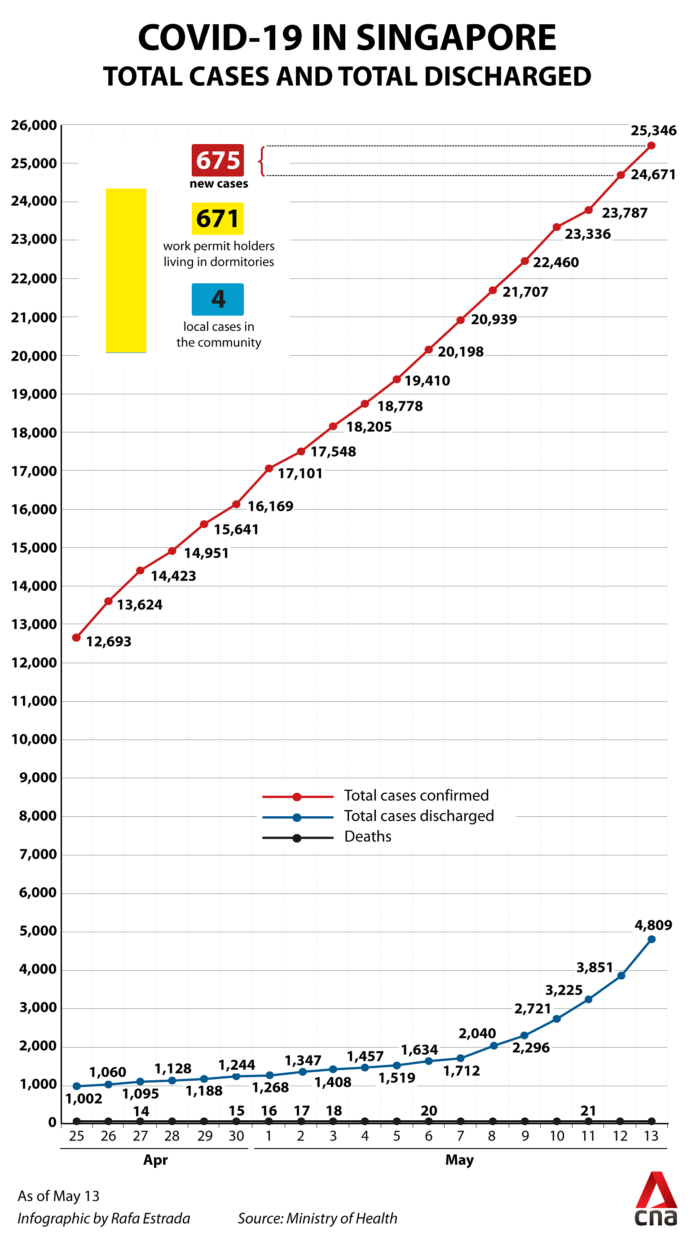
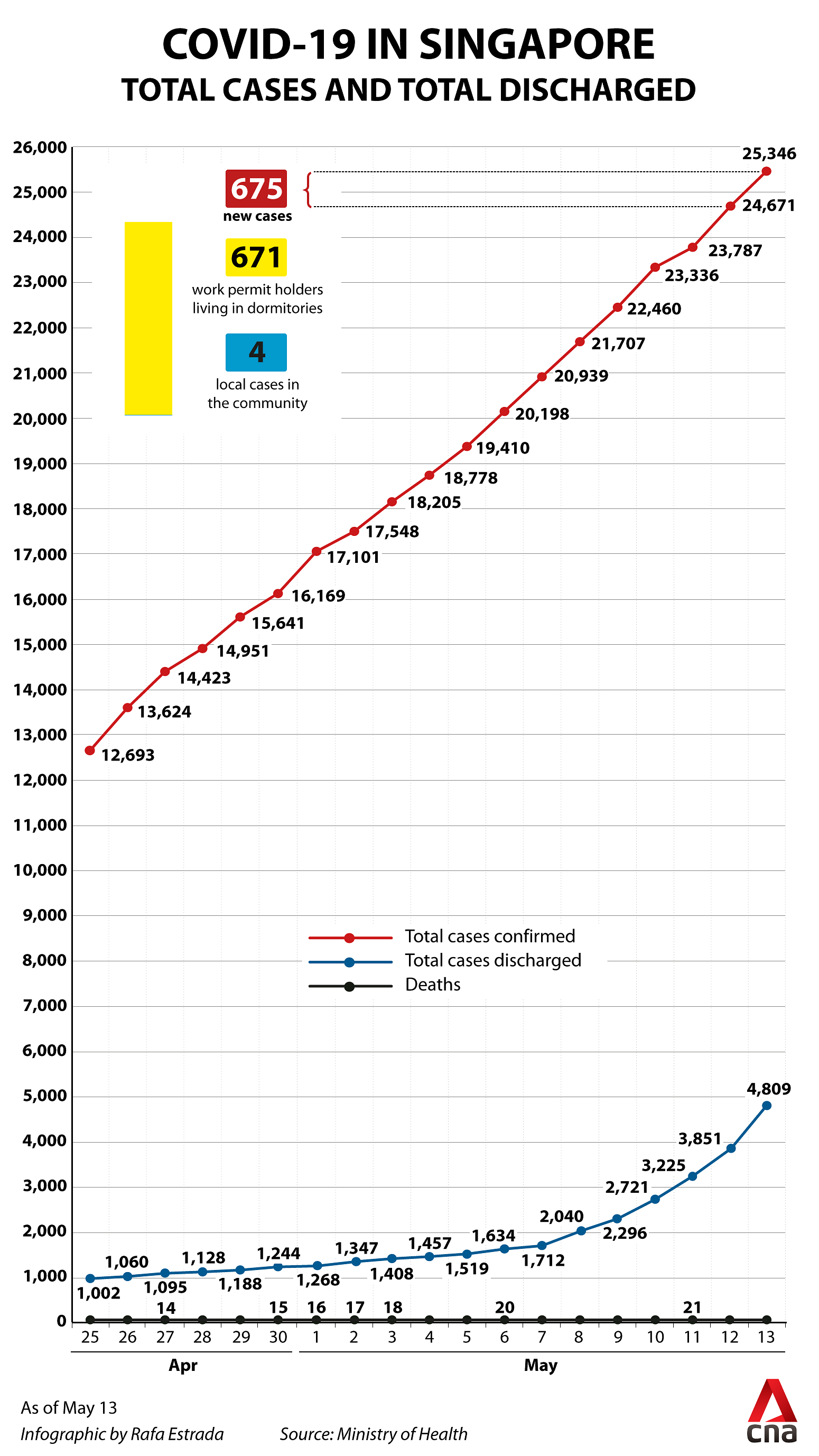
SINGAPORE: A total of 958 patients were discharged on Wednesday (May 13) after recovering from COVID-19, a new daily high, and more than the number of new cases reported in a single day.

In all, 4,809 have fully recovered from COVID-19 and have been discharged from hospitals or community care facilities, said the Ministry of Health (MOH) in a press release. 

A total of 675 new infections were reported on Wednesday.

READ: Singapore’s COVID-19 cases exceed 25,000; new daily high of 958 patients discharged 

This is not the first time Singapore has reported more discharged cases than new patients in a single day.

On Monday, MOH reported 486 new COVID-19 cases with 504 more patients discharged. However, the number of new cases was lower on that day because fewer tests had been processed, as one of the laboratories was recalibrating its apparatus for one of the test kits, said MOH. 

MOST CASES STABLE OR IMPROVING: MOH 

Health Minister Gan Kim Yong on Tuesday said that 20,000 migrant workers who have COVID-19 are expected to be ready to be discharged by the end of May. 

Speaking at a press conference, he said that the number of migrant workers who have COVID-19 is likely to “remain high for some time” while “aggressive” testing is carried out to progressively clear those living in dormitories so that they can safely return to work. 

Singapore is testing about 3,000 people living in the dormitories a day, but officials are looking to increase this number over the coming weeks. 

MOH COVID-19 cases chart May 13

In Wednesday’s report, MOH said that there are currently 1,037 confirmed cases who are still in hospital. Most are stable or improving, while 19 are in a critical condition in the intensive care unit. 

A total of 19,479 patients are isolated and cared for at community facilities, MOH said. These are cases who have mild symptoms, or are clinically well but still test positive for COVID-19. 

MAJORITY OF NEW CASES ARE WORK PERMIT HOLDERS IN DORMS

Of the 675 new cases, 671 are work permit holders residing in foreign worker dormitories.

MOH said it continues to pick up many more cases among work permit holders residing in dormitories, including in factory-converted dormitories, because of extensive testing in these premises, as part of its process to verify and test the status of all workers. 

READ: For mum of 7 with husband fighting COVID-19 in ICU, home quarantine is an anxious but tight-knit affair

Four new cases were also reported in the community – two Singaporeans, including a 73-year-old woman who is currently an unlinked case. 

The other case, a 48-year-old man, had been deployed for operations duties at CDPL Tuas Dormitory. The dormitory at 6 Tuas South Street 15 is a COVID-19 cluster that currently has a total of 309 confirmed cases. 

The two other community cases are work pass holders.

MOH said the number of new cases in the community has decreased, from an average of eight cases per day in the week before, to an average of six per day in the past week. 

Of the new cases, 99 per cent are linked to known clusters while the rest are pending contact tracing. 

BOOKMARK THIS: Our comprehensive coverage of the coronavirus outbreak and its developments

Download our app or subscribe to our Telegram channel for the latest updates on the coronavirus outbreak: https://cna.asia/telegram
Source link

NParks officer who almost lost finger in stabbing attack now recovering at home

[ad_1]

SINGAPORE – The National Parks Board (NParks) officer who almost lost a finger in a vicious attack at Sungei Serangoon Park Connector is out of hospital and recuperating at home.

Senior Parliamentary Secretary for National Development and Home Affairs Sun Xueling shared the update on her Facebook page on Wednesday (May 13).

She said the officer almost had his finger severed in the attack which also saw him sustain serious injuries on his chest, arm and hand.

The officer, who was performing safe distancing enforcement duties on May 4, needed emergency surgery after being stabbed repeatedly.

[ad_2]

Source link

Circuit-breaker week 5: Nando's free support meals, 100,000 free tickets from Qatar & other deals

[ad_1]

We scour the island for the best deals to help you stretch your dollar, and keep you in the loop on the hottest shopping trends.

‘Cos good things must share.


[UPDATED, May 13]

Nando’s free meals for those who have lost their jobs

From now till June 1, Nando’s will be giving out 50 free “support meals” per restaurant per day to help those who have lost their jobs or livelihoods due to Covid-19.

One takeaway meal will be available per person from 2.30pm to 5.30pm daily, while stocks last. The meal consists of a quarter chicken with a regular side of Mediterranean rice.

To redeem, simply ask for a “Support Meal” at any of its restaurants located below:

  • Bugis Junction #01-85
  • Plaza Singapura #04-10
  • Tanglin Mall #01-14
  • Tampines Mall #01-46
  • The Star Vista #B1-09
  • NEX #B1-41

Qatar offers 100,000 free tickets for healthcare workers

Attention all healthcare professionals. Qatar is giving away 100,000 free tickets to frontliners in the ongoing battle against the coronavirus. 

[ad_2]

Source link

Responding to GrabFood rider's viral post, restaurant owner says there are errant delivery workers too

[ad_1]

After a GrabFood rider voiced out his frustrations dealing with rude F&B staff during the course of the circuit breaker, a Dempsey Hill restaurateur has spoken out about his own grievances with errant delivery personnel. 

On Saturday (May 9), a man by the name of Jerry Toh wrote a lengthy Facebook post about how he and his fellow food delivery workers are treated poorly by restaurant workers who can’t cope with their orders, resulting in late deliveries and angrier customers. The post went viral, with many netizens empathising with his plight. 

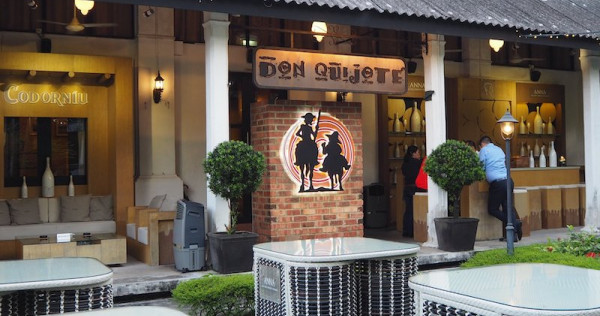
AsiaOne spoke to Ken Lim, the owner of Spanish eatery Don Quijote, who has another perspective on the issue. He highlighted that restaurants have also been struggling under the pressures of the pandemic — and some food delivery workers are not without fault too.  

Lim shared that he faced some troubles with food delivery personnel on more than a few occasions, some of which required him to personally calm his customers down. 

[ad_2]

Source link

Tan Min-Liang responds to criticisms about requiring Razer Pay sign-ups to get free masks

[ad_1]

Objectively, Razer’s decision to give away millions of masks to Singapore residents is a generous gesture. 

But it’s been catching quite a bit of flak online over that fact that the initiative requires getting on board the company’s mobile e-wallet app, Razer Pay. 

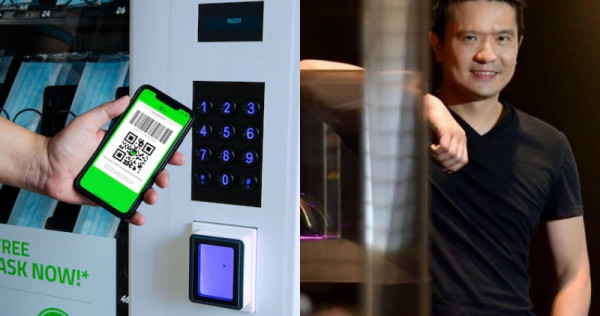
Negative feedback started emerging after it was revealed that Singapore residents would be entitled to receiving a free made-by-Razer surgical mask each… but the catch is that they have to download the Razer Pay app and sign up for an account first. 

Once the account is verified, they will receive a digital coupon that can be scanned at one of Razer’s mask-distributing vending machines, which will soon be deployed islandwide. Razer Pay’s verification system is fraud-free, the company proudly claimed, ensuring that every verified Singapore resident will be issued a mask. The app would also provide locations of the vending machines for users to find the nearest one in a jiffy. 

[ad_2]

Source link

COVID-19: Legal relief for those who buy or lease homes from developers

SINGAPORE: Property buyers who have entered into agreements to purchase or lease homes from developers can now apply for temporary legal protection should they face difficulties making payments because of the COVID-19 pandemic.

The move is an extension of the COVID-19 (Temporary Measures) Bill passed last month, which provides temporary relief from certain legal action for non-residential leases, construction or supply contracts, event agreements, tourism-related contracts such as tour packages as well as secured loan facilities.

The relief measures, which took effect from Apr 20, will last for six months in the first instance.

With the extension, which came into effect on Wednesday, the Act will now cover buyers who have entered option to purchase agreements, sale and purchase agreements or agreements for lease for residential properties, said the Ministry of Law (MinLaw) on Wednesday (May 13).

The extension covers only contracts between buyers and private developers or the Housing & Development Board, said the Law Ministry in a press release. It does not cover agreements made between individuals.

An option to purchase agreement is granted by a housing developer to a buyer for the purchase of residential property. It generally provides for the payment of a certain portion of the purchase price when the agreement is exercised.

A sales and purchase agreement or agreement for lease is granted by a housing developer to a buyer for the sale and purchase of residential property.

“MinLaw is including these two contracts in the list of contracts covered by the Act, to provide relief in such situations,” said the ministry.

“Like other contracts covered by the Act, these contracts must have been entered into before Mar 25, 2020, with contractual performance due on or after Feb 1, 2020.”

READ: COVID-19: Construction projects could be delayed months, as contractors fear manpower crunch when clearing backlog

The Law Ministry said it had received feedback that some buyers who had entered into such agreements faced difficulties making payments because of COVID-19, and stood to lose their booking fees or deposits.

But before applying for relief, buyers should first seek an extension from the developer, MinLaw said.

If the two parties are unable to agree on the terms of the extension, or if negotiations with the developer are not possible, the buyer may serve a Notification for Relief (NFR) on the developer to enjoy relief under the Act.

“Relief applies where a contracting party is unable to perform a contractual obligation due to COVID-19,” said the ministry, adding that the buyer must serve a notification on the developer before it can be applied.

READ: S$16 billion in COVID-19 support given out as of May: Indranee Rajah

In the case of an option to purchase agreement, the developer will then be prohibited from withholding or forfeiting any part of the booking fee paid under the agreement during the relief period.

In the case of a sales and purchase agreement or agreement for lease, the developer will be prohibited from terminating the agreement on the basis of the buyer’s non-payment.

A housing developer may also serve a notification to seek temporary protection from being sued during the relief period, if it is unable to perform any contractual obligation due to COVID-19, the Law Ministry said.

Private Housing landed home building property - file photo

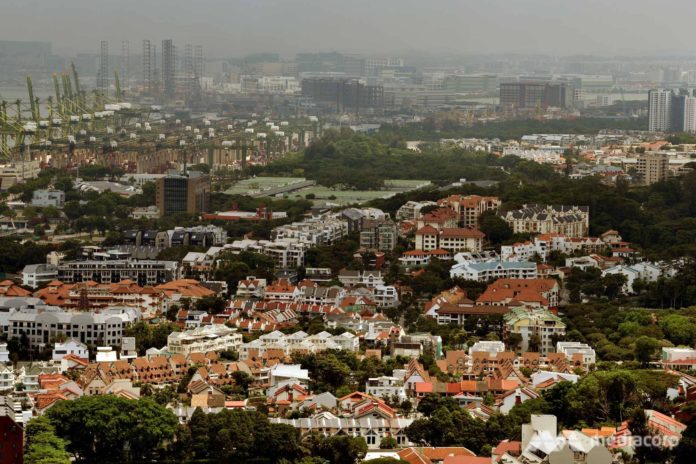
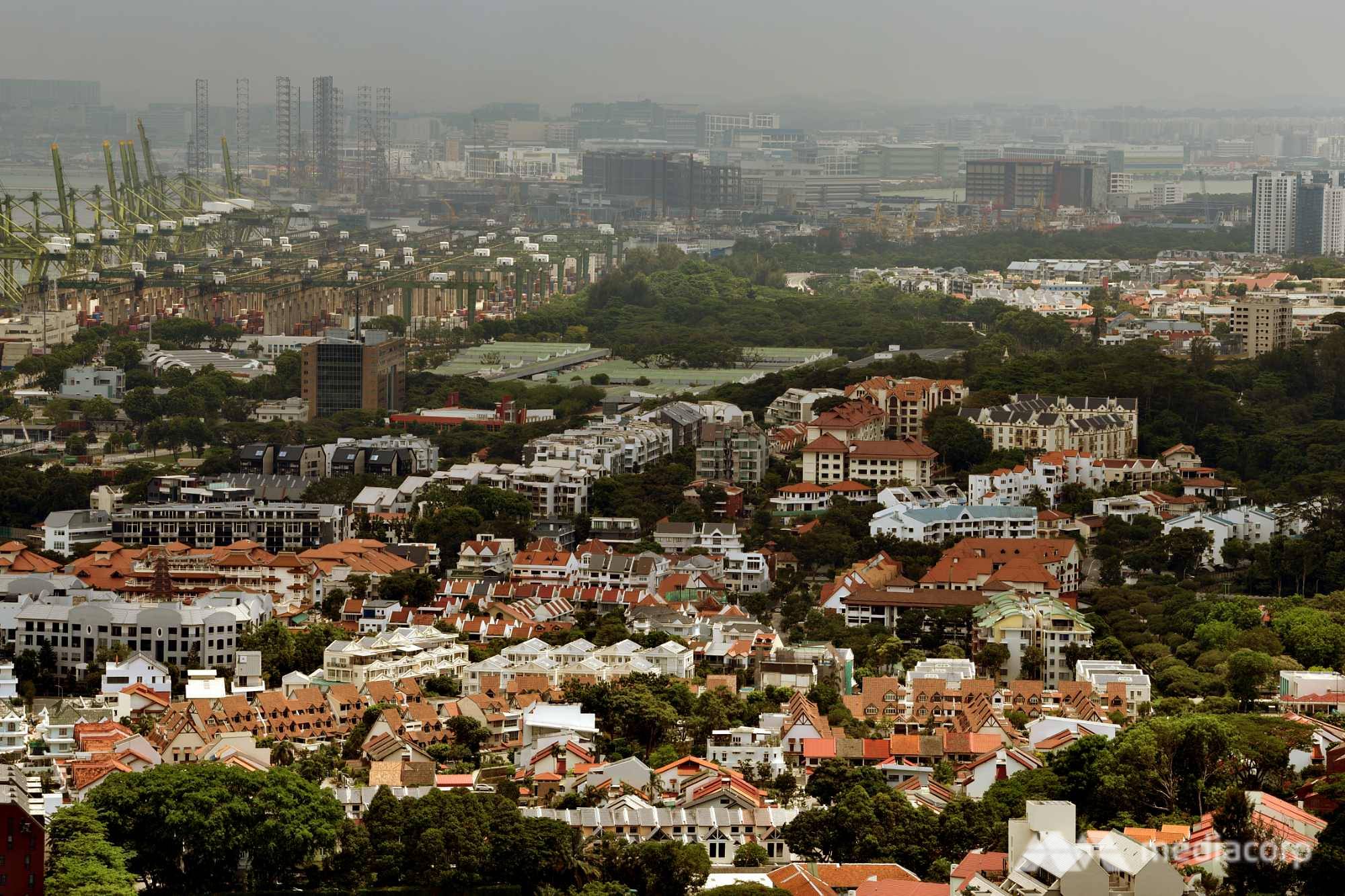
File photo of private houses in Singapore (Photo: Jeremy Long)

“The conditions and framework for how disputes are to be resolved under the Act will apply. We encourage parties to discuss and reach a mutual agreement,” MinLaw said.

If the parties are unable to reach a compromise even after a Notification for Relief is served, either party may make an Application for an Assessor’s Determination, it added.

“The Assessor will consider both parties’ arguments and will seek to achieve an outcome that is just and equitable in the circumstances.”

INCREASES IN INTEREST RATE, CHARGES PROHIBITED

As part of the announced changes on Wednesday, additional actions relating to the “unilateral increase of charges” will also be prohibited.

“Since the Act commenced, MinLaw has received queries and feedback that some parties are seeking to impose additional interest and charges for late payment that are not provided for in their contracts, even though an NFR has been served,” the ministry said.

“Among other things, the Act gives affected non-performing parties temporary relief from making payments.

“In such a situation, landlords are not permitted to unilaterally increase interest rates or impose new charges on delayed payment, in order to prevent or discourage parties from seeking the relief granted under the Act.”

READ: Singapore new private home sales plunge 12% in the first quarter as prices dip

READ: HDB resale transactions down 7% in Q1, prices remain flat

After a NFR has been served, it is prohibited to increase of any charges or interest rate payable under the contract, unless the charge or interest rate increase was specified in the contract or was a result of a formula or reference rate.

It is also forbidden to impose new charges under the contract or require that a security deposit be replaced by the non-performing party without their agreement.

“HIGHLY HELPFUL”

The Singapore property market has been adversely impacted by the COVID-19 pandemic, with the Government announcing last week a slew of temporary relief measures for property developers and individuals affected by the outbreak.

Wednesday’s announcements were welcomed by property analysts as a “highly helpful and timely” move.

Private apartment blocks - file photo

Private property in Singapore (File photo: Gaya Chandramohan)

“By offering relief to property buyers who have difficulty in exercising their option to purchase or fulfilling obligations of their sales and purchase agreement, this is actually beneficial to developers – because they will not end up in conundrums with such buyers who faced difficulties in financing their property going forward,” said property analyst Ong Kah Seng.

“It provides a clearer way for buyers to exit and how developers can efficiently receive back that returned unit – that can ultimately still be sold if competitive pricing is adopted amid the recession,” he added.

“As for lease agreement, the relief is helpful for tenants who indeed have to be repatriated due to corporate downsizing amid the recession. Landlords who face this issue can however quickly refund them initial deposit and move on to rent out their property to other interested tenants,” said Mr Ong.

The Real Estate Developers’ Association of Singapore (REDAS) said the relief measures will help genuine buyers during these challenging times.

“REDAS shares the Government’s views that contracting parties face considerable constraints on many fronts.

“The enhanced COVID-19 (Temporary Measures) Act will help to provide relief to affected genuine buyers from financial commitments and protection as well as time to reach an amiable settlement with developers in good faith.”

BOOKMARK THIS: Our comprehensive coverage of the coronavirus outbreak and its developments

Download our app or subscribe to our Telegram channel for the latest updates on the coronavirus outbreak: https://cna.asia/telegram

Source link

Driver calls out motorcyclist for spitting at car, gets slammed instead

[ad_1]

After an attempt at vigilantism backfired spectacularly, one driver learnt the hard way that perhaps people who live in glass houses shouldn’t throw stones.

Sharing a recording of an incident which took place at Hougang Avenue 5 on May 12, the driver ranted against a motorcyclist who “insisted” on his right of way, confronted them and spat at their car.

The only problem? The motorcyclist did in fact have the right of way, as many netizens were quick to point out.

Dashcam footage uploaded by the driver, who remains anonymous, shows the car turning out of a carpark and into the path of a motorcyclist on the main road.

[ad_2]

Source link

Thum Ping Tjin, New Naratif website issued correction order over video on Pofma

[ad_1]

SINGAPORE – Historian Thum Ping Tjin has been asked to put up corrections to a video in which he asserted that Singapore’s fake news law renders all criticism of the Government illegal.

Describing this claim and several others as false and misleading, the Protection from Online Falsehoods and Manipulation Act (Pofma) Office on Wednesday (May 13) issued corrections directions to Dr Thum as well as the New Naratif a website he founded.

Dr Thum had posted the video on New Naratif’s YouTube channel on May 8 as part of his online video series The Show With PJ Thum, in which he analyses and criticises various government policies and actions.

Under the correction direction, initiated by Minister for Law K. Shanmugam, Dr Thum will have to run a correction notice alongside the video that provides a link to the facts on the Government’s fact-checking website Factually.

The Law Ministry noted in a statement that the video itself will remain fully accessible to the public.

“Thus, members of the public will be in a position to view the video, read the correction notice and clarifications, and come to their own conclusions,” it said.

[ad_2]

Source link

82-year-old among 26 people arrested during illegal gambling operation

SINGAPORE: Twenty-six people have been arrested for suspected involvement in illegal gambling activities, the police said in a news release on Wednesday (May 13).

The individuals – 16 men and 10 women – were arrested during a five-day operation at Everton Park, Geylang Bahru, Temple Street and Jalan Besar.

Those arrested were between 43 and 82 years old.

The police said that S$8,499 in cash was seized during the operation.

26 arrested for illegal gambling and breaching safe distancing measures (2)

26 people have been arrested for illegal gambling activities and will also be investigated for breaching safe distancing measures, the police said on May 13, 2020. (Photo: Singapore Police Force)

All 26 individuals were arrested for offences under the Common Gaming Houses Act and the Betting Act.

They are also being investigated for breaching COVID-19 safe distancing measures.

BOOKMARK THIS: Our comprehensive coverage of the coronavirus outbreak and its developments

Download our app or subscribe to our Telegram channel for the latest updates on the coronavirus outbreak: https://cna.asia/telegram

Source link