SINGAPORE – Overall revenues of Southeast Asian firm Grab have dropped since the coronavirus pandemic began, dragged down by the core ride-hailing business, the company’s co-founder said on Thursday.
Tan Hooi Ling said the Softbank-backed private firm had seen an uptick in its food delivery business but its total revenue was “lower than it used to be pre-Covid”, referring to the respiratory disease caused by the virus.
The firm was preparing for “a potentially long winter”, and taking measures to be more efficient and conserve cash, Tan added.
For the latest updates on the coronavirus, visit here.
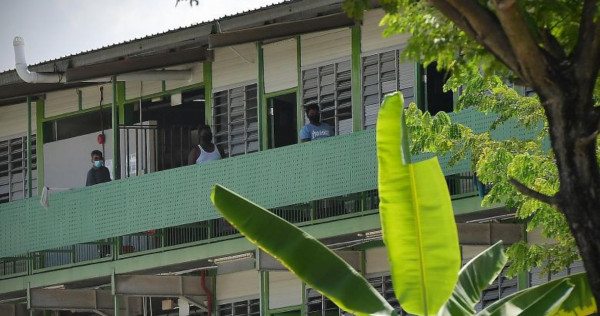
The Ministry of Health (MOH) has preliminarily confirmed 752 new coronavirus cases in Singapore today (May 14). Out of these, the vast majority are cases involving work permit holders residing in dormitories and two are Singaporeans or Permanent Residents.
This brings the total number of cases to 26,098 with 4,809 patients discharged and 21 deaths.
MOH will share more details in its update later tonight.
For the latest updates on the coronavirus, visit here.
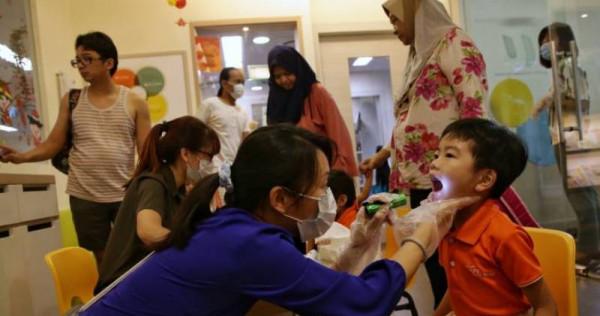
SINGAPORE – All pre-school staff will undergo a one-time swab test for Covid-19 starting from Friday (May 15) before centres reopen on June 2.
The test would cover principals, teachers and educarers, or those who look after infants and toddlers.
It also includes non-programme staff like cleaners and cooks, as well as relief and new staff starting work in June, to be sure that they are not infected before they start working.
The Early Childhood Development Agency’s (ECDA) chief licensing officer Jamie Ang had announced the need for swab tests in a circular to operators on Wednesday.
The Health Promotion Board (HPB) will conduct the tests for staff between Friday and May 26, at four swabbing centres located in polytechnics, at areas segregated from the rest of the campus.
In the circular seen by The Straits Times, Ms Ang said that to allow faster testing, a pooled approach will be used, where swab samples from up to five individuals will tested in one batch, instead of individually.
Bishan-Ang Mo Kio Park’s state-of-the-art protector of safe distancing has made big enough waves overseas to get featured in a late-night talk show in the US, and it’s not for its adorability.
Like everyone else on the internet, comedian Stephen Colbert couldn’t resist pointing out the resemblance between our own robotic public-health ambassador and a certain dystopian murder-machine from a Black Mirror episode.
SINGAPORE: Ways to make pet adoption easier amid safe distancing measures are set to roll out by end of May, according to the National Development Ministry (MND).
This follows a meeting between MND, the National Parks Board (NParks) and 11 animal welfare groups last Friday (May 8).
Among the plans is a monthly pet adoption drive by NParks, called “Pet’s Day Out”, which is expected to go online for virtual viewings of animals.
Senior Parliamentary Secretary for National Development Sun Xueling said the authorities are also looking at how one-on-one meetings between animal and human can be facilitated before an adoption.
“Definitely whatever it is we decide on, in terms of the protocol, we have to make sure it takes into account safe distancing measures that are important within the current COVID-19 pandemic,” said Ms Sun.
“We are mindful that even when the circuit breaker ends, now come Jun 1, life will not exactly go back to normal … We still have to be careful about safe distancing measures, we still have to protect our animals and potential pet owners. We are looking at different modalities we can do with animal welfare groups.”
In addition, Ms Sun told CNA that the Government is considering a one-year waiver on dog licences in a bid to get more people to adopt during this time. Other pets, such as cats, currently do not need such a licence.
Animal welfare groups such as Action for Singapore Dogs, Cat Welfare Society and House Rabbit Society – which were part of the meeting last Friday – run programmes that rescue animals which are put up for adoption.
But this has been made difficult since “circuit breaker” measures kicked in. For instance, open houses have been cancelled and visitors have been unable to visit shelters to interact with the animals.
While online adoption platforms exist, those who run such adoption programmes said that interaction is necessary before making such a life-changing decision.
“Having a remote adoption thing is not really working out for us,” said Ricky Yeo, President of Action for Singapore Dogs.
“You can’t let a potential adopter see a dog they like on a website and then say, ‘Wow, that’s great, I’m going to ship a dog to you in an hour.’ It’s not ordering a pizza. You do need that interaction, you do need to assess, the potential adopters themselves need to assess if that dog’s going to be for them,” he added.
A stray cat in Singapore. (File photo: Vivien Loon)
With the dogs at his shelter getting bigger with age, space is also becoming an issue, which Mr Yeo said could also affect the dogs’ physical and mental health.
He pointed out that having a place for strays also keeps members of the public healthy and safe.
“If there are more strays out there, they may start to forage more, they may start to become a public nuisance, may cause safety concerns,” Mr Yeo said.
“Would this incremental increase of dogs, is that going to impact society on a whole? Are we going to get more complaints from the public? Are the authorities going to have to deal with more manpower issues to look into all these issues?” he added.
The circuit breaker has also meant manpower is becoming scarce at animal welfare homes.
From about 40 volunteers, Mr Yeo now only has seven “essential volunteers” coming in to help feed and bring the dogs out for exercise. The non-profit organisation, which has rehomed more than 300 dogs, has resorted to forgoing lengthy walks and letting the dogs play in the corridors instead.
HELP TO COME
Ms Sun said NParks will work individually with these groups to better understand the number of volunteers they need at this time, and discuss this with the Trade and Industry Ministry, which gives out exemptions for essential services during this period.
“The animal welfare groups were interfacing directly with the Trade and Industry Ministry, and different animal welfare groups put forward their proposals in different ways,” said Ms Sun.
“We’re looking to try to standardise that a little to see how we can make it more efficient, more effective, and that is also to facilitate a better understanding from the government agencies as to what the animal welfare groups need.”
But Ms Sun added that shelters will need to find creative solutions to the manpower problem, with safe distancing measures likely here to stay.
“They are going to have to think about how to optimise the use of manpower … how to stagger the volunteers out so that at each time we only have a handful of volunteers who are appropriately spaced out, so that even as they look to care about their animals, they are also protecting their volunteers,” she said.
In the meantime, animal welfare groups also have to struggle with finances, as there are fewer visitors, adoptions and donations.
To further help with operating costs, MND is also looking to provide free food packs for animals that are rehomed from the Animal and Veterinary Service. This is on top of an existing two-month rental waiver.
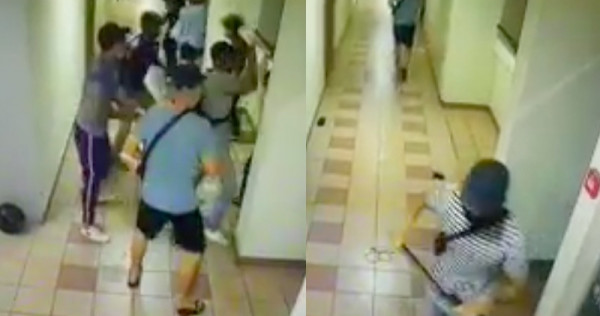
SINGAPORE – Three men appeared in a district court on Thursday (May 14) over their alleged involvement in a riot at a Chinatown apartment block on Sunday.
Muhammad Farid Surian and Noor Najat Alwi, who are both 20, and Muhammad Roslan Bin Mohamed Rumli, who turned 29 on Thursday, were each charged with one count of rioting while armed with deadly weapons.
Farid is said to have taken part in the brawl at Block 101 Upper Cross Street, People’s Park Centre while he was out on bail.
Prior to last weekend’s incident, he allegedly trespassed into the Institute of Technical Education College West in Choa Chu Kang Grove at around 4pm on May 16 last year with the intention to commit assault.
The three Singaporeans will be remanded at Central Police Division and will be back in court on May 21.
Court documents state that the trio allegedly ganged up with two others – Muhammad Syukri Muhammad Iskandar and Muhammad Ilham Noordin – to cause hurt to five men.
A fibre broadband disruption at telco M1 lasted 33 hours, hitting subscribers during this period when many are working and studying from home, prompting a stern warning from the industry regulator.
In a statement yesterday, regulator Infocomm Media Development Authority (IMDA) said it has started investigations and would “not hesitate to take strong enforcement action should there be any lapses on M1’s part”.
“IMDA takes a serious view of any service disruption to public telecommunications, especially during the circuit breaker period where many are working and studying from home,” an IMDA spokesman said.
Yesterday, many subscribers continued to face Internet connection issues even after the telco said services had been restored earlier in the morning.
Service was fully restored only around 2pm yesterday, more than 33 hours after connectivity problems were first reported on the Downdetector website, which logs Internet outages, at 4.30am on Tuesday.
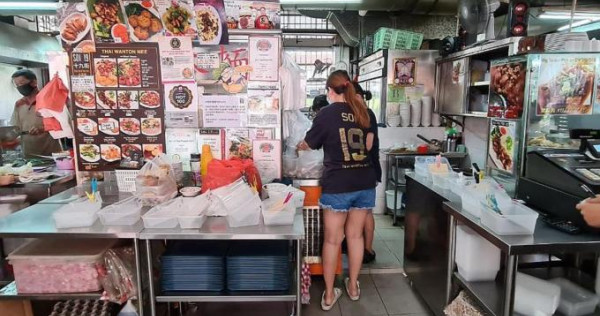
As takeaway and delivery orders shot up after the circuit breaker period kicked in last month, a chicken rice seller drove around frantically in search of disposable food containers.
As several suppliers had run of stock, Mr Daniel Tan, 40, finally managed to buy 5,000 containers from a retail store. Despite paying $1,150 for them, about 35 per cent more than the wholesale price, he was relieved to get his hands on them.
The owner of OK Chicken Rice in Ang Mo Kio Avenue 8 told The New Paper of his container hunt: “I was panicking and it was very stressful.”
Mr Tan added that he decided not to raise prices by absorbing the extra cost despite already paying more for rice and raw chicken by 10 per cent to 15 per cent.
The shortage and high prices of food containers were a common refrain among eatery and stall operators after dining-in was banned as circuit breaker measures took effect on April 7.
Of the 28 operators contacted by TNP, seven said they had problems with supplies and several others complained of having to pay up to 20 per cent more as prices went up because of demand.
DELHI: In the past few weeks, Delhi has experienced what it has not breathed and seen in years: Cleaner air and blue skies.
It is something that had “seemed impossible to achieve”, according to Tamseel Hussain, co-founder of Let Me Breathe, India’s largest online platform dedicated to pollution-related stories.
He has the COVID-19 lockdown on the city to thank for his lungs feeling “lighter”. The reduced noise pollution from traffic also allows him to hear the chirping of birds.
“Apart from this, many parts of India have reported witnessing mountain ranges that weren’t visible previously,” he told CNA Insider over WhatsApp.
Tamseel Hussain.
Before this lockdown began on March 23, he had spoken to CNA about his city’s toxic air instead, on the programme Undercover Asia. (Watch the episode here.)
Just in November, the air in the world’s most polluted major city had turned deadly again: Air quality was in the hazardous range for nine days straight. But now, Delhi is having its longest spell of clean air on record.
The lockdown has been extended to May 17, with some easing of restrictions, and could even continue beyond that. Once it ends, however, can India’s movement for clean air ride the momentum of the lockdown effects?
“Realistically speaking, it’s difficult. Prioritising the economy would require opening up and the functioning of all sectors, so there’s a chance that after the lockdown is lifted, we might lose these blue skies,” said Tamseel.
“Still, this is a strong opportunity to focus on long-term solutions and ensure cities prioritise sustainable living and development. A lovable and livable city is a plus to the economy too.”
Watch: India Air-pocalypse: Delhi’s youth fight to breathe clean air (2:50)
Whether the respite is short-lived or not may well depend on the government and even the courts, among others.
‘I COULDN’T TAKE MY KID OUTSIDE’
During the first 25 days of the lockdown, Delhi’s concentration of PM2.5 already indicated a “good” rating, which is the safest level.
The Central Pollution Control Board reported a 46 per cent reduction in PM2.5 levels and a 50 per cent reduction in PM10 concentrations in the capital compared with the week before lockdown.
PM2.5 and PM10 refer to particulate matter not more than 2.5 and 10 micrometres in diameter. Particles within this range make up a large proportion of dust that can enter the lungs or be trapped in the nose, mouth or throat.
Delhi’s smog peaks from October to February, routinely exceeding World Health Organisation recommendations for PM2.5, and some days registers levels more than 20 times the safe limit. (Photo: AFP/ Sajjad Hussain)
They are among the air pollutants in Delhi that, a few months ago, sent families seeking greener pastures — like Vaibhav Wardhan’s family, one of various stakeholders affected by the fight for cleaner air who spoke to Undercover Asia.
Vaibhav grew up in Delhi, so it is where he believes he belongs.
After landing a role in supply chain consulting with an American multinational, he and his wife, Nishu, moved from Hyderabad to their new home in Delhi in April 2018, excited to begin a fresh chapter of their lives.
Eight months later, their first child was born. But everything changed after that, with the deadly November air. “I couldn’t take my kid outside my home. It was as if he was under house arrest,” said Vaibhav.
Vaibhav Wardhan with his son.
“It was very difficult to see him not being able to sleep properly,” added Nishu. “We used to wake 10 or 20 times at night … Since I couldn’t take him outside, he used to be very cranky.”
Vaibhav refused to let his child grow up in a city enveloped by dust and smog, so he began looking for opportunities outside Delhi. The family eventually moved back to Hyderabad.
ILLEGAL CROP BURNING CONTINUES
The air pollution that drove them out of Delhi is nothing new, but its escalation in November has been linked to the neighbouring states of Punjab, Haryana and Uttar Pradesh.
Every winter, more than two million farmers in these states burn about 23 million tonnes of paddy straw on more than 80,000 square kilometres of land, even though stubble burning has been banned since 2015 by an Indian court dedicated to environmental matters.
Stubble burning.
Farmers can be fined up to 15,000 rupees (S$280) for flouting the law. But farmers like Sukhvinder Singh have little choice, as they must “feed (their) children”.
Dharmendra Singh, another farmer in Punjab, said they used to plant rice in May so they had enough time to harvest the crop.
But to save groundwater, the government passed a law in 2009 that forbade rice planting before June 15. This pushed back the rice harvest season from September to October, which means less time to clear the fields.
“The gap between harvesting and sowing … became shorter,” said Dharmendra. “The stubble had to be burned immediately … (so) the wheat crop can be grown.”
Dharmendra Singh.
No matter when the farmers plant their rice, they risk getting fined for breaking either law.
One proposed solution is the Happy Seeder, developed by the Punjab Agricultural University. Mounted on a tractor, it helps farmers to plant wheat without having to clear the leftover paddy straw.
But the farmers’ enthusiasm has been dismal for three main reasons: Tradition, cost and time.
Farming is an old profession, and farmers are not confident that new methods like the Happy Seeder will deliver the same yield, which would affect their income, said research fellow Karthik Ganesan from the Council on Energy, Environment and Water.
Moreover, each Happy Seeder costs about 150,000 rupees, and government subsidies are not enough to win over farmers.
Even when the government of Punjab wants to pay farmers not to burn their stubble and to use more Happy Seeders, these payments have been slow.
“Our village has farmable land of 800 acres, and we have two Happy Seeder machines,” said Dharmendra.
“To use them, a farmer has to wait for about 30 to 40 days, (but) we have only 15 to 20 days … between harvesting rice and sowing wheat.”
On top of all this, climate and geography exacerbate the impact of crop burning. Delhi is landlocked and flanked by mountains, so the slow wind movement during winter traps the smoke in a deadly shroud over the city.
NEVER-ENDING TRAFFIC POLLUTION
What’s more pertinent than agricultural burning, which only happens for 20 to 30 days, is that Delhi is blighted by the worst vehicle emissions in India, according to a 2018 study by the Centre for Science and Environment, a Delhi-based think tank.
In winter 2016, the Delhi government introduced the ‘odd-even’ policy: odd-numbered license plates are allowed on the road one day, even numbers the next. They implemented it again in November 2019 after the city declared a public health emergency.
On a daily basis, however, the Delhi government uses their Pollution Under Control (PUC) certificate to regulate vehicle emissions, with the idea to keep older and dirtier vehicles off the streets. Without the certificate, drivers could be fined up to 10,000 rupees.
But this measure has major loopholes. In Tamseel’s own experiment as a citizen journalist, he managed to get an authentic PUC certificate for a car that failed its emissions test at another facility.
All he did was use a photo of the license plate and an expired PUC certificate.
To implement more effective solutions, the government established its Electric Vehicle policy to subsidise electric vehicles.
The downside is these schemes only affect vehicles registered inside Delhi. A large percentage of air pollution spews from trucks and buses running on diesel fuel that come from outside the city’s borders – and beyond the reach of its laws.
“We plan to nearly double the entire bus fleet in the next couple of years,” said Jasmine Shah, vice chairperson of the dialogue and development commission in Delhi’s government.
“We are working on affordability. Bus travel is free for women. We also plan to make it free for students. This will ensure more people shift from private vehicles to public transport.”
LOOKING TO THE COURTS FOR SOLUTIONS
On the ground, environmental activists like 16-year-old Aditya Dubey, are trying to eradicate Delhi’s air pollution crisis one step at a time.
The effects of air pollution have taken a toll on his body, causing him to wake up in the middle of the night with breathlessness – a symptom many more students experience too.
Besides using Twitter to call out Delhi’s authorities, Aditya filed a Public Interest Litigation on behalf of the millions of schoolchildren in Delhi in November.
Separately, on his platform, Let Me Breathe, Tamseel carries out his own investigations into Delhi’s chronic problems – and possible solutions – and makes them available online.
But activists like Aditya and Tamseel need the backing of a Supreme Court order to see significant change. Aditya’s case was taken on by Aparajita Singh, who has been litigating cases on pollution and environmental protection for over two decades.
“When we are talking specifically about air pollution, it’s covered by Article 21 of the constitution, which is right to life – and that’s the most fundamental provision of the constitution,” said the senior advocate at the Supreme Court.
The activists also seek a Supreme Court order to enforce the states of Delhi, Punjab, Haryana, and Uttar Pradesh to clean up Delhi’s air. But the chief secretaries of these states were a no show on the day they were supposed to present their plans of action to the court.
It might be disheartening, but Tamseel has decided to focus on helping people upload pollution and climate change stories using their mobile phones.
“The media might move on, politicians might keep throwing blame games at each other, trending topics are never going to end, sensational news will keep happening. But you know what doesn’t change is (the) citizen’s voice,” he said.
“Citizens’ voices asking for positive change have a long lasting impact.”
CHANCE OF A FRESH START
Since the Undercover Asia episode aired, Tamseel has some suggestions for how the government can ride the wave of the environmental benefits of the COVID-19 lockdown.
Having seen how “beautiful and healthy” life can be with “next to zero cars on the road”, he wants the government, institutions, and citizens to work together. The government, for instance, can use their “powerful public engagement techniques” to ensure lasting behaviour change.
“We need to limit vehicular traffic. The push for electric mobility needs to be amplified. Industrial emissions need stricter control. And cities can look at a more accessible plan when it comes to public transport,” he said.
“The lockdown also highlights challenges in interstate travel, so this is a great opportunity to fix a robust and sustainable travel system between states.”
Then, if the air pollution finally abates, families like Vaibhav’s wouldn’t need to leave the capital anymore just to give their newborn children a fighting chance at breathing clean air.
SINGAPORE: The spread of the coronavirus has had a tremendous impact on the travel industry.
With a vast majority of flights grounded to stop the international spread of the virus, major airports like Singapore and Dubai have seen passenger volumes plummet.
Airports continue to incur fixed costs for maintaining the infrastructure. Their burden is even greater because partners such as retail outlets and airlines have been given breaks in terms of rentals and reduced parking and other fees, respectively.
Though governments might share the costs burden of airports in the short term, it remains to be seen how long they will stomach such a responsibility.
A BLACK SWAN EVENT THAT HAS ONLY GOTTEN WORSE
Admittedly, the current crisis was a black swan type of event that could not have been anticipated.
It was barely a few months ago in December 2019 that the International Air Transport Authority (IATA) had predicted profits of US$29.3 billion for airlines in 2020.
We should anticipate that, going forward, the future will be very challenging for airport hubs like Singapore and Dubai because the air travel industry may take a long time to come back to the passenger volumes it enjoyed before the eruption of the pandemic.
There is a distinct possibility passenger volumes may never return to pre COVID-19 levels. Even the financially strong Changi Airport (with share capital and reserves at S$3.54 billion and retained profits of S$4.29 billion in the last financial year) is treading carefully.
Changi Airport announced on Tuesday (May 12) it will suspend Terminal 4 operations until a sufficient number of flights resume at the terminal. It had earlier announced in April a suspension of Terminal 2 operations for 18 months.
In wake of COVID-19, Changi Airport has seen much lesser human traffic. (Photo: Jeremy Long)
The huge uncertainty has shaken projections of the prospects for air travel. In March, based on a scenario of extensive spread of the virus, IATA projected a 19 per cent loss in revenues for airlines in 2020, equating to US$113 billion. They revised that estimate to US$314 billion barely a few weeks later.
According to a Dollar Flight Club survey, as many as 60 per cent of consumers in the US feel comfortable travelling internationally in the second half of the year, if travel restrictions are lifted. About 45 per cent have a trip booked and have not cancelled yet.
The same source predicted a 35 per cent decline in prices through 2021, and a 27 per cent increase on average through 2025 (versus the base of 2020 prices).
WORSE THAN THE GLOBAL FINANCIAL CRISIS
Some of these projections were based on the experience of the global financial crisis and the 9/11 attacks but I remain far less sanguine about the prospects of air travel in general and airport hubs in particular.
A unique aspect of this coronavirus crisis is that it is primarily a public health crisis, which will leave psychological scars on the health risks of traveling and potentially catching the virus.
Even if the mortality rates turn out to be low in the long run, public perceptions about the health hazards of COVID-19 may not change quickly or easily.
Although cooped-up-at-home leisure travelers are keener than ever to ditch the growing cabin fever and go explore the world, they are unlikely do so if it jeopardises their health, not to mention if traveling involves them being quarantined for weeks once they’ve touched down at their destination.
First, although youths travel the most out of any given demographic, the elderly form a sizable proportion of leisure travelers who take longer vacations. Extensive travel forms an important of the retirement plan for many retirees.
Regardless of the overall mortality rate of the COVID-19 virus, there is an overwhelming scientific consensus the virus is more dangerous if seniors contract it. If the elderly stay away from leisure travel, this will affect overall leisure travel demand tremendously.
Second, regulatory policies for travel post COVID-19 are not yet clear. There is a school of thought which argues post COVID-19, airlines will be forced to keep middle seats empty for social distancing.
That is likely to lead to higher prices. Basic economic principles suggest higher prices would dampen demand for air travel.
This dynamic runs against the grain of the last several years, during which airlines were packing an ever larger number of passengers into each of their flights.
BUSINESS TRAVEL ISN’T LOOKING GOOD EITHER
Turning to business travel, I am again cautious about the long term demand and projections of a rebound for several reasons.
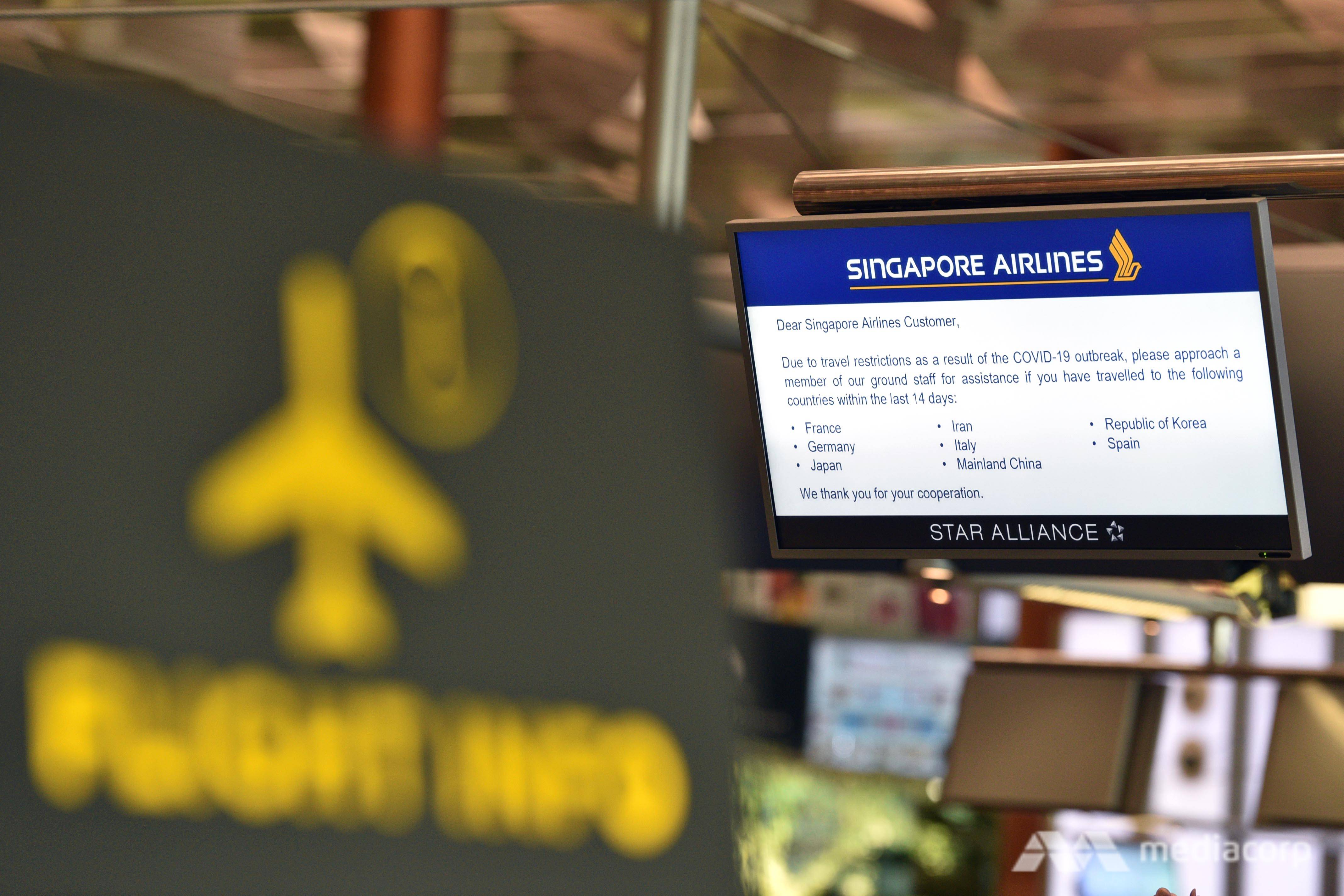
A Singapore Airlines travel advisory at Changi Airport Terminal 3. (Photo: Jeremy Long)
First, business travelers typically have to bear inconveniences such as fatigue, lower productivity and jet lag, which are mitigated to some extent because of the greater level of comfort in business and first class.
The threat of jeopardising one’s health will add significantly to the “costs” of these inconveniences. The eventual cost-benefit analysis for many business travelers will likely suggest less air travel.
Second, during the lockdowns imposed in many countries, many businesses and employees would have probably realised that though technological solutions such as video conferencing cannot fully replace the face-to face interaction facilitated by air travel, they impose lower cash costs and inconveniences.
I believe a significant part of the demand for business travel will permanently shift to video conferencing.
Third, in the post COVID-19 world, businesses are likely to be cost conscious because of challenged profitability. Business travel is a discretionary expense that can be easily cut when businesses are looking to save costs.
The above analysis doesn’t mean that either leisure or business travel will go to zero. In fact, even a 10 per cent decline in demand will inflict a lot of pain on businesses such as airlines and airport operations, because of their high fixed costs.
Air hubs like Singapore, which depend on transit traffic are even more vulnerable.
According to IATA, planes have excellent filters and frequently refresh the cabin air, thus posing very little risk of catching infections. Airports are another matter though.
If travelers are concerned about catching infections at the airport, they will exhibit a strong preference for direct flights compared to those involving a transit, thus affecting passenger volumes at hubs like Singapore or Dubai.
Health workers take a blood test at the Dubai International Airport on May 7, 2020. (Photo: AFP/Karim SAHIB)
In fact, airlines might have a few more degrees of freedom to deal with the challenges in the post COVID-19 environment compared to airports.
Some airlines are already going out of business (thus reducing alternatives and competition), the survivors might code-share (thus reducing costs and supply) and airlines might find new ways to charge customers for conveniences that have been taken for granted in the past (for instance, inflight entertainment).
Meanwhile, airports will suffer from reduced passenger volumes even if airlines deal with the new environment through the above strategies – impacting not only landing, parking and other charges they would normally charge airlines, but also airport retail and food and beverage revenue streams.
There are two caveats to the above analysis. The first relates to how long people will remember the COVID-19 crisis and its health implications.
If public memory is short, air travel volumes might bounce back quickly. But I think that the memories of COVID-19 are going to be long-lasting, though nobody knows the exact answer to this.
Second, coronavirus-related regulations (for instance, rules about middle seats) may not be as stringent as is expected at this point in time.
Post 9/11, people complained about cumbersome additional screening procedures but save for initial grumbling, that did little to dampen eventual demand within a full year.
Still, I think even with these caveats, the future of airports, especially hubs such as Singapore, will be incredibly challenged.
So, what might hub airports like Singapore and Dubai do? I would recommend putting expansion plans on hold.
People wearing protective face masks walk in Singapore, Mar 30, 2020. (Photo: Reuters/Edgar Su)
I would also suggest investing in only those initiatives that lead to productivity improvements and staying away from making airports more luxurious — projects which airports like Dubai and Doha have been undertaking
Finally, I would also suggest avoiding debt financing and conserving capital for rainy days or for a time when the uncertainty about the future of air travel is resolved.
Other than financially strong airports like Changi, other airports use debt financing extensively.
Airports frequently turn to the capital markets to finance long-term construction projects. Bond proceeds are the largest sources of funds for airport capital needs, accounting for approximately 54 per cent of total funds historically, according to the International Civil Aviation Organisation.
Download our app or subscribe to our Telegram channel for the latest updates on the coronavirus outbreak: https://cna.asia/telegram
Nitin Pangarkar is Associate Professor in the Department of Strategy and Policy at the National University of Singapore Business School and author of Flying High in a Competitive Industry: Singapore Airlines.