Home Blog Page 3165

Foreigner jailed for subletting condo to prostitutes and living off them

0

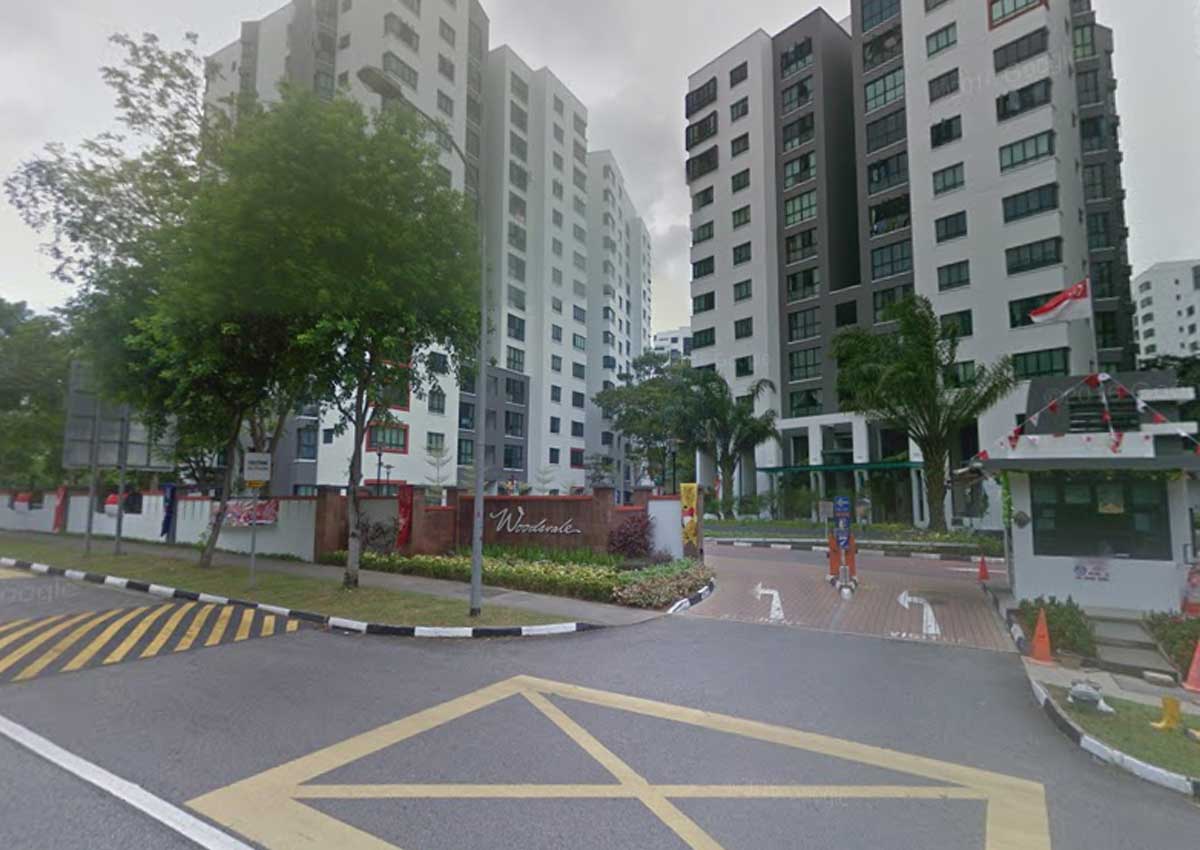
A 26-year-old tenant from China rented out his condominium apartment in Woodlands to three prostitutes in April and May, a district court heard.

The condo’s estate manager suspected vice activities and reported it but the sex workers, also from China, refused to open the door when the police came knocking on May 26. The officers were forced to break into the unit.

The next month, the tenant and two of the prostitutes were again nabbed in an anti-vice raid at a Yishun flat. This time, the sex workers were also found to have overstayed in Singapore.

Yesterday, the tenant, Dong Bin, was jailed for three months and fined $12,000. He pleaded guilty to two charges of living off the earnings of a prostitute, and one count of permitting a place to be used as a brothel. Two similar charges were considered in sentencing.

Dong earned $6,300 in total from his vice-related activities.

The court heard that he rented a Woodsvale condo unit in Woodlands Drive 72 in April, knowing it was to be used as a brothel. A compatriot, who was known to him as Zhang Ge, had asked him to rent a home anywhere in Singapore, but where the rooms could be sublet to sex workers for vice activities.

For each unit that he rented, Zhang would deduct $2,000 from the money Dong owed him. Dong was also promised at least $40 a day if he helped Zhang to collect the rent for the room from each prostitute.

Dong rented the Woodlands condo unit under his name and that of a friend. He paid a monthly rent of $2,400, and signed an agreement with the owner and property agent.

The court heard that Zhang gave him $4,800, and Dong handed over the rental papers and house keys. Zhang rented the rooms out to the three prostitutes aged 21, 23 and 37, for $100 a day.

But on May 26, suspecting vice activities due to the number of people entering and leaving the unit, the estate manager called the police. Despite repeatedly knocking on the door, the occupants refused to open up and officers from Jurong Police Division had to break into the unit.

The three prostitutes admitted to providing sexual services there and were arrested on suspicion of having breached immigration laws.

Dong was called up for investigations but was released. However, just four days later, he rented a unit in Block 665, Yishun Avenue 4, again at Zhang’s behest.

Zhang, whose identity has not been established, is still at large.


This article was first published on August 11, 2016.
Get a copy of The Straits Times or go to straitstimes.com for more stories.

Image: 
Publication Date: 
Thursday, August 11, 2016 – 15:47
Send to mobile app: 
Source: 


Story Type: 
Others

Source link

Pakistan government faces grilling over bogus bomb detectors

0

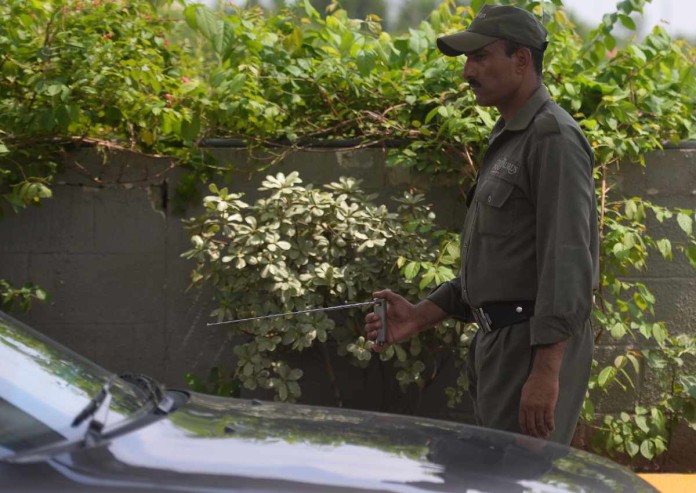
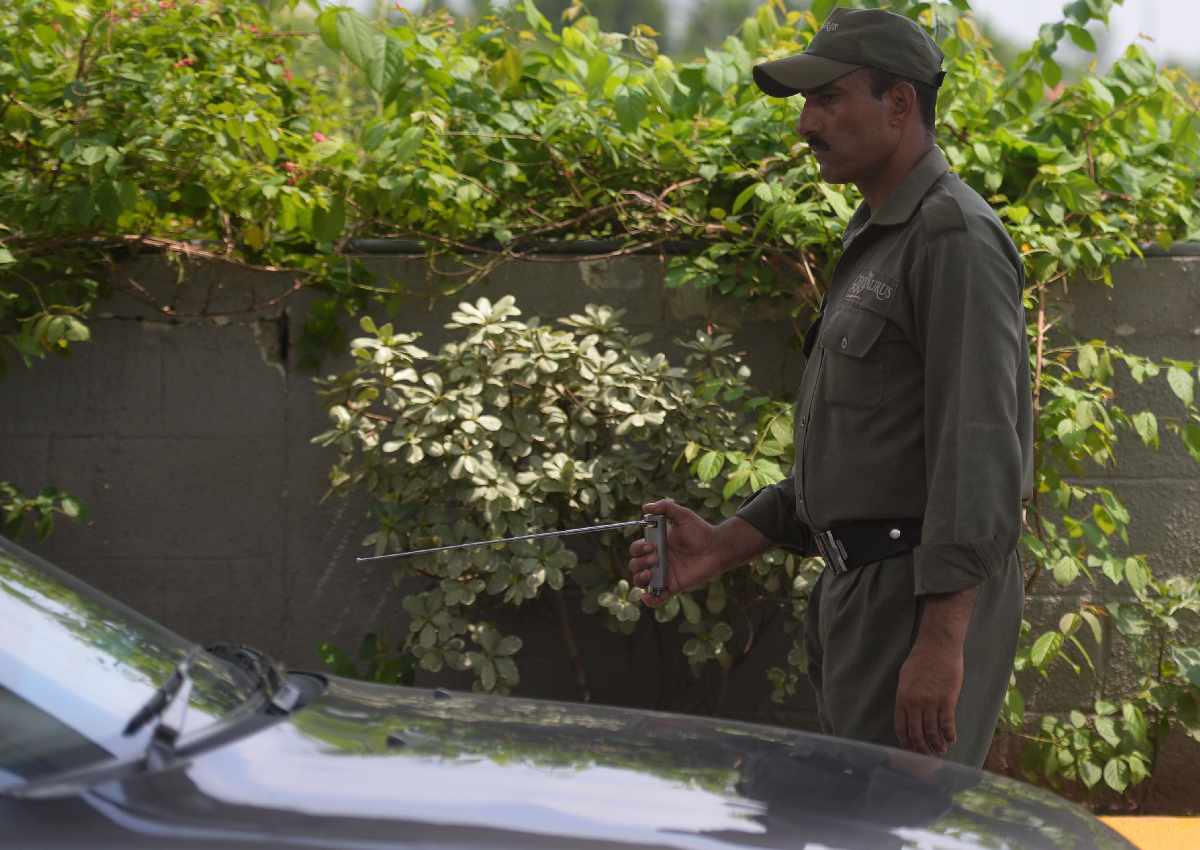
ISLAMABAD – Pakistan’s government will face a grilling in the senate over its continued use of bogus bomb-detectors to secure high-value facilities, a lawmaker said Thursday, claiming the devices “endangered the lives of millions”.

A Pakistani government agency has built and sold more than 15,000 of the so-called “Khojis” bomb detectors, earning millions in revenue. But the technology they use was exposed as a sham years ago in a global scandal.

“The continuous use of bogus bomb detectors to secure high-risk facilities such as airports and government installations has recently come to light in the media,” said opposition Pakistan People’s Party senator Sherry Rehman, referring to an AFP report that drew attention to the issue this week.

“This is a serious security risk that endangers the lives of millions of people and merits an immediate response from the Minister on the floor of the House,” she wrote in a formal notice to parliament.

Rehman said she would quiz the government on the issue at the next session of the senate on August 22.

The government did not officially respond to AFP’s queries about the ongoing use of the device. But senior officials conceded off the record that they were ineffective.

Many creators of the original devices are serving long prison sentences for fraud, including British businessman James McCormick. His ADE-651 became a mainstay of security forces in Iraq, where $85 million was spent on them, before they were officially banned last month.

Pakistan’s variant device, known as the “Khoji”, claims an accuracy level of 90 percent, but uses the principles of radiesthesia, or dowsing, which experts consider junk science.

Pakistan’s Express Tribune newspaper also slammed the devices in an editorial called “A dangerous folly”.

“These ‘magic wands’ are based on the same crackpot science that is behind dowsing, the ability to detect underground water with birch twigs. Powerful vested interests are behind the scam and somebody somewhere is getting very rich at the expense of the safety and security of all of us,” the paper wrote.

Image: 
Category: 
Publication Date: 
Thursday, August 11, 2016 – 15:50
Keywords: 
Send to mobile app: 
Source: 


Hermes ID: 
2 513 337
Hermes ID String: 
VLBOMB11
Hermes Author: 
GRONGLOH
Story Type: 
Others

Source link

30 more pre-schools to have support programme for special needs: Tan Chuan-Jin

0

Teaching children to be “completely inclusive” and comfortable around those with disabilities starts early, Minister Tan Chuan-Jin tells programme Talking Point.

Source link

Shades of profiteering and abuse at Vietnamese 'haven' for unwanted babies

0

It’s a heart-warming story that began more than a decade ago but is still used to inspire today – a poor construction worker in Vietnam who had little to his name used his own money to build a cemetery for aborted babies in 2001.

It all started when Mr Tong Phuoc Phuc would go to hospitals in the city of Nha Trang to collect aborted foetuses and bury them to give them a resting place.

He went on to adopt children of women who were considering abortion, and eventually start several orphanages to house these children.

His aim, he said, is to reunite the children with their mothers – many of them unwed – after the women had settled down and are better able to care for their children.

Mr Tong received a commendation letter from the Vietnamese president in 2006.

His story was reported by major media outlets in 2008, including Associated Press, and has been reproduced by many media outlets. Each time the story is repeated, there are people who will want to donate to his cause.

However, it appears things were not as it seemed in these “havens” run by Mr Tong.

A 2012 documentary, Blush Of Fruit, showed viewers how some children were mistreated in one of the orphanages.

The children, mostly toddlers, were manhandled and “disciplined” in seemingly inappropriate manners. 

They were neglected and abused by some of their caregivers – women, some of them pregnant, who were given shelter by Mr Tong. In exchange for that, the women had to take care of the children in the orphanage. 

In some scenes, it’s obvious that the women were venting their frustration on the young children.

Without professional childcare training, the women caring for the children seemed clearly unfit for the task.

One of the women said that Mr Tong was rarely at the orphanage, sometimes turning up for just 10 minutes in the morning. She said she had not seen Mr Tong cradle the children or care for them in her time at the orphanage. She claimed that Mr Tong was running the orphanage more like a business than a charity.

In one scene, Mr Tong and the women appeared to be attentive and caring towards the children when donors visited. However, their behaviour changed visibly after the visitors left.

In an interview in the documentary, Mr Tong’s neighbour accused him of profiteering through the orphanage, saying that money has changed the man.

Filmmaker Jakeb Anhvu lived in Nha Trang for at least a year to shoot the documentary. He said he didn’t start filming until after three or four weeks at the orphanage – presumably for the women and Mr Tong to get used to the presence of the camera.

Seeing the documentary, one can’t help but feel that maybe, the “business” had gotten too big for Mr Tong.

The silver lining is that things seem to have gotten better in the orphanage.

Mr Anhvu said an Australian non-government organisation in Vietnam visited the orphanage in 2014 after trailers for the documentary were shown. They reported that the children were healthy and happy.

The orphanage was also more welcoming to volunteers and more transparent in its work.

Photos that volunteers took in 2014 showed the children that appeared in the documentary smiling and looking healthy. 

sinsh@sph.com.sg

Image: 
Category: 
Publication Date: 
Thursday, August 11, 2016 – 15:30
Send to mobile app: 
Source: 


Story Type: 
Rewritten Story

Source link

Illegal bird trade threatens Indonesian species: report

0

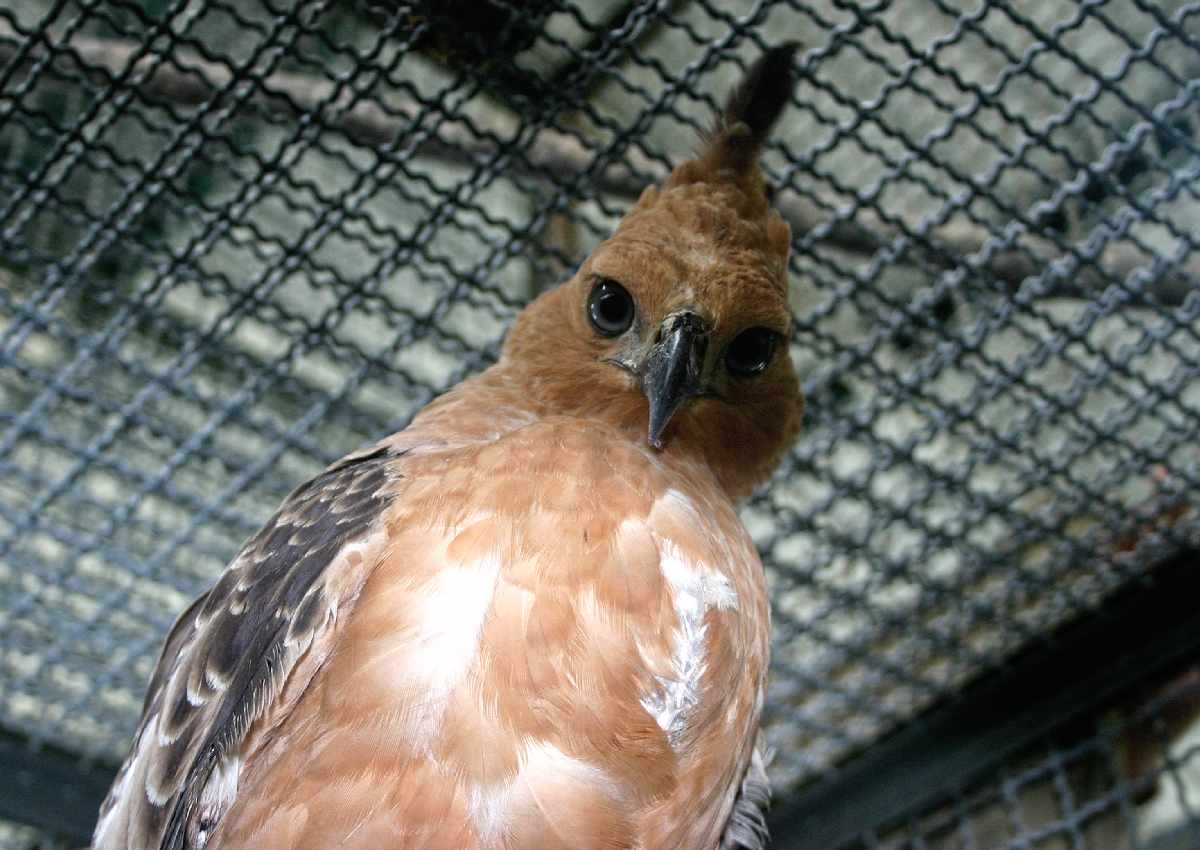
JAKARTA – Tens of thousands of endangered Indonesian birds are being sold illegally at markets across the country, a wildlife trade watchdog warned Thursday, flouting laws aimed at protecting these species from extinction.

Wildlife trade monitoring network TRAFFIC recorded nearly 23,000 birds for sale at five markets in three major cities on the main island of Java.

More than two dozen species identified in the survey were fully protected under Indonesian law, meaning all hunting and trafficking of them is prohibited.

These included the critically endangered Black-Winged Myna, native to Java and Bali, and other rare species found nowhere outside Indonesia’s vast archipelago.

Bird keeping has long been part of Indonesia’s national culture, with birdcages a common sight outside homes and shops, but increasing demand for some species as pets has led to dramatic population declines.

“If this level of trade continues, in the next few years some species of birds could be wiped out completely from the wild,” Serene Chng, the co-author of TRAFFIC’s new report into the bird trade, told AFP.

Wildlife activists have urged the government to close several notorious bird markets in Jakarta – vast, often grimy emporiums openly offering thousands of protected species for sale.

But in this latest report TRAFFIC says the widespread trafficking of birds extends far beyond the markets of the Indonesian capital, and called for law enforcement to shut down the illegal trade for good.

Indonesia has the highest number of threatened bird species in Asia, wildlife experts say. The government is revising its wildlife legislation, and conservationists are calling for several species to be granted greater protection.

Image: 
Category: 
Publication Date: 
Thursday, August 11, 2016 – 15:16
Send to mobile app: 
Source: 


Hermes ID: 
2 513 202
Hermes ID String: 
VLBIRD11
Hermes Author: 
GRONGLOH
Story Type: 
Others

Source link

Japan searches for shipwrecked Chinese fishermen

0

TOKYO – Japan is searching for eight Chinese crew members who went missing when their fishing boat sank after colliding with a Greek cargo vessel near disputed East China Sea islands on Thursday, the Japanese coast guard said.

The coast guard, which dispatched a patrol boat and plane to the site after receiving a signal from the cargo ship, has rescued the six other members of the sunk vessel’s 14-strong crew, a coast guard spokeswoman told AFP.

“We ‘ve put priority on the search and rescue of the missing eight. We have not been able to determine the cause of the collision,” she said.

China expressed its appreciation for the rescue efforts, the Japanese foreign ministry said in a statement.

The accident comes after Foreign minister Fumio Kishida on Tuesday called in Cheng Yonghua, Beijing’s envoy to Tokyo, following what Tokyo calls “intrusions” by Chinese ships near the disputed islands for five consecutive days.

“The situation surrounding the Japan-China relationship is markedly deteriorating,” he told Cheng, according to the ministry’s statement on its website.

The two countries are locked in a long-running dispute over the uninhabited islets known as the Senkaku in Japan and the Diaoyu in China.

The Japanese coast guard on Monday caught sight of 15 Chinese coast guard ships near the islands – the highest number ever spotted in the area.

Some 230 Chinese fishing vessels and seven coast guard ships, including four apparently carrying weapons, sailed into waters close to the disputed island on Sunday.

Bilateral relations had improved over the past two years, but tensions over the islands have been a frequent irritant between the countries.

Image: 
Category: 
Publication Date: 
Thursday, August 11, 2016 – 15:07
Keywords: 
Send to mobile app: 
Source: 


Hermes ID: 
2 513 085
Hermes ID String: 
VLCHINAJAPAN11
Hermes Author: 
GRONGLOH
Story Type: 
Others

Source link

Husband of Bishan maid murder accused faces charges of assault, withholding evidence

0

A 37-year-old man, whose wife and mother-in-law were charged last month with the murder of the family’s maid, was hauled to court to face charges of his own on Thursday (Aug 11).

Source link

Olympics: Armenian lifter rushed to hospital with injury

0

RIO DE JANEIRO – Armenian weightlifter Andranik Karapetyan was rushed to hospital in agony after appearing to dislocate his elbow during the men’s 77kg competition at the Rio Olympics.

The 20-year-old was in contention for a bronze medal when he attempted to lift 195kg in the clean and jerk.

Halfway through the attempt his left elbow seemed to pop out and Karapetyan screamed in agony before being helped off the platform in tears by members of his coaching team.

A short while later he was loaded into an ambulance on a stretcher, with a saline drip attached to him, as several of his team-mates and Armenian staff looked on distraught.

Kazakhstan’s Nijat Rahimov won gold while Lyu Xiaojun of China took silver and Egypt’s Mohamed Mahmoud claimed bronze.

It comes after China’s Xiang Yianmei earlier dropped a barbell stacked with 118kg on the back of her head, drawing gasps from the crowd.

She brushed off the incident to win the women’s 69kg category.

“I got hurt a little bit and it feels sore now when I nod my head,” she said later.

Image: 
Category: 
Publication Date: 
Thursday, August 11, 2016 – 14:43
Send to mobile app: 
Source: 


Story Type: 
Others

Source link

Two former police dogs help bring suicidal hit-and-run victim out of depression

0

All it took was one touch.

For two years, Madam Karen Teng, 46, struggled with post-traumatic stress disorder (PTSD) after a hit-and-run accident on Oct 9, 2010.

Madam Teng was on her way home from work when another car rear-ended her Ford Fiesta along Tampines Expressway.

Her vehicle spun round once, hit the guardrail, then spun round twice more.

When the car finally stopped moving, Madam Teng was facing oncoming traffic.

She said: “For the first few weeks, when I closed my eyes, I had this feeling that I was spinning round and round.”

But it was the feeling of being trapped in her wrecked car and facing approaching headlights that lingered on.

She had awful nightmares. Her psychologist prescribed anti-depressant and anti-anxiety drugs to help her manage her PTSD.

But the drugs, coupled with work stress and an impending civil suit against the driver, drove Madam Teng deeper into depression. She also became suicidal.

Then, on March 21, 2013, a chance encounter changed everything.

Madam Teng and her husband, air force engineer, Mr Michael Koh, 49, were in Somerset MRT station when she was drawn to a golden labrador retriever.

Madam Karen Teng, 46, and her husband, airforce engineer Michael Koh, 49, with their dogs Murphy (right), 10, and Happy (left), 8. 

It was a Singapore Police Force (SPF) K-9 unit sniffer dog that was on duty with its handler.

Even though it is not usually allowed, Madam Teng asked for permission to touch the dog.

Madam Teng, who had three dogs when she was growing up, said: “At that point in time, my world was very dark. But with that one touch, I felt my spirits being lifted.

“It felt as if I was being transported back to my carefree childhood years when there was no stress in my life.”

That night, she tried to adopt the dog, which was known as Juno, but found that it was not available for adoption as it was too young. It was only three years old and working dogs with the police are not retired until they are seven or eight.

Instead, she was directed to the Police K-9 unit’s dog adoption drive then.

A year and a month later, Madam Teng adopted Murphy, a pale yellow labrador retriever that was a Police K-9 unit sniffer dog.

Madam Teng said: “I wanted to adopt a police dog because I have seen them at work

“They are indeed the unsung four-legged heroes who deserve a good retirement after having spent their youth serving the nation.”

But Madam Teng never forgot the police dog that had made her feel better.

She sent cards and photographs of Murphy to the K-9 unit often, especially on special occasions like Christmas.
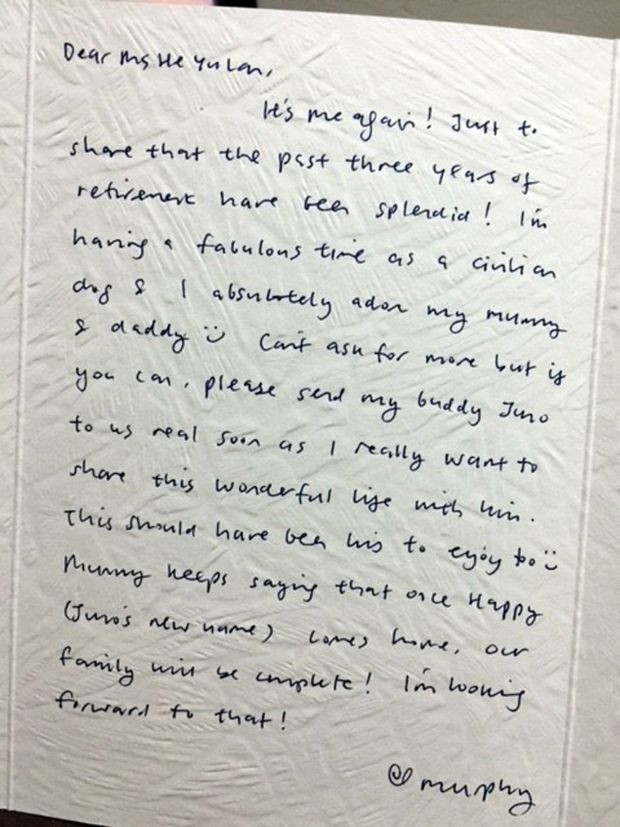
Before Happy joined her family, Madam Teng used to send cards to the K-9 unit inquiring about Happy’s possible adoption.

NEW FAMILY ADDITION

“I would write (the cards) in (Murphy’s) voice and say, ‘Dear (officer-in-charge), I’m having a good life here…’, then end off with a ‘P.S: When is my friend, Juno, joining me?'”

Then, on May 19 this year, she was told by Police K-9 unit para-veterinarian, Senior Staff Sergeant Bernard Tan, 35, that Juno was being prepared for retirement and that she could take him home in a few months.

Officer Tan said: “I felt Karen’s sincerity because every festival, she’d send updates, cards and e-mails. We kept all of the cards she sent.”

On June 17, Madam Teng finally brought Juno home and renamed it Happy.

Madam Teng and her husband, Mr Michael Koh, with the two dogs. 

It joyfully runs round Madam Teng’s home and occasionally shows a mischievous streak – it loves chewing her socks.

Madam Teng, who left her job in 2014, spends her time with her dogs.

On the perks of adopting an ex-police dog, Madam Teng said: “(Police dogs) are more well-trained and are very obedient. They are also easy to train and very loyal.”

She recalled: “I left Murphy outside White Sands while I returned library books. When I came back, he was sitting quietly waiting for me.”

Added Madam Teng: “Every night before I go to sleep, I will tell them that I love them.”

Especially close to her heart is the 10-year-old Murphy. Age is catching up with it, she revealed. It moves more slowly and sleeps more now.

Madam Teng is dreading the day when she will have to say goodbye to her fur-child, but she said: “I just hope that when he goes, I will be there with him.”

K-9 dog adoption a ‘lifelong commitment’
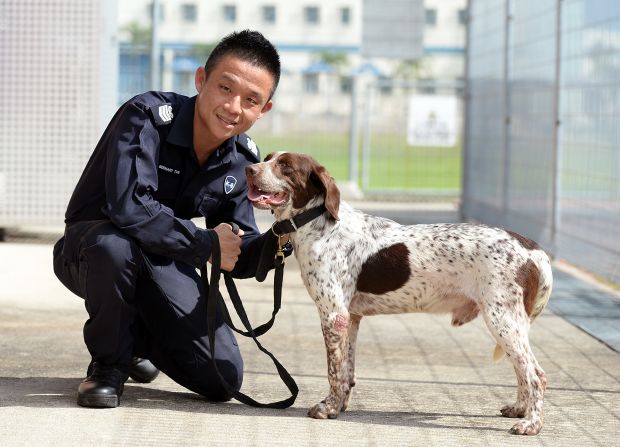
NO ORDINARY CANINES: Singapore Police Force K-9 unit para-veterinarian, Senior Staff Sergeant Bernard Tan, with former explosive detector dog Morris, who is now retired and up for adoption.

As a para-veterinarian with the Police K-9 unit, Senior Staff Sergeant Bernard Tan, 35, looks after the health, disposition and well-being of more than 200 K-9 unit dogs.

Officer Tan has been a para-veterinarian for the past three years. Before this, he was a police dog handler and had worked with four dogs over seven years.

Para-veterinarians are the first port of call for basic first-aid treatment when police dogs get cuts and bruises, or suffer from basic skin issues or diarrhoea. They also act as the middleman between police dog handlers and veterinarians.

The four main breeds that are used in the K-9 unit are german shepherds, belgian shepherds, labrador retrievers, and springer spaniels. Pointers and cocker spaniels are also used.

These dogs are trained for and perform a specific role throughout their years of service. These roles include explosive detection, drug detection and guarding.

The K-9 unit’s dogs are retired from service and put up for adoption when they turn seven.

About three to four police dogs are adopted by the public every month.

NO GUARD WORK

Officer Tan said: “Some adopters come in with the intention to adopt our dogs to use as guard dogs.

“But it is under the terms and conditions of adoption that these retired police dogs are meant to serve as house pets and not to perform any guard work.”

He added: “Some also come in expecting the dogs to be perfectly fine without any health issues.

“However, we must emphasise that these retired dogs are old and therefore may suffer from typical ageing issues like excessive shedding, and skin issues like eczema and yeast infections.

“Adopting a retired police dog is a lifelong commitment.”


This article was first published on Aug 11, 2016.
Get The New Paper for more stories.

Image: 
Category: 
Publication Date: 
Thursday, August 11, 2016 – 21:00
Send to mobile app: 
Source: 


Story Type: 
Others

Source link

Many Olympians strugle just to make ends meet

0

All Olympic athletes all have lucrative sponsorship deals, right? Wrong. Many have to take side jobs just to get by.

When Serena Williams takes to the court at the Rio Olympics this month, the US tennis star won’t really be alone. She will have arrived at the Games with an entourage of paid staffers, coaches and sponsors who’ve helped her every step of the way.

Worth an estimated US$150 million (S$201.57 million) in 2016 (more than any other female athlete, according to Forbes), Williams trains upwards of 30 hours per week, but has never had to work a second job to get by and pay her way in sport. She’s one of a small minority of Olympians.

More likely, walking through the athlete’s village in Rio, you’d find people like Canadian Donna Vakalis.

To compete in the modern pentathlon, she trains a minimum of 30 hours per week in fencing, shooting, swimming, horse riding and cross-country running.

And when she’s not training, the 36-year-old is pursuing a PhD in civil engineering at the University of Toronto and juggling a handful of jobs just to support her Olympic dreams.

Vakalis estimates that it costs about CAD$50,000 ($39,000) a year to train and compete in the modern pentathlon.

Yet, because the sport barely registers with Canadian audiences (and has the International Olympic Committee’s lowest revenue ranking), there is a major funding gap between what she receives in government support – CAD$4,500 (US$3,450) last year – and what she needs to get by.

Vakalis says that the national team foots most of the bills for coaches and access to training facilities for many Olympic sports. Not so for pentathlon.

“We pay the coaches ourselves, we pay for the athletic centre access ourselves, we pay for the physio and the massage ourselves, and that means that there is a higher financial burden,” she says.

Read the full article here

Image: 
Category: 
Publication Date: 
Thursday, August 11, 2016 – 15:15
Send to mobile app: 
Source: 


Story Type: 
Others

Source link