Home Blog Page 314

‘Like a mediator’: From spot checks to investigating breaches, here’s how ICA officers enforce stay-home notices

SINGAPORE: While on house visits, Immigration and Checkpoints Authority (ICA) investigation officer Ganesh Reddi Gurusamy has been berated, asked to retrieve letters from the mailbox and stepped in to solve technical difficulties.

“There was one instance where we visited this old uncle and the moment we come to the door, he was like: ‘Are you guys the house visit team?’ And he started to really get angry with us,” recalled Staff Sergeant (SSGT) Ganesh, who for about three months was part of the team conducting house visits on those serving stay-home notices.

“The moment you listen to them, they calm down. The uncle ended up saying: ‘Boy, I understand. I’m very angry (because) every day I sit at home … and look at the ceiling’,” said SSGT Ganesh.

“Most of the time they understand; it is only the initial part where they are really mad. At that point, nothing goes in. After that, it is okay.”

Since February, about 460 personnel including officers from the Home Team agencies and contracted external agencies have been deployed to conduct spot checks on people on stay-home notices, said ICA.

The house visits are part of a three-pronged approach, which includes text messages and phone calls, to ensure that the stay-home notices are adhered to.

Individuals who have been issued stay-home notices are required to remain at home at all times for 14 days, as a precautionary measure to minimise the risk of COVID-19 transmission in Singapore.

The notice is stricter than a leave of absence, which allows people to leave their homes briefly to have a meal or buy household supplies, but slightly more flexible than a home quarantine order, which requires individuals to be separated from others within the same home.

READ: COVID-19 FAQ: When will a stay-home notice be issued, and what does it mean?

The task of enforcing stay-home notices has brought with it a number of challenges when it comes to the novelty, volume and scope of operations, said Superintendent (SUPT) Tan Hoe Koon, who is deputy director of the intelligence division.

“Stay-home notice enforcement operations were totally new to us. We’d not done anything like this before. When it first started, it was very tough because we didn’t expect the massiveness of the issue,” said SUPT Tan, who oversees the enforcement of stay-home notices for ICA.

“But I have to give it to my team, they stayed prepared, they stayed flexible. Whenever there are fast-evolving border control measures, they are always there to adapt,” said SUPT Tan.

The stay-home notice was first implemented on Feb 18 for Singapore residents, long-term pass holders and foreign work pass holders returning from mainland China outside Hubei province.

It was later expanded to include travellers returning from several different countries, before being made mandatory for anyone entering Singapore, including citizens and residents.

ICA House visit

While on house visits, SSGT Ganesh and CI(1) Nurhayati faced a variety of different reactions. (Photo: Gaya Chandramohan)

As of May 19, the ICA has issued more than 70,000 stay-home notices and at the peak of operations had monitored about 40,000 individuals serving those orders, said SUPT Tan.

During the peak, officers conducted about 1,200 house visits daily.

This “strain on resources” meant gathering ICA officers from various different departments as well as from Home Team agencies to join in efforts, said SUPT Tan.

“The numbers have plateaued to much lower, but the framework is still in place. The load has decreased but the framework and diligence to be put into these administration remains the same,” he added.

As of May 19, the ICA is monitoring about 2,000 individuals on stay-home notices.

“Enforcing the stay-home notices is not just about making sure this person stays at home. There’s a lot more behind it,” said SUPT Tan.

“There are many exceptional cases that we need to take into consideration. Their issues may span across a few government agencies or ministries, so we have to identify what the issue is and which ministries and agencies we need to work with to address those issues,” said SUPT Tan.

These cases include appeals from individuals to be exempted from the stay-home notice, or to be given a short-term excuse from the order because of certain “really urgent or personal” issues, added SUPT Tan.

‘THE EYES AND THE EARS’

Officers on house visit teams are briefed and prepped to work 12-hour shifts in general. Each pair of officers will take on about 10 to 12 house visits per shift.

Once the officers receive the list of addresses they are to visit, they will decide on the most efficient route to take. This “prep work” takes about an hour, said SUPT Tan.

They will then spend the next eight to 10 hours conducting the visits, and report any feedback or issues to headquarters.

The job of an officer on stay-home notice duty is akin to the “eyes and the ears” of the operations branch, said SSGT Ganesh.

During the house visits, officers will enquire about the well-being of the resident, and “make sure that the resident is who it is supposed to be”.

“We make sure they actually know that they have to stay at home for 14 days. We also have to verify this because when they send out these SMSes and phone calls, some of these people don’t receive it. Some of them (have phones) on flight mode or their phones don’t work, so we have to make sure they receive all our information,” SSGT Ganesh.

House visit 3

Sometimes those on stay-home notices need a “listening ear” said CI(1) Nurhayati Adnan, who was part of the house visit team for about a month. (Photo: Gaya Chandramohan)

In the event that the individual serving the stay-home notice cannot receive messages, there are other avenues to reach out to them, such as phone calls and house visits, said SUPT Tan.

“There was one instance where technology was a problem. They said that they had not been receiving SMSes,” recalled SSGT Ganesh.

“I roughly understood that when you go overseas, you set (the phone to) auto roam … When we checked, it was on flight mode. The moment we (turned the flight mode off) all the SMSes came in … You go there like a mediator, basically like a technology person, trying to sort out their phone.”

READ: Jail for man who breached stay-home notice to eat bak kut teh at hawker centre, run errands

There have been some instances where family members go to great lengths to isolate the individual on stay-home notice from the rest of the household, said SSGT Ganesh.

“This meant locking them in a room, and only opening the door to pass them food.

“One girl came out with her hair all (messy), she was like: ‘I haven’t even seen broad daylight and I’ve been stuck in here for I don’t know many days”, said SSGT Ganesh.

Others just want a listening ear, said Checkpoint Inspector 1 CI(1) Nurhayati Adnan, who was with the house visit team for about a month.

“Especially for those older people, they are stuck inside the house and want dearly to have somebody to talk to,” she said. “So sometimes when we come to their house, they will just pour out their hearts to us … We try to talk to them.”

‘ARE YOU SAFE DOING THESE VISITS?’

The main challenge to overcome for CI(1) Nurhayati were concerns from family members over her safety. 

“On the first day itself, I had to cover like 12 to 13 houses, and it was a big shock to me,” said CI(1) Nurhayati, who had been temporarily redeployed from her role at ICA’s sea domain response team.

“We don’t know if the person we are visiting has contracted the virus,” she said.

“My family was asking: ‘Are you safe doing these visits? The virus is already everywhere already – we don’t know if they have it or not.’  I was blessed that my family understood after that. The challenges are answering to my family.”

Officers on house visit teams bring hand sanitisers as well as wear gloves and a surgical mask during visits.

They are not allowed to step into the houses of the people they visit, and are required to keep a safe distance from those individuals.

“My first question (when I was assigned this role) was … ‘If I visited the person, what if I get it?’ I’m also married and have two young kids, so my biggest concern is what if I go back home after doing house visits and spread it to them,” recalled SSGT Ganesh. 

“One of the things that makes us feel that we can do this is because of the personal protective equipment (PPE) … With that we know we have protection, that is like a first line of defence for us.  If every officer is going to back out from this, how is this going to work? … We have to do this enforcement, ensure the community is safe.”

As a additional precaution, both SSGT Ganesh and CI(1) Nurhayati also take a shower immediately after returning to their respective homes.

Said CI(1) Nurhayati: “When I reach home, I don’t meet my husband. I go straight to my bathroom for a shower then I meet him.”

Assistant Superintendent Khairul Nasir

ASP Khairul Nasir is part of a team that investigates stay-home notice breaches. (Photo: Gaya Chandramohan)

And should breaches occur, a team of ICA’s investigation officers such as Assistant Superintendent (ASP) Khairul Nasir step in.

“ICA has been leading these checks for people under stay-home notices and so during the house visits they will encounter instances of breaches … This will be surfaced and flagged out to us,” he explained.

“On top of that, we receive information from tip-offs, from the public, or our other agency counterparts.”

This team will assess the facts of the case before the information is passed to an ICA-led task force. This task force comprises 43 investigators from the ICA and other Home Team agencies such as the Singapore Police Force. 

The task force works together with a team of prosecutors from the Attorney-General’s Chambers to investigate and prosecute those who flout the orders. 

READ: COVID-19: More than 21,200 stay-home notices issued, ICA to increase manpower

“We have to find ways to ensure that we have enough facts and evidence for us to actually build a case,” said ASP Khairul. “We have cases where it is straightforward, whereby they are cooperative and say: ‘Yes, I did go out.’ 

“For these cases, it is quite swift, we can do it in one or two days. But there are cases where they do not want to admit or they give different facts so we need to investigate a bit further. This is where we need to engage our different partners.”

Individuals who fail to comply with stay-home notices may face prosecution under Section 21A of the Infectious Diseases Act. Among other penalties, first-time offenders are liable for a fine of up to S$10,000, jail of up to six months, or both.

Both SSGT Ganesh and CI(1) Nurhayati have not come across an instance where an individual on stay-home notice was not at home.

But there have been close shaves, such as when one of those individuals was unresponsive for almost 45 minutes.

“We really thought the guy was not there, we kept calling him, no answer,” said SSGT Ganesh. “We waited a good 45 minutes and we thought he wasn’t there … We kept calling and suddenly the door opened and he asked us who we were.”

BOOKMARK THIS: Our comprehensive coverage of the coronavirus outbreak and its developments

Download our app or subscribe to our Telegram channel for the latest updates on the coronavirus outbreak: https://cna.asia/telegram

Source link

Fresh chicken prices to rise due to higher cost of buying from Malaysia

[ad_1]

SINGAPORE – Fresh chicken prices in Singapore are expected to rise next week as suppliers deal with the rising costs of procuring from poultry farms in Malaysia.

Speaking to The Straits Times on Thursday (May 21), chairman of the Poultry Merchants’ Association Ong Kian San said the cost of chicken from across the causeway has increased by about 45 per cent in the last two weeks.

Mr Ong said: “Most suppliers have been absorbing the cost and keeping prices stable for now but will most likely have to increase prices next week. We can’t hold the price for so long without losses.”

He expects that prices of fresh chicken sold to supermarkets and wet markets will increase by about 10 per cent to 15 per cent next week.

“Unfortunately, customers will have to bear with an increase in price. The whole supply chain has been affected by Covid-19, so cost will inevitably rise,” said Mr Ong.

Asked about the chicken cost increase in Malaysia, Mr Ong said that when Malaysia first implemented its movement control order in March, demand for chicken drastically dropped and farmers stopped rearing them.

[ad_2]

Source link

Coronavirus: Work out at home, urges SportSG, but if you exercise outdoors you may do so with those from your same household

[ad_1]

SINGAPORE – While Sport Singapore (SportSG) still encourages people to work out from home, the national agency said those going out to exercise can now do so with those in the same household in its updated advisory issued on Sunday (May 17).

This applies until the circuit breaker period ends on June 1.

The previous advisory on April 21 urged individuals to exercise alone and only in their immediate neighbourhoods.

The May 17 update noted individuals should not linger after their exercise and should return home immediately after they are done with their exercise.

Safe distancing measures must be observed at all times between people of different households, and there shall not be any gathering in groups.

It is also mandatory for those who leave home to exercise to wear masks, unless they are engaging in strenuous exercise or children under the age of two.

SportSG defined strenuous exercise as running, jogging, cycling, static exercises and drills for warm-ups, brisk walking and walking on hilly terrain.

Exercises such as walking and strolling leisurely do not fall under this category.

[ad_2]

Source link

Covid-19: Singapore reports 448 cases on Thursday, 13 are community cases

[ad_1]

The Ministry of Health (MOH) has preliminarily confirmed 448 new coronavirus cases in Singapore today (May 21). Most of the new cases are foreign workers living in the dormitories, with 13 community cases from Singaporeans/Permanent Residents.

Of these, seven cases were picked up from MOH’s active surveillance and screening of nursing home residents and pre-school staff, and four are part of a family cluster linked to a dormitory.

Further details will be provided later tonight.

A total of 29,812 cases have been reported in Singapore so far, with 11,207 patients discharged and 22 deaths.

For the latest updates on the coronavirus, visit here.

bryanlim@asiaone.com

[ad_2]

Source link

NUS researchers discover creatures, some possibly new, in depths of Pacific Ocean

SINGAPORE: On Feb 14, a team of nine researchers from the National University of Singapore (NUS) embarked on an expedition to explore an understudied area in the world’s largest ocean.

Five weeks later, they returned with hundreds of deep-sea creatures, some of them possibly new to science.

The creatures were pulled from the depths of the Pacific Ocean, thousands of metres below the surface, in an understudied area known as the Clarion-Clipperton Zone (CCZ).

The expedition, led by Keppel’s Corporation subsidiary, Ocean Mineral Singapore, is part of the research done by Keppel-NUS Corporate Laboratory.

The expedition team aimed to conduct environmental studies and surveys for the collection of polymetallic nodule deposits in an environmentally friendly way.

Keppel-NUS Corporate Laboratory researchers take a deep-sea expedition (1)

Members of the team getting ready to set off on their 5-week expedition. (Photo: Keppel-NUS Corporate Laboratory)

Polymetallic nodules contain valuable metals such as cobalt, copper, nickel, manganese and other valuable ores. These are used in electronics and green technology, such as electric cars, wind turbines and solar panels.

UNIQUE DEEP-SEA HABITAT

Reaching down between depths of 4,000m to 6,000m below the surface, the CCZ is also often referred to as an abyssal plain. 

The creatures that live on the seafloor of the CCZ mostly feed from food that falls from above and are often very small, measuring less than 2cm. 

Box corers were used in taking samples from the seabed. When a piece of the seabed was brought up from the seafloor, the team would take samples of the sediment to study the microbes, foraminiferans, meiofauna, macrofauna and megafauna.

“The vast seafloor of the CCZ … comprises a unique deep-sea habitat that is little known,” said NUS Tropical Marine Science Institute (TMSI) senior research fellow Dr Tan Koh Siang.

“More work needs to be done to understand the impact of nodule collection on the biological community and how we can conserve and protect it for future generations.”

The team hopes by determining the identities and distribution of the species in the seafloor, it would help further understand the biology and ecology of the zone. 

“The knowledge gained will help in managing the nodule collection activities without undue detriment to the ecosystem,” NUS said.

At the moment, the plan is to sort, identify and count the samples the collected collected. 

“This is an involved process as most of the organisms are less than 2mm in size,” Dr Tan said. 

He added if new species are discovered, they will need to be formally described and published.

“BAMBOO WORMS” AND DEEP-SEA SPONGES

Here are some of the creatures discovered by the team, in photos.

Three species were discovered, potentially new to science. 

They include a deep-sea sponge, some isopod crustaceans, as well as a unique type of single celled organisms with nuclei called Foraminifera – with a skeleton made up of numerous glass-like needles woven together. 

Keppel-NUS Corporate Laboratory researchers take a deep-sea expedition (4)

This specimen is a deep-sea sponge belonging to the family Polymastiidae, and it may be new to science. (Photo: Keppel-NUS Corporate Laboratory)

Belonging to the family Polymastiidae, this deep-sea sponge is distinguished by its reduced or simplified skeleton, possibly due to the limited food available in the depths of the zone. 

Keppel-NUS Corporate Laboratory researchers take a deep-sea expedition (7)

These two specimens of isopods could be new to science. Related to crabs and shrimp, isopods are quite common in the CCZ. (Photo: Keppel-NUS Corporate Laboratory)

Related to crabs and shrimps, these isopods are quite common in the zone. While most of these are small, some can grow up to half a metre in length in deeper waters.

Keppel-NUS Corporate Laboratory researchers take a deep-sea expedition (3)

Potentially new to science, this specimen is from a group of organisms called Foraminifera, which are single-celled organisms with nuclei known as protists. (Photo: Keppel-NUS Corporate Laboratory)

This specimen is from a group of organisms called Foraminifera, which are single-celled organisms with nuclei known as protists. 

Unlike other Foraminifera, this specimen’s skeleton is made up of numerous glass-like needles woven together, which appear to be unique among the diverse creatures in the zone.

Other creatures included an unusually long deep-sea worm, a variety of copepod crustaceans as well as mollusc. 

Keppel-NUS Corporate Laboratory researchers take a deep-sea expedition (6)

This deep-sea polychaete worm belongs to the family Maldanidae. (Photo: Keppel-NUS Corporate Laboratory)

This “unusually long” deep-sea worm belongs to the family Maldanidae. Members of this family are often referred to as “bamboo worms”, due to the resemblance to bamboo stems. 

Measuring 10cm, this worm is one of the largest polychaete worms seen to date from the CCZ. 

Keppel-NUS Corporate Laboratory researchers take a deep-sea expedition (2)

These deep-sea copepods live on or in the sediment and they belong to a large group known as the Harpacticoida. (Photo: Keppel-NUS Corporate Laboratory)

Belonging to a large group known as the Harpacticoida, these deep-sea copepods live on or in the sediment of the seafloor. 

Commonly found in oceans around the world, these tiny crustaceans come in a variety of body shapes. Many of these could be new to science.

Keppel-NUS Corporate Laboratory researchers take a deep-sea expedition (8)

A mollusc with an umbrella-shaped shell like that of a limpet – specimens like these were thought to be extinct for years until living specimens were found in the 1950s. (Photo: Keppel-NUS Corporate Laboratory)

A mollusc with an umbrella-shaped shell like that of a limpet – specimens like these were thought to be extinct for years until living specimens were found in the 1950s.

Source link

'Xiao Bengs and Xiao Lians' still posting videos of themselves gathering during circuit breaker

[ad_1]

Despite knowing that social gatherings are prohibited during the circuit breaker period, several young people appear to still be flouting the rules and posting evidence of their misdemeanours online to boot.

Stomp contributor Simon alerted Stomp to a video posted on Instagram Story of a group of youths gathered smoking and hanging out at the lift lobby and staircase of a Housing Board block (HDB).

He screen-recorded the video on April 18 and the video was posted within 24 hours of him seeing it.

Stomp contributor Peggy also alerted Stomp to another Instagram Story shared on SG Dirty Fella’s Facebook group page of another group of youths gathered in an apartment.

The caption says: “Xiao Bengs and Xiao Lian having merry fun at one of their house[s] during circuit breaker period. Proceed to post on social media to show off their crimes.”

[ad_2]

Source link

Boy with mild autism getting surprised with McDonald's will make your day

[ad_1]

Singaporeans across the island rejoiced when McDonald’s re-opened on May 10 after three weeks of closure.

However, the award for best reaction goes to nine-year-old Adam Bin Mohammad Irwan who was surprised with his favourite meal.

Stomp contributor Fyza alerted Stomp to a video posted by Adam’s mother Madam Wati.

In the video, the mother-of-four had bought McDonald’s meals for her children from Pioneer Mall as a special treat to break their fast on Monday (May 18).

She is seen hiding the food in a red plastic bag so that they do not suspect anything.

When Adam exits his room and notices the McDonald’s food on the family’s table, he bursts into tears.

[ad_2]

Source link

Man trolls 'sugar mummy' scammer who offered up to $7k a week

[ad_1]

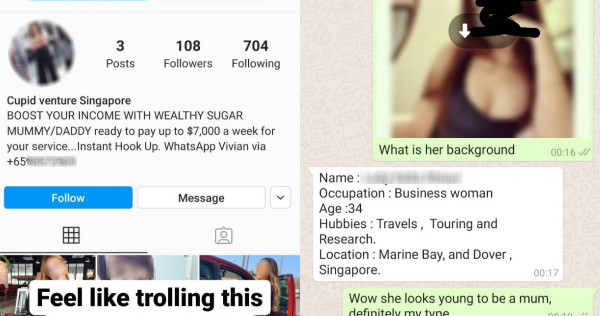
Hook up with an attractive older woman and get paid $7,000 a week? Instead of taking the bait on this sweet deal, hilarity ensued when one man decided to give a scammer a run for their money.

Amos Heng took to Facebook on May 19 to share how he had led the scammer by the nose for over two hours, even managing to obtain their bank details in the process.

It all started when an Instagram account, one @miss_amelia01, requested to follow Heng on Instagram.

In their bio, miss_amelia01 promised the opportunity to “service” a wealthy sugar daddy or mummy who would pay up to $7,000 a week, an offer that proved far too intriguing for Heng to ignore.

“What do you do on the evening after a busy Monday workday when someone offers you a sugar mummy service online? Take him up on the offer of course!

“After all, how can I claim to be a proponent of local businesses if I myself don’t support a local enterprise,” Heng quipped.

He got the ball rolling by pretending to be a potential sugar baby “seeking love from the Merdeka generation”.

[ad_2]

Source link

Manpower Minister Josephine Teo takes legal action against ‘baseless’ corruption claims

SINGAPORE: Manpower Minister Josephine Teo has instructed her lawyers to issue formal letters of demand to two people who accused her and her husband of profiteering and corruption in relation to COVID-19 community care facilities developed by Surbana Jurong, calling the allegations untrue and “completely baseless”.

Mrs Teo’s husband, Mr Teo Eng Cheong, is chief executive (International) of Surbana Jurong.

“Some false statements have recently been circulated, accusing me and my spouse of profiteering and corruption in relation to the community care facilities developed by Surbana Jurong,” said a statement issued on Wednesday (May 20) by law firm Allen & Gledhill, on behalf of Mrs Teo.

“These claims are untrue, scurrilous and completely baseless.

“On these projects, Surbana Jurong dealt directly with the Ministry of Health and the Ministry of National Development. Neither my spouse nor I have any involvement with the commissioning of these projects or the monetary transactions.”

The legal letters demand that the allegations be publicly withdrawn. 

“I understand that I am legally entitled to substantial damages for these serious and baseless allegations. However, I do not intend to pursue the matter further, or to claim damages, if the allegations are publicly withdrawn, and apologies given. This has been made clear in my lawyers’ letters,” said the statement.

“The letters also require the two persons to make a donation of S$1,000 each to the Migrant Workers’ Assistance Fund.”

In response to queries from CNA, Allen & Gledhill confirmed that the two people who were issued letters of demand are Jolovan Wham and Donald Liew.

READ: Accusations of ‘profiteering and corruption’ over COVID-19 community care facilities untrue: Surbana Jurong

Surbana Jurong, a Temasek-owned company, had helped to develop the community care facilities at the Singapore Expo and Changi Exhibition Centre. These facilities house COVID-19 patients with mild or no symptoms, or recovering patients who have been discharged from hospital. 

Earlier on Wednesday, the Ministry of Health (MOH) and Ministry of National Development (MND) said the allegations of profiteering and corruption over Surbana Jurong’s development of the facilities are “false and malicious”.

“The Government accepts that legitimate questions can be raised about the spending, and is fully prepared to explain why and how money was spent,” said the ministries in a joint press release.

“However, the Government will respond firmly and appropriately to any scurrilous allegation of corruption.”

CONVERTING SINGAPORE EXPO INTO A COMMUNITY CARE FACILITY

Detailing the process in which the community care facilities were developed, MOH and MND said those facilities – along with additional government quarantine facilities and community recovery facilities – had to be “built and prepared quickly, in a matter of days”.

The Government asked Temasek to help “at short notice”, the ministries said.

“Temasek was approached because it had the necessary resources, to be marshalled, at short notice, through its subsidiaries,” they added.

“Temasek agreed to assist, and also agreed that the work done by Temasek and its linked companies, would be done at cost recovery basis, and in some cases, below cost. 

“There will be no profit made by Temasek and its linked companies for the work done. The Temasek linked companies agreed with these arrangements.”

The Singapore Expo was then identified by Temasek as a suitable venue for a community care facility. It asked Surbana Jurong to convert it into Singapore’s first large-scale community care facility.

SAF Medical Corps deployed at Singapore Expo COVID-19 3

A community isolation facility has been set up at the Singapore Expo. (Photo: Ministry of Defence)

READ: Stretched but coping: How Singapore’s healthcare system has cranked up efforts to deal with COVID-19

Temasek also asked other companies to help with the Singapore Expo development, including overall project coordinator PSA International, Singapore Technologies Engineering and Sheares Healthcare. 

External vendors such as Parkway Pantai, Resorts World Sentosa and Certis Cisco also contributed to the development of the Singapore Expo community care facility.

MOH worked with Temasek and the other entities on the healthcare requirements and needs for the community care facility site. 

Once these were confirmed, MND liaised with the entities on the payments for the development of the Singapore Expo community care facility.

“This is because MND has also been liaising with other parties to pay for the provision of other facilities, like the dedicated stay-home notice facilities,” the press release added.

Temasek did not charge any management fees and has only invoiced MND for expenses paid to third parties, the ministries said.

The Temasek-linked companies, including Surbana Jurong, will only charge for “direct expenditure”, at cost.

“Some aspects were charged at below normal cost,” the release said. 

The Government was told by Temasek that SingEx Venues, which manages the Expo, will not charge the full capex cost.

“The Ministry of Manpower and the Minister for Manpower were not involved in the selection of Surbana Jurong (or any of the parties) to participate in the development of the Singapore Expo community care facility, and were not involved in the process of managing the costs of the project,” said the ministries.

The Community Isolation Facility for Covid-19 patients at the Singapore Expo and Max Atria.

The Community Isolation Facility for COVID-19 patients at the Singapore Expo and Max Atria. (Photo: Ministry of Health)

On Tuesday, Surbana Jurong also refuted “unfounded accusations of profiteering and corruption in some social media posts” about the setting up and running of community care facilities, but did not specify which posts it was referring to.

The company said it would not hesitate to take legal action against “any perpetrator who continues to make scurrilous attacks” against it. 

“Surbana Jurong worked with the other partners to complete the development of the Singapore Expo community care facility in a very short time,” MND and MOH said. 

“It was able to leverage its sourcing processes to obtain construction and other needed materials on an urgent basis. 

“Despite the tight timelines and extensive work that was required, Surbana Jurong provided its expertise to develop the Singapore Expo community care facility at cost, without any profit or management fee.”

MOH and MND thanked the parties involved in the fight against COVID-19, including Temasek companies, private sector companies, and other Singaporeans.

“We are grateful to all who have worked hard and around the clock to set up the Singapore Expo community care facility under extraordinary circumstances. 

“This is a testament to the whole-of-society effort that has made it possible for us to combat and manage the COVID-19 virus.”

BOOKMARK THIS: Our comprehensive coverage of the coronavirus outbreak and its developments

Download our app or subscribe to our Telegram channel for the latest updates on the coronavirus outbreak: https://cna.asia/telegram
Source link

In viral clip, 91-year-old grandad tries a McSpicy burger for the first time and hates it

[ad_1]

Sheltering in place during the Covid-19 outbreak has offered folks a chance to spend more quality time at home with their family and trying out new things. 

In the case of Emerson Gideon Ng, he guided his 91-year-old grandad through a new experience: eating Singapore’s cult favourite McDonald’s order, the McSpicy burger. 

Much has been said about the chicken sandwich from the fast-food chain, including its effects on bowel movements. Its absence was indelibly felt when the fast-food chain closed temporarily due to the coronavirus, prompting many Singaporeans to question their own identity. 

[ad_2]

Source link