Yip Pin Xiu’s Paralympic goldmedal win will be celebrated when she returns from Rio de Janeiro with the rest of the Team Singapore contingent.
Minister for Culture, Community and Youth Grace Fu revealed this in a Facebook post when she congratulated the swimmer yesterday afternoon.
Yip, 24, struck gold in the 100m backstroke S2 event yesterday morning (Singapore time) at the Olympics Aquatics Stadium in Rio by breaking her own world record with a time of 2min 7.09sec.
It was her second Paralympic triumph, after winning the gold medal in the 50m backstroke S2 at the Beijing Games in 2008.
Fu said that she was “very proud” of Yip, and added: “She mentioned that the swim was very tough, yet she gave her best. Because of her determination, we all got to hear Majulah Singapura at the Games.
“Her indomitable spirit is something we can all emulate and celebrate as #OneTeamSG.
“Some have asked if we have plans to celebrate her win, and the answer is ‘yes’.
“When our Paralympians return after the Games, we will have a public celebration to honour their extraordinary achievements.”
Yip is expected to return to Singapore on the morning of Sept 21.
Fu was one of many who paid tribute to Yip, who suffers from muscular dystrophy.
Prime Minister Lee Hsien Loong also wrote on Facebook: “(Yip’s) amazing achievement reminds us that with hard work, determination and grit, we can overcome the odds and come out on top. Pin Xiu, you have made Singapore very proud today.”
President Tony Tan Keng Yam wrote: “Well done, Pin Xiu! Singapore is so proud of you.
“When I met Pin Xiu during her training in June, she was still very modest about her chances, but told me she will do her best. She certainly did her best today.
“I hope Pin Xiu’s gold will be only the first of many pieces of good news we will hear from Rio in the coming week.”
Joseph Schooling, who won Singapore’s first Olympic gold medal when he triumphed in Rio just 28 days before Yip, also shared a video of her race on his Facebook page, and congratulated her on her win.
Singapore Disability Sports Council (SDSC) president Dr Teo-Koh Sock Miang praised Yip, a final-year Singapore Management University social sciences undergraduate, for inspiring persons with disabilities to challenge themselves.
“Pin Xiu has blazed a trail for Singapore’s para athletes,” said Dr Teo- Koh, who is also chairman of the Singapore National Paralympic Council.
“Her spectacular win will inspire and motivate her fellow athletes to dream big and believe that everything is possible if you are willing to push yourself and train to achieve the goal of podium finish.
“Pin Xiu’s win is also testament that the human spirit can triumph over limitations; and challenge all of us to change our perceptions about what persons with disabilities can and cannot do.
“I certainly hope persons with disabilities can look at Pin Xiu’s achievement and be inspired and motivated to give sports a try.
“Truly, Pin Xiu’s win showed us that impossible is possible when you dig deep within yourself and find that strength to finish the race when your entire body is screaming with pain.”
Rio Paralympic Games 2016: Singapore’s Para-athletes
Click on thumbnail to view photos. Source:
AFP, Reuters, The Straits Times, MCCY, Singapore Sports Council
This article was first published on Sept 11, 2016. Get The New Paper for more stories.
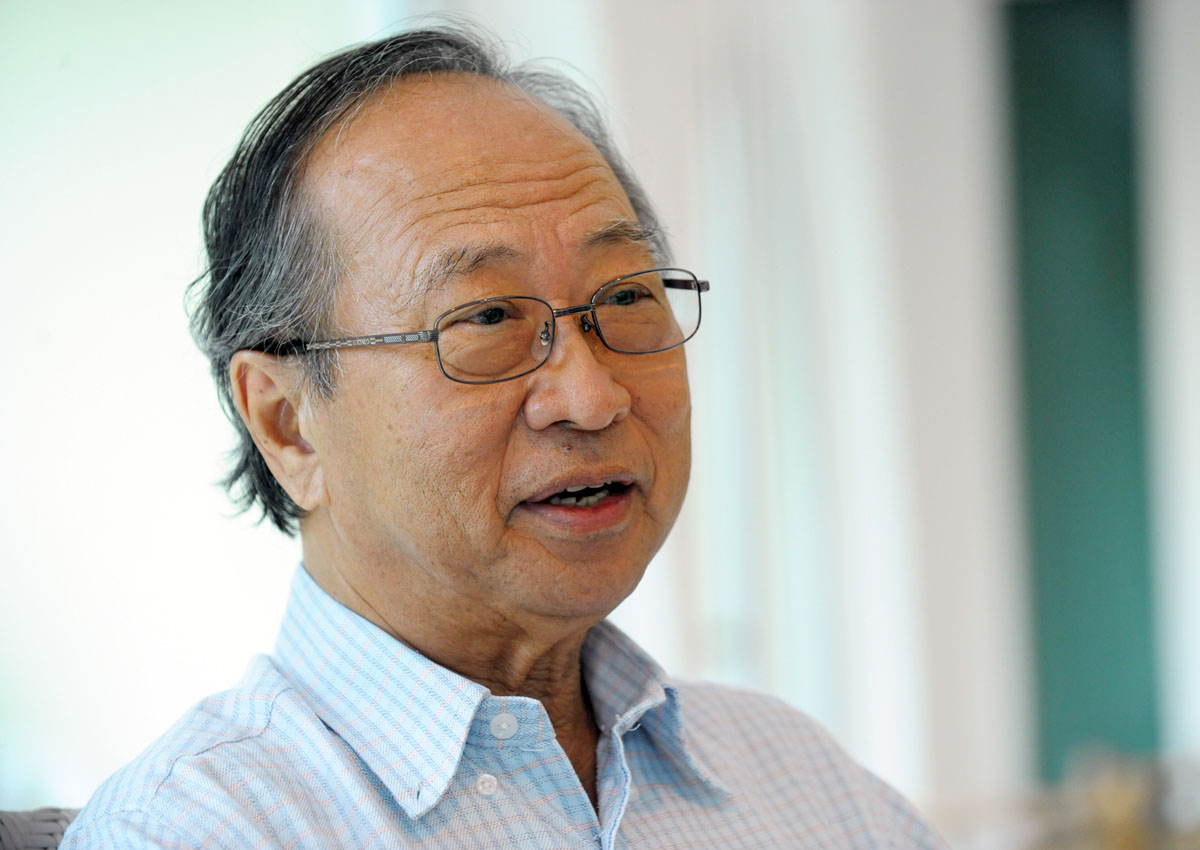
People should not jump to conclusions that the elected presidency was reviewed to disqualify him from running in the upcoming elections, said Dr Tan Cheng Bock in a Facebook post yesterday.
Dr Tan, who contested in the 2011 presidential election, may not be eligible for this round after the Constitutional Commission recommended more stringent criteria for candidates in its report published last Wednesday. In his first comments since then, Dr Tan told his supporters to wait for the debate in Parliament over the proposed changes.
He said many Singaporeans have expressed worry that he will be excluded by the new criteria put forth by the panel. The former People’s Action Party MP had declared his intention to make a second bid for the presidency earlier this year.
The commission suggested that candidates must have been, for at least six years, the most senior executive of a company with up to $500 million in shareholders’ equity.
Dr Tan qualified for the 2011 election as he was non-executive chairman of investment holding company Chuan Hup. The current rules require a candidate to have been chairman or chief executive of a company with paid-up capital of at least $100 million.
A look at the presidents of Singapore
Click on thumbnail to view photos. Source:
The Straits Times, Zawiyah Salleh, New Nation, Wee Kim Wee, The Business Times, The New Paper, The Ong family, Lianhe Zaobao
But the suggested changes would disqualify him on two counts. He would not have been the company’s most senior executive, nor would Chuan Hup meet the proposed shareholders’ equity threshold. The company had $300.7 million in shareholders’ equity as of June 30.
The commission also recommended, among other things, that if nobody from one racial group has been president for five terms, the next election should be reserved for members of that race.
The Government will issue a White Paper in response to the report on Thursday, and it will later be tabled in Parliament.
Dr Tan noted that when the Bill is debated, it may be supported, amended, or even rejected.
“We should not jump into (sic) conclusion that the whole exercise was to prevent me from running,” he wrote.
“After all, the people in charge are men of virtue and integrity and would not resort to doing this.”
oliviaho@sph.com.sg
This article was first published on September 11, 2016. Get a copy of The Straits Times or go to straitstimes.com for more stories.
Pay a landowner in Sumatra as little as 500,000 rupiah, or just S$52, and he will clear his land for farming using the easiest and cheapest method possible – fire.
Throw in a few hundred dollars more and he will farm any crop, from oil palm to trees for pulpwood, on his land, which can vary in size from one to a few dozen hectares.
Such arrangements by plantation firms are not only common in rural Indonesia, but they also make locals ready “fall guys” for the companies when the authorities look for culprits of slash-and-burn violations, say green activists.
“The firms use the farmers as their shields, which absolve them of wrongdoing because it shifts the blame squarely on the farmers,” said Greenpeace Indonesia campaigner Yuyun Indradi.
Plantation conglomerates and their suppliers are often accused of turning a blind eye when farmers they pay to plant their crops use fire to clear land, he said.
Many are also suspected to have paid local residents to start the fires in their own concessions, so that they cannot be implicated if the fires spread and cause a haze crisis.
Mr Yuyun said firms have become more organised in the last three years, hiring middlemen to mobilise hundreds of villagers to burn land.
Groups such as the Indonesian Forum for the Environment (Walhi) and Greenpeace Indonesia say the hundreds of dollars paid to small-time locals in poor rural areas are generous by local standards.
Farmers can also multiply their earnings by using fire to clear land – all they need is a box of matches – instead of paying hundreds or thousands of dollars to rent or buy hand-tractors.
The Indonesian government, however, has finally cottoned on to the ruse and is clamping down on such practices, Environment and Forestry Minister Siti Nurbaya Bakar said.
Ms Siti said last week that some errant firms have formed organised groups backed by “mobile financiers”, who The Sunday Times understands are middlemen hired by firms to make illicit payments to locals to start fires or gang up against land inspectors.
The minister spoke following two recent incidents in Riau province, where locals prevented government officials from investigating farming violations.
In the first incident on Sept 2, a mob threatened to harm her ministry officials if they refused to destroy photo and video evidence collected from the field.
In the second case three days later, Peatland Restoration Agency (BRG) chief Nazir Foead and his team were blocked from entering a site to conduct their investigations by outsourced security guards.
Mr Nazir told The Sunday Times that many companies in Riau are guilty of using fire to clear land but blame farmers for the misdeed.
Walhi agreed, adding that hired security guards sometimes use violence to get their way. Its members had been “chased away with knives by security people” at plantation sites. These locals paid to be private security guards or gangs are indirectly bankrolled by some plantations.
Indonesian Oil Palm Smallholders Union coordinator Mansuetus Darto told The Sunday Times that it is not uncommon for firms to pay off farmers to cover their own tracks and bribe local authorities to turn a blind eye to their illegal activities.
“The firms also pay huge sums to some individuals to take the legal rap when there’s trouble,” he said.
The government and police have been criticised by environmental groups in the past for being slow to take action against errant firms.
Last month, Indonesian lawmakers said they were investigating a controversial decision by the police to drop charges against 15 companies allegedly behind forest fires in Riau province last year.
The move came after Walhi and the Riau Forest Rescue Network reported that fires were recently detected on land owned by eight of the 15 companies.
Ms Siti has since vowed to get tough on the companies, while the police, which have received flak for letting the firms off the hook, have thrown their weight behind her.
National police chief Tito Karnavian has promised that any land and forest fire case involving companies in the future will be solved together with legal and forestry agencies at the national level.
“All cases will be made open so there won’t be any more untoward suspicions,” he said.
aarlina@sph.com.sg
This article was first published on September 11, 2016. Get a copy of The Straits Times or go to straitstimes.com for more stories.
The local film-maker experienced a mixed bag of emotions when he walked his daughter, Ethel, 25, down the aisle yesterday.
He was over the moon, yet he could not shake off the sense of sadness.
“Different feelings and memories came flooding back when we were doing the slow march into the church sanctuary,” the 56-year-old told The New Paper on Sunday over the phone.
“I didn’t expect this day would come so soon.”
The ceremony was held at Bedok Methodist Church.
Neo has three other children, sons aged 22, 17 and 12.
He admitted that it was initially hard to accept that his only girl is now a married woman.
He said: “It was the part of the (wedding) ceremony where I had to hand her over to the pastor, that really hit me hard.
“Reality finally sank in when they were pronounced ‘man and wife’ and she was introduced as Mrs Lau.
“She is no longer Miss Neo… She is not mine any more.”
Neo said the days leading up to the wedding were rough as he was overwhelmed by emotions.
His wife, Irene, is handling the emotion better than him, he said while laughing.
Neo said: “Maybe it is because talks about marriage have been going on for years.
“When a video of her growing up – from baby to adulthood – was screened, it was a test of self-control.
“I called the video, A Movie: 25 Years In The Making.”
In his thank-you speech, Mr Peter Lau, 31, told Neo: “I grew up watching (the long-running variety show) Gao Xiao Xing Dong (Comedy Nite), Liang Popo and Liang Ximei… and I can’t believe that you are now my father- in-law.”
Neo said the couple had agreed to wait for Ethel to get some working experience before exchanging vows.
She has her own online business, while the groom is a training manager at Golden Village.
They will be having their wedding dinner in December.
Neo is thankful that his son-in-law is someone he can entrust Ethel to.
“They have been dating for seven years, so we knew very well what kind of person he is,” he said.
Trust
“He is my daughter’s first and only boyfriend. I trust her judgment.
“(Peter) has also shown to us that he truly loves my daughter and is one who will look after her well.”
While he feels that his daughter is still young, the Neos did encourage her to settle down early.
“I married Irene when she was 25. I was 31, like Peter.”
The next milestone Neo is anticipating will be his first grandchild.
Photo: Jack Neo’s Facebook
“I have been a father for so many years, it is time to get promoted. My wife gave birth to Ethel when she was 26, so Ethel can follow her mum’s example too,” he said.
He added that it is good to start a family while they are young, especially if they want to have a few children.
“There are several government incentives now, they might as well make full use of them,” he added, laughing.
“Don’t be like me… I am 56, and I still have to worry about PSLE.”
While Ethel may no longer be Miss Neo, Neo is happy that she is not leaving the nest yet.
The newlyweds will live with the Neos until renovations at their own home is completed by year end.
“I can still see her every night at home,” said Neo.
“So nothing has changed… yet,” he said, laughing.
7 tips for avoiding a wedding toast disaster
Click on thumbnail to view photos. Source:
The Straits Times
This article was first published on Sept 11, 2016. Get The New Paper for more stories.
Yip Chee Khiong and Margaret Chong did not know their daughter, Yip Pin Xiu, had made history at the Paralympic Games in Rio de Janeiro until several hours after her feat.
The 24-year-old Singaporean swimmer had won the 100m backstroke (S2) in a world-record time of 2min 7.09sec yesterday.
Both 61, Yip and Chong were en route to Rio to support their daughter, and learnt of her triumph only after landing in their stopover in Dubai.
Said Chong: “It was always good that she gets better with each race. Getting a gold and in world-record time is a bonus. Her years of training have paid off and we are very happy and proud of her.”
Chong and Yip will be at the Olympic Aquatics Stadium on Thursday evening (Rio time) to support their daughter in her next event, the 50m backstroke (S2).
In the 100m backstroke (S2), Yip finished ahead of China’s Feng Yazhu (2:18.65) and Ukraine’s Iryna Sotska (2:21.98) at the same arena to bag Singapore’s first medal of the Rio Paralympics, which began on Thursday.
President Tony Tan Keng Yam wrote on Facebook: “I hope Pin Xiu’s Gold will be only the first of many pieces of good news we will hear from Rio in the coming week.”
Minister for Social and Family Development Tan Chuan-Jin and Minister for Community, Culture and Youth Grace Fu also congratulated the swimmer on their respective Facebook pages.
Mr Tan, who is also president of Singapore National Olympic Council president, wrote: “Awesome Pinxiu Yip! Gold. Paralympic & World record. 100m backstroke S2. Well done!”
Ms Fu added that a public celebration is in store for the Republic’s Paralympians when they return.
Fellow swimmer Joseph Schooling, who won Singapore’s first Olympic gold medal last month, offered his congratulations in a Facebook post as well.
Singapore Disability Sports Council (SDSC) president Dr Teo-Koh Sock Miang lauded Yip’s feat, saying the swimmer has “blazed the trail for Singapore’s para-athletes”.
Adding that she hoped Yip’s triumph would inspire more disabled persons to pick up sport, Dr Teo-Koh said: “Her spectacular win (re-writing her own world record) will inspire and motivate her fellow athletes to dream big and believe that everything is possible if you are willing to push yourself and train to achieve the goal of a podium finish.
“Pin Xiu’s win is also testament that the human spirit can triumph over limitations; and challenge all of us to change our perceptions about what persons with disabilities can and cannot do.”
SDSC vice-president Raja Singh believes disability sports will gain more traction in Singapore following Yip’s repeat win. She had clinched her first gold in the 50m backstroke (S3) at the Beijing Games in 2008.
He said: “After the APG (ASEAN Para Games) there was a slight momentum for para sports – new sports like wheelchair rugby and wheelchair tennis were introduced, and the respective national disability sports associations as well as ActiveSG have been encouraging people to play sports.
“With Pin Xiu’s win, we can certainly expect to see new developments in disability sports, and her win will also spur other athletes to continue training to achieve their goals.”
The 55-year-old, a former Paralympian who competed in the 1988 and 1992 editions of the Games, added that he was proud of the 13-strong Paralympic contingent.
“It’s a big step to have 13 athletes at the Paralympic Games,” he said. “Their achievements will bring a lot to other disabled athletes, who will be motivated to achieve the goals they set.”
Rio Paralympic Games 2016: Singapore’s Para-athletes
Click on thumbnail to view photos. Source:
AFP, Reuters, The Straits Times, MCCY, Singapore Sports Council
cnicole@sph.com.sg
This article was first published on September 11, 2016. Get a copy of The Straits Times or go to straitstimes.com for more stories.
Most young people here underestimate the cost of owning a car in Singapore, and are willing to pay only a small part of their monthly income on car-related expenses.
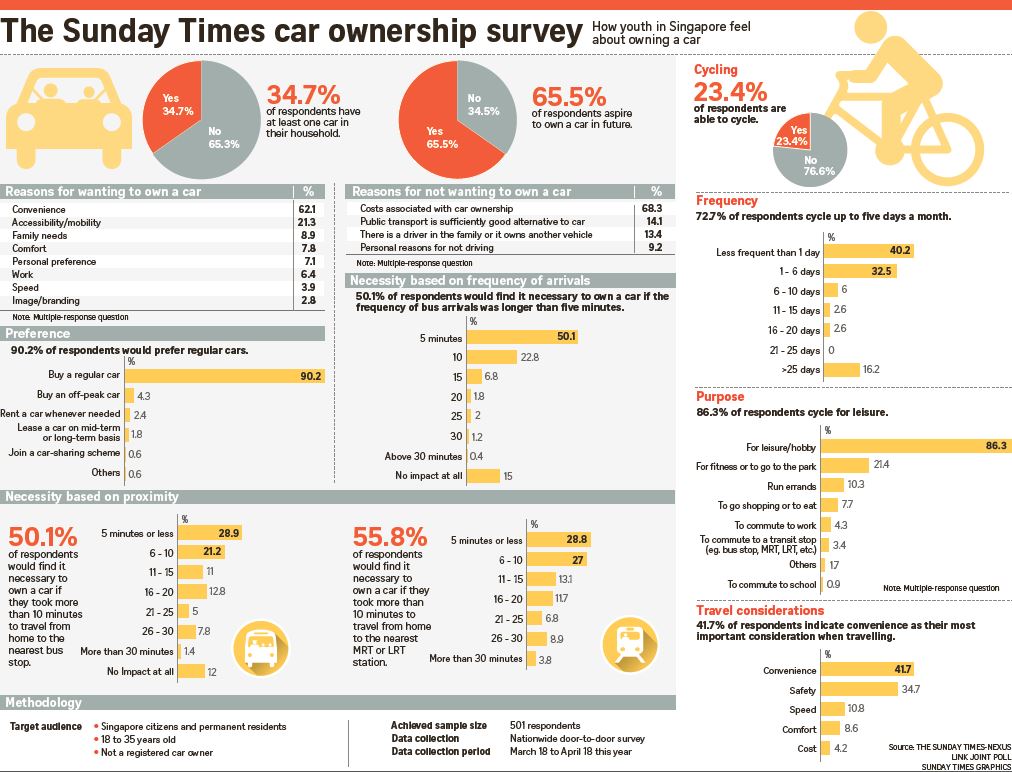
About two thirds of respondents in The Sunday Times’ survey on attitudes towards car ownership said they would not set aside more than 15 per cent of their monthly wages on a car.
About three in four of the 501 people aged 18 to 35 polled said they are willing to pay up to $500 a month for car-related expenses such as fuel and maintenance.
Just over six in 10 said they would pay up to $1,000 for monthly car instalments.
But the costs of owning a car, including monthly instalments, fuel, and parking, can easily amount to more than $2,000 a month, according to a post on car costs on the Government’s Gov.sg website.
This is more than half the median monthly income of about $4,000 here, based on 2015 Ministry of Manpower figures.
Chief methodologist Jack Loo of Nexus Link, which was commissioned to conduct the survey, said respondents might not have a good idea of the cost of maintaining a car as they are not car owners.
Only 12 per cent of respondents agreed that cars are affordable.
Experts say that while most would take into account expenses such as monthly instalments and petrol, few consider factors such as depreciation when buying a car.
“These are harder to grasp, because they don’t appear as items on a billing statement,” said SIM University economist Walter Theseira.
Healthcare professional Juliana Koh, 28, said she found the cost of owning a car here prohibitive.
“It’s too expensive. Unless there’s a train fault, public transport here is quite convenient for getting around,” she said.
This article was first published on September 11, 2016. Get a copy of The Straits Times or go to straitstimes.com for more stories.
Having an MRT station or bus stop within walking distance from home – no further away than 10 minutes – would reduce the need to own a car.
About one in two young people said in a recent survey that this was how far they were willing to walk to take the train or bus, before they found it necessary to drive instead.
As the distance to rail stations or bus stops increased, fewer of the 501 respondents were willing to make the longer walk to take public transport. The study, commissioned by The Sunday Times and conducted by research firm Nexus Link, sought to understand the attitude of citizens and permanent residents aged between 18 and 35 towards car ownership.
It found that only 13.1 per cent of respondents would take the train if they had to walk between 11 and 15 minutes to the MRT station.
If the walking time increased to between 16 and 20 minutes, only 11.7 per cent said they would consider the train. These percentages dipped correspondingly when walking times increased.
When respondents were asked how far they would walk to the bus stop, similar findings emerged.
Asked why commuters are unwilling to walk longer than 10 minutes, SIM University senior lecturer Park Byung Joon said this is psychological. “We are programmed to think in blocks of five minutes. If we say we are only prepared to walk five minutes, we sound impatient. But 15 minutes sounds too long, so most will say 10 minutes,” he said.
Commuter Vidya Krithivasan, 33, a part-time accountant, said: “In Singapore’s hot and rainy weather, walking more than 10 minutes can be exhausting.”
Dr Park said that given Singapore’s climate, it can be challenging to get commuters to walk longer distances.
“Maybe we can encourage them on the basis of it being good for health,” he said, adding that building wider pedestrian pavements and shadier walkways may also encourage more to go on foot.
Currently, six in 10 households are within a 10-minute walk from a train station. This ratio will go up to eight in 10 households after the rail network is doubled in length to 360km by 2030.
Bus stops, on the other hand, are spaced about 300m to 400m apart from one another, but their locations are dependent on site constraints and traffic conditions.
Under its Walk2Ride programme, the Land Transport Authority is building more than 200km of new sheltered walkways by 2018, adding to the existing 56km. These will link commuters from MRT stations to residences as well as amenities such as schools and healthcare facilities in a 400m radius.
Besides proximity to bus stops, respondents also expected their buses to arrive promptly – about half said it would not be necessary to own a car if buses came at intervals of no longer than five minutes.
Nearly 23 per cent said they would ride the bus if services arrived at 10-minute intervals, while only 6.8 per cent would take the bus if it had a frequency of 15 minutes.
Dr Park said that rather than boosting bus frequencies, which can be costly as more resources and drivers will be needed, more can be done to adjust bus routes, so commuters get to transport nodes and public amenities in a shorter time.
But university undergraduate Goh Wei Hao, 22, said: “As buses are not as predictable as trains, it will be better if they can arrive more frequently. It’ll make the wait less anxious.”
As to how far he was prepared to walk to a bus stop or train station, Mr Goh said: “Ten minutes, but that’s an estimate… If the stroll was smoother, for example, with nice pavements or fewer road crossings, I could do 15 minutes.”
adrianl@sph.com.sg
This article was first published on MONTH DAY, 2016. Get a copy of The Straits Times or go to straitstimes.com for more stories.
BEIJING – Days after Communist China’s founding father Mao Zedong died 40 years ago the problem of what to do with his corpse was becoming increasingly heated – literally.
Mao himself had requested cremation, but powerful officials including his mercurial widow Jiang Qing decided he would join the likes of Vladimir Lenin and Ho Chi Minh in being embalmed and put on display.
Before the natural processes of decay could take hold, Xie Piao, an official overseeing an experimental thermoelectric cooling project, was summoned in the middle of the night and tasked with cooling the corpse.
“No one expected that Chairman Mao would die, so there were no preparations at all,” said Xie, now 75, who said he then felt “quite proud” to be involved in preserving the Great Helmsman’s body.
He arrived at the cavernous Great Hall of the People four decades ago on Sunday to find the prostrate body of the man who led the Communist party to victory, founding the People’s Republic before plunging it into chaos, in a hastily-constructed glass and wood coffin, at room temperature beneath hot electric lights.
“Our aim was to get the temperature down to 4 or 5 degrees Celsius (39-41 degrees Fahrenheit),” he told AFP, adding that some 400 people were involved in the entire project.
“We couldn’t freeze him – that was his doctors’ order,” Xie told AFP.
At the time Chinese refrigeration systems were basic. With Soviet relations still on a war footing, asking Moscow for help was unthinkable and its ally Hanoi rebuffed calls from Beijing for assistance, Xie said.
China remembers Chairman Mao, 40 years after death
Click on thumbnail to view photos. Source:
AFP
“I thought the technology was very reliable, it was very simple,” he said in what is believed to be his first interview with foreign media.
“The fear came later.” Within hours nitrogen gas surrounding the corpse had been bought down to a cool eight degrees Celsius. But that did not prevent Mao’s anointed successor Hua Guofeng berating Xie for using “experimental” techniques.
Senior leaders arrived day and night to bow before the body, adding to the seven-strong refrigeration team’s tensions.
“Once I was so tired I fell asleep in the middle of work. We had no time to sleep for five, seven days,” he said.
Mao’s death on September 9 1976 is seen as bringing to an end the destructive decade of “Cultural Revolution” he unleashed on his nation.
But the period’s intense political atmosphere still permeated the corridors of the Great Hall.
“It was very serious, no one chatted,” Xie said.
When Jiang arrived to pay respects to her husband, Xie hid among the floral tributes for fear of becoming a focus for her notorious temper, according to an account he published for the first time this year.
Eight days after arriving at the Great Hall, Xie’s work was declared complete.
He knows little of the embalming, said to have involved draining the corpse of fluids and injecting it with the chemical preservative formaldehyde.
Mao’s former doctor Li Zhisui published a ghoulish account of the process, describing the former ruler’s head swelling up “like a football”.
Xie dismisses it as “unreliable”, but whatever the details, Mao was put on permanent display in 1977 in a monumental pillared memorial hall in Beijing’s Tiananmen Square.
Mao lies in a dim chamber, garbed in a grey suit, his sallow waxy face framed by thick black hair bathed in a patch of orange light.
With debate about his legacy stifled by Communist authorities, he still retains a powerful hold over some sections of Chinese society and receives hundreds, sometimes thousands of visitors a day.
No detailed official account of the preservation efforts has been published.
The editorial staff of liberal intellectual magazine Yanhuang Chunqiu, or Annals of The Yellow Emperor, was purged in August, shortly after it published Xie’s account, in a sign of further tightening under current President Xi Jinping.
Xie, the son of a first generation Communist who himself suffered in the Cultural Revolution, only visited the corpse once again – in the 1980s – and said he was “too busy” to pay any respects this week.
Top leaders also stayed away.
While still celebrating Mao, the ruling party has acknowledged the “gross mistakes” of a man whose Great Leap Forward resulted in a famine which killed tens of millions of people in the early 1960s.
Intellectuals have periodically called for his body’s removal from the square.
But Xie said: “Although there is controversy, I think that Mao’s corpse has been somewhat useful to China over the decades.
“The spirit of the Chinese people finds a focus on Chairman Mao’s body.”
Despite the best efforts of doctors and a flood of offers from good Samaritans willing to donate a part of their liver, nine-month-old Zarouhi Singla died on Friday, her father Sandeep Singla told The Sunday Times yesterday.
She was born with biliary atresia, a rare liver disease that affects one in every 15,000 infants and can be deadly.
Mr Sandeep donated part of his liver to his daughter last month but the transplant failed. A Straits Times story about a week later on his desperate plea for liver donors drew over 200 e-mail from supporters and would-be donors, he said.
About 90 people were picked for compatibility screening at the National University Hospital (NUH), where Zarouhi fought for her life in the paediatric intensive care unit.
However, she developed sepsis, a severe blood infection, which put plans for a transplant on hold. After weeks of fighting the infection and organ failure, she died from bleeding in the lungs.
Professor K. Prabhakaran, director of the paediatric organ transplant programme at NUH, told The Sunday Times that the team was sad, but proud of Zarouhi, “who had been very brave”.
Today, instead of celebrating their sixth wedding anniversary, Mr Sandeep, a general manager at Shell, and his wife, Ms Neha Wilson, will be burying their only child.
The couple, both 34, are Indian nationals who have been living here for about 19 months. While foreigners are allowed to be buried here only if their next of kin is a citizen or permanent resident, Mr Sandeep had filed a request for an exception for Zarouhi with the National Environment Agency, which was granted late last night.
Mr Sandeep, who is a Hindu, prefers that his daughter not be cremated for religious reasons. “It is a very difficult time for us. We thought we’d celebrate our anniversary with her, but instead, we are bidding her goodbye.”
The couple are touched by the outpouring of support from Singaporeans and plan to stay on, he added.
In honour of Zarouhi, they will set up a charity to help needy kids with medical costs. “It’s painful to live with such harsh memories, but hopefully, we will be able to find a new meaning in life,” he said.
tiffanyt@sph.com.sg
This article was first published on September 11, 2016. Get a copy of The Straits Times or go to straitstimes.com for more stories.
You might have seen them resting or sleeping in a 24-hour McDonald’s outlet near you – slumped over a table, bag by their side.
Some are seeking refuge from noisy neighbours, or the heat in homes without air-conditioning.
Others do not want to impose on their housemates, or are simply trying to kill time on sleepless nights.
The Sunday Times visited six McDonald’s outlets to speak to Singapore’s own “McRefugees”.
REFUGE FROM NOISY NEIGHBOURS
Mr Ng P. L. was sitting alone in a corner of a quiet McDonald’s outlet in a polo tee and bermudas, engrossed with his phone, when The Sunday Times spotted him past 1am on a recent weekday.
While the 56-year-old was cagey at first, he broke into a smile when asked what he was doing – he was catching virtual monsters on the popular mobile game Pokemon Go.
The unemployed man is no stranger to the McDonald’s outlet near his home in the southern part of Singapore. A few years ago, he spent his nights at the eatery for three consecutive months, although he visits less often now.
“I used to live across the road and my neighbours were very noisy,” said Mr Ng in Mandarin. “I couldn’t sleep for the past five years.”
“After being ‘tortured’ over these years, now even if I sleep for more than five hours, I wake up with a headache,” he said.
While he initially used earplugs to block out the noise, he ended up pushing them too deep into his ear canals, causing an infection.
“Thank goodness there was this outlet. I used to spend time at the void deck of my block and even the police knew me,” he said.
Eight months ago, he moved from his old flat to a nearby block but the damage has been done – he suffers discomfort and pain from the inflammation in his sinuses and check-ups have proven too costly.
A chronic lack of sleep also cost him his job as a coffee seller in a school canteen, and he continues to spend some nights at the same McDonald’s outlet, still within walking distance from his new home.
“There is air-conditioning, Wi-Fi and even a Pokemon gym nearby,” said Mr Ng with a smile.
Some seek respite in the air-conditioned outlets while others find it hard to sleep at home. Photo: The Straits Times
SLEEPLESS SWELTERING NIGHTS
An elderly man sat by the window, eyes closed, with a bag and a music player the size of a Walkman on the table. He was wearing earphones.
It was 3.30am on a recent weekday.
For the 69-year-old cleaner who wanted to be known only as Mr See, the McDonald’s near his home in the east is where he listens to music in the wee hours.
“I wake up around 2am and come out of the house. I can’t fall asleep; I get up automatically in the morning,” Mr See, who lives with his wife, said in Mandarin.
“I’ve been coming here for a few years. Some old people come here to sleep, but not me,” he said. “The coffee shop and market nearby open at 5am, and I eat there before going to work in town.”
“Sometimes, when I sit outside, the police will question me and explain that there is a risk of robbery,” he said, adding that most other people who spend nights in the eatery are youngsters who are studying.
Retiree Low Kee Tong, 62, whose neck and head would swell after going for kidney dialysis, also spent his nights at McDonald’s when he could not fall asleep in his two-room flat.
Pointing to middle-aged men slumped over tables in the Princess Cinema outlet in Bedok, he said many who slept in the store lived nearby in Chai Chee too.
Among those asleep was a man who had spent at least five months in the outlet after losing his flat, due to financial difficulties. He ended up sharing an address with his friend – but only in name.
The man, who is in his 50s, slept with his bags of belongings and did not want to be identified. While he went back to his friend’s place every weekend to rest, he spent most nights at McDonald’s, not wanting to trouble the man’s family.
This Bedok outlet had up to 13 “McRefugees”, mostly middle-aged or elderly men, sleeping in its premises, when The Sunday Times visited in May. The outlet closed last month but its former overnight patrons have not taken to another 24-hour outlet in the same area, said staff of the other outlet.
SLEEPING IN A CONSIDERATE WAY
Mr William Lim, 40, was sleeping seated in a McDonald’s outlet at around 1am on a recent weekday. He later woke up and took a laptop out of his bag. The self-employed father of three stays there overnight to do work once or twice a week, as he is unable to focus at home.
McDonald’s 24-hour outlets allow people to work or rest in a safe environment, he said. “I often see elderly (patrons) who are slumped on a table,” he said, adding that staff do not chase them away.
“The people here are quite considerate; we seldom have people who block up a whole row of seats.”
‘Not common’ for people to spend night at McDonald’s
A spokesman for McDonald’s Singapore said it was not very common for people to sleep overnight in their restaurants.
Mr Faz Hussen, director of communications and government relations at McDonald’s Singapore said: “Generally this is not prevalent in our Singapore restaurants.”
While all are welcome, he added, he appealed to those who are not eating to be “considerate to dine-in customers who would need the seats”, especially in peak periods.
McDonald’s has about 130 outlets here, excluding kiosks, and 48 of them are open 24 hours for at least two days a week, said its website.
Other McDonald’s staff who declined to be named told The Sunday Times not all 24-hour outlets have people who stay overnight. Those who do tend to leave by around 6am.
Store managers sometimes have to chase such patrons away if they are drunk or cause trouble.
“McRefugees” made headlines in Hong Kong last year when a woman was found dead in a McDonald’s outlet in Kowloon Bay.
In Singapore, not many people who sleep on the streets go to 24-hour McDonald’s outlets as there might be complaints, said Ms Fion Phua, founder of volunteer group Keeping Hope Alive, which works to meet the urgent needs of the less privileged. “They might go in to use the toilets, or when it is raining very heavily,” she said.
Those who sleep outside may also be unwilling to part with their trolleys, which they use to collect cardboard and store belongings. These are hard to bring indoors, or to places with steps and slopes.
They keep to bus stops, void decks or near 24-hour supermarkets instead, said Ms Phua, adding: “When there are more people around, there is a smaller chance they will be pickpocketed.
The Ministry of Social and Family Development (MSF) provided help and support to 300 cases involving the homeless each year on average, from 2005 to last year. Homeless people often go through stressors such as divorce, financial difficulties or health issues, said MSF.
Many sold their flats and spent the money to clear debts or for other purposes, said a spokesman, and some could not live with their families due to strained relationships.
Agencies coordinate help for those at risk of homelessness. There are also welfare homes and shelters for the destitute. The public can dial ComCare Call on 1800-220-0000 or approach an MSF Social Service Office or family service centre if they know of someone in need.
Work is a refuge for deliveryman with no home to return to
With no home to return to, John (not his real name) spends most of his days sleeping on a park bench.
Come nightfall, the 53-year-old McDonald’s deliveryman reports for work at an outlet in the south of Singapore. He puts on a smile and banters with customers before zooming off on a company motorbike as orders come in.
Work is his refuge.
This is why he willingly clocks 13-hour days, he told The Sunday Times. After sleeping at a park not far from his workplace, he showers at a shopping mall before work.
After work, he buys breakfast for his mother and spends time with her before catching some sleep outdoors. She lives with his brother’s family in a two-room flat.
John, who earns around $1,500 a month, was referred to temporary housing once, but did not feel safe sharing the space with many others.
“Nobody knows what I face,” said the father of three, whose oldest child is 24. He has been sleeping on the streets for six years. “But I don’t show this to anybody… I joke and laugh, just as normal.”
On why he does not live with his relatives, he said: “I don’t want to be a burden to anybody.”
It was about six years ago, that creditors turned up at his doorstep, saying that he had failed to pay his loan, which he denied.
He had taken a bank loan of $19,000 for renovations, he said. He then borrowed from loan sharks and eventually sold his home. His wife later divorced him.
With no address, he was hauled to court twice for failing to pay fines for traffic offences. He was fined and jailed twice two years ago for up to 16 days. He lost his job of 14 years as a clerk.
Life in the park is rough – at one point, all his belongings were stolen, including his wallet, clothes and documents such as his divorce certificate. Now, he leaves important documents with his relatives.
Police advised him not to sleep in the park, he said. “A park is for people to enjoy, not sleep in… But I have no choice,” he added.
Last year, he got into a traffic accident, earning him five stitches above his ear and perpetual headaches.
A hospital social worker advised him to get help from the Government and he plans to write to the authorities.
He said: “I want to get back what I have lost.”
Click on thumbnail to view photos. Source:
The Straits Times
This article was first published on September 11, 2016. Get a copy of The Straits Times or go to straitstimes.com for more stories.