SUZUKA (Japan) – Nico Rosberg won the Formula One Japanese Grand Prix on Sunday to extend his lead over team-mate Lewis Hamilton in the World Championship.
The result moves him a step closer to a maiden drivers’ title and he now as a 33-point lead over his fellow Mercedes driver with four races to go.
Hamilton, the reigning world champion, finished third, behind Red Bull’s Max Verstappen.
The Briton had started second on the grid but a poor start saw him shoved down the order to eighth by the end of the first lap. He was then forced to fight his way back up through the field.
Ferrari’s Kimi Raikkonen, who had qualified third, was forced to start the race in eighth after collecting a five-place penalty for an unscheduled gearbox change.
Instead, the 2007 world champion lined up alongside Romain Grosjean’s Haas on the fourth row of the grid. The rules require a driver to use a single gearbox for six straight races. He eventually finished fifth.
Raikkonen’s penalty allowed Verstappen and team-mate Daniel Ricciardo to lock out the second row. The duo had scored the team’s first one-two finish since 2013 in Malaysia last weekend. Ricciardo, who was hampered by a slow stop in the pits, was sixth.
Raikkonen’s Ferrari team-mate Sebastian Vettel, who started seventh having collected a grid penalty for shoving Rosberg into a spin at the start of the last race at Sepang, finished fourth.
Mercedes wrapped up the constructors’ title, their third consecutive championship.
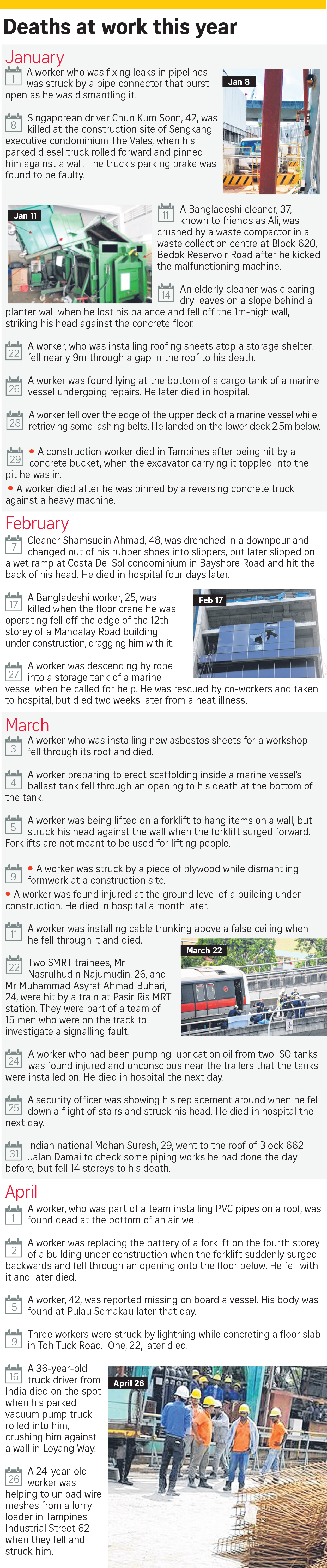
Three days before he was to fly home for his wedding, Mr Mohan Suresh fell 14 storeys to his death.
On the morning of March 31, the 29-year-old plumber from India decided to check on some pipes on the roof of an HDB block in Jalan Damai, which he had fixed the day before.
He did not put on the safety harness and helmet lying in a storeroom 12 minutes’ walk away, a coroner’s finding on Sept 23 noted.
Perhaps he thought they were too far away. Perhaps it never crossed his mind to put them on. He had gone without them before. It had been fine. An hour later, his sandals lay empty on a ledge, next to a pipe which he had perhaps stretched a little too far to reach. He was found on the ground 45m below.
Mr Mohan never got to be a husband. He became a statistic.
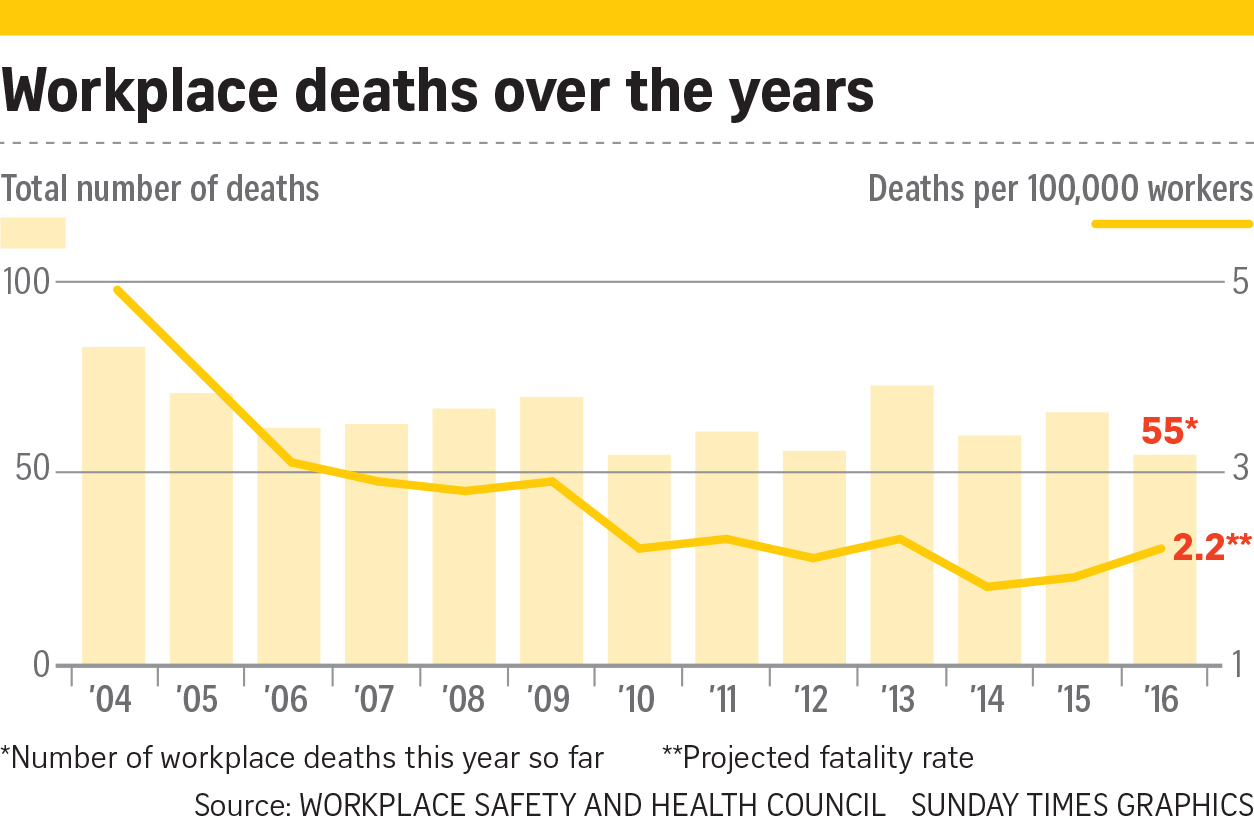
He was one of the 55 people who died at work this year so far.
The rise in workplace deaths saw Manpower Minister Lim Swee Say warn last month that the fatality rate is likely to hit 2.2 per 100,000 workers this year.
Singapore had some success in bringing this down from 2.8 in 2008, when Prime Minister Lee Hsien Loong called for it to be pared to 1.8 within 10 years. In 2004, it had been a dire 4.9.
Singapore met the goal of 1.8 four years early in 2014, but this was short-lived. The rate crept up again to 1.9 last year, with 66 fatalities.
Compared to other countries, Singapore fared better than the United States, which had a rate of 3.3 in 2014. However, it lagged behind Australia at 1.61 in 2014, and the United Kingdom, which had a rate of 0.46 from April 2014 to March last year.
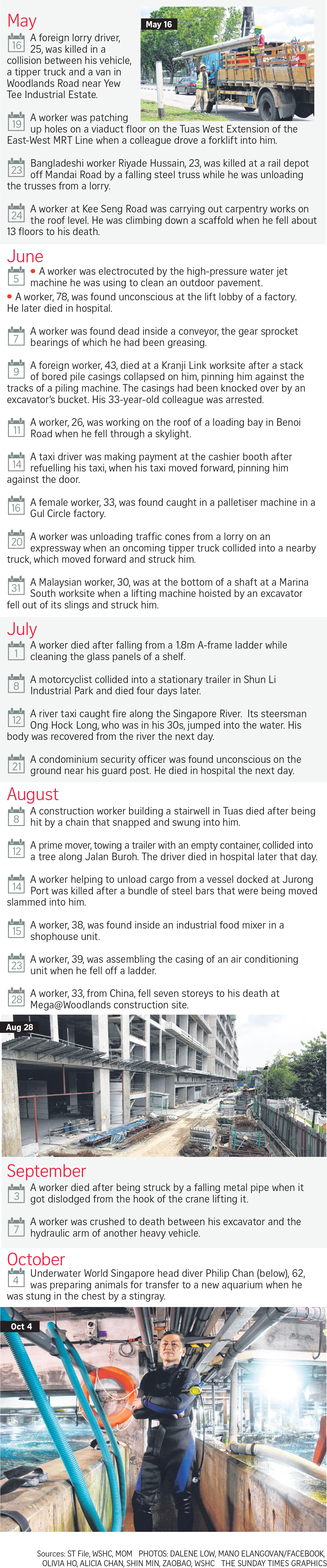
The construction sector had the highest casualty rate with 20 deaths.
Of the others, five occurred in marine, six in manufacturing, nine in the transport and storage sector, and 15 in other workplaces.
The total number of accidents at work also rose in the first half of the year to 6,149 injuries, up from 6,009 in the same period last year.
Said a Ministry of Manpower (MOM) spokesman: “Our analysis of the construction workplace fatalities indicates systemic lapses, workers’ competency and absence of ownership as key drivers of the deteriorating situation in the construction sector.”
GETTING THE MESSAGE OUT
Walk through a construction site and a barrage of hazards stands out even to the untrained eye.
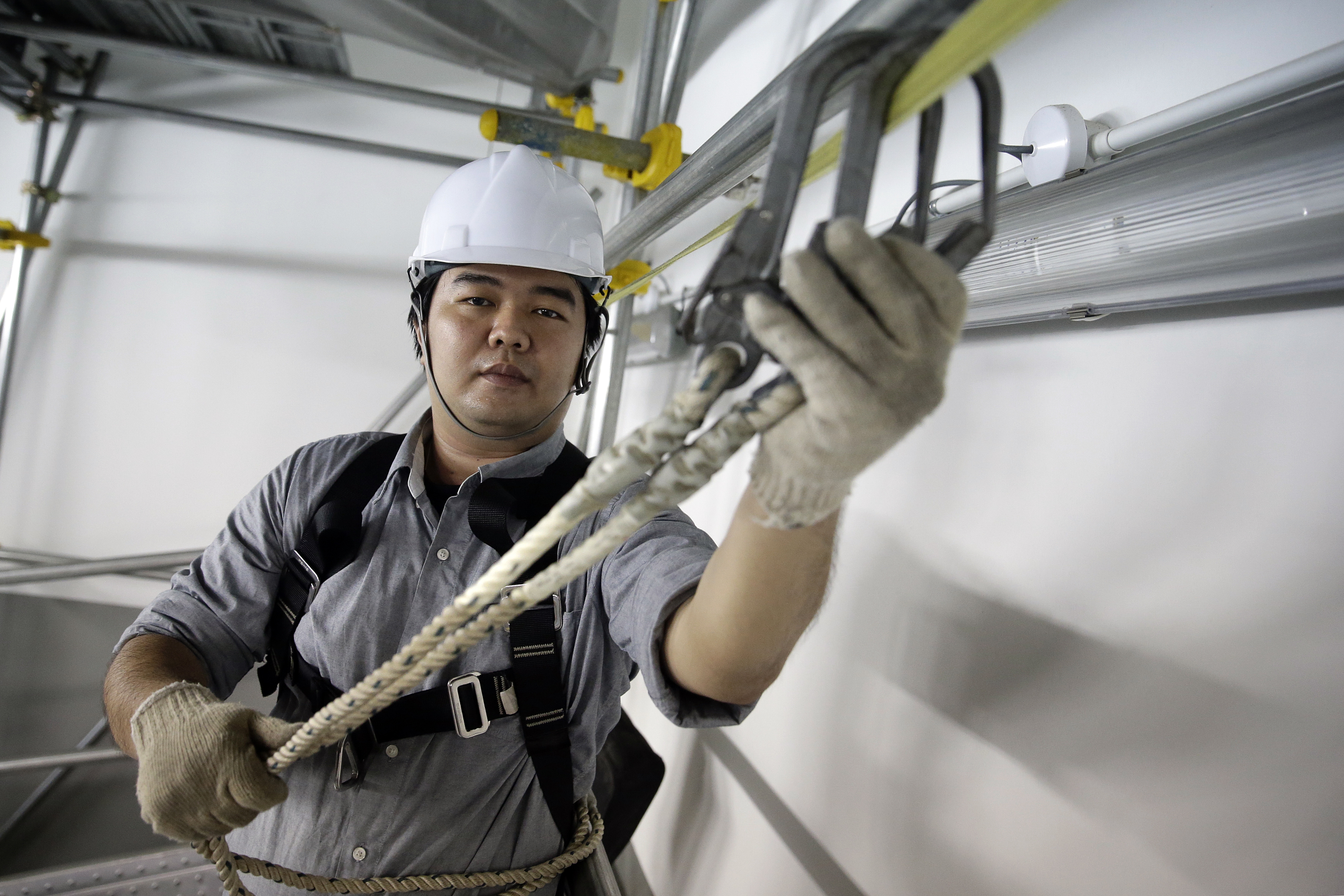
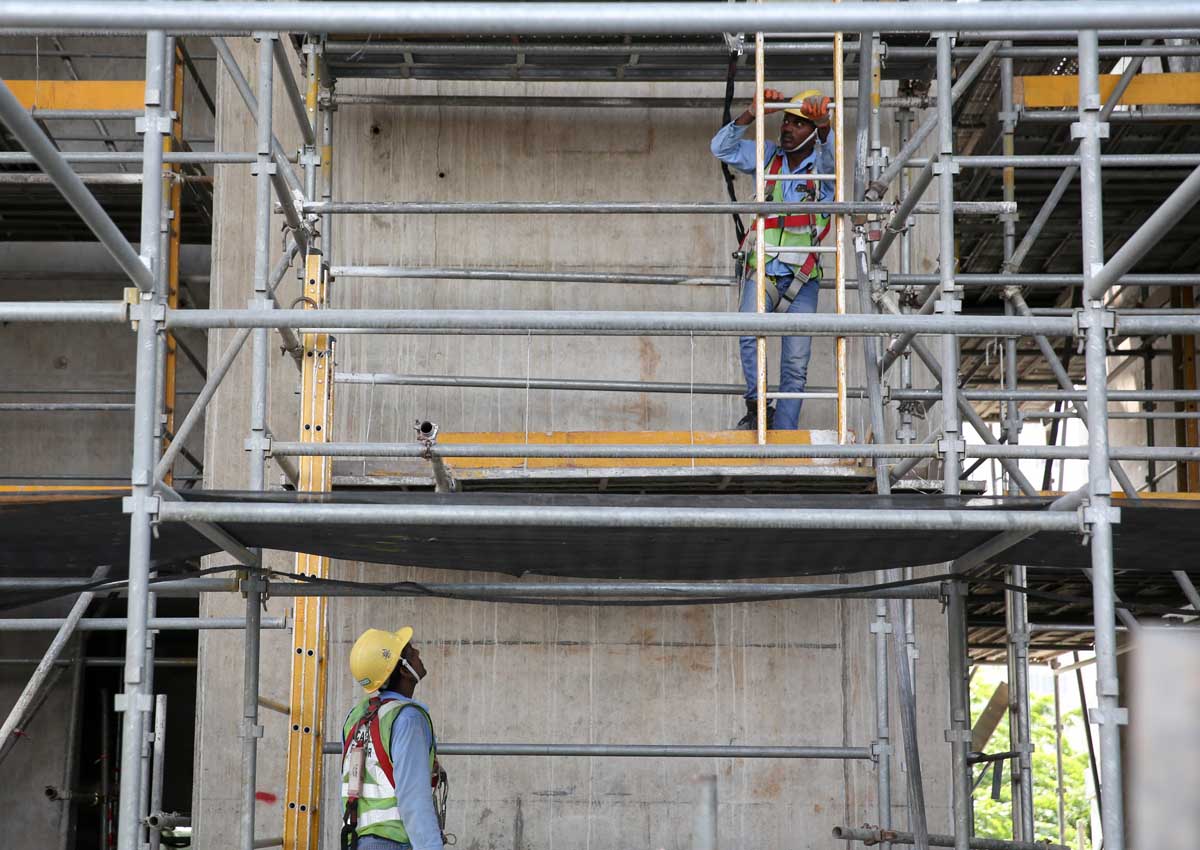
Sharp lengths of metal protrude across paths. Workers pick their way among them, some in slippers, some checking their phones. Overhead, their colleagues clamber up and down scaffolding. Not all wear harnesses. Not all of those with harnesses have lifelines to hook onto.
Falls from height remain the most common cause of workplace death here, with 11 such deaths in the first half of the year.
Report a lapse via MOM’s app
Spot a workplace safety lapse? Snap a photo and send it to free mobile app Snap@MOM.
The app by the Ministry of Manpower will send your feedback to the company occupying the site if it has subscribed to the service, so it can then take action. Companies which have not subscribed will be alerted to follow up on the issue. You will get an acknowledgement through the app when the workplace occupier has acted on your report.
Workers have died from other factors too – struck by falling objects, rolled into by trucks and forklifts.
The most recent death at work was unusual. Underwater World Singapore head diver Philip Chan, 62, died last Tuesday when a stingray he was handling pierced his lung with its tail. It is believed to be the first incident of its kind here.
The one thing all these deaths have in common, said National Trades Union Congress (NTUC) assistant secretary-general Patrick Tay, is that they were preventable.
Mr Tay, an MP for West Coast GRC, said top-down enforcement can go only so far: “Everyone along the value chain has to play his part. Leaders of organisations need to take ownership. Supervisors need to lead by example. And workers on the ground cannot be complacent, they must be proactive.”
The Workplace Safety and Health Institute (WSHI) last month released a study on the beleaguered construction sector. It found that of 33 construction deaths between June last year and this May, nine in 10 deaths were due to unsafe behaviour by workers – such as not wearing protective gear, for instance.
Singapore Institution of Safety Officers president Bernard Soh said there are workers who cut corners with safety because it is convenient or they are distracted, especially given the prevalence of smartphones in the workplace.
But he is more worried about foreign workers for whom English is not a first language, who may not understand safety requirements. He said: “They will listen to what the supervisor wants them to do. I am concerned the supervisor may ask them to do something that is risky, and they may not realise it.”
The Workplace Safety and Health Council (WSHC) this June launched an Awareness Booster Campaign, with pictogram posters teaching workers how to prevent injuries.
They are translated into Chinese, Tamil and Bengali, and distributed through channels such as dormitories, worksites and roadshows.
Older workers are another group the WSHC wants employers to pay attention to, with 18 per cent of accidents in the first half of the year happening to those aged 55 and above.
On Jan 14, an elderly cleaner sweeping leaves fell off a 1m-high planter wall and hit his head. He later died from his injuries.
Risks to older workers’ health could be avoided, the WSHC said, if employers redesign tasks and equipment – like better lighting for visual tasks, or reducing physical workloads through mechanical aids.
WHY MESSAGE ISN’T HEEDED
But whether companies heed the call for safety is another matter.
The WSHI study on construction deaths also showed that nearly nine in 10 were due to companies failing to adequately manage risks. Some cut corners by neglecting to do risk assessments or withholding lifelines for workers’ safety harnesses.
Contractors said it is tough to keep up standards in a cut-throat industry, where they have to undercut tender bids and rush to meet project deadlines in order to get by.
Singapore Contractors Association president Kenneth Loo said: “The economic situation is very challenging. Having gone through a period when growth in the industry was unprecedented, we are now having the reverse. Since the property market slowed down about two years ago, a lot of firms have been fighting for survival.”
Struggling firms have been strapped ever since the MOM stiffened penalties in May by raising the minimum duration of a stop-work order from two to three weeks.
During such an order, companies cannot do any work until safety issues are rectified.
This drives up costs as they continue to pay workers and may face fines from developers if they miss deadlines.
Since May, 52 extended stop- work orders have been issued, each lasting an average of four weeks as companies also had to send their workers for refresher training.
Also in May, the MOM introduced the Safety Compliance Assistance Visits Plus (SCAV+). The programme offers free site assessments by certified WSH professionals to identify safety lapses, and 142 companies have made use of it.
The Government is also incentivising employers who put safety first. From this month, those who hire foreign construction workers trained in specific safety standards will have levies reduced from $650 to $300, and get to keep these workers for up to 22 years, up from 10 previously.
Contractors wonder if more can be done to support those who put in extra effort. Wee Chwee Huat Scaffolding and Construction operations manager V. Manimaran suggests making it compulsory for a chunk of each project budget – at least 5 per cent – to be set aside for safety. “This would even the playing field for companies which already invest in safety,” he said.
The MOM noted that the number of construction fatalities per month has declined from an average of three between January and May to two between June and September. Its spokesman said: “While the drop in fatalities for the third quarter does indicate that our enforcement and outreach activities are taking effect, nonetheless, every fatality is still one too many.”
MORE MUST BE DONE
Those who die at work include Singaporeans and foreigners alike. But the bulk of the workforce in high-risk sectors such as construction and marine are foreigners from countries such as China, India, Bangladesh and Myanmar.
The MOM does not release information on the nationalities of individual victims, but has said that on average, two-thirds of workers who have died in fatal workplace accidents are foreigners.
SIM University labour economist Walter Theseira said this predominantly migrant workforce upends the economic theory that an employer has to pay workers more to get them to take up an undesirable job with higher risk.
“Here, these dangerous jobs are held mostly by foreigners who are not paid a lot and come from countries where workplace standards are significantly lower,” he said.
“The economic incentives for employers to enforce safety are not there. So we have categories of workers in Singapore where the value of their lives is not as high as it should be. Is this because they come from countries where the value of their lives is lower, or because we, as a society, don’t treat them the way we would if they were Singaporean?”
Migrant worker groups have called for more to be done to address what they view as the root causes of unsafe worker behaviour – low wages, high debts, a fear of speaking out against employers who could send them home at the drop of a hat.
Transient Workers Count Too committee member Debbie Fordyce said workers are often in debt because of high recruitment fees they pay to agents before they even come to Singapore and “we have to get rid of these”.
Another problem is the amount of overtime some workers do, to earn more or due to employers rushing to meet deadlines. Ms Fordyce has heard of men working 15 hours a day, seven days a week, that “causes chronic fatigue, which leads to impairment of judgment and inattention to detail”.
Under the Employment Act, workers commonly work up to nine hours a day. They should not work more than 12 hours except in emergency circumstances.
Social work executive Jevon Ng of the Humanitarian Organisation for Migration Economics said he often hears from workers that they are not given proper equipment, and cables are the wrong length for the height they must work at. Some even have to buy their own safety equipment. But workers are reluctant to voice concerns about safety hazards and near misses, as they fear being repatriated for doing so.
One way for the public to help out is the mobile app Snap@ MOM, through which anyone can anonymously report safety lapses. Since April, the MOM has seen a 40 per cent rise in reports on lapses via the app, with an average of 70 reports a month.
In one case, a photo taken of an unsafe worksite landed the contractor in question with a stop-work order for work at height and scaffolding activities, and fines of $7,500. The photo showed open edges at height not guarded by effective guard-rails or barriers to prevent falls.
Singapore’s workplace safety will be in the spotlight when it hosts the 21st World Congress on Safety and Health at Work next September. It remains to be seen whether the workplace fatality rate will fall before then.
Said NTUC’s Mr Tay: “When it comes to safety, it’s not a matter of trying, but doing. There can be no compromise.”
Injured workers stuck in limbo
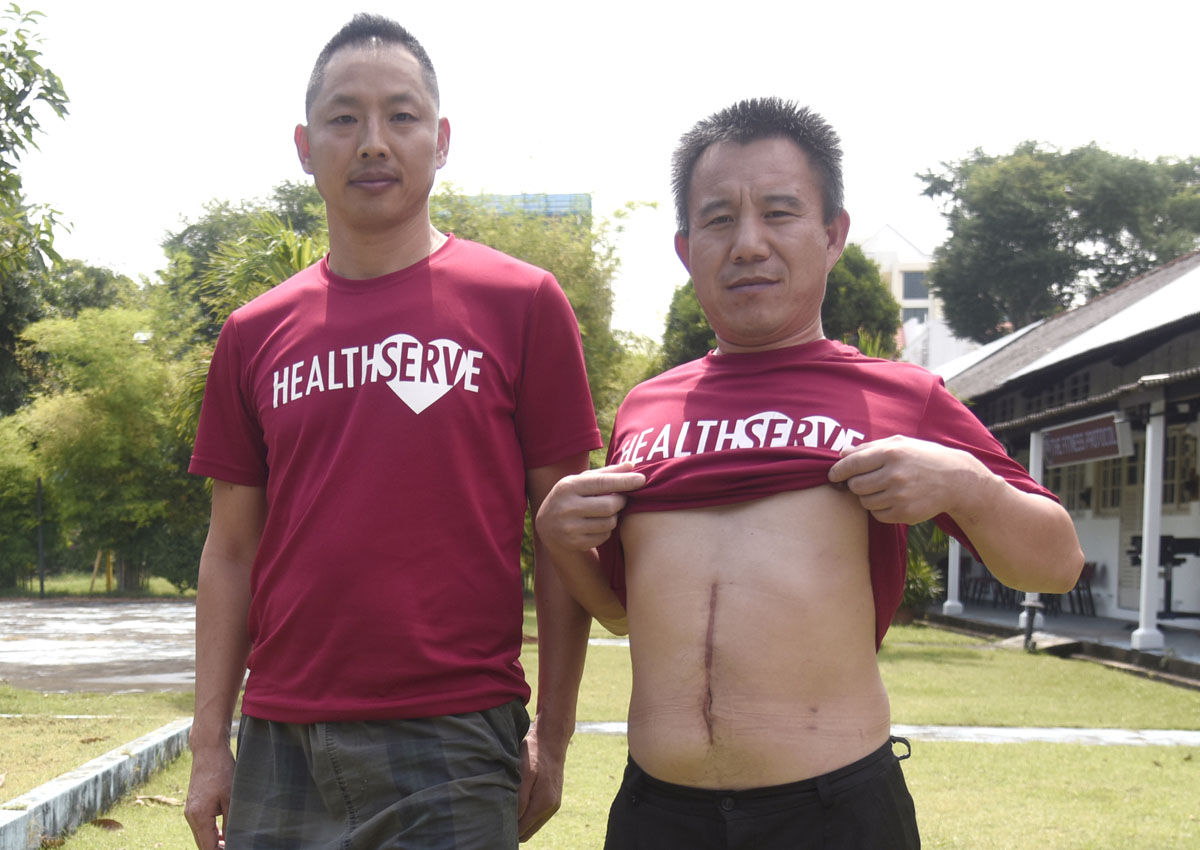
Construction worker Qiu Lin Min (far left) and carpenter Zhao Lian Wei were injured on their worksites and remain in Singapore on a Special Pass as they await compensation. Mr Qiu broke his leg while Mr Zhao broke his wrist and had to have his spleen removed. Photo: The Straits Times
Carpenter Zhao Lian Wei had no idea what a spleen was until he fell three storeys at work and ruptured his own.
The 42-year-old from China had been working on scaffolding at a construction site in June when a plank above him came loose and struck him.
Mr Zhao lost his balance and fell, breaking his left wrist and rupturing his spleen, which caused internal bleeding.
What happened next was a haze of pain and nausea, he says. His supervisor took him to three different hospitals. He kept passing out in the toilet. He was parched, but every time he tried to drink water, he vomited.
“They told me I had to go for surgery,” he says in Mandarin. “I was terrified. I had never had surgery before. They said, ‘we need to take out your spleen.’ I didn’t even know what a spleen was.”
He was eventually operated on and warded for eight days at Tan Tock Seng Hospital. Since then, he has been unable to work and still has difficulty moving around.
According to Mr Zhao, the scaffolding structure where he worked was shoddily built.
“We did not have lifelines,” he adds. “We brought this up to our bosses, but they just told us to be more careful.”
He is now stuck in Singapore in limbo on a Special Pass, which is given to foreign workers who have to stay here for an injury compensation claim or salary dispute.
Community clinic HealthServe is helping him with free meals and following up on his case, but Mr Zhao has no idea how much longer he will be in this situation.
Such cases usually take three to six months to process, but can sometimes stretch past a year. Those on Special Passes are not allowed to work, and many depend on non-governmental organisations (NGOs) for food and support.
Mr Zhao has told his family back home about his broken wrist, but not about the missing spleen. “I don’t want to stress them out,” he says.
A report by the Workplace Safety and Health Institute two weeks ago said there were 284 major injuries in the first half of this year, 4 per cent less than in the same period last year. Major injuries are non-fatal but severe. They include injuries that result in amputation, blindness, or burns with more than 20 days’ medical leave.
But Mr Jevon Ng, a social work executive at NGO Humanitarian Organisation for Migration Economics (Home), is concerned the number of injuries could be higher as some employers might not report them to the Manpower Ministry (MOM) to avoid investigations or higher insurance premiums.
Last year, Home saw 170 workers whose injuries went unreported by their employers. These ranged from a cut on the thumb to a neck fracture, which would constitute a major injury.
HealthServe communications manager Nhaca Le Schulze says: “The economy has gone sour this year, and workplace safety can be expensive. So companies trying to finish their projects quickly will cut corners.”
Construction worker Qiu Lin Min, 42, broke his left leg in February after the contractor he was working for pushed him to meet a deadline. Mr Qiu, who is from China, was removing formwork panels used to create concrete walls when one of the panels fell on him.
It required more than one person to support the heavy panels, he says, but the rest of his team were too busy with other tasks to help.
“The boss kept rushing us, saying it was very urgent. That was why we had to work even on Sunday, our day off. There was not enough manpower and not enough time.”
Mr Qiu, who is also on a Special Pass, has been waiting for seven months for his claim to be processed. “I’ve already been here too long,” he says.
Doctors told him he needs to undergo another operation on his leg. It would cost $9,000, which he cannot afford.
He is worried about his wife and three school-going children, aged 11 to 15, who no longer have a source of income now that he cannot work. “I want to be with my family. I want to go home.”
Local supervisors must speak up
Workplace safety and health trainer Han Wenqi believes safety officers should be empowered to order work to stop at once when they see something dangerous on site. Photo: The Straits Times
When he was 14, Mr Han Wenqi saw a man fall to his death.
He was on his way home from school when he witnessed a construction worker topple over the guard rails of a gondola in the air.
Shaken, he wondered: “How did this happen? Why didn’t he anchor his harness? Where was the supervisor?”
The incident spurred him to pursue a career in workplace safety and health. He has spent 10 years in the construction industry, starting as a site supervisor and later becoming a safety officer.
Today, the 31-year-old is the principal trainer at centre Achieve Safety Training, conducting classes for several thousand workers a year.
Mr Han, who has worked on projects such as shopping centres, Build-To-Order flats and multi-storey carparks during his career, says safety professionals must tread a fine line between the cost concerns of their employers and the preservation of life and limb.
“Inadvertently, you will offend a lot of people,” he says. “You could even risk losing your rice bowl.”
Once, during the building of a major hotel, he upset colleagues when he delayed construction on a Sunday because a tower crane did not have a valid permit to be used at work. Some threatened to get him fired, although he was eventually able to make the upper management see sense.
Mr Han believes safety officers should be empowered to order work to stop at once when they see something dangerous on site.
“A two-hour internal stop-work order is better than a three-week one imposed by the Ministry of Manpower,” he says.
He also feels that local supervisors have a responsibility to speak up as foreign workers are often hesitant to raise safety issues because they fear being sent back home.
“I’m Singaporean,” he says. “If I lose my livelihood, at least I can go on JobStreet.com and look for something else. These guys, they can lose everything.”
Mr Han has dealt first-hand with the consequences of such oversight. When workers died, he would sometimes have to pick up their next-of-kin from the airport and take them to the mortuary to identify the bodies.
“This is never an easy process,” he says. “The first thing the family asks is, ‘How did he die? Why couldn’t you do something to protect him?'”
He asks workers to put up photos of their families around their workplaces.
“Many take safety for granted. They think it won’t happen to them. I want to remind them of the reason they work, which is to send money home to their families. Every worker is someone’s husband, son or father.”
This article was first published on Oct 09, 2016. Get a copy of The Straits Times or go to straitstimes.com for more stories.
At the Tan Boon Liat Building off Outram Road is an office about half the size of a basketball court with just over 40 computer screens.
In it, more than half a dozen people remotely monitor over 6,000 locations in Singapore.
This is the central monitoring station of the Ademco Security Group, and the nerve centre of surveillance for the company’s clients in the public and private sectors.
Instead of having their own security guards monitor their premises, these companies rely on Ademco to do everything from monitoring their carparks to looking out for medical emergencies and preventing would-be intruders from trying to break in.
Security companies told The Sunday Times this is what surveillance and security will increasingly look like – with monitoring done off-site, reducing the need for security guards on the ground.
There are about a dozen such remote monitoring sites operated by different companies here.
While security companies estimate that as little as 5 per cent of buildings here have their security monitored in such a way, this is increasing as building owners start taking security more seriously. This is due in part to the increased threat of a terror attack, which is at its highest level in recent times.
Home Affairs Minister K. Shanmugam has said boosting surveillance is a key part of Singapore’s counter-terrorism strategy.
On its part, the police have been installing tens of thousands of closed-circuit television (CCTV) cameras in public areas.
In August, during a counter-terrorism seminar held by the police and Singapore Civil Defence Force for the finance industry, companies were told to enhance security measures such as CCTV and access control systems.
But traditional methods of surveillance – with guards sitting in a building’s security room watching CCTV screens – are not going to cut it, said Ademco’s group managing director Toby Koh. Modern CCTV systems have video analysis capabilities that can pick out people who have been loitering in an area, for instance, said Mr Koh.
“Now, which security guard would be able to monitor… a person who has been loitering there for more than two minutes? (It’s) impossible, but technology can do it,” he said, adding that human operators are still needed to verify incidents flagged by machines.
Such systems can also be programmed to play loud recorded warnings and shine blinding lights when there are breaches, said Mr Jeffrey Seah, director of the Security Industry Institute.
“The obvious advantage is that of saving labour and greater 24/7 coverage, especially in remote and expansive locations,” he said.
Modern surveillance relies heavily on such systems, which can alert security operators to incidents, reducing the need for “warm bodies” to physically patrol premises, said Mr Ong Kok Leong, group director of business development and operations at Secura Group.
He added that these systems can detect threats faster, allowing security guards to alert the police more quickly. “The sooner you realise something is wrong and call the police, the faster they can react. That is a big change compared to last time,” said Mr Ong.
These systems would result in significant costs savings over the long term, he added.
This month, developer CapitaLand started using smart CCTV cameras to monitor its drop-off points at three of its malls, eliminating the need for security guards there.
Certis Cisco, which is handling security for these malls, said security manpower needs for these malls have been reduced by one-fifth.
“An officer will be deployed only during peak periods or when congestion is detected. This frees up the officer to perform other duties like patrolling the mall, managing incidents and doing crowd control,” said a Certis Cisco spokesman.
Security companies say this is one way they can deal with the manpower crunch in the sector.
Manpower Ministry data shows that last year, there were 2,010 vacancies for security guards, and 1,440 stayed unfilled after six months.
Mr Koh said the cost savings from reducing manpower are considerable. He added: “I’m not saying eliminate guards, but reduce them… and invest that money into systems that will perform 24/7.”
This article was first published on Oct 09, 2016. Get a copy of The Straits Times or go to straitstimes.com for more stories.
It was a night dedicated to honouring the biggest and brightest in Taiwan’s television industry, and for the first time in his hosting career, Singaporean TV host Wong Jinglun found himself ranked among the stars.
The 33-year-old, who found fame in Taiwan since taking part in singing competition One Million Star in 2008, was named Best Host In A Children’s Programme at the prestigious 51st Golden Bell Awards on Saturday (Oct 8).
Megan Liao , his co-host on the educational programme “Cheng Yu Sai En Si” was a joint winner for the category.
In his acceptance speech, Wong said he did not expect to win and thanked Taiwan for recognising his work.
This year’s Golden Bell Awards was held at the National Sun Yat Sen Memorial Hall in Taipei, and saw the reunion of two top-selling boybands from the 1990s and early 2000s – S.B.D.W and 5566.
Other stars present at the ceremony include Running Man’s Kim Jong-kook, actress Cheryl Yang, Lady First host Pauline Lan and popular drama actress Chen Meifeng.
TOKYO – More than one in five Japanese companies have employees who work such long hours they are at serious risk of death, according to a new government survey into the country’s notoriously strenuous working culture.
Hundreds of deaths related to overwork – from strokes, heart attacks and suicide – are reported every year in Japan, along with a host of serious health problems, sparking lawsuits and calls to tackle the problem.
The survey was part of the nation’s first white paper on “karoshi”, or death from overwork, endorsed by Prime Minister Shinzo Abe’s cabinet on Friday.
While the popular image of Japanese salarymen toiling long hours for the company before taking the last train home is changing, many still spend far more hours at the workplace than counterparts in other modern economies.
According to the paper, 22.7 per cent of companies polled between December 2015 and January 2016 said some of their employees logged more than 80 hours of overtime a month – the official threshold at which the prospect of death from work becomes serious.
The report added that approximately 21.3 per cent of Japanese employees work 49 or more hours each week on average, well above the 16.4 per cent reported in the US, 12.5 per cent in Britain and 10.4 in France.
The survey concluded that Japanese employees also reported feeling high levels of stress related to their work, pushing officials to call on companies to improve working conditions.
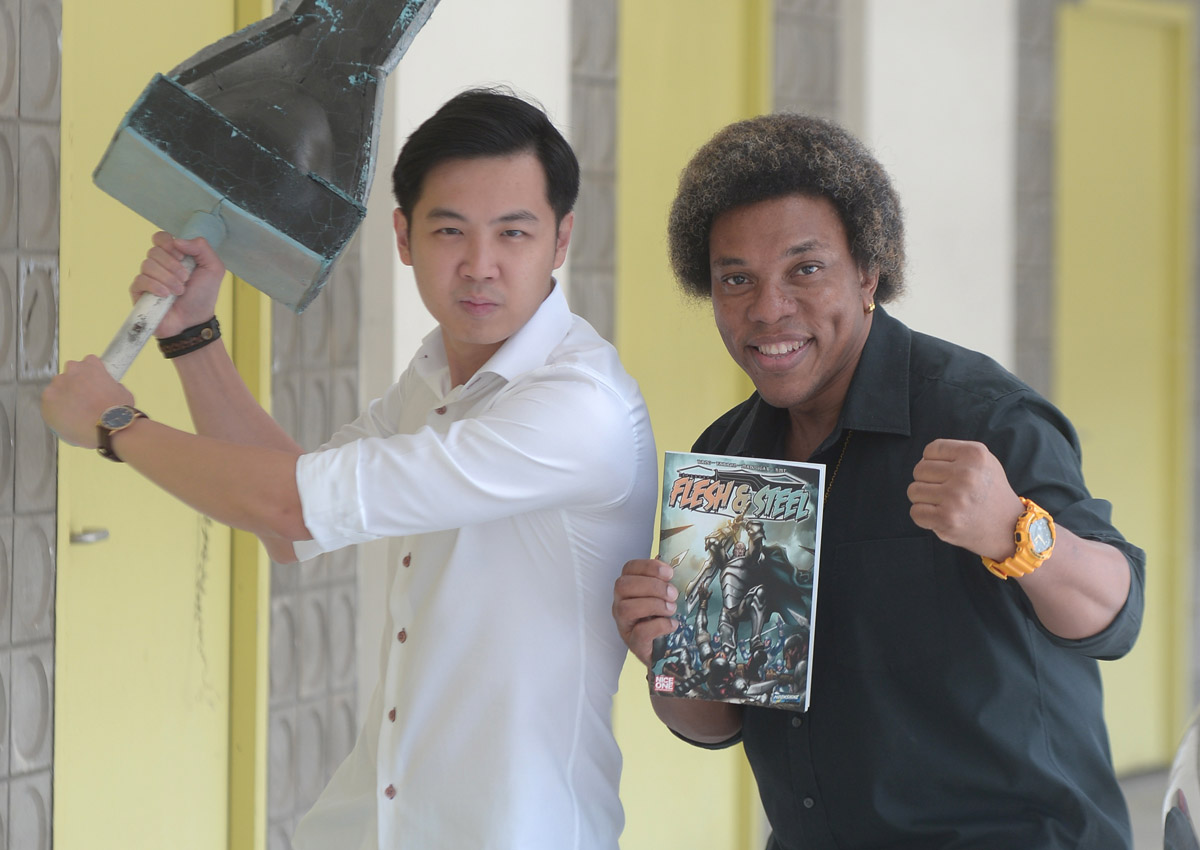
First-time Singaporean comic book writer Shaun Kang’s graphic novel Flesh & Steel took four years to hit the shelves here. But the 160-page fantasy comic, which was released here in April, has already been picked up by a foreign publisher.
American publisher Caliber Comics will release it for the Western market next year.
It is a dream come true for Kang, who was gunning to have his first book travel beyond Singapore.
“It’s not a localised story with Singaporean elements driving it. I wanted to create something that could be appreciated without the context of our local culture. I wanted to create fantasy. And maybe see it made into a Hollywood movie,” says the 31-year-old.
At the heart of the black-and-white comic is Golem, a humanoid weapon forged from steel. Living and battling in a time of war, among knights and cavaliers armed with guns and swords, he struggles to find acceptance while trying to live with the fact that he was brought to life to kill.
It is Kang’s spin on the tale of Golem of Prague, a creature fashioned from clay and brought to life to defend a Jewish community from their enemies.
The concept for it had been stewing in his head for years – one of the earlier story ideas he had been nursing since he started making up his own tales at age 15.
“But it took 15 years more before I finally had the time, determination and money to turn my book into reality. Aside from interest, you need those three things at the very least to get your work published,” says the investment adviser at a private bank.
Kang finished his script in 2012, but was initially unsure whom he could send it to for consideration.
He decided to float it by comic artist Jerry Hinds, the president of the Association of Comic Artists (Singapore). Their first encounter was in 2009, when Kang submitted an entry for a comics anthology Hinds was putting together.
“My work didn’t get selected, but we still kept in touch which, in hindsight, has been a great blessing,” says Kang.
“I ended up getting in touch with Jerry because he seemed like the only guy in Singapore who would even bother to give my submission a read. And I know that he’s published his own comics before, so if anyone could help, it would be him.”
Hinds, a Briton who moved to Singapore in 1997, loved it. It was, he says, an easy read and a solid story – and he enjoyed that it was high fantasy, a different concept from what most comic offerings from Singapore were.
Flesh & Steel was produced with the support of the Association of Comic Artists (Singapore) and the National Arts Council, and published by Nice One Entertainment.
Hinds, 52, started Nice One Entertainment in 2002 as a vehicle to publish his own concept, Get Carter! The Last Dragon Scout. It is slowly growing its stable and has since put out 11 comics.
“I set it up not to make money, but rather to further a cause,” says Hinds. “Local publishers of comics, graphic novels and manga tend to produce books that are either reprints from foreign territories, stories closely based on Singapore society, or educational.”
But Nice One Entertainment, he says, looks for works that may not fit neatly in those boxes – stories that are “distinctly escapist” or that deal with the “extraordinary”.
Another graphic novel it published here this year, Return, has also caught the eye of Caliber Comics, which has put out works by creators such as critically acclaimed comic book writer Brian Michael Bendis.
Caliber founder Gary Reed said that when he looked through Flesh & Steel, he was impressed by the quality and professionalism of the package.
He said: “Everything resonated – from the story to the artwork – into an exciting story that was well-told, well-drawn and well-executed.”
He died of a heart attack last Sunday.
For Kang, a lifelong comic fan, creating a comic was an eye-opening experience he describes as “on-the-job training”.
Conceptualising and writing the script was the easy part because he had full control of the story, but then came the real slog: cobbling it together with the artists.
“As a writer, it’s not always easy to effectively communicate what you envision to the artist and that creates the need for a lot of back-and-forth and redrafts to get it in shape,” he says.
“After a while, you learn the importance of specificity when describing a panel to the artist, from the angle to how ‘clean’ you want the panel to be. It’s a lot like being a film director, I suppose.”
While the script took him about three months to write, the actual production work took years.
Partway through the project, the book lost its original artist, Filipino Ernani Faraon – an Association of Comic Artists (Singapore) member – when he migrated to Australia.
The book was then continued by a group of artists from Indonesia’s Madougar Studios and a team from HMT Studios – which is co- founded by comic artist Harvey M. Tolibao, who works for comic giants such as Marvel and DC – in the Philippines.
Another obstacle was production costs. More than $10,000 – cobbled together by the Association of Comic Artists (Singapore), Nice One Entertainment, Kang and the National Arts Council – was sunk into producing 1,000 copies for the first print run.
Hinds says they are still waiting for updates on sales figures, which will be released next month.
Kang has more yarns up his sleeve. He completed a magical realism short story collection earlier this year and has submitted the manuscript to local publishers.
And he already has an idea for his next graphic novel, which he says will be in the vein of manga rather than a Western comic like Flesh & Steel.
“I still have a lot of stories to tell. I easily have 30 or so story concepts that I’d like to turn into graphic novels, but I’d probably die before fulfilling them all,” he says with a laugh.
•Flesh & Steel is available from major bookstores and selected comic stores at $18.95.
This article was first published on Oct 09, 2016. Get a copy of The Straits Times or go to straitstimes.com for more stories.
You can call Greater Bukit Brown Cemetery a social and cultural repository of early Singapore. In recent years, researchers have slowly unearthed the stories of many pioneering Chinese immigrants who rest there.
But it was only last month that the 1888 grave of a key personality, a merchant who was one of the original land donors of the cemetery itself, was found.
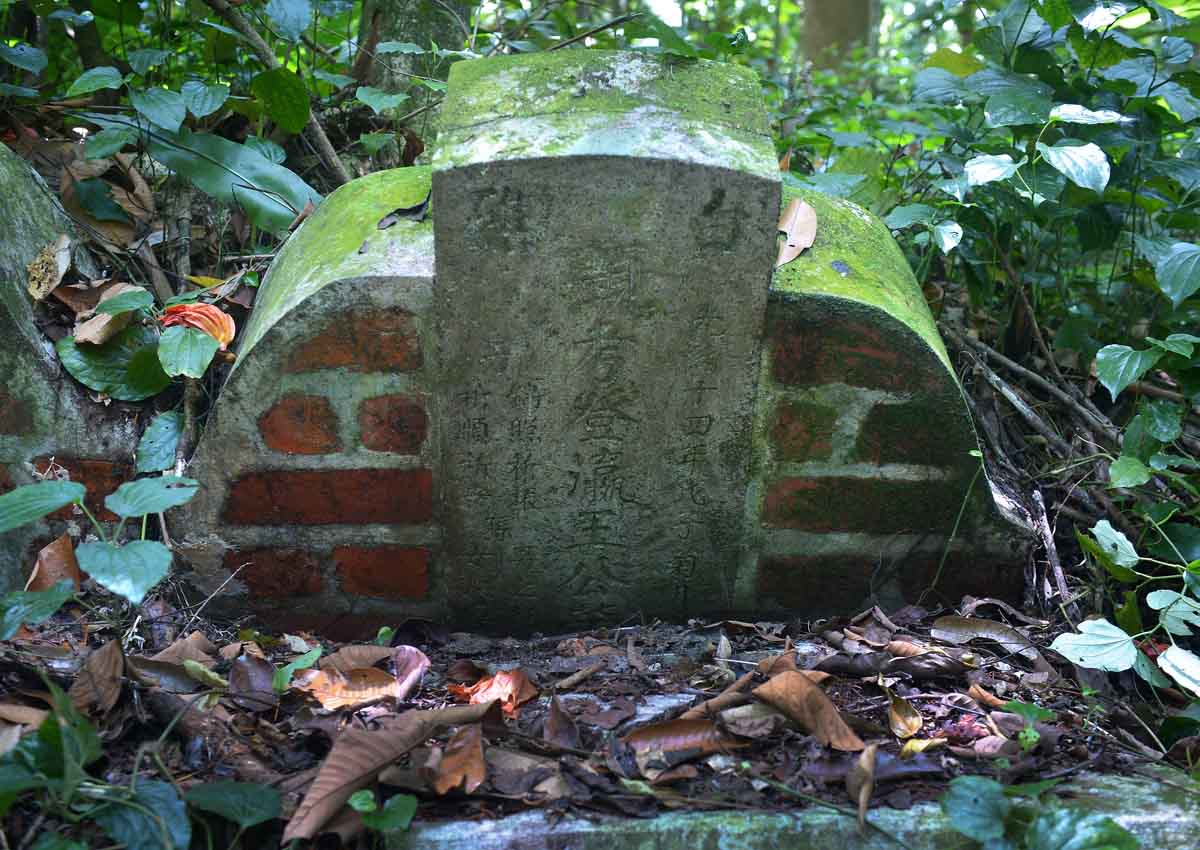
Mr Raymond Goh, a “tomb hunter” famous in the heritage scene here, had often passed by the tomb of Mr Ong Chong Chew without realising it was what he had been looking for. It was only on Sept 17, on one of his tomb-hunting walks in the grounds of Seh Ong Cemetery, that Mr Goh found the tomb.
“It had escaped my radar all this time because I was expecting a tomb from the Qing dynasty era to have a more elaborate design.”
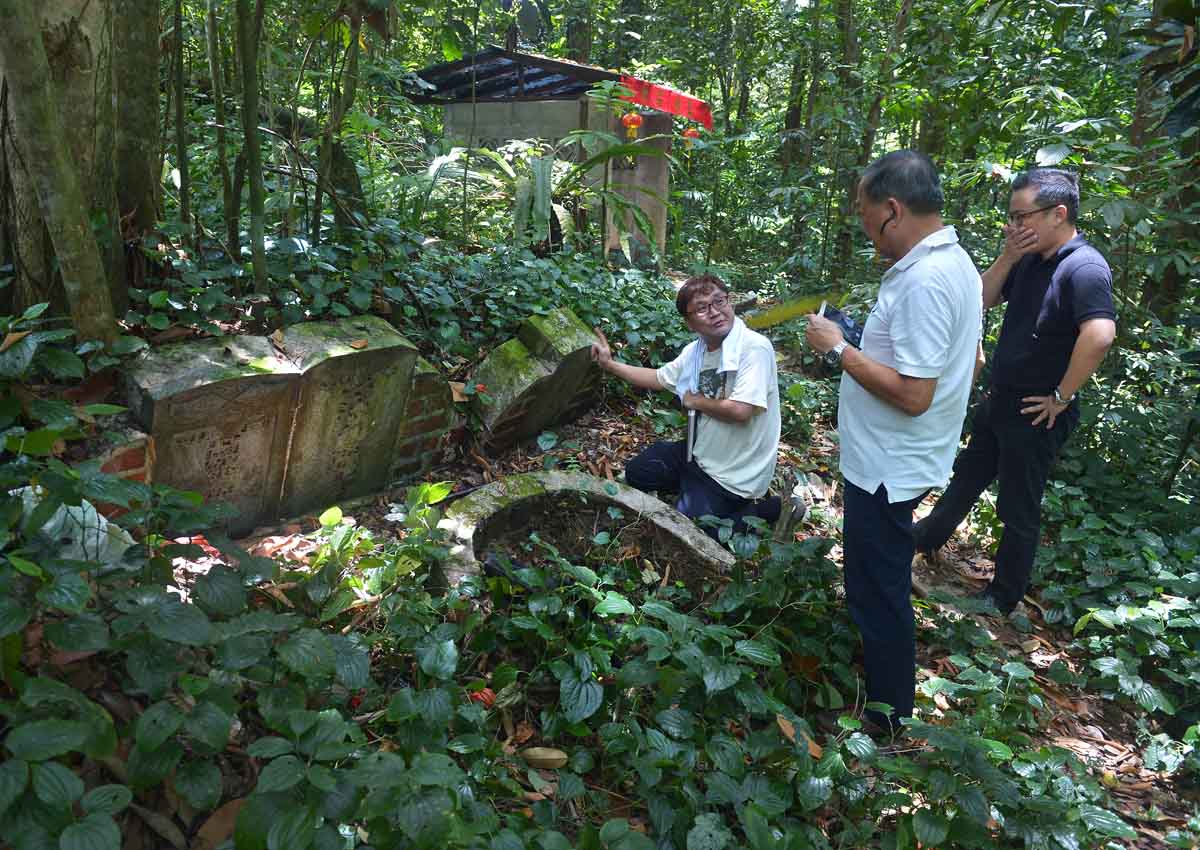
The tomb is in a forested part of the cemetery slanting downwards. It had been nudged into that position by the roots of an old tree.
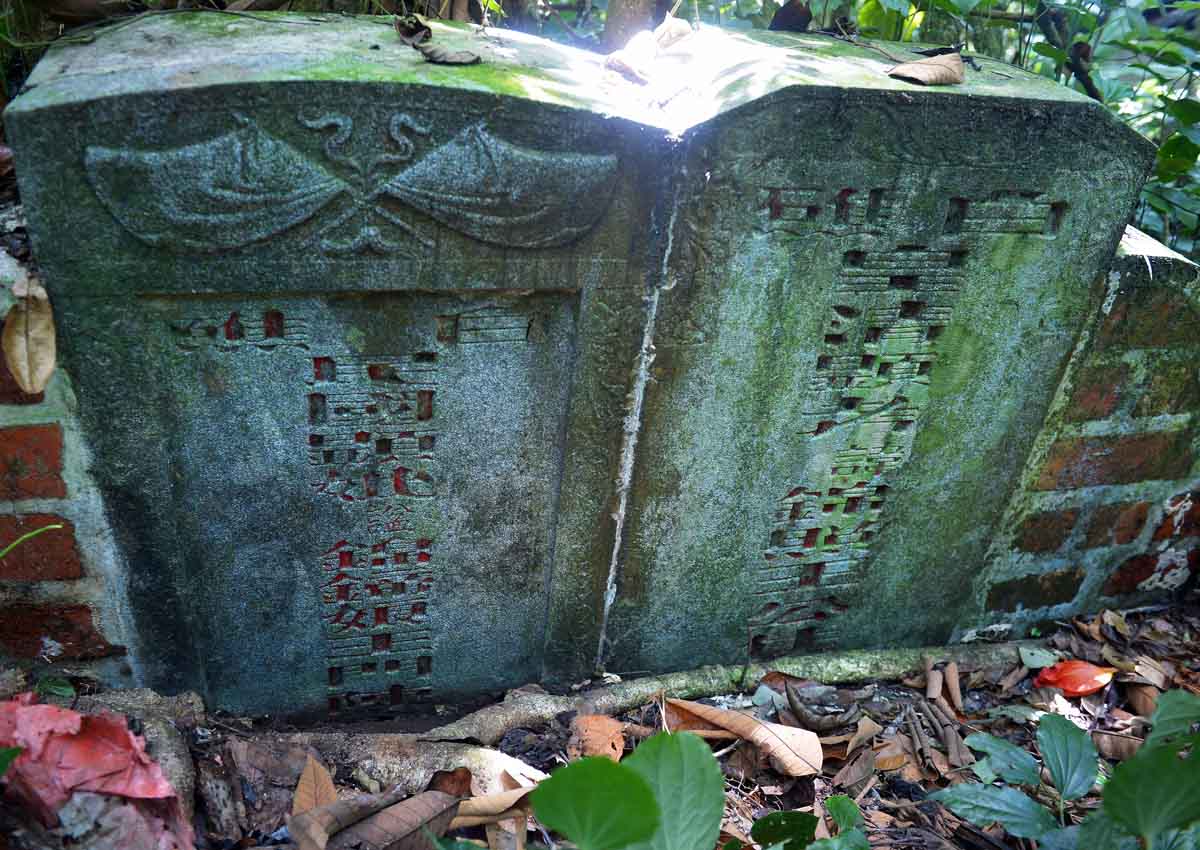
On closer inspection, Mr Goh saw it bore the posthumous name of Mr Ong as “Ting Ying”, and listed the names of his four sons. This corroborated with research by his great-great granddaughter, retired librarian Ong Chwee Im, 75, who had written a book about her ancestor in 2006.
The tomb bearing Mr Ong Chong Chew’s posthumous name, “Ting Ying”, and the names of his four sons. Photo: The Straits Times
The inscribed 1888 date in Chinese was another telltale sign.
Mr Goh had been trying to track down the tomb after descendants of the late pioneer asked him for help in doing so in 2011.
He told The Sunday Times his search was especially intense in the first year, and he spent many weekends combing through different parcels of Greater Bukit Brown, which includes Seh Ong and the Hokkien Huay Kuan cemeteries. “His descendants and I had looked through old records from the Ong Clan but we couldn’t find any paper trail… It was very challenging locating the tomb.”
It turns out that Mr Goh had been looking in the wrong area – bashing through overgrowth at the Sime Road section of Seh Ong Cemetery after a false lead.
Mr Goh was elated when he finally found Mr Ong’s tomb. “I realised that the long-lost grave I had been looking for over the past five years had finally been found.”
The late Mr Ong had come to Singapore from “dirt poor conditions” in Bai Qiao village in Fujian province as a young man in the 1850s.
He did well, setting up a lumber and shipping company called Teck Cheang located along Rochor River.
By 1864, he began buying land, and came to own parcels in Toa Payoh, Amoy Street, Bugis Street, Telok Ayer, Hylam Street, Victoria Street and Cecil Street.
Ms Ong had learnt about her ancestor’s role in Bukit Brown Cemetery only in the 1980s. She had read about him in a 1923 tome called One Hundred Years’ History Of The Chinese In Singapore, which listed the late Mr Ong, as well as Mr Ong Ewe Hai and Mr Ong Kew Ho, both of whom can also be traced back to Bai Qiao, as having donated 500 yuan (S$103) to buy 85ha of Bukit Timah land. The trio had decided to give back to the community in 1872.
Their original plan was to build a village for newly arrived immigrants from China. “The three Ongs left a worthwhile, noble and pragmatic gift to the people of Singapore,” said Ms Ong.
But eventually the area was used as a cemetery and came to be known as Seh Ong Cemetery.
As the area was under-utilised, the colonial authorities converted 39ha of it into a burial ground for the Chinese around 1919, before officially opening it as the Bukit Brown Municipal Cemetery in 1922.
Mr Goh said the remains of the late Ong Ewe Hai either rest in Bukit Brown or have been transferred to a temple. Ms Ong said Mr Ong Kew Ho is likely to be buried in Malacca.
Her research also points to why the late Mr Ong’s grave was not as elaborate as those of his contemporaries – it had likely been remade in the 1950s following its reinterment from the family’s estate in Telok Blangah to Kheam Hock Road where Seh Ong Cemetery is today.
Man discovers final resting places of Lee Kuan Yew’s maternal ancestors
Click on thumbnail to view photos. Source:
The New Paper, Raymond Goh
Last week, Mr Goh took The Sunday Times and Ms Ong’s brother, Mr Ong Chin Leong, 69, a retired businessman, and her son, businessman Yeo Han Yong, 47, to the site.
There, they also got to see the graves of Mr Ong Chong Chew’s eldest son Ong Kim Cheow, a founding member of the Straits Chinese Recreation Club who died in 1909, along with his wife “Tan Kim Tay Neo”, as was written on the tombstone.
The graves of Mr Ong Kim Cheow (right) and his wife “Tan Kim Tay Neo”. Photo: The Straits Times
Mr Ong hopes to show the graves of their forefathers to the rest of his family.
“This find is important to us because I get to tell them that our line goes back this far.”
Meanwhile, work goes on for Mr Goh. While he has helped to reconnect more than 100 families with their ancestors, he still has another 50 or so outstanding requests.
“New discoveries await. The search must go on,” he said.
melodyz@sph.com.sg
This article was first published on October 9, 2016. Get a copy of The Straits Times or go to straitstimes.com for more stories.
The hallucinations and delusions started in her late teens. Then five years ago, Ms Hafizah Kamarulzaman was diagnosed with schizophrenia after giving birth to her son.
While the single mother, now 23, managed to control her condition after seeking help, she struggled to get a job for almost four years, she told The Sunday Times.
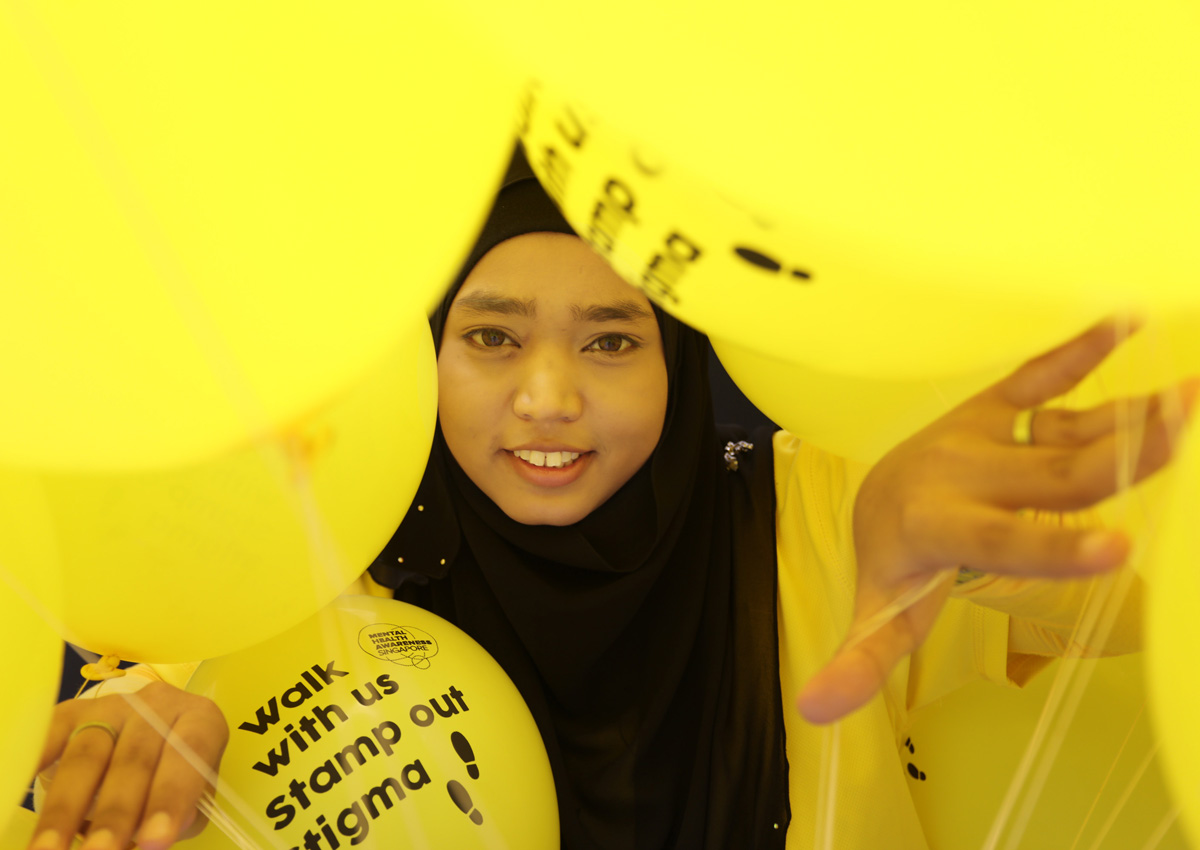
She described how she was turned down for positions in the food and beverage and healthcare sectors, on the sidelines of an event called “Walk with Us, Stamp out Stigma”. It was held in Orchard Road yesterday to combat the stigma faced by people with mental health conditions.
She said: “When the boss saw in my application form for a waitressing job that I had a mental illness, he asked what would happen if I had a relapse. I told him I had coping methods that I could use.
“His response was, ‘If that’s the case, then our position is full’.”
Ms Hafizah finally found a job late last year as a programme executive at Club Heal, a social service organisation that helps people who have mental illnesses. It was also where she had been treated.
Yesterday’s event was co-organised by the Agency for Integrated Care alongside 14 other community health partners such as Caregivers Alliance and the Institute of Mental Health, to commemorate World Mental Health Day, which is observed tomorrow.
At the event, Speaker of Parliament Halimah Yacob urged employers not to be prejudiced against people with mental health conditions.
In a recent National Council of Social Service survey of 477 people recovering from mental health issues, seven in 10 said they had problems “living with dignity” because of other people’s attitudes and actions, making them feel unaccepted by society or unable to contribute meaningfully to it.
Others interviewed by The Sunday Times said they felt the sense of societal rejection most acutely while job hunting.
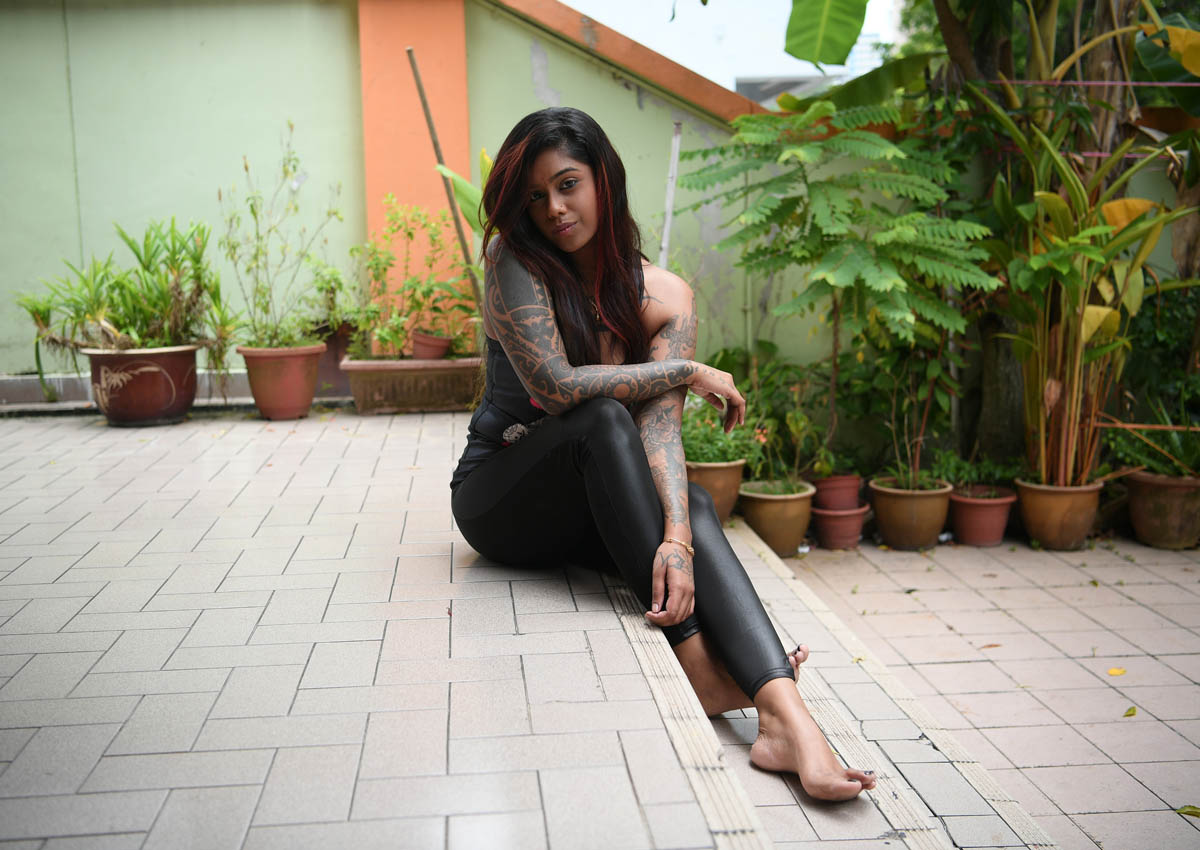
Ms Yamuna Segaran (above) suffers from acute anxiety and depression. Photo: The Straits Times
Ms Yamuna Segaran, 26, who has had acute anxiety and depression since her teenage years, said an interviewer once pushed her resume away upon learning about her mental health condition.
This was even though the interviewer had initially been impressed by her work experience.
Ms Yamuna, a part-time student at Kaplan Singapore who is pursuing a counselling degree from Northumbria University, said: “The look on the interviewer’s face is still etched in my mind.”
While she wanted to reintegrate into society, the difficulties she faced in finding a job made it harder to do so. She persisted in her job search, thanks to the support of her family, counsellor and psychiatrist and has since found a job as a supervisor at a bar.
Ms Valerie Liu, 34, who has had schizophrenia since 2008, feels that people with mental illnesses also have to overcome their own biases and fears. Some may themselves hold negative stereotypes associated with mental health sufferers, or be afraid of communicating with people.
Ms Winnie Kong, 28, a thrift shop sales assistant who suffers from borderline personality disorder, said she had been rejected by employers for positions in administration and sales.
She said: “They think that we are violent but this is not true in most cases. I think we should be given a chance.”
Seven in 10 people with mental illness believe they are stigmatised by society, while slightly more than half have problems joining community events.
These are some of the key findings of the first government survey on the well-being of those with mental health issues.
Describing the findings as worrying, social workers are calling for more to be done to raise awareness of the problem.
The National Council of Social Service (NCSS) – a statutory board that oversees more than 450 social service organisations here – polled 477 people recovering from mental health issues such as mood and anxiety disorders or schizophrenia last year.
The study, whose results were released to The Sunday Times yesterday, found that 55 per cent had problems joining communal activities, including public festivities and communal sporting events.
Seven in 10 said they had problems “living with dignity” because of the attitudes and actions of others, meaning they do not feel accepted by society or that they can contribute meaningfully to it.
Ms Tan Li Li, executive director of the Singapore Association for Mental Health, said the findings are of concern as the respondents were using mental health social services in the community.
This means that they were likely to have less severe mental health issues and were able to hold jobs.
“So, knowing that 70 per cent have problems due to the attitudes of others may be cause for us to think about what we are lacking as a society,” she said.
More than one in 10 people here will have a mental health condition in their lifetime, according to a 2010 Singapore mental health study.
The most common condition is major depressive disorder, which affected more than 5 per cent of adults in the 2010 survey, or more than 57,000 men and twice as many adult women.
Mr Anjan Ghosh, director of the service planning and development group at NCSS, highlighted that this feeling of being stigmatised could also stem from the respondents’ own perceived fears and misconceptions.
He urged more interaction between both groups.
He added: “It is a vicious circle. The more there is perceived stigma, the more people with mental health issues isolate themselves and the more misconceptions develop due to the lack of interaction.”
To raise awareness and educate the public on mental health issues, NCSS is coming up with a series of videos featuring real-life stories of people with conditions such as depression.
Last year, NCSS and the Singapore Anglican Community Services started an employment internship programme that provides on-the-job training for people with mental health issues.
By March next year, NCSS intends to start an employment assistance programme that will enable employers, through training for instance, to better understand and harness the potential of such workers.
Speaker of Parliament Halimah Yacob yesterday also made a call for employers to drop their prejudices and stop discriminating against people with mental health conditions.
Speaking on the sidelines of a mass walk in Orchard Road aimed at combating such stigma, held to mark World Mental Health Day tomorrow, she said getting hired is an important step in the road towards recovery for such people.
Employment will help them find a “meaningful purpose” and enable them to take care of their own needs, explained Madam Halimah, who is an MP in Marsiling-Yew Tee GRC. “Give people with mental health issues a chance to work and also to contribute to the company,” she urged.
•Additional reporting by Melody Zaccheus
This article was first published on Oct 09, 2016. Get a copy of The Straits Times or go to straitstimes.com for more stories.
<p>Seven in 10 people with mental illness believe they are stigmatised by society, while slightly more than half have problems joining community events.</p>
MANILA – In the run-up to his 100 days in office, President Rodrigo Duterte has continued to adopt an aggressive stance against the US and EU.
President Duterte’s foreign policy in his first 100 days in office could generally be characterised as being, ‘If you’re not with us, you’re against us,’ at least in his war against illegal drugs.
Just before leaving for his first international appearance as head of state in Laos for the 28th and 29th Association of Southeast Asian Nations Summits, he made international headlines for cussing US President Barack Obama, something he has denied doing and explained away as being taken out of context.
His communications group made matters worse by announcing that Duterte would be seated between Obama and UN Secretary General Ban Ki-moon, but he actually sat between Indonesian President Joko Widodo and Russian President Dmitry Medvedev.
The seating arrangement allowed him to speak with the Indonesian president on the plight of convicted drug mule Mary Jane Veloso. However, then again, Duterte drew strong criticism from the Filipino community for his conversation with Widodo where he was said to have given the ‘go-ahead’ to Veloso’s execution.
In his defence, the presidential staff explained that what he had told Widodo was, “Follow your laws. I will not interfere.”
After the summits, Duterte proclaimed that he was the one who snubbed Obama and that he was inclined to send home the US troops in Mindanao, hinting at scrapping the Enhanced Defence Cooperation Agreement with the US.
Returning from his official visit to Vietnam, Duterte drew the ire of the international community by saying that he would just be happy to slaughter three million drug addicts similar to Adolf Hitler’s massacre of millions of Jews.
He was quoted in his return speech in Davao City from Vietnam to have taken exception to comparisons of him with the leader of Nazi Germany during the campaign period in May and said in disgust, “Then I am him.”
He drew the line, though, that while Hitler slaughtered innocent Jews, he would be killing criminals.
When the rhetoric drew the ire of the international community, particularly the Jews, he apologised and compared himself to Israeli President Benjamin Netanyahu instead.
Anti-crime blitz sweeps Philippines as Duterte comes into power
Click on thumbnail to view photos. Source:
AFP, Reuters
Flames of scorn
However, within days, the president fanned the flames of scorn anew by telling Obama that he can go to hell after his criticism of the bloody war against drugs, while the EU can go to purgatory “because hell’s already full.”
Over at the House of Representatives, Albay Rep. Edcel Lagman, a member of the opposition, might have seen the succeeding events before they took place.
On October 4, Tuesday, Lagman declined to give an assessment of President Duterte’s first 100 days in office.
“Let us wait until we reach the 100 days, because between now and Friday, he (Duterte) might make a serious blunder or an important miracle,” Lagman said at a press conference.
The very next day, Duterte once again lambasted US President Barack Obama and the EU, telling them to go to hell and purgatory, respectively, for supposedly meddling in his administration’s war against drugs.
There was no let-up from the president. On Thursday, he called international foreign aids as “crumbs from other nations’ favours” in a speech in Butuan City.
He also said that if the US refuses to sell arms to the Philippines, then his administration will be inclined to buy arms from Russia and China instead.
US officials have started finding his rhetoric ‘at odds’ with the long and warm relations between our two countries and said that the Philippines is always free to pursue other diplomatic links if it so wishes.
Foreign Affairs Secretary Perfecto Yasay’s statement on Duterte’s independent foreign policy where he said, “America has failed us,” did not help in any way fortify the two countries’ ties.
In his latest tirade, Duterte dared the US and the EU to pull out its assistance from the Philippines saying, “We can survive on our own.”
Akbayan partylist Rep. Tom Villarin said there is something wrong with always “playing the victim in circumstances that he (the president) created.”
Villarin said it was high time for the president “to act like a statesman.”
“If the approach to governance is all emotion-laden, that there’s always an outburst of emotions that is being made into policy-that is dangerous. In governance, you really have to take all sides. In the end, you will have to look at the perspective of differing, opposing views,” Villarin said.
Villarin said the Duterte administration is likely to “implode” after 100 days if it would continue with a “lack of coherence in policies.”
Villarin, who is also from Davao, noted that President Duterte is not exactly a leader exposed to foreign policy and diplomacy, having been ensconced in Davao City all his life but thrown into the national scene all too suddenly.
National security analyst Chester Cabalza said that the president “should clarify and define his foreign and security policies as he asserts the country’s own interests and direction.”
“Although his intents for independent foreign and security policies are sound and revolutionary, his approach of expressing it seems tactical that may lead to the misconstruction of his language,” Cabalza added.
“The Philippines, under his tenure, has the right to explore engagements and renew friendships with other big powers, but an old ally should still be accorded with special attention,” Cabalza noted.