 SINGAPORE – For the past three days, Mr Tan Teck Loon spent 10 hours in the pool daily to swim more than 500 laps.
With that, he set a new record of 1,639 laps, equivalent to 82km, in the Safra charity event Swim for Hope, breaking last year’s record by more…
Source link
MOH officer swims 82km in 3 days for charity

Jurong wet market gutted beyond repair, will be demolished
SINGAPORE – Demolition work on the wet market in Jurong West Street 41, which was gutted in a fire on Tuesday, could begin as early as this week.
The professional engineer appointed by the Housing and Development Board (HDB) has found that the stalls are…
Source link
‘More interaction between S’poreans and new citizens needed’

 SINGAPORE – There is room to increase interaction between Singaporeans and new citizens to help them understand each other better, Chua Chu Kang Member of Parliament Zaqy Mohamad said yesterday.
Speaking on the sidelines of a constituency event, the Big Farm…
Source link
Demolition work for Jurong West market to start next week
A job fair focused on the food and beverage sector will be held on Oct 27 at Jurong Green Community Centre to help stallholders who do not wish to move elsewhere.
Source link
Over-prescription of medicine a growing problem, pharmacists highlight

 SINGAPORE – If you are taking more than five pills, speak to a community pharmacist, as there is a chance you may be overprescribed, pharmacists said at the end of Pharmacy Week 2016.
And they are appealing to the public about the increasing importance of…
Source link
Business owners provide shuttle for Thai workers to bid late king goodbye
Business owners at Golden Mile complex hire shuttle buses to ferry some 400 Thai workers to the Thai embassy for them to pay tribute to King Bhumibol.
Source link
Youths seek opportunities in hawker trade
A growing number of Singaporeans in their 20s and early 30s are diving into the food and beverage industry, mostly opening cafes while a handful joins the hawker trade.
Source link
Guinness world record set by KKH for largest reunion of people born at same hospital
SINGAPORE – Ms Pauline Wee, 68, had her first child born at KK Women’s and Children’s Hospital (KKH) 45 years ago.
She joined the hospital to be trained as a midwife a year later and stayed on with KKH long enough to help deliver five of her own grandchildren.
“I was at the bedside of my daughter and daughter-in-law when they were in labour and I helped to dry and wrap their babies. I can’t describe the feeling,” said Ms Wee, who is now KKH’s assistant director of nursing.
Guinness world record set by KKH for largest reunion of people born at same hospital
A total of 2,241 people – all born at KKH – gathered at Bishan Stadium on Sunday morning to break the Guinness world record for the largest reunion of people born at the same hospital.
The participants, aged between seven and 84, had to produce their NRIC as well as their Birth Certificate to prove they were born at KKH during the registration process.
The previous record-holder was The Medical City, a hospital in the Philippines which set the record on April 12, 2015 with a reunion of 1,221 individuals who were born in that hospital.
KKH previously held another Guinness world record- for 10 years- for being the largest maternity hospital with a record 39,835 babies born in 1966. Some of these “babies” turned up to celebrate their 50th birthday, and the 50th anniversary of the record, with a cake-cutting ceremony on Sunday.
“We are very heartened and humbled by the strong show of support from those born in KKH. The encouraging response which we have received from the community for the ‘Born in KKH’ event is a true testament to their appreciation for the holistic medical care and compassion that we provide to our patients every day,” said Associate Professor Tan Heng Hao, deputy chairman at KKH’s division of obstetrics and gynaecology.
Deputy Prime Minister Teo Chee Hean and Senior Minister of State Josephine Teo attended the event, which included a community family carnival, where families played games such as rocket shuttling, giant jenga and target frisbee.

This article was first published on October 16, 2016.
Get a copy of The Straits Times or go to straitstimes.com for more stories.
Image:

Publication Date:
Monday, October 17, 2016 – 09:00
Keywords:
Send to mobile app:
Source:
Story Type:
Others
71-year-old woman dies after being hit by lorry in Choa Chu Kang
The police have arrested a 30-year-old driver in relation to the accident.
Source link
Small and successful nations climb to top of the league
When it comes to successful nations, small ones often climb to the top of the league. Here are some examples.
In the game of nations, size matters. Big countries tend to have big populations, economies, militaries, resources and ambitions. From time immemorial, big countries have tended to dominate small countries. Even in the contemporary world, important institutions such as the United Nations Security Council, Group of Seven and Group of 20 are dominated by big countries.
It would, however, be a mistake to equate size with success. Some of the most successful countries in the world, in different fields of endeavour, are small countries. This fact is seldom highlighted. What I would like to do in this essay is to restore some balance to our perception of small countries.
I will give examples of small countries which have overcome the disadvantage of size and achieved extraordinary success.
RICHEST NATIONS: 14 OUT OF TOP 20
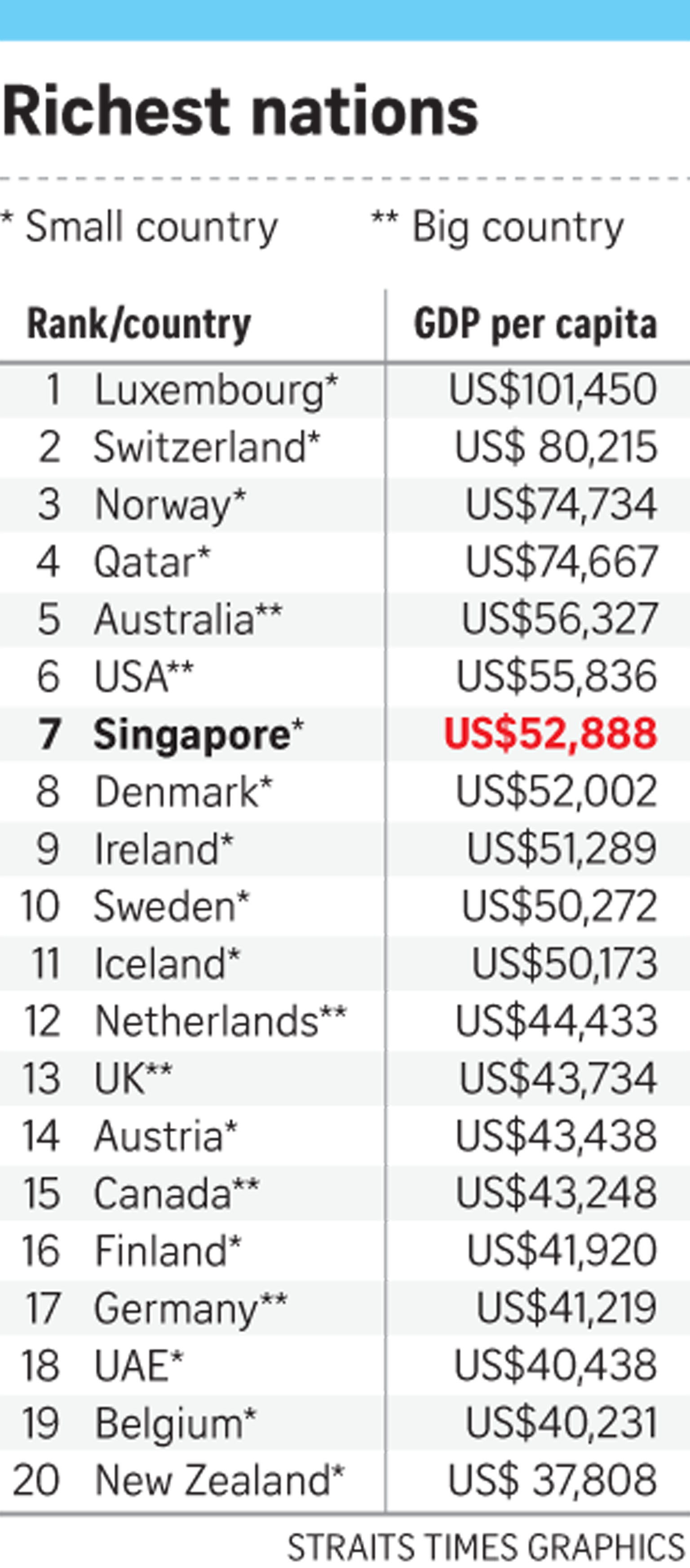
Since we live in a world which worships money, let me begin by asking which are the richest countries in the world. I will use GDP per capita as the criterion and define a small country as one with a population of less than 10 million. The 20 richest countries of the world are listed in the table on the left.
The astonishing fact is that, of the 20 richest countries, a majority of them, 14, are small countries.
HUMAN DEVELOPMENT INDEX: 12 OUT OF TOP 20
I acknowledge the validity of the view that GDP per capita may not be the best criterion of human welfare. Many prefer the UN’s Human Development Index, which also looks at a country’s achievements in education, health, housing, gender equity, and so on.
Which are the top 20 countries in the Human Development Index (2014)? They are: Norway, Australia, Switzerland, Denmark, the Netherlands, Germany, Ireland, the United States, Canada, New Zealand, Singapore, Liechtenstein, Sweden, UK, Iceland, South Korea, Israel, Luxembourg, Japan and Belgium. Of the 20, 12 are small countries.
As a matter of interest, I would mention that China is ranked at No. 90, Indonesia at No. 110 and India at No. 130.
LEAST CORRUPT COUNTRIES: 13 OUT OF 20
Corruption is a universal evil. It is the aspiration of citizens everywhere to live in a society which is free of corruption. The non-governmental organisation, Transparency International, publishes the highly respected Corruption Perceptions Index annually.
Which are the 20 least corrupt countries in the 2015 index? They are: Denmark, Finland, Sweden, New Zealand, the Netherlands, Norway, Switzerland, Singapore, Canada, Germany, Luxembourg, UK, Australia, Iceland, Belgium, Austria, the US, Ireland, Japan and Uruguay. Thirteen of the 20 are small countries. India, China and Indonesia are ranked at 76, 83 and 88 respectively.
GENDER EQUALITY: 14 OUT OF TOP 20
Women have fought the longest battle for equality with men. Although women have made enormous progress in the last 50 years, the progress has been uneven. In some countries and in some cultures, women are still treated as second-class citizens. We must continue the fight until women throughout the world achieve equality and all glass ceilings have been broken.
The UN Development Report contains the Gender Inequality Index. Which are the top 20 countries in the 2016 index for gender equality? They are: Slovenia, Switzerland, Germany, Denmark, Austria, Sweden, the Netherlands, Belgium, Norway, Italy, Finland, Iceland, France, Singapore, Czech Republic, Spain, Luxembourg, Israel, Australia and Portugal. Fourteen of the 20 are small countries.
BEST EDUCATED COUNTRIES: 8 OUT OF 11
In this new world, human resource is a country’s most important resource. Countries do well when they educate and train their people well. The World Economic Forum has just published the list of the 11 best educated countries in the world. The countries are ranked in the following order: (1) Singapore (2) Finland (3) the Netherlands (4) Switzerland (5) Belgium (6) Denmark (7) Norway (8) the US (9) Australia (10) New Zealand (11) Iceland. Eight of the 11 are small countries.
A HYPOTHESIS
A pattern seems to be emerging from these facts and figures. Some small countries are extremely successful because they are well governed (non-corrupt), pro-women (high gender equality) and pro-inclusive growth (high score on Human Development Index). I would add two more factors to account for their success. The first is that they have educated and trained their population well. The second is that they are open economies, with an outward orientation and are highly globalised.
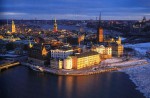
Top 10 countries and regions with fastest Internet speed
Click on thumbnail to view photos. Source:
Reuters, AFP, Wikimedia Commons









SUCCESS IN COMPETITIVE SPORTS
I will conclude my essay with some observations on the success of some small countries in competitive sports.
The Olympic Games is the apex of competitive sports. I was watching the Rio Olympic Games. I was not surprised that the US, Britain and China won the most gold medals. I was, however, surprised at how well some small countries did in Rio.
I was impressed that Jamaica, with a population of 2.7 million, won six gold medals and a total of 11 medals in track and field; Usain Bolt, the fastest man in the world, is a Jamaican.
Croatia, with a population of 4.2 million, won five gold medals and a total of 10 medals.
New Zealand, with a population of 4.5 million, won four gold medals and a total of 18 medals.
Fiji, with a population of only 880,000, defeated Britain for the gold medal in rugby!
Our own national hero, Joseph Schooling, defeated three world champions from the US, South Africa and the Czech Republic to win the gold medal in the hotly contested 100m Butterfly.
The moral of the story is that small countries can produce world champions. Small countries can defeat big countries in sports, as Fiji did to Britain in rugby in Rio or Iceland did to England in football in the Euro Cup. Iceland’s population is even smaller than that of Fiji. There are only 332,000 people in Iceland.
We live in a world where size does matter.
It would, however, be a mistake to equate size with success. Some of the world’s most successful countries are small countries.
We therefore need not have an inferiority complex because we are small.
If we work hard and we work smart, we can outperform the big countries.
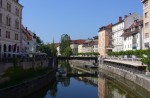
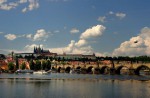
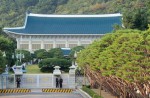
Top 30 countries with most open governments
Click on thumbnail to view photos. Source:
The Straits Times, Reuters, AFP, Wikimedia Commons


























The writer is an Ambassador-At- Large with the Ministry of Foreign Affairs and Rector of the Tembusu College at the National University of Singapore.
This article was first published on Octob 15, 2016.
Get a copy of The Straits Times or go to straitstimes.com for more stories.
Image:

Category:
Publication Date:
Sunday, October 16, 2016 – 17:29
Send to mobile app:
Source:
Rotator Headline:
Small nations outdo bigger countries to achieve extraordinary success
Story Type:
Others


