 SINGAPORE – Three years ago, Madam Beatrice Lopez hired a domestic helper after living alone in a condominium unit in Upper Bukit Timah for 13 years.
Her children live abroad, and with her hearing problems and deteriorating eyesight, she then became worried…
Source link
Elderly don’t mind assisted-living facilities: Survey

Save up to 80% off at the Philips Year End Biggest Sale at Singapore Expo from 4 – 6 Nov 2016

THIS WEEKEND: Save up to 80% off Philips home appliances & TVs at Expo (4 – 6 Nov)
Save up to 80% off at the Philips Year End Biggest Sale at Singapore Expo from 4 – 6 Nov 2016
Save up to 80% off at the Philips year end biggest home appliances and TVs sale at Singapore EXPO Hall 6 from 4 – 6 November 2016, 11am-9pm
Friend at centre of S Korea presidential crisis to answer probe
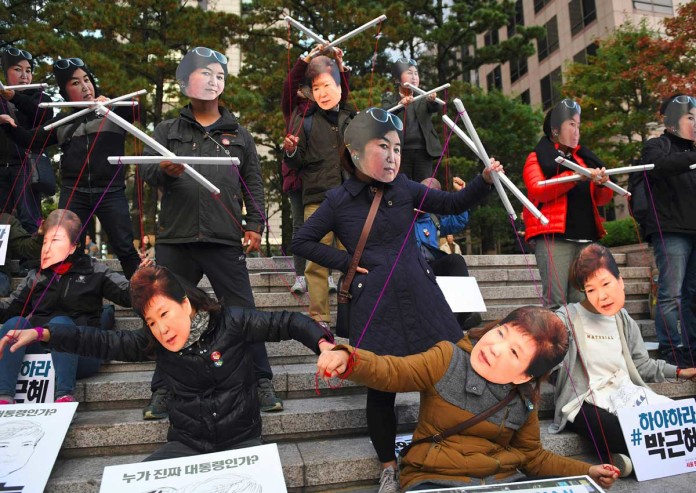
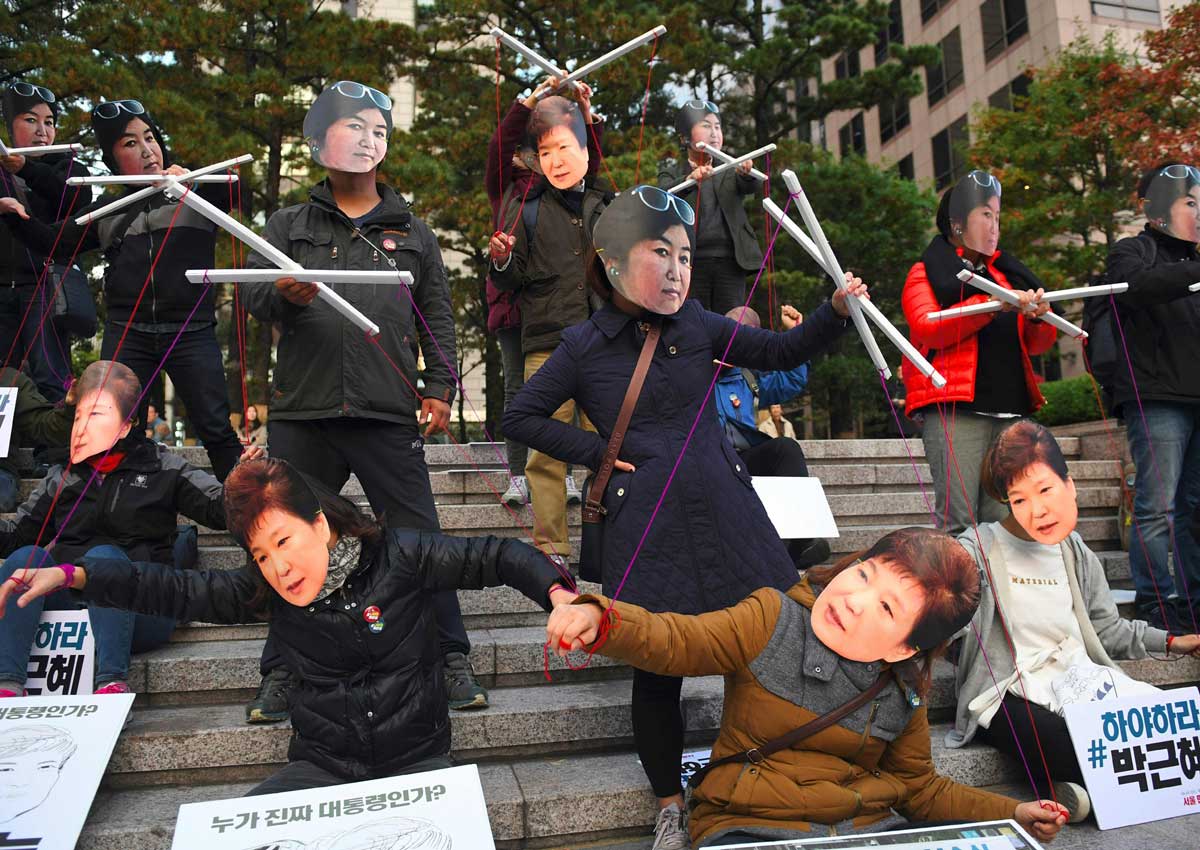
SEOUL – The woman at the centre of a deepening political crisis around South Korean President Park Geun-hye will cooperate with prosecutors investigating allegations that she had improper control over state affairs, her lawyer said on Sunday.
Choi Soon-sil returned to South Korea early on Sunday from Germany, where she had been staying, her lawyer told reporters.
“Choi has expressed through her attorney that she will actively respond to prosecutors’ investigation and will testify according to the facts,” Lee Kyung-jae, her lawyer, said on Sunday morning.
“She is deeply remorseful that she had caused frustration and despondency among the public,” Lee said.
Choi left Europe on a flight from London to avoid media camped out in Germany, Lee said. She would make herself available for questioning by prosecutors, he said.
In the midst of the political crisis, Park has accepted the resignations of five of the top presidential aides, including the chief of staff, the presidential office said on Sunday.
Three long-time Park aides, the insular core of advisors who have been criticised of tightly controlling the access to the president, had also stepped down, according to the presidential office.
Park’s office said on Friday she ordered her senior secretaries to tender their resignations.
Choi was under intense pressure to return to South Korea as the political crisis engulfed Park over allegations that she allowed Choi to use her friendship to exert improper influence and benefit personally.
Thousands of South Koreans rallied in Seoul on Saturday night demanding Park’s resignation over the scandal. Angry Koreans say Park betrayed public trust and mismanaged the government, and has lost a mandate to lead the country.
The protest came as prosecutors investigate presidential aides and other officials to determine whether they broke the law to allow Choi to wield undue influence or gain financially.
Park said last week she had given Choi access to speech drafts early in her term and apologised for causing concern among the public.
In an interview with South Korea’s Segye Ilbo newspaper published on Thursday, Choi said she received drafts of Park’s speeches after Park’s election victory but denied she had access to other official material, or that she influenced state affairs or benefited financially.
Park is in the fourth year of a five-year term, and the crisis threatens to complicate policymaking during the lame-duck period that typically sets in toward the end of South Korea’s single-term presidency. Opposition parties have demanded a thorough investigation, but have not raised the possibility of impeaching her.
The crisis has sent Park’s public support to an all-time low. In one opinion poll, more than 40 percent of respondents said Park should resign or be impeached.
The ruling conservative Saenuri Party said on Sunday it had urged Park to form a coalition government with various political parties, which would mean the appointment of a new prime minister approved by the ruling and opposition parties.
Choi was seen in photographs with Park from 1979 when Park, as eldest daughter of then-President Park Chung-hee, was filling in as first lady for her mother who had been killed five years earlier by an assassin intending to kill her father.
Park’s father, who took power in a military coup in 1961, was shot dead by his disgruntled spy chief later in 1979.
Choi was someone “who gave me help when I was going through a difficult time,” Park said in a brief televised address on Tuesday.
Image:
Publication Date:
Sunday, October 30, 2016 – 17:40
Keywords:
Send to mobile app:
Source:
Hermes ID:
2 706 251
Hermes ID String:
30102016_SKOREA
Story Type:
Others
More break-ups among less educated
When it comes to marriage, love is not enough.
Money matters, and the lack of it can easily tear a marriage apart.
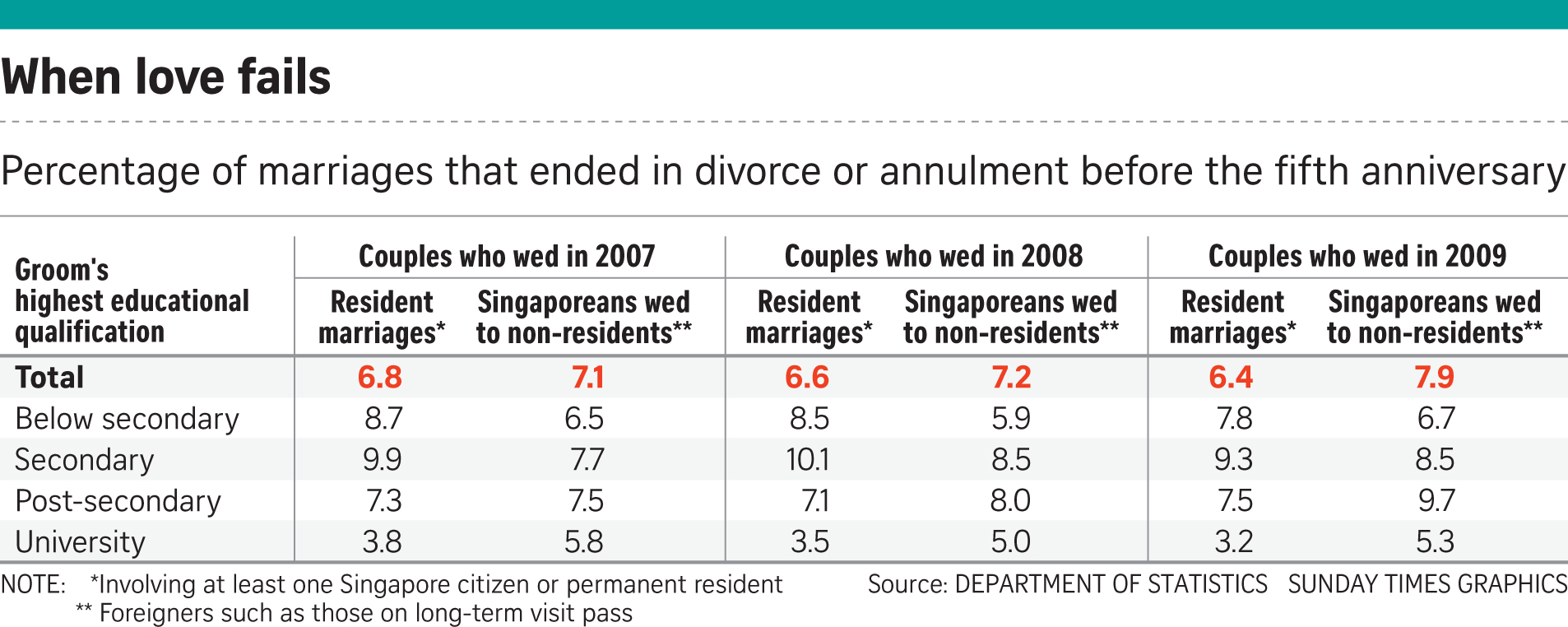
The proportion of non-university-educated men who end up divorced by their fifth wedding anniversary is two to three times that of their university-educated peers, according to government data tracking the 20,000-plus resident couples who wed each year.
The data used educational qualifications as a proxy for income, as couples do not reveal their incomes when they register their marriages.
The latest data looked at those who registered their marriages in Singapore in 2009.
Of this cohort, 9.3 per cent of the resident marriages involving grooms with secondary education had ended in a divorce or annulment before their fifth wedding anniversary in 2014.
This is almost three times the 3.2 per cent of university-educated men.
Resident marriages refer to those involving at least one Singapore citizen or permanent resident.
Minister for Social and Family Development Tan Chuan-Jin revealed the information in a written reply earlier this month to Mr Gan Thiam Poh, an MP for Ang Mo Kio GRC.
More women in their 50s and 60s get divorced
Click on thumbnail to view photos. Source:
The Straits Times





Mr Gan had asked in Parliament for the number of divorces by income groups and how many of these break-ups involved a foreign spouse in the past three years.
While the ministry’s reply did not pinpoint reasons why those who are less educated tend to see higher rates of divorces, experts say lack of resources could be one reason.
Institute of Policy Studies senior research fellow Mathew Mathews said the difference in percentages of divorces among the higher and less educated is significant.
He said: “It reminds us that it takes more than love to keep a marriage. You need resources.”
Marriage counsellors and divorce lawyers said the lack of money to pay the bills and make ends meet is a lot more pronounced among lower-educated men, compared to the tertiary-educated men who draw higher salaries.
They added that men tend to marry women with similar socio- economic backgrounds. And financial woes faced by the couple are a major stress factor that can kill the marriage.
Ms Jessie Koh, head of Reach Counselling Centre, said that generally, lower-educated couples tend to be less prepared for married life.
They do not put as much thought into issues such as finances and housing before tying the knot.
Some live with their in-laws as they cannot afford their own home. When they cannot get along with their elders, this strains the marriage.
On top of that, many barely earn enough to support themselves, let alone a family, she said.
The constant fights over providing for the family can easily drive a couple apart.
Family lawyer Lim Chong Boon added that for couples who are struggling financially, often the final straw is when one party cheats or gambles.
He said: “If the husband does not provide for the family and he gambles or he does not treat the wife well, the women often leave. Why should they stay?”
Money aside, counsellors said that less-educated men may not be as equipped to handle the conflicts and stresses in a marriage.
For example, the husband may not be able to see the wife’s point of view or might be unable to figure out how to resolve the conflict.
Ms Madelin Tay, a counsellor at Fei Yue Community Services, said: “We see it’s the younger and better-educated couples who identify their marital problems and seek help to save their marriages.”
Ms Lim, a 20-year-old who declined to give her full name, filed for divorce from her 23-year-old husband of one year recently. The couple have a 10-month-old son.
Ms Lim said: “I was too stupid. We did not ask ourselves whether we had enough money to support a family or buy a flat. It was after marriage that I realised it’s not easy to raise a family.”
Her husband, who studied up to his N levels, was working as a chef earning about $2,000 a month. But he could not stay in one job for long, kept changing jobs and went through periods of unemployment.
It was only after they tied the knot that she found out he had a gambling habit. They lived with his parents as they could not afford a flat. He did not give her any money to support their son and even stole from her.
Ms Lim, an O-level graduate who earns $1,300 a month as a salesgirl, said: “This man is irresponsible and I feel there is no point living with him. The marriage was a mistake.”
theresat@sph.com.sg

This article was first published on October 30, 2016.
Get a copy of The Straits Times or go to straitstimes.com for more stories.
Image:

Publication Date:
Sunday, October 30, 2016 – 17:29
Keywords:
Send to mobile app:
Source:
Story Type:
Others
Employment costs for foreign domestic workers need to be more transparent: CDE
There is currently “a lack of clarity on what employers and FDWs are paying for,” says CDE, a unit of the National Trades Union Congress (NTUC).
Source link
Marriage to foreigner less likely to last
For the first time, the Government has released data that shows just how many marriages involving a Singaporean and a foreigner break up.
This comes more than a decade after a trend of Singaporean men – mainly older and blue-collared – seeking foreign brides from developing countries in the region such as Vietnam and Thailand began.
The data confirms what many counsellors and divorce lawyers have said for some time now: these unions have a greater risk of collapsing, given their often shaky foundations, and impact on the children if any.
Among marriages registered in Singapore in 2009, 7.9 per cent of those involving a Singaporean and a non-resident – such as foreigners on long-term visit pass, ended before their fifth wedding anniversary. They either divorced or annulled their marriage. This is higher than the 6.4 per cent for resident marriages – those involving at least one Singapore citizen or permanent resident.
The Minister for Social and Family Development (MSF) released the data earlier this month in response to a parliamentary question by Ang Mo Kio GRC MP Gan Thiam Poh.
Starting in the early 2000s, lower-income bachelors, who struggled to find local partners, sought wives from Vietnam and Thailand. Matchmaking agencies sprouted, hawking catalogues of photographs of “eager and docile Vietnamese women”, giving currency to the moniker “mail order bride”. These foreigners also came to Singapore for “holidays”, while really hoping to find a job – and a husband.
Foreign brides in Singapore: Their stories
Click on thumbnail to view photos. Source:
The New Paper










Marriage counsellors and divorce lawyers said such unions are often more vulnerable. One reason is that many of these transnational couples do not have a strong foundation for marriage.
They may hardly know each other, with some having met just a few times before saying “I do”.
Many soon realise they are not compatible after marriage and some do not even speak a common language, noted Care Corner Counselling Centre’s counsellor Jonathan Siew. “We see many transnational couples where they have realised their spouses are different from how they had portrayed themselves before marriage.”
Lawyer Shone Aye Cheng said some of these foreign women may marry not for love, but for better prospects in Singapore – such as the chance to get permanent residency or citizenship here through marriage. The cultural differences and the challenges of adapting to life in Singapore can add further strain on a marriage.
Ms Teo Seok Bee, senior manager of Touch Family Services, said some foreign wives have not even visited Singapore before marriage. Adjusting to life here, on top of learning to live with a new spouse and his family, can place great strain on the union.
Last year, there were 6,450 marriages involving a Singaporean and a non-resident, down 5 per cent from the 6,777 in 2005. Three in four of these marriages last year were between a Singaporean groom and a non-resident bride, going by the Population in Brief 2016 report published by the National Population and Talent Division.
Steven (not his real name), a 43-year-old manager, married a Chinese national after a whirlwind four-month courtship. The nurse, who is in her 30s, was here on holiday when his friends introduced them. But the marriage soured shortly after the wedding. She kept asking Steven, an university graduate, for money to pay her housing loan in China. He gave her tens of thousands.
She also confessed that she was pregnant with another man’s child, which she aborted. The couple also have a son, who is now eight years old.
Some years ago, he decided on divorce as he felt he could not trust her and she neglected their son. They were wed for about two years.
He said: “Everything changed after marriage. She went from being loving to nasty and harsh.”
More women in their 50s and 60s get divorced
Click on thumbnail to view photos. Source:
The Straits Times
This article was first published on Oct 30, 2016.
Get a copy of The Straits Times or go to straitstimes.com for more stories.
Image:

Publication Date:
Sunday, October 30, 2016 – 16:09
Keywords:
Send to mobile app:
Source:
Story Type:
Others
New 8.8km cycling path network opens in Punggol
The cycling network in Punggol was originally slated for completion in the first quarter of next year.
Source link
E-bikes still being modified illegally despite stricter rules
Riders on a budget persist in souping up e-bikes, risking safety
Illegal modification of electric bicycles into devices that resemble motorcycles remains a problem despite stricter rules put in place by the Land Transport Authority (LTA) last December.
E-bike shops report receiving requests for such work, while some riders – young men on a budget – appear to be doing the tinkering themselves.
The devices came under greater scrutiny this week after the deaths of Mr Ang Yee Fong, 25, and Mr Ong Zi Quan, 18, on Thursday night. The pair died after being hit by a trailer near the junction of Pandan Crescent along West Coast Highway while riding their e-bikes .
A third rider, 17-year-old Marcus Loke, survived. He was hospitalised with injuries, and was discharged yesterday. Mr Ang was cremated yesterdayat the Mandai Crematorium, while Mr Ong was cremated on Friday afternoon. The 34-year-old trailer driver was arrested for causing death by negligence.
Read also: E-bike safety in spotlight after fatal accident
Mr Ong Beng Teng, owner of e-bike shop Esibike in Ubi, said illegally modified e-bikes appeal to those who cannot afford motorcycles. “They don’t need a licence, they don’t need to go through tests, but they can ride it like a motorcycle,” he said, adding that he gets requests for illegal e-bike modifications from people of all ages, but he rejects them.
E-bikes are allowed only on the roads and must meet a number of regulations, including a weight limit of 20kg and a maximum speed of 25kmh.
Illegal modifications of e-bikes include the installation of more powerful motors that allow the bikes to go faster than 25kmh, as well as throttles, which allow users to control their speed. Some modifications allow a bike to reach speeds of up to 120kmh.
Earlier this month, the LTA announced that three retailers had been charged with selling illegally modified e-bikes.
E-bike retailers The Sunday Times spoke to said they do not carry out such work but are aware of shops that do. They declined to give names but said a number were located in Geylang.
More than 20 e-bikes were seen on the roads in Geylang when The Sunday Times visited the area yesterday evening. Some riders were seen going against the flow of traffic.
While a number of the e-bikes bore the orange or blue tags that identify them as LTA-approved devices, they had also been heavily modified. None of the riders spotted wore helmets.
A 24-year-old shop assistant, who wanted to be known only as Mr Lee, was seen riding an e-bike without an LTA tag. When asked, he said he did not realise it was required, adding that he had bought the bike online for about $400 and used it to make deliveries.
Modified e-bikes have also been seen in other areas, with some netizens saying that they have seen riders speeding along relatively deserted stretches of road at night.
Graphic artist Shahrizal Ismail said he regularly sees young e-bike riders at night near his home in Marsiling. They ride in the middle of the road at speeds of about 50kmh.
“I used to see them at the void decks tinkering with their bikes,” said the 34-year-old, adding that the men appeared to be in their late teens or early 20s.
Mr Ifrey Lai, owner of mobility device retailer Mobot, said current regulations are stringent enough but that greater enforcement is needed.
Stricter regulations and greater enforcement by the LTA have reduced the number of errant e-bike riders, said Mr Swen Einhaus, founder of e-bike community Power Assisted Cyclists SG.
However, he added that more well-organised e-bike communities could help in educating users on the dos and don’ts when riding.
“Many still don’t know the rules,” he said.
334079
 Photo Gallery
Accident involving e-bikers and truck in West Coast kills 2, injures 1
-

<!–
-

<!–
-

<!–
-

<!–
-

<!–
-

<!–
-

<!–
-

<!–
-

<!–
-

<!–
-

<!–
-

<!–
-

<!–
-

<!–
-

<!–
-

<!–
-

<!–
-

<!–
-

<!–
-

<!–
-

<!–
-

<!–
-

<!–
-

<!–
-

<!–
-

<!–
-

<!–
-

<!–
-

<!–
This article was first published on Oct 30, 2016.
Get a copy of The Straits Times or go to straitstimes.com for more stories.
Image:

Publication Date:
Sunday, October 30, 2016 – 15:51
Keywords:
Send to mobile app:
Source:
Story Type:
Others
Cars get bigger, but not parking spaces
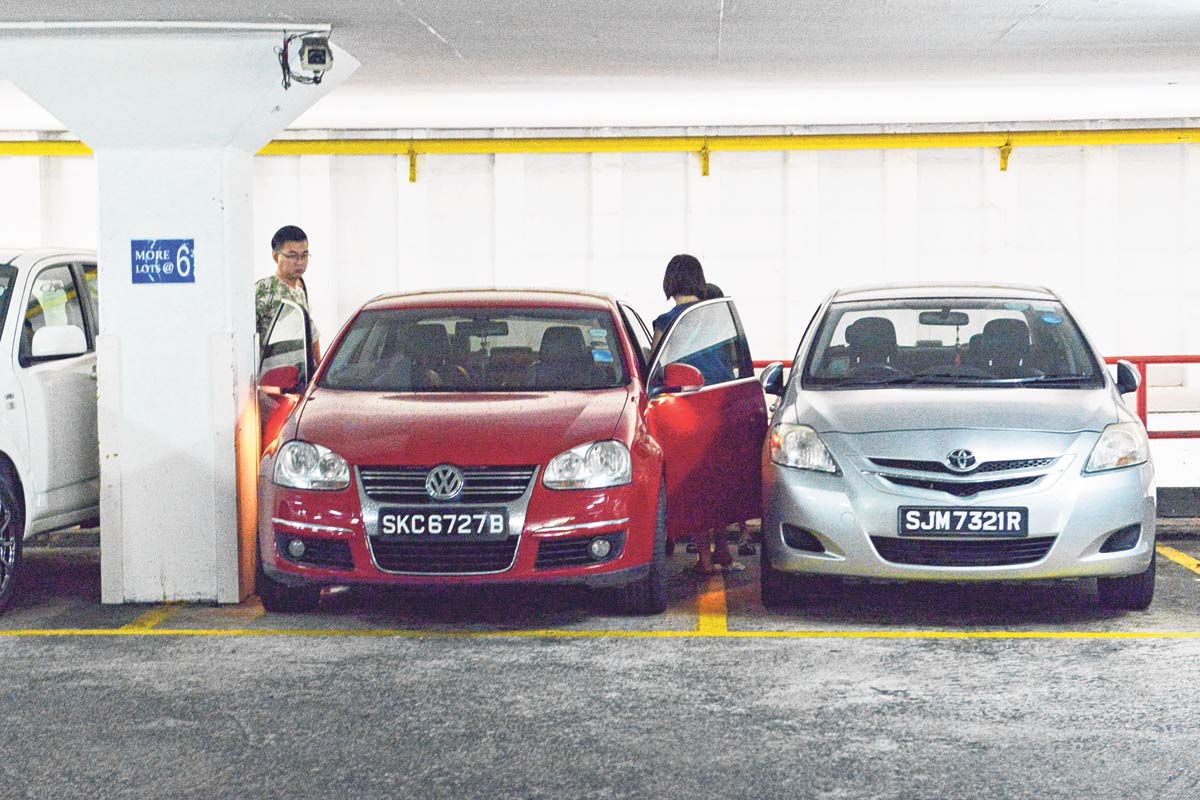
Over the years, Singaporeans’ cars have become bigger. But the authorities’ rules for carpark space size have remained the same for a while now, prompting drivers to call for an update.
By some estimates, drivers of bigger cars have difficulty navigating inside about 25 per cent of shopping centre carparks today. Car repair workshops are also reporting a rise in accidents at such carparks.
Land Transport Authority rules state that carpark spaces have to be at least 4.8m long and 2.4m wide. LTA told The Sunday Times that regulations on space and ramp dimensions are reviewed “regularly”. It declined to say when the last update was done.
But industry players said it has been a while. Mr Raymond Tang, first vice-president of the Singapore Vehicle Traders Association, said the requirements have not been changed for as far as he could recall.
This is even though Singaporeans’ cars have increased in size discernably since the 1990s.
Existing models have fattened up. For instance, the Honda Accord’s width has increased by 7 per cent since 1990 to 1.85m.
Meanwhile, Singaporeans also have a greater appetite for bigger car types such as sports utility vehicles and multi-purpose vehicles.
In the past three years, the number of such vehicles here has risen by about 25 per cent, estimated Mr Nigel Chan, managing director of Huat Lee Batteries and Motor Services, a car repair workshop. As the population ages, many are opting for bigger cars which require less effort to get in and out, he said.
But the downside is the greater risk of scrapes, scratches and dents inside carparks with narrow spaces.
At Huat Lee, the number of bigger cars coming in because they were damaged at such carparks has gone up from an average of four a month two years ago to seven today. At Dynamics Mechanic, the number has risen from 11 a month to 15, said director Eric Chew.
On forums online, there are discussions on which carparks to avoid. Unsurprisingly, older carparks pose the biggest challenge. These include the one at Liang Court, built in 1985, and that at Shaw Centre, built in the 1970s. Another is at People’s Park Complex in Chinatown.
The head of a financial firm located there, who declined to be named, said she scratched her BMW 7 Series on the wall while going up the carpark’s narrow ramp on Thursday.
Some malls have contemplated restructuring their carparks.
Mr Steven Tan, the building services manager at Shaw Organisation, said spaces at the Shaw Centre carpark are narrow because they had been designed in the 1970s when cars were smaller.
Now, if a row of three spaces is occupied by three big cars, the people in the vehicles will find it difficult to move out or open their doors, he said.
The company did consider shaving away parts of the columns in the carpark to make room for new spaces but this move was advised against by an engineer, he added. Besides, it receives fewer than five complaints a year on carpark space size, he said.
People’s Park Complex did not respond to queries on its carpark.
Government Parliamentary Committee for Transport deputy chairman Ang Hin Kee said that setting aside more land space for carparks with bigger spaces is not the direction land-scarce Singapore is heading in. Hence, those considering buying wide vehicles should first consider if their vehicle would fit the facilities Singapore has, he said.
This article was first published on Oct 30, 2016.
Get a copy of The Straits Times or go to straitstimes.com for more stories.
Image:
Publication Date:
Sunday, October 30, 2016 – 15:38
Send to mobile app:
Source:
Rotator Headline:
Risk of dents higher as S'poreans get bigger cars
Story Type:
Others
Community effort helps raise S$40,000 for needy residents
A ground-up initiative that saw Marsiling-Yew Tee residents collecting ring tabs from canned drinks has helped to raise S$40,000 for the needy.
Source link


